
LEARNING-AN
INTRODUCTION
DR. MAHESWARI JAIKUMAR
maheswarijaikumar2103@gmail.com
• Learning is the process of
growth and development,
where by the learner acquires
a body of knowledge,
develops skills & knowledge.
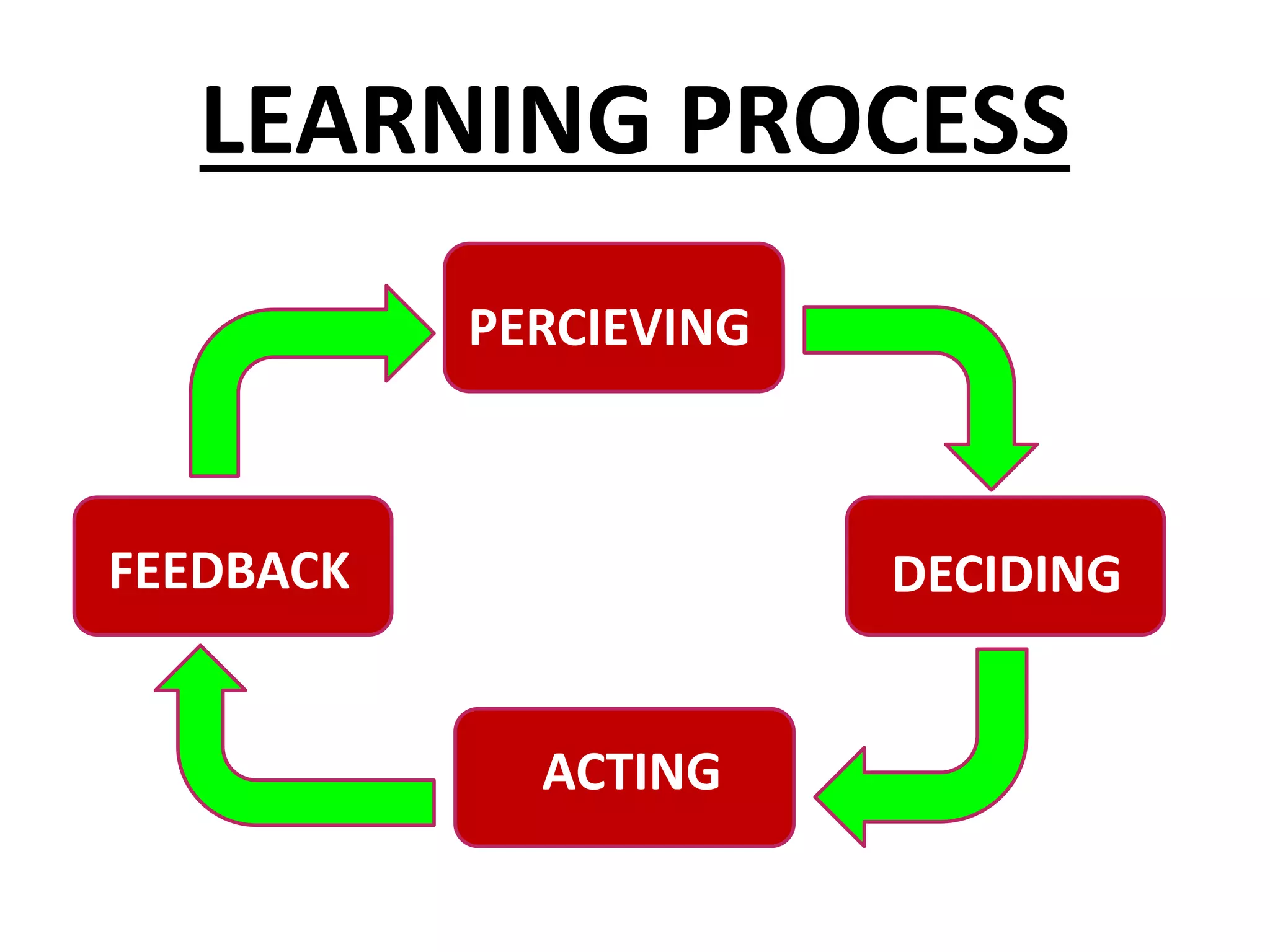
LEARNING PROCESS
PERCIEVING
DECIDING
ACTING
FEEDBACK
• Leaning results in
modification of behaviour.
Learning is relatively a
permanent change in
behaviour as a result of
reinforced practices.
• John P Deccan defines
learning as mental activity by
means of which knowledge,
skills, attitudes & ideas are
acquired resulting in
modification of behaviour.
• There are four conceptual
approaches to comprehend
learning :
1. CLASSICAL PHILOSOPHICAL.
2. FIELD.
3. ASSOCIATION.
4.STRUCTURE.
CLASSICAL PHILOSOPHICAL
•The classists explains
learning in its fundamental
ultimate cause as well as
its proximate cause.
FIELD
• Man is an energy system, an
adaptive, purposeful creature
whose behaviour is
determined by the manner in
which he/she perceives his
environment .
• Man is said to perceive the
field ground relationship, i.e..,
the object perceived stands
out against a back ground
which is part of the whole
system.
• Because perception is
regarded as the power by
which he understands,
experiences stimuli. It is
considered as the critical
factor in the theory or
learning.
• The development of insight –
(sudden awareness or
perception) is essential for
learning process.
ASSOCIATION
• Association theorist recognize
that things tend to become
associated when they are
experienced together in time
or space.
• Modern associationist explain
learning to be associated
between stimuli and
response. Stimuli is the
learner’s environment & his
response constitutes the
central focus of these
theories.
• A stimuli is regarded as any
event that an individual is
capable of sensing and
perceiving. Response refers to
any act on the part of the
learner in response to the
stimuli.
STRUCTURE
• Brunner (1960) stressed the
importance of a return to the
intellectual approach in learning. He
introduced four themes :
1. STRUCTURE.
2. INTUITION.
3. READINESS.
4. MOTIVATION
THEORIES OF
LEARNING
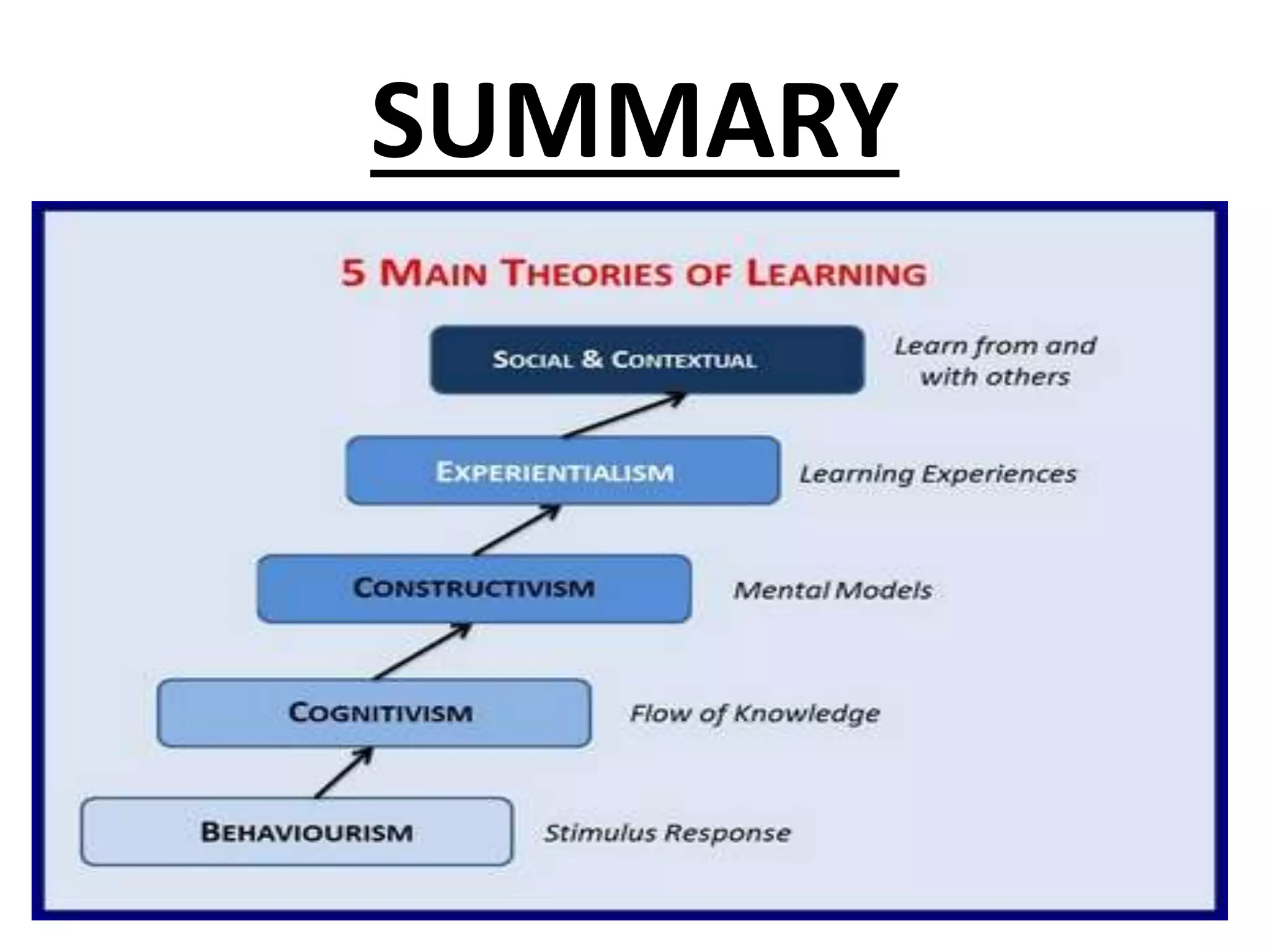
• Presents five main theories
of learning :(Carlton Reeves)
Behaviourism, Cognitivism,
Constructivist, Experientialism
and Social Learning which
underpin personal learning.
• Over the years, academicians
have proposed a number of
theories to describe and
explain the learning process.
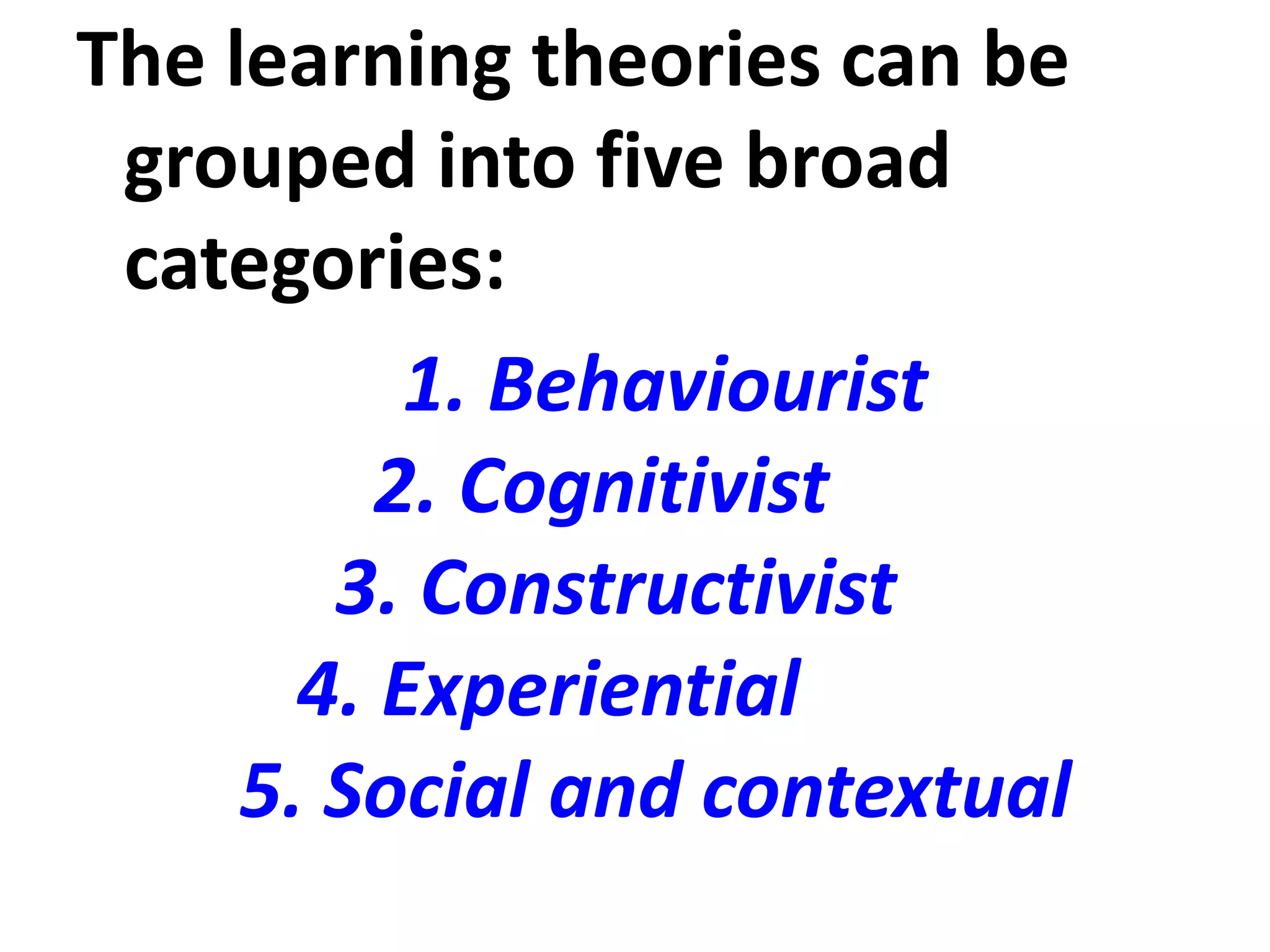
The learning theories can be
grouped into five broad
categories:
1. Behaviourist
2. Cognitivist
3. Constructivist
4. Experiential
5. Social and contextual
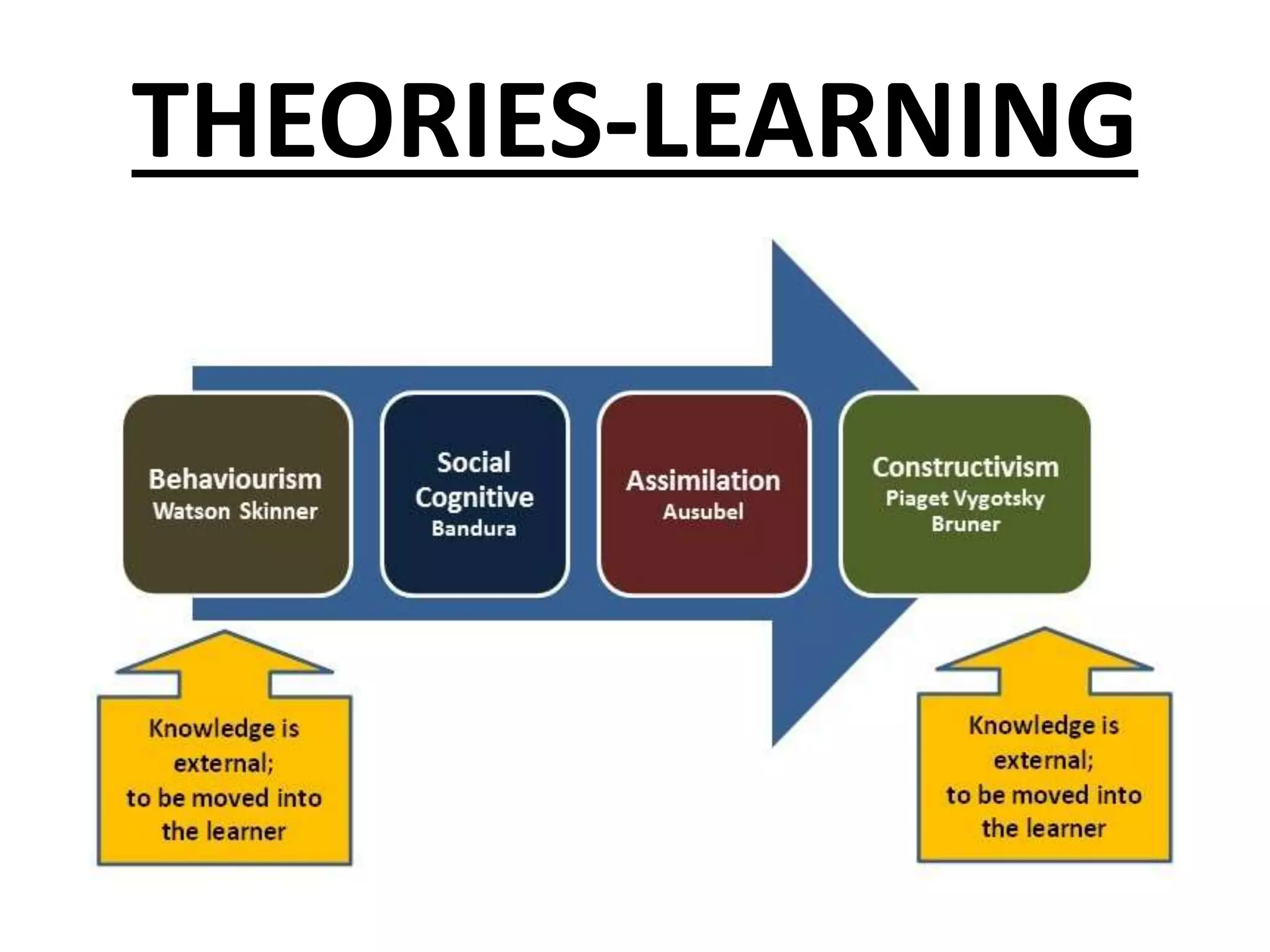
THEORIES-LEARNING
BEHAVIOURISM
• Key behaviourist thinkers
including Thorndike, Pavlov
and Skinner have
hypothesized that learning is
a change in observable
behaviour caused by external
stimuli in the environment.
• The key principle of
Behaviourism is the reward or
punishment of a new
behaviour, commonly
described as the 'carrot and
stick' approach to learning.
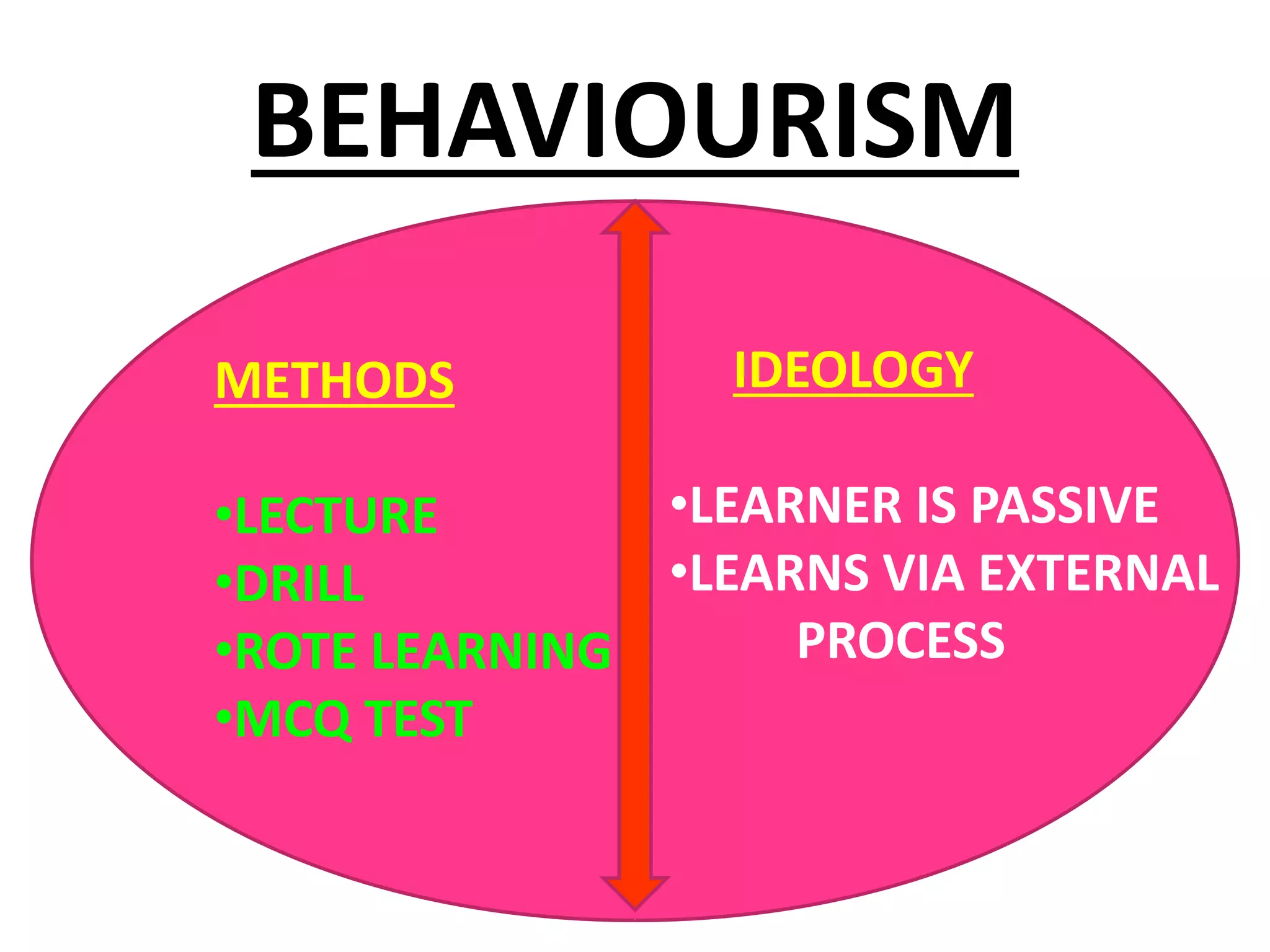
BEHAVIOURISM
METHODS
•LECTURE
•DRILL
•ROTE LEARNING
•MCQ TEST
IDEOLOGY
•LEARNER IS PASSIVE
•LEARNS VIA EXTERNAL
PROCESS
COGNITIVISM
• According to the cognitivists,
learning is not a stimulus-
response phenomenon as
described by Behaviourism.
Cont…..
• Learning requires self-
regulation and the building of
conceptual structures through
reflection and abstraction.
• The learner takes an active
role in constructing his own
understanding rather than
receiving it from someone
who knows, learning through
observation, processing and
interpretation.
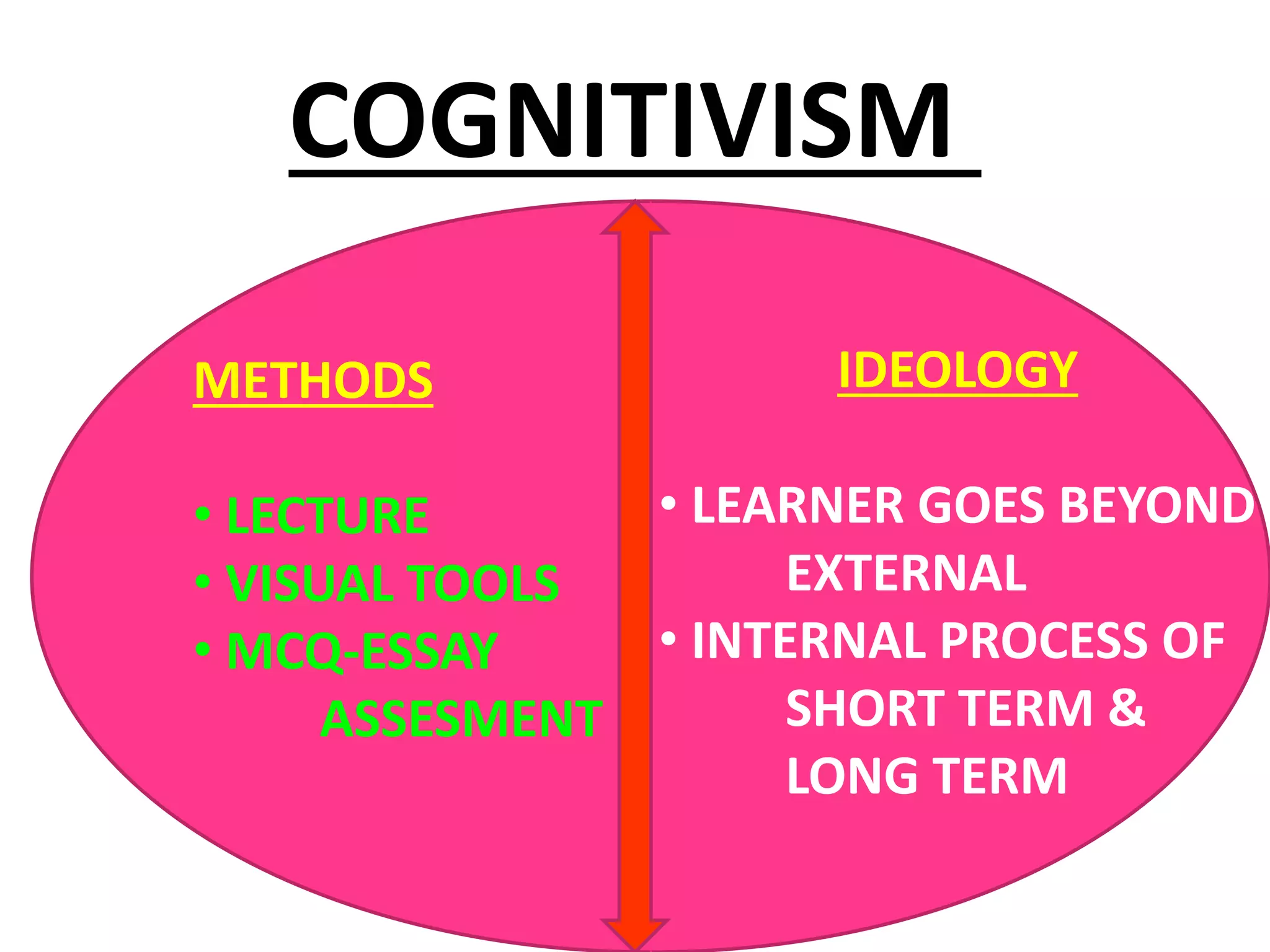
COGNITIVISM
METHODS
• LECTURE
• VISUAL TOOLS
• MCQ-ESSAY
ASSESMENT
IDEOLOGY
• LEARNER GOES BEYOND
EXTERNAL
• INTERNAL PROCESS OF
SHORT TERM &
LONG TERM
EXPERIENTIALISM
• An individual learns from
experience and described
learning as following a cycle
of experiential stages.
• One of the key theorists
of experiential
learning is David Kolb who
developed his experiential
model.
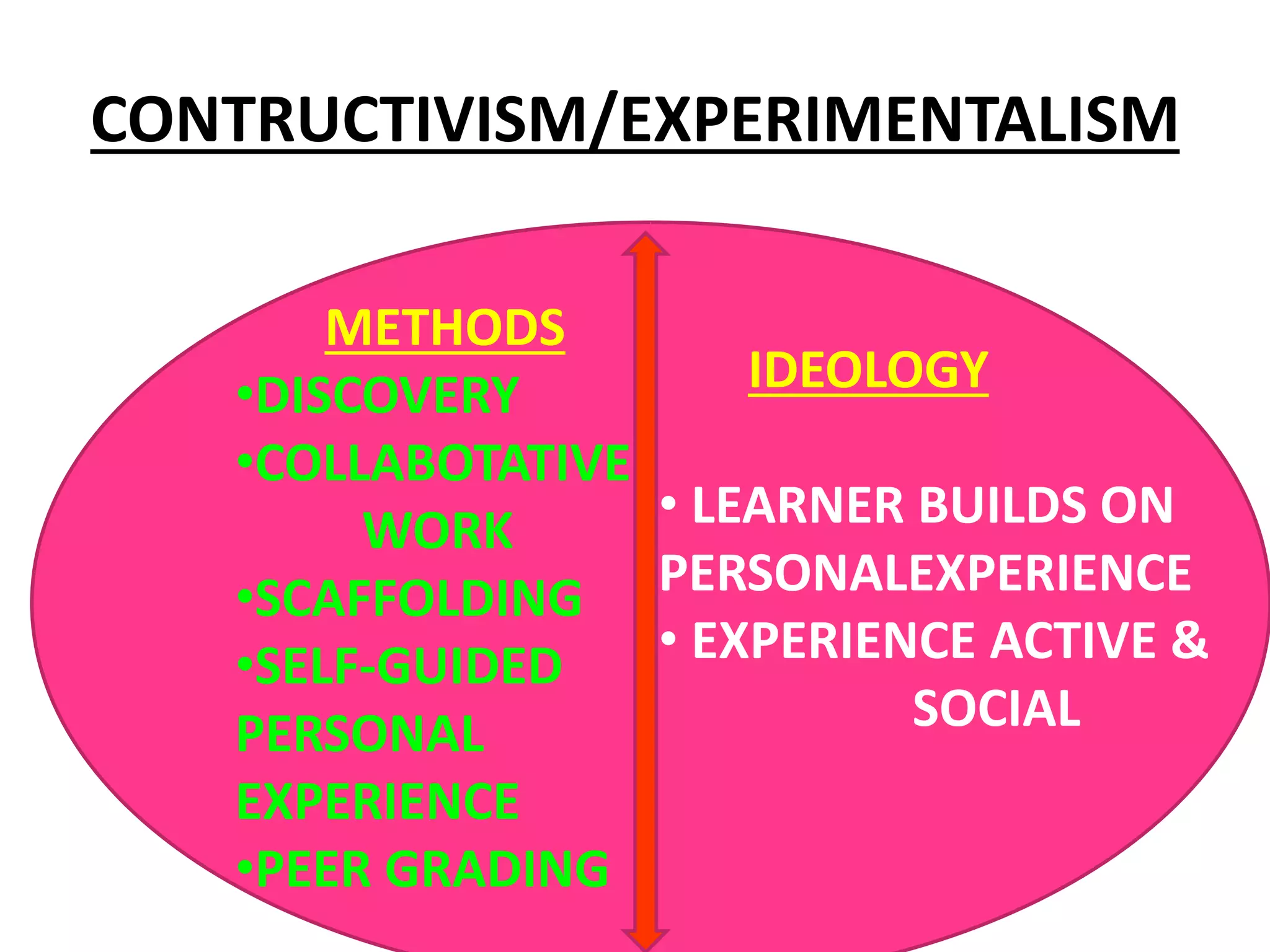
CONTRUCTIVISM/EXPERIMENTALISM
METHODS
•DISCOVERY
•COLLABOTATIVE
WORK
•SCAFFOLDING
•SELF-GUIDED
PERSONAL
EXPERIENCE
•PEER GRADING
IDEOLOGY
• LEARNER BUILDS ON
PERSONALEXPERIENCE
• EXPERIENCE ACTIVE &
SOCIAL
SOCIAL AND CONTEXTUAL
• In the Social and
Contextual approach, learning
does not occur solely within
the learner, but in the group
and community in which they
work.
• Learning is a shared process
which takes place through
observing, working together
and being part of a larger
group.
• This includes colleagues of
varying levels of experience,
able to stimulate each other's
development.
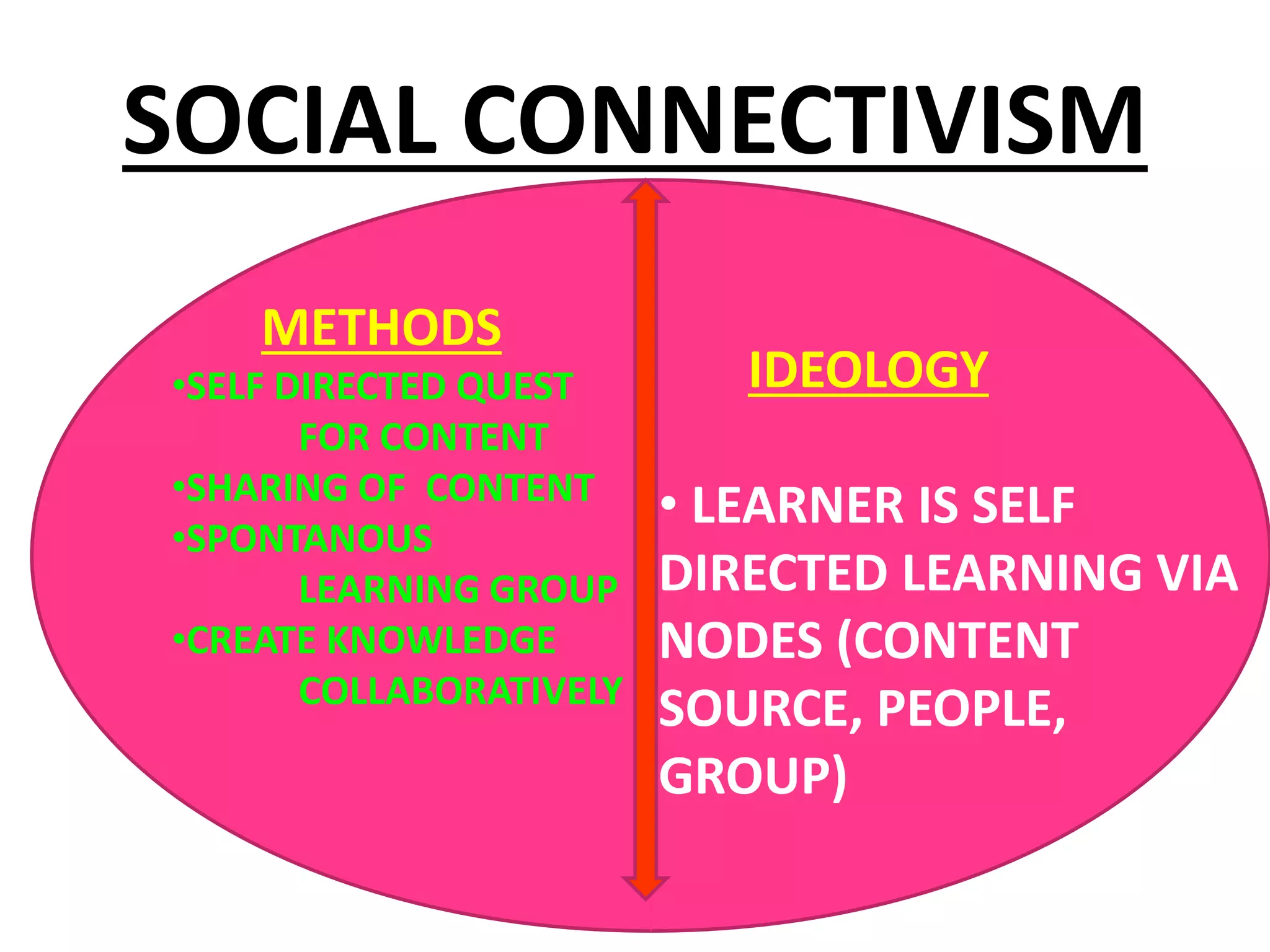
SOCIAL CONNECTIVISM
METHODS
•SELF DIRECTED QUEST
FOR CONTENT
•SHARING OF CONTENT
•SPONTANOUS
LEARNING GROUP
•CREATE KNOWLEDGE
COLLABORATIVELY
IDEOLOGY
• LEARNER IS SELF
DIRECTED LEARNING VIA
NODES (CONTENT
SOURCE, PEOPLE,
GROUP)
SUMMARY
• Learning under behaviourism
and cognitivism are teacher
focused while learning under
constructivism and
connectivism are student
focused.
THANK YOU

LEARNING - INTRODUCTION