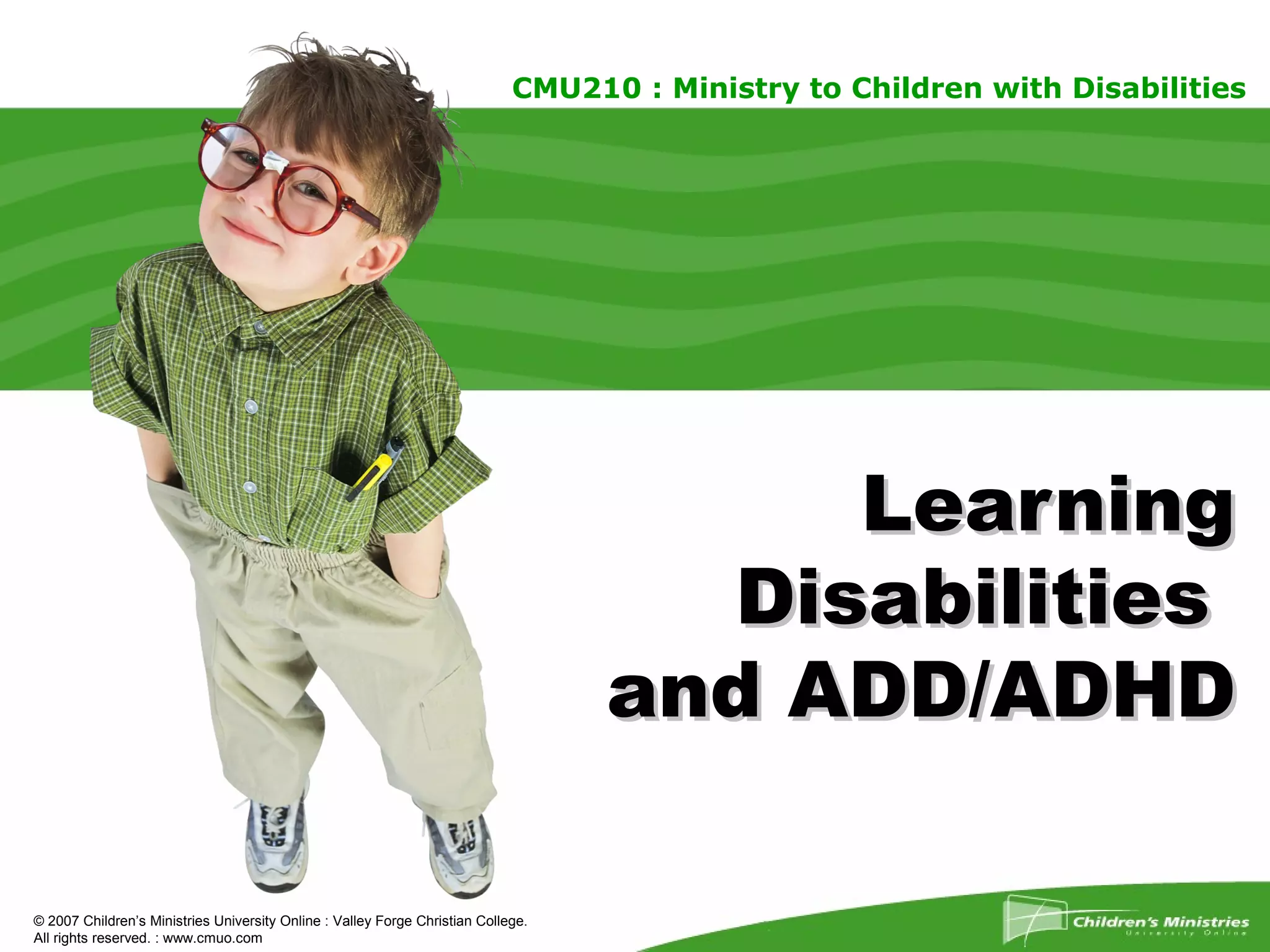
CMU210 : Ministry to Children with Disabilities
© 2007 Children’s Ministries University Online : Valley Forge Christian College.
All rights reserved. : www.cmuo.com
LearningLearning
DisabilitiesDisabilities
and ADD/ADHDand ADD/ADHD
© 2007 Children’s Ministries University Online : Valley Forge Christian College.
All rights reserved. : www.cmuo.com
Learning disabilities is a
disorder that:
1. Affects the student’s ability to interpret
what he/she sees or hears
2. Interferes with the ability to integrate
information from the various parts of
his/her brain
3. Results in difficulties in speech &
language, attention, self-control, and
coordination
(Pierson, p 13).
© 2007 Children’s Ministries University Online : Valley Forge Christian College.
All rights reserved. : www.cmuo.com
If I had a learning
disability, …
I am trying to sit still
I can’t keep my mind on one subject very
long
A noise outside will distract me
I don’t always pick up on cues about how
you are feeling
I can be impulsive. Often I do something &
then think about it.
I try to listen, but my mind wanders. (cont)
© 2007 Children’s Ministries University Online : Valley Forge Christian College.
All rights reserved. : www.cmuo.com
If I had a learning
disability, …
I don’t always remember.
I lose my belongings.
In my mind, one and one do not
always equal two.
Often I feel stupid.
I am really a nice person trying to learn
and stay focused.
I get frustrated.
© 2007 Children’s Ministries University Online : Valley Forge Christian College.
All rights reserved. : www.cmuo.com
3 Broad Categories
1 – developmental speech and
language disorders
2 – academic skills disorders
3 – attention deficit disorders
© 2007 Children’s Ministries University Online : Valley Forge Christian College.
All rights reserved. : www.cmuo.com
Developmental speech
and language disorders
- Developmental articulation
disorder
- Developmental expressive
language disorder
- Developmental receptive
language disorder
http://www.fsu.edu/~goals/ld_types.pdf
© 2007 Children’s Ministries University Online : Valley Forge Christian College.
All rights reserved. : www.cmuo.com
Academic skills
disorders
• Developmental reading
disorder
• Developmental writing disorder
• Developmental arithmetic
disorder
http://www.fsu.edu/~goals/ld_types.pdf
© 2007 Children’s Ministries University Online : Valley Forge Christian College.
All rights reserved. : www.cmuo.com
Attention deficit
disorders
• ADD means attention deficit
disorder
• ADHD means attention deficit
hyperactivity disorder
© 2007 Children’s Ministries University Online : Valley Forge Christian College.
All rights reserved. : www.cmuo.com
ADD/ADHD
Samples from bibliography
• *Attention Deficit Disorder. A Different Perception. Thorn
Hartmann, Underwood Books, Grass Valley, CA, 1993.
• *The Attention Deficit Child (2001), Dr. Grant Martin,
ChariotVictor Publishing (Division of Cook Communications),
Colorado Springs, CO
• *ADD the Facts, the Fables. Hope for Your Family (1997),
Theresa Lamson, Vital Issues Press, Lafayette, LA, 1996.
• *You and Your ADD Child (1995), Paul Warren, MD,
Thomas Nelson, Inc, Nashville, Tennessee
• *Why A.D.H.D. Doesn't Mean Disaster, (2003) Dennis
Swanberg & Diane Passno, Focus on the Family, Tyndale
House Publishers, Wheaton, IL
*A Christian perspective (See handout Special Needs bibliography)
© 2007 Children’s Ministries University Online : Valley Forge Christian College.
All rights reserved. : www.cmuo.com
What is ADD?
Attention Deficit Disorder (A.D.D.)
Simple definition: A.D.D. is a chemical
disorder that is genetically based. Not
caused by any of the following: faulty diet,
preservatives in food, visual disorders,
schizophrenia, childhood head injuries,
inadequately trained teachers, air
pollution, or poor parenting.
(see handout – Attention Deficit Disorder)
© 2007 Children’s Ministries University Online : Valley Forge Christian College.
All rights reserved. : www.cmuo.com
What is ADHD?
• ADHD is a disorder that affects 5% to 10% of all children. That
means that in school you may find 1 or 2 children in each class who
have a problem with attention. As many as 2,000,000 kids in the
United States may have ADHD. It affects boys and girls and can be
found in children and adults.
• People with attention deficit may have difficulty with focusing,
listening, and remembering. They can be
– distractible: trouble focusing on just one thing
– hyperactive: trouble keeping still
– impulsive: often act without thinking
– inattentive: trouble paying attention
• Some have trouble with learning, keeping track of things, finishing
what they start, or making and keeping friends.
• Not all kids with ADHD have problems in all of these areas. The
checklist on the next page will help you take a look at these
symptoms and decide which ones describe you.
(see handout – What is ADHD?)
© 2007 Children’s Ministries University Online : Valley Forge Christian College.
All rights reserved. : www.cmuo.com
What are Kids like who
have ADD/ADHD?
• It is hard for me to pay attention to my teacher when he/she is
talking.
• When I should be working, I am often thinking of other things.
• I have trouble starting my work.
• I have trouble finishing my work.
• I do things without thinking first.
• I am disorganized.
• I have trouble sitting still.
• I have trouble making or keeping friends.
• I have trouble following rules.
• I forget what I am supposed to do.
• It is hard for me to get ready for school on time in the morning.
• Noises or other children in the classroom distract me.
• I frequently lose things.
(see handout – ADD Checklist)
© 2007 Children’s Ministries University Online : Valley Forge Christian College.
All rights reserved. : www.cmuo.com
Emotional
Instability:
• Angry outbursts
• Social loner
• Blames others for problems
• Fights with others quickly
• Very sensitive to criticism
© 2007 Children’s Ministries University Online : Valley Forge Christian College.
All rights reserved. : www.cmuo.com
10 Key Facts About ADD
• There are 3 major types of Attention Deficit
Disorder
• ADD is a biochemical disorder in which
neurotransmitters, the chemical
messengers of the brain, do not work
properly
• Medications such as Ritalin and Dexedrine
help the neurotransmitters work more
effectively
• ADD rarely occurs alone
• All children with ADD are not alike
Chris. A Ziegler, 1996; Chris Ziegler Dendy, revised
2000. http://www.chrisdendy.com/keyfacts.htm
© 2007 Children’s Ministries University Online : Valley Forge Christian College.
All rights reserved. : www.cmuo.com
10 Key Facts About ADD
(cont)
(Ziegler, 1996)
• Children with ADD don’t learn from
punishment and reward as easily as other
children.
• “Ready. Fire!! Aim…Oops” is often a
description of their impulsivity.
• Children with ADD have an impaired sense
of time.
• A 2-4 year “development lag” may be
present.
• For 50%, the symptoms of ADD do not carry
over into adulthood. 40% of children with
ADD have at least one parent with ADD
© 2007 Children’s Ministries University Online : Valley Forge Christian College.
All rights reserved. : www.cmuo.com
Ways we can succeed in
teaching children with
A.D.D.
Behavioral Assumptions
• You have clearly defined rules and logical
consequences that are age appropriate.
• You have logical routines that are followed and
rationales that are explained.
• You are only expecting what you are willing to
teach.
• You know and understand the power of praise
and how to avoid the criticism trap.
© 2007 Children’s Ministries University Online : Valley Forge Christian College.
All rights reserved. : www.cmuo.com
Ways we can succeed in
teaching children with
A.D.D. (cont)
Behavioral Assumptions (cont.)
• You are committed to teaching all children who
are made in God’s image, regardless of their
apparent worth or abilities.
• You are willing to love all children and will try
to understand their individual needs.
• You believe that all authority comes from God
(Romans 13), that rules and policies must be
enforced; and that the teacher must be in
control of the learning environment at all times.
© 2007 Children’s Ministries University Online : Valley Forge Christian College.
All rights reserved. : www.cmuo.com
Ways we can succeed in
teaching children with
A.D.D. (cont)
Behavioral Assumptions (cont.)
• You are committed to creative, engaging,
multi-sensory, and interactive teaching
strategies that keep students involved with
fellow students.
• Your goal in managing behavior is to enhance
the learning environment.
• You will never intentionally humiliate or
embarrass a student.
• You view parents are partners.
© 2007 Children’s Ministries University Online : Valley Forge Christian College.
All rights reserved. : www.cmuo.com
Golden Rules
• Children with ADHD need consequences
that are immediate
• Feedback must be given more frequently
• Children with ADHD require powerful
consequences
• Interventions must occur at the point of
performance
• Positives before negatives
© 2007 Children’s Ministries University Online : Valley Forge Christian College.
All rights reserved. : www.cmuo.com
Golden Rules (cont)
• 6. Expect variability of performance
• 7. Plan ahead and anticipate situations
• 8. Clarity of rules
• 9. Stop talking – to much talking is a
distraction
• 10. Attention = consistency – verbiage
• 11. Inattention = inconsistency + verbiage
• 12. Parents and teachers need to be
ancillary organizers
© 2007 Children’s Ministries University Online : Valley Forge Christian College.
All rights reserved. : www.cmuo.com
Golden Rules (cont)
• 13. Maintain a disability perspective
• 14. Tolerance
• 15. Choose your battles wisely
• 16. Maintain a sense of humor
• 17. Do not take the child’s behaviors
personally
• 18. Patience and understanding
• 19. Forgiveness
© 2007 Children’s Ministries University Online : Valley Forge Christian College.
All rights reserved. : www.cmuo.com
Strategy for Dealing
with Problem
Behaviors
• It’s usually better to teach positive
behavior rather than to eliminate
negative behavior.
• State the problem behaviorally.
• Identify why and for whom this is a
problem behavior.
• Ask yourself how are we/am I
contributing to this problem?
© 2007 Children’s Ministries University Online : Valley Forge Christian College.
All rights reserved. : www.cmuo.com
Management Techniques
Resources
* See handout on Management Techniques
* Special Kids Problem Solver (1999).
Kenneth Shore, PsyD, Prentice Hall,
Paramus, NJ 07652
* Good Kids, Difficult Behavior, (2000).
Joyce Divinyi, MS, LPC, The Wellness
Connection, Peachtree, GA; ISBN# 0-
9656353-4-1
© 2007 Children’s Ministries University Online : Valley Forge Christian College.
All rights reserved. : www.cmuo.com
Strategy for Dealing
with Problem
Behaviors (cont.)
• Determine under what conditions the
problem occurs most.
• Determine under what conditions the
problem behavior occurs least.
• Teach a competing or replacement
behavior.
© 2007 Children’s Ministries University Online : Valley Forge Christian College.
All rights reserved. : www.cmuo.com
Look beyond the
disability

Learning disabilities-and-add/adhd

  • 1.
    CMU210 : Ministryto Children with Disabilities © 2007 Children’s Ministries University Online : Valley Forge Christian College. All rights reserved. : www.cmuo.com LearningLearning DisabilitiesDisabilities and ADD/ADHDand ADD/ADHD
  • 2.
    © 2007 Children’sMinistries University Online : Valley Forge Christian College. All rights reserved. : www.cmuo.com Learning disabilities is a disorder that: 1. Affects the student’s ability to interpret what he/she sees or hears 2. Interferes with the ability to integrate information from the various parts of his/her brain 3. Results in difficulties in speech & language, attention, self-control, and coordination (Pierson, p 13).
  • 3.
    © 2007 Children’sMinistries University Online : Valley Forge Christian College. All rights reserved. : www.cmuo.com If I had a learning disability, … I am trying to sit still I can’t keep my mind on one subject very long A noise outside will distract me I don’t always pick up on cues about how you are feeling I can be impulsive. Often I do something & then think about it. I try to listen, but my mind wanders. (cont)
  • 4.
    © 2007 Children’sMinistries University Online : Valley Forge Christian College. All rights reserved. : www.cmuo.com If I had a learning disability, … I don’t always remember. I lose my belongings. In my mind, one and one do not always equal two. Often I feel stupid. I am really a nice person trying to learn and stay focused. I get frustrated.
  • 5.
    © 2007 Children’sMinistries University Online : Valley Forge Christian College. All rights reserved. : www.cmuo.com 3 Broad Categories 1 – developmental speech and language disorders 2 – academic skills disorders 3 – attention deficit disorders
  • 6.
    © 2007 Children’sMinistries University Online : Valley Forge Christian College. All rights reserved. : www.cmuo.com Developmental speech and language disorders - Developmental articulation disorder - Developmental expressive language disorder - Developmental receptive language disorder http://www.fsu.edu/~goals/ld_types.pdf
  • 7.
    © 2007 Children’sMinistries University Online : Valley Forge Christian College. All rights reserved. : www.cmuo.com Academic skills disorders • Developmental reading disorder • Developmental writing disorder • Developmental arithmetic disorder http://www.fsu.edu/~goals/ld_types.pdf
  • 8.
    © 2007 Children’sMinistries University Online : Valley Forge Christian College. All rights reserved. : www.cmuo.com Attention deficit disorders • ADD means attention deficit disorder • ADHD means attention deficit hyperactivity disorder
  • 9.
    © 2007 Children’sMinistries University Online : Valley Forge Christian College. All rights reserved. : www.cmuo.com ADD/ADHD Samples from bibliography • *Attention Deficit Disorder. A Different Perception. Thorn Hartmann, Underwood Books, Grass Valley, CA, 1993. • *The Attention Deficit Child (2001), Dr. Grant Martin, ChariotVictor Publishing (Division of Cook Communications), Colorado Springs, CO • *ADD the Facts, the Fables. Hope for Your Family (1997), Theresa Lamson, Vital Issues Press, Lafayette, LA, 1996. • *You and Your ADD Child (1995), Paul Warren, MD, Thomas Nelson, Inc, Nashville, Tennessee • *Why A.D.H.D. Doesn't Mean Disaster, (2003) Dennis Swanberg & Diane Passno, Focus on the Family, Tyndale House Publishers, Wheaton, IL *A Christian perspective (See handout Special Needs bibliography)
  • 10.
    © 2007 Children’sMinistries University Online : Valley Forge Christian College. All rights reserved. : www.cmuo.com What is ADD? Attention Deficit Disorder (A.D.D.) Simple definition: A.D.D. is a chemical disorder that is genetically based. Not caused by any of the following: faulty diet, preservatives in food, visual disorders, schizophrenia, childhood head injuries, inadequately trained teachers, air pollution, or poor parenting. (see handout – Attention Deficit Disorder)
  • 11.
    © 2007 Children’sMinistries University Online : Valley Forge Christian College. All rights reserved. : www.cmuo.com What is ADHD? • ADHD is a disorder that affects 5% to 10% of all children. That means that in school you may find 1 or 2 children in each class who have a problem with attention. As many as 2,000,000 kids in the United States may have ADHD. It affects boys and girls and can be found in children and adults. • People with attention deficit may have difficulty with focusing, listening, and remembering. They can be – distractible: trouble focusing on just one thing – hyperactive: trouble keeping still – impulsive: often act without thinking – inattentive: trouble paying attention • Some have trouble with learning, keeping track of things, finishing what they start, or making and keeping friends. • Not all kids with ADHD have problems in all of these areas. The checklist on the next page will help you take a look at these symptoms and decide which ones describe you. (see handout – What is ADHD?)
  • 12.
    © 2007 Children’sMinistries University Online : Valley Forge Christian College. All rights reserved. : www.cmuo.com What are Kids like who have ADD/ADHD? • It is hard for me to pay attention to my teacher when he/she is talking. • When I should be working, I am often thinking of other things. • I have trouble starting my work. • I have trouble finishing my work. • I do things without thinking first. • I am disorganized. • I have trouble sitting still. • I have trouble making or keeping friends. • I have trouble following rules. • I forget what I am supposed to do. • It is hard for me to get ready for school on time in the morning. • Noises or other children in the classroom distract me. • I frequently lose things. (see handout – ADD Checklist)
  • 13.
    © 2007 Children’sMinistries University Online : Valley Forge Christian College. All rights reserved. : www.cmuo.com Emotional Instability: • Angry outbursts • Social loner • Blames others for problems • Fights with others quickly • Very sensitive to criticism
  • 14.
    © 2007 Children’sMinistries University Online : Valley Forge Christian College. All rights reserved. : www.cmuo.com 10 Key Facts About ADD • There are 3 major types of Attention Deficit Disorder • ADD is a biochemical disorder in which neurotransmitters, the chemical messengers of the brain, do not work properly • Medications such as Ritalin and Dexedrine help the neurotransmitters work more effectively • ADD rarely occurs alone • All children with ADD are not alike Chris. A Ziegler, 1996; Chris Ziegler Dendy, revised 2000. http://www.chrisdendy.com/keyfacts.htm
  • 15.
    © 2007 Children’sMinistries University Online : Valley Forge Christian College. All rights reserved. : www.cmuo.com 10 Key Facts About ADD (cont) (Ziegler, 1996) • Children with ADD don’t learn from punishment and reward as easily as other children. • “Ready. Fire!! Aim…Oops” is often a description of their impulsivity. • Children with ADD have an impaired sense of time. • A 2-4 year “development lag” may be present. • For 50%, the symptoms of ADD do not carry over into adulthood. 40% of children with ADD have at least one parent with ADD
  • 16.
    © 2007 Children’sMinistries University Online : Valley Forge Christian College. All rights reserved. : www.cmuo.com Ways we can succeed in teaching children with A.D.D. Behavioral Assumptions • You have clearly defined rules and logical consequences that are age appropriate. • You have logical routines that are followed and rationales that are explained. • You are only expecting what you are willing to teach. • You know and understand the power of praise and how to avoid the criticism trap.
  • 17.
    © 2007 Children’sMinistries University Online : Valley Forge Christian College. All rights reserved. : www.cmuo.com Ways we can succeed in teaching children with A.D.D. (cont) Behavioral Assumptions (cont.) • You are committed to teaching all children who are made in God’s image, regardless of their apparent worth or abilities. • You are willing to love all children and will try to understand their individual needs. • You believe that all authority comes from God (Romans 13), that rules and policies must be enforced; and that the teacher must be in control of the learning environment at all times.
  • 18.
    © 2007 Children’sMinistries University Online : Valley Forge Christian College. All rights reserved. : www.cmuo.com Ways we can succeed in teaching children with A.D.D. (cont) Behavioral Assumptions (cont.) • You are committed to creative, engaging, multi-sensory, and interactive teaching strategies that keep students involved with fellow students. • Your goal in managing behavior is to enhance the learning environment. • You will never intentionally humiliate or embarrass a student. • You view parents are partners.
  • 19.
    © 2007 Children’sMinistries University Online : Valley Forge Christian College. All rights reserved. : www.cmuo.com Golden Rules • Children with ADHD need consequences that are immediate • Feedback must be given more frequently • Children with ADHD require powerful consequences • Interventions must occur at the point of performance • Positives before negatives
  • 20.
    © 2007 Children’sMinistries University Online : Valley Forge Christian College. All rights reserved. : www.cmuo.com Golden Rules (cont) • 6. Expect variability of performance • 7. Plan ahead and anticipate situations • 8. Clarity of rules • 9. Stop talking – to much talking is a distraction • 10. Attention = consistency – verbiage • 11. Inattention = inconsistency + verbiage • 12. Parents and teachers need to be ancillary organizers
  • 21.
    © 2007 Children’sMinistries University Online : Valley Forge Christian College. All rights reserved. : www.cmuo.com Golden Rules (cont) • 13. Maintain a disability perspective • 14. Tolerance • 15. Choose your battles wisely • 16. Maintain a sense of humor • 17. Do not take the child’s behaviors personally • 18. Patience and understanding • 19. Forgiveness
  • 22.
    © 2007 Children’sMinistries University Online : Valley Forge Christian College. All rights reserved. : www.cmuo.com Strategy for Dealing with Problem Behaviors • It’s usually better to teach positive behavior rather than to eliminate negative behavior. • State the problem behaviorally. • Identify why and for whom this is a problem behavior. • Ask yourself how are we/am I contributing to this problem?
  • 23.
    © 2007 Children’sMinistries University Online : Valley Forge Christian College. All rights reserved. : www.cmuo.com Management Techniques Resources * See handout on Management Techniques * Special Kids Problem Solver (1999). Kenneth Shore, PsyD, Prentice Hall, Paramus, NJ 07652 * Good Kids, Difficult Behavior, (2000). Joyce Divinyi, MS, LPC, The Wellness Connection, Peachtree, GA; ISBN# 0- 9656353-4-1
  • 24.
    © 2007 Children’sMinistries University Online : Valley Forge Christian College. All rights reserved. : www.cmuo.com Strategy for Dealing with Problem Behaviors (cont.) • Determine under what conditions the problem occurs most. • Determine under what conditions the problem behavior occurs least. • Teach a competing or replacement behavior.
  • 25.
    © 2007 Children’sMinistries University Online : Valley Forge Christian College. All rights reserved. : www.cmuo.com Look beyond the disability

Editor's Notes

  • #2 In chapter one of your text, Exceptional Teaching, you read about learning disabilities. We want to spend some time reviewing learning disabilities and give you additional material regarding attention deficit disorders.
  • #3 Learning disabilities is a disorder that: 1. Affects the student’s ability to interpret what he/she sees or hears; 2. Interferes with the ability to integrate information from the various parts of his/her brain; 3. Results in difficulties in speech & language, attention, self-control, and coordination (see p 13). This group represents the largest group of students that receive special education services in public schools. It is estimated that at least 50% of the children who receive special education services deal with learning disabilities.
  • #4 We really like this list the author, Jim Pierson, included on p 13. He states from the viewpoint of a child, “If I had a learning disability, here is what I’d want my teacher to know about me.” As a review, let’s read these statements together. READ SLIDE
  • #5 (Continue reading statements) It’s so easy to forget that some of these kids just can’t behave and just can’t learn like other children who don’t have learning disabilities. As the teacher or children’s pastor, it is up to you and/or your staff to reach these kids.
  • #6 This will be a brief review of the material in your text. As you know the text covered the specific learning disabilities in detail and has presented “Exceptional Teaching Tips” for each specific learning disability. So now let’s review: Typically learning disabilities are divided into 3 broad categories 1 – developmental speech and language disorders 2 – academic skills disorders 3 – attention deficit disorders
  • #7 (read slide)
  • #8 (read slide)
  • #9 We agree with the author that “sometimes students with ADD and ADHD are discussed as though they are not in the learning disability category. Medically, that is probably correct. However the basic similarity between a student with a learning disability and a student with ADD & ADHD is simple.” We decided that the text only superficially covered this area of Attention Deficit Disorders. So here is some additional information that is not found in the text.
  • #10 Probably students with attention deficit disorders will create more behavioral issues for you than students in any other category. It appears that we are facing increasing numbers of students with attention disorders. Entire classes are available dealing specifically with attention disorders. Countless numbers of articles, books, dissertations, and online resources are available dealing with children who have these disorders. In our bibliography we have listed several outstanding resources dealing with Attention Deficit Disorder (ADD) and Attention Deficit Hyperactivity Disorder (ADHD). Here’s a brief overview using material from a workshop we presented at a national children’s ministry conference.
  • #11 Read slide
  • #12 As you can see, ADHD effects 5-10% of all children. As many as 2 million children in the US are effected with ADHD; effecting both boys and girls and can be found in children and adults. People with attention deficit may have difficulty with focusing, listening, and remembering. Four buzz words that are used continuously: distractible: hyperactive: impulsive: inattentive: Not all kids with attention deficit disorders have problems in all of these areas. The checklist on the next slide will give you a list of characteristics associated with attention deficit disorders from a child’s perspective.
  • #13 Let’s take a moment and read through this list. (READ SLIDE) Imagine how frustrating it must be for children who exhibit these characteristics. This disability impacts every area of their lives. Our prisons are filled with men and women who have attention deficit disorders, failed in school, failed in making and maintaining positive peer relationships. These are kids that desperately need your unconditional love and acceptance. These are kids that are at risk because of their emotional instability.
  • #14 Their emotional instability is played out with angry outbursts, being a social loner, blaming others for their problems, fighting with others quickly and being very sensitive to criticism from everyone. These kids typically have no close friends, and are consistently frustrated, angry, and unhappy. They often deal with poor self esteem because they fail in so many areas of their lives. Often these kids are difficult to like, create classroom management problems, and rarely express remorse. Remember these kids have a physical disability that prevents them from acting like children without the disability.
  • #15 Here are 10 key facts about ADD. The handout will provide you with additional information. Let’s read them together. There are 3 major types of Attention Deficit Disorder: ADD/H only; ADD/I/WO; ADHD. ADD is a biochemical disorder in which neurotransmitters, the chemical messengers of the brain, do not work properly. 3. Medications such as Ritalin and Dexedrine help the neurotransmitters work more effectively. 4. ADD rarely occurs alone. 5. All children with ADD are not alike.
  • #16 6. Children with ADD don’t learn from punishment and reward as easily as other children. 7. “Ready. Fire!!! Aim…Oops” is often a fitting description of their impulsivity. 8. Children with ADD have an impaired sense of time. 9. A 2-4 year “developmental lag” may be present. 10a. For fifty (50) percent, the symptoms of ADD do not carry over into adulthood. 10.b Forty (40) percent of all children who have ADD have at least one parent with ADD.
  • #17 We have listed the 11 behavioral assumptions again. They are especially important when dealing with kids who have attention deficit disorders. Let’s read them together. (READ SLIDE)
  • #18 Read slide
  • #19 Read slide. With these 11 behavioral assumptions in mind, now let’s look at Barkley/Bauer’s 19 “Golden Rules to Live By in Dealing with an ADHD Child”
  • #20 read slide
  • #21 Read slide
  • #22 READ SLIDE We hope by now you’re committed to doing whatever it takes to build and maintain relationships with kids that present behavior management problems. Let ‘s take a look at developing a strategy for dealing with problem behaviors.
  • #23 Here are 7 steps to develop a strategy for dealing with problem behaviors. Read #1 – it’s much better to take a group of children and teach them to sit quietly that nag them about being too noisy. Read #2 – that is the child is not the problem, but identify what the child is doing that creates the problem Read #3 – This is an important concept. Is the problem behavior only a problem for me as the teacher or is it a problem for the class or is it a problem for the student? If you can identify for the student and the class why the behavior is a problem, it will be easier to eliminate the problem. For example students shouting out answers is a problem because it wastes time and is disruptive. That’s why we raise our hands and wait to be called on. Read #4 – If you have unclear expectations or have inconsistent classroom routines or are ineffective at classroom management, you may be part of the problem. If you feel you need additional help in the area of classroom management, check out these resources:
  • #24 Read slide
  • #25 Read #5 – (self explanatory) Read #6 – (self explanatory) Read #7 – This final step allows you to teach positive behaviors that will replace the problem behaviors. Remember you can’t expect what you’re not willing to teach and you must have realistic expectations. If problem behaviors are beyond the child’s control, you will need to help the class understand why you are accepting or tolerating some behaviors. You may have to make individual exceptions for individual students with disabilities. Your class may not think it’s fair, but we all know life is not fair.
  • #26 As we close this session on learning disabilities, we hope and pray that you will learn to look beyond problematic behavior and see a child who desperately needs love and acceptance, who desperately needs to be successful, who desperately needs to know they fit into your kids ministry and the Kingdom of God. In Hebrews 12:1, we learn that a race has been marked out for each of us. Each of us are called to run our race with perseverance. We are surrounded by a great cloud of witnesses encouraging us along the way. The kids with disabilities that the Lord brings to you run a race filled with frustration. Please be willing to look beyond the disability and see the student who is created in God’s image who needs what you have to offer.