Dr : alghaliya albusaidi
Family medicine R 4
 INTRODUCTION
 EATIOLOGY
 DIAGNOSIS
 SCREENING
 EVULATION
 TREATMANT
o Autism is a lifelong disorder that has a great
impact on the child or young person and their
family or carers.
o When autism is diagnosed, families and carers
and the child or young person themselves can
experience a variety of emotions, shock and
concern about the implications for the future.
• Autism was first described by psychiatrist
Leo Kanner in 1943 as a disorder in children
who had problems relating to others and a high
sensitivity to changes in their environment.
Prevalence of one in 68 children, with a male-
to-female ratio of 4.5-to-1.
o Genetic: range from 40% to 90%, with most
recent estimates at nearly 50% genetic
liability.
o Environmental factors.
• Advanced paternal or
maternal age
• Maternal metabolic
conditions, such as ,DM ,HTN
,obesity.
• In utero risks include
valproate (Depacon) exposure.
• Maternal infections.
• Traffic-related air pollution,
and pesticide exposure
• Perinatal events such as low
birth weight and preterm
delivery increase the risk of
ASD as a part of the greater
overall risk of
neurodevelopmental injury.
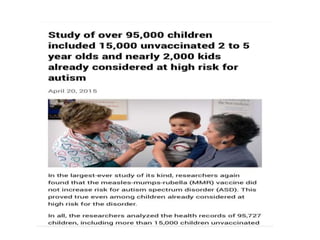
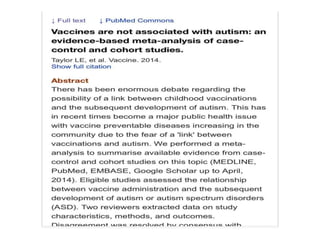
• Previous concerns for causality related to
thimerosal-based vaccines have been
conclusively disproven.
• A large amount of research has shown that
vaccines are safe and do not cause ASD.
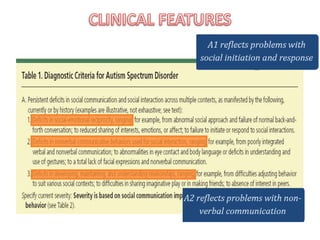
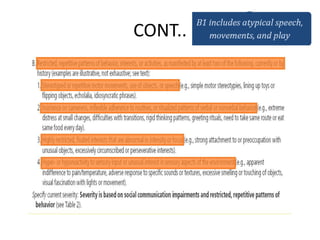
Key diagnostic features of children with ASD
include
• Deficits in Social communication.
• Restricted, repetitive patterns of behavior,
interest, or activities.
• Some signs and symptoms may emerge between
six and 12 months of age. In many cases, a
reliable diagnosis can be made by 24 months of
age.
• Parents may present with a concern for
hearing loss because children with ASD may
not respond after multiple attempts to get
their attention by calling their name.
CONT..
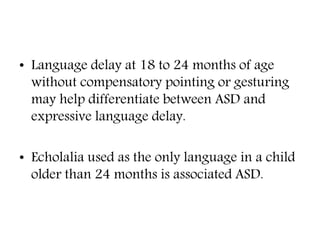
• Language delay at 18 to 24 months of age
without compensatory pointing or gesturing
may help differentiate between ASD and
expressive language delay.
• Echolalia used as the only language in a child
older than 24 months is associated ASD.
CONT..
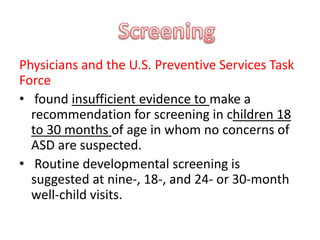
Physicians and the U.S. Preventive Services Task
Force
• found insufficient evidence to make a
recommendation for screening in children 18
to 30 months of age in whom no concerns of
ASD are suspected.
• Routine developmental screening is
suggested at nine-, 18-, and 24- or 30-month
well-child visits.
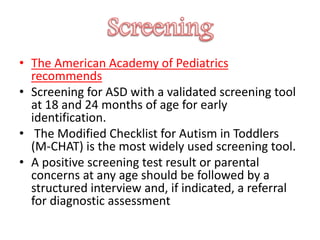
• The American Academy of Pediatrics
recommends
• Screening for ASD with a validated screening tool
at 18 and 24 months of age for early
identification.
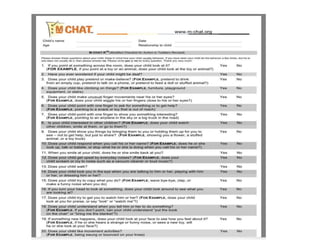
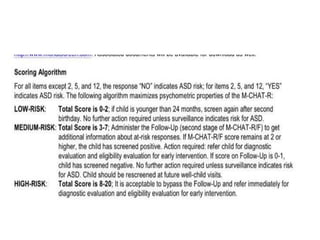
• The Modified Checklist for Autism in Toddlers
(M-CHAT) is the most widely used screening tool.
• A positive screening test result or parental
concerns at any age should be followed by a
structured interview and, if indicated, a referral
for diagnostic assessment
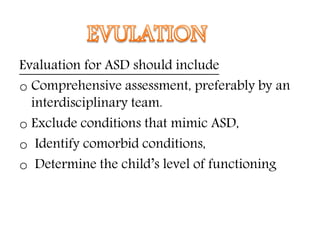
Evaluation for ASD should include
o Comprehensive assessment, preferably by an
interdisciplinary team.
o Exclude conditions that mimic ASD,
o Identify comorbid conditions,
o Determine the child’s level of functioning
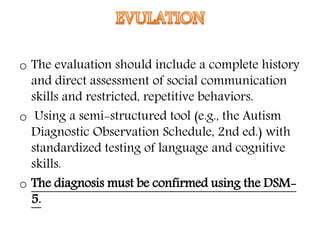
o The evaluation should include a complete history
and direct assessment of social communication
skills and restricted, repetitive behaviors.
o Using a semi-structured tool (e.g., the Autism
Diagnostic Observation Schedule, 2nd ed.) with
standardized testing of language and cognitive
skills.
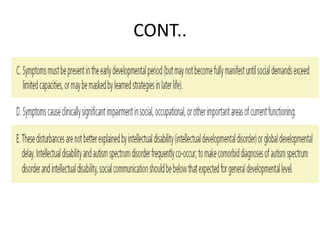
o The diagnosis must be confirmed using the DSM-
5.
TREATMENT
oBehavioral Treatments
oMedical Management
Behavioral
o Early intensive behavioral intervention is an
immersive behavioral therapy for at least 25
hours per week that is recommended for
preschool- to early school–aged children with
ASD.
o Applied behavior analysis is a cornerstone of
most early intensive behavioral intervention
approaches
CONT.
o applied behavior analysis–improvement in
cognitive ability, language, and adaptive skills.
o Strong evidence shows that cognitive
behavior therapy substantially reduces
anxiety symptoms in older children with ASD
who have average to above-average IQ.
Behavioral
o Social skills training has demonstrated short-
term improvement in social skills and
emotional recognition in school-aged
children without intellectual dysfunction.
o Parent training and education programs
improve language skills and decrease
disruptive behavior
o Although there is no medication available to
treat the composite symptoms of ASD, medical
management can be a beneficial adjunct.
o For which intensive behavioral therapy has
not been effective.
o Medical management may also target comorbid
diagnoses, such as anxiety disorders, attention-
deficit/hyperactivity disorder (ADHD), and sleep
disorders.
o Underlying conditions such as headaches,
sinusitis, and gastrointestinal disorders can mimic
or increase behavior symptoms common to ASD.
These conditions should be ruled out before
initiating targeted therapy.
o Aripiprazole (Abilify) and risperidone (Risperdal)
are the only medications approved by the U.S.
Food and Drug Administration for the treatment
of ASD.
o These atypical antipsychotics are approved for
ASD-associated irritability and, in some trials,
have proven beneficial for treating aggression,
explosive outbursts, and self-injury.
o Aripiprazole is approved for children six to 17
years of age.
o Risperidone is approved for children five to 16
years of age.
o Although these medications may provide some
benefits, they must be weighed against serious
potential adverse effects including sedation,
weight gain, tremor, and extrapyramidal
symptoms. Subspecialty referral should be
strongly considered for these treatments.
o Stimulants such as methylphenidate (Ritalin)
may prove beneficial in children with
comorbid ADHD, but treatment effects are less
significant than in children without ASD and
adverse effects are more common.
o Non–stimulant-based treatments may have a
larger role in children with comorbid ADHD
and have shown fewer adverse effects.
o There is strong evidence that melatonin helps
manage sleep disorders, improves daytime
behavior, and has minimal adverse effects.
o Massage therapy has been studied in several
single-blinded randomized controlled trials
that demonstrated benefits on ASD symptoms,
sleep, language, repetitive behaviors, and
anxiety.
o Vitamin B6 and magnesium in larger doses
have been studied for use in children with
ASD to improve behavior, speech, and
language.
o Results were equivocal, and asupratherapeutic
doses, there is risk of neuropathy from
vitamin B6 and diarrhea from magnesium
toxicity.
o Outcome markers for adults with ASD include
independent living, employment, friendship,
and marriage.
o Diagnostic severity and IQ levels were the
best predictors of future function.
o One limited study found that 12% of adults
with ASD and an IQ of at least 70 lived
independently.
o A small percentage of children with a
documented history of ASD no longer meet
diagnostic criteria and reach normal cognitive
function.
o These children achieve an optimal outcome.
When compared with a high-functioning ASD
cohort, children with optimal outcomes had
earlier referrals and more intensive interventions
with more applied behavior analysis therapy
and fewer pharmacologic interventions
o Autism spectrum disorder is characterized by
difficulty with social communication and
restricted, repetitive patterns of behavior,
interest, or activities.
o Screening for autism spectrum disorder with
a validated tool is recommended at 18- and
24-month well-child visits to assist with early
detection.
o An applied behavior analysis–based early
intensive behavioral intervention delivered
over an extended time frame improves
cognitive ability, language, and adaptive skills
REFERENCES
• WWW.AAFP/2016
• WWW.NICE GUIDLINES
TAHNKYOU

Autism

  • 1.
    Dr : alghaliyaalbusaidi Family medicine R 4
  • 2.
     INTRODUCTION  EATIOLOGY DIAGNOSIS  SCREENING  EVULATION  TREATMANT
  • 3.
    o Autism isa lifelong disorder that has a great impact on the child or young person and their family or carers. o When autism is diagnosed, families and carers and the child or young person themselves can experience a variety of emotions, shock and concern about the implications for the future.
  • 4.
    • Autism wasfirst described by psychiatrist Leo Kanner in 1943 as a disorder in children who had problems relating to others and a high sensitivity to changes in their environment. Prevalence of one in 68 children, with a male- to-female ratio of 4.5-to-1.
  • 5.
    o Genetic: rangefrom 40% to 90%, with most recent estimates at nearly 50% genetic liability. o Environmental factors.
  • 6.
    • Advanced paternalor maternal age • Maternal metabolic conditions, such as ,DM ,HTN ,obesity. • In utero risks include valproate (Depacon) exposure. • Maternal infections. • Traffic-related air pollution, and pesticide exposure • Perinatal events such as low birth weight and preterm delivery increase the risk of ASD as a part of the greater overall risk of neurodevelopmental injury.
  • 7.
    • Previous concernsfor causality related to thimerosal-based vaccines have been conclusively disproven. • A large amount of research has shown that vaccines are safe and do not cause ASD.
  • 11.
    Key diagnostic featuresof children with ASD include • Deficits in Social communication. • Restricted, repetitive patterns of behavior, interest, or activities. • Some signs and symptoms may emerge between six and 12 months of age. In many cases, a reliable diagnosis can be made by 24 months of age.
  • 13.
    • Parents maypresent with a concern for hearing loss because children with ASD may not respond after multiple attempts to get their attention by calling their name.
  • 14.
  • 15.
    • Language delayat 18 to 24 months of age without compensatory pointing or gesturing may help differentiate between ASD and expressive language delay. • Echolalia used as the only language in a child older than 24 months is associated ASD.
  • 16.
  • 21.
    Physicians and theU.S. Preventive Services Task Force • found insufficient evidence to make a recommendation for screening in children 18 to 30 months of age in whom no concerns of ASD are suspected. • Routine developmental screening is suggested at nine-, 18-, and 24- or 30-month well-child visits.
  • 22.
    • The AmericanAcademy of Pediatrics recommends • Screening for ASD with a validated screening tool at 18 and 24 months of age for early identification. • The Modified Checklist for Autism in Toddlers (M-CHAT) is the most widely used screening tool. • A positive screening test result or parental concerns at any age should be followed by a structured interview and, if indicated, a referral for diagnostic assessment
  • 25.
    Evaluation for ASDshould include o Comprehensive assessment, preferably by an interdisciplinary team. o Exclude conditions that mimic ASD, o Identify comorbid conditions, o Determine the child’s level of functioning
  • 26.
    o The evaluationshould include a complete history and direct assessment of social communication skills and restricted, repetitive behaviors. o Using a semi-structured tool (e.g., the Autism Diagnostic Observation Schedule, 2nd ed.) with standardized testing of language and cognitive skills. o The diagnosis must be confirmed using the DSM- 5.
  • 27.
  • 28.
  • 29.
    Behavioral o Early intensivebehavioral intervention is an immersive behavioral therapy for at least 25 hours per week that is recommended for preschool- to early school–aged children with ASD. o Applied behavior analysis is a cornerstone of most early intensive behavioral intervention approaches
  • 30.
    CONT. o applied behavioranalysis–improvement in cognitive ability, language, and adaptive skills. o Strong evidence shows that cognitive behavior therapy substantially reduces anxiety symptoms in older children with ASD who have average to above-average IQ.
  • 31.
    Behavioral o Social skillstraining has demonstrated short- term improvement in social skills and emotional recognition in school-aged children without intellectual dysfunction. o Parent training and education programs improve language skills and decrease disruptive behavior
  • 32.
    o Although thereis no medication available to treat the composite symptoms of ASD, medical management can be a beneficial adjunct. o For which intensive behavioral therapy has not been effective.
  • 33.
    o Medical managementmay also target comorbid diagnoses, such as anxiety disorders, attention- deficit/hyperactivity disorder (ADHD), and sleep disorders. o Underlying conditions such as headaches, sinusitis, and gastrointestinal disorders can mimic or increase behavior symptoms common to ASD. These conditions should be ruled out before initiating targeted therapy.
  • 34.
    o Aripiprazole (Abilify)and risperidone (Risperdal) are the only medications approved by the U.S. Food and Drug Administration for the treatment of ASD. o These atypical antipsychotics are approved for ASD-associated irritability and, in some trials, have proven beneficial for treating aggression, explosive outbursts, and self-injury.
  • 35.
    o Aripiprazole isapproved for children six to 17 years of age. o Risperidone is approved for children five to 16 years of age. o Although these medications may provide some benefits, they must be weighed against serious potential adverse effects including sedation, weight gain, tremor, and extrapyramidal symptoms. Subspecialty referral should be strongly considered for these treatments.
  • 36.
    o Stimulants suchas methylphenidate (Ritalin) may prove beneficial in children with comorbid ADHD, but treatment effects are less significant than in children without ASD and adverse effects are more common. o Non–stimulant-based treatments may have a larger role in children with comorbid ADHD and have shown fewer adverse effects.
  • 37.
    o There isstrong evidence that melatonin helps manage sleep disorders, improves daytime behavior, and has minimal adverse effects. o Massage therapy has been studied in several single-blinded randomized controlled trials that demonstrated benefits on ASD symptoms, sleep, language, repetitive behaviors, and anxiety.
  • 38.
    o Vitamin B6and magnesium in larger doses have been studied for use in children with ASD to improve behavior, speech, and language. o Results were equivocal, and asupratherapeutic doses, there is risk of neuropathy from vitamin B6 and diarrhea from magnesium toxicity.
  • 39.
    o Outcome markersfor adults with ASD include independent living, employment, friendship, and marriage. o Diagnostic severity and IQ levels were the best predictors of future function.
  • 40.
    o One limitedstudy found that 12% of adults with ASD and an IQ of at least 70 lived independently.
  • 41.
    o A smallpercentage of children with a documented history of ASD no longer meet diagnostic criteria and reach normal cognitive function. o These children achieve an optimal outcome. When compared with a high-functioning ASD cohort, children with optimal outcomes had earlier referrals and more intensive interventions with more applied behavior analysis therapy and fewer pharmacologic interventions
  • 42.
    o Autism spectrumdisorder is characterized by difficulty with social communication and restricted, repetitive patterns of behavior, interest, or activities. o Screening for autism spectrum disorder with a validated tool is recommended at 18- and 24-month well-child visits to assist with early detection.
  • 43.
    o An appliedbehavior analysis–based early intensive behavioral intervention delivered over an extended time frame improves cognitive ability, language, and adaptive skills
  • 44.
  • 45.