Attention Deficit Disorder Liceo Cultural Británico  Lic. Gonzalo Camp
 
Syndrome characterized by serious and persistent difficulties in three areas 1) distractibility (poor sustained attention to tasks)  2) impulsivity (impaired impulse control and delay of gratification)  3) hyperactivity (excessive activity and physical restlessness)  DEFINITION OF ADD:
What are the Symptoms of ADD? Easily distracted by sounds and other things. Difficulty focusing on assignments. Very forgetful on appointments and other due dates Having difficulty studying quietly.
WHO HAS ADD  According to epidemiological data, approximately 4% to 6% of the U.S. population has ADD  In Argentina Los niños que recibieron el diagnóstico según el ambos sistemas fueron del 4,99%. Los resultados según los criterios del DSM-IV fueron de 7,86 y la utilización de la escala más estricta, por su parte, arrojó una prevalencia del 5,24% Los resultados se muestran dentro de lo esperable, aunque la prevalencia en niñas encontrada sobrepasan aquellas que encontraron estudios similares en otros lugares. Ruben O. Scandar  - La Fundación de Neuropsicología Clínica
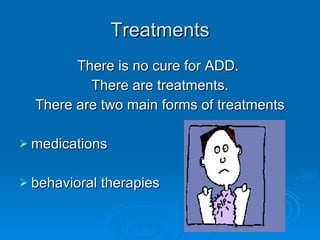
Treatments There is no cure for ADD.  There are treatments. There are two main forms of treatments medications behavioral therapies
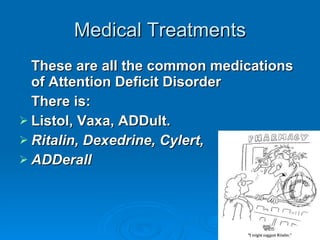
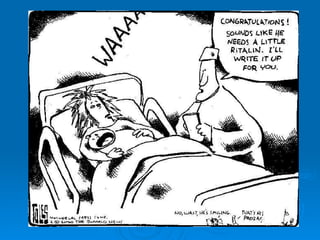
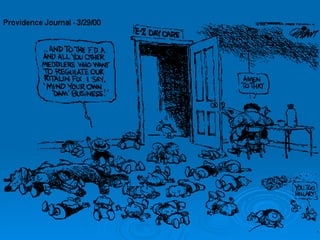
Medical Treatments These are all the common medications of Attention Deficit Disorder There is:  Listol, Vaxa, ADDult. Ritalin, Dexedrine, Cylert,  ADDerall
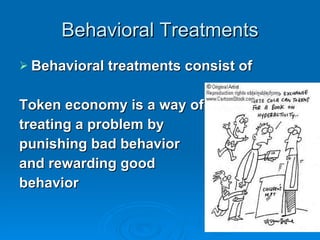
Behavioral Treatments Behavioral treatments consist of  Token economy is a way of  treating a problem by  punishing bad behavior  and rewarding good behavior
Good Things About ADD. People with ADD may be very creative. Like a painting in your home could come from someone who has Attention Deficit Disorder. Some of the Gifted are label as to having Attention Deficit Disorder. It is very misunderstood.
Bad things About ADD People with ADD can get really annoying. Have temper tantrums They could one minute be mad and then the next be very happy.  Then they could eventually get over what ever they are doing. They may have very bad anger problems. He or she may have trouble remembering things and forget what they are doing.
 
 
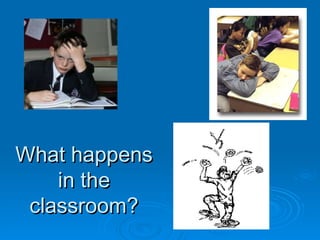
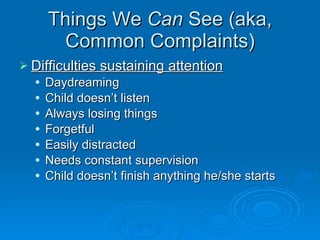
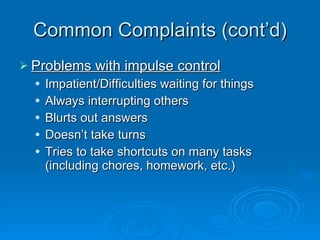
What happens in the classroom?
Things We  Can  See (aka, Common Complaints) Difficulties sustaining attention Daydreaming Child doesn’t listen Always losing things Forgetful Easily distracted Needs constant supervision Child doesn’t finish anything he/she starts
Common Complaints (cont’d) Problems with impulse control Impatient/Difficulties waiting for things Always interrupting others Blurts out answers Doesn’t take turns Tries to take shortcuts on many tasks (including chores, homework, etc.)
Common Complaints (cont’d) Hyperactivity Always on the go Squirmy…can’t sit still Talks too much Frequently hums or makes odd noises Unable to “put the brakes on” motor activity Child has two speeds; asleep and awake
What Do These Behaviors Have in Common? Problem isn’t as much sustaining attention as it is sustaining  inhibition …this is the hallmark of ADHD Inhibition : a mental process that restrains an action (behavior) or emotion Problems of inhibition are not a matter of choice, but are instead a result of what is (or is not) going on in the child’s brain
ADHD and the Human Brain Portions of brain’s frontal lobe are responsible for “Executive” functions: Consolidating information from other areas of the brain “ Considers” potential consequences and implications of behaviors Puts “brakes” on ( inhibits ) impulsive reactions Initiates appropriate response to environment
ADHD and the Brain (cont’d) Research suggests that in in children with ADHD, these “executive” areas of the brain are  under-active Increasing the activity level in these areas of the ADHD brain have been shown to decrease behavioral symptoms.  This is the logic behind using Stimulant medications as a first line treatment for the disorder.
Things That Look Like ADHD Depression Anxiety Hearing problems Visual problems Seizure disorder Oppositional defiant disorder Autism Learning disabilities Parenting problems Substance use Medication side-effects Lead poisoning
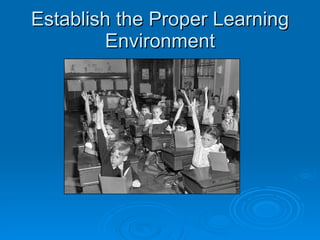
Establish the Proper Learning Environment
Establish the Proper Learning Environment Place students with ADD near you, but in regular seating orientation Place students with backs to rest of class Surround students with ADD with good role models (encourage peer tutoring)
Establish the Proper Environment (cont.) Pay attention to change in child’s schooling (avoid physical relocation, change in schedule, and disruptions) watch them on field trips Have a reduced-distraction study area, encourage parents to do the same.  Have parents set up regular homework routines
Instructing Students With ADD Maintain eye contact when possible (i.e. giving verbal instructions) Make directions clear and concise. Be consistent with daily instructions. Simplify complex directions. Avoid multiple commands.
Instructing Student with ADD (cont.) Make sure students comprehend the instructions before beginning the task  Repeat instructions in a calm, positive manner, if needed  Help the students feel comfortable with seeking assistance
Instructing Student with ADD (cont.) provide opportunity for students to apply concepts they have studied to the reality of their daily lives  bridge from previously taught concepts to new concepts
Giving Assignments  Give out only one task at a time.  Monitor frequently. Maintain a supportive attitude  Give extra time for certain tasks. Students with ADD may work slowly. Do not penalize them for needed extra time.
Modifying Behavior And Enhancing Self-Esteem  Providing Supervision and Discipline:   Remain calm, state the infraction of the rule, and avoid debating or arguing with the student. Have pre-established consequences for misbehavior. Administer consequences immediately, and monitor proper behavior frequently. Enforce classroom rules consistently.
Modifying Behavior And Enhancing Self-Esteem (cont.) Providing   Encouragement : Reward more than you punish, in order to build self-esteem. Praise immediately any and all good behavior and performance. Change rewards if they are not effective in motivating behavioral change. Find ways to encourage the child.
Modifying Behavior And Enhancing Self-Esteem (cont.) use contingency-based self-management techniques  have individuals keep track of their own behavior and then receive consequences   use self-monitoring of attention to increase on-task behavior  Helps students become more aware of what trigger off-task behavior
Other Educational Recommendations  Check for other learning disabilities (present in ~30% of kids with add) Try a private tutor Individualized mildly or non-competitive activities (bowling, walking, swimming) Involvement in Social Activities (scouting, church group)
KEY Tips for Managing ADHD Be patient Be persistent  Be understanding *Most importantly, remember to differentiate the behaviors from the child Bad behaviors  are not  synonymous with a bad child
Thank you very much!!!!

Class On Attention Deficit Disorderteens

  • 1.
    Attention Deficit DisorderLiceo Cultural Británico Lic. Gonzalo Camp
  • 2.
  • 3.
    Syndrome characterized byserious and persistent difficulties in three areas 1) distractibility (poor sustained attention to tasks) 2) impulsivity (impaired impulse control and delay of gratification) 3) hyperactivity (excessive activity and physical restlessness) DEFINITION OF ADD:
  • 4.
    What are theSymptoms of ADD? Easily distracted by sounds and other things. Difficulty focusing on assignments. Very forgetful on appointments and other due dates Having difficulty studying quietly.
  • 5.
    WHO HAS ADD According to epidemiological data, approximately 4% to 6% of the U.S. population has ADD In Argentina Los niños que recibieron el diagnóstico según el ambos sistemas fueron del 4,99%. Los resultados según los criterios del DSM-IV fueron de 7,86 y la utilización de la escala más estricta, por su parte, arrojó una prevalencia del 5,24% Los resultados se muestran dentro de lo esperable, aunque la prevalencia en niñas encontrada sobrepasan aquellas que encontraron estudios similares en otros lugares. Ruben O. Scandar - La Fundación de Neuropsicología Clínica
  • 6.
    Treatments There isno cure for ADD. There are treatments. There are two main forms of treatments medications behavioral therapies
  • 7.
    Medical Treatments Theseare all the common medications of Attention Deficit Disorder There is: Listol, Vaxa, ADDult. Ritalin, Dexedrine, Cylert, ADDerall
  • 8.
    Behavioral Treatments Behavioraltreatments consist of Token economy is a way of treating a problem by punishing bad behavior and rewarding good behavior
  • 9.
    Good Things AboutADD. People with ADD may be very creative. Like a painting in your home could come from someone who has Attention Deficit Disorder. Some of the Gifted are label as to having Attention Deficit Disorder. It is very misunderstood.
  • 10.
    Bad things AboutADD People with ADD can get really annoying. Have temper tantrums They could one minute be mad and then the next be very happy. Then they could eventually get over what ever they are doing. They may have very bad anger problems. He or she may have trouble remembering things and forget what they are doing.
  • 11.
  • 12.
  • 13.
    What happens inthe classroom?
  • 14.
    Things We Can See (aka, Common Complaints) Difficulties sustaining attention Daydreaming Child doesn’t listen Always losing things Forgetful Easily distracted Needs constant supervision Child doesn’t finish anything he/she starts
  • 15.
    Common Complaints (cont’d)Problems with impulse control Impatient/Difficulties waiting for things Always interrupting others Blurts out answers Doesn’t take turns Tries to take shortcuts on many tasks (including chores, homework, etc.)
  • 16.
    Common Complaints (cont’d)Hyperactivity Always on the go Squirmy…can’t sit still Talks too much Frequently hums or makes odd noises Unable to “put the brakes on” motor activity Child has two speeds; asleep and awake
  • 17.
    What Do TheseBehaviors Have in Common? Problem isn’t as much sustaining attention as it is sustaining inhibition …this is the hallmark of ADHD Inhibition : a mental process that restrains an action (behavior) or emotion Problems of inhibition are not a matter of choice, but are instead a result of what is (or is not) going on in the child’s brain
  • 18.
    ADHD and theHuman Brain Portions of brain’s frontal lobe are responsible for “Executive” functions: Consolidating information from other areas of the brain “ Considers” potential consequences and implications of behaviors Puts “brakes” on ( inhibits ) impulsive reactions Initiates appropriate response to environment
  • 19.
    ADHD and theBrain (cont’d) Research suggests that in in children with ADHD, these “executive” areas of the brain are under-active Increasing the activity level in these areas of the ADHD brain have been shown to decrease behavioral symptoms. This is the logic behind using Stimulant medications as a first line treatment for the disorder.
  • 20.
    Things That LookLike ADHD Depression Anxiety Hearing problems Visual problems Seizure disorder Oppositional defiant disorder Autism Learning disabilities Parenting problems Substance use Medication side-effects Lead poisoning
  • 21.
    Establish the ProperLearning Environment
  • 22.
    Establish the ProperLearning Environment Place students with ADD near you, but in regular seating orientation Place students with backs to rest of class Surround students with ADD with good role models (encourage peer tutoring)
  • 23.
    Establish the ProperEnvironment (cont.) Pay attention to change in child’s schooling (avoid physical relocation, change in schedule, and disruptions) watch them on field trips Have a reduced-distraction study area, encourage parents to do the same. Have parents set up regular homework routines
  • 24.
    Instructing Students WithADD Maintain eye contact when possible (i.e. giving verbal instructions) Make directions clear and concise. Be consistent with daily instructions. Simplify complex directions. Avoid multiple commands.
  • 25.
    Instructing Student withADD (cont.) Make sure students comprehend the instructions before beginning the task Repeat instructions in a calm, positive manner, if needed Help the students feel comfortable with seeking assistance
  • 26.
    Instructing Student withADD (cont.) provide opportunity for students to apply concepts they have studied to the reality of their daily lives bridge from previously taught concepts to new concepts
  • 27.
    Giving Assignments Give out only one task at a time. Monitor frequently. Maintain a supportive attitude Give extra time for certain tasks. Students with ADD may work slowly. Do not penalize them for needed extra time.
  • 28.
    Modifying Behavior AndEnhancing Self-Esteem Providing Supervision and Discipline: Remain calm, state the infraction of the rule, and avoid debating or arguing with the student. Have pre-established consequences for misbehavior. Administer consequences immediately, and monitor proper behavior frequently. Enforce classroom rules consistently.
  • 29.
    Modifying Behavior AndEnhancing Self-Esteem (cont.) Providing Encouragement : Reward more than you punish, in order to build self-esteem. Praise immediately any and all good behavior and performance. Change rewards if they are not effective in motivating behavioral change. Find ways to encourage the child.
  • 30.
    Modifying Behavior AndEnhancing Self-Esteem (cont.) use contingency-based self-management techniques have individuals keep track of their own behavior and then receive consequences use self-monitoring of attention to increase on-task behavior Helps students become more aware of what trigger off-task behavior
  • 31.
    Other Educational Recommendations Check for other learning disabilities (present in ~30% of kids with add) Try a private tutor Individualized mildly or non-competitive activities (bowling, walking, swimming) Involvement in Social Activities (scouting, church group)
  • 32.
    KEY Tips forManaging ADHD Be patient Be persistent Be understanding *Most importantly, remember to differentiate the behaviors from the child Bad behaviors are not synonymous with a bad child
  • 33.