Alistair J. Howitt-Marshall Educational & Developmental Psychologist
My Background BA (Hons) Psychology and Sociology at the University of Reading, UK MA Educational & Developmental Psychology at the University of Western Sydney, Australia  3 years as an Offender Case Manager with the National Probation Office, UK 1 year as a Trainee Forensic Psychologist working in Sex Offender Rehabilitation at HM Prison Stafford, UK 5 years in Special Needs Education, Australia Currently working in Private Practice with Laura Kiln, ‘Laura’s Place’, Central Coast  Father of 3 children, Scarlett (3 years), Ronan (2 years) and Alicia (8 months) I was diagnosed with Dyslexia in primary school
Learning Objectives  An understanding of the problems associated with the current diagnostic criteria for learning disorders An understanding of the cognitive and developmental profile of dyslexia  An understanding of the behaviour problems associated with dyslexia
Definitions  Medical / Psychiatric - Diagnostic and Statistical Manual, 4 th  Ed (DSM-IV), - International Classification of  Diseases, 10 th  Ed.  (ICD-10)  Organisations - Australia: ALDA, SPELD - UK: Lucid Research, British Dyslexia Assoc.  Governmental / Legal –  State departments of education –  Federal Legislation: Disability Discrimination  Act, Disability Standards for Education
Definitions The term  “specific learning disability” means a disorder in one or more of the basic psychological processes involved in understanding or in using language, spoken or written, which may manifest itself in an imperfect ability to listen, speak, read, write, spell, or do mathematical calculations.  U.S. Office of Education (1968)
Current Diagnostic Classifications: Specific Learning Disorders DSM-IV Classifications Expressive Language Disorder Mixed Receptive-Expressive Language Disorder Phonological Disorder Reading Disorder Disorder of Written Expression Mathematics Disorder Note: Dyslexia is NOT a recognised diagnostic classification in the DSM-IV, but may encompass some or all of the above.
Dyslexia: Neurological in Origin Dyslexia presupposes the existence of certain cognitive deficits that are believed to underpin the condition.  Recording of the electrical activity of the brain Brain imaging techniques  Post-mortem examination -  all reveal a range of functional and structural cerebral anomalies of persons with dyslexia. These are believed to be either inherited or neurological abnormalities which have arisen before (or during) birth.
Other useful terminologies  Dysgraphia  – difficulty in writing Dyspraxia  – difficulties with balance and co-ordination Dyscalculia  – difficulties with maths  Auditory Processing Disorder  – difficulties distinguishing sounds in language and comprehending what they hear
Cognitive Characteristics of  Dyslexia  Uneven cognitive profile: strengths and weaknesses  Phonological processing difficulties  Weakness in working memory and short-term memory function Difficulties with automatising skills  Problems connected to visual processing
Diagnostic Criteria: DSM-IV The DSM-IV uses an IQ – Achievement Discrepancy Analysis to determine the presence of specific learning disorder Academic skills below expectation for age (2 years below chronological age) and general cognitive ability Not due to intellectual disability, sensory or physical deficit, emotional disorder, inadequate environment or lack of educational experiences
A multi-disciplinary approach A number of professionals should be involved in the identification of dyslexia  Parents or primary caregivers Registered Psychologists Teachers (esp. Special Ed. trained) & Teacher’s Aides Speech Pathologists
Test Selection Below is the minimum number of tests required to formally diagnose an individual with a specific learning disorder.  Cognitive assessment  -  Wechsler Intelligence Scale for Children, 4 th  Ed. OR - Stanford-Binet, 5 th  Ed.  Achievement assessment  (incl. reading, writing, mathematics and oral language) -  Wechsler Individual Achievement Test, 2 nd  & 3 rd  Ed. OR - Woodcock Johnson, 3 rd  Ed. Language assessment  -  Clinical Language of Fundamental, 4 th  Ed.
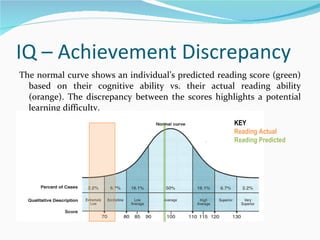
IQ – Achievement Discrepancy  The normal curve shows an individual ’ s predicted reading score (green) based on their cognitive ability vs. their actual reading ability (orange). The discrepancy between the scores highlights a potential learning difficulty.  KEY Reading Actual Reading Predicted
Problems with IQ – Achievement Discrepancy  Relies on a  ‘wait to fail’ model, problematic when it comes to early identification  Identification is confined to bright, middle class children Difficult to establish discrepancy if child is below average IQ, yet dyslexia can affect children of all abilities  Assessments are relatively expensive and time consuming to analyse  Assessments are not widely accessible, i.e. can only be carried out by certain professionals
IQ – Achievement Discrepancy  “…  the assumption that a discrepancy between achievement and intelligence (typically assessed using intelligence tests) is a clear diagnostic marker for learning disabilities or can be considered a characteristic sign is at best premature, and at worst invalid” Lyon (1995)
A useful definition!  Dyslexia is typically characterised by  ‘an unusual balance of skills ’ .  Dyslexia is a syndrome: a collection of associated characteristics that vary in degree and from person to person. These characteristics encompass not only distinctive clusters of problems  but sometimes also distinctive talents. Lucid Research (2003)
Dyslexia and Behaviour  The incidence of behavioural problems amongst those with learning disabilities is three times the norm by eight years of age (Mash & Wolfe, 2002). High co-morbidity with Attention Deficit Hyperactivity Disorder (ADHD).  Unfortunately, ADHD will often be detected first.
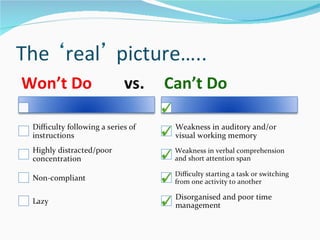
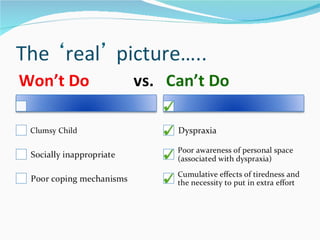
Dyslexia and Behaviour: common complaints?!  Won ’t follow a series of instructions  Highly distracted/Poor concentration  Non-compliant  Lazy Clumsy Socially inappropriate Poor coping mechanisms
 
 
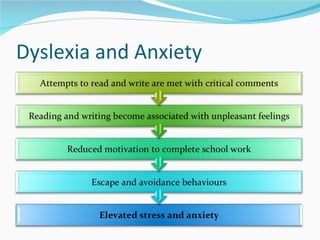
Dyslexia and Anxiety
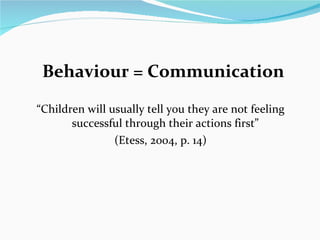
Behaviour = Communication  “ Children will usually tell you they are not feeling successful through their actions first ” (Etess, 2004, p. 14)
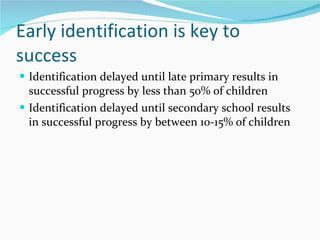
Early identification is key to success Identification delayed until late primary results in successful progress by less than 50% of children  Identification delayed until secondary school results in successful progress by between 10-15% of children
Dyslexia Screening Tests for Teachers Bangor Dyslexia Test  (1983; Second edition, 1997). T.R.Miles. Cambridge: LDA. Several brief subtests tap  ‘positive signs’ of dyslexia; about 7 years to 18 years.  CoPS – Cognitive Profiling System  (1996/97) C. H. Singleton, K.V. Thomas and Leedale, R.C. Beverley, East Yorks: Lucid Creative Ltd. Computer software. Comprises 9 subtests of memory, phonological awareness and auditory discrimination; 4 yrs to 8 yrs 11mths.  Dyslexia Early Screening Test  (DEST-2; 4:6 –6:5 yrs) (2002) and Dyslexia Screening Test (DST; 6:6 – 16.5 yrs) (1996) A. Fawcett and R. Nicolson and. London: Psychological Corporation. 10 short subtests of phonological skills, memory, reading, spelling, postural stability, etc.
Know Your Rights Disability Standards for Education, 2005 The standards clarify the obligations of education and training providers to ensure that students with a disability are able to access and participate in education without experiencing discrimination.  Weblink: http://www.comlaw.gov.au/ComLaw/Legislation/LegislativeInstrument1.nsf/all/search/4B28EE956766891FCA256FCC0004EF81
Useful Websites www.lucid-research.com/ www.bdadyslexia.org.uk   www.dyslexiaassociation.org.au   www.speldnsw.org.au/   www.stampout.com.au/   UK kid demonstrates speech recognition software www.youtube.com/watch?v= lXHawlHLmtI

Dyslexia assoc-pp

  • 1.
    Alistair J. Howitt-MarshallEducational & Developmental Psychologist
  • 2.
    My Background BA(Hons) Psychology and Sociology at the University of Reading, UK MA Educational & Developmental Psychology at the University of Western Sydney, Australia 3 years as an Offender Case Manager with the National Probation Office, UK 1 year as a Trainee Forensic Psychologist working in Sex Offender Rehabilitation at HM Prison Stafford, UK 5 years in Special Needs Education, Australia Currently working in Private Practice with Laura Kiln, ‘Laura’s Place’, Central Coast Father of 3 children, Scarlett (3 years), Ronan (2 years) and Alicia (8 months) I was diagnosed with Dyslexia in primary school
  • 3.
    Learning Objectives An understanding of the problems associated with the current diagnostic criteria for learning disorders An understanding of the cognitive and developmental profile of dyslexia An understanding of the behaviour problems associated with dyslexia
  • 4.
    Definitions Medical/ Psychiatric - Diagnostic and Statistical Manual, 4 th Ed (DSM-IV), - International Classification of Diseases, 10 th Ed. (ICD-10) Organisations - Australia: ALDA, SPELD - UK: Lucid Research, British Dyslexia Assoc. Governmental / Legal – State departments of education – Federal Legislation: Disability Discrimination Act, Disability Standards for Education
  • 5.
    Definitions The term “specific learning disability” means a disorder in one or more of the basic psychological processes involved in understanding or in using language, spoken or written, which may manifest itself in an imperfect ability to listen, speak, read, write, spell, or do mathematical calculations. U.S. Office of Education (1968)
  • 6.
    Current Diagnostic Classifications:Specific Learning Disorders DSM-IV Classifications Expressive Language Disorder Mixed Receptive-Expressive Language Disorder Phonological Disorder Reading Disorder Disorder of Written Expression Mathematics Disorder Note: Dyslexia is NOT a recognised diagnostic classification in the DSM-IV, but may encompass some or all of the above.
  • 7.
    Dyslexia: Neurological inOrigin Dyslexia presupposes the existence of certain cognitive deficits that are believed to underpin the condition. Recording of the electrical activity of the brain Brain imaging techniques Post-mortem examination - all reveal a range of functional and structural cerebral anomalies of persons with dyslexia. These are believed to be either inherited or neurological abnormalities which have arisen before (or during) birth.
  • 8.
    Other useful terminologies Dysgraphia – difficulty in writing Dyspraxia – difficulties with balance and co-ordination Dyscalculia – difficulties with maths Auditory Processing Disorder – difficulties distinguishing sounds in language and comprehending what they hear
  • 9.
    Cognitive Characteristics of Dyslexia Uneven cognitive profile: strengths and weaknesses Phonological processing difficulties Weakness in working memory and short-term memory function Difficulties with automatising skills Problems connected to visual processing
  • 10.
    Diagnostic Criteria: DSM-IVThe DSM-IV uses an IQ – Achievement Discrepancy Analysis to determine the presence of specific learning disorder Academic skills below expectation for age (2 years below chronological age) and general cognitive ability Not due to intellectual disability, sensory or physical deficit, emotional disorder, inadequate environment or lack of educational experiences
  • 11.
    A multi-disciplinary approachA number of professionals should be involved in the identification of dyslexia Parents or primary caregivers Registered Psychologists Teachers (esp. Special Ed. trained) & Teacher’s Aides Speech Pathologists
  • 12.
    Test Selection Belowis the minimum number of tests required to formally diagnose an individual with a specific learning disorder. Cognitive assessment - Wechsler Intelligence Scale for Children, 4 th Ed. OR - Stanford-Binet, 5 th Ed. Achievement assessment (incl. reading, writing, mathematics and oral language) - Wechsler Individual Achievement Test, 2 nd & 3 rd Ed. OR - Woodcock Johnson, 3 rd Ed. Language assessment - Clinical Language of Fundamental, 4 th Ed.
  • 13.
    IQ – AchievementDiscrepancy The normal curve shows an individual ’ s predicted reading score (green) based on their cognitive ability vs. their actual reading ability (orange). The discrepancy between the scores highlights a potential learning difficulty. KEY Reading Actual Reading Predicted
  • 14.
    Problems with IQ– Achievement Discrepancy Relies on a ‘wait to fail’ model, problematic when it comes to early identification Identification is confined to bright, middle class children Difficult to establish discrepancy if child is below average IQ, yet dyslexia can affect children of all abilities Assessments are relatively expensive and time consuming to analyse Assessments are not widely accessible, i.e. can only be carried out by certain professionals
  • 15.
    IQ – AchievementDiscrepancy “… the assumption that a discrepancy between achievement and intelligence (typically assessed using intelligence tests) is a clear diagnostic marker for learning disabilities or can be considered a characteristic sign is at best premature, and at worst invalid” Lyon (1995)
  • 16.
    A useful definition! Dyslexia is typically characterised by ‘an unusual balance of skills ’ . Dyslexia is a syndrome: a collection of associated characteristics that vary in degree and from person to person. These characteristics encompass not only distinctive clusters of problems but sometimes also distinctive talents. Lucid Research (2003)
  • 17.
    Dyslexia and Behaviour The incidence of behavioural problems amongst those with learning disabilities is three times the norm by eight years of age (Mash & Wolfe, 2002). High co-morbidity with Attention Deficit Hyperactivity Disorder (ADHD). Unfortunately, ADHD will often be detected first.
  • 18.
    Dyslexia and Behaviour:common complaints?! Won ’t follow a series of instructions Highly distracted/Poor concentration Non-compliant Lazy Clumsy Socially inappropriate Poor coping mechanisms
  • 19.
  • 20.
  • 21.
  • 22.
    Behaviour = Communication “ Children will usually tell you they are not feeling successful through their actions first ” (Etess, 2004, p. 14)
  • 23.
    Early identification iskey to success Identification delayed until late primary results in successful progress by less than 50% of children Identification delayed until secondary school results in successful progress by between 10-15% of children
  • 24.
    Dyslexia Screening Testsfor Teachers Bangor Dyslexia Test (1983; Second edition, 1997). T.R.Miles. Cambridge: LDA. Several brief subtests tap ‘positive signs’ of dyslexia; about 7 years to 18 years. CoPS – Cognitive Profiling System (1996/97) C. H. Singleton, K.V. Thomas and Leedale, R.C. Beverley, East Yorks: Lucid Creative Ltd. Computer software. Comprises 9 subtests of memory, phonological awareness and auditory discrimination; 4 yrs to 8 yrs 11mths. Dyslexia Early Screening Test (DEST-2; 4:6 –6:5 yrs) (2002) and Dyslexia Screening Test (DST; 6:6 – 16.5 yrs) (1996) A. Fawcett and R. Nicolson and. London: Psychological Corporation. 10 short subtests of phonological skills, memory, reading, spelling, postural stability, etc.
  • 25.
    Know Your RightsDisability Standards for Education, 2005 The standards clarify the obligations of education and training providers to ensure that students with a disability are able to access and participate in education without experiencing discrimination. Weblink: http://www.comlaw.gov.au/ComLaw/Legislation/LegislativeInstrument1.nsf/all/search/4B28EE956766891FCA256FCC0004EF81
  • 26.
    Useful Websites www.lucid-research.com/www.bdadyslexia.org.uk www.dyslexiaassociation.org.au www.speldnsw.org.au/ www.stampout.com.au/ UK kid demonstrates speech recognition software www.youtube.com/watch?v= lXHawlHLmtI

Editor's Notes

  • #5 Acronyms SPELD - Specific Learning Disabilities Association ALDA -
  • #8 The principal difference between ‘dyslexia’ and ‘specific learning difficulty’ is that dyslexia presupposes the existence of certain cognitive deficits that are believed to underpin the condition. Such cognitive deficits (e.g. in phonological processing, memory, visual processing, or motor co-ordination) are believed to be either inherited or due to neurological anomalies which have arisen before (or during) birth or in early childhood.
  • #10 1). Phonological processing abilities , which affects the acquisition of phonic skills in reading and spelling so that unfamiliar words are frequently misread. 2). Working memory abilities affect the ability to retain letter-sound associations (acquisition of phonics), processing errors of mental lexicon (incorrect words used), and delays in access to mental lexicon (slow down the rate of reading), difficulty in retaining the meaning of text, difficulty sequencing and organising written information, disjointed written because the individual loses track. 3). Automatising skills , which results in a high degree of mental effort when carrying out skilled and unfamiliar tasks. Dyslexics can ’t concentrate on both the mechanics (spelling, grammar, punctuation) and the content of written work, they do not read for meaning. Difficulty with listening and taking notes at the same time. 4). Visual processing , susceptibility to visual discomfort strong visual contrast and rapid flicker which can be irritating. Use of coloured overlays or filters (e.g. by use of acetate sheets or tinted lenses) can be beneficial in alleviating the symptoms of visual discomfort in a fair proportion of cases.
  • #13 There are a number of other standarised cognitive assessments, but the WISC-IV and SB5 are the industry GOLD standard. Other achievement assessment include the NEALE Analysis of Reading Ability, Wide Range Achievement Test (WRAT) and South Australian Spelling Test.
  • #15 The discrepancy method implies that dyslexia can only be identified when there is a significant discrepancy between intelligence and attainment and when all other potential causes of reading disability are excluded. Unfortunately, this has unwittingly had the effect of making dyslexia a condition observed mainly in bright, middle-class children, which has in turn given cause for some professional disparagement of the condition over many years. It also results in diagnosis being delayed until a ‘significant’ discrepancy between intelligence and attainment can be demonstrated.
  • #17 I like this definition because it acknowledges that people with dyslexia have extraordinary strengths, as well as the obvious weaknesses.