
Overview
Scrum Vs. Kanban
JALADHIKUMAR BHATT
Scrum
What is Scrum ?
Agile Scrum is one of the leading causes of scope creep because unless there is a definite end
date, the project management stakeholders will be tempted to keep demanding that new
functionality be delivered. If a task is not well defined, estimating project costs and time will not
be accurate.
Advantage of Scrum
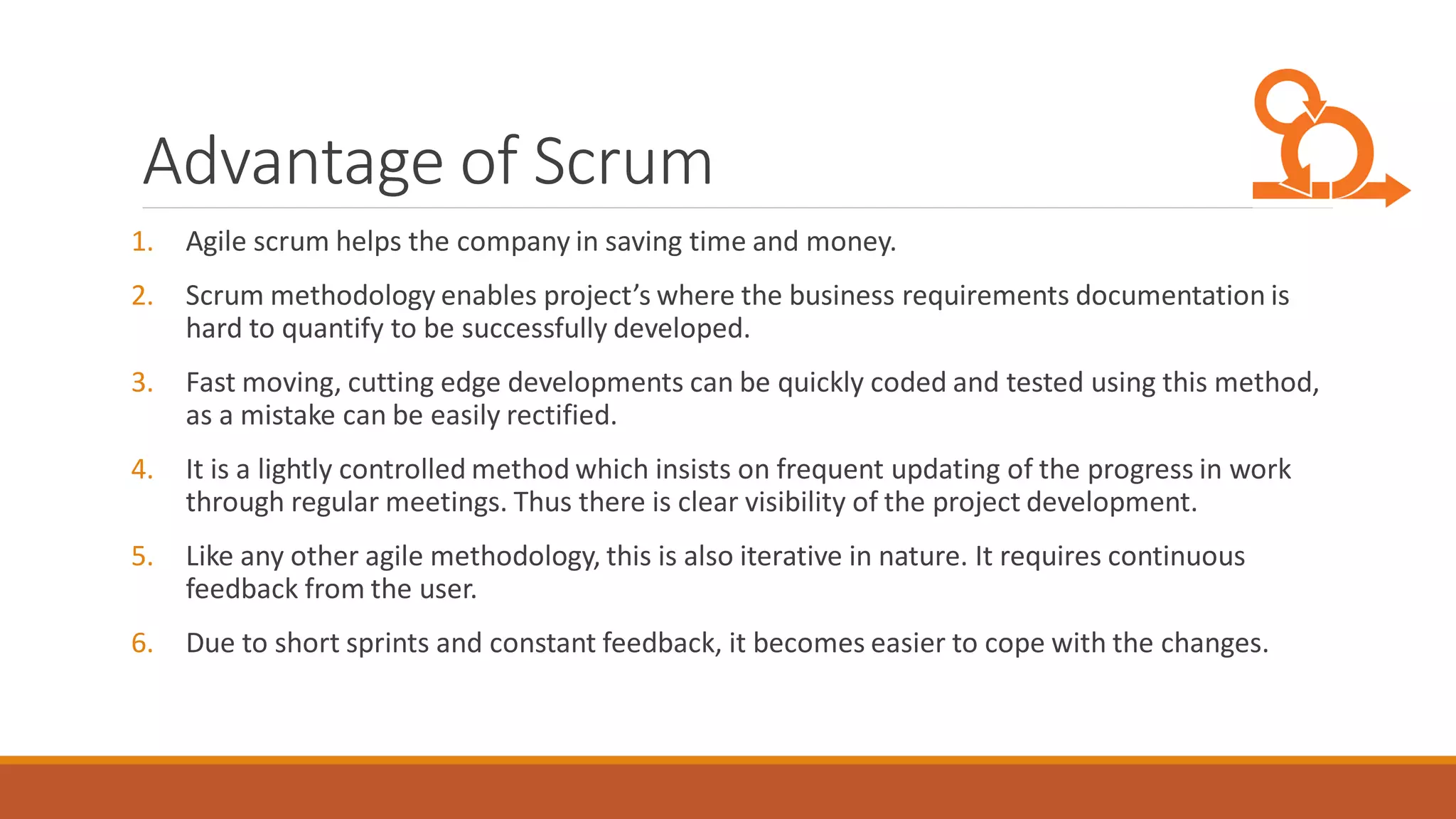
1. Agile scrum helps the company in saving time and money.
2. Scrum methodology enables project’s where the business requirements documentation is
hard to quantify to be successfully developed.
3. Fast moving, cutting edge developments can be quickly coded and tested using this method,
as a mistake can be easily rectified.
4. It is a lightly controlled method which insists on frequent updating of the progress in work
through regular meetings. Thus there is clear visibility of the project development.
5. Like any other agile methodology, this is also iterative in nature. It requires continuous
feedback from the user.
6. Due to short sprints and constant feedback, it becomes easier to cope with the changes.
Advantage of Scrum (Continue…)
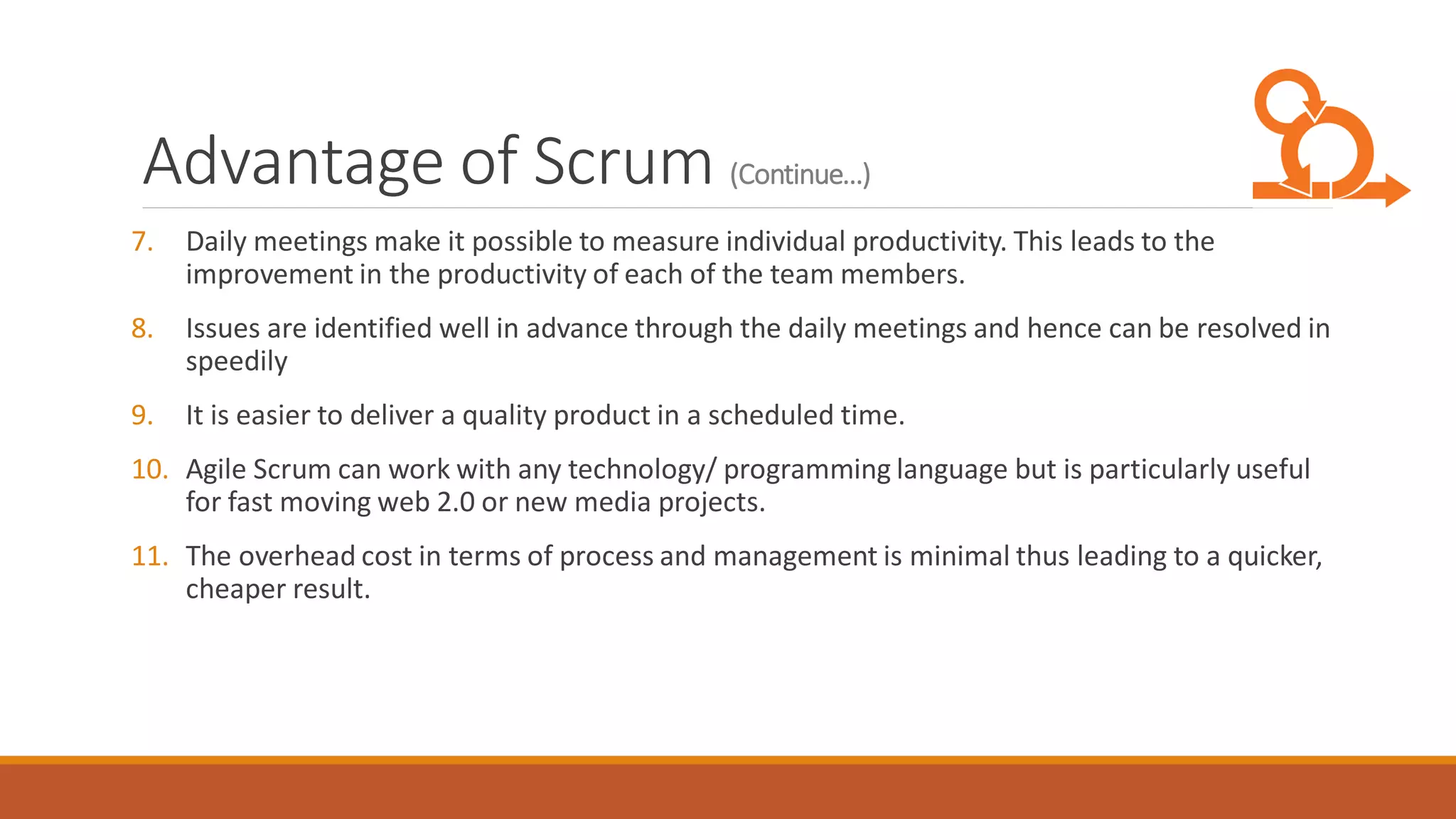
7. Daily meetings make it possible to measure individual productivity. This leads to the
improvement in the productivity of each of the team members.
8. Issues are identified well in advance through the daily meetings and hence can be resolved in
speedily
9. It is easier to deliver a quality product in a scheduled time.
10. Agile Scrum can work with any technology/ programming language but is particularly useful
for fast moving web 2.0 or new media projects.
11. The overhead cost in terms of process and management is minimal thus leading to a quicker,
cheaper result.
Disadvantage of Scrum
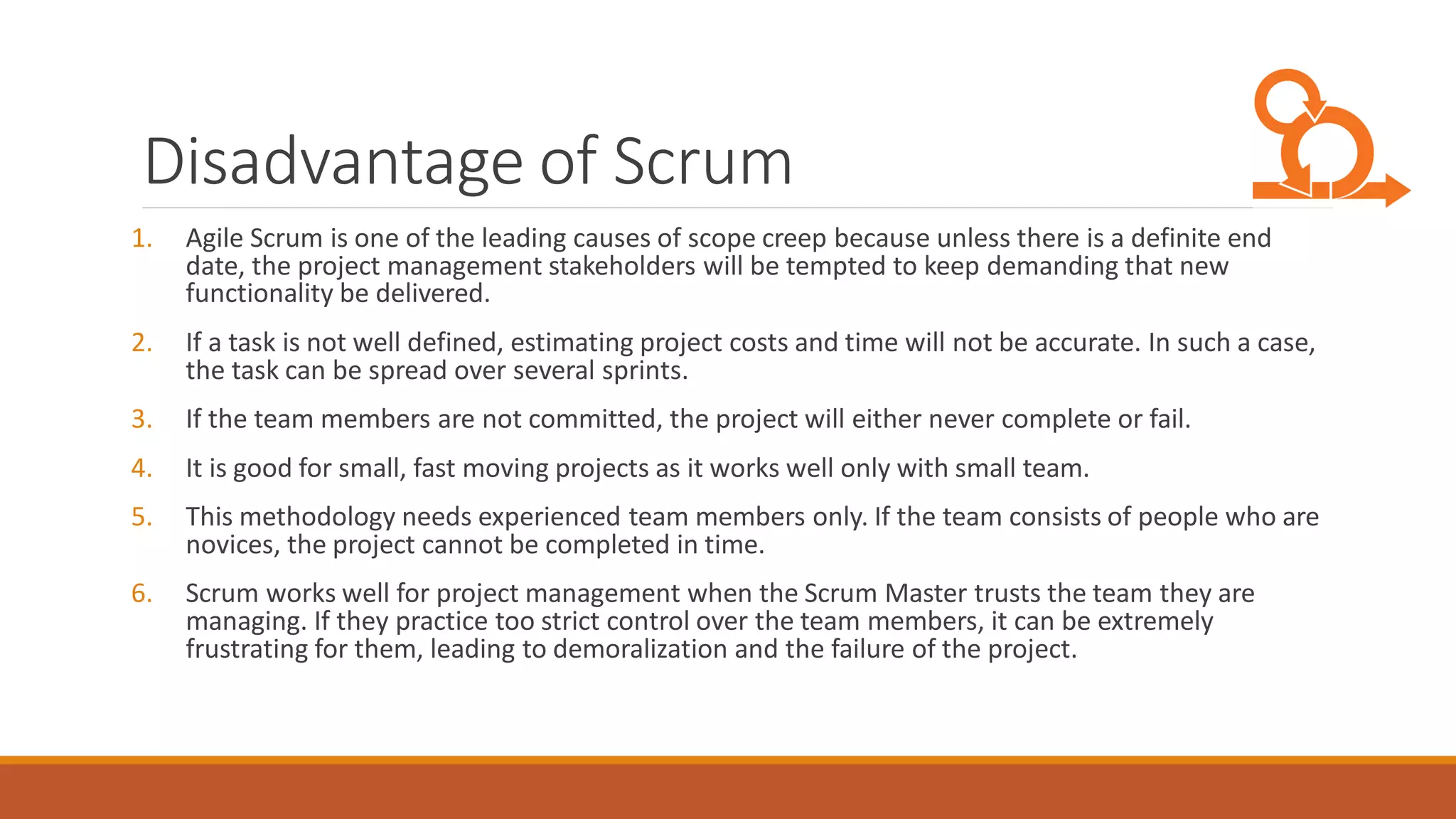
1. Agile Scrum is one of the leading causes of scope creep because unless there is a definite end
date, the project management stakeholders will be tempted to keep demanding that new
functionality be delivered.
2. If a task is not well defined, estimating project costs and time will not be accurate. In such a case,
the task can be spread over several sprints.
3. If the team members are not committed, the project will either never complete or fail.
4. It is good for small, fast moving projects as it works well only with small team.
5. This methodology needs experienced team members only. If the team consists of people who are
novices, the project cannot be completed in time.
6. Scrum works well for project management when the Scrum Master trusts the team they are
managing. If they practice too strict control over the team members, it can be extremely
frustrating for them, leading to demoralization and the failure of the project.
Disadvantage of Scrum (Continue…)
7. If any of the team members leave during a development it can have a huge inverse effect on
the project development
8. Project quality manager is hard to implement and quantify unless the test team are able to
conduct regression testing after each sprint.
Kanban
What is Kanban ?
Kanban is a visual system for managing work as it moves through a process. Kanban visualizes
both the process (the workflow) and the actual work passing through that process. The goal of
Kanban is to identify potential bottlenecks in your process and fix them so work can flow
through it cost-effectively at an optimal speed or throughput.
It is a method for managing the creation of products with an emphasis on continual delivery
while not overburdening the development team. Like Scrum, Kanban is a process designed to
help teams work together more effectively.
The method Kanban (large K) was developed in the software sector in 1990 and is applied to:
▪Business productivity improvement
▪Personal productivity improvement
Advantage of Kanban
1. Optimize inventory and reduce product obsolescence – As it product component parts on
requirement/need it required less storage space. If product or designed be upgraded that
upgrade can be included in final product as earliest. There is no inventory of products or
component that become obsolete. Product design can be upgraded in small increment on a
continual basis and those upgrades are immediately incorporated into the product with no waste
from obsolete components or parts.
2. Reduces waste and scrap: Products and components are only manufactured when they are
needed. This eliminates overproduction. Raw materials are not delivered until they are needed,
reducing waste and cutting storage costs.
3. Provide flexibility in production: If there is sudden drop in demand of product, this eliminates
excess inventory issues by supportive rapid respond methodology to changing in demand. It also
flexible in how our production lines are used. Production areas are not locked in supply chain they
quickly switch to different products as demand of various product changes. It imposes limited by
the types of machines and equipment and employee skills, however the supply of raw materials
and component is eliminated as a bottleneck
Advantage of Kanban (Continue…)
4. Increate Output : The flow of Kanban (card, bins, pallets etc..) will stop on production
problem. This makes problem visible quickly and allowing them to be corrected asap. It
reduced wait time by making supplies more accessible and breaking down administrative
barrier. This result in an increase in production using the same resources.
5. Reduces Total Cost : It reduces total cost by : Preventing over production, developing flexible
work station, Reducing waste and scrap, Minimizing wait time and logistics cost, reducing
stock level and overhead costs, saving resources by streamlining production, reducing
inventory cost.
6. Improve Flows
7. Prevents overproduction
8. Places control at the operation level
9. Improves responsiveness to change in demand (i.e. Synchronization of supply and demand)
Disadvantage of Kanban
1. It is less effective in shared-resources situation.
2. Surges in mix or demand clause problems because Kanban assumes stable repetitive
production plans. It is less suited to industries where to mix and volumes fluctuate.
3. Kanban in itself doesn’t eliminate variability, so unpredictable and lengthy down times could
disrupt the system; poor quality in terms of scrap and rework also affect its good functioning.
4. Kanban systems are not suited for manufacturing environment with short production runs,
highly variable product demand, poor quality product and multitude of product types.
5. Breakdown in Kanban system can result in the entire line shutting down.
6. Throughput of Kanban system is not managed but is instead of controlled WIP and known
cycle times.
Scrum Vs. Kanban
Scrum Vs. Kanban
Scrum Kanban
Timeboxed iterations prescribed Timeboxed iterations optional. This can
have separate cadences for planning,
release and process improvement. This can
be event-driven instead of timeboxed.
Team commits to a specific amount of
work for this iteration
Commitment optional.
User velocity as default metric for planning
and process improvement
Use Lead time as default metric for
planning and process improvement.
Items must be broken down so they can be
completed within 1 sprint
No particular item size is prescribed
Burndown chart is prescribed No particular type of diagram is prescribed
Scrum Vs. Kanban(Continue…)
Scrum Kanban
This can use a sprint burndown report to
show the health of sprint.
It may use a cumulative flow diagram to
report progress
Its priorities do not change during a sprint Priorities changes on daily basis.
Great for new product or feature
development
Better suited for tasks that are repetitive
such as tasks that most would considered
“ Business as Usual”
Requires small , dedicated team Team size is not relevant
Bottlenecks are not always obvious until
your Sprint review or retrospective
Bottlenecks are reveled quickly- through
visualization
Scrum Vs. Kanban (Continue…)
Scrum Kanban
Based on Agile Value Based on Lean values
Requirement a change in current processes Reuses your current processes and doesn’t
require a massive change in how your
team works.
Team is required to estimate work Your team is not required to estimate
tasks.
Velocity is a metric to determine when
working software can be delivery to a
customer or stakeholder
Lead time is a metric to determine when
working software can be delivered to a
customer or stakeholder
Prescribed 3 Roles : Product Manager,
Scrum Master and member of Delivery
team.
Does not have specific or prescribed roles
Scrum Vs. Kanban (Continue…)
Scrum Kanban
Specific Roles X
Timeboxed Iterations X
Accommodate change X
Estimation X
Empirical X X
Lean and Agile X X
Limits WIP X X
Work can be done
simultaneously
X X
Board is continuously used X
Scrum Vs. Kanban (Continue…)
Scrum Kanban
Team must be cross
functional
X
Pull scheduling X X
Transparency X X
Deliver software early and
often
X X
Scrum Vs. Kanban (Continue…)
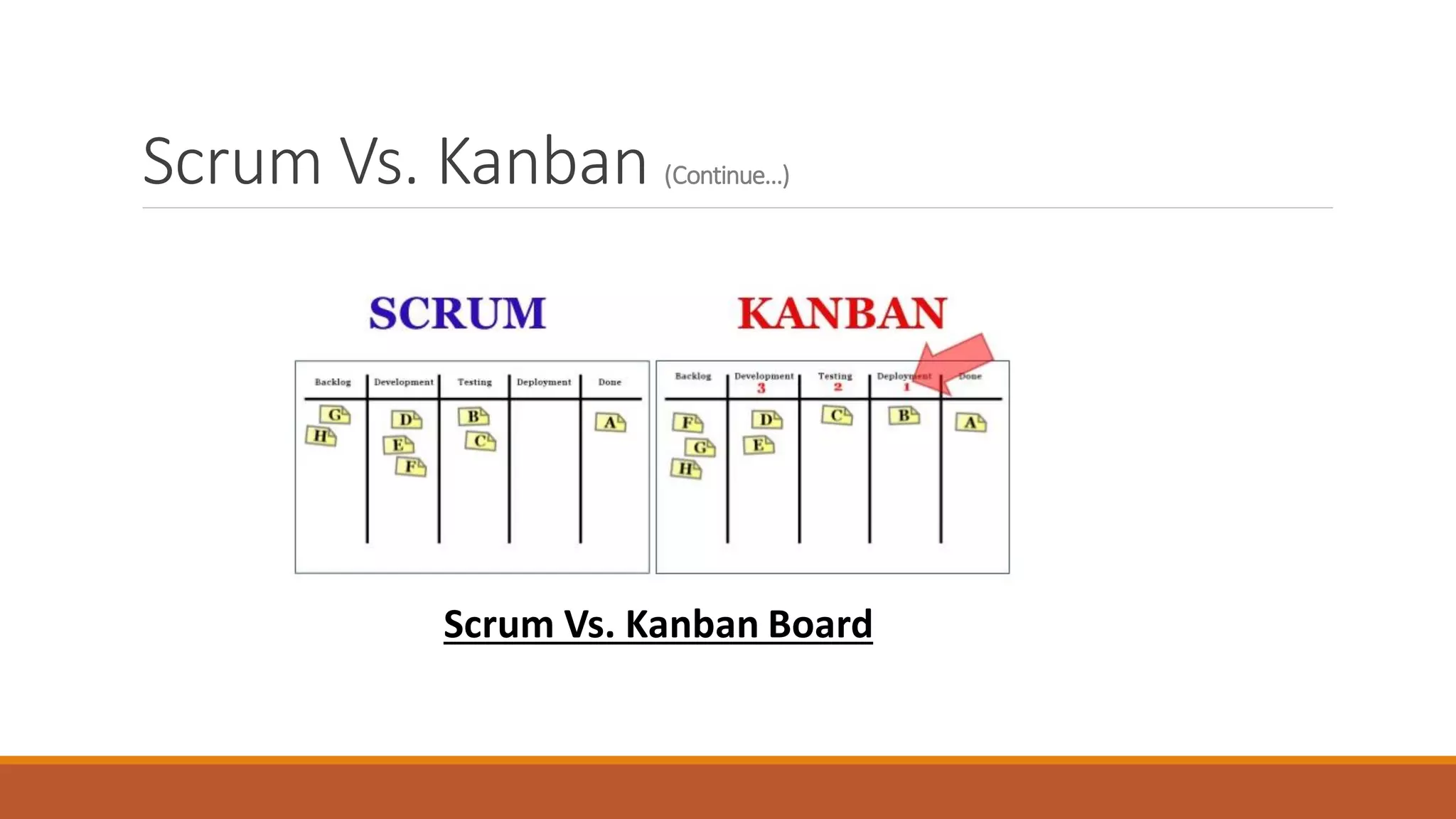
Scrum Vs. Kanban Board
Jaladhikumar Bhatt

Scrum vs Kanban

  • 1.
  • 2.
  • 3.
    What is Scrum? Agile Scrum is one of the leading causes of scope creep because unless there is a definite end date, the project management stakeholders will be tempted to keep demanding that new functionality be delivered. If a task is not well defined, estimating project costs and time will not be accurate.
  • 4.
    Advantage of Scrum 1.Agile scrum helps the company in saving time and money. 2. Scrum methodology enables project’s where the business requirements documentation is hard to quantify to be successfully developed. 3. Fast moving, cutting edge developments can be quickly coded and tested using this method, as a mistake can be easily rectified. 4. It is a lightly controlled method which insists on frequent updating of the progress in work through regular meetings. Thus there is clear visibility of the project development. 5. Like any other agile methodology, this is also iterative in nature. It requires continuous feedback from the user. 6. Due to short sprints and constant feedback, it becomes easier to cope with the changes.
  • 5.
    Advantage of Scrum(Continue…) 7. Daily meetings make it possible to measure individual productivity. This leads to the improvement in the productivity of each of the team members. 8. Issues are identified well in advance through the daily meetings and hence can be resolved in speedily 9. It is easier to deliver a quality product in a scheduled time. 10. Agile Scrum can work with any technology/ programming language but is particularly useful for fast moving web 2.0 or new media projects. 11. The overhead cost in terms of process and management is minimal thus leading to a quicker, cheaper result.
  • 6.
    Disadvantage of Scrum 1.Agile Scrum is one of the leading causes of scope creep because unless there is a definite end date, the project management stakeholders will be tempted to keep demanding that new functionality be delivered. 2. If a task is not well defined, estimating project costs and time will not be accurate. In such a case, the task can be spread over several sprints. 3. If the team members are not committed, the project will either never complete or fail. 4. It is good for small, fast moving projects as it works well only with small team. 5. This methodology needs experienced team members only. If the team consists of people who are novices, the project cannot be completed in time. 6. Scrum works well for project management when the Scrum Master trusts the team they are managing. If they practice too strict control over the team members, it can be extremely frustrating for them, leading to demoralization and the failure of the project.
  • 7.
    Disadvantage of Scrum(Continue…) 7. If any of the team members leave during a development it can have a huge inverse effect on the project development 8. Project quality manager is hard to implement and quantify unless the test team are able to conduct regression testing after each sprint.
  • 8.
  • 9.
    What is Kanban? Kanban is a visual system for managing work as it moves through a process. Kanban visualizes both the process (the workflow) and the actual work passing through that process. The goal of Kanban is to identify potential bottlenecks in your process and fix them so work can flow through it cost-effectively at an optimal speed or throughput. It is a method for managing the creation of products with an emphasis on continual delivery while not overburdening the development team. Like Scrum, Kanban is a process designed to help teams work together more effectively. The method Kanban (large K) was developed in the software sector in 1990 and is applied to: ▪Business productivity improvement ▪Personal productivity improvement
  • 10.
    Advantage of Kanban 1.Optimize inventory and reduce product obsolescence – As it product component parts on requirement/need it required less storage space. If product or designed be upgraded that upgrade can be included in final product as earliest. There is no inventory of products or component that become obsolete. Product design can be upgraded in small increment on a continual basis and those upgrades are immediately incorporated into the product with no waste from obsolete components or parts. 2. Reduces waste and scrap: Products and components are only manufactured when they are needed. This eliminates overproduction. Raw materials are not delivered until they are needed, reducing waste and cutting storage costs. 3. Provide flexibility in production: If there is sudden drop in demand of product, this eliminates excess inventory issues by supportive rapid respond methodology to changing in demand. It also flexible in how our production lines are used. Production areas are not locked in supply chain they quickly switch to different products as demand of various product changes. It imposes limited by the types of machines and equipment and employee skills, however the supply of raw materials and component is eliminated as a bottleneck
  • 11.
    Advantage of Kanban(Continue…) 4. Increate Output : The flow of Kanban (card, bins, pallets etc..) will stop on production problem. This makes problem visible quickly and allowing them to be corrected asap. It reduced wait time by making supplies more accessible and breaking down administrative barrier. This result in an increase in production using the same resources. 5. Reduces Total Cost : It reduces total cost by : Preventing over production, developing flexible work station, Reducing waste and scrap, Minimizing wait time and logistics cost, reducing stock level and overhead costs, saving resources by streamlining production, reducing inventory cost. 6. Improve Flows 7. Prevents overproduction 8. Places control at the operation level 9. Improves responsiveness to change in demand (i.e. Synchronization of supply and demand)
  • 12.
    Disadvantage of Kanban 1.It is less effective in shared-resources situation. 2. Surges in mix or demand clause problems because Kanban assumes stable repetitive production plans. It is less suited to industries where to mix and volumes fluctuate. 3. Kanban in itself doesn’t eliminate variability, so unpredictable and lengthy down times could disrupt the system; poor quality in terms of scrap and rework also affect its good functioning. 4. Kanban systems are not suited for manufacturing environment with short production runs, highly variable product demand, poor quality product and multitude of product types. 5. Breakdown in Kanban system can result in the entire line shutting down. 6. Throughput of Kanban system is not managed but is instead of controlled WIP and known cycle times.
  • 13.
  • 14.
    Scrum Vs. Kanban ScrumKanban Timeboxed iterations prescribed Timeboxed iterations optional. This can have separate cadences for planning, release and process improvement. This can be event-driven instead of timeboxed. Team commits to a specific amount of work for this iteration Commitment optional. User velocity as default metric for planning and process improvement Use Lead time as default metric for planning and process improvement. Items must be broken down so they can be completed within 1 sprint No particular item size is prescribed Burndown chart is prescribed No particular type of diagram is prescribed
  • 15.
    Scrum Vs. Kanban(Continue…) ScrumKanban This can use a sprint burndown report to show the health of sprint. It may use a cumulative flow diagram to report progress Its priorities do not change during a sprint Priorities changes on daily basis. Great for new product or feature development Better suited for tasks that are repetitive such as tasks that most would considered “ Business as Usual” Requires small , dedicated team Team size is not relevant Bottlenecks are not always obvious until your Sprint review or retrospective Bottlenecks are reveled quickly- through visualization
  • 16.
    Scrum Vs. Kanban(Continue…) Scrum Kanban Based on Agile Value Based on Lean values Requirement a change in current processes Reuses your current processes and doesn’t require a massive change in how your team works. Team is required to estimate work Your team is not required to estimate tasks. Velocity is a metric to determine when working software can be delivery to a customer or stakeholder Lead time is a metric to determine when working software can be delivered to a customer or stakeholder Prescribed 3 Roles : Product Manager, Scrum Master and member of Delivery team. Does not have specific or prescribed roles
  • 17.
    Scrum Vs. Kanban(Continue…) Scrum Kanban Specific Roles X Timeboxed Iterations X Accommodate change X Estimation X Empirical X X Lean and Agile X X Limits WIP X X Work can be done simultaneously X X Board is continuously used X
  • 18.
    Scrum Vs. Kanban(Continue…) Scrum Kanban Team must be cross functional X Pull scheduling X X Transparency X X Deliver software early and often X X
  • 19.
    Scrum Vs. Kanban(Continue…) Scrum Vs. Kanban Board
  • 20.