
Copyright © 2017, edureka and/or its affiliates. All rights reserved.
Challenges of Scaling Agile
www.edureka.co
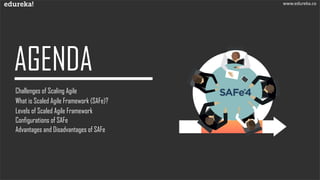
What is Scaled Agile Framework (SAFe)?
Levels of Scaled Agile Framework
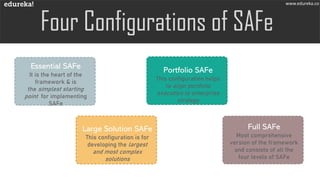
Configurations of SAFe
Advantages and Disadvantages of SAFe
www.edureka.co
www.edureka.co
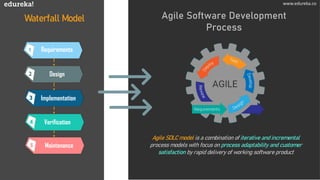
Waterfall Model
Requirements1
Design2
Implementation3
Verification4
Maintenance5
Agile Software Development
Process
Agile SDLC model is a combination of iterative and incremental
process models with focus on process adaptability and customer
satisfaction by rapid delivery of working software product
www.edureka.co
www.edureka.co
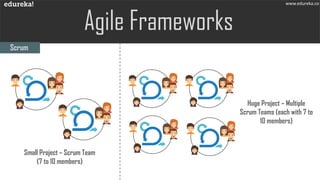
Scrum
Small Project – Scrum Team
(7 to 10 members)
Huge Project – Multiple
Scrum Teams (each with 7 to
10 members)
www.edureka.co
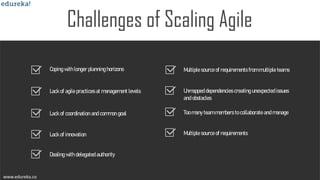
Challenges of Scaling Agile
www.edureka.co
Coping with longer planning horizons
Too many team members to collaborate and manageLack of coordination and common goal
Lack of innovation
Dealing with delegated authority
Unmapped dependencies creating unexpected issues
and obstacles
Multiple source of requirements from multiple teams
Lack of agile practices at management levels
Multiple source of requirements
www.edureka.co
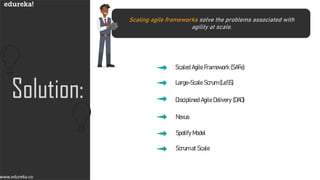
Scaling agile frameworks solve the problems associated with
agility at scale.
www.edureka.co
www.edureka.co
Scaled Agile Framework (SAFe)
Large-Scale Scrum (LeSS)
Disciplined Agile Delivery (DAD)
Nexus
Spotify Model
Scrum at Scale
www.edureka.co
Scaled Agile Framework (SAFe)
www.edureka.co
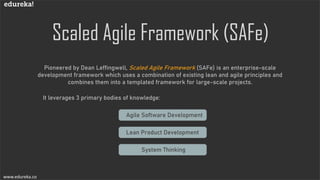
Pioneered by Dean Leffingwell, Scaled Agile Framework (SAFe) is an enterprise-scale
development framework which uses a combination of existing lean and agile principles and
combines them into a templated framework for large-scale projects.
It leverages 3 primary bodies of knowledge:
Agile Software Development
Lean Product Development
System Thinking
Core Values of Scaled Agile
Framework
www.edureka.co
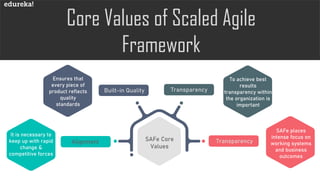
Alignment
Built-in Quality Transparency
Transparency
Ensures that
every piece of
product reflects
quality
standards
It is necessary to
keep up with rapid
change &
competitive forces
To achieve best
results
transparency within
the organization is
important
SAFe places
intense focus on
working systems
and business
outcomes
SAFe Core
Values
SAFe Core
Values
www.edureka.co
SAFe Lean-
Agile
Principles
www.edureka.co
www.edureka.co
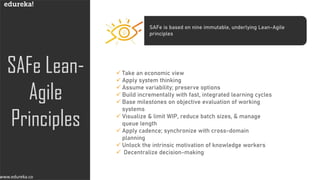
SAFe is based on nine immutable, underlying Lean-Agile
principles
✓ Take an economic view
✓ Apply system thinking
✓ Assume variability; preserve options
✓ Build incrementally with fast, integrated learning cycles
✓ Base milestones on objective evaluation of working
systems
✓ Visualize & limit WIP, reduce batch sizes, & manage
queue length
✓ Apply cadence; synchronize with cross-domain
planning
✓ Unlock the intrinsic motivation of knowledge workers
✓ Decentralize decision-making
www.edureka.co
www.edureka.co
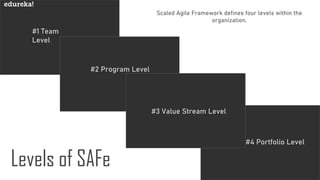
Levels of SAFe
Scaled Agile Framework defines four levels within the
organization.
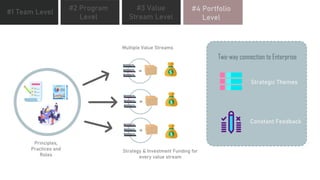
#4 Portfolio Level
#1 Team
Level
#2 Program Level
#3 Value Stream Level
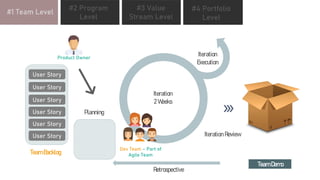
Iteration
2 Weeks
www.edureka.co
#1 Team Level #4 Portfolio
Level
#2 Program
Level
#3 Value
Stream Level
User Story
User Story
User Story
User Story
User Story
User Story
Product Owner
Dev Team – Part of
Agile Team
Planning
Team Backlog
Iteration
Execution
Iteration Review
Retrospective
Team Demo
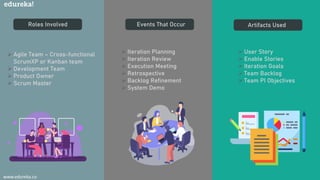
Roles Involved
www.edureka.co
System Thinking
Events That Occur Artifacts Used
➢ Agile Team – Cross-functional
ScrumXP or Kanban team
➢ Development Team
➢ Product Owner
➢ Scrum Master
➢ Iteration Planning
➢ Iteration Review
➢ Execution Meeting
➢ Retrospective
➢ Backlog Refinement
➢ System Demo
➢ User Story
➢ Enable Stories
➢ Iteration Goals
➢ Team Backlog
➢ Team PI Objectives
www.edureka.co
#1 Team Level #4 Portfolio
Level
#2 Program
Level
#3 Value
Stream Level
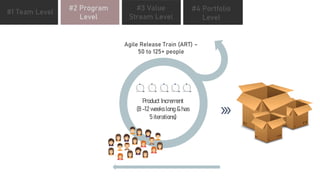
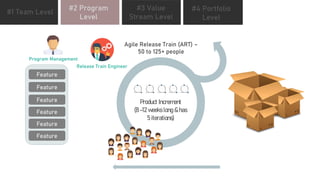
Agile Release Train (ART) –
50 to 125+ people
Product Increment
(8 -12 weeks long & has
5 iterations)
www.edureka.cowww.edureka.co
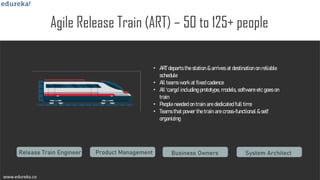
Agile Release Train (ART) – 50 to 125+ people
• ART departs the station & arrives at destination on reliable
schedule
• All teams work at fixed cadence
• All ‘cargo’ including prototype, models, software etc goes on
train
• People needed on train are dedicated full time
• Teams that power the train are cross-functional & self
organizing
Release Train Engineer Product Management Business Owners System Architect
www.edureka.cowww.edureka.co
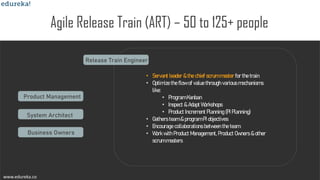
Agile Release Train (ART) – 50 to 125+ people
Product Management
Business Owners
System Architect
• Servant leader & the chief scrum master for the train
• Optimize the flow of value through various mechanisms
like:
• Program Kanban
• Inspect & Adapt Workshops
• Product Increment Planning (PI Planning)
• Gathers team & program PI objectives
• Encourage collaborations between the team
• Work with Product Management, Product Owners & other
scrum masters
Release Train Engineer
www.edureka.cowww.edureka.co
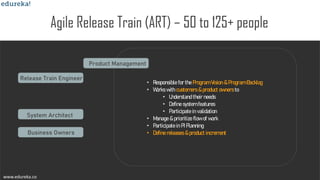
Agile Release Train (ART) – 50 to 125+ people
Business Owners
System Architect
• Responsible for the Program Vision & Program Backlog
• Works with customers & product owners to
• Understand their needs
• Define system features
• Participate in validation
• Manage & prioritize flow of work
• Participate in PI Planning
• Define releases & product increment
Release Train Engineer
Product Management
www.edureka.cowww.edureka.co
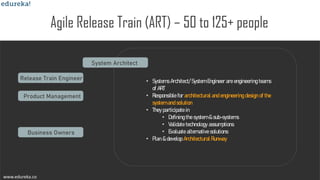
Agile Release Train (ART) – 50 to 125+ people
Business Owners
• Systems Architect/ System Engineer are engineering teams
of ART
• Responsible for architectural and engineering design of the
system and solution
• They participate in
• Defining the system & sub-systems
• Validate technology assumptions
• Evaluate alternative solutions
• Plan & develop Architectural Runway
Release Train Engineer
Product Management
System Architect
www.edureka.cowww.edureka.co
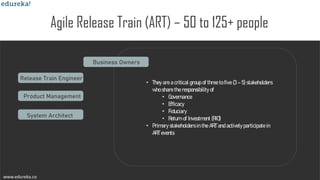
Agile Release Train (ART) – 50 to 125+ people
• They are a critical group of three to five (3 – 5) stakeholders
who share the responsibility of
• Governance
• Efficacy
• Fiduciary
• Return of Investment (RIO)
• Primary stakeholders in the ART and actively participate in
ART events
Release Train Engineer
Product Management
System Architect
Business Owners
www.edureka.co
#1 Team Level #4 Portfolio
Level
#2 Program
Level
#3 Value
Stream Level
Feature
Feature
Feature
Feature
Feature
Feature
Program Management
Agile Release Train (ART) –
50 to 125+ people
Product Increment
(8 -12 weeks long & has
5 iterations)
Release Train Engineer
www.edureka.co
#1 Team Level #4 Portfolio
Level
#2 Program
Level
#3 Value
Stream Level
PM
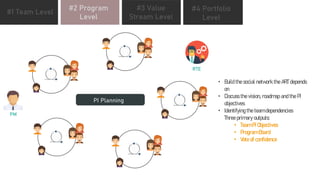
PI Planning
RTE
• Build the social network the ART depends
on
• Discuss the vision, roadmap and the PI
objectives
• Identifying the team dependencies
Three primary outputs:
• Team PI Objectives
• Program Board
• Vote of confidence
www.edureka.co
#1 Team Level #4 Portfolio
Level
#2 Program
Level
#3 Value
Stream Level
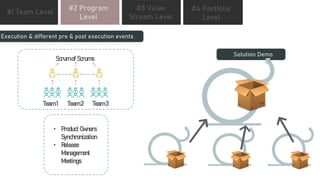
Team 1 Team 2 Team 3
Scrum of Scrums
Execution & different pre & post execution events
• Product Owners
Synchronization
• Release
Management
Meetings
Solution Demo
www.edureka.co
#1 Team Level #4 Portfolio
Level
#2 Program
Level
#3 Value
Stream Level
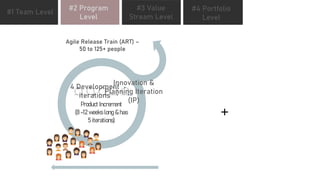
Agile Release Train (ART) –
50 to 125+ people
Product Increment
(8 -12 weeks long & has
5 iterations)
4 Development
iterations
Innovation &
Planning Iteration
(IP)
#1 Team Level #4 Portfolio
Level
#2 Program
Level
#3 Value
Stream Level
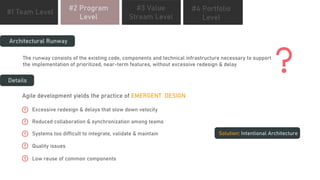
Architectural Runway
The runway consists of the existing code, components and technical infrastructure necessary to support
the implementation of prioritized, near-term features, without excessive redesign & delay
Details
Agile development yields the practice of EMERGENT DESIGN
Excessive redesign & delays that slow down velocity
Reduced collaboration & synchronization among teams
Systems too difficult to integrate, validate & maintain
Quality issues
Low reuse of common components
Solution: Intentional Architecture
www.edureka.co
#1 Team Level #4 Portfolio
Level
#2 Program
Level
#3 Value
Stream Level
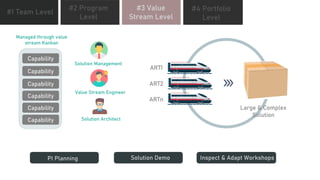
ARTn
Large & Complex
Solution
Solution Management
Value Stream Engineer
Solution Architect
Capability
Capability
Capability
Capability
Capability
Capability
Managed through value
stream Kanban
PI Planning Solution Demo Inspect & Adapt Workshops
ART1
ART2
www.edureka.co
#1 Team Level #4 Portfolio
Level
#2 Program
Level
#3 Value
Stream Level
Multiple Value Streams
Strategy & Investment Funding for
every value stream
Principles,
Practices and
Roles
Two-way connection to Enterprise
Strategic Themes
Constant Feedback
www.edureka.co
www.edureka.co
Essential SAFe
It is the heart of the
framework & is
the simplest starting
point for implementing
SAFe
Large Solution SAFe
This configuration is for
developing the largest
and most complex
solutions
Portfolio SAFe
This configuration helps
to align portfolio
execution to enterprise
strategy
Full SAFe
Most comprehensive
version of the framework
and consists of all the
four levels of SAFe
www.edureka.co
www.edureka.cowww.edureka.co
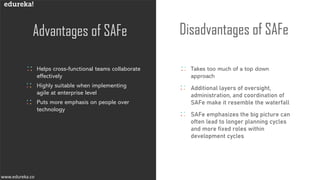
Advantages of SAFe Disadvantages of SAFe
Helps cross-functional teams collaborate
effectively
Highly suitable when implementing
agile at enterprise level
Puts more emphasis on people over
technology
Takes too much of a top down
approach
Additional layers of oversight,
administration, and coordination of
SAFe make it resemble the waterfall
SAFe emphasizes the big picture can
often lead to longer planning cycles
and more fixed roles within
development cycles
Copyright © 2017, edureka and/or its affiliates. All rights reserved.
www.edureka.co
www.edureka.co

What is Scaled Agile Framework | Edureka

  • 1.
    Copyright © 2017,edureka and/or its affiliates. All rights reserved.
  • 2.
    Challenges of ScalingAgile www.edureka.co What is Scaled Agile Framework (SAFe)? Levels of Scaled Agile Framework Configurations of SAFe Advantages and Disadvantages of SAFe
  • 3.
  • 4.
    www.edureka.co Waterfall Model Requirements1 Design2 Implementation3 Verification4 Maintenance5 Agile SoftwareDevelopment Process Agile SDLC model is a combination of iterative and incremental process models with focus on process adaptability and customer satisfaction by rapid delivery of working software product www.edureka.co
  • 5.
    www.edureka.co Scrum Small Project –Scrum Team (7 to 10 members) Huge Project – Multiple Scrum Teams (each with 7 to 10 members)
  • 6.
    www.edureka.co Challenges of ScalingAgile www.edureka.co Coping with longer planning horizons Too many team members to collaborate and manageLack of coordination and common goal Lack of innovation Dealing with delegated authority Unmapped dependencies creating unexpected issues and obstacles Multiple source of requirements from multiple teams Lack of agile practices at management levels Multiple source of requirements
  • 7.
    www.edureka.co Scaling agile frameworkssolve the problems associated with agility at scale. www.edureka.co www.edureka.co Scaled Agile Framework (SAFe) Large-Scale Scrum (LeSS) Disciplined Agile Delivery (DAD) Nexus Spotify Model Scrum at Scale
  • 8.
  • 9.
    Scaled Agile Framework(SAFe) www.edureka.co Pioneered by Dean Leffingwell, Scaled Agile Framework (SAFe) is an enterprise-scale development framework which uses a combination of existing lean and agile principles and combines them into a templated framework for large-scale projects. It leverages 3 primary bodies of knowledge: Agile Software Development Lean Product Development System Thinking
  • 10.
    Core Values ofScaled Agile Framework www.edureka.co Alignment Built-in Quality Transparency Transparency Ensures that every piece of product reflects quality standards It is necessary to keep up with rapid change & competitive forces To achieve best results transparency within the organization is important SAFe places intense focus on working systems and business outcomes SAFe Core Values SAFe Core Values
  • 11.
    www.edureka.co SAFe Lean- Agile Principles www.edureka.co www.edureka.co SAFe isbased on nine immutable, underlying Lean-Agile principles ✓ Take an economic view ✓ Apply system thinking ✓ Assume variability; preserve options ✓ Build incrementally with fast, integrated learning cycles ✓ Base milestones on objective evaluation of working systems ✓ Visualize & limit WIP, reduce batch sizes, & manage queue length ✓ Apply cadence; synchronize with cross-domain planning ✓ Unlock the intrinsic motivation of knowledge workers ✓ Decentralize decision-making
  • 12.
  • 13.
    www.edureka.co Levels of SAFe ScaledAgile Framework defines four levels within the organization. #4 Portfolio Level #1 Team Level #2 Program Level #3 Value Stream Level
  • 14.
    Iteration 2 Weeks www.edureka.co #1 TeamLevel #4 Portfolio Level #2 Program Level #3 Value Stream Level User Story User Story User Story User Story User Story User Story Product Owner Dev Team – Part of Agile Team Planning Team Backlog Iteration Execution Iteration Review Retrospective Team Demo
  • 15.
    Roles Involved www.edureka.co System Thinking EventsThat Occur Artifacts Used ➢ Agile Team – Cross-functional ScrumXP or Kanban team ➢ Development Team ➢ Product Owner ➢ Scrum Master ➢ Iteration Planning ➢ Iteration Review ➢ Execution Meeting ➢ Retrospective ➢ Backlog Refinement ➢ System Demo ➢ User Story ➢ Enable Stories ➢ Iteration Goals ➢ Team Backlog ➢ Team PI Objectives
  • 16.
    www.edureka.co #1 Team Level#4 Portfolio Level #2 Program Level #3 Value Stream Level Agile Release Train (ART) – 50 to 125+ people Product Increment (8 -12 weeks long & has 5 iterations)
  • 17.
    www.edureka.cowww.edureka.co Agile Release Train(ART) – 50 to 125+ people • ART departs the station & arrives at destination on reliable schedule • All teams work at fixed cadence • All ‘cargo’ including prototype, models, software etc goes on train • People needed on train are dedicated full time • Teams that power the train are cross-functional & self organizing Release Train Engineer Product Management Business Owners System Architect
  • 18.
    www.edureka.cowww.edureka.co Agile Release Train(ART) – 50 to 125+ people Product Management Business Owners System Architect • Servant leader & the chief scrum master for the train • Optimize the flow of value through various mechanisms like: • Program Kanban • Inspect & Adapt Workshops • Product Increment Planning (PI Planning) • Gathers team & program PI objectives • Encourage collaborations between the team • Work with Product Management, Product Owners & other scrum masters Release Train Engineer
  • 19.
    www.edureka.cowww.edureka.co Agile Release Train(ART) – 50 to 125+ people Business Owners System Architect • Responsible for the Program Vision & Program Backlog • Works with customers & product owners to • Understand their needs • Define system features • Participate in validation • Manage & prioritize flow of work • Participate in PI Planning • Define releases & product increment Release Train Engineer Product Management
  • 20.
    www.edureka.cowww.edureka.co Agile Release Train(ART) – 50 to 125+ people Business Owners • Systems Architect/ System Engineer are engineering teams of ART • Responsible for architectural and engineering design of the system and solution • They participate in • Defining the system & sub-systems • Validate technology assumptions • Evaluate alternative solutions • Plan & develop Architectural Runway Release Train Engineer Product Management System Architect
  • 21.
    www.edureka.cowww.edureka.co Agile Release Train(ART) – 50 to 125+ people • They are a critical group of three to five (3 – 5) stakeholders who share the responsibility of • Governance • Efficacy • Fiduciary • Return of Investment (RIO) • Primary stakeholders in the ART and actively participate in ART events Release Train Engineer Product Management System Architect Business Owners
  • 22.
    www.edureka.co #1 Team Level#4 Portfolio Level #2 Program Level #3 Value Stream Level Feature Feature Feature Feature Feature Feature Program Management Agile Release Train (ART) – 50 to 125+ people Product Increment (8 -12 weeks long & has 5 iterations) Release Train Engineer
  • 23.
    www.edureka.co #1 Team Level#4 Portfolio Level #2 Program Level #3 Value Stream Level PM PI Planning RTE • Build the social network the ART depends on • Discuss the vision, roadmap and the PI objectives • Identifying the team dependencies Three primary outputs: • Team PI Objectives • Program Board • Vote of confidence
  • 24.
    www.edureka.co #1 Team Level#4 Portfolio Level #2 Program Level #3 Value Stream Level Team 1 Team 2 Team 3 Scrum of Scrums Execution & different pre & post execution events • Product Owners Synchronization • Release Management Meetings Solution Demo
  • 25.
    www.edureka.co #1 Team Level#4 Portfolio Level #2 Program Level #3 Value Stream Level Agile Release Train (ART) – 50 to 125+ people Product Increment (8 -12 weeks long & has 5 iterations) 4 Development iterations Innovation & Planning Iteration (IP)
  • 26.
    #1 Team Level#4 Portfolio Level #2 Program Level #3 Value Stream Level Architectural Runway The runway consists of the existing code, components and technical infrastructure necessary to support the implementation of prioritized, near-term features, without excessive redesign & delay Details Agile development yields the practice of EMERGENT DESIGN Excessive redesign & delays that slow down velocity Reduced collaboration & synchronization among teams Systems too difficult to integrate, validate & maintain Quality issues Low reuse of common components Solution: Intentional Architecture
  • 27.
    www.edureka.co #1 Team Level#4 Portfolio Level #2 Program Level #3 Value Stream Level ARTn Large & Complex Solution Solution Management Value Stream Engineer Solution Architect Capability Capability Capability Capability Capability Capability Managed through value stream Kanban PI Planning Solution Demo Inspect & Adapt Workshops ART1 ART2
  • 28.
    www.edureka.co #1 Team Level#4 Portfolio Level #2 Program Level #3 Value Stream Level Multiple Value Streams Strategy & Investment Funding for every value stream Principles, Practices and Roles Two-way connection to Enterprise Strategic Themes Constant Feedback
  • 29.
  • 30.
    www.edureka.co Essential SAFe It isthe heart of the framework & is the simplest starting point for implementing SAFe Large Solution SAFe This configuration is for developing the largest and most complex solutions Portfolio SAFe This configuration helps to align portfolio execution to enterprise strategy Full SAFe Most comprehensive version of the framework and consists of all the four levels of SAFe
  • 31.
  • 32.
    www.edureka.cowww.edureka.co Advantages of SAFeDisadvantages of SAFe Helps cross-functional teams collaborate effectively Highly suitable when implementing agile at enterprise level Puts more emphasis on people over technology Takes too much of a top down approach Additional layers of oversight, administration, and coordination of SAFe make it resemble the waterfall SAFe emphasizes the big picture can often lead to longer planning cycles and more fixed roles within development cycles
  • 33.
    Copyright © 2017,edureka and/or its affiliates. All rights reserved. www.edureka.co
  • 34.