Multidisciplinary perspectives for knowledge hub projects (multi-tribal context)
Social Capital
Theory
(Putnam)
Collective
Intelligence
&
Innovation
Cultural &
Organisational
Evolution
Social Cognition,
Semantics & Knowledge
Management
Context: How to facilitate
sustaining co-evolution in
heterogenous/tribal networks?
Willi Schroll, Berlin – August 2019
Creative Commons CC BY SA 4.0
Multidisciplinary perspectives for knowledge hub projects (multi-tribal context)
Social Capital
Theory
(Putnam)
Collective
Intelligence
&
Innovation
Cultural &
Organisational
Evolution
Folksonomy
Common Language
Contextuality of
expressions
Knowledge Tribes
Bonding
Bridging
Linking
Create attractors
Meet &
create trust &
interest
Find protégé
Activate next level
resources
Access power structures
Whirlpool of
resources, creativity
Organize open
& safe space
Social Cognition,
Semantics & Knowledge
Management
Evolvability
Taming tensions &
complexity
Communities of
Practice
Connect to new
perspecitves
Connect with „strangers“
Attract with the adventure of
the unique co-evolution journey
Instant benefits of
community/cooperation Embrace difference &
accept divergence
Create consensus &
useful standards
Knowledge flow for
creativity & innovation
Structured Knowledge
Living Knowledge
Cultivate curiosity
Mapping plural
perspectives
Context: How to facilitate
sustaining co-evolution in
heterogenous/tribal networks?
Willi Schroll, Berlin – August 2019
Creative Commons CC BY SA 4.0
Complexity surfing
Appreciation of Wisdom
Learn, facilitate, lead with
evolutionary patience
Next Edge
Connect with pioneers, radicals, misfits
Love the the unknown & sacred
Accept mutants & selection, divorce & death
Reflect selection mode/roles
Multidisciplinary perspectives for knowledge hub projects (multi-tribal context)
Context: How to facilitate
sustaining co-evolution in
heterogenous/tribal networks?
Willi Schroll, Berlin – August 2019
Creative Commons CC BY SA 4.0
Perspectives for innovation and knowledge hub projects (complex,
wicked)
Our global, local and even corporate challenges get more dynamic
and complex. Happily so do our tools and media to design, facilitate
and govern the structures and processes. Many models, theories
and practices from different disciplines are involved.
Truism: You cannot unravel a knot in dimension n in a space of lower
dimension n-1.
Consequence: A successful path might involve at least a handful of
approaches.
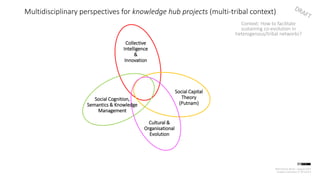
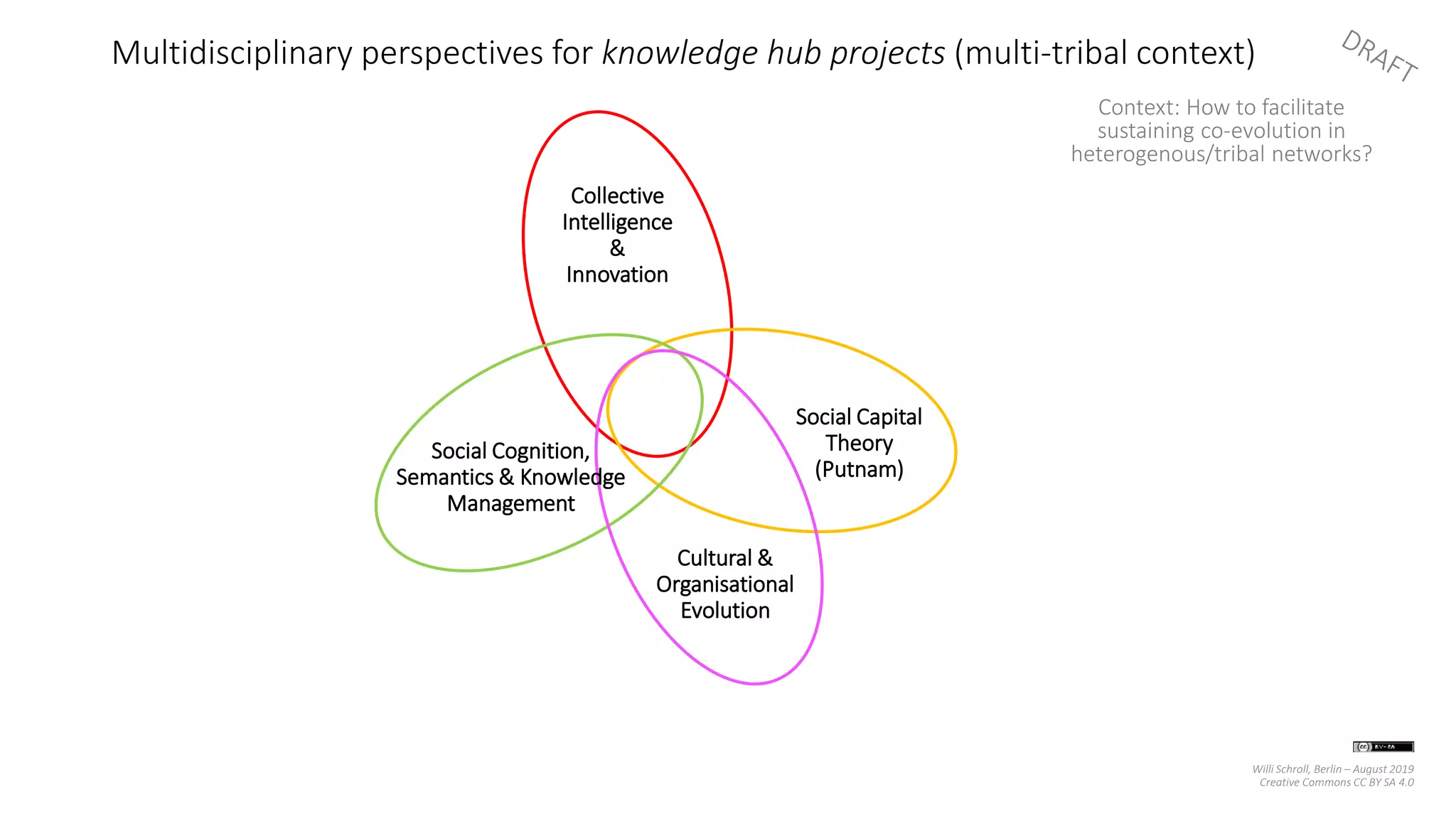
(1) Cultural Evolution, Organisational Development and Evolution
… to have a perspective of progress and the momentum of „learning
from failures“
(2) Social Cognition, Semantics & Knowledge Management
… understanding is at the core, finding a common language is a
must.
(3) Social Capital Theory (Putnam)
… to raise the social and communicative energies of teams and
communities
(4) Collective Intelligence & Social Innovation
… wisdom of crowds, creativity methods, open space approaches,
the Appreciative Inquiry stance etc
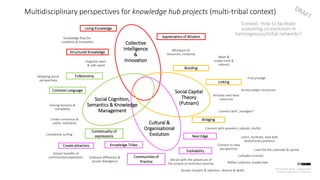
A lot of the steering is about finding common language and
connected perspectives, common goals; accept cultural differences
without the trap of indifference. Putnam’s approach teaches how to
grow dynamics in communities, use active bridging and linking to
create access to new resources.
Culture, values and virtues are key of course. If a certain culture
level is not part of the setting in the beginning they have to be
created, curated and stabilized first.
Evolution allows for disruptions, leaps and surprises, but also
comprises a certain path dependency.
BACKGROUND:
Starting point: Innovation and knowledge management in complex
social settings is tricky and often fails when there is not a good level
of systems thinking involved. That happens for projects in civil
society as well as in corporate settings which strive to facilitate
innovation culture and meaningful conversations.
Kudos to many unnamed, but, esp. to Otto Scharmer (Presencing
Institute, Theory U).

Perspectives for innovation and knowledge hub projects

  • 1.
    Multidisciplinary perspectives forknowledge hub projects (multi-tribal context) Social Capital Theory (Putnam) Collective Intelligence & Innovation Cultural & Organisational Evolution Social Cognition, Semantics & Knowledge Management Context: How to facilitate sustaining co-evolution in heterogenous/tribal networks? Willi Schroll, Berlin – August 2019 Creative Commons CC BY SA 4.0
  • 2.
    Multidisciplinary perspectives forknowledge hub projects (multi-tribal context) Social Capital Theory (Putnam) Collective Intelligence & Innovation Cultural & Organisational Evolution Folksonomy Common Language Contextuality of expressions Knowledge Tribes Bonding Bridging Linking Create attractors Meet & create trust & interest Find protégé Activate next level resources Access power structures Whirlpool of resources, creativity Organize open & safe space Social Cognition, Semantics & Knowledge Management Evolvability Taming tensions & complexity Communities of Practice Connect to new perspecitves Connect with „strangers“ Attract with the adventure of the unique co-evolution journey Instant benefits of community/cooperation Embrace difference & accept divergence Create consensus & useful standards Knowledge flow for creativity & innovation Structured Knowledge Living Knowledge Cultivate curiosity Mapping plural perspectives Context: How to facilitate sustaining co-evolution in heterogenous/tribal networks? Willi Schroll, Berlin – August 2019 Creative Commons CC BY SA 4.0 Complexity surfing Appreciation of Wisdom Learn, facilitate, lead with evolutionary patience Next Edge Connect with pioneers, radicals, misfits Love the the unknown & sacred Accept mutants & selection, divorce & death Reflect selection mode/roles
  • 3.
    Multidisciplinary perspectives forknowledge hub projects (multi-tribal context) Context: How to facilitate sustaining co-evolution in heterogenous/tribal networks? Willi Schroll, Berlin – August 2019 Creative Commons CC BY SA 4.0 Perspectives for innovation and knowledge hub projects (complex, wicked) Our global, local and even corporate challenges get more dynamic and complex. Happily so do our tools and media to design, facilitate and govern the structures and processes. Many models, theories and practices from different disciplines are involved. Truism: You cannot unravel a knot in dimension n in a space of lower dimension n-1. Consequence: A successful path might involve at least a handful of approaches. (1) Cultural Evolution, Organisational Development and Evolution … to have a perspective of progress and the momentum of „learning from failures“ (2) Social Cognition, Semantics & Knowledge Management … understanding is at the core, finding a common language is a must. (3) Social Capital Theory (Putnam) … to raise the social and communicative energies of teams and communities (4) Collective Intelligence & Social Innovation … wisdom of crowds, creativity methods, open space approaches, the Appreciative Inquiry stance etc A lot of the steering is about finding common language and connected perspectives, common goals; accept cultural differences without the trap of indifference. Putnam’s approach teaches how to grow dynamics in communities, use active bridging and linking to create access to new resources. Culture, values and virtues are key of course. If a certain culture level is not part of the setting in the beginning they have to be created, curated and stabilized first. Evolution allows for disruptions, leaps and surprises, but also comprises a certain path dependency. BACKGROUND: Starting point: Innovation and knowledge management in complex social settings is tricky and often fails when there is not a good level of systems thinking involved. That happens for projects in civil society as well as in corporate settings which strive to facilitate innovation culture and meaningful conversations. Kudos to many unnamed, but, esp. to Otto Scharmer (Presencing Institute, Theory U).