The ICT Profile
Rafael Scapin, Ph.D.
Coordinator of Educational Technology
IST Department
Dawson College
• ICT Profile: Definition
• Importance
• How to Implement it
• Questions
Content
The ICT Profile for College Students is a
framework that teachers and colleges can rely
on to help their students develop the
informational, methodological, and technological
skills required.
What is the ICT Profile?
ICT = Information and Communication Technologies
Rare is the college curriculum that does not
involve searching for, processing and presenting
information.
The ICT Profile sets out an approach that allows
these skills to be acquired within a single course
or an entire program.
What is the ICT Profile?
The Dawson Graduate Profile is based upon the outcomes
that were identified in the report College Learning for the
New Global Century issued by the Association of American
Colleges and Universities in 2007.
The report recognized that today’s students will need broad
knowledge, strong intellectual skills and a grounded sense of
ethical and civic responsibility to be able to meet the myriad
challenges of the 21st century with respect to environmental,
global, intercultural, technological and scientific changes.
Dawson Graduate Profile
https://www.dawsoncollege.qc.ca/strategic-plan/the-dawson-graduate-profile/
The Graduate Profile builds on and expands program
competencies and can be viewed as cross-curricular in
that all students, regardless of the program in which they
are enrolled, should develop these outcomes. These
outcomes are integrated and supported extensively
throughout the curriculum and outside of the curriculum
through a deliberate and systematic approach.
Dawson Graduate Profile
https://www.dawsoncollege.qc.ca/strategic-plan/the-dawson-graduate-profile/
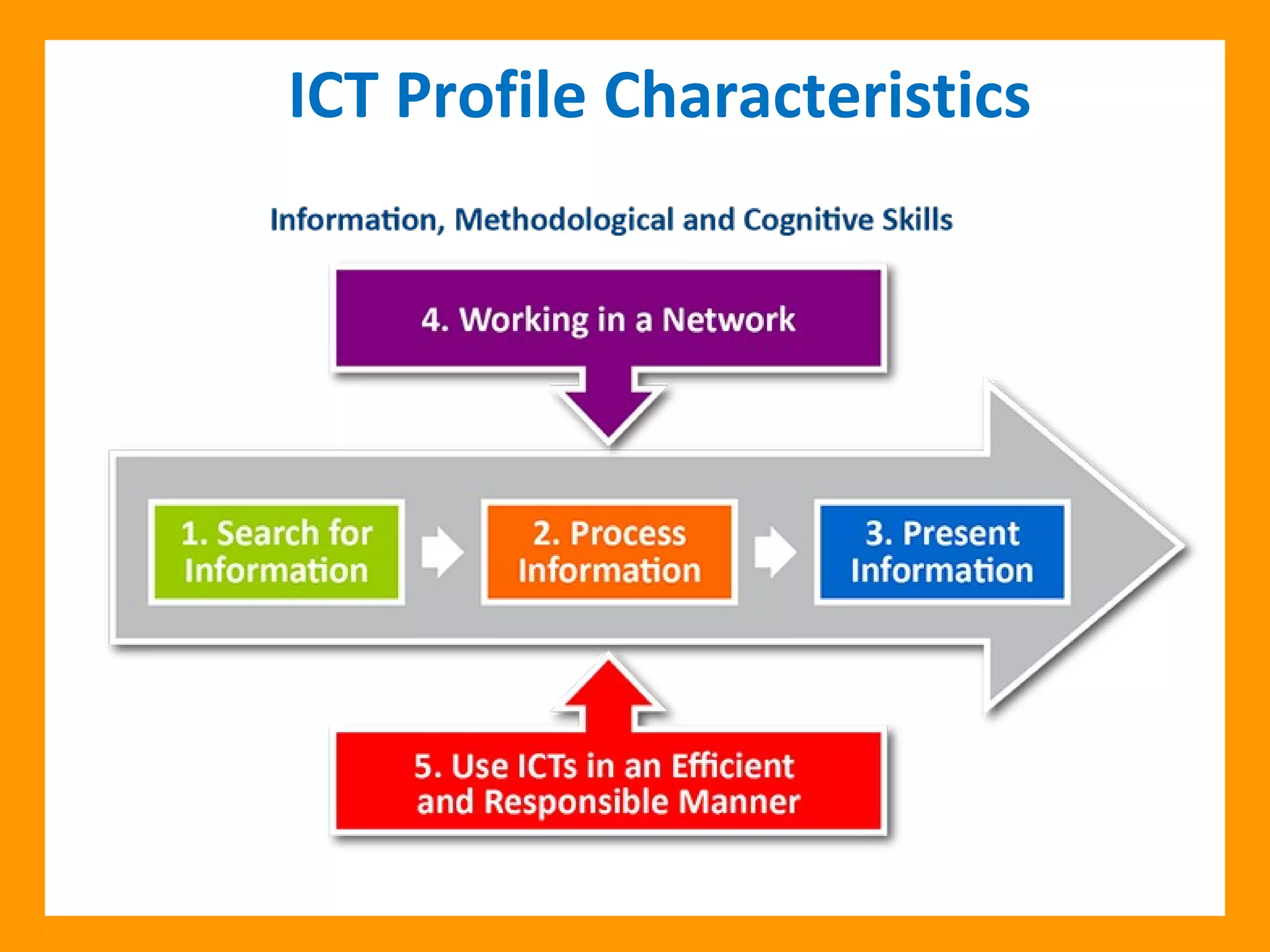
It consists of five skills. Each skill has
defined objectives that involve tasks to be
accomplished. It therefore presents a three-level
structure of elements.
Universal, it can be adapted to all programs and
to all colleges.
ICT Profile Characteristics
Relevance for Students
Prepares students for the labour market, university
and for a digital society
Information and technological skills required for:
All technical or career programs: biological,
physical, social, business, arts areas
All pre-university programs: Social Sciences,
Sciences, Arts, Literature and Communications, etc.
ICT Profile Characteristics
An ICT Profile for students:
All programs that put forward a cognitive and
methodological approach (knowledge, skills, soft
skills)
Options within the programs using software
applications in order to master a skill
More flexible and simplified structure
Long-term, independent of technological change
lt targets all students, including those with
disabilities.
Its logic is similar to “Universal Design for
Learning” (UDL), which aims to develop
pedagogical skills for all learners.
It offers the help needed to acquire technological
skills to support the mastering of high-level skills,
whether informational, methodological or
cognitive.
ICT Profile Characteristics
It gives teachers in programs flexibility when it
comes to choosing software applications and the
right digital environment to use for mastering a
skill.
Because it is independent from technological
changes, its relevancy will last longer.
ICT Profile Characteristics
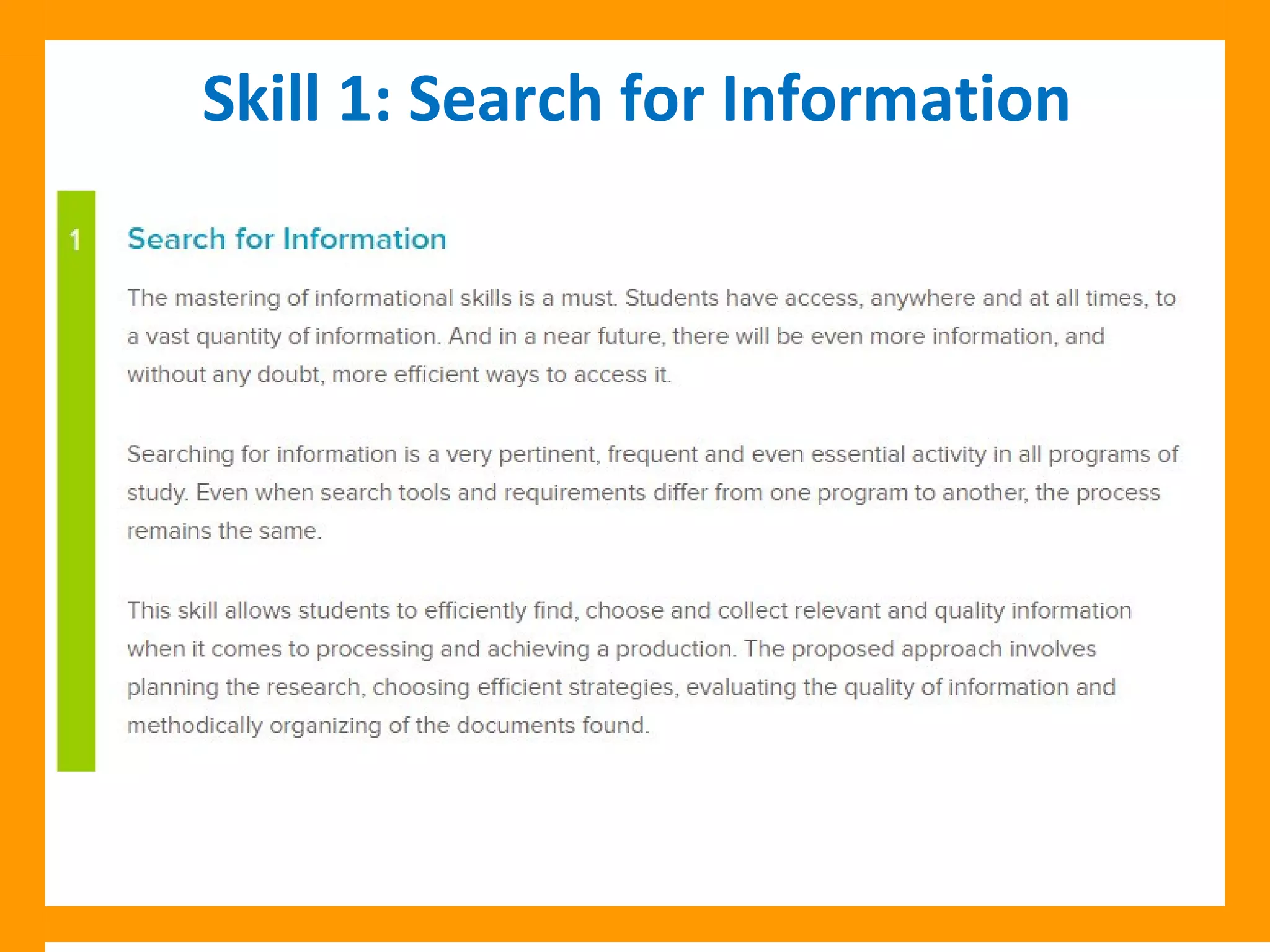
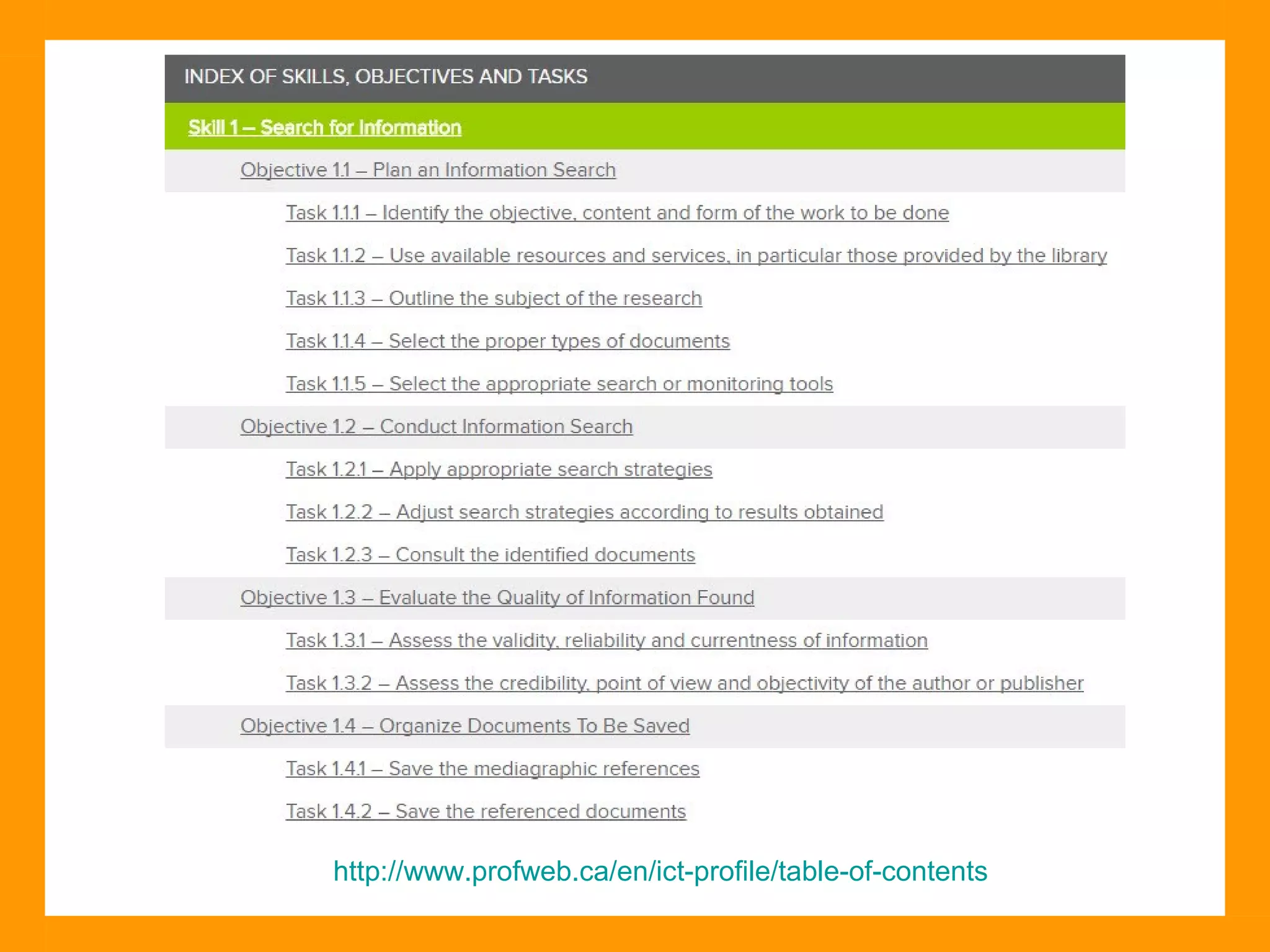
Skill 1: Search for Information
http://www.profweb.ca/en/ict-profile/search-for-information
Skill 1: Search for Information
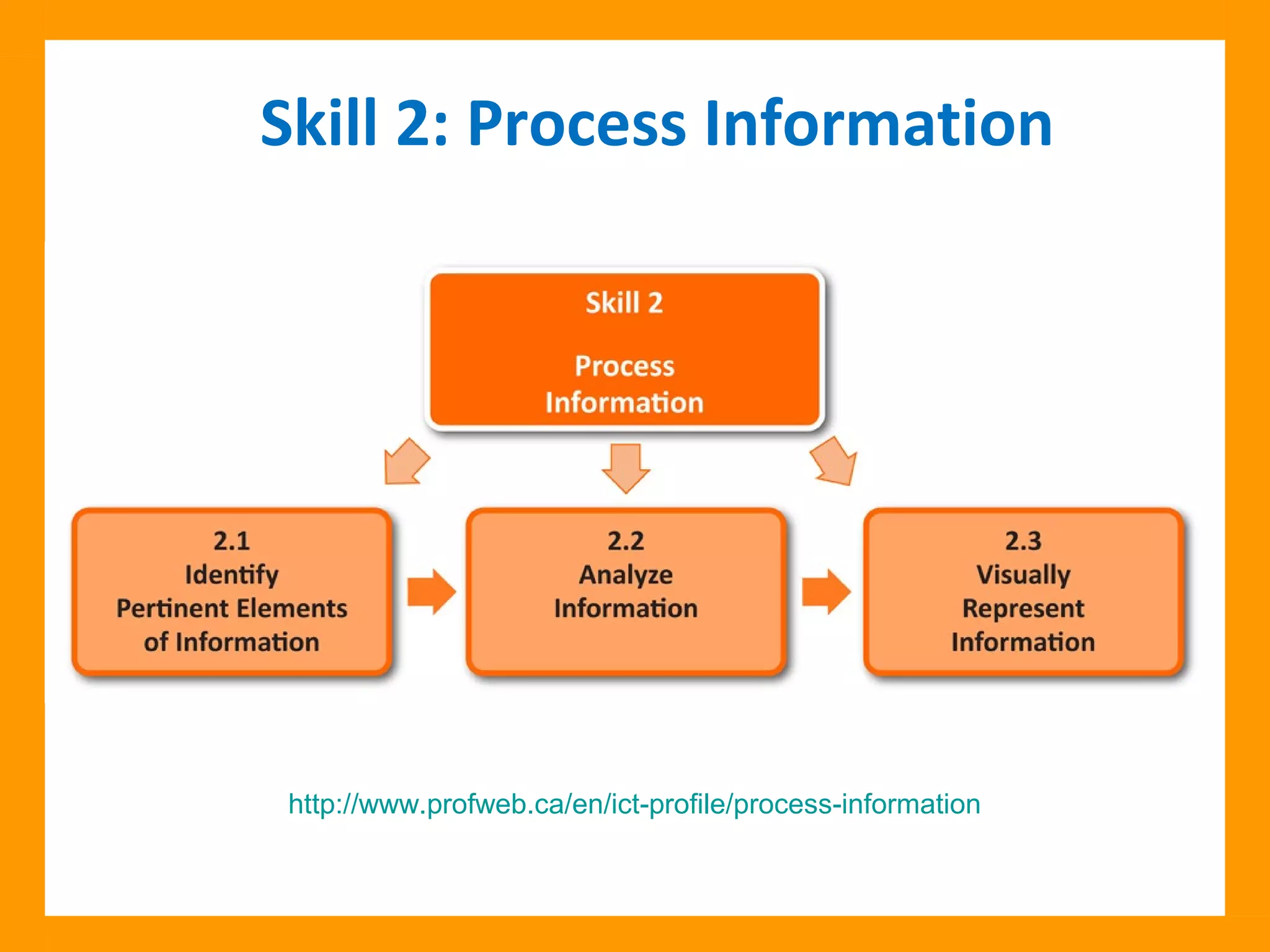
Skill 2: Process Information
http://www.profweb.ca/en/ict-profile/process-information
Skill 2: Process Information
Skill 3: Present Information
http://www.profweb.ca/en/ict-profile/present-information
Skill 3: Present Information
Skill 4: Working in a Network
http://www.profweb.ca/en/ict-profile/working-in-a-network
Skill 4: Working in a Network
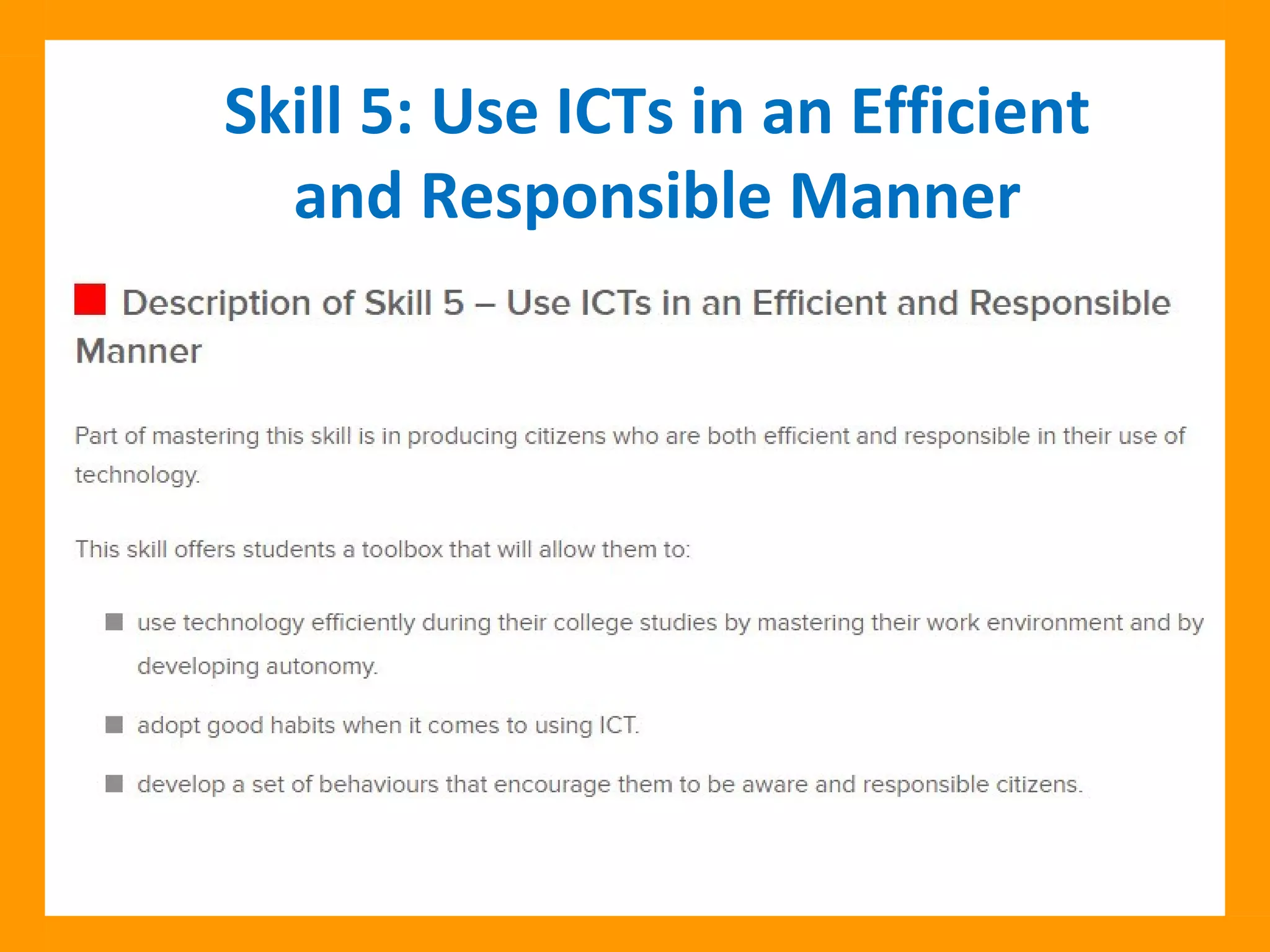
Skill 5: Use ICTs in an Efficient
and Responsible Manner
http://www.profweb.ca/en/ict-profile/use-icts-in-an-efficient-and-responsible-manner
Skill 5: Use ICTs in an Efficient
and Responsible Manner
This skill offers students a toolbox that will allow them to:
•use technology efficiently during their college studies by mastering their work
environment and by developing autonomy.
•adopt good habits when it comes to using ICT.
•develop a set of behaviours that encourage them to be aware and responsible citizens.
http://www.profweb.ca/en/ict-profile/table-of-contents
SKILL 2
Process
Information
SKILL 2
Process
Information
Task 2.3.2
Choose the type and appropriate
tools of representation
Task 2.3.2
Choose the type and appropriate
tools of representation
involves
OBJECTIVE 2.3
Structure the Information
OBJECTIVE 2.3
Structure the Information
involves
Concept
plan
Concept
planTableTable GraphGraph PlanPlan Other...Other...
can be in the form of
Concept
map
Concept
map
Spreadshee
t
Spreadshee
t
Word
processing
Word
processing
Other...Other...
with (as
required)
SKILL 3
Present Information
SKILL 3
Present Information
OBJECTIVE 3.2
Carry out the Production
OBJECTIVE 3.2
Carry out the Production
involves
Task 3.2.2
Integrate the content
elements into the production
Task 3.2.2
Integrate the content
elements into the production
involves
AnimationAnimationTableTable SoundSound ClipartClipart Other...Other...
can be in the form of
TextText
BlogBlogWord
processing
Word
processing Slide showSlide show Other...Other...
Included in
VideoVideo
https://www.youtube.com/user/ICTprofile/videos
ICT Profile Youtube Channel
https://youtu.be/ojP0FApgYa4
Why the ICT Profile?
Digital Skills
Technical
Skills
Cognitives
Skills
Collaborative
Skills
Digital Skills
Higher Education
Citizenship Labour Market
Eucalyp from Flaticon (Creative Commons BY 3.0)
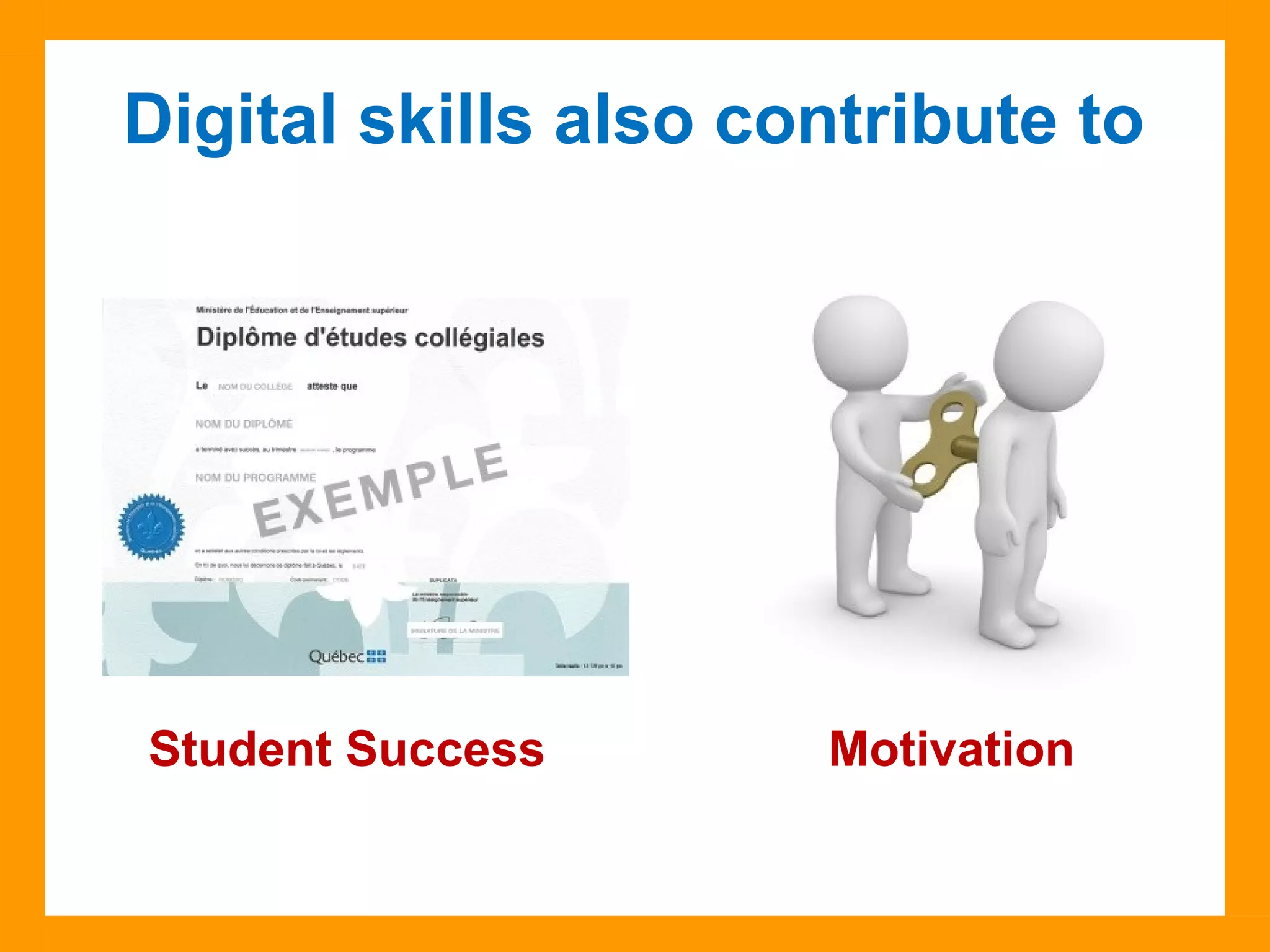
Digital skills also contribute to
Student Success Motivation
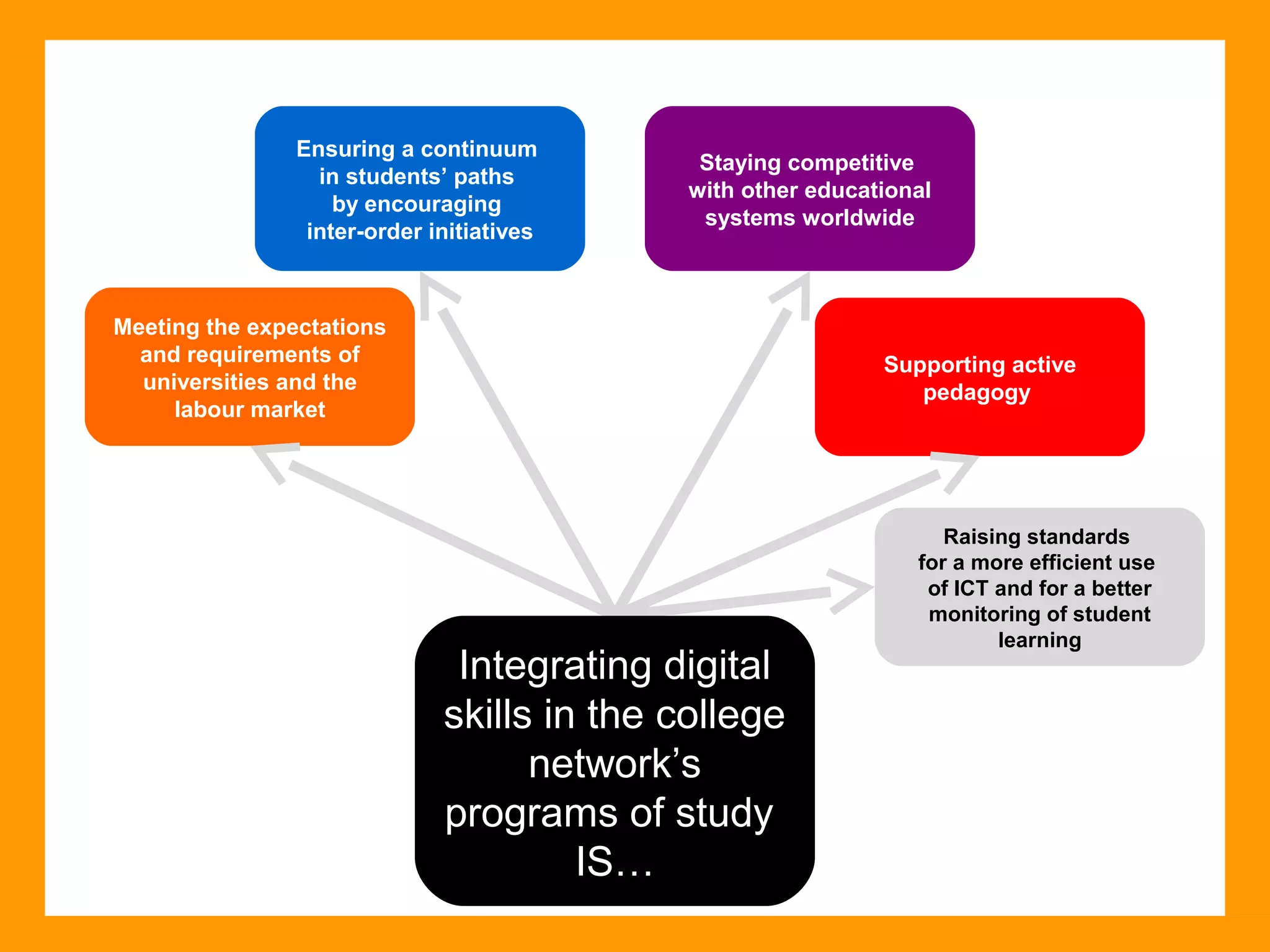
Meeting the expectations
and requirements of
universities and the
labour market
Ensuring a continuum
in students’ paths
by encouraging
inter-order initiatives
Staying competitive
with other educational
systems worldwide
Supporting active
pedagogy
Raising standards
for a more efficient use
of ICT and for a better
monitoring of student
learning
Integrating digital
skills in the college
network’s
programs of study
IS…
SEARCH FOR
INFORMATION
SEARCH FOR
INFORMATION
PROCESS
INFORMATION
PROCESS
INFORMATION
PRESENT
INFORMATION
PRESENT
INFORMATION
WORKING IN A NETWORKWORKING IN A NETWORK
USE ICTs IN AN EFFICIENT
AND REPONSIBLE MANNER
USE ICTs IN AN EFFICIENT
AND REPONSIBLE MANNER
Supporting the Mastering of Digital Skills
ICTProfile.ca [En]
ProfilTIC.ca [Fr]
Recognizing the Mastering of Digital Skills
The Recognition of Acquired Competencies
(RAC) process provides individuals with the
opportunity to have their experience and
competencies acquired in the workplace, recognized
and accredited.
https://www.dawsoncollege.qc.ca/recognition-of-acquired-competencies/
Integrating Digital Technology in Classrooms for:
Source: Collège Montmorency
• Collaborative learning
• Worldwide connections
• Higher-level learning
• Communication
Eucalyp from Flaticon (Creative Commons BY 3.0)
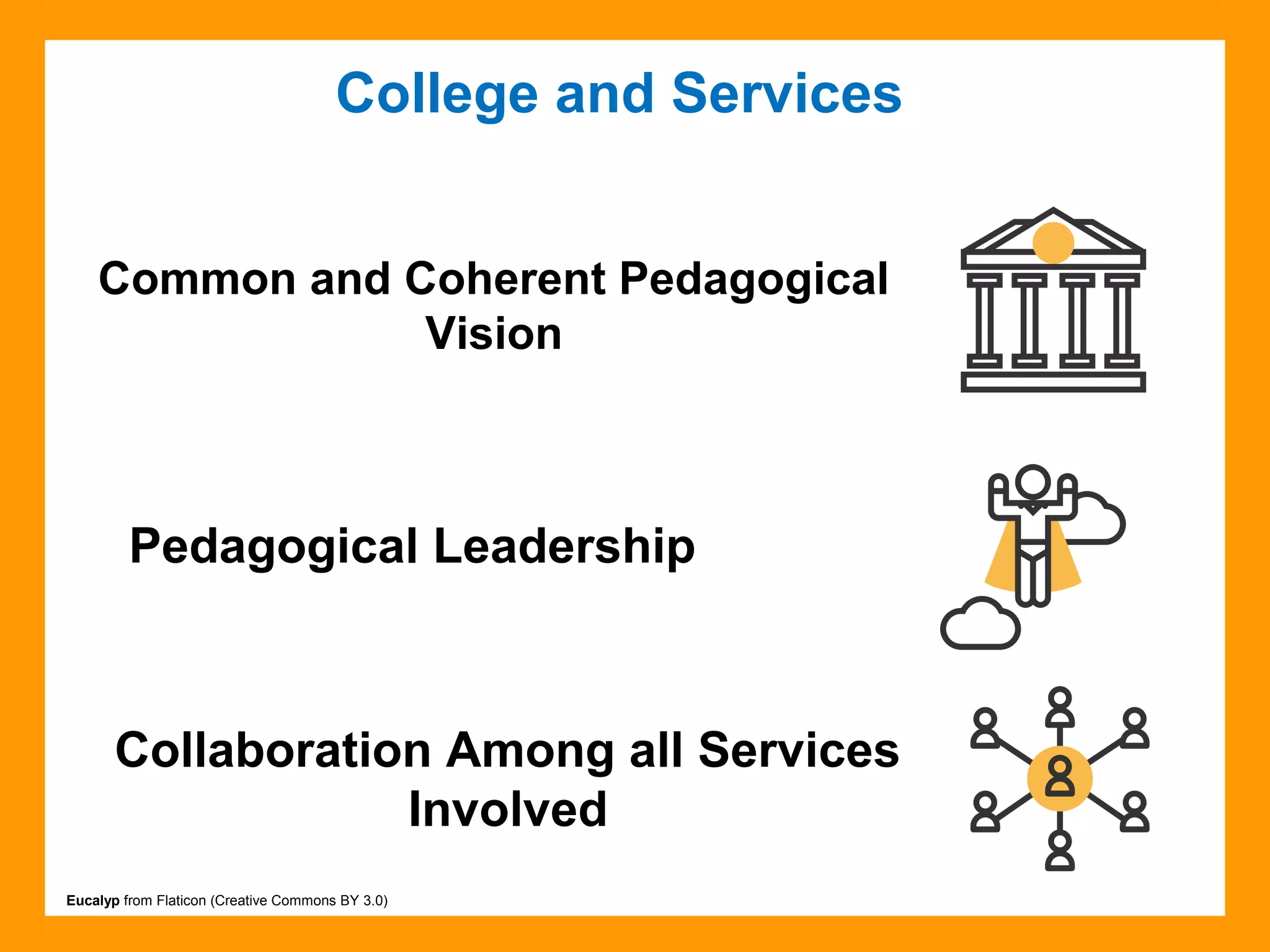
College and Services
Source: Collège Montmorency
Eucalyp from Flaticon (Creative Commons BY 3.0)
Pedagogical Leadership
Collaboration Among all Services
Involved
Common and Coherent Pedagogical
Vision
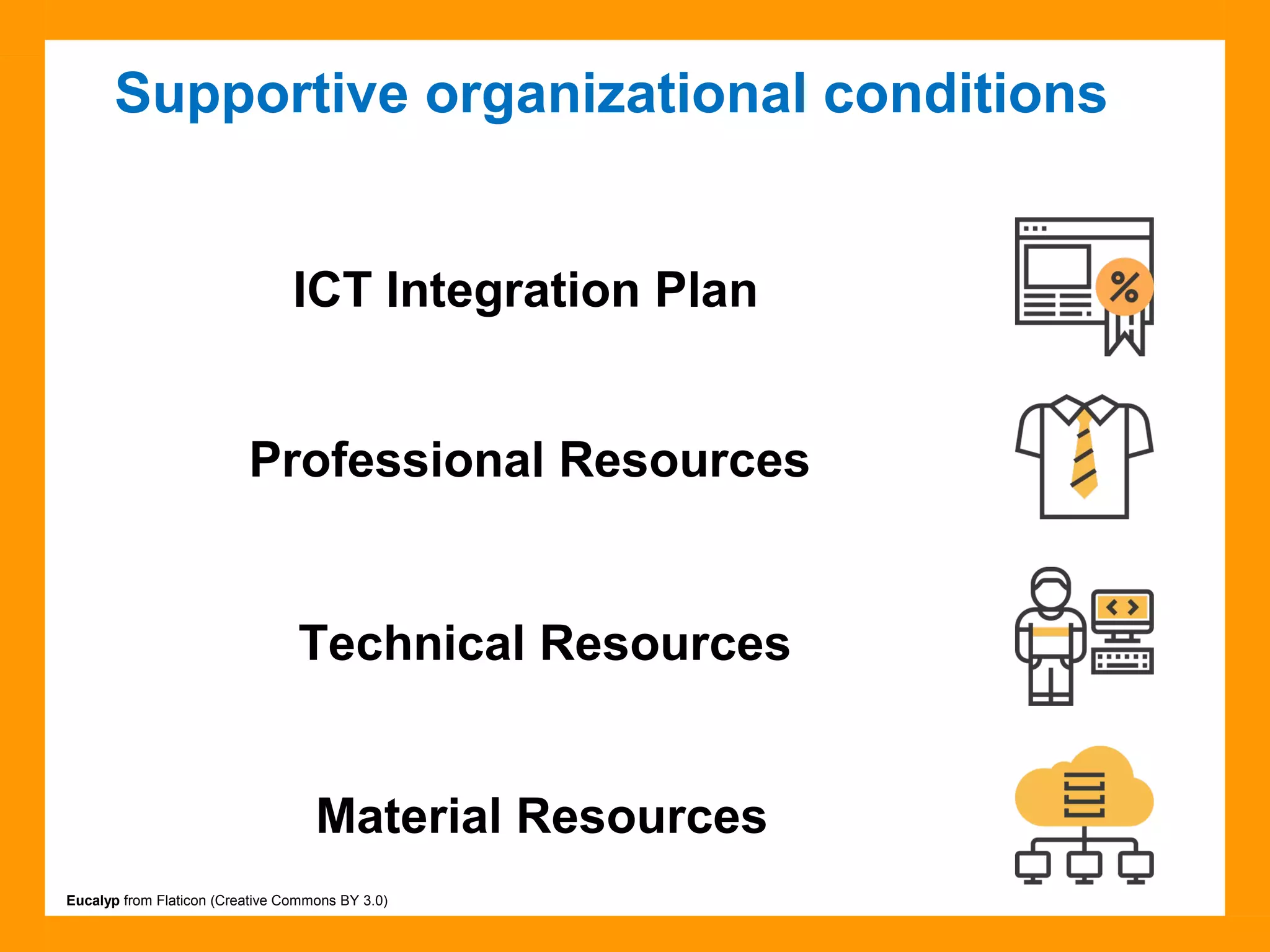
Supportive organizational conditions
Source: Collège Montmorency
Eucalyp from Flaticon (Creative Commons BY 3.0)
ICT Integration Plan
Professional Resources
Technical Resources
Material Resources
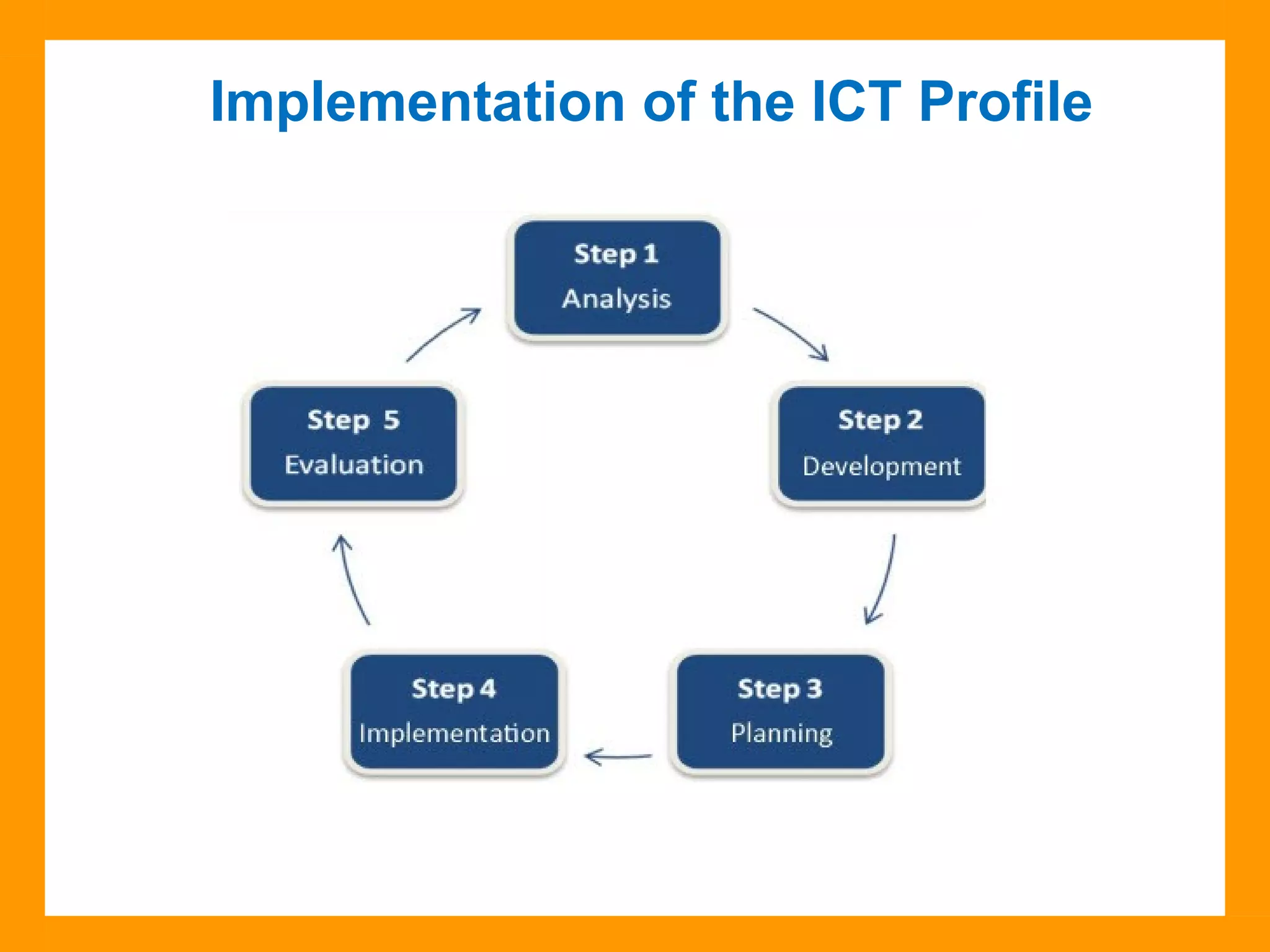
Implementation of the ICT Profile
Source: Collège Montmorency
Implementation of the ICT Profile
Source: Collège Montmorency
To fully integrate the ICT profile in a curriculum, it is
essential to have the willingness of a college’s director
and its teachers.
As well, IT-REP/RepTIC Network studies show that the
ICT pedagogical advisor plays an important role in
effectively guiding the work.
Implementation of the ICT Profile in a Curriculum
Source: Collège Montmorency
Teachers:
The teacher works in conjunction with the ICT
pedagogical advisor and the ICT subcommittee in the
targeted program, developing a plan for integrating the
ICT profile in the curriculum.
He is involved in producing the integration plan and,
together with the ICT pedagogical advisor, submitting it
to various groups and boards for review or approval.
Implementation of the ICT Profile in a Curriculum
Source: Collège Montmorency
ICT subcommittee:
A subcommittee may be formed by the home
department of the teacher who is granted release time.
The department selects the members; it is
recommended that members be selected according to
the disciplines in a program of study. The committee
assists the teacher given release time as well as the
ICT pedagogical advisor.
It participates in and guides the development of a plan
for integrating the ICT profile.
Implementation of the ICT Profile in a Curriculum
Source: Collège Montmorency
ICT pedagogical advisor:
The ICT pedagogical advisor counsels, facilitates,
supports and gives feedback to senior cadres
responsible for educational services, to teachers, and
to other professionals.
He or she contributes to the development,
implementation and monitoring of the ICT profile
integration plan.
Implementation of the ICT Profile in a Curriculum
Source: Collège Montmorency
Department:
The department is involved in approving the program
ICT Profile and gives its opinion on the ICT integration
plan.
Teachers in the department participate in some work
related to educational activities involving ICT.
Implementation of the ICT Profile in a Curriculum
Source: Collège Montmorency
Program committee:
The program committee reviews the proposal for
integrating the ICT profile and approves the final
version.
The plan is then presented to the director, who in turn
submits it to the board in accordance with the college’s
current procedures.
Sources
Source: Collège Montmorency
ICT Profile Website: http://www.ictprofile.ca
Guide : Integrating the ICT Profile for College Students into a Program
Normand Kevin Aubin, M.Sc., ICT pedagogical advisor (2016)
2014 Edition of the ICT Profile for College Students: A Cognitive
Approach First!
Nicole Perreault, Réseau REPTIC In collaboration with Huguette Dupont,
Cégep de Granby
Questions
rscapin@dawsoncollege.qc.ca
Contact Me
Rafael Scapin, Ph.D.
Book an Appointment
http://rscapin.youcanbook.me
1404
The ICT Profile

The ICT Profile

  • 1.
    The ICT Profile RafaelScapin, Ph.D. Coordinator of Educational Technology IST Department Dawson College
  • 2.
    • ICT Profile:Definition • Importance • How to Implement it • Questions Content
  • 3.
    The ICT Profilefor College Students is a framework that teachers and colleges can rely on to help their students develop the informational, methodological, and technological skills required. What is the ICT Profile? ICT = Information and Communication Technologies
  • 4.
    Rare is thecollege curriculum that does not involve searching for, processing and presenting information. The ICT Profile sets out an approach that allows these skills to be acquired within a single course or an entire program. What is the ICT Profile?
  • 5.
    The Dawson GraduateProfile is based upon the outcomes that were identified in the report College Learning for the New Global Century issued by the Association of American Colleges and Universities in 2007. The report recognized that today’s students will need broad knowledge, strong intellectual skills and a grounded sense of ethical and civic responsibility to be able to meet the myriad challenges of the 21st century with respect to environmental, global, intercultural, technological and scientific changes. Dawson Graduate Profile https://www.dawsoncollege.qc.ca/strategic-plan/the-dawson-graduate-profile/
  • 6.
    The Graduate Profilebuilds on and expands program competencies and can be viewed as cross-curricular in that all students, regardless of the program in which they are enrolled, should develop these outcomes. These outcomes are integrated and supported extensively throughout the curriculum and outside of the curriculum through a deliberate and systematic approach. Dawson Graduate Profile https://www.dawsoncollege.qc.ca/strategic-plan/the-dawson-graduate-profile/
  • 7.
    It consists offive skills. Each skill has defined objectives that involve tasks to be accomplished. It therefore presents a three-level structure of elements. Universal, it can be adapted to all programs and to all colleges. ICT Profile Characteristics
  • 8.
    Relevance for Students Preparesstudents for the labour market, university and for a digital society Information and technological skills required for: All technical or career programs: biological, physical, social, business, arts areas All pre-university programs: Social Sciences, Sciences, Arts, Literature and Communications, etc.
  • 9.
  • 10.
    ICT Profile Characteristics AnICT Profile for students: All programs that put forward a cognitive and methodological approach (knowledge, skills, soft skills) Options within the programs using software applications in order to master a skill More flexible and simplified structure Long-term, independent of technological change
  • 11.
    lt targets allstudents, including those with disabilities. Its logic is similar to “Universal Design for Learning” (UDL), which aims to develop pedagogical skills for all learners. It offers the help needed to acquire technological skills to support the mastering of high-level skills, whether informational, methodological or cognitive. ICT Profile Characteristics
  • 12.
    It gives teachersin programs flexibility when it comes to choosing software applications and the right digital environment to use for mastering a skill. Because it is independent from technological changes, its relevancy will last longer. ICT Profile Characteristics
  • 13.
    Skill 1: Searchfor Information
  • 14.
  • 15.
    Skill 2: ProcessInformation
  • 16.
  • 17.
    Skill 3: PresentInformation
  • 18.
  • 19.
    Skill 4: Workingin a Network
  • 20.
  • 21.
    Skill 5: UseICTs in an Efficient and Responsible Manner
  • 22.
    http://www.profweb.ca/en/ict-profile/use-icts-in-an-efficient-and-responsible-manner Skill 5: UseICTs in an Efficient and Responsible Manner This skill offers students a toolbox that will allow them to: •use technology efficiently during their college studies by mastering their work environment and by developing autonomy. •adopt good habits when it comes to using ICT. •develop a set of behaviours that encourage them to be aware and responsible citizens.
  • 23.
  • 24.
    SKILL 2 Process Information SKILL 2 Process Information Task2.3.2 Choose the type and appropriate tools of representation Task 2.3.2 Choose the type and appropriate tools of representation involves OBJECTIVE 2.3 Structure the Information OBJECTIVE 2.3 Structure the Information involves Concept plan Concept planTableTable GraphGraph PlanPlan Other...Other... can be in the form of Concept map Concept map Spreadshee t Spreadshee t Word processing Word processing Other...Other... with (as required)
  • 25.
    SKILL 3 Present Information SKILL3 Present Information OBJECTIVE 3.2 Carry out the Production OBJECTIVE 3.2 Carry out the Production involves Task 3.2.2 Integrate the content elements into the production Task 3.2.2 Integrate the content elements into the production involves AnimationAnimationTableTable SoundSound ClipartClipart Other...Other... can be in the form of TextText BlogBlogWord processing Word processing Slide showSlide show Other...Other... Included in VideoVideo
  • 26.
  • 27.
  • 28.
  • 29.
    Digital Skills Higher Education CitizenshipLabour Market Eucalyp from Flaticon (Creative Commons BY 3.0)
  • 30.
    Digital skills alsocontribute to Student Success Motivation
  • 31.
    Meeting the expectations andrequirements of universities and the labour market Ensuring a continuum in students’ paths by encouraging inter-order initiatives Staying competitive with other educational systems worldwide Supporting active pedagogy Raising standards for a more efficient use of ICT and for a better monitoring of student learning Integrating digital skills in the college network’s programs of study IS…
  • 32.
    SEARCH FOR INFORMATION SEARCH FOR INFORMATION PROCESS INFORMATION PROCESS INFORMATION PRESENT INFORMATION PRESENT INFORMATION WORKINGIN A NETWORKWORKING IN A NETWORK USE ICTs IN AN EFFICIENT AND REPONSIBLE MANNER USE ICTs IN AN EFFICIENT AND REPONSIBLE MANNER
  • 33.
    Supporting the Masteringof Digital Skills ICTProfile.ca [En] ProfilTIC.ca [Fr]
  • 34.
    Recognizing the Masteringof Digital Skills The Recognition of Acquired Competencies (RAC) process provides individuals with the opportunity to have their experience and competencies acquired in the workplace, recognized and accredited. https://www.dawsoncollege.qc.ca/recognition-of-acquired-competencies/
  • 35.
    Integrating Digital Technologyin Classrooms for: Source: Collège Montmorency • Collaborative learning • Worldwide connections • Higher-level learning • Communication Eucalyp from Flaticon (Creative Commons BY 3.0)
  • 36.
    College and Services Source:Collège Montmorency Eucalyp from Flaticon (Creative Commons BY 3.0) Pedagogical Leadership Collaboration Among all Services Involved Common and Coherent Pedagogical Vision
  • 37.
    Supportive organizational conditions Source:Collège Montmorency Eucalyp from Flaticon (Creative Commons BY 3.0) ICT Integration Plan Professional Resources Technical Resources Material Resources
  • 38.
    Implementation of theICT Profile Source: Collège Montmorency
  • 39.
    Implementation of theICT Profile Source: Collège Montmorency To fully integrate the ICT profile in a curriculum, it is essential to have the willingness of a college’s director and its teachers. As well, IT-REP/RepTIC Network studies show that the ICT pedagogical advisor plays an important role in effectively guiding the work.
  • 40.
    Implementation of theICT Profile in a Curriculum Source: Collège Montmorency Teachers: The teacher works in conjunction with the ICT pedagogical advisor and the ICT subcommittee in the targeted program, developing a plan for integrating the ICT profile in the curriculum. He is involved in producing the integration plan and, together with the ICT pedagogical advisor, submitting it to various groups and boards for review or approval.
  • 41.
    Implementation of theICT Profile in a Curriculum Source: Collège Montmorency ICT subcommittee: A subcommittee may be formed by the home department of the teacher who is granted release time. The department selects the members; it is recommended that members be selected according to the disciplines in a program of study. The committee assists the teacher given release time as well as the ICT pedagogical advisor. It participates in and guides the development of a plan for integrating the ICT profile.
  • 42.
    Implementation of theICT Profile in a Curriculum Source: Collège Montmorency ICT pedagogical advisor: The ICT pedagogical advisor counsels, facilitates, supports and gives feedback to senior cadres responsible for educational services, to teachers, and to other professionals. He or she contributes to the development, implementation and monitoring of the ICT profile integration plan.
  • 43.
    Implementation of theICT Profile in a Curriculum Source: Collège Montmorency Department: The department is involved in approving the program ICT Profile and gives its opinion on the ICT integration plan. Teachers in the department participate in some work related to educational activities involving ICT.
  • 44.
    Implementation of theICT Profile in a Curriculum Source: Collège Montmorency Program committee: The program committee reviews the proposal for integrating the ICT profile and approves the final version. The plan is then presented to the director, who in turn submits it to the board in accordance with the college’s current procedures.
  • 45.
    Sources Source: Collège Montmorency ICTProfile Website: http://www.ictprofile.ca Guide : Integrating the ICT Profile for College Students into a Program Normand Kevin Aubin, M.Sc., ICT pedagogical advisor (2016) 2014 Edition of the ICT Profile for College Students: A Cognitive Approach First! Nicole Perreault, Réseau REPTIC In collaboration with Huguette Dupont, Cégep de Granby
  • 46.
  • 47.
    rscapin@dawsoncollege.qc.ca Contact Me Rafael Scapin,Ph.D. Book an Appointment http://rscapin.youcanbook.me 1404

Editor's Notes

  • #25 Prenons par exemple l’habileté 2 « Traiter l’information > Structurer l’information > Choisir le type de représentation et l’outil appropriés ». La démarche cognitive est analogue selon que l’on étudie en Arts plastiques, en Sciences de la nature ou en Techniques de travail social. Toutefois, comme la nature de l’information à analyser est souvent différente d’un programme à l’autre, le choix d’applications logicielles à utiliser pourra varier d’un programme d’études à l’autre.
  • #26 Même chose pour l’habileté 3 Traiter l’information. La démarche proposée s’applique à tous les logiciels possibles et impossibles