University of LiverpoolUniversity of Liverpoolin partnership within partnership with
Laureate Online EducationLaureate Online Education
Second Presentation on EdD Thesis progress titled:Second Presentation on EdD Thesis progress titled:
Factors Influencing Retention inFactors Influencing Retention in
Pre-service Primary TeacherPre-service Primary Teacher
Education in Malawi Education in Malawi 
byby
Elvis SalagiElvis Salagi
1313thth
February, 2015February, 2015
Doctoral Supervisors: Dr Lee Graham and Dr Peter KahnDoctoral Supervisors: Dr Lee Graham and Dr Peter Kahn
PillarsPillars
• Why I did it!!
• What I did!!!
• What I found out!!!
Presentation overviewPresentation overview
• Introduction
• Background context
• Purpose & questions
• Problem statement
• Methodology
• Findings
• Recommendations
• Further research
• Q&A
IntroductionIntroduction
• Quality education provision
• Revolves around 4 thematic areas: access,
equity, governance, mgt
• Hinges on resource availability
• Requires sound financial, human and
material resources
• Need for staff and infrastructural devt
• Provision of quality teacher education
• Challenges of attrition, motivation & limited
resource envelope
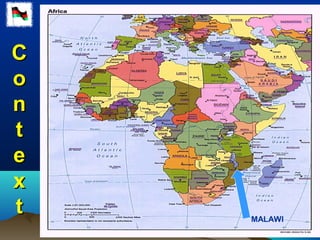
CC
oo
nn
tt
ee
xx
tt MALAWI
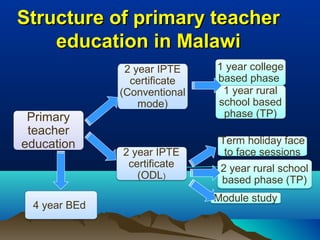
Structure of primary teacherStructure of primary teacher
education in Malawieducation in Malawi
Primary
teacher
education
2 year IPTE
certificate
(Conventional
mode)
1 year college
based phase
1 year rural
school based
phase (TP)
2 year IPTE
certificate
(ODL)
Term holiday face
to face sessions
2 year rural school
based phase (TP)
Module study
4 year BEd
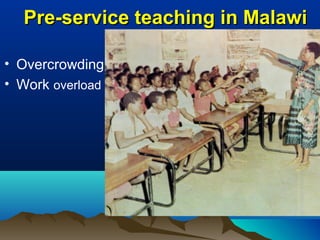
• Overcrowding
• Work overload
Pre-service teaching in MalawiPre-service teaching in Malawi
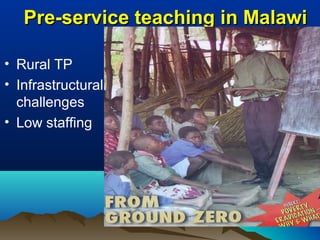
• Rural TP
• Infrastructural
challenges
• Low staffing
Pre-service teaching in MalawiPre-service teaching in Malawi
Background context cont’d
•Tuition-free training programme
•Monthly stipend as a motivator
•Long time attrition
•Low retention
•Affects plans to reduce current PQTR of
1:78 to 1:60 by 2017
•Frustrates efforts by govt & DPs investment
•infrastructure, teaching & learning materials,
staff capacity development
Leads to:
•Low annual college output
•Low school staffing levels
•underutilized resources: infrastructure,
financial, material
This researchThis research
Purpose
To examine factors that
influence retention of pre-
service primary teachers in
Malawi.
Question
What factors influence
retention of pre-service
primary teachers in Malawi?
Secondary questions:
•To what extent do pre-service teachers’
primary dimensions of diversity and
professional experiences relate to their intention
to remain in teaching?
•How can recruitment procedures influence
retention of primary pre-service teachers?
•What mentorship practices influence retention
of primary pre-service teachers?
•What strategies do primary teacher education
institutions follow to promote retention?
What I did !What I did !
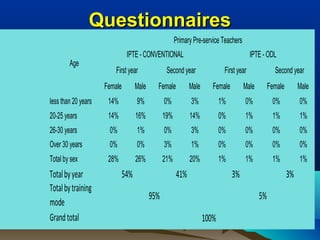
QuestionnairesQuestionnaires
Female Male Female Male Female Male Female Male
less than 20 years 14% 9% 0% 3% 1% 0% 0% 0%
20-25 years 14% 16% 19% 14% 0% 1% 1% 1%
26-30 years 0% 1% 0% 3% 0% 0% 0% 0%
Over 30 years 0% 0% 3% 1% 0% 0% 0% 0%
Total by sex 28% 26% 21% 20% 1% 1% 1% 1%
Totalbyyear
Totalbytraining
mode
Grandtotal 100%
54% 41% 3% 3%
95% 5%
Age
Primary Pre-service Teachers
IPTE - CONVENTIONAL IPTE - ODL
First year Second year First year Second year
Statistical analysis and justification
Quantitative analysis
•Use of SPSS version 20.
•Preferred because it is modern, fast and
simplifies process of analyzing quant. data
•Coding of descriptive responses
male & female; married & single coded as 1
& 2 respectively.
1st
Yr ODL, 2nd
Yr ODL, 1st
Yr conventional & 2nd
Yr Conventional were coded as 1, 2, 3 & 4
•SPSS analyzed data into descriptive statistics
eg frequency counts and percentages.
• Data presentation in form of tables, bar
graphs and pie charts
• To enhance proper understanding of results
• Some instances, conducted Chi-square test
• Obtains the Pearson correlation co-efficient
• To determine statistical significance of
relationship between two categorical variables
(Byers, Steinhorst, & Krausman, (1984)
• The limitation!!! data needs to be sufficient
enough ie count of ≥ 5 per cell
Qualitative analysis
•Qualitative data collected through interviews
with teacher trainers, mentors and teaching
practice coordinators
•Responses were recorded and transcribed
into a narrative form
•Six-phase process of thematic analysis.
•Aronson (1994) views thematic analysis as a
focus on identifiable themes and patterns
emerging from respondents’ ideas in an
interview
Why thematic analysis?Why thematic analysis?
According to Alhojailan (2012)
•Allows a researcher to precisely determine
the relationships between concepts.
•Allows linking the various concepts and
opinions of interview respondents with data
that has been gathered in different situations
and at different times.
6-Phase Thematic Analysis
((Braun & Clarke, 2006)
Pre-service teacher retentionPre-service teacher retention
has bearing on:has bearing on:
• Reasons for choosing teaching
• Significance of a teacher training program
• Satisfaction of pre-service teachers with training
program
• Relationship of primary dimensions of diversity
and professional factors to retention
• Relationship of recruitment factors to retention
• Relationship of recruitment procedures to
retention
• Influence of mentorship
• Strategies for retention
PreliminariesPreliminaries
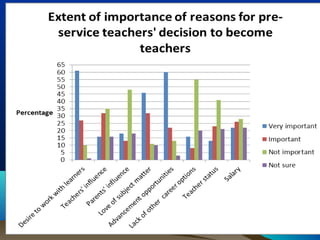
Important reasons for choosing teaching
•desire to work with learners
•Advancing their career opportunities
•Love of subject matter
Less important reasons for choosing teaching
•lack of other career options
•parental influence
•Teachers’ influence
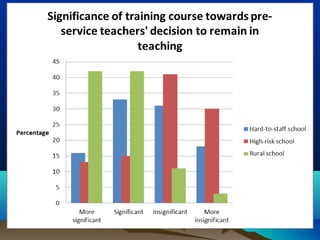
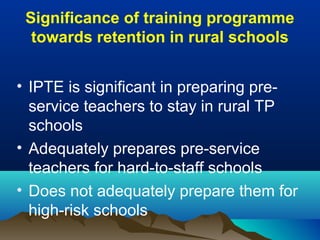
Significance of training programme
towards retention in rural schools
• IPTE is significant in preparing pre-
service teachers to stay in rural TP
schools
• Adequately prepares pre-service
teachers for hard-to-staff schools
• Does not adequately prepare them for
high-risk schools
• Possibly, attributes of high-risk
schools are not well covered and
integrated in IPTE
• Consistent with this finding, Tamir,
(2013) suggests that preparation can
have some effect on teacher’s
preparedness to teach in culturally
diverse environments and adapt to
challenging demands of hard-to-staff
schools
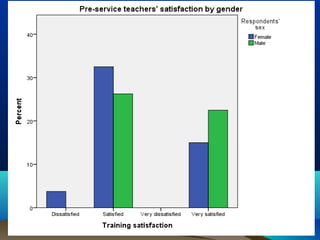
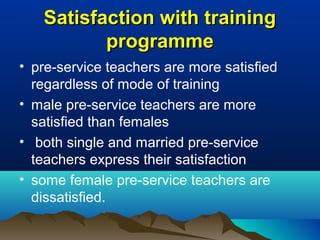
Satisfaction with trainingSatisfaction with training
programmeprogramme
• pre-service teachers are more satisfied
regardless of mode of training
• male pre-service teachers are more
satisfied than females
• both single and married pre-service
teachers express their satisfaction
• some female pre-service teachers are
dissatisfied.
What I found out !!What I found out !!
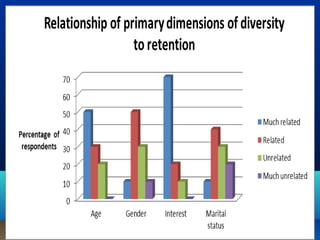
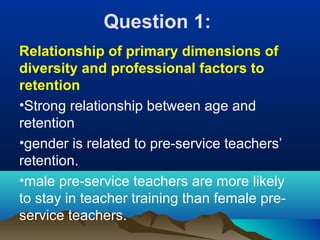
Question 1:
Relationship of primary dimensions of
diversity and professional factors to
retention
•Strong relationship between age and
retention
•gender is related to pre-service teachers’
retention.
•male pre-service teachers are more likely
to stay in teacher training than female pre-
service teachers.
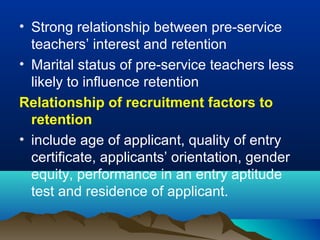
• Strong relationship between pre-service
teachers’ interest and retention
• Marital status of pre-service teachers less
likely to influence retention
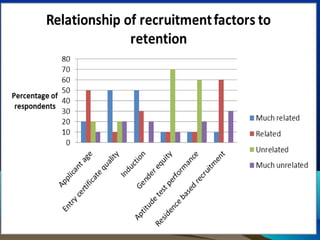
Relationship of recruitment factors to
retention
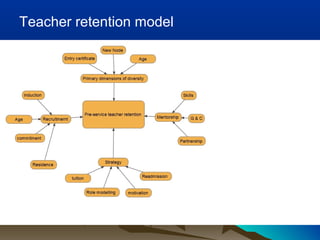
• include age of applicant, quality of entry
certificate, applicants’ orientation, gender
equity, performance in an entry aptitude
test and residence of applicant.
• Age of pre-service teachers is related to
retention
• Older ones are mature enough and settled in
their minds and stay in training
• Younger ones are unstable/undecided and
drop out
• Quality of entry certificate is related to
retention
• Some candidates with better subject grades
on entry certificate leave primary teacher
training as compared to those with fairly not
so good grades
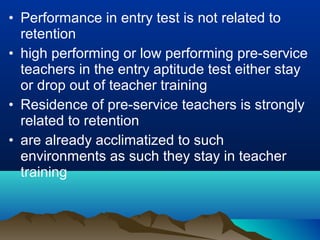
• Performance in entry test is not related to
retention
• high performing or low performing pre-service
teachers in the entry aptitude test either stay
or drop out of teacher training
• Residence of pre-service teachers is strongly
related to retention
• are already acclimatized to such
environments as such they stay in teacher
training
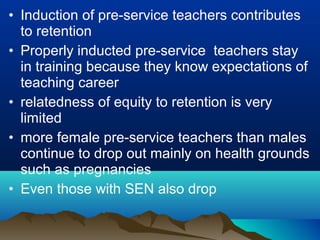
• Induction of pre-service teachers contributes
to retention
• Properly inducted pre-service teachers stay
in training because they know expectations of
teaching career
• relatedness of equity to retention is very
limited
• more female pre-service teachers than males
continue to drop out mainly on health grounds
such as pregnancies
• Even those with SEN also drop
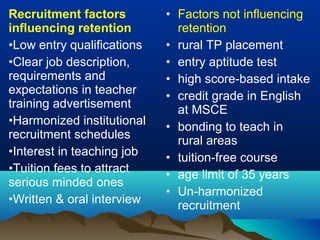
Recruitment factors
influencing retention
•Low entry qualifications
•Clear job description,
requirements and
expectations in teacher
training advertisement
•Harmonized institutional
recruitment schedules
•Interest in teaching job
•Tuition fees to attract
serious minded ones
•Written & oral interview
• Factors not influencing
retention
• rural TP placement
• entry aptitude test
• high score-based intake
• credit grade in English
at MSCE
• bonding to teach in
rural areas
• tuition-free course
• age limit of 35 years
• Un-harmonized
recruitment
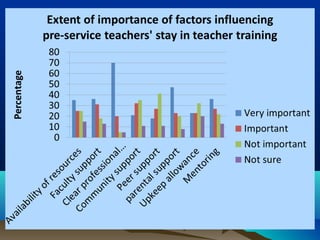
Importance of factorsImportance of factors
influencing retentioninfluencing retention
• Factors that influence retention are accorded
different levels of importance
• Include availability of resources, faculty support,
clear professional career, community support,
peer support, parental support, upkeep allowance
and mentoring
• All are important in influencing retention but extent
of importance differs
• clear professional career has highest influence on
retention followed by parental support, faculty
support, and mentoring
Research Q2:Research Q2:
Influence of recruitment proceduresInfluence of recruitment procedures
to retentionto retention
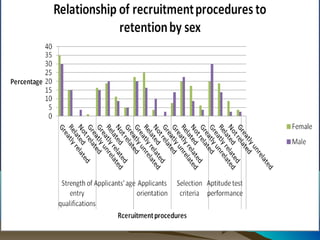
• In Malawi, recruitment of pre-service
primary teachers takes into consideration
a number of procedures
• Scores in the aptitude test are for
selection purposes but negatively
correlate with certification scores
• Strong relationship between retention and
the recruitment procedures
• Slight gender differences in perceptions
on extent of relationships
• More female than male pre-service
teachers feel the procedures are related to
retention
• Why do they think so?
• Some who score highly in aptitude test fail
training assessments and are withdrawn
• procedure of using entry aptitude test
scores does not predict retention
• Hence retention of some pre-service
teachers is not achieved
• I also found it necessary to consider
extent of impact of recruitment procedures
on retention
• Perceptions on the impact registered slight
gender differences
• More male than females feel procedures
exert a large impact on the retention
• More female than males feel procedures have
some impact
• But procedures comprise various aspects that
might exert their own share of extent of
impact
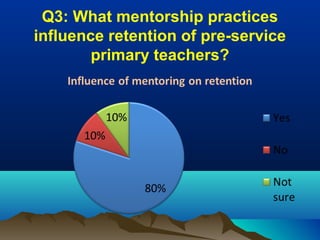
Q3: What mentorship practices
influence retention of pre-service
primary teachers?
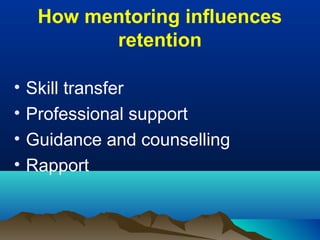
How mentoring influences
retention
• Skill transfer
• Professional support
• Guidance and counselling
• Rapport
How mentoring fails to
influence retention
• Lack of capacity building
• Lack of incentives
• Work overload
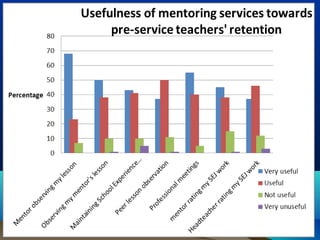
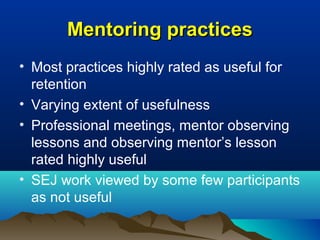
Mentoring practicesMentoring practices
• Most practices highly rated as useful for
retention
• Varying extent of usefulness
• Professional meetings, mentor observing
lessons and observing mentor’s lesson
rated highly useful
• SEJ work viewed by some few participants
as not useful
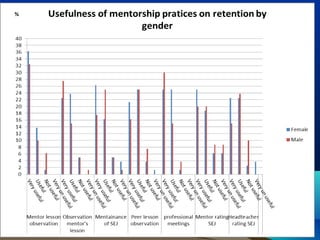
• Slight gender differences in perceptions
on usefulness of mentoring on retention
• More females than males feel mentoring
practices are useful for retention
• Fewer respondents feel SEJ work is not
useful though males outnumber females
• Both male and female feel professional
meetings and mentor observing lessons
are useful for retention
What strategies do primary teacher
education institutions follow to
promote retention?
• Upkeep allowances
• Tuition-free course
• Orientation
• Role modelling
• Community-TPS partnership
• Readmission
ConclusionConclusion
• Pre-service teachers attribute various
reasons for choosing teaching career esp
desire to work with children
• Reasons have a bearing on retention
• Various factors influence and impact on
retention of pre-service teachers in Malawi
• primary dimensions of diversity and
professional experiences have a positive
correlation with retention
RecommendationsRecommendations
Implications for practiceImplications for practice
• Introduce tuition fees to attract committed
applicants
• Regular payment of upkeep allowances to
sustain motivation
• Harmonize recruitment of trainees for different
professional training programmes
• Introduce oral interviews to ascertain
commitment and interest for training
• Enhance the school experience journal work
Teacher retention model
Further researchFurther research
• Effect of mentors’ gender differences in
respect of the mentoring practices for
retention of pre-service teachers.
• Determine candidates’ commitment for
primary teacher training during recruitment
• Establish impact of introducing a tuition
fee- paying arrangement and non-financial
incentives on retention
• Thanks to Dr Lee and Dr Peter for your
commendable advice for the study
• Thanks to audience for your attention
Q & AQ & A

Ed d research results presentation elvis

  • 1.
    University of LiverpoolUniversityof Liverpoolin partnership within partnership with Laureate Online EducationLaureate Online Education Second Presentation on EdD Thesis progress titled:Second Presentation on EdD Thesis progress titled: Factors Influencing Retention inFactors Influencing Retention in Pre-service Primary TeacherPre-service Primary Teacher Education in Malawi Education in Malawi  byby Elvis SalagiElvis Salagi 1313thth February, 2015February, 2015 Doctoral Supervisors: Dr Lee Graham and Dr Peter KahnDoctoral Supervisors: Dr Lee Graham and Dr Peter Kahn
  • 2.
    PillarsPillars • Why Idid it!! • What I did!!! • What I found out!!!
  • 3.
    Presentation overviewPresentation overview •Introduction • Background context • Purpose & questions • Problem statement • Methodology • Findings • Recommendations • Further research • Q&A
  • 4.
    IntroductionIntroduction • Quality educationprovision • Revolves around 4 thematic areas: access, equity, governance, mgt • Hinges on resource availability • Requires sound financial, human and material resources • Need for staff and infrastructural devt • Provision of quality teacher education • Challenges of attrition, motivation & limited resource envelope
  • 5.
  • 6.
    Structure of primaryteacherStructure of primary teacher education in Malawieducation in Malawi Primary teacher education 2 year IPTE certificate (Conventional mode) 1 year college based phase 1 year rural school based phase (TP) 2 year IPTE certificate (ODL) Term holiday face to face sessions 2 year rural school based phase (TP) Module study 4 year BEd
  • 7.
    • Overcrowding • Workoverload Pre-service teaching in MalawiPre-service teaching in Malawi
  • 8.
    • Rural TP •Infrastructural challenges • Low staffing Pre-service teaching in MalawiPre-service teaching in Malawi
  • 9.
    Background context cont’d •Tuition-freetraining programme •Monthly stipend as a motivator •Long time attrition •Low retention •Affects plans to reduce current PQTR of 1:78 to 1:60 by 2017
  • 10.
    •Frustrates efforts bygovt & DPs investment •infrastructure, teaching & learning materials, staff capacity development Leads to: •Low annual college output •Low school staffing levels •underutilized resources: infrastructure, financial, material
  • 12.
    This researchThis research Purpose Toexamine factors that influence retention of pre- service primary teachers in Malawi. Question What factors influence retention of pre-service primary teachers in Malawi?
  • 13.
    Secondary questions: •To whatextent do pre-service teachers’ primary dimensions of diversity and professional experiences relate to their intention to remain in teaching? •How can recruitment procedures influence retention of primary pre-service teachers? •What mentorship practices influence retention of primary pre-service teachers? •What strategies do primary teacher education institutions follow to promote retention?
  • 14.
    What I did!What I did !
  • 15.
    QuestionnairesQuestionnaires Female Male FemaleMale Female Male Female Male less than 20 years 14% 9% 0% 3% 1% 0% 0% 0% 20-25 years 14% 16% 19% 14% 0% 1% 1% 1% 26-30 years 0% 1% 0% 3% 0% 0% 0% 0% Over 30 years 0% 0% 3% 1% 0% 0% 0% 0% Total by sex 28% 26% 21% 20% 1% 1% 1% 1% Totalbyyear Totalbytraining mode Grandtotal 100% 54% 41% 3% 3% 95% 5% Age Primary Pre-service Teachers IPTE - CONVENTIONAL IPTE - ODL First year Second year First year Second year
  • 17.
    Statistical analysis andjustification Quantitative analysis •Use of SPSS version 20. •Preferred because it is modern, fast and simplifies process of analyzing quant. data •Coding of descriptive responses male & female; married & single coded as 1 & 2 respectively. 1st Yr ODL, 2nd Yr ODL, 1st Yr conventional & 2nd Yr Conventional were coded as 1, 2, 3 & 4 •SPSS analyzed data into descriptive statistics eg frequency counts and percentages.
  • 18.
    • Data presentationin form of tables, bar graphs and pie charts • To enhance proper understanding of results • Some instances, conducted Chi-square test • Obtains the Pearson correlation co-efficient • To determine statistical significance of relationship between two categorical variables (Byers, Steinhorst, & Krausman, (1984) • The limitation!!! data needs to be sufficient enough ie count of ≥ 5 per cell
  • 19.
    Qualitative analysis •Qualitative datacollected through interviews with teacher trainers, mentors and teaching practice coordinators •Responses were recorded and transcribed into a narrative form •Six-phase process of thematic analysis. •Aronson (1994) views thematic analysis as a focus on identifiable themes and patterns emerging from respondents’ ideas in an interview
  • 20.
    Why thematic analysis?Whythematic analysis? According to Alhojailan (2012) •Allows a researcher to precisely determine the relationships between concepts. •Allows linking the various concepts and opinions of interview respondents with data that has been gathered in different situations and at different times.
  • 21.
    6-Phase Thematic Analysis 6-PhaseThematic Analysis ((Braun & Clarke, 2006)
  • 22.
    Pre-service teacher retentionPre-serviceteacher retention has bearing on:has bearing on: • Reasons for choosing teaching • Significance of a teacher training program • Satisfaction of pre-service teachers with training program • Relationship of primary dimensions of diversity and professional factors to retention • Relationship of recruitment factors to retention • Relationship of recruitment procedures to retention • Influence of mentorship • Strategies for retention
  • 24.
    PreliminariesPreliminaries Important reasons forchoosing teaching •desire to work with learners •Advancing their career opportunities •Love of subject matter Less important reasons for choosing teaching •lack of other career options •parental influence •Teachers’ influence
  • 26.
    Significance of trainingprogramme towards retention in rural schools • IPTE is significant in preparing pre- service teachers to stay in rural TP schools • Adequately prepares pre-service teachers for hard-to-staff schools • Does not adequately prepare them for high-risk schools
  • 27.
    • Possibly, attributesof high-risk schools are not well covered and integrated in IPTE • Consistent with this finding, Tamir, (2013) suggests that preparation can have some effect on teacher’s preparedness to teach in culturally diverse environments and adapt to challenging demands of hard-to-staff schools
  • 29.
    Satisfaction with trainingSatisfactionwith training programmeprogramme • pre-service teachers are more satisfied regardless of mode of training • male pre-service teachers are more satisfied than females • both single and married pre-service teachers express their satisfaction • some female pre-service teachers are dissatisfied.
  • 31.
    What I foundout !!What I found out !!
  • 32.
    Question 1: Relationship ofprimary dimensions of diversity and professional factors to retention •Strong relationship between age and retention •gender is related to pre-service teachers’ retention. •male pre-service teachers are more likely to stay in teacher training than female pre- service teachers.
  • 33.
    • Strong relationshipbetween pre-service teachers’ interest and retention • Marital status of pre-service teachers less likely to influence retention Relationship of recruitment factors to retention • include age of applicant, quality of entry certificate, applicants’ orientation, gender equity, performance in an entry aptitude test and residence of applicant.
  • 35.
    • Age ofpre-service teachers is related to retention • Older ones are mature enough and settled in their minds and stay in training • Younger ones are unstable/undecided and drop out • Quality of entry certificate is related to retention • Some candidates with better subject grades on entry certificate leave primary teacher training as compared to those with fairly not so good grades
  • 36.
    • Performance inentry test is not related to retention • high performing or low performing pre-service teachers in the entry aptitude test either stay or drop out of teacher training • Residence of pre-service teachers is strongly related to retention • are already acclimatized to such environments as such they stay in teacher training
  • 37.
    • Induction ofpre-service teachers contributes to retention • Properly inducted pre-service teachers stay in training because they know expectations of teaching career • relatedness of equity to retention is very limited • more female pre-service teachers than males continue to drop out mainly on health grounds such as pregnancies • Even those with SEN also drop
  • 38.
    Recruitment factors influencing retention •Lowentry qualifications •Clear job description, requirements and expectations in teacher training advertisement •Harmonized institutional recruitment schedules •Interest in teaching job •Tuition fees to attract serious minded ones •Written & oral interview • Factors not influencing retention • rural TP placement • entry aptitude test • high score-based intake • credit grade in English at MSCE • bonding to teach in rural areas • tuition-free course • age limit of 35 years • Un-harmonized recruitment
  • 39.
    Importance of factorsImportanceof factors influencing retentioninfluencing retention • Factors that influence retention are accorded different levels of importance • Include availability of resources, faculty support, clear professional career, community support, peer support, parental support, upkeep allowance and mentoring • All are important in influencing retention but extent of importance differs • clear professional career has highest influence on retention followed by parental support, faculty support, and mentoring
  • 41.
    Research Q2:Research Q2: Influenceof recruitment proceduresInfluence of recruitment procedures to retentionto retention • In Malawi, recruitment of pre-service primary teachers takes into consideration a number of procedures
  • 43.
    • Scores inthe aptitude test are for selection purposes but negatively correlate with certification scores • Strong relationship between retention and the recruitment procedures • Slight gender differences in perceptions on extent of relationships • More female than male pre-service teachers feel the procedures are related to retention • Why do they think so?
  • 44.
    • Some whoscore highly in aptitude test fail training assessments and are withdrawn • procedure of using entry aptitude test scores does not predict retention • Hence retention of some pre-service teachers is not achieved • I also found it necessary to consider extent of impact of recruitment procedures on retention
  • 46.
    • Perceptions onthe impact registered slight gender differences • More male than females feel procedures exert a large impact on the retention • More female than males feel procedures have some impact • But procedures comprise various aspects that might exert their own share of extent of impact
  • 47.
    Q3: What mentorshippractices influence retention of pre-service primary teachers?
  • 48.
    How mentoring influences retention •Skill transfer • Professional support • Guidance and counselling • Rapport
  • 49.
    How mentoring failsto influence retention • Lack of capacity building • Lack of incentives • Work overload
  • 51.
    Mentoring practicesMentoring practices •Most practices highly rated as useful for retention • Varying extent of usefulness • Professional meetings, mentor observing lessons and observing mentor’s lesson rated highly useful • SEJ work viewed by some few participants as not useful
  • 53.
    • Slight genderdifferences in perceptions on usefulness of mentoring on retention • More females than males feel mentoring practices are useful for retention • Fewer respondents feel SEJ work is not useful though males outnumber females • Both male and female feel professional meetings and mentor observing lessons are useful for retention
  • 54.
    What strategies doprimary teacher education institutions follow to promote retention? • Upkeep allowances • Tuition-free course • Orientation • Role modelling • Community-TPS partnership • Readmission
  • 55.
    ConclusionConclusion • Pre-service teachersattribute various reasons for choosing teaching career esp desire to work with children • Reasons have a bearing on retention • Various factors influence and impact on retention of pre-service teachers in Malawi • primary dimensions of diversity and professional experiences have a positive correlation with retention
  • 56.
    RecommendationsRecommendations Implications for practiceImplicationsfor practice • Introduce tuition fees to attract committed applicants • Regular payment of upkeep allowances to sustain motivation • Harmonize recruitment of trainees for different professional training programmes • Introduce oral interviews to ascertain commitment and interest for training • Enhance the school experience journal work
  • 57.
  • 58.
    Further researchFurther research •Effect of mentors’ gender differences in respect of the mentoring practices for retention of pre-service teachers. • Determine candidates’ commitment for primary teacher training during recruitment • Establish impact of introducing a tuition fee- paying arrangement and non-financial incentives on retention
  • 59.
    • Thanks toDr Lee and Dr Peter for your commendable advice for the study • Thanks to audience for your attention
  • 60.
    Q & AQ& A