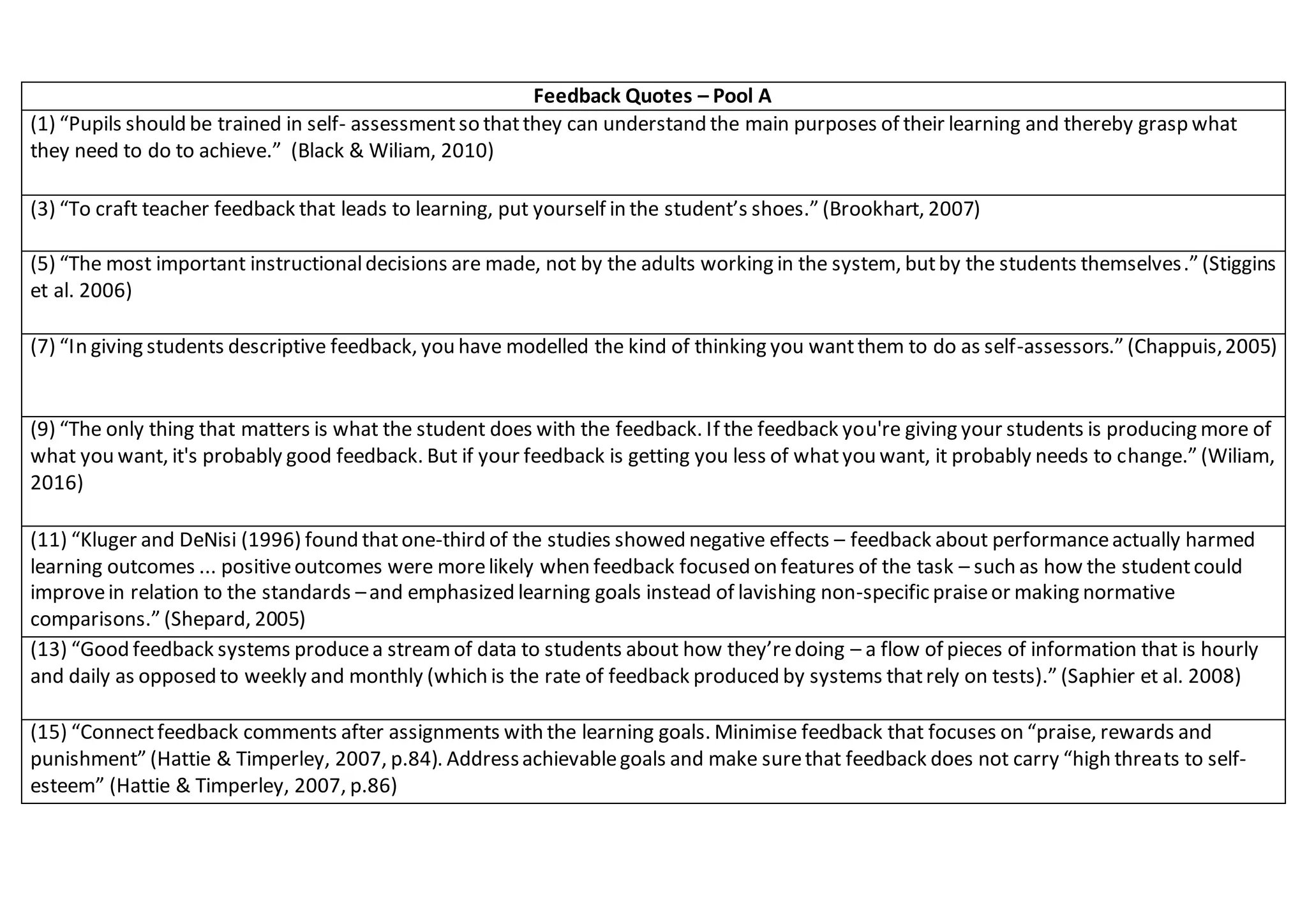
Feedback Quotes – Pool A
(1) “Pupils should be trained in self- assessmentso thatthey can understand the main purposes of their learning and thereby grasp what
they need to do to achieve.” (Black & Wiliam, 2010)
(3) “To craft teacher feedback that leads to learning, put yourself in the student’s shoes.” (Brookhart, 2007)
(5) “The most important instructionaldecisions are made, not by the adults working in the system, butby the students themselves.” (Stiggins
et al. 2006)
(7) “In giving students descriptive feedback, you have modelled the kind of thinking you wantthem to do as self-assessors.” (Chappuis,2005)
(9) “The only thing that matters is what the student does with the feedback. If the feedback you're giving your students is producing more of
what you want, it's probably good feedback. But if your feedback is getting you less of whatyou want, it probably needs to change.” (Wiliam,
2016)
(11) “Kluger and DeNisi (1996) found thatone-third of the studies showed negative effects – feedback about performanceactually harmed
learning outcomes ... positiveoutcomes were morelikely when feedback focused on features of the task – such as how the studentcould
improvein relation to the standards –and emphasized learning goals instead of lavishing non-specific praiseor making normative
comparisons.” (Shepard, 2005)
(13) “Good feedback systems producea streamof data to students about how they’redoing – a flow of pieces of information that is hourly
and daily as opposed to weekly and monthly (which is the rate of feedback produced by systems thatrely on tests).” (Saphier et al. 2008)
(15) “Connectfeedback comments after assignments with the learning goals. Minimise feedback that focuses on “praise, rewards and
punishment” (Hattie & Timperley, 2007, p.84). Addressachievablegoals and make surethat feedback does not carry “high threats to self-
esteem” (Hattie & Timperley, 2007, p.86)
Feedback Quotes – Pool B
(2) “We may need to teach less in order for the students to learn more. Teach less more carefully, and discuss it with our students. We need
to clarify the purposeand expected outcomes of the tasks we design for students, and give them specific, clear and constructivefeedback,
and the chance to usethat feedback to improve their own work.” (Sutton, 2000)
(4) “Learning is more likely to be fostered when feedback focuses on features of the task (success criteria) and emphasizes learning goals.”
(Kluger & DeNisi, 1996)
(6) “When students know that there are no additional opportunities to succeed, they frequently take teacher feedback on their performance
and stuff it into desks, back packs, and wastebaskets.” (Reeves, 2004)
(8) “[Sadler] argued that it was insufficientsimply to point out right and wrong answers to students. For assessmentto be ‘formative,’ a
student must: - come to hold a concept of quality roughly similar to that of the teacher - be able to compare the current level of
performancewith the standard - be able to take action to close the gap.” (Shepard, 2005)
(10) “Itis commonly reported that students do not read teacher feedback comments (Duncan, 2007). Theliterature suggests that a partof
the problemis that teachers (and students) seefeedback in isolation fromother aspects of the teaching and learning process and consider
feedback to be primarily a teacher owned endeavour.” (Taras, 2003).
(12) “A major role for teachers in the learning process is to provide the kind of feedback to students that encourages their learning and
provides signposts and directions along the way, bringing them closer to independence.” (Earl, 2003)
(14) “If you can both listen to children and accept their answers notas things to just be judged right or wrong but as pieces of information
which may reveal whatthe child is thinking, you will have taken a giant step toward becoming a master teacher, rather than merely a
disseminator of information.” (Easley and Zwoyer, 1975: p 25)
(16) “Assessmentis derived from[the word] ‘assidere’ to sit with or beside. It is something we do with and for a student, not something we
do to them.” (Wiggins, cited in Green, 1998)
2019   feedback showdown - pool a and b - Edu Gurus

2019 feedback showdown - pool a and b - Edu Gurus

  • 1.
    Feedback Quotes –Pool A (1) “Pupils should be trained in self- assessmentso thatthey can understand the main purposes of their learning and thereby grasp what they need to do to achieve.” (Black & Wiliam, 2010) (3) “To craft teacher feedback that leads to learning, put yourself in the student’s shoes.” (Brookhart, 2007) (5) “The most important instructionaldecisions are made, not by the adults working in the system, butby the students themselves.” (Stiggins et al. 2006) (7) “In giving students descriptive feedback, you have modelled the kind of thinking you wantthem to do as self-assessors.” (Chappuis,2005) (9) “The only thing that matters is what the student does with the feedback. If the feedback you're giving your students is producing more of what you want, it's probably good feedback. But if your feedback is getting you less of whatyou want, it probably needs to change.” (Wiliam, 2016) (11) “Kluger and DeNisi (1996) found thatone-third of the studies showed negative effects – feedback about performanceactually harmed learning outcomes ... positiveoutcomes were morelikely when feedback focused on features of the task – such as how the studentcould improvein relation to the standards –and emphasized learning goals instead of lavishing non-specific praiseor making normative comparisons.” (Shepard, 2005) (13) “Good feedback systems producea streamof data to students about how they’redoing – a flow of pieces of information that is hourly and daily as opposed to weekly and monthly (which is the rate of feedback produced by systems thatrely on tests).” (Saphier et al. 2008) (15) “Connectfeedback comments after assignments with the learning goals. Minimise feedback that focuses on “praise, rewards and punishment” (Hattie & Timperley, 2007, p.84). Addressachievablegoals and make surethat feedback does not carry “high threats to self- esteem” (Hattie & Timperley, 2007, p.86)
  • 2.
    Feedback Quotes –Pool B (2) “We may need to teach less in order for the students to learn more. Teach less more carefully, and discuss it with our students. We need to clarify the purposeand expected outcomes of the tasks we design for students, and give them specific, clear and constructivefeedback, and the chance to usethat feedback to improve their own work.” (Sutton, 2000) (4) “Learning is more likely to be fostered when feedback focuses on features of the task (success criteria) and emphasizes learning goals.” (Kluger & DeNisi, 1996) (6) “When students know that there are no additional opportunities to succeed, they frequently take teacher feedback on their performance and stuff it into desks, back packs, and wastebaskets.” (Reeves, 2004) (8) “[Sadler] argued that it was insufficientsimply to point out right and wrong answers to students. For assessmentto be ‘formative,’ a student must: - come to hold a concept of quality roughly similar to that of the teacher - be able to compare the current level of performancewith the standard - be able to take action to close the gap.” (Shepard, 2005) (10) “Itis commonly reported that students do not read teacher feedback comments (Duncan, 2007). Theliterature suggests that a partof the problemis that teachers (and students) seefeedback in isolation fromother aspects of the teaching and learning process and consider feedback to be primarily a teacher owned endeavour.” (Taras, 2003). (12) “A major role for teachers in the learning process is to provide the kind of feedback to students that encourages their learning and provides signposts and directions along the way, bringing them closer to independence.” (Earl, 2003) (14) “If you can both listen to children and accept their answers notas things to just be judged right or wrong but as pieces of information which may reveal whatthe child is thinking, you will have taken a giant step toward becoming a master teacher, rather than merely a disseminator of information.” (Easley and Zwoyer, 1975: p 25) (16) “Assessmentis derived from[the word] ‘assidere’ to sit with or beside. It is something we do with and for a student, not something we do to them.” (Wiggins, cited in Green, 1998)