Sententia
Learner
Personas
DesignTool
What is a Learner Persona?
Learner Personas are a fictional representation of your targeted
learners. They are based on real data about learner demographics
and behavior, along with educated speculation about their personal
histories, motivations, and concerns.
How are Learner Personas Created?
Learner personas are created through research, surveys, and
interviews of your target audience. That includes a mix of new and
seasoned employees – both “good” and “bad” -- who might align with
your target audience. You’ll collect data that is both qualitative and
quantitative to paint a picture of who your typical learner is, what
they value, and how your program fits into their daily lives.
How do you use a Learner Persona?
In order to bring together what you learn during assessments,
surveys, and interviews, the next step is to develop a set of personas.
Personas are composite characters that represent typical learners in
your target audience segments. They do not reflect a single person,
but rather are a combination of various employees, and portray the
types of people you are designing for.
You’ll want to create learner personas so that you can quickly explain
and disseminate that information across the organization in an
organized format, that is easy for your SME’s and developers to
understand.
© 2016, Sententia
www.SententiaGames.com
2
Learner Persona – Team Challenge
Description: Learning to develop learner personas is essential to building a solid
gamification strategy. When implemented properly these learner personas create
stronger alignment with your business and learning objectives. When developing a
learner persona, you should include more than just demographic statistics. Some other
identifiers you may want to include are personal histories, motivations, fears,
challenges, and concerns.
Personas are a detailed description of your learner and what they want to accomplish.
Usually the persona includes a short narrative describing the learner and are a useful
design technique to get a confident start in the analysis phase. A properly framed
learner persona will enable effective communication between members of the design
team. Personas enable a more focused, effective, and in-context gamification strategy
to drive motivation in learners.
The most effective personas are going to emerge out of a learner analysis that includes
interviews and real conversations with sample learners, as well as supervisors and
other stakeholders in the training.
Learner personas are:
• Hypothetical - Not real people
• Archetypal - Not average users
• Very specific - Name, background, picture, etc.
• Not the same as job roles
Ways to get information for your Learner Personas:
1. Surveys with learners as part of your standard ‘smile sheet’ course evaluations
2. Interviews with learners - Interviewing learners takes a little more work, but your
learners will feel like you care. What is stressing them out? What scares them? What
challenges does your program (process) help eliminate? What important problem
does your program (process) solve for them? Take these questions and have candid
conversations with a percentage of your learners to see what keeps them up at
night and what’s helping them the most.
3. Formal assessments
© 2016, Sententia
www.SententiaGames.com
3
Learner Persona – Team Challenge
The Persona Debate:
There can be some debate over whether personas are a help or a hindrance. Some
user experience (UX) designers argue that personas are a poor approach for
understanding the needs and wants of your learners because personas can allow a
distance between designers and users.
Personas end up being a representation of what designers wish their users were
like, rather than a reflection of true learners and prevent designers from having
empathy for their users. But, we think they are worth exploration, and can be
enhanced by including empirical data from a trusted assessment like the Reiss
profile.
Use these tips to get the most from your Learner Personas:
• Schedule conversations with sample members of your target learners. Even a
few conversations will help you remember there are real people behind the
personas.
• Although this is no place for politically correct conversations, be sure to watch
that stereotypes and social judgments don’t slip into your personas. (Ex: All
millennials want to use mobile devices for training.)
• Build empathy for the target learners by naming and adding photographs to
your personas. The more you can imagine their life and their story, the more
likely you are to understand who they are.
• It is ok to have more than one persona for your target learner group.
• Test your assumptions early and often.
© 2016, Sententia
www.SententiaGames.com
4
Player Centric Design is a philosophy that puts the user, and their goals, at the
center of the design and development process. It strives to develop programs that
are aligned with the learner’s needs. The first step in the player centered design
approach is to understand the player and their context within your L&D program.
The success of your gamification efforts depends on this clear understanding. It is
important to realize that you, as a designer, have different motivations for playing
than most of the people you encounter. The problem for the designer is without
anticipating different motivation profiles of potential players, you will not be able
to identify why some people engage and others disengage.
Gamification Attraction
TEAM CHALLENGE (Teams of 2-4 people)
Discuss with your team:
1. Have you ever a created a persona for your target learners?
2. What kind of personality/communication/preference assessments have you conducted
with your employees or clients? If you were to segment groups by attitudes, motivations,
values or other characteristics, what data or statistics do you have to help you determine
these groups?
3. Do you understand what work your learners do? What pain points exist in their lives?
4. What kind of questions might you ask to create a persona?
a. Demographics (age, gender, education, income, etc.)
b. Psychographics (values, beliefs, personality, lifestyle, etc.)
c. What’s a typical day like?
d. What makes the role challenging?
e. What values drive and motivate the learner?
5. What kind of incentive/reward/recognition programs do your learners desire?
The Challenge
Based on conversation with your team, and using the Learner Persona worksheets, develop a
Learner Persona for _____________________________.
Share
Choose one team member to speak for the team and give a 2 minute presentation. One
representative from each team will show and describe your Learner Persona.
This is the first time for many participants to create a persona. Have fun!
Learner Personas – Team Challenge
© 2016, Sententia
www.SententiaGames.com
Sententia
Learner
Personas
DesignTool
Equip yourself with the current best-
practices in Talent Development to
enhance your career.
Soon, you'll be creating and delivering
programs that not only engage learners,
but you'll also be able to show a clear
Return on Investment.
Learn more about earning a Certification in
Gamification. Live and online courses
available.
Go to:
http://www.sententiagames.com/certifications.html
© 2016, Sententia
www.SententiaGames.com
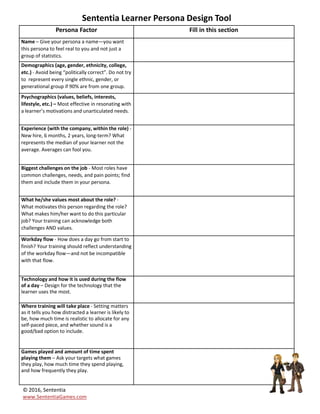
Persona Factor Fill in this section
Name – Give your persona a name—you want
this persona to feel real to you and not just a
group of statistics.
Demographics (age, gender, ethnicity, college,
etc.) - Avoid being “politically correct”. Do not try
to represent every single ethnic, gender, or
generational group if 90% are from one group.
Psychographics (values, beliefs, interests,
lifestyle, etc.) – Most effective in resonating with
a learner’s motivations and unarticulated needs.
Experience (with the company, within the role) -
New hire, 6 months, 2 years, long-term? What
represents the median of your learner not the
average. Averages can fool you.
Biggest challenges on the job - Most roles have
common challenges, needs, and pain points; find
them and include them in your persona.
What he/she values most about the role? -
What motivates this person regarding the role?
What makes him/her want to do this particular
job? Your training can acknowledge both
challenges AND values.
Workday flow - How does a day go from start to
finish? Your training should reflect understanding
of the workday flow—and not be incompatible
with that flow.
Technology and how it is used during the
flow of a day – Design for the technology
that the learner uses the most.
Where training will take place - Setting
matters as it tells you how distracted a
learner is likely to be, how much time is
realistic to allocate for any self-paced piece,
and whether sound is a good/bad option to
include.
Games played and amount of time spent
playing them – Ask your targets what
games they play, how much time they spend
playing, and how frequently they play.
Sententia Learner Persona Design Tool
© 2016, Sententia
www.SententiaGames.com
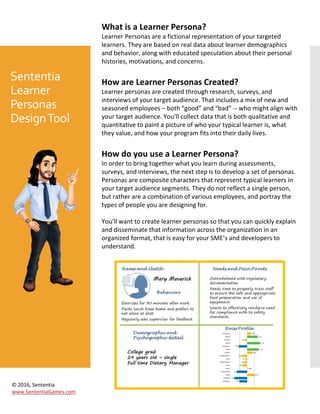
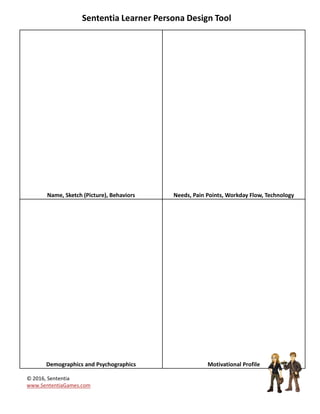
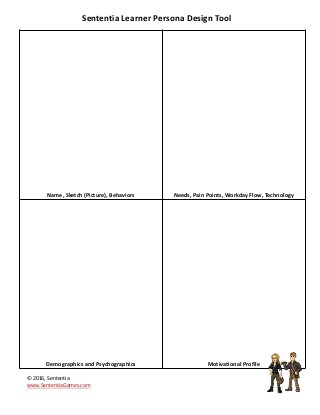
Name, Sketch (Picture), Behaviors Needs, Pain Points, Workday Flow, Technology
Demographics and Psychographics Motivational Profile
Sententia Learner Persona Design Tool
© 2016, Sententia
www.SententiaGames.com

Learner Personas - A Team Challenge

  • 1.
    Sententia Learner Personas DesignTool What is aLearner Persona? Learner Personas are a fictional representation of your targeted learners. They are based on real data about learner demographics and behavior, along with educated speculation about their personal histories, motivations, and concerns. How are Learner Personas Created? Learner personas are created through research, surveys, and interviews of your target audience. That includes a mix of new and seasoned employees – both “good” and “bad” -- who might align with your target audience. You’ll collect data that is both qualitative and quantitative to paint a picture of who your typical learner is, what they value, and how your program fits into their daily lives. How do you use a Learner Persona? In order to bring together what you learn during assessments, surveys, and interviews, the next step is to develop a set of personas. Personas are composite characters that represent typical learners in your target audience segments. They do not reflect a single person, but rather are a combination of various employees, and portray the types of people you are designing for. You’ll want to create learner personas so that you can quickly explain and disseminate that information across the organization in an organized format, that is easy for your SME’s and developers to understand. © 2016, Sententia www.SententiaGames.com
  • 2.
    2 Learner Persona –Team Challenge Description: Learning to develop learner personas is essential to building a solid gamification strategy. When implemented properly these learner personas create stronger alignment with your business and learning objectives. When developing a learner persona, you should include more than just demographic statistics. Some other identifiers you may want to include are personal histories, motivations, fears, challenges, and concerns. Personas are a detailed description of your learner and what they want to accomplish. Usually the persona includes a short narrative describing the learner and are a useful design technique to get a confident start in the analysis phase. A properly framed learner persona will enable effective communication between members of the design team. Personas enable a more focused, effective, and in-context gamification strategy to drive motivation in learners. The most effective personas are going to emerge out of a learner analysis that includes interviews and real conversations with sample learners, as well as supervisors and other stakeholders in the training. Learner personas are: • Hypothetical - Not real people • Archetypal - Not average users • Very specific - Name, background, picture, etc. • Not the same as job roles Ways to get information for your Learner Personas: 1. Surveys with learners as part of your standard ‘smile sheet’ course evaluations 2. Interviews with learners - Interviewing learners takes a little more work, but your learners will feel like you care. What is stressing them out? What scares them? What challenges does your program (process) help eliminate? What important problem does your program (process) solve for them? Take these questions and have candid conversations with a percentage of your learners to see what keeps them up at night and what’s helping them the most. 3. Formal assessments © 2016, Sententia www.SententiaGames.com
  • 3.
    3 Learner Persona –Team Challenge The Persona Debate: There can be some debate over whether personas are a help or a hindrance. Some user experience (UX) designers argue that personas are a poor approach for understanding the needs and wants of your learners because personas can allow a distance between designers and users. Personas end up being a representation of what designers wish their users were like, rather than a reflection of true learners and prevent designers from having empathy for their users. But, we think they are worth exploration, and can be enhanced by including empirical data from a trusted assessment like the Reiss profile. Use these tips to get the most from your Learner Personas: • Schedule conversations with sample members of your target learners. Even a few conversations will help you remember there are real people behind the personas. • Although this is no place for politically correct conversations, be sure to watch that stereotypes and social judgments don’t slip into your personas. (Ex: All millennials want to use mobile devices for training.) • Build empathy for the target learners by naming and adding photographs to your personas. The more you can imagine their life and their story, the more likely you are to understand who they are. • It is ok to have more than one persona for your target learner group. • Test your assumptions early and often. © 2016, Sententia www.SententiaGames.com
  • 4.
    4 Player Centric Designis a philosophy that puts the user, and their goals, at the center of the design and development process. It strives to develop programs that are aligned with the learner’s needs. The first step in the player centered design approach is to understand the player and their context within your L&D program. The success of your gamification efforts depends on this clear understanding. It is important to realize that you, as a designer, have different motivations for playing than most of the people you encounter. The problem for the designer is without anticipating different motivation profiles of potential players, you will not be able to identify why some people engage and others disengage. Gamification Attraction TEAM CHALLENGE (Teams of 2-4 people) Discuss with your team: 1. Have you ever a created a persona for your target learners? 2. What kind of personality/communication/preference assessments have you conducted with your employees or clients? If you were to segment groups by attitudes, motivations, values or other characteristics, what data or statistics do you have to help you determine these groups? 3. Do you understand what work your learners do? What pain points exist in their lives? 4. What kind of questions might you ask to create a persona? a. Demographics (age, gender, education, income, etc.) b. Psychographics (values, beliefs, personality, lifestyle, etc.) c. What’s a typical day like? d. What makes the role challenging? e. What values drive and motivate the learner? 5. What kind of incentive/reward/recognition programs do your learners desire? The Challenge Based on conversation with your team, and using the Learner Persona worksheets, develop a Learner Persona for _____________________________. Share Choose one team member to speak for the team and give a 2 minute presentation. One representative from each team will show and describe your Learner Persona. This is the first time for many participants to create a persona. Have fun! Learner Personas – Team Challenge © 2016, Sententia www.SententiaGames.com
  • 5.
    Sententia Learner Personas DesignTool Equip yourself withthe current best- practices in Talent Development to enhance your career. Soon, you'll be creating and delivering programs that not only engage learners, but you'll also be able to show a clear Return on Investment. Learn more about earning a Certification in Gamification. Live and online courses available. Go to: http://www.sententiagames.com/certifications.html © 2016, Sententia www.SententiaGames.com
  • 6.
    Persona Factor Fillin this section Name – Give your persona a name—you want this persona to feel real to you and not just a group of statistics. Demographics (age, gender, ethnicity, college, etc.) - Avoid being “politically correct”. Do not try to represent every single ethnic, gender, or generational group if 90% are from one group. Psychographics (values, beliefs, interests, lifestyle, etc.) – Most effective in resonating with a learner’s motivations and unarticulated needs. Experience (with the company, within the role) - New hire, 6 months, 2 years, long-term? What represents the median of your learner not the average. Averages can fool you. Biggest challenges on the job - Most roles have common challenges, needs, and pain points; find them and include them in your persona. What he/she values most about the role? - What motivates this person regarding the role? What makes him/her want to do this particular job? Your training can acknowledge both challenges AND values. Workday flow - How does a day go from start to finish? Your training should reflect understanding of the workday flow—and not be incompatible with that flow. Technology and how it is used during the flow of a day – Design for the technology that the learner uses the most. Where training will take place - Setting matters as it tells you how distracted a learner is likely to be, how much time is realistic to allocate for any self-paced piece, and whether sound is a good/bad option to include. Games played and amount of time spent playing them – Ask your targets what games they play, how much time they spend playing, and how frequently they play. Sententia Learner Persona Design Tool © 2016, Sententia www.SententiaGames.com
  • 7.
    Name, Sketch (Picture),Behaviors Needs, Pain Points, Workday Flow, Technology Demographics and Psychographics Motivational Profile Sententia Learner Persona Design Tool © 2016, Sententia www.SententiaGames.com