Understanding 

Your Users
Research: Developing Personas
Before We Begin

We are going to talk about a design led project 

that will aid in business and engineering efforts.
Premise
We all have biases, assumptions, and perspectives.

Naturally, we all tend to build products that fulfill our
own preferences, desires, and ways of thinking.

We are not our users. 

We need to design for them
and not for ourselves.
There are methods to ensure we create products tailor
made for the specific needs and goals of our users.
Here in Silicon Valley, we forget how skewed our population
is, and we should frequently remind ourselves how abnormal
we really are. The average person who uses a software based
product around here isn't really very average. – Alan Cooper
Q
A

Question

How can we build better software?

Answer

By better understanding our users.

But who are our users really?
Your Users

Goals
Attitudes
Motivations
Mental Models
Relationships
Technology
Pain Points
Environment
Processes
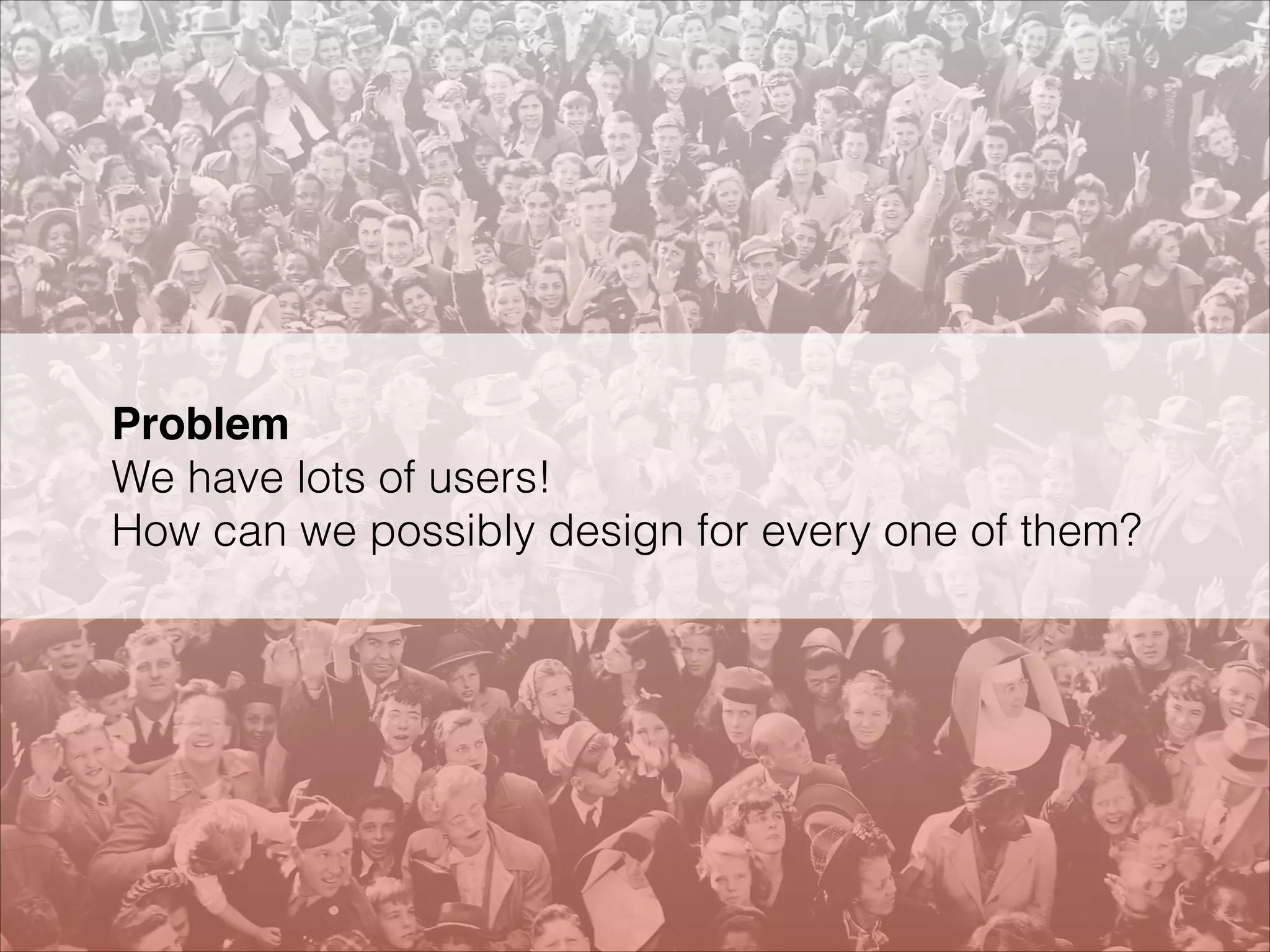
Problem

We have lots of users! 

How can we possibly design for every one of them?
If you design for everyone, you make no individual happy.

You can design for specific types of users.
We determine what types of users we serve with research.

We analyze that research to find segments of user types.

Each type of user is represented by a model called a persona.
Persona noun pərˈsōnə

Personas are archetypes (models) 

that represent groups of real users 

who have similar attributes.
A persona encapsulates and
explains the most critical data
about users in a way that team
members can understand,
remember, and relate to.
Persona

Each persona serves as a single
surrogate for many actual users,
which produces a clear target to
aim for.
By designing for these personas, you can satisfy the
needs of the thousands or millions of potential users who
have similar characteristics and goals.
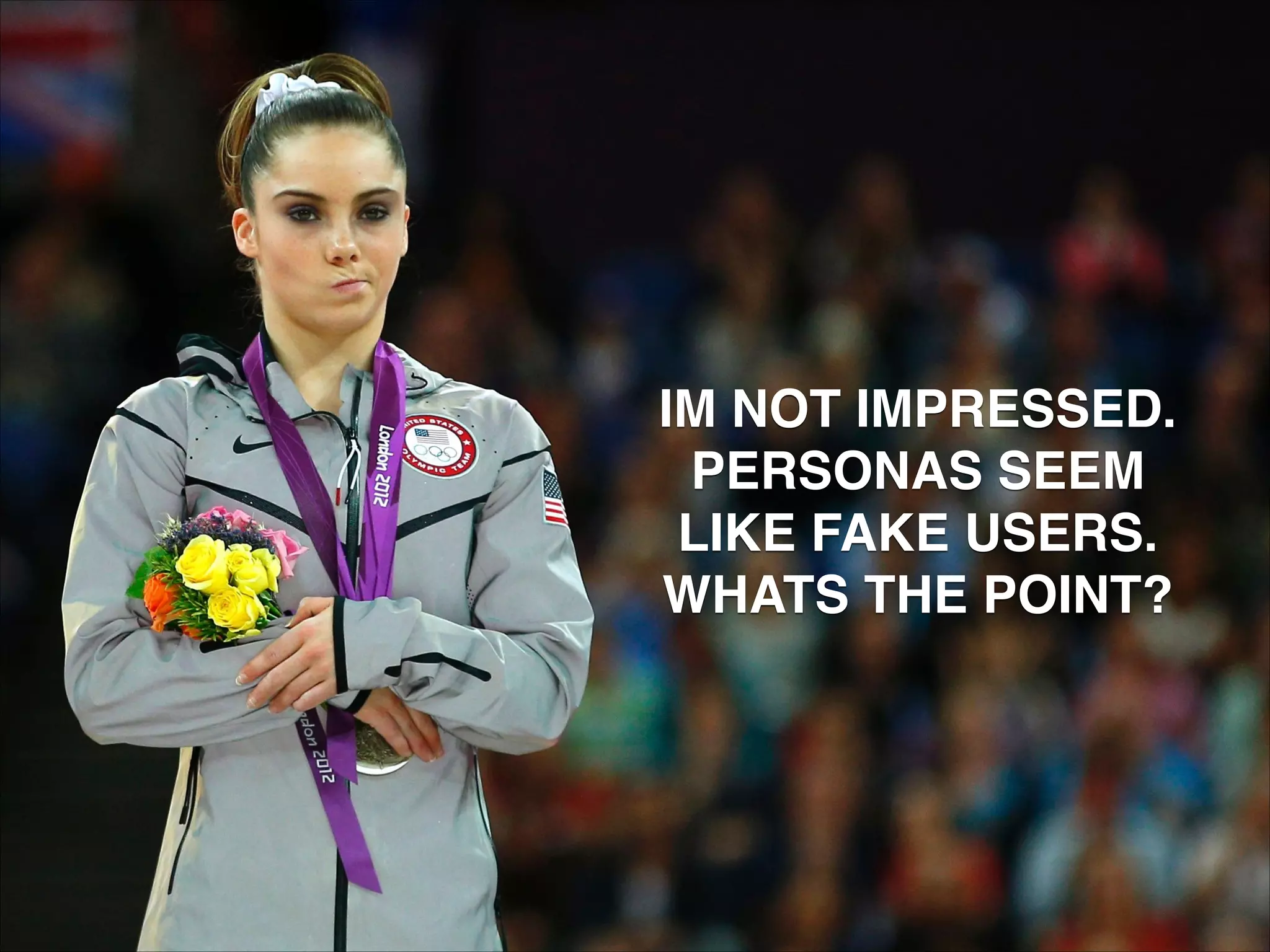
IM NOT IMPRESSED."
PERSONAS SEEM 

LIKE FAKE USERS. "
WHATS THE POINT?
PERSONAS ARE
USEFUL IF THEY
IM NOT IMPRESSED"
ARE CREATED WITH"
DIDN’T WE MAKE"
ETHNOGRAPHY.
PERSONAS BEFORE?
Ethnography noun eTHˈnägrəfē

Ethnography informs design by
revealing a deep understanding of
people and how they make sense
of their world.
Ethnography is a research method
based on observing people in their
natural environment rather than in
a formal research setting.
When ethnography is applied to
design, it helps designers create
more compelling solutions.
Uses

defining and designing the product

communicating with stakeholders
about your audience

building consensus and
rallying a team around a goal

marketing the product

developing documentation

prioritizing bug fixes
Uses

Personas can be used for almost anything.
For the entire life cycle of product creation."
If you want to use user-centric methodology.
What Personas Are Not

Market Segments

Stereotypes

Average Users

Roles
What Personas Are Not
Market Segments
What Personas Are Not
Roles
What Personas Are Not
Roles
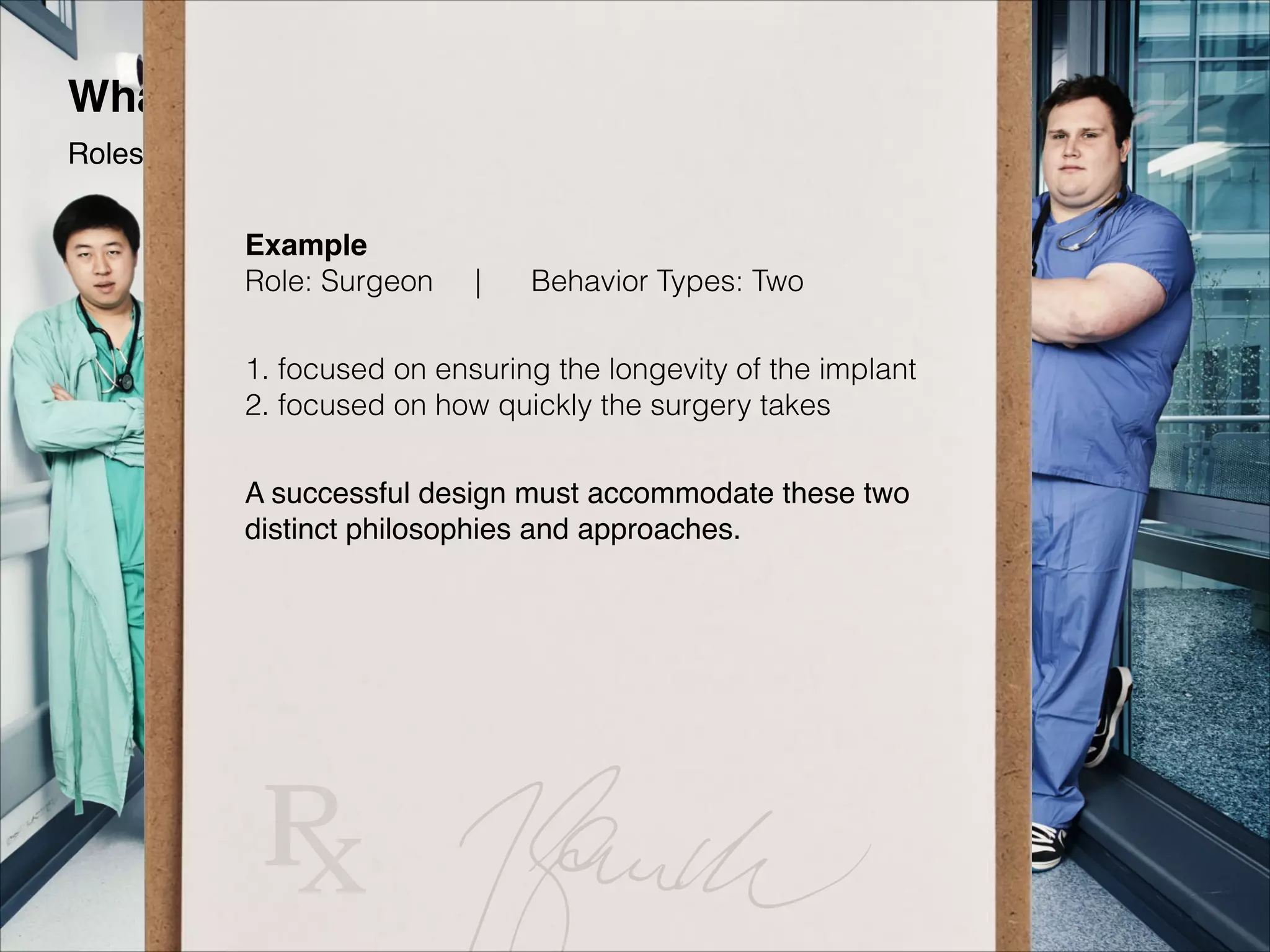
Example

Role: Surgeon

|

Behavior Types: Two"

1. focused on ensuring the longevity of the implant

2. focused on how quickly the surgery takes
A successful design must accommodate these two
distinct philosophies and approaches.
A Lesson

Howard Moskowitz & Spaghetti Sauce
http://www.ted.com/talks/malcolm_gladwell_on_spaghetti_sauce.html
There is no one right spaghetti sauce for everyone.

There is no one right feature or workflow for everyone.
Personas help us implement 

the right features to the right people in the right way.
Personas are important and useful.

They help us get into our user’s heads 

and use their perspective to inform our decisions.
How to create
and use personas

Whats next
The Plan Phase 1
Setup
form a team

determine project

scope, milestones, deliverables

state research goals

Leverage Existing Info
secondary
domain
research

external resources (people)

internal resources (people)

validate and refine

develop a hypothesis

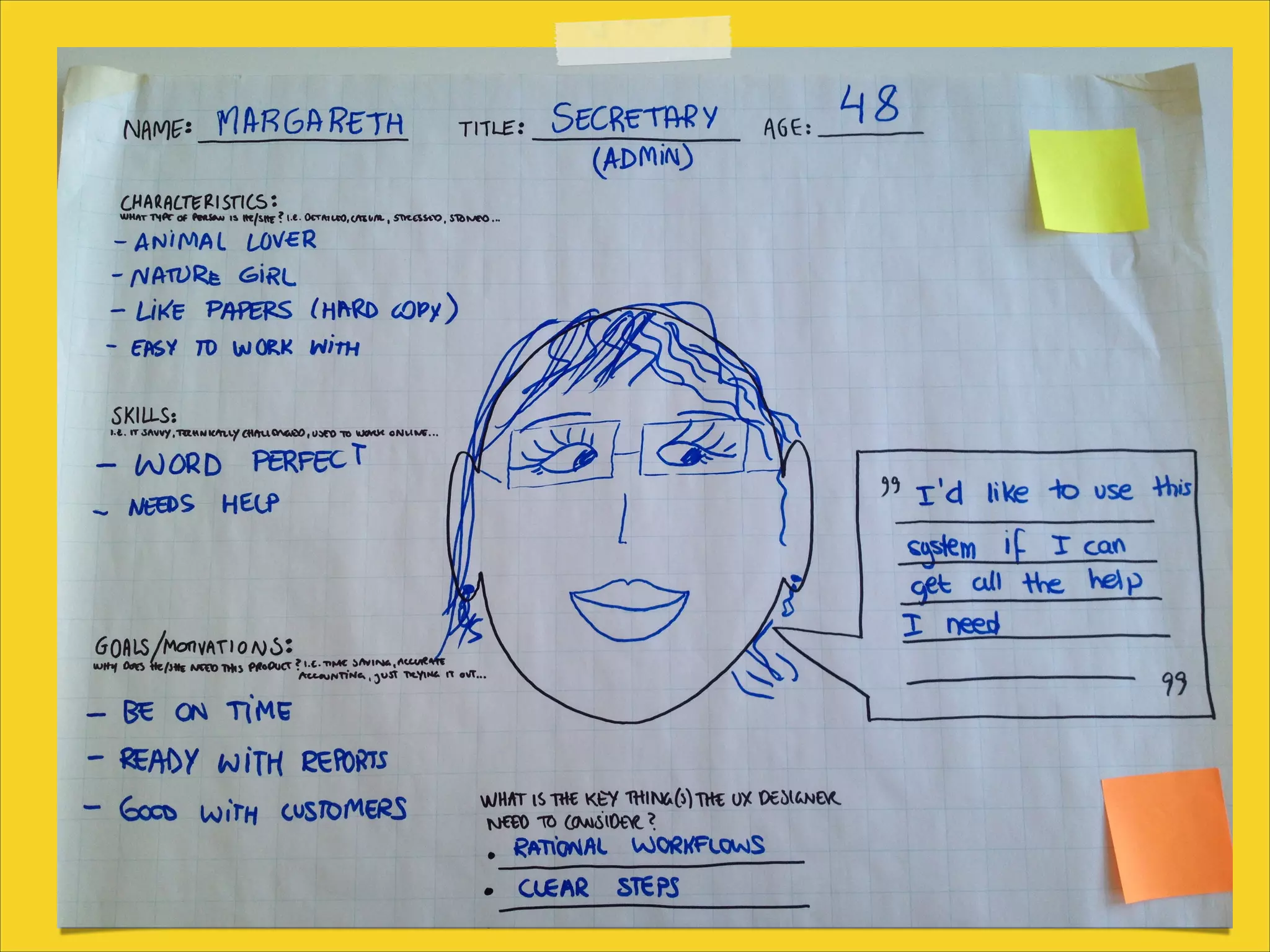
Prototyping
create
provisional
personas
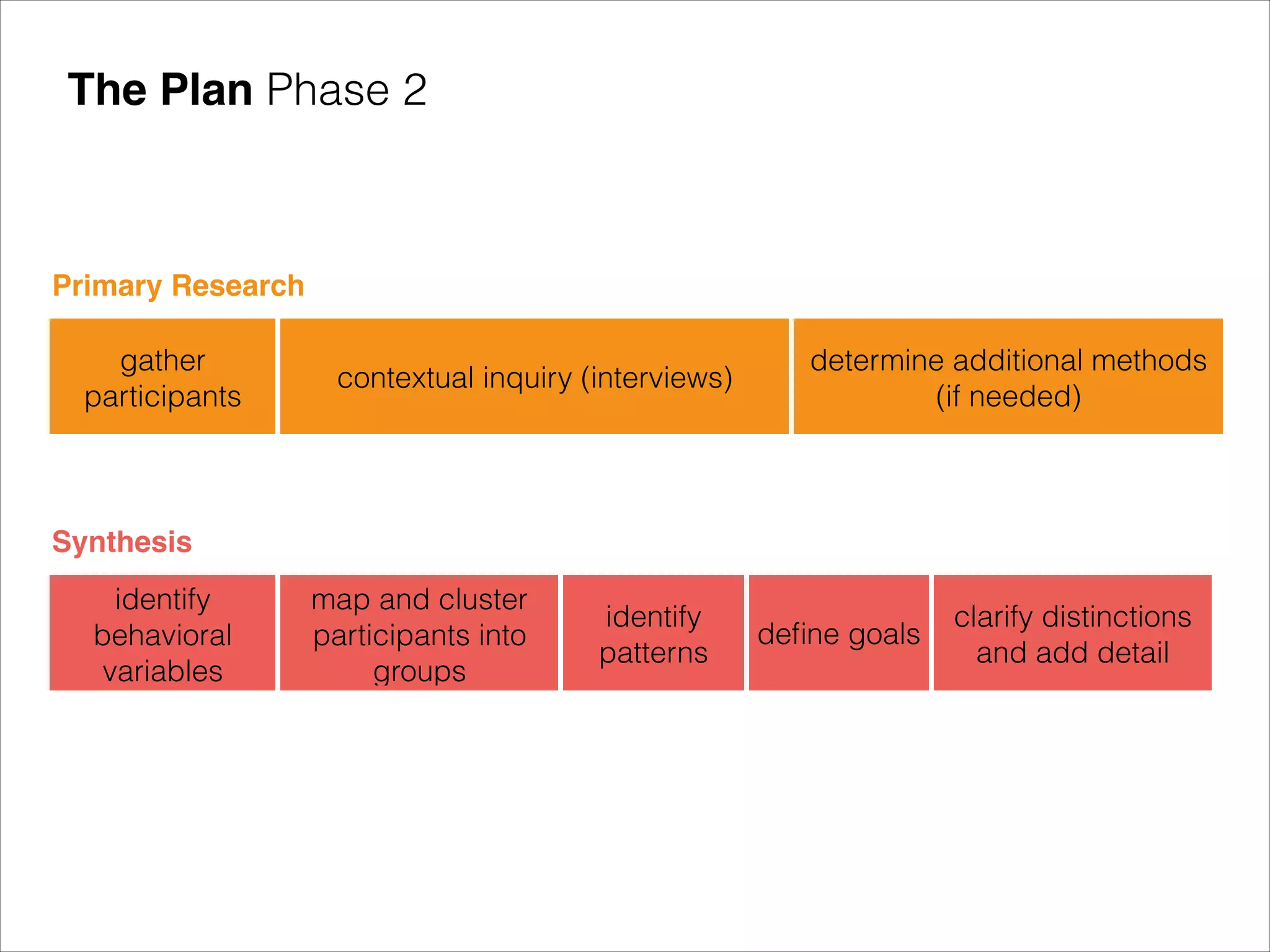
The Plan Phase 2

Primary Research
gather
participants

contextual inquiry (interviews)

determine additional methods
(if needed)

Synthesis
identify
behavioral
variables

map and cluster 

participants into
groups

identify
patterns

define goals

clarify distinctions
and add detail
The Plan Phase 3

Presentation and Use
design individual
personas

create a persona
set to compare

introduce

personas

continually socialize,
utilize, and reference
personas
The Plan All Phases
Setup

Leverage Existing Info

Prototyping

Primary Research

Synthesis

Presentation and Use
Timing

How long will this process take?
Depends on many variables. This is difficult to determine
and requires more research to figure this aspect out.
Setup
1. Develop a team

Who will work together to create personas?

2. Determine Project Scope, milestones and deliverables 

3. State Research Goals

What do you want to find out? This will help you determine what methods to find
answers to your questions. Also beneficial is to determine how you will use the
personas. Ensure that personas don't just become an artifact, because the value
is so not in the artifact itself.
Leverage Existing Info
1. Domain Knowledge

Primary research quality goes up when you have already researched the subject
matter and domain before hand. This knowledge will help you ask insightful
questions later on.

2. Existing External sources

Talk to Stakeholders and Subject Matter Experts - Leverage the knowledge of
others who know more then you do. What are the possible external sources of
data relevant to your domain, company, or product? Are there institutions or other
companies that might have conducted research related to your domain?

3. Existing Internal Sources

Who are the subject-matter experts in your company? Who has the most contact
with existing customers? Your support organization, sales force, and account
representatives can be great sources of information about your users.
Prototyping
It’s recommend that you create provisional personas whether or not you plan to
collect first-hand data about your target users."
!
• Help you target your field research to validate (or contradict) current impressions of
who users are.

• Provide some practice with persona conception and gestation methods before you
need to create your “real” personas. 

• Provisional personas are easy to create and help people understand why personas
are valuable

• Provisional personas can be the eye-opening catalyst that gets your team interested
in some real user research. When your assumptions are exposed, so are gaps in
your knowledge of your users. Ad hoc personas can lead your organization toward
more rigorous user-centered design (UCD) techniques.
Primary Research
1. Identify likely roles

From stakeholder and subject matter expert discussions, you should be able to
develop an educated guess of the roles people who will use the product.

2. Determine the base number of interviewees per role

If the product or service is in a highly specialized industry with narrowly defined
roles, assume you need a minimum of about four interviewees per role; this is
usually the minimum number to see a behavior pattern.!
!
4. Multiply sample size for important factors

Next, you may need to increase the sample size based on other factors that you
expect to cause BEHAVIORAL DIFFERENCES.

5. Trim the sample and incorporate other factors

Time and cost may become prohibitive when numbers get large. For most
projects, the optimal sample size turns out to be the base number of people per
role (usually 4 or 8) multiplied by your top one or two factors.

6. Adjust for no shows and poor interviews
Primary Research
Primary Research
Synthesis
1. Divide interviewees by role, if appropriate

When the division between roles is very clear, its best to treat research
participants in each role as a separate group for the purpose of identifying
patterns. This is because large differences tend to obscure smaller differences.
Make sure to compare apples to apples, and not apples to oranges.

2. Identify behavioral and demographic variables

For each role, identify which aspects of BEHAVIOR and ATTITUDE seem to differ
across interviewees. Then add DEMOGRAPHIC information, as well as
ENVIRONMENTAL factors.

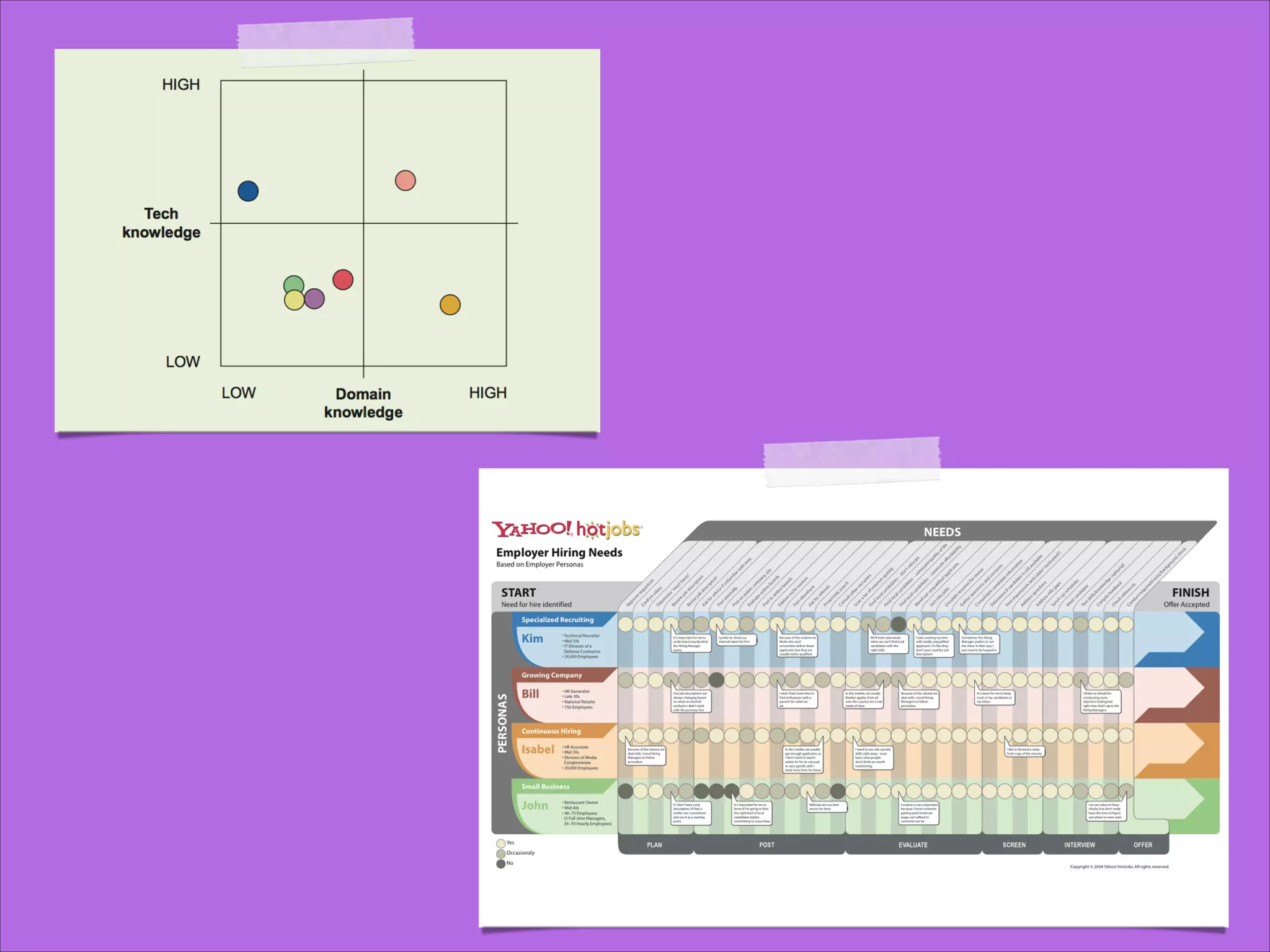
3. Map interviewees to variables

Place each interviewee relative to the others in each spectrum (and in the
appropriate multiple choice categories, if applicable).

4. Identify Patterns

Start by trying to find two or more people who frequently appear together across
multiple variables. After this, try explaining and/or rationalizing why these variables
are related – this will help strengthen the patterns you find.
Synthesis
5. Define Goals

Goals are an integral part of personas. The level of specificity of goals is known as
END GOALS: aims the persona could accomplish, at least in part, by using the
product or service. Its typical to have 1-3 goals per persona.

6. Clarify distinctions and add detail

Patterns and goals are just the beginning; to become a real persona, you still
need to add details about BEHAVIOR, ATTITUDES, ENVIRONMENT, and others
to make the personas effective tools for design and communication.


Every user persona should incorporate a ‘day in the life’ description of current
behaviors relevant to the problems you are trying to solve. 


Don’t insert a bunch of fictitious details or needless fluff.

7. Fill in other persona types as needed

Using the methods described previously.


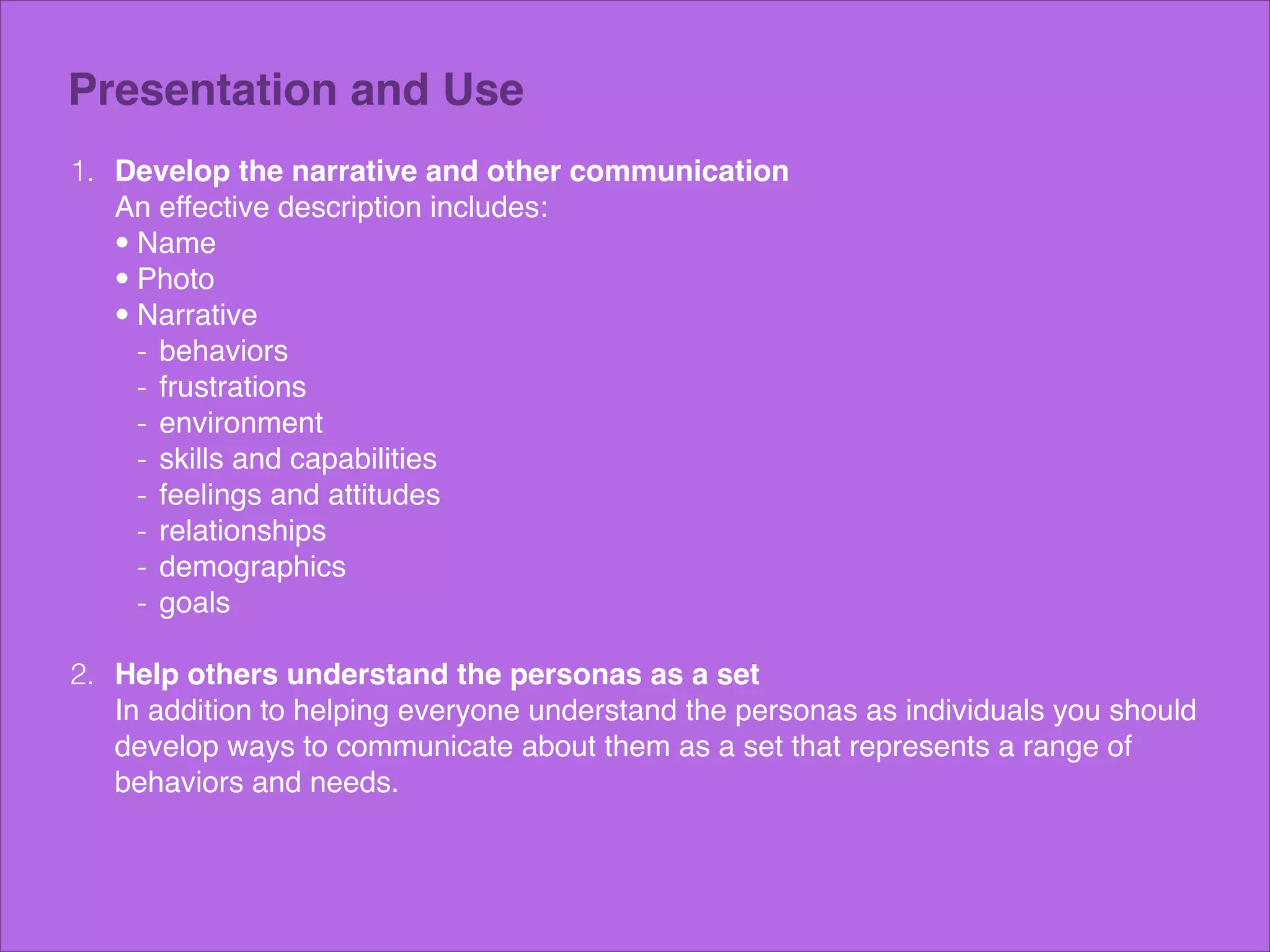
Presentation and Use
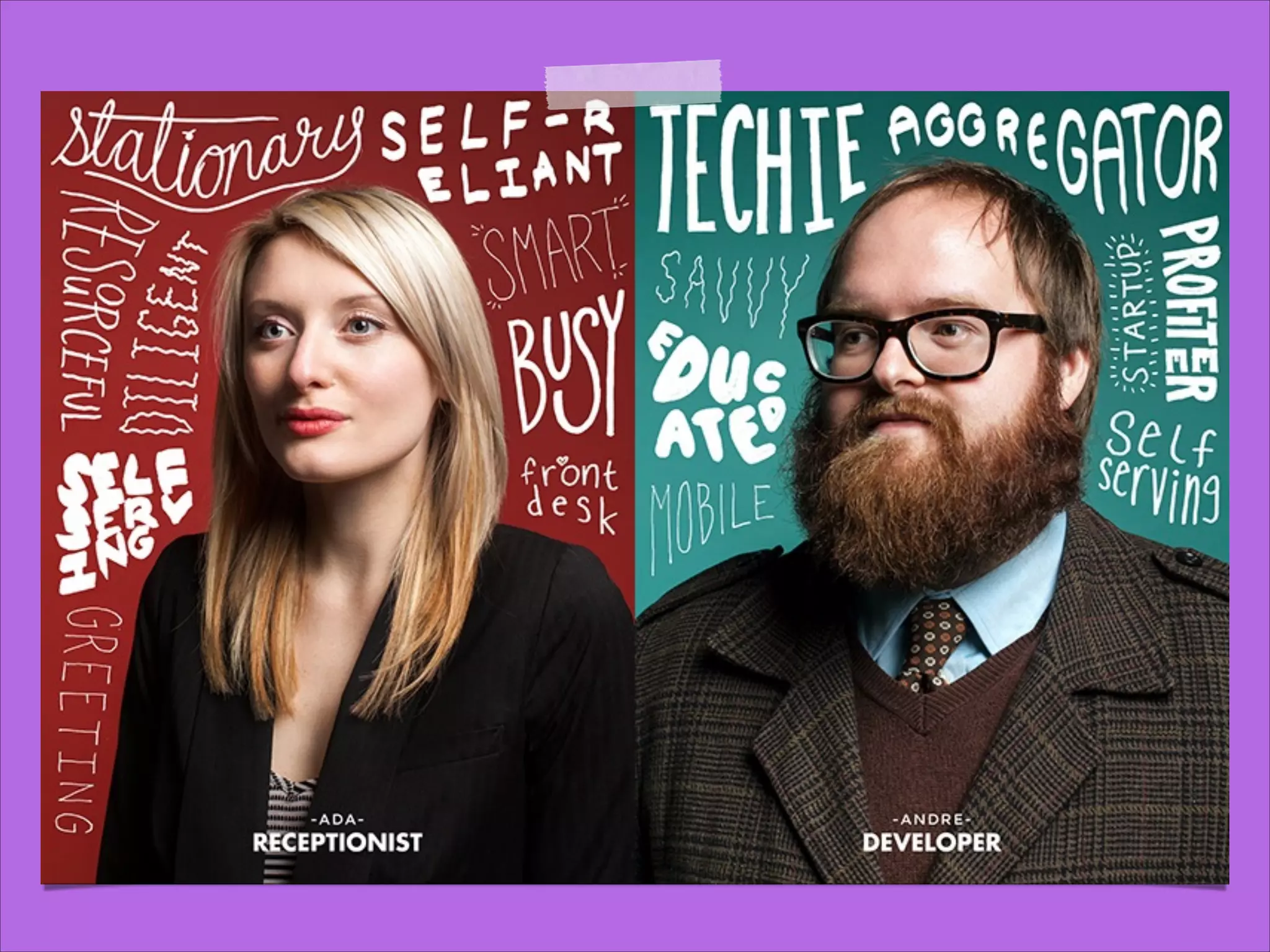
1. Develop the narrative and other communication

An effective description includes:!
• Name!
• Photo!
• Narrative!
- behaviors!
- frustrations!
- environment!
- skills and capabilities!
- feelings and attitudes!
- relationships!
- demographics!
- goals

2. Help others understand the personas as a set

In addition to helping everyone understand the personas as individuals you should
develop ways to communicate about them as a set that represents a range of
behaviors and needs.!
Lets go make
some personas!
Thank You
Works Cited

some of the presentation was copied directly from the sources below but was also
remixed and altered by Shlomo ‘Mo’ Goltz ( www.sgoltz.com )

About Face 3 - Alan Cooper, Robert Reiman, and David Cronin!
An Enthographic Primer - AIGA!
Designing For the Digital Age - Kim Goodwin!
Interviewing Users - Steve Portigal!
The User is Always Right - Steve Mulder and Ziv Yaar!
The Inmates are Running the Asylum - Alan Cooper!

Images are not given proper attribution but were found on google, flickr, and the sources above.
Additional Sources
http://www.interaction-design.org/encyclopedia/personas.html!
http://www.frontend.com/the-effectiveness-of-using-personas-in-product-design.html!
http://en.wikipedia.org/wiki/Persona_(user_experience)!
http://asinthecity.com/2011/05/13/explaining-personas-used-in-ux-design-–-part-1/!
http://uxmag.com/articles/love-hate-and-empathy-why-we-still-need-personas!
http://www.ux-lady.com/diy-user-personas/!
http://www.ux-lady.com/introduction-to-user-personas/!
http://www.cooper.com/journal/2009/06/measuring_the_effectiveness_of!
http://www.cooper.com/journal/2008/05/perfecting_your_personas!
http://www.cooper.com/journal/2008/05/reconciling_market_segments_an!
http://www.cooper.com/journal/2008/05/getting_from_research_to_perso!
http://www.cooper.com/journal/2008/05/ignore_that_designer_behind_th!
http://www.steptwo.com.au/papers/kmc_personas!
http://www.greenbook.org/marketing-research/w5-on-personas-06410!
http://msdn.microsoft.com/en-us/magazine/dd569755.aspx!
http://www.uxmatters.com/mt/archives/2009/04/user-research-for-personas-and-other-audience-models.php!
http://boxesandarrows.com/personas-and-the-role-of-design-documentation/!
http://www.deyalexander.com.au/resources/uxd/personas.html!
http://johnnyholland.org/2009/03/why-shouldnt-i-kill-personas/
Additional Sources
http://en.wikipedia.org/wiki/Contextual_inquiry!
http://www.uxmatters.com/mt/archives/2012/06/why-are-contextual-inquiries-so-difficult.php!
http://www.amazon.com/101-Design-Methods-Structured-Organization/dp/1118083466/ref=pd_sim_b_19!
http://www.designstaff.org/articles/get-better-data-from-user-studies-interviewing-tips-2012-03-07.html!
http://www.uie.com/brainsparks/2007/02/22/focus-questions-for-site-visits/!
https://confluence.sakaiproject.org/display/SLIB/Interview+Protocol!
http://alistapart.com/article/interviewing-humans!
http://www.nsf.gov/pubs/1997/nsf97153/chap_3.htm!
http://www.uxmatters.com/mt/archives/2008/07/preparing-for-user-research-interviews-seven-things-to-remember.php!
http://www.uxmatters.com/mt/archives/2011/01/developing-your-interviewing-skills-part-i-preparing-for-an-interview.php!
http://www.uxmatters.com/mt/archives/2011/02/developing-your-interview-skills-part-ii-during-the-interview.php

Personas Demystified 1.0