
UX Designers Pittsburgh MeetUp
February 2014

Presented by Carol Smith - @Carologic
Supports people
who research, design, and evaluate
the user experience of products and services.

www.uxpa.org
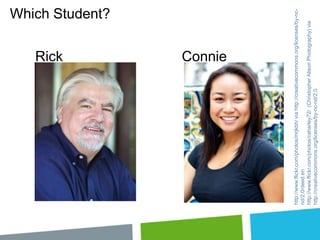
Rick
Connie

http://www.flickr.com/photos/mrjkbh/ via http://creativecommons.org/licenses/by-ncnd/2.0/deed.en
http://www.flickr.com/photos/caharley72/ (Christopher Alison Photography) via
http://creativecommons.org/licenses/by-nc-nd/2.0

Which Student?
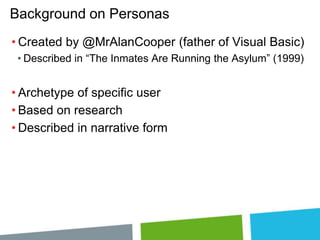
Background on Personas
• Created by @MrAlanCooper (father of Visual Basic)
• Described in “The Inmates Are Running the Asylum” (1999)

• Archetype of specific user
• Based on research
• Described in narrative form
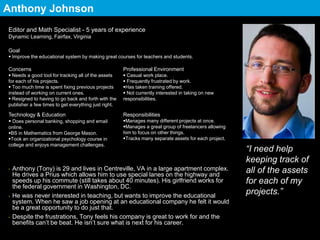
Anthony Johnson
Editor and Math Specialist - 5 years of experience
Dynamic Learning, Fairfax, Virginia
Goal
 Improve the educational system by making great courses for teachers and students.

Concerns

Professional Environment

 Needs a good tool for tracking all of the assets
for each of his projects.
 Too much time is spent fixing previous projects
instead of working on current ones.
 Resigned to having to go back and forth with the
publisher a few times to get everything just right.

 Casual work place.
 Frequently frustrated by work.
Has taken training offered.
 Not currently interested in taking on new
responsibilities.

Technology & Education
 Does personal banking, shopping and email

Responsibilities

online.
BS in Mathematics from George Mason.
Took an organizational psychology course in
college and enjoys management challenges.

•

•

•

Manages many different projects at once.
Manages a great group of freelancers allowing
him to focus on other things.
Tracks many separate assets for each project.

Anthony (Tony) is 29 and lives in Centreville, VA in a large apartment complex.
He drives a Prius which allows him to use special lanes on the highway and
speeds up his commute (still takes about 40 minutes). His girlfriend works for
the federal government in Washington, DC.
He was never interested in teaching, but wants to improve the educational
system. When he saw a job opening at an educational company he felt it would
be a great opportunity to do just that.
Despite the frustrations, Tony feels his company is great to work for and the
benefits can’t be beat. He isn’t sure what is next for his career.

“I need help
keeping track of
all of the assets
for each of my
projects.”
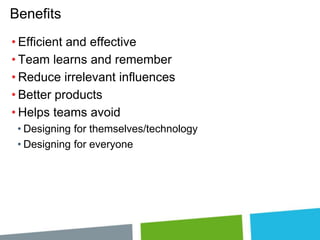
Benefits
• Efficient and effective
• Team learns and remember
• Reduce irrelevant influences
• Better products
• Helps teams avoid
• Designing for themselves/technology
• Designing for everyone
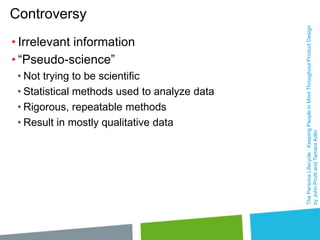
• Irrelevant information
• “Pseudo-science”
• Not trying to be scientific
• Statistical methods used to analyze data
• Rigorous, repeatable methods
• Result in mostly qualitative data

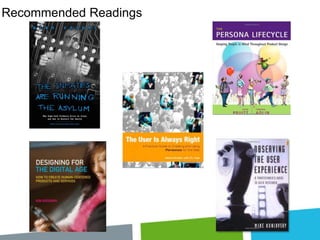
The Persona Lifecycle : Keeping People in Mind Throughout Product Design
by John Pruitt and Tamara Adlin

Controversy
Selling Personas
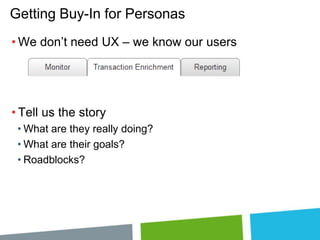
Getting Buy-In for Personas
• We don’t need UX – we know our users

• Tell us the story
• What are they really doing?
• What are their goals?
• Roadblocks?
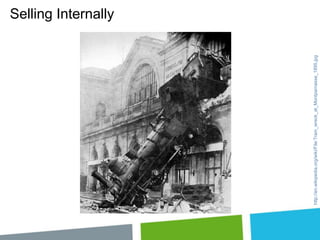
http://en.wikipedia.org/wiki/File:Train_wreck_at_Montparnasse_1895.jpg

Selling Internally
Introducing Personas
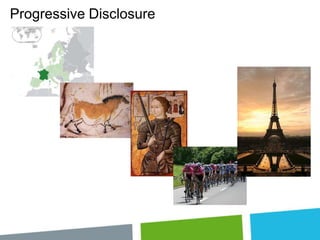
Progressive Disclosure
• Like real-life, dating
• You are the match-maker
• Create opportunities to get to know them
• Tell the story, effectively
• Support recall of significant details
Progressive Disclosure
Tell the Story
• Clarify how the personas are to be used
• Support design and development
• Limitations

• For each persona:
• Goals, Needs
• How use product
• Challenges
• “Irrelevant Information” creates the mnemonic
Make it Real
• Introduce Artifacts
• Encourage and answer questions
Get The Persona
To Work
Share What You Learn
Successful Programs
• Form a team that includes product/project team
members
• The team:
• Supports persona development
• Reviews personas regularly
• Advocates for personas
• Watches for opportunities
Team Leader
• Curates personas
• Tracks work that may influence personas
• Identifies opportunities to enhance them
Keep Personas Alive
• Make opportunities to sew them into culture
• Regular touch points
• Refresh documentation regularly
• E-mail addresses for personas
• Include them at meetings
• Role play or “channel” the persona
• Review of interface thru eyes of Persona
• Analyze competition
• Review stories/scenarios
What would they do? Would they use this?

The User is Always Right: A Practical Guide to Creating and Using Personas for the
Web by Steve Mulder and Ziv Yaar.

Working Sessions
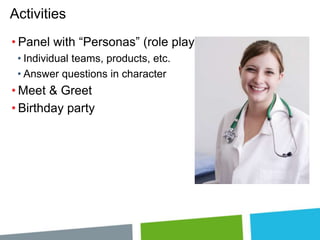
Activities
• Panel with “Personas” (role playing)
• Individual teams, products, etc.
• Answer questions in character

• Meet & Greet
• Birthday party
Artifacts
• Public
• Posters
• Large Boards

• Personal
• Persona
• Reference Sheets
• Books
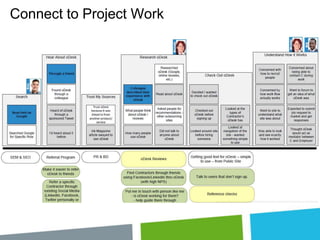
Connect to Project Work
Managing Personas
Communication Plan
• What to communicate
• Progressive disclosure - Highlights
• Updates
• Tips for use

• When
• To whom (team, stakeholders, etc.)
• How (Web site, Email, etc.)
Plan for Updating Personas
• Ongoing work
• Include open questions in new projects.

• Include in planning templates
• Usability study triggers a persona review.

• Communication Plan
• Regular reviews.
• Plan for distribution of updates.
Reusing Personas
• Up-to-date personas and profiles used:
• Indefinitely for same product
• Goals and Needs must remain static

• Inform new persona - preliminary context
Not Repurposed
• For different:
• Products
• Scenarios
• Needs and goals
Persona Teams (Families)
• Extend - include all aspects of experience
• Complex set of products
• Group personas in meaningful ways
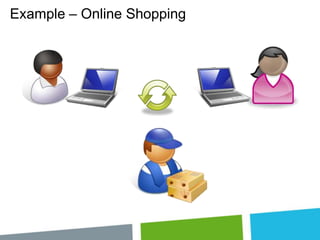
Example – Online Shopping
Online Shopping (cont)
• One persona = all Shoppers
• Unlikely

• More likely:
• Small set of personas for each role
• Few more for additional roles
Share What You Know
• Personas interact at various times
• In person
• Virtual “handshakes”

• Convey to the team:
• Where occur?
• When?
• Frequency?
• What information is exchanged?
Knowledge Shared
• Clear relationships between personas
• Frequency of interactions
• Needs from each other
• What provide to each other
Different Lenses
• Pain points
• Product, service, experience

• Motivations
• Goals, needs, tasks, occupation, family,
and environment

• Commonalities
• Tech use, tech purpose, demographics, occupation, and
context of use
Prioritize Relationships
• Which interactions most important?
• Users
• Product functionality

• Visual work flows are ideal
Next Steps
• Identify gaps and plan to fill them.
• Sync with market segments (if they exist).
Start Now
• Conduct research with users
• Create strawman Profiles now
• Expand Profiles into Personas
• Build on what you know
• Keep digging - each project can answer more
questions
Do UX Early & Often
• Create Information Radiators
• Personas
• Artifacts
• Schedule of activities

• Tell others about the power of Personas
Recommended Readings
Contact Carol Smith
Twitter: @Carologic

LinkedIn: http://www.linkedin.com/in/caroljsmith
Slideshare: http://www.slideshare.net/carologic
Special Thanks
Richard Douglass – previous co-presenter on this
material.
@RichardDouglass

http://improvedusability.com/
References
Designing for the Digital Age: How to Create Human-Centered Products and Services by Kim Goodwin (one
chapter)
The Persona Life-Cycle by John Pruitt and Tamara Adlin
The User Is Always Right: A Practical Guide to Creating and Using Personas for the Web by Steve Mulder
The Inmates are Running the Asylum by Alan Cooper
Observing the User Experience: A Practitioner's Guide to User Research by Mike Kuniavsky
Babcock, L. and Sara Laschever. (2008). “Ask For It: How Women can use the Power of Negotiation to Get
What They Really Want.” Bantam Books.
Godin, Seth. (2010) “Linchpin: Are you Indispensable?” Penguin Group.
Ury. William L. (1991) “Getting Past NO: Negotiating in Difficult Situations.” Bantam.

Fisher, Roger and William L. Ury. (1981) “Getting to YES: Negotiating Agreement Without Giving In.”
Penguin Group.
Kennedy, Gavin. (2004). “Essential Negotiation.” The Economist and Profile Books LTD.
Lavington, Camille. (2004) “You’ve Only Got Three Seconds: How to make the right impression in your
business and social life.” Doubleday.
Lewicki, Roy J., et. Al. (2004) “Essentials of Negotiation.” McGraw-Hill Irwin.

Young, Ed. (2011) “Justice is served, but more so after lunch: how food-breaks sway the decisions of
judges.” Discover Magazine. http://blogs.discovermagazine.com/notrocketscience/2011/04/11/justice-isserved-but-more-so-after-lunch-how-food-breaks-sway-the-decisions-of-judges/ Retrieved on October 24,
2011.

Putting Personas to Work at UX Pittsburgh

  • 1.
    UX Designers PittsburghMeetUp February 2014 Presented by Carol Smith - @Carologic
  • 2.
    Supports people who research,design, and evaluate the user experience of products and services. www.uxpa.org
  • 3.
    Rick Connie http://www.flickr.com/photos/mrjkbh/ via http://creativecommons.org/licenses/by-ncnd/2.0/deed.en http://www.flickr.com/photos/caharley72/(Christopher Alison Photography) via http://creativecommons.org/licenses/by-nc-nd/2.0 Which Student?
  • 4.
    Background on Personas •Created by @MrAlanCooper (father of Visual Basic) • Described in “The Inmates Are Running the Asylum” (1999) • Archetype of specific user • Based on research • Described in narrative form
  • 5.
    Anthony Johnson Editor andMath Specialist - 5 years of experience Dynamic Learning, Fairfax, Virginia Goal  Improve the educational system by making great courses for teachers and students. Concerns Professional Environment  Needs a good tool for tracking all of the assets for each of his projects.  Too much time is spent fixing previous projects instead of working on current ones.  Resigned to having to go back and forth with the publisher a few times to get everything just right.  Casual work place.  Frequently frustrated by work. Has taken training offered.  Not currently interested in taking on new responsibilities. Technology & Education  Does personal banking, shopping and email Responsibilities online. BS in Mathematics from George Mason. Took an organizational psychology course in college and enjoys management challenges. • • • Manages many different projects at once. Manages a great group of freelancers allowing him to focus on other things. Tracks many separate assets for each project. Anthony (Tony) is 29 and lives in Centreville, VA in a large apartment complex. He drives a Prius which allows him to use special lanes on the highway and speeds up his commute (still takes about 40 minutes). His girlfriend works for the federal government in Washington, DC. He was never interested in teaching, but wants to improve the educational system. When he saw a job opening at an educational company he felt it would be a great opportunity to do just that. Despite the frustrations, Tony feels his company is great to work for and the benefits can’t be beat. He isn’t sure what is next for his career. “I need help keeping track of all of the assets for each of my projects.”
  • 6.
    Benefits • Efficient andeffective • Team learns and remember • Reduce irrelevant influences • Better products • Helps teams avoid • Designing for themselves/technology • Designing for everyone
  • 7.
    • Irrelevant information •“Pseudo-science” • Not trying to be scientific • Statistical methods used to analyze data • Rigorous, repeatable methods • Result in mostly qualitative data The Persona Lifecycle : Keeping People in Mind Throughout Product Design by John Pruitt and Tamara Adlin Controversy
  • 8.
  • 9.
    Getting Buy-In forPersonas • We don’t need UX – we know our users • Tell us the story • What are they really doing? • What are their goals? • Roadblocks?
  • 10.
  • 11.
  • 12.
    Progressive Disclosure • Likereal-life, dating • You are the match-maker • Create opportunities to get to know them • Tell the story, effectively • Support recall of significant details
  • 13.
  • 14.
    Tell the Story •Clarify how the personas are to be used • Support design and development • Limitations • For each persona: • Goals, Needs • How use product • Challenges • “Irrelevant Information” creates the mnemonic
  • 15.
    Make it Real •Introduce Artifacts • Encourage and answer questions
  • 16.
  • 17.
  • 18.
    Successful Programs • Forma team that includes product/project team members • The team: • Supports persona development • Reviews personas regularly • Advocates for personas • Watches for opportunities
  • 19.
    Team Leader • Curatespersonas • Tracks work that may influence personas • Identifies opportunities to enhance them
  • 20.
    Keep Personas Alive •Make opportunities to sew them into culture • Regular touch points • Refresh documentation regularly • E-mail addresses for personas
  • 21.
    • Include themat meetings • Role play or “channel” the persona • Review of interface thru eyes of Persona • Analyze competition • Review stories/scenarios What would they do? Would they use this? The User is Always Right: A Practical Guide to Creating and Using Personas for the Web by Steve Mulder and Ziv Yaar. Working Sessions
  • 22.
    Activities • Panel with“Personas” (role playing) • Individual teams, products, etc. • Answer questions in character • Meet & Greet • Birthday party
  • 23.
    Artifacts • Public • Posters •Large Boards • Personal • Persona • Reference Sheets • Books
  • 24.
  • 25.
  • 26.
    Communication Plan • Whatto communicate • Progressive disclosure - Highlights • Updates • Tips for use • When • To whom (team, stakeholders, etc.) • How (Web site, Email, etc.)
  • 27.
    Plan for UpdatingPersonas • Ongoing work • Include open questions in new projects. • Include in planning templates • Usability study triggers a persona review. • Communication Plan • Regular reviews. • Plan for distribution of updates.
  • 28.
    Reusing Personas • Up-to-datepersonas and profiles used: • Indefinitely for same product • Goals and Needs must remain static • Inform new persona - preliminary context
  • 29.
    Not Repurposed • Fordifferent: • Products • Scenarios • Needs and goals
  • 30.
    Persona Teams (Families) •Extend - include all aspects of experience • Complex set of products • Group personas in meaningful ways
  • 31.
  • 32.
    Online Shopping (cont) •One persona = all Shoppers • Unlikely • More likely: • Small set of personas for each role • Few more for additional roles
  • 33.
    Share What YouKnow • Personas interact at various times • In person • Virtual “handshakes” • Convey to the team: • Where occur? • When? • Frequency? • What information is exchanged?
  • 34.
    Knowledge Shared • Clearrelationships between personas • Frequency of interactions • Needs from each other • What provide to each other
  • 35.
    Different Lenses • Painpoints • Product, service, experience • Motivations • Goals, needs, tasks, occupation, family, and environment • Commonalities • Tech use, tech purpose, demographics, occupation, and context of use
  • 36.
    Prioritize Relationships • Whichinteractions most important? • Users • Product functionality • Visual work flows are ideal
  • 37.
    Next Steps • Identifygaps and plan to fill them. • Sync with market segments (if they exist).
  • 38.
    Start Now • Conductresearch with users • Create strawman Profiles now • Expand Profiles into Personas • Build on what you know • Keep digging - each project can answer more questions
  • 39.
    Do UX Early& Often • Create Information Radiators • Personas • Artifacts • Schedule of activities • Tell others about the power of Personas
  • 40.
  • 41.
    Contact Carol Smith Twitter:@Carologic LinkedIn: http://www.linkedin.com/in/caroljsmith Slideshare: http://www.slideshare.net/carologic
  • 42.
    Special Thanks Richard Douglass– previous co-presenter on this material. @RichardDouglass http://improvedusability.com/
  • 43.
    References Designing for theDigital Age: How to Create Human-Centered Products and Services by Kim Goodwin (one chapter) The Persona Life-Cycle by John Pruitt and Tamara Adlin The User Is Always Right: A Practical Guide to Creating and Using Personas for the Web by Steve Mulder The Inmates are Running the Asylum by Alan Cooper Observing the User Experience: A Practitioner's Guide to User Research by Mike Kuniavsky Babcock, L. and Sara Laschever. (2008). “Ask For It: How Women can use the Power of Negotiation to Get What They Really Want.” Bantam Books. Godin, Seth. (2010) “Linchpin: Are you Indispensable?” Penguin Group. Ury. William L. (1991) “Getting Past NO: Negotiating in Difficult Situations.” Bantam. Fisher, Roger and William L. Ury. (1981) “Getting to YES: Negotiating Agreement Without Giving In.” Penguin Group. Kennedy, Gavin. (2004). “Essential Negotiation.” The Economist and Profile Books LTD. Lavington, Camille. (2004) “You’ve Only Got Three Seconds: How to make the right impression in your business and social life.” Doubleday. Lewicki, Roy J., et. Al. (2004) “Essentials of Negotiation.” McGraw-Hill Irwin. Young, Ed. (2011) “Justice is served, but more so after lunch: how food-breaks sway the decisions of judges.” Discover Magazine. http://blogs.discovermagazine.com/notrocketscience/2011/04/11/justice-isserved-but-more-so-after-lunch-how-food-breaks-sway-the-decisions-of-judges/ Retrieved on October 24, 2011.