Page 1 of 15 
Intro 
Hello and Welcome to today’s Webinar – Gamification 101: 
Are you Ready for the Gamer Employees? – My name is 
Monica Cornetti and I will be your facilitator today. 
As you move into your Workforce 2020 plan – I believe that 
you are going to be very excited about adding gamification into 
your training mix. 
Gamification is becoming the hottest, cutting-edge tool not 
only in the areas of patron engagement but also internally in 
organizations in such areas as employee engagement and on-boarding, 
knowledge transfer, and training and development. 
I’m going to move fast. My plan is to go broad today to give 
you the overview. You may have additional questions as you 
start to go deeper into any of the topics that we cover today. 
Take notes – we have scheduled time for Q&A into our time 
together today, and you can also email me - see my email on 
screen monica@monicacornetti.com 
Let’s have some fun! I’ve informally gamified this webcast. 
We’ll be on the honor system – you’ll be keeping track of your 
points and badges on the scorecard I’ve provided or you. What 
better way to learn about the power of gamification, than to 
actually experience it? 
LEVEL 1: The New Normal 
If your employees and or clients/customers were born after 
1971 – there is a new normal. 
POINTS 
If you were born after 1971 – 1 point 
If you were born before 1971 – 2 points 
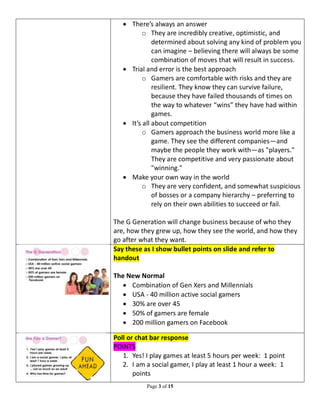
The Gamers! Known as the G Generation 
The G Generation – over 56 million strong – is a combination of 
Gen Xers (born between 1965 and 1981) and the Millennials 
(born since 1982).
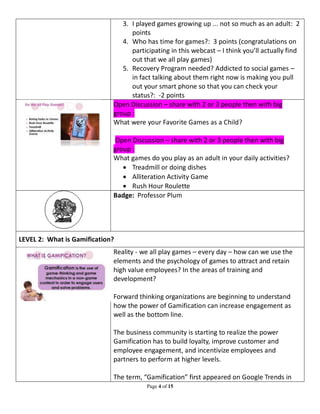
Right now the G Generation is moving up in the business ranks, 
becoming managers, partners, and eventually CEOs. Chances 
are you manage employees from this generation, and in all 
likelihood, before you leave your career, you may be managed 
by them. 
Before long, their way of thinking will pass the tipping point 
and become standard operating procedure in business. 
POINTS 
If you manage someone from the G Generation (born after 
1971) – 1 point 
If you are G Generation and you are a manager (born after 
1971) – 2 points 
And the Boomers (born between 1946 and 1964), who grew up 
without video games, will have to understand the gamers. That 
means not only learning what they’re all about, but finding 
ways to redesign organizational on-boarding, engagement, 
training, and even how work is done. 
If that sounds unlikely or unreasonable, you may — like me 
and many people — have not realized the influence that video 
games have inserted into all areas of our culture. 
In the book Outliers, Malcolm Gladwell says that to be an 
expert in your field requires a devotion to one’s craft for at 
least 10,000 hours. 
And a dedicated gamer will spend 10,000 hours playing by the 
time they turn 21 – the time it takes to become an “expert.” 
Badge: If you’ve read a book by Malcolm Gladwell – Fan Of 
Wild Hair Gurus Badge 
So the question is, just what exactly has the G Generation 
become experts at? And how have these 10,000 hours affected 
the way the G Generation views the business world? 
Refer to handout 
Page 2 of 15
 There’s always an answer 
o They are incredibly creative, optimistic, and 
determined about solving any kind of problem you 
can imagine – believing there will always be some 
combination of moves that will result in success. 
 Trial and error is the best approach 
o Gamers are comfortable with risks and they are 
resilient. They know they can survive failure, 
because they have failed thousands of times on 
the way to whatever “wins” they have had within 
games. 
 It’s all about competition 
o Gamers approach the business world more like a 
game. They see the different companies—and 
maybe the people they work with—as "players." 
They are competitive and very passionate about 
"winning." 
 Make your own way in the world 
o They are very confident, and somewhat suspicious 
of bosses or a company hierarchy – preferring to 
rely on their own abilities to succeed or fail. 
The G Generation will change business because of who they 
are, how they grew up, how they see the world, and how they 
go after what they want. 
Say these as I show bullet points on slide and refer to 
handout 
The New Normal 
 Combination of Gen Xers and Millennials 
 USA - 40 million active social gamers 
 30% are over 45 
 50% of gamers are female 
 200 million gamers on Facebook 
Poll or chat bar response 
POINTS 
1. Yes! I play games at least 5 hours per week: 1 point 
2. I am a social gamer, I play at least 1 hour a week: 1 
points 
Page 3 of 15
3. I played games growing up ... not so much as an adult: 2 
points 
4. Who has time for games?: 3 points (congratulations on 
participating in this webcast – I think you’ll actually find 
out that we all play games) 
5. Recovery Program needed? Addicted to social games – 
in fact talking about them right now is making you pull 
out your smart phone so that you can check your 
status?: -2 points 
Open Discussion – share with 2 or 3 people then with big 
group : 
What were your Favorite Games as a Child? 
Open Discussion – share with 2 or 3 people then with big 
group : 
What games do you play as an adult in your daily activities? 
 Treadmill or doing dishes 
 Alliteration Activity Game 
 Rush Hour Roulette 
Badge: Professor Plum 
Page 4 of 15 
LEVEL 2: What is Gamification? 
Reality - we all play games – every day – how can we use the 
elements and the psychology of games to attract and retain 
high value employees? In the areas of training and 
development? 
Forward thinking organizations are beginning to understand 
how the power of Gamification can increase engagement as 
well as the bottom line. 
The business community is starting to realize the power 
Gamification has to build loyalty, improve customer and 
employee engagement, and incentivize employees and 
partners to perform at higher levels. 
The term, “Gamification” first appeared on Google Trends in
September 2010. It is currently a $100 million a year industry, 
expected to swell to $2.8 billion by 2015 and 5.8 billion by 
2018. 
With a trend like this, is it any wonder PepsiCo is planning the 
implementation of Gamification for employee motivation and 
engagement efforts? 
Walk through examples on slides 
 McDonald’s Monopoly Game. Since 1989 – 6-7% 
increase in revenue 
 FFP or Frequent flyer programs. 
 Foursquare, the location-based social network. 
o People "check in" to places via their phones. 
o Users are awarded badges for going out and 
experiencing new things. 
o And the more they frequent a place, the higher 
their status becomes. 
o They may become the "mayor" of their coffee 
shop, potentially opening the door to discounts 
and other prizes. 
POINTS 
Make a list of the FFP programs that you use. 
Coffee, dry cleaner, restaurants, hotels, rental cars, airlines, 
grocery stores, even Big Lots has a program and offer discounts 
and special shopping hours. Give yourself a point for each FFP 
program with a max of 5 
So what about in your organization? Can you use Gamification 
internally to motivate employees or in a specific project? 
Getting started with gamification can be overwhelming and a 
bit intimidating. 
Gamification always should start with 3 major components: 
1. Business Objectives 
2. Player Profile 
3. Good Game Design 
Page 5 of 15
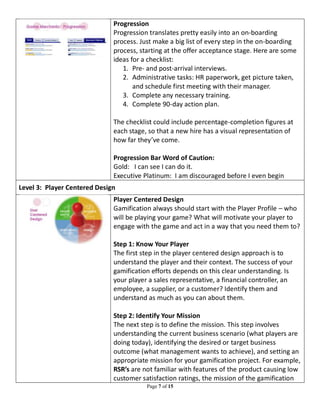
Let’s start with Business Objectives 
Gartner Research Group predicts that by the end of this year - 
80% of gamified business applications will fail to meet their 
business objectives. No different than any other change 
initiative in the workplace. 
Before you start the gamification design process, you should 
ask 
 What are your business objectives? 
 Why are we gamifying this process or project? 
 Will gamification help us to meet our business 
objectives? 
Open discussion: What specific business/learning objectives 
and resulting actions might you gamify for your team? 
There is space in your handout to record your ideas 
Badge: Creative Contributor if you participated in discussion. 
Recap: The goals should be as narrow as possible to help you 
tailor your gamified activities and also to allow you to assess 
the success of the project following completion. 
Let’s use the example of on-boarding of new high value staff 
members. 
 It is estimated that 50 to 60 percent of new hires quit 
within the first six months of their employment. 
 Evidence suggests a mismatch between expectations 
and actual job responsibilities plays a significant role in 
early turnover, job dissatisfaction and low morale. 
 By gamifying certain processes along the way – for 
example, filling out forms, taking sexual-harassment 
courses, and learning about the company policies – you 
can improve the rate at which these tasks are 
completed, eliminate confusion and have a clear, well-defined 
plan of action for new hires. 
Page 6 of 15
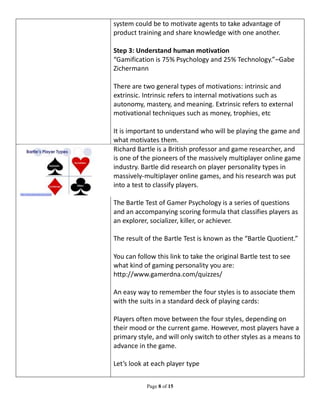
Progression 
Progression translates pretty easily into an on-boarding 
process. Just make a big list of every step in the on-boarding 
process, starting at the offer acceptance stage. Here are some 
ideas for a checklist: 
1. Pre- and post-arrival interviews. 
2. Administrative tasks: HR paperwork, get picture taken, 
and schedule first meeting with their manager. 
3. Complete any necessary training. 
4. Complete 90-day action plan. 
The checklist could include percentage-completion figures at 
each stage, so that a new hire has a visual representation of 
how far they’ve come. 
Progression Bar Word of Caution: 
Gold: I can see I can do it. 
Executive Platinum: I am discouraged before I even begin 
Page 7 of 15 
Level 3: Player Centered Design 
Player Centered Design 
Gamification always should start with the Player Profile – who 
will be playing your game? What will motivate your player to 
engage with the game and act in a way that you need them to? 
Step 1: Know Your Player 
The first step in the player centered design approach is to 
understand the player and their context. The success of your 
gamification efforts depends on this clear understanding. Is 
your player a sales representative, a financial controller, an 
employee, a supplier, or a customer? Identify them and 
understand as much as you can about them. 
Step 2: Identify Your Mission 
The next step is to define the mission. This step involves 
understanding the current business scenario (what players are 
doing today), identifying the desired or target business 
outcome (what management wants to achieve), and setting an 
appropriate mission for your gamification project. For example, 
RSR’s are not familiar with features of the product causing low 
customer satisfaction ratings, the mission of the gamification
system could be to motivate agents to take advantage of 
product training and share knowledge with one another. 
Step 3: Understand human motivation 
“Gamification is 75% Psychology and 25% Technology.”–Gabe 
Zichermann 
There are two general types of motivations: intrinsic and 
extrinsic. Intrinsic refers to internal motivations such as 
autonomy, mastery, and meaning. Extrinsic refers to external 
motivational techniques such as money, trophies, etc 
It is important to understand who will be playing the game and 
what motivates them. 
Richard Bartle is a British professor and game researcher, and 
is one of the pioneers of the massively multiplayer online game 
industry. Bartle did research on player personality types in 
massively-multiplayer online games, and his research was put 
into a test to classify players. 
The Bartle Test of Gamer Psychology is a series of questions 
and an accompanying scoring formula that classifies players as 
an explorer, socializer, killer, or achiever. 
The result of the Bartle Test is known as the “Bartle Quotient.” 
You can follow this link to take the original Bartle test to see 
what kind of gaming personality you are: 
http://www.gamerdna.com/quizzes/ 
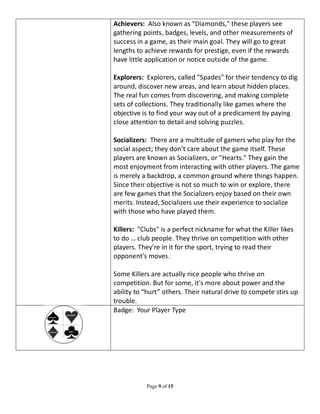
An easy way to remember the four styles is to associate them 
with the suits in a standard deck of playing cards: 
Players often move between the four styles, depending on 
their mood or the current game. However, most players have a 
primary style, and will only switch to other styles as a means to 
advance in the game. 
Let’s look at each player type 
Page 8 of 15
Achievers: Also known as "Diamonds," these players see 
gathering points, badges, levels, and other measurements of 
success in a game, as their main goal. They will go to great 
lengths to achieve rewards for prestige, even if the rewards 
have little application or notice outside of the game. 
Explorers: Explorers, called "Spades" for their tendency to dig 
around, discover new areas, and learn about hidden places. 
The real fun comes from discovering, and making complete 
sets of collections. They traditionally like games where the 
objective is to find your way out of a predicament by paying 
close attention to detail and solving puzzles. 
Socializers: There are a multitude of gamers who play for the 
social aspect; they don’t care about the game itself. These 
players are known as Socializers, or "Hearts." They gain the 
most enjoyment from interacting with other players. The game 
is merely a backdrop, a common ground where things happen. 
Since their objective is not so much to win or explore, there 
are few games that the Socializers enjoy based on their own 
merits. Instead, Socializers use their experience to socialize 
with those who have played them. 
Killers: "Clubs" is a perfect nickname for what the Killer likes 
to do … club people. They thrive on competition with other 
players. They're in it for the sport, trying to read their 
opponent's moves. 
Some Killers are actually nice people who thrive on 
competition. But for some, it's more about power and the 
ability to “hurt” others. Their natural drive to compete stirs up 
trouble. 
Badge: Your Player Type 
Page 9 of 15
Page 10 of 15 
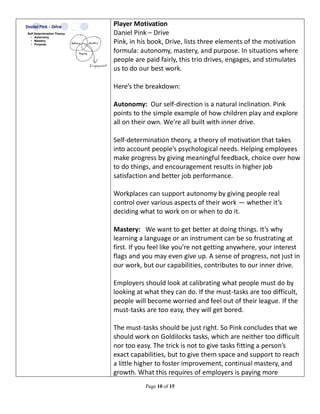
Self Determination Theory: 
• Autonomy 
• Mastery 
• Purpose 
Player Motivation 
Daniel Pink – Drive 
Pink, in his book, Drive, lists three elements of the motivation 
formula: autonomy, mastery, and purpose. In situations where 
people are paid fairly, this trio drives, engages, and stimulates 
us to do our best work. 
Here’s the breakdown: 
Autonomy: Our self-direction is a natural inclination. Pink 
points to the simple example of how children play and explore 
all on their own. We’re all built with inner drive. 
Self-determination theory, a theory of motivation that takes 
into account people’s psychological needs. Helping employees 
make progress by giving meaningful feedback, choice over how 
to do things, and encouragement results in higher job 
satisfaction and better job performance. 
Workplaces can support autonomy by giving people real 
control over various aspects of their work — whether it’s 
deciding what to work on or when to do it. 
Mastery: We want to get better at doing things. It’s why 
learning a language or an instrument can be so frustrating at 
first. If you feel like you’re not getting anywhere, your interest 
flags and you may even give up. A sense of progress, not just in 
our work, but our capabilities, contributes to our inner drive. 
Employers should look at calibrating what people must do by 
looking at what they can do. If the must-tasks are too difficult, 
people will become worried and feel out of their league. If the 
must-tasks are too easy, they will get bored. 
The must-tasks should be just right. So Pink concludes that we 
should work on Goldilocks tasks, which are neither too difficult 
nor too easy. The trick is not to give tasks fitting a person’s 
exact capabilities, but to give them space and support to reach 
a little higher to foster improvement, continual mastery, and 
growth. What this requires of employers is paying more
attention to how employees are doing and feeling about their 
tasks in order to avoid keeping square Bob or triangle Mary 
from trying and losing heart at fitting into round tasks. 
Purpose: People who find purpose in their work unlock the 
highest level of the motivation game. Pink says that it’s 
connecting to a cause larger than yourself that drives the 
deepest motivation. Purpose is what gets you out of bed in the 
morning and into work without groaning and grumbling — 
something that you just can’t fake. 
Successful gamification should bring out learning as a natural 
by-product of a pleasant and fun experience, not as a forced 
outcome. 
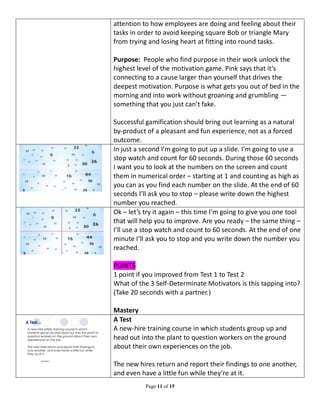
In just a second I’m going to put up a slide. I’m going to use a 
stop watch and count for 60 seconds. During those 60 seconds 
I want you to look at the numbers on the screen and count 
them in numerical order – starting at 1 and counting as high as 
you can as you find each number on the slide. At the end of 60 
seconds I’ll ask you to stop – please write down the highest 
number you reached. 
Ok – let’s try it again – this time I’m going to give you one tool 
that will help you to improve. Are you ready – the same thing – 
I’ll use a stop watch and count to 60 seconds. At the end of one 
minute I’ll ask you to stop and you write down the number you 
reached. 
POINTS 
1 point if you improved from Test 1 to Test 2 
What of the 3 Self-Determinate Motivators is this tapping into? 
(Take 20 seconds with a partner.) 
Page 11 of 15 
Mastery 
A new-hire safety training course in which 
students group up and head out into the plant to 
question workers on the ground about their own 
experiences on the job. 
The new hires return and report their findings to 
one another, and even have a little fun while 
they’re at it. 
Autonomy 
A Test 
A new-hire training course in which students group up and 
head out into the plant to question workers on the ground 
about their own experiences on the job. 
The new hires return and report their findings to one another, 
and even have a little fun while they’re at it.
What of the 3 Self-Determinate Motivators is this tapping into? 
(Take 20 seconds with a partner.) 
Autonomy - The quest to seek out information on their own 
radically transforms what easily could have been another 
boring training seminar. 
Page 12 of 15 
Company goals are clearly explained to new 
employees. 
Using the principle of “cascading information,” 
new workers are then given goals one at a time. 
A second goal is given only when the first is 
finished. 
Cascading information delivery gives the 
employee incentive to get to the “next” goal. 
Purpose 
Try Another: 
Company goals are clearly explained to new employees. 
Using the principle of “cascading information,” new workers 
are then given goals one at a time. A second goal is given only 
when the first is finished. (“Finished,” in this case, can mean a 
lot of different things — maybe they’ve written out a plan, or 
maybe they’ve actually completed a definite task.) 
The cascading nature of information delivery in this case gives 
the new employee some incentive to get to the “next” goal. 
Done well – they company clearly explains their goals to new 
employees. That allows employees to set their own goals in 
support of the greater, company-wide ones. 
What of the 3 Self-Determinate Motivators is this tapping into? 
(Take 20 seconds with a partner.) 
Purpose: Purposeful work is created when employees know 
how their performance contributes to the progress of the 
organization. 
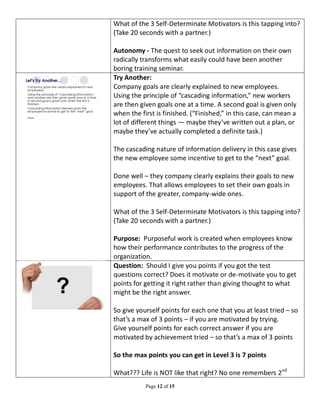
Question: Should I give you points if you got the test 
questions correct? Does it motivate or de-motivate you to get 
points for getting it right rather than giving thought to what 
might be the right answer. 
So give yourself points for each one that you at least tried – so 
that’s a max of 3 points – if you are motivated by trying. 
Give yourself points for each correct answer if you are 
motivated by achievement tried – so that’s a max of 3 points 
So the max points you can get in Level 3 is 7 points 
What??? Life is NOT like that right? No one remembers 2nd
place? You’re in a competitive sales environment – make sure 
your gamification is player centric – it’s different than if you 
were going to do consumer facing gamification where you 
would reward them for their engagement with you as a brand. 
Page 13 of 15 
Level 4: Gamification Simplified 
Do work and fun need to be mutually exclusive 
in a professional and profitable company 
such as yours? 
www.monicacornetti.com 
You’re probably thinking – no – of course not. 
But then when we think about managing employees, dealing 
with difficult people, handling the required training for new 
hires or internal policies and procedures – sometimes that 
doesn’t seem so fun… 
And yet, are you making work fun? Have you worked to make 
training and learning fun? 
Points: 
1. Yes – we’re important people doing important work – it’s 
time to put down the games and get to work: -1 point 
2. No – of course not: 1 point 
3. If you said No – but haven’t made it fun: -2 points 
Check with the person next to you – with a smile on your face 
ask them, “Are you being honest?” 
Badge: If you truly believe that learning can be fun and that 
work and fun do not have to be mutually exclusive – give 
yourself the “Learning is Fun” Badge 
Gamification is the use of 
and techniques 
in . 
www.monicacornetti.com 
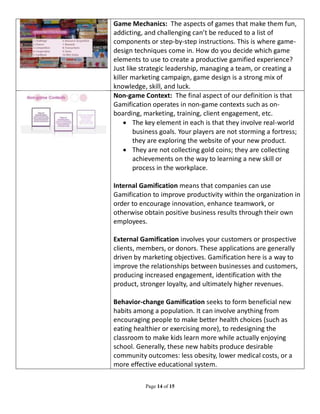
Gamification is the use of game elements and game-design 
techniques and mechanics in non-game contexts. Let me break 
that down for you 
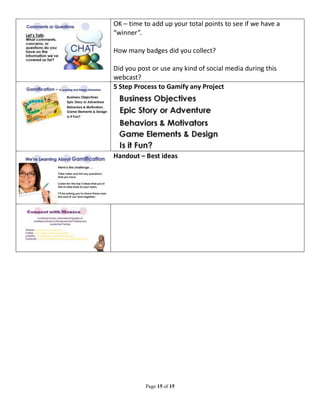
Refer to handout chart with game elements, game mechanics 
and non-game contexts on p.2 
1.Avatars 
2.Badges 
3.Collections 
4.Game Boards 
5.Leaderboards 
6.Levels 
7.Narrative 
8.Points 
Game Elements: Think of game elements as a toolkit for 
building a game. Game elements include game pieces, avatars, 
rules, scoring points, proceeding to the next level, receiving 
badges, or unlocking a reward. As you begin to gamify a 
system, you should modify the elements to target certain 
business objectives, and to make the experience more 
engaging.
Game Mechanics: The aspects of games that make them fun, 
addicting, and challenging can’t be reduced to a list of 
components or step-by-step instructions. This is where game-design 
techniques come in. How do you decide which game 
elements to use to create a productive gamified experience? 
Just like strategic leadership, managing a team, or creating a 
killer marketing campaign, game design is a strong mix of 
knowledge, skill, and luck. 
Non-game Context: The final aspect of our definition is that 
Gamification operates in non-game contexts such as on-boarding, 
marketing, training, client engagement, etc. 
 The key element in each is that they involve real-world 
business goals. Your players are not storming a fortress; 
they are exploring the website of your new product. 
 They are not collecting gold coins; they are collecting 
achievements on the way to learning a new skill or 
process in the workplace. 
Internal Gamification means that companies can use 
Gamification to improve productivity within the organization in 
order to encourage innovation, enhance teamwork, or 
otherwise obtain positive business results through their own 
employees. 
External Gamification involves your customers or prospective 
clients, members, or donors. These applications are generally 
driven by marketing objectives. Gamification here is a way to 
improve the relationships between businesses and customers, 
producing increased engagement, identification with the 
product, stronger loyalty, and ultimately higher revenues. 
Behavior-change Gamification seeks to form beneficial new 
habits among a population. It can involve anything from 
encouraging people to make better health choices (such as 
eating healthier or exercising more), to redesigning the 
classroom to make kids learn more while actually enjoying 
school. Generally, these new habits produce desirable 
community outcomes: less obesity, lower medical costs, or a 
more effective educational system. 
Page 14 of 15
OK – time to add up your total points to see if we have a 
“winner”. 
How many badges did you collect? 
Did you post or use any kind of social media during this 
webcast? 
5 Step Process to Gamify any Project 
Handout – Best ideas 
Page 15 of 15