Otto Freijser
Scaling Lean
Startup in an
Enterprise
Otto Freijser
Lean Startup Evangelist / Coach
@ofreijser
Sparking entrepreneurial action
Partner at:
enjoy helping teams in organisations such as:
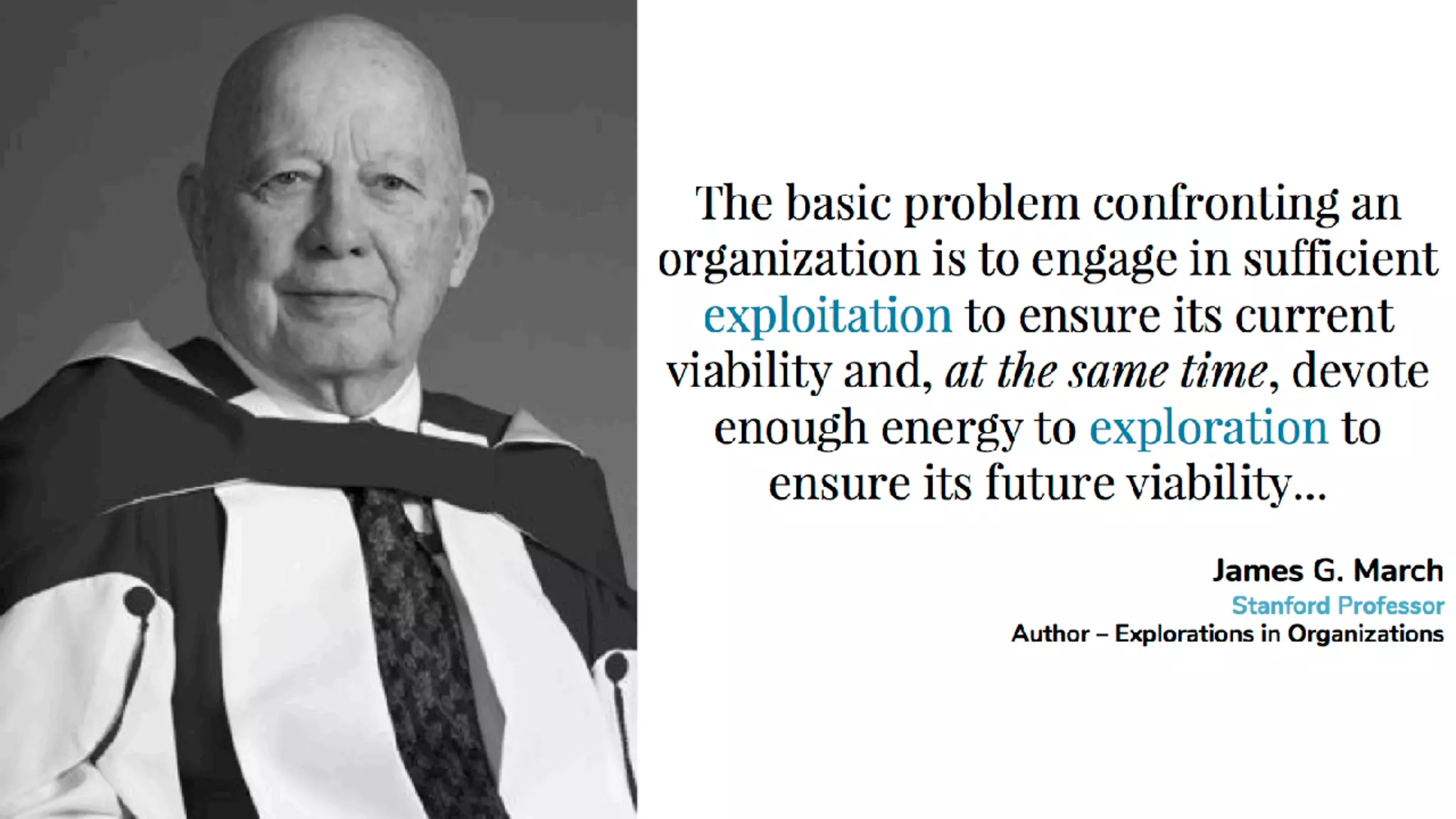
Standing on the shoulders of Giants ☺
Lean
Startup
for
corporate
s?
WE START
WITH A
VISION
WE PROCEED
WITHOUT
VALIDATING
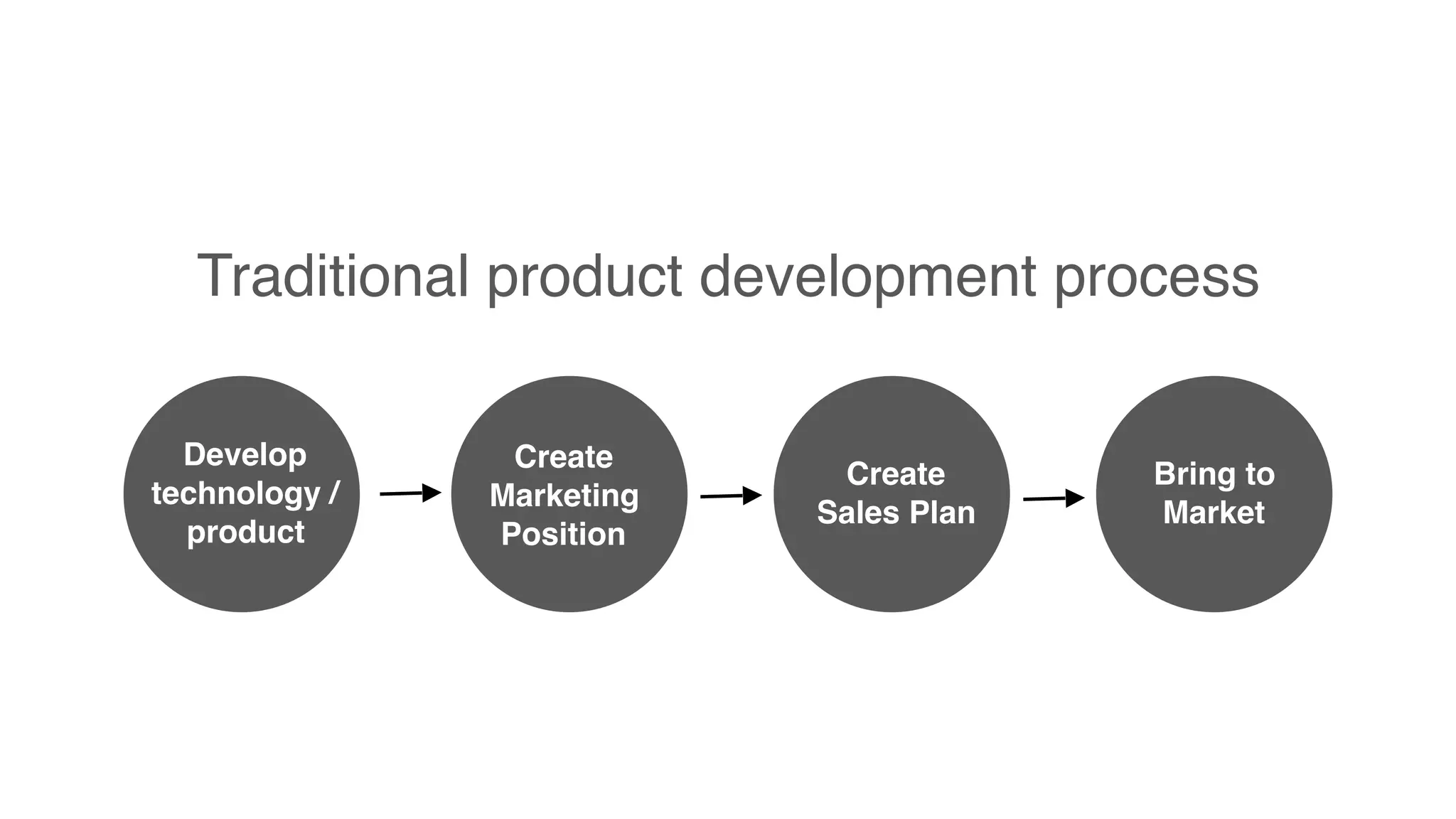
Traditional product development process
Develop
technology /
product
Create
Marketing
Position
Create
Sales Plan
Bring to
Market
Dr. Robert G. Cooper. “Doing It Right.” Product Development Institute. 2006 77%
Frost & Sullivan. “Growth Process Toolkit: New Product Development.” 2008 0.3%
Frost & Sullivan. “Growth Process Toolkit: New Product Development,” 2008. 1%
Andrew Campbell and Robert Park. “Stop Kissing Frogs.” Harvard Business Review. July-August 2004.
1%
Dr. John Sviokla. “The Calculus of Commerce.” DiamondCluster International. 2004 3%
Corporate Strategy Board. “Stall Points” 1998. Cited in Clayton Christensen and
Michal Raynor “The Innovator’s Solution.” page 5. 5%
Andrew Campbell and Robert Park. “Stop Kissing Frogs.” Harvard Business Review. July-August 2004.
10%
Kevin Clancy and Randy Stone. “Don’t Blame the Metrics.” Harvard Business Review. June 2005.
10%
Corporate Strategy Board. “Overcoming Stall Points.” 2006. 10%
PricewaterhouseCoopers. “Shaking the Money Tree.” Slide 33. US Venture Liquidity, 2001-2007. Q3 2008. 11%
Average: 17% of
product introductions
are successful
17
WE CAN’T AFFORD
TO MISS THE TARGET
NO DRAMATIC FAILURES
WE CAN LEARN
FROM STARTUPS
- Steve Blank
"A startup is not a
smaller version of a
big organisation."
"A human institution
designed to create a new
product or service under
conditions of extreme
uncertainty."
Eric Ries
How do you create a blockbuster new product?
Develop
technology /
product
Create
Marketing
Position
Create Sales
Plan
Bring to
MarketXXXX
No business plan
survives first
contact with
customers!
66%
Changes their
original plan –
drastically
Search Execution
Goal: Find a repeatable
and scalable business.
(internal) startup.
Goal: Execute on a given
business, financial, and
operating plan.
Process driven hierarchy.
Analysis
Requirement
Specification
Design
Development
Testing and
Integration
Implementation
/ Deployment
Goal: Find a repeatable
and scaleable business
Search Execution
LIFE’S TOO SHORT...
TO BUILD SOMETHING NOBODY
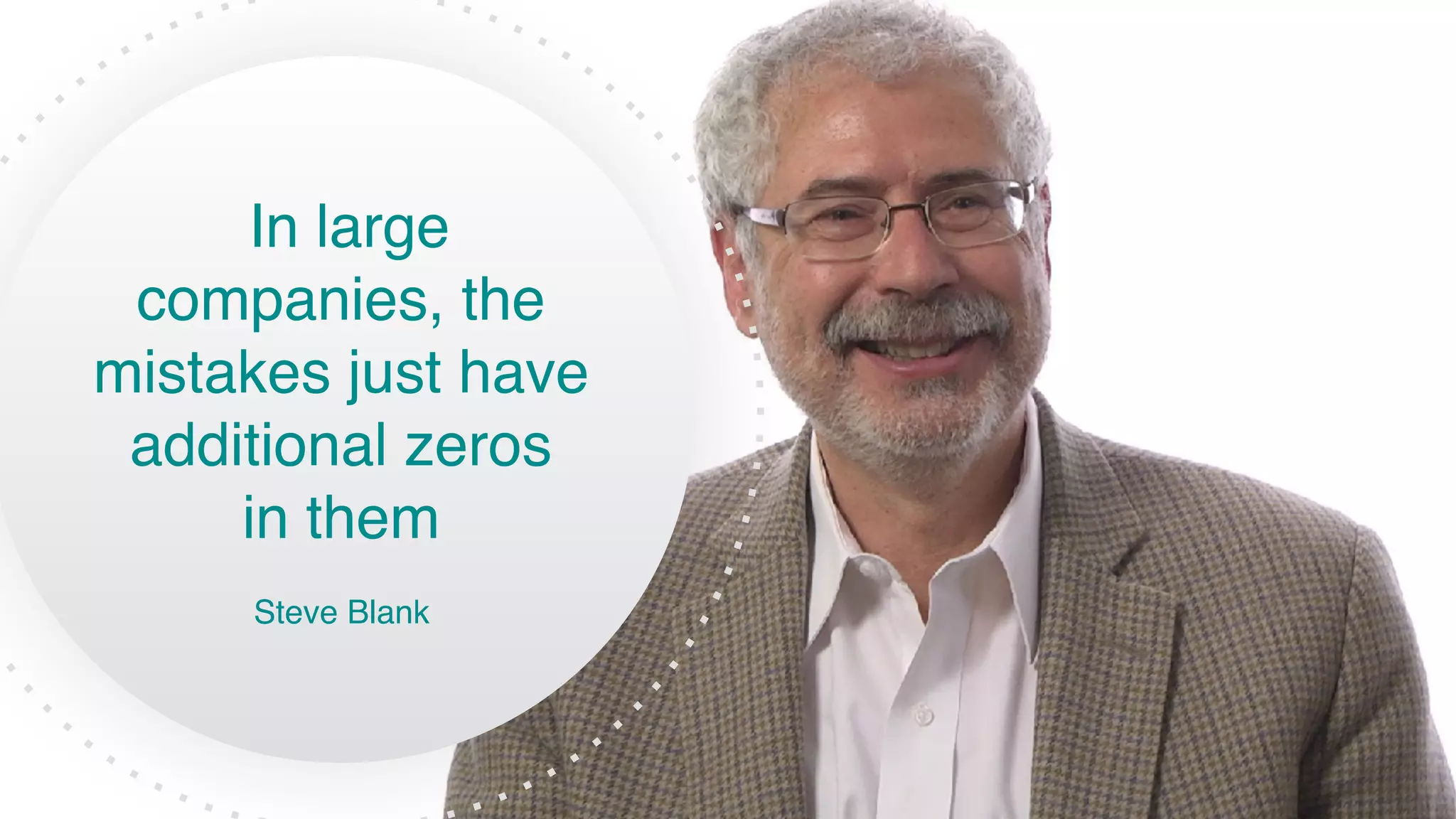
In large
companies, the
mistakes just have
additional zeros
in them
Steve Blank
Customer
discovery
Customer
validation
Search
Problem / Solution Fit Product / Market Fit
Pivot
Growth
Hacking
Company
Building
Execute
You learn by doing
You can't learn kung-fu by watching
Bruce Lee movies
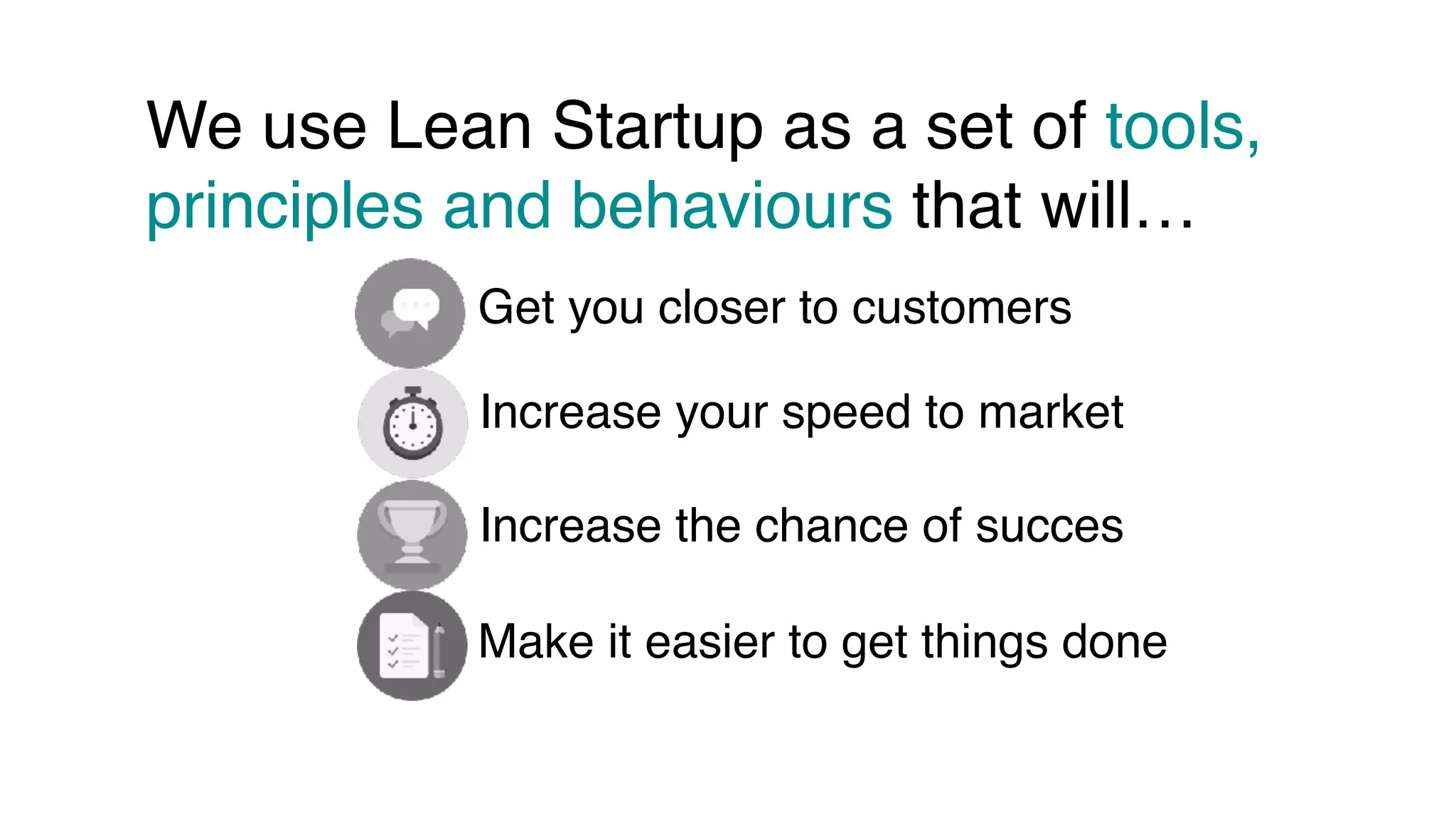
We use Lean Startup as a set of tools,
principles and behaviours that will…
Get you closer to customers
Increase your speed to market
Increase the chance of succes
Make it easier to get things done
“Lean startup is a basic philosophy that
systematically identifies risk in a business
model and designs research and
experimental methods to bring more certainty
to the business. We do this through rapid
iteration of our business model.”
Tristan Kromer
TRIKRO.com
Build
Measure
Learn (BML)
Learn Build
Meas
ure
Plan A assumptions
Every loop consists of one
or more experiments
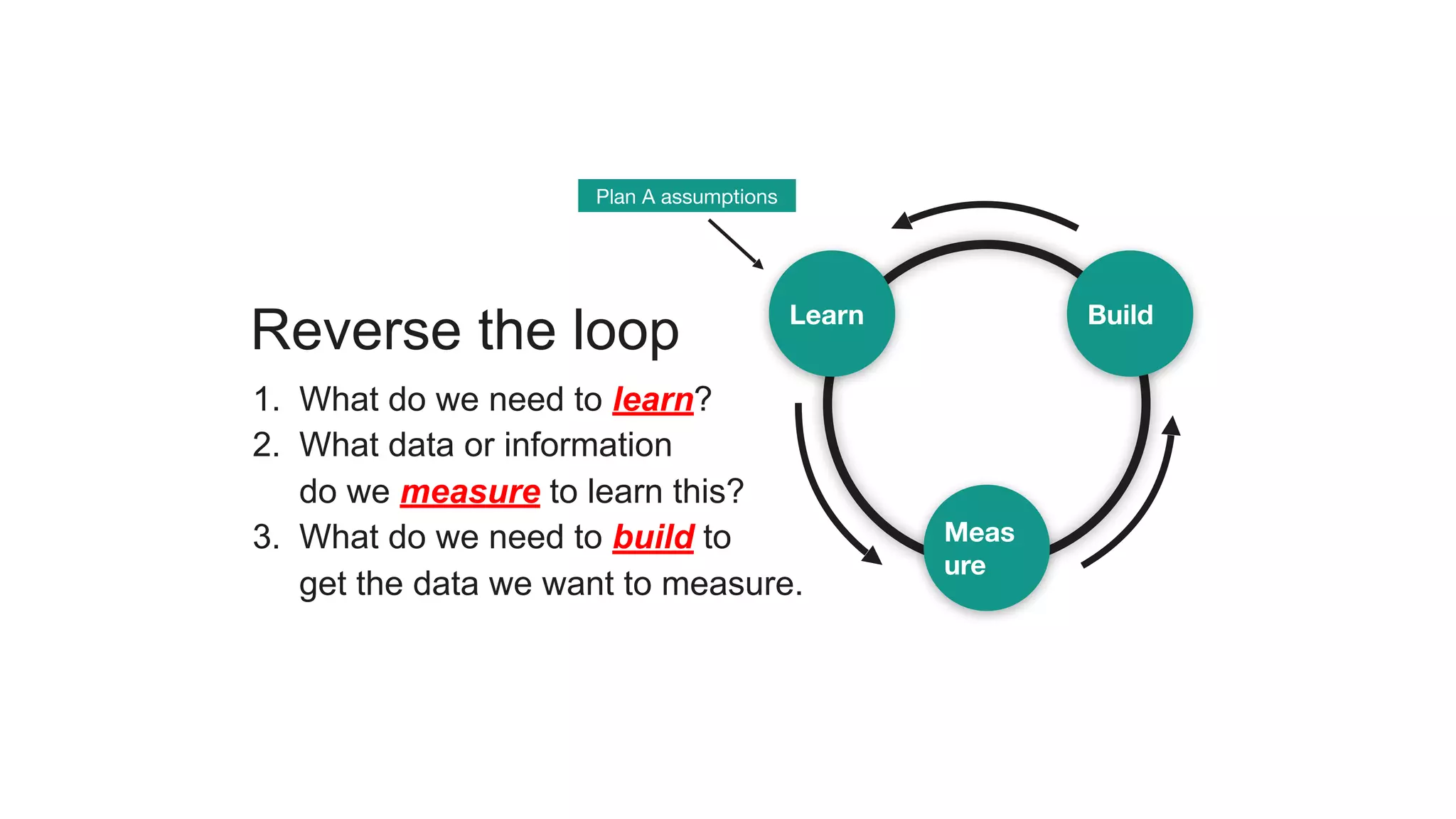
Reverse the loop Learn Build
Meas
ure
Plan A assumptions
1. What do we need to learn?
2. What data or information

do we measure to learn this?
3. What do we need to build to

get the data we want to measure.
So, how do we apply 

this to our corporate 

world?
O
u
r
f
i
r
s
t
e
i
g
h
t
i
d
U
n
a
c
c
e
p
t
a
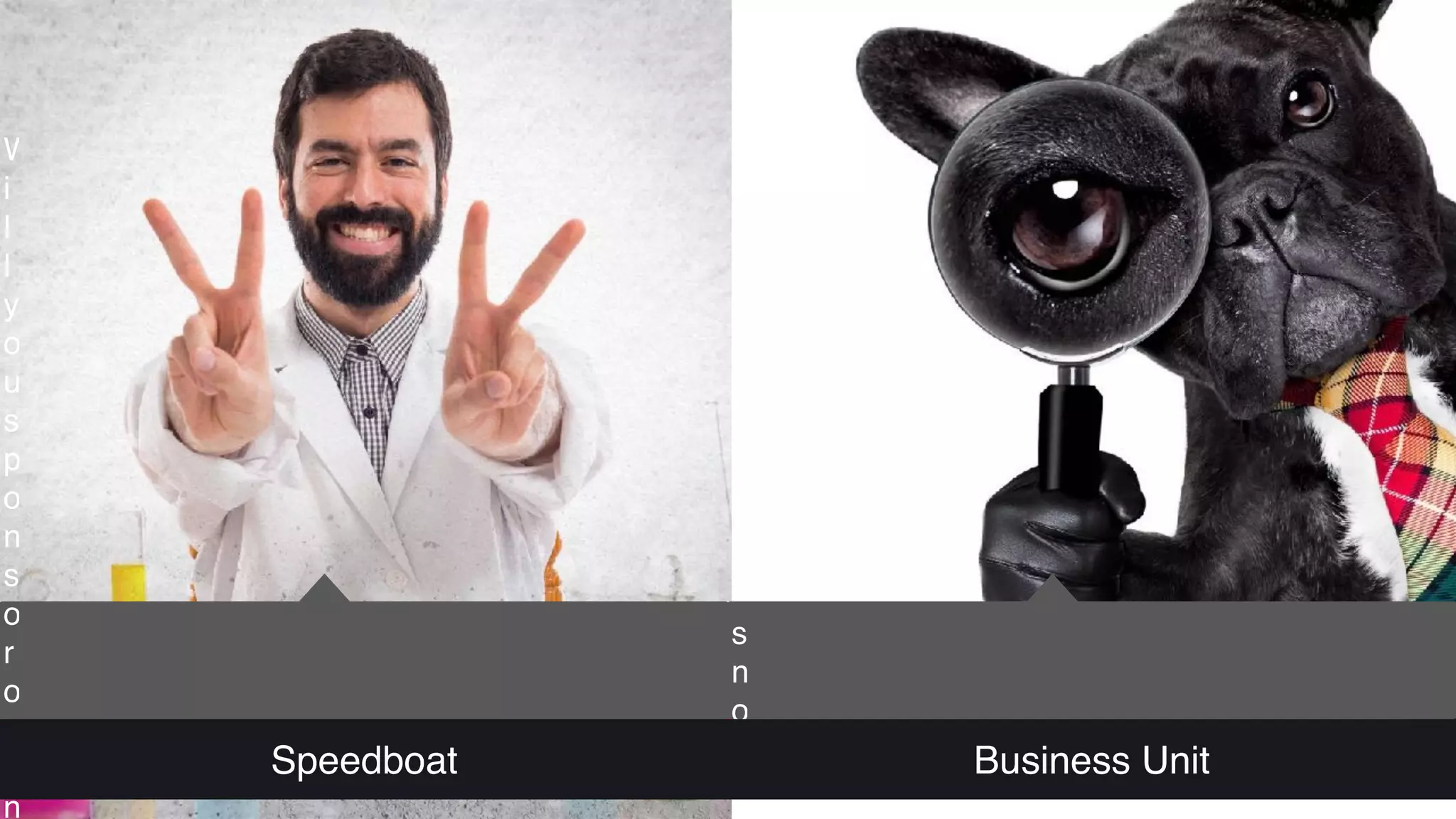
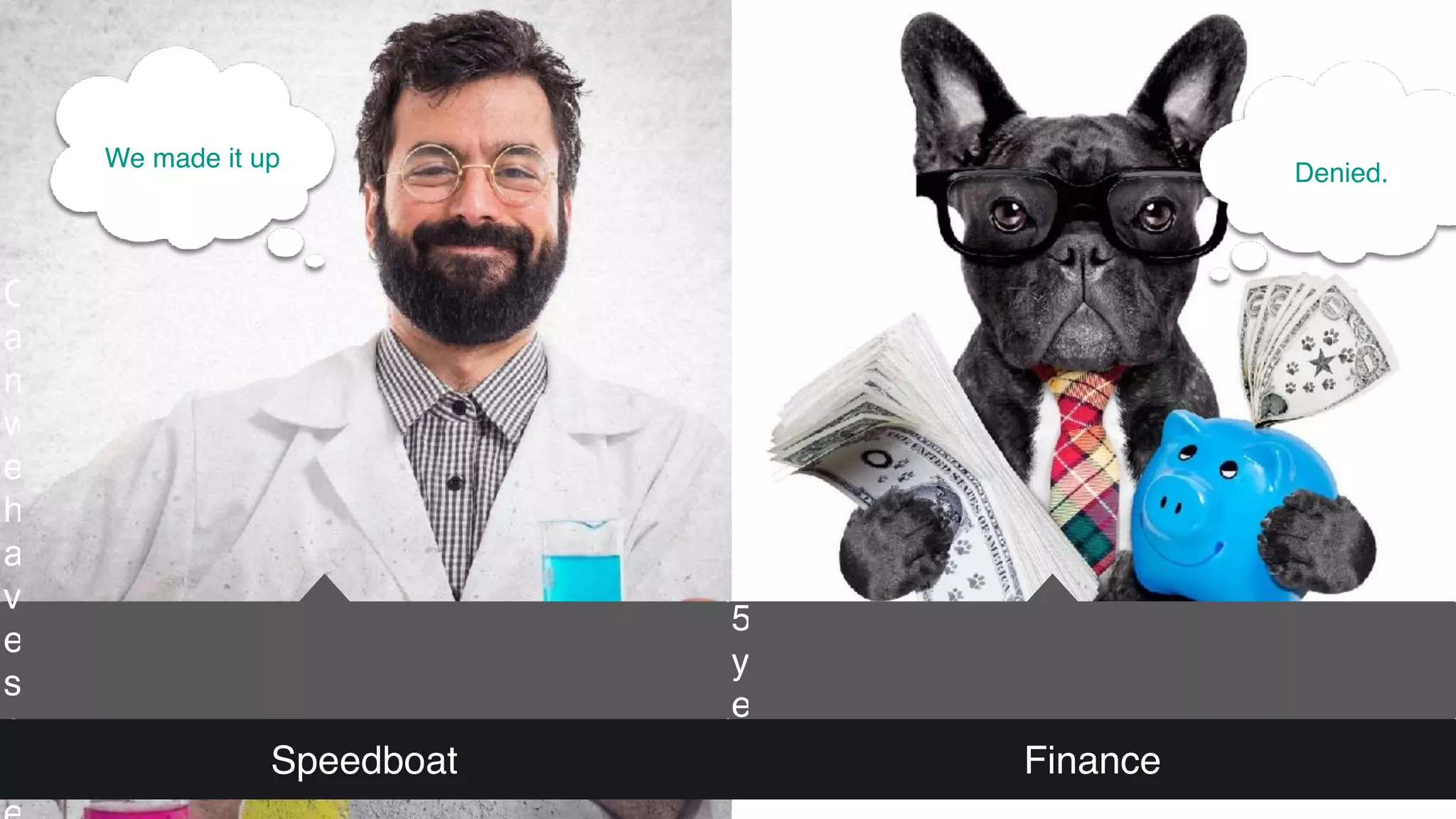
Speedboat Managers
T
o
t
a
l
l
y
b
r
a
n
d
n
e
n
’
t
h
a
v
e
p
r
e
c
e
d
e
n
c
e
f
o
r
t
Speedboat Lawyers
W
i
l
l
y
o
u
s
p
o
n
s
o
r
o
u
r
n
O
h
,
n
o
,
n
o
.
T
h
a
t
’
s
n
o
t
i
Speedboat Business Unit
C
a
n
w
e
h
a
v
e
s
o
m
W
h
a
t
’
s
y
o
u
r
5
y
e
a
r
Speedboat Finance
We made it up
Denied.
50
STARTUP
ENDUP
How do you become
big without breaking?
Install an ‘OS’,
that assumes
that you
are wrong
“Duh” – Peter Senge
”New Corporate” = Ambidextrous / Dual-core
+
Combining Search (Speed) & Execution (Efficiency)
A ? A B
Startup = Speedboot Corporate = Oil tanker
Fast
Scaling
Organize
for Innovation
Fast
Scaling
Organize
for Innovation
INNOVATION STAGES
VISIONING GOVERNANCE EXPLORE EXPERIMENT
Macro
economic
Forces
Industry
forces
Market
Forces
Key
Trends
Company
Goal / Way to PlayVisioning
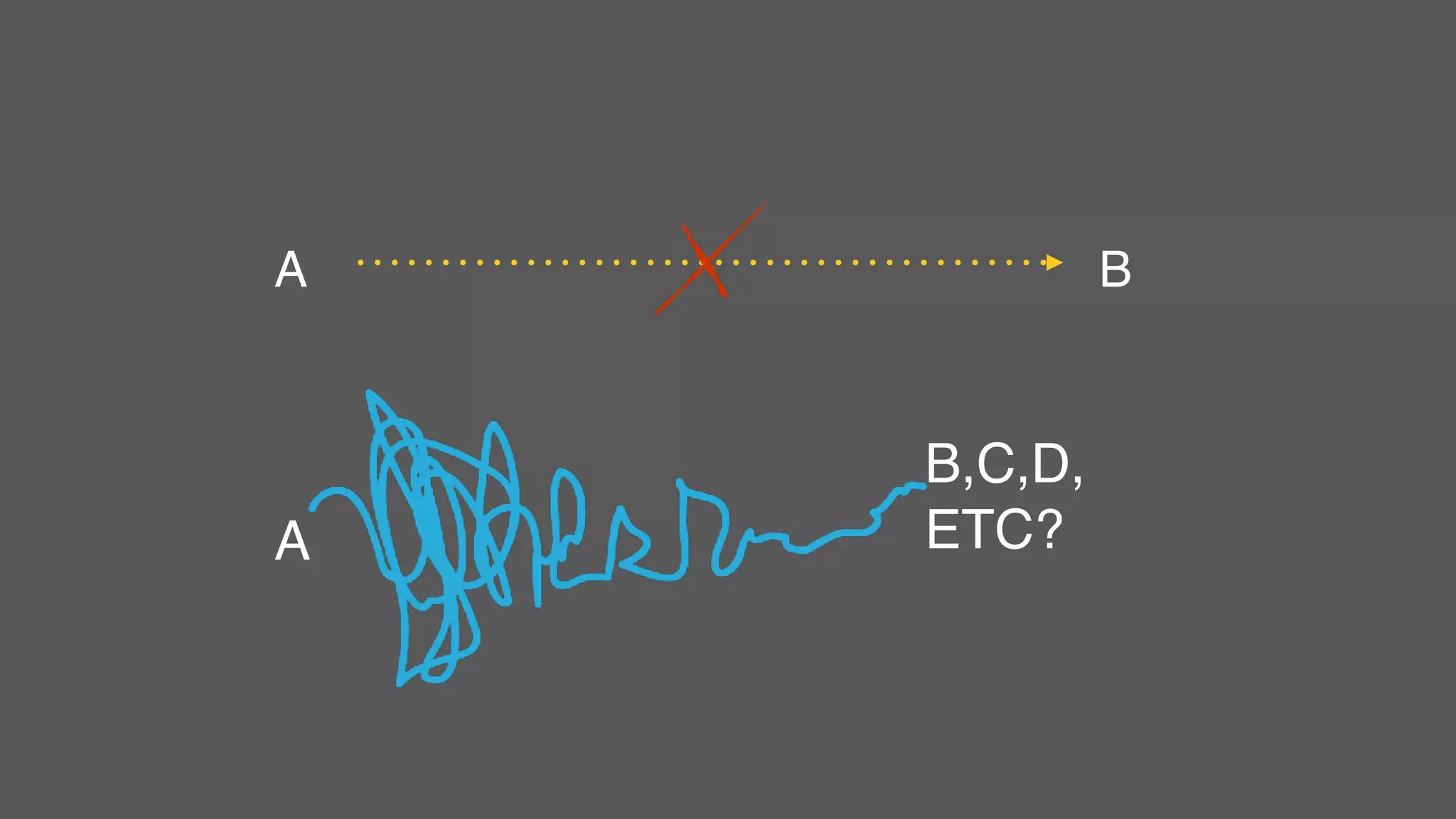
A
B,C,D,
ETC?
A B
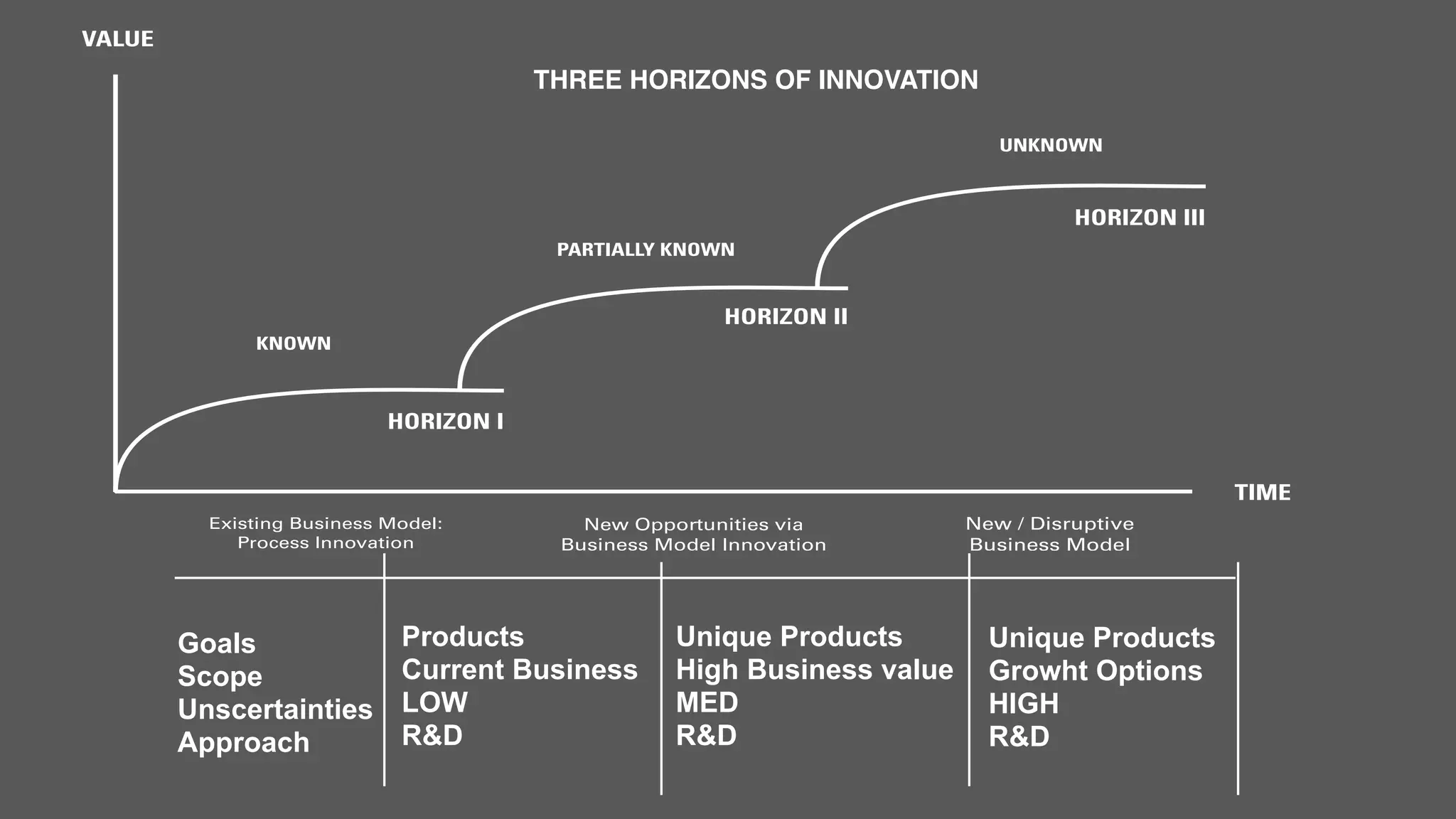
THREE HORIZONS OF INNOVATION
Goals
Scope
Unscertainties
Approach
Unique Products
Growht Options
HIGH
R&D
Unique Products
High Business value
MED
R&D
Products
Current Business
LOW
R&D
Supporting innovation project teams
Innovation
Accounting
AAARR
VS
Execution
Financial
KPI
measure relevant progress
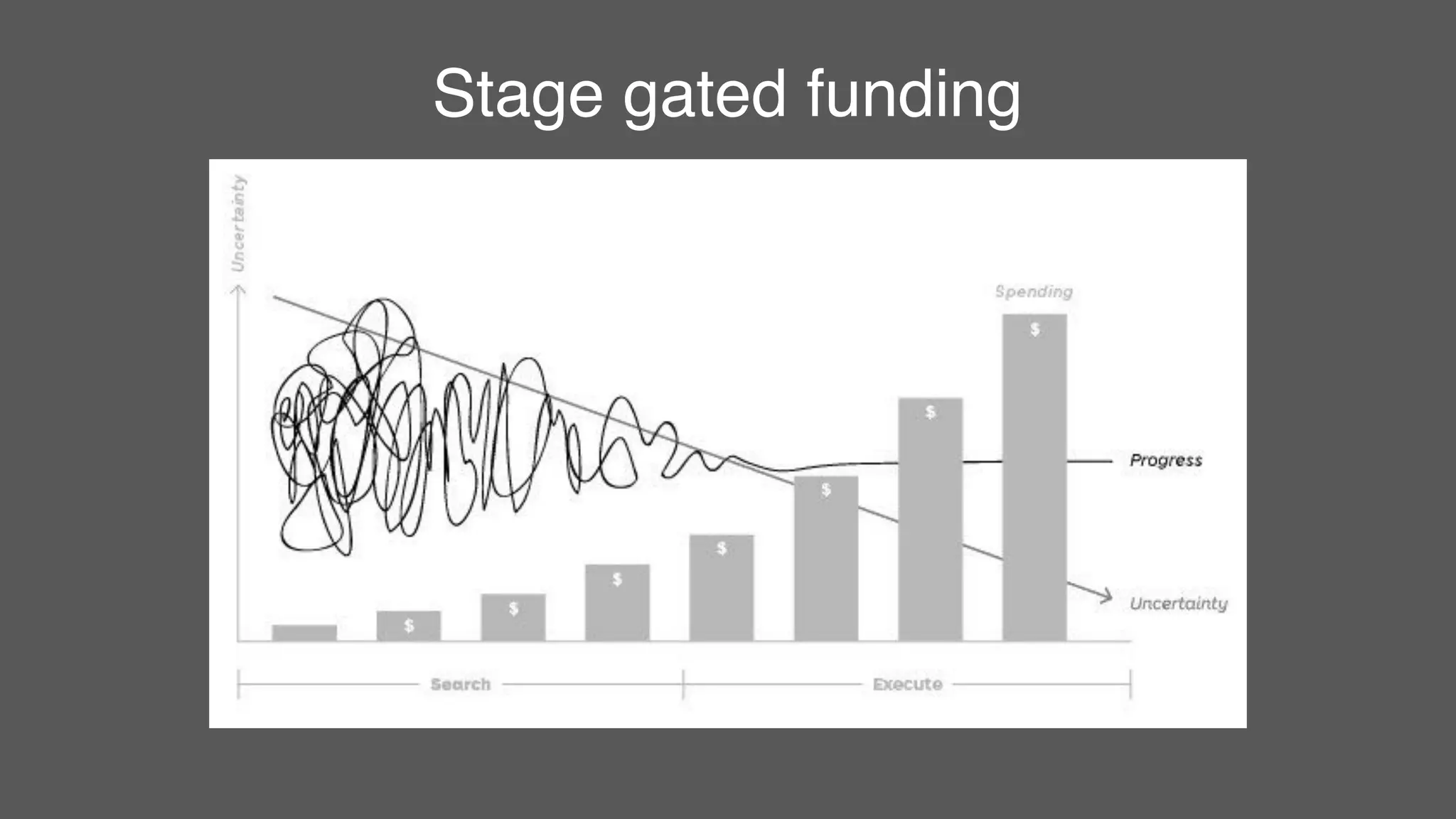
Stage gated funding
don’t DO Innovation, manage the Innovation Funnel
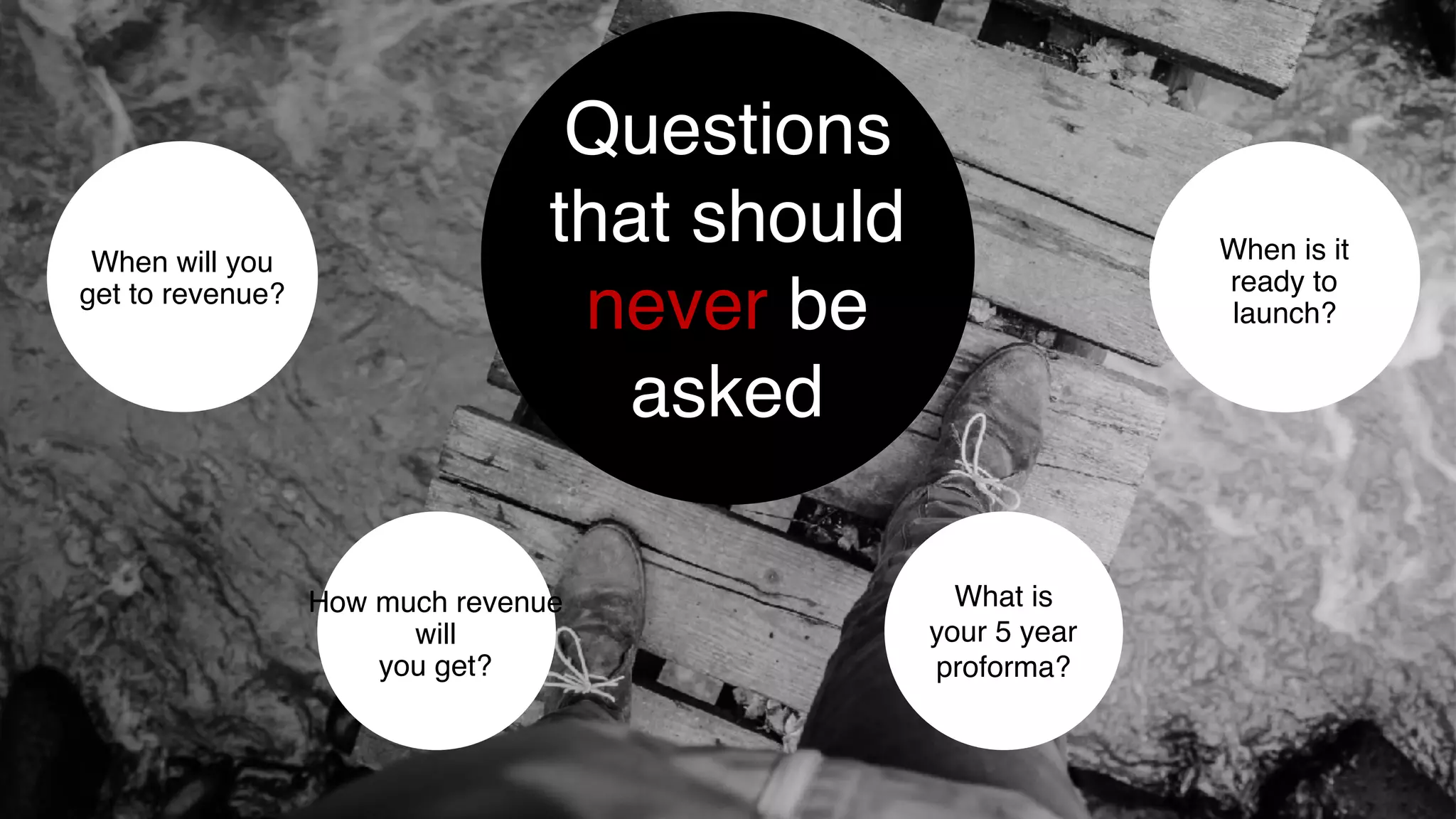
When will you
get to revenue?
What is
your 5 year
proforma?
When is it
ready to
launch?
How much revenue
will
you get?
Questions
that should
never be
asked
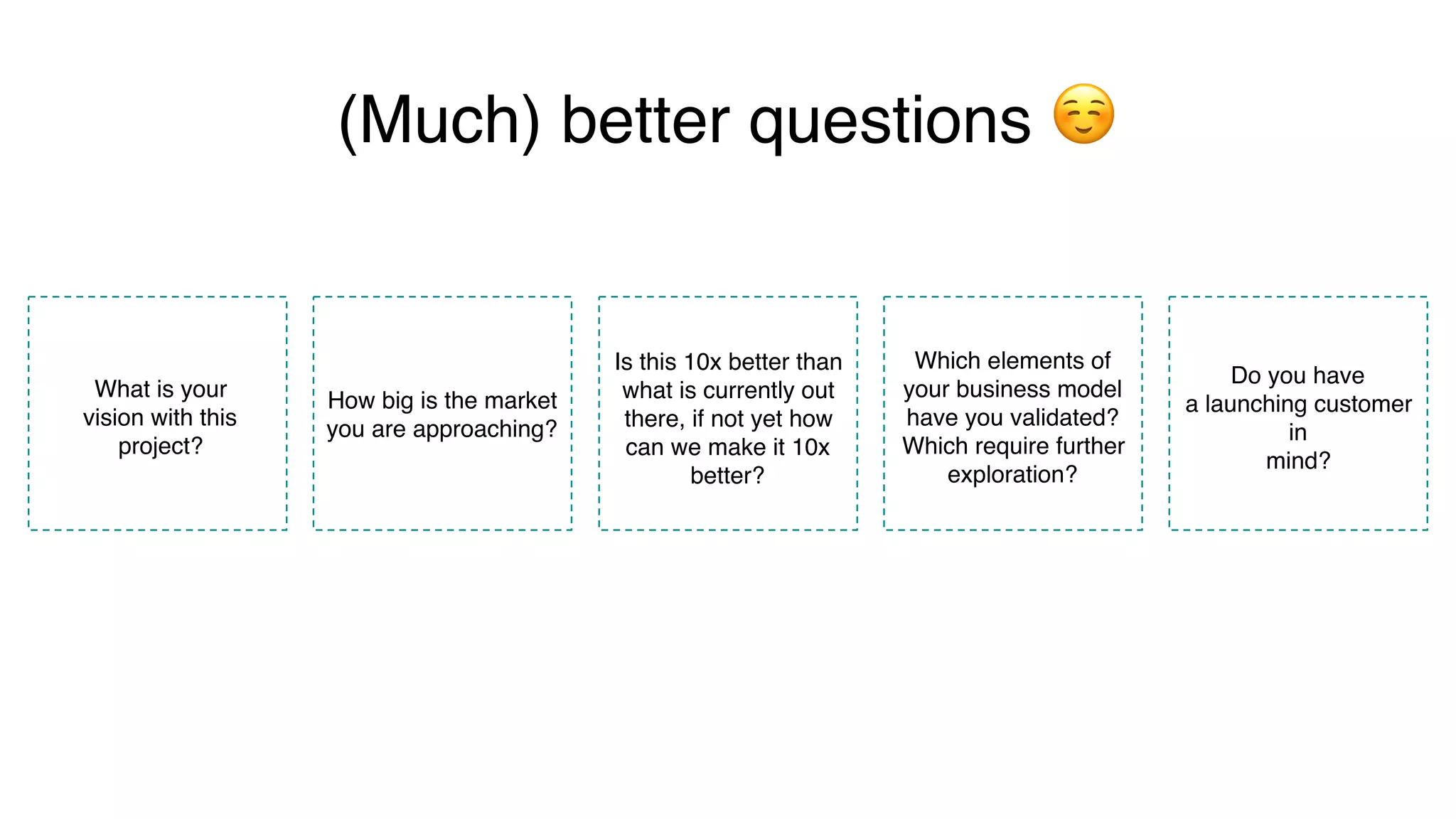
(Much) better questions ☺
What is your
vision with this
project?
How big is the market
you are approaching?
Which elements of
your business model
have you validated?
Which require further
exploration?
Do you have
a launching customer
in
mind?
Is this 10x better than
what is currently out
there, if not yet how
can we make it 10x
better?
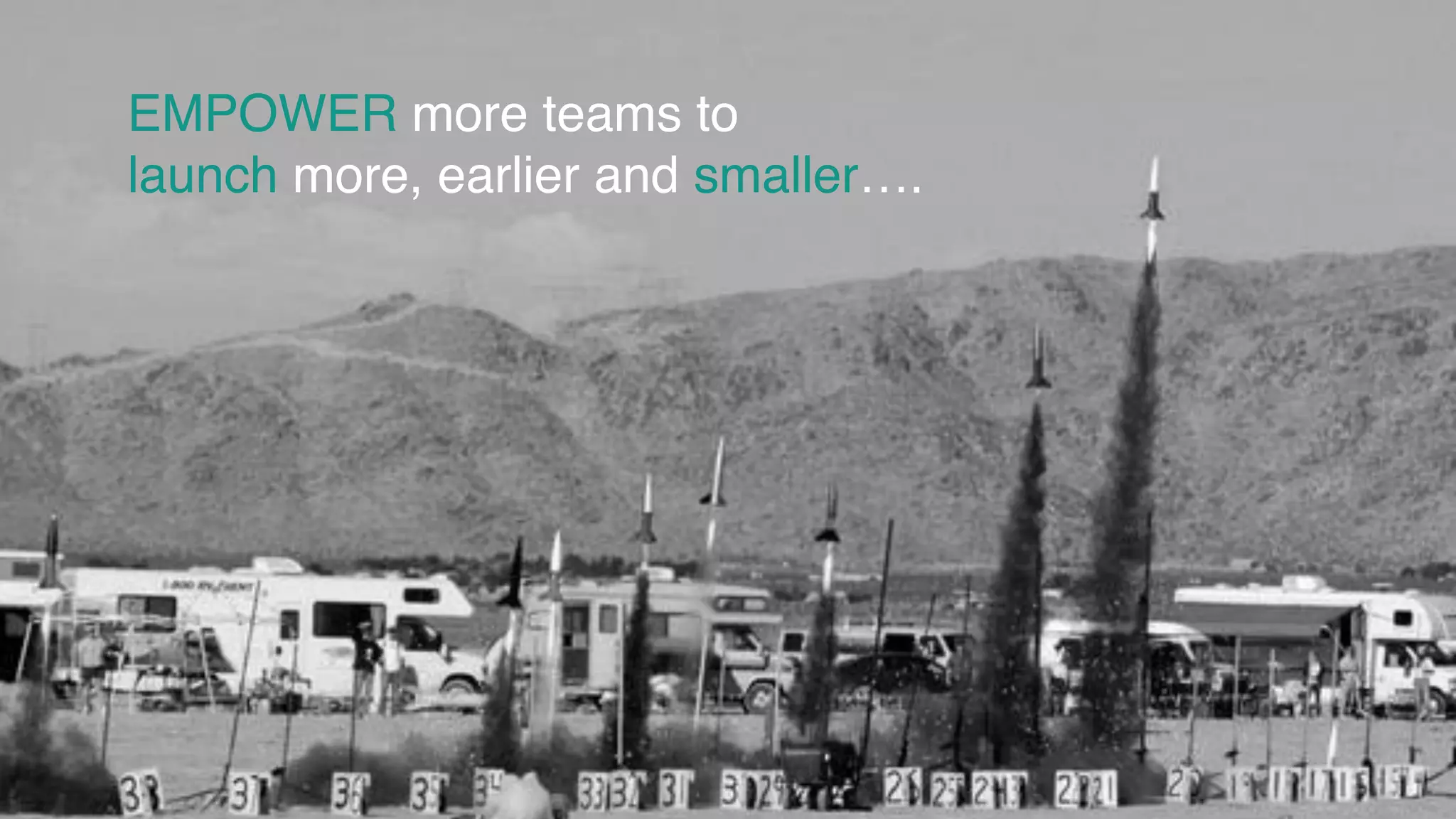
EMPOWER more teams to
launch more, earlier and smaller….
Cool Solution
Customer
Customer
Customer
Customer
Customer
X
X
X
X
X
☹€ €
€
Solution-first Thinking
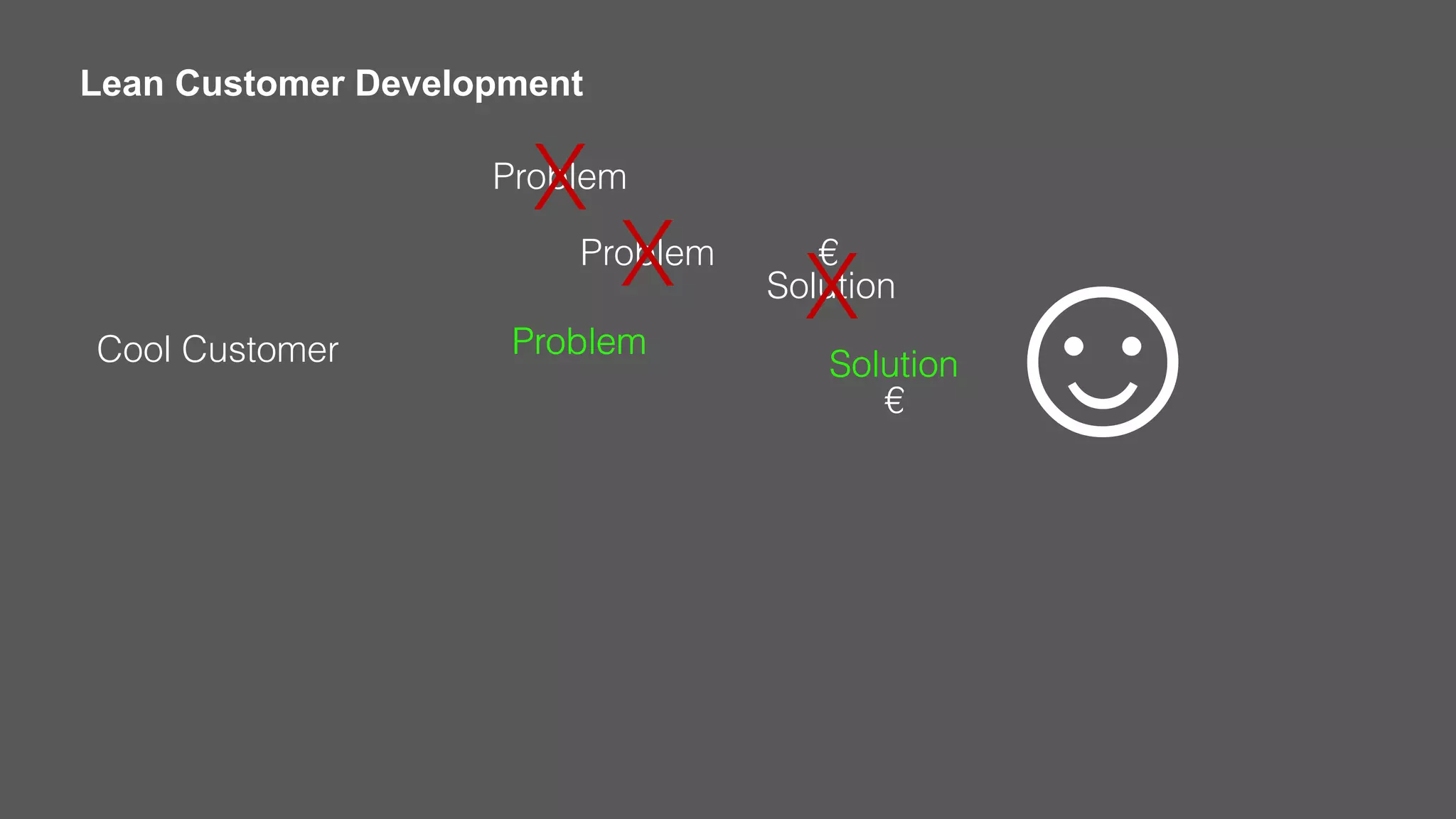
Cool Customer
Problem
Problem
Problem
X
X
☺Problem
Solution
X
SolutionSolution
€
€
Lean Customer Development
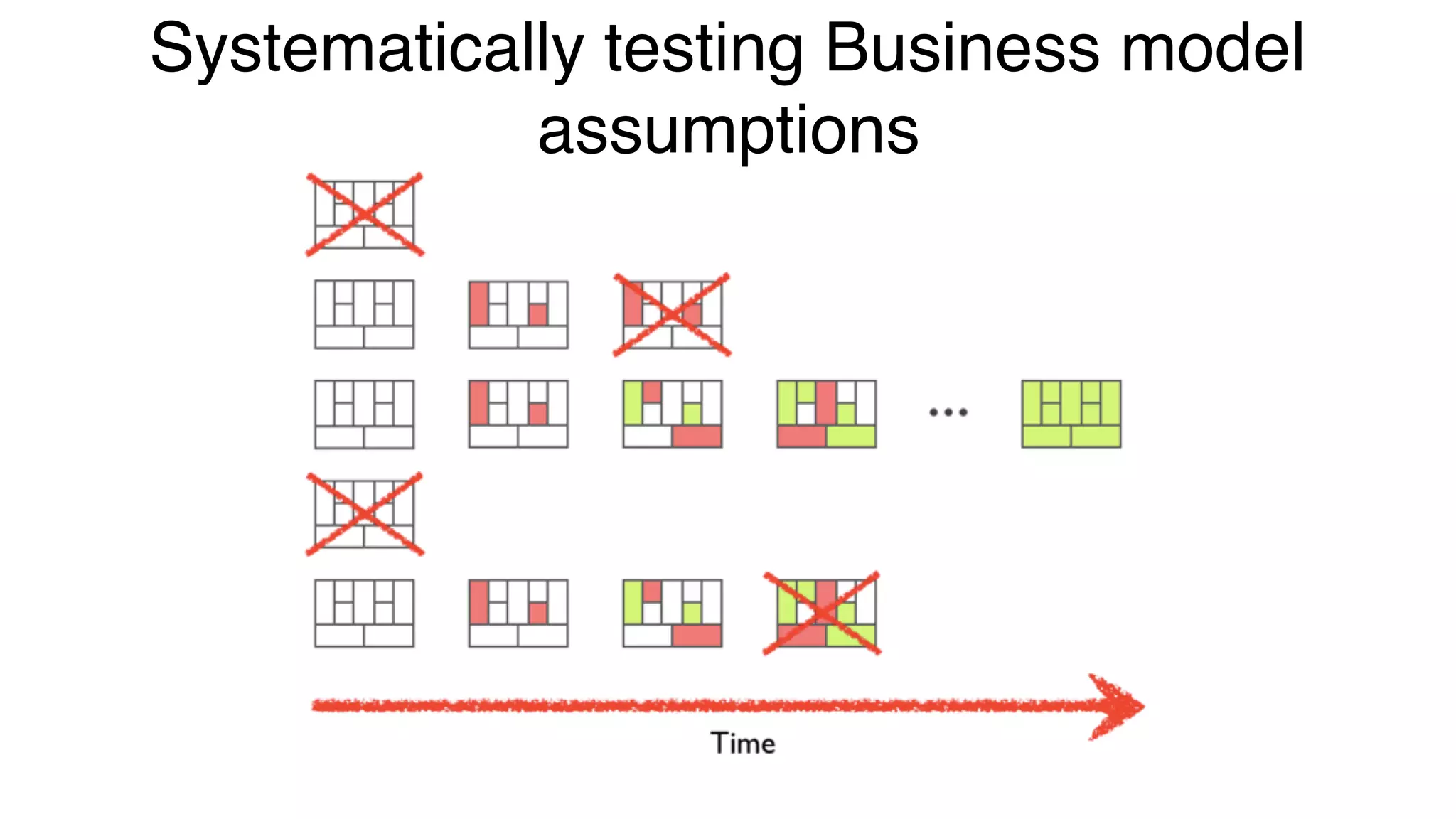
Turn assumptions
into facts and data
points
Systematically testing Business model
assumptions
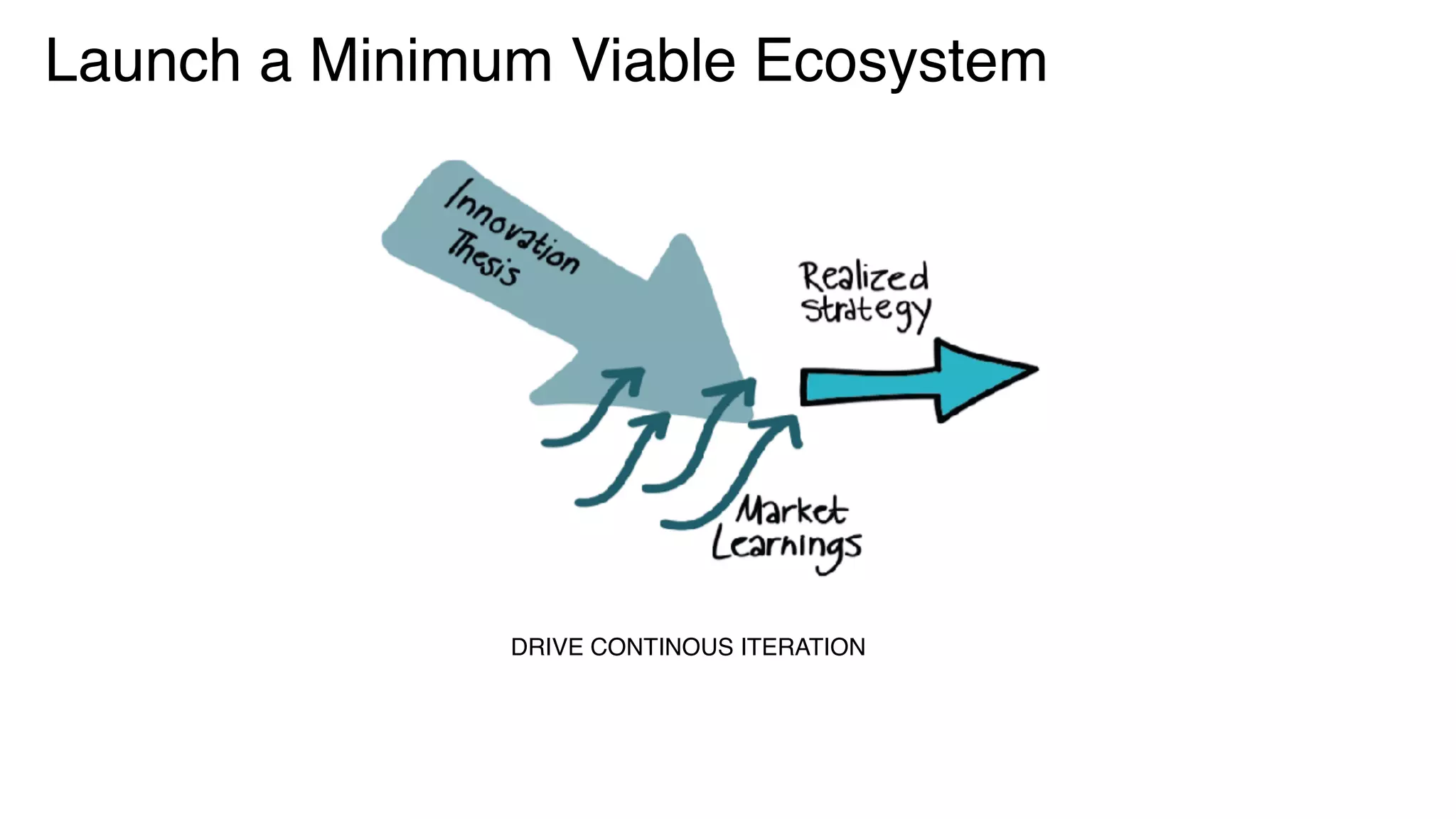
Launch a Minimum Viable Ecosystem
DEFINE AND DESIGN MINIMUM VIABLE ECOSYSTEM
And learn what works and what doesn’t, by starting small with only the minimum viable requirements to allow 2-3
teams to run through one cycle of the Validation Loop, minimizing waste and maximising speed of learning.
Launch a Minimum Viable Ecosystem
SUPPORT VALIDATION SPRINTS
Launch a Minimum Viable Ecosystem
DRIVE CONTINOUS ITERATION
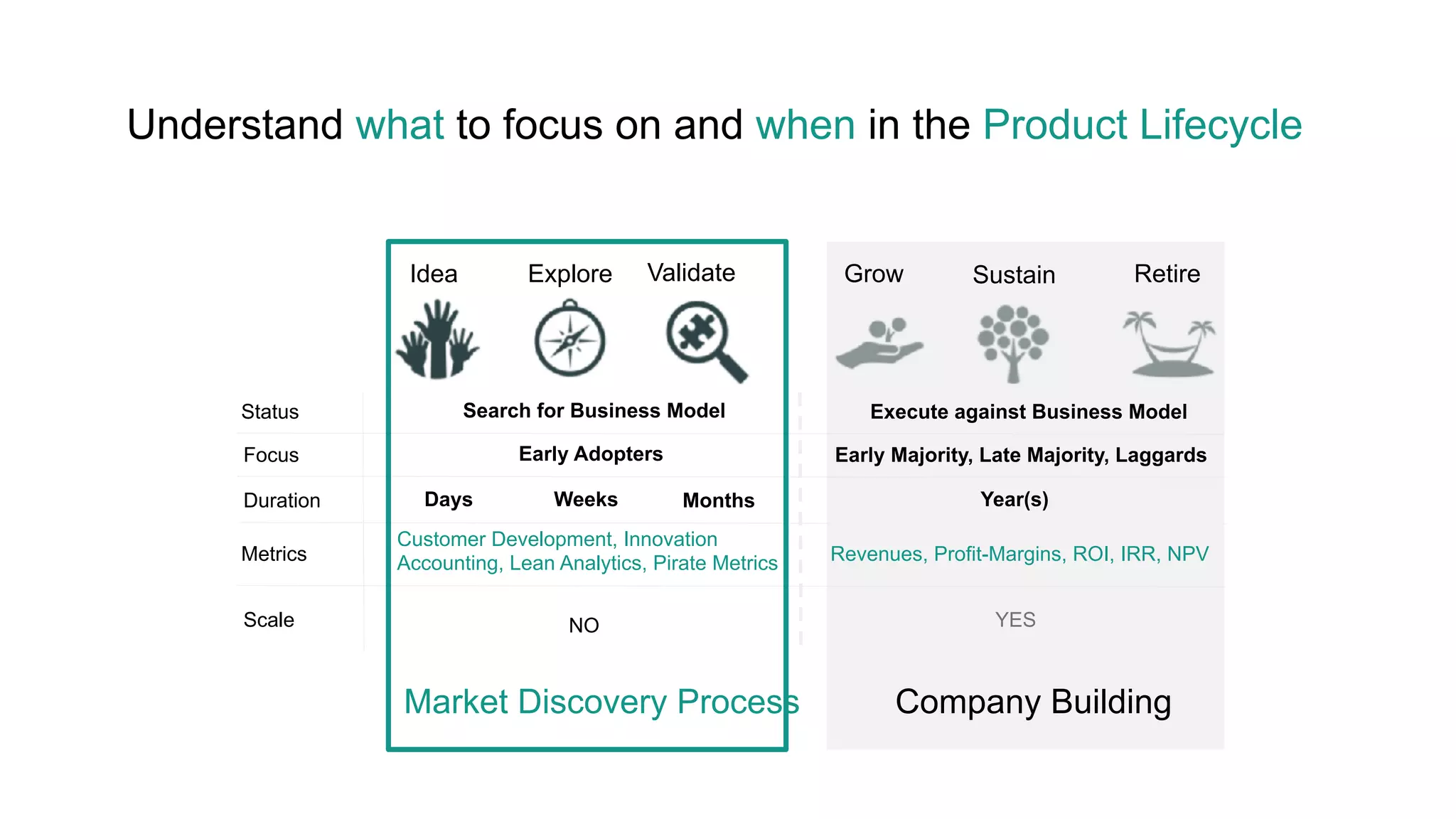
NO YES
Status
Focus
Duration
Metrics
Scale
Idea Explore Validate Grow Sustain Retire
Search for Business Model Execute against Business Model
Early Adopters Early Majority, Late Majority, Laggards
Weeks Year(s)Days Months
Customer Development, Innovation
Accounting, Lean Analytics, Pirate Metrics Revenues, Profit-Margins, ROI, IRR, NPV
Understand what to focus on and when in the Product Lifecycle
Company BuildingMarket Discovery Process
Fast
Scaling
Organize
for Innovation
A Revolution At Work
Learning organizations adopt a learn by doing
approach, have a bias for action, and design for
reflection and iteration.
Open organizations make information easily accessible
and open to all. Everyone has the information they
need at all times.
Networked organizations enable people to work easily
in teams that cut across functions and geographies,
and even extend beyond the formal boundaries of the
organization.
79
- so firstly, Spotify organise their teams in a super interesting way.
- they have very fluid structures where teams are organised in to chapters, squads and guilds.
- the design here is all about enabling a culture which is product and user focused first, and encouraging people from different teams to have very grey edges
to the roles they perform.
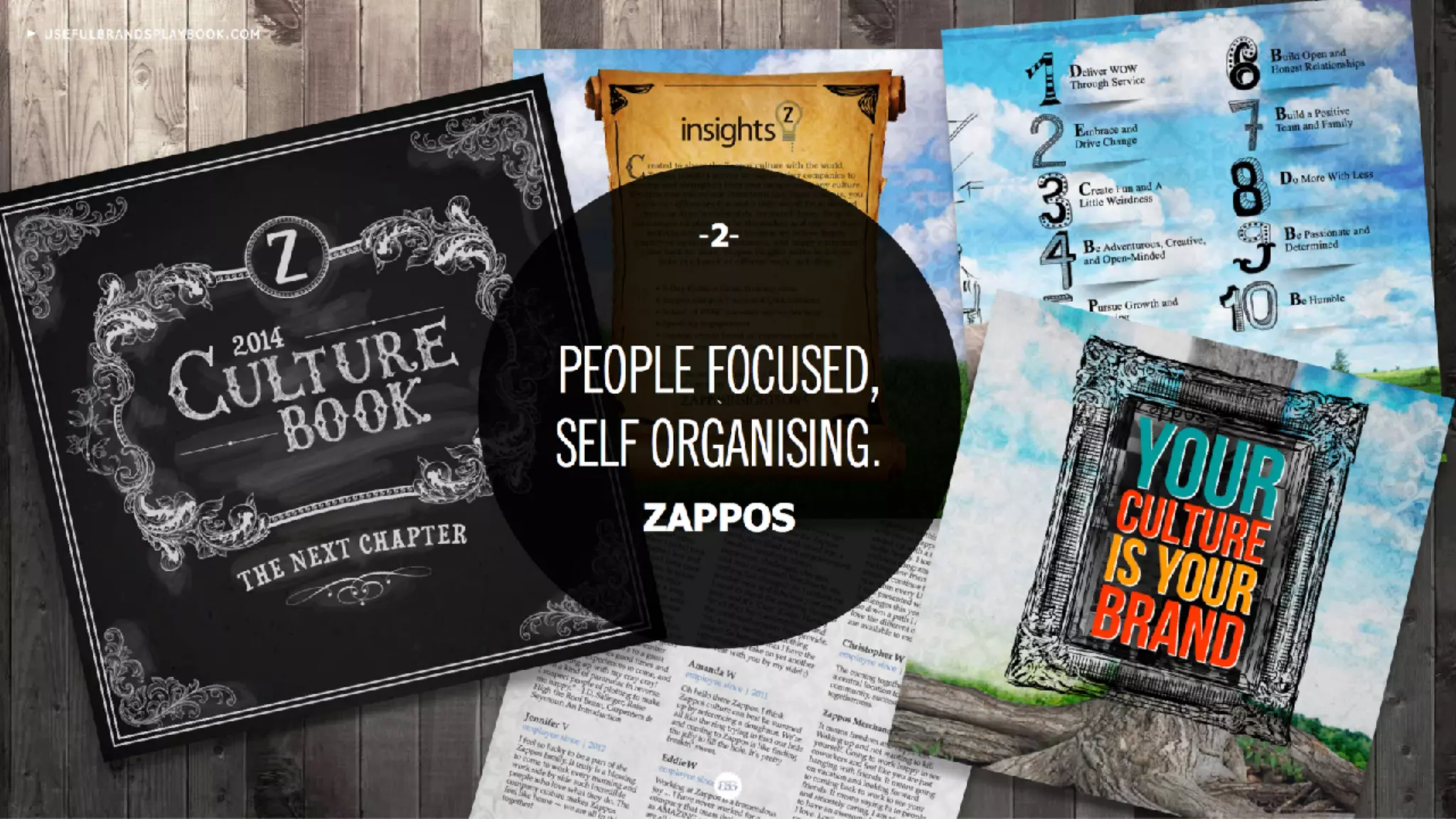
- Zappos, are another company who demonstrate a very innovative post bureaucratic culture.
- They’re incredibly people focused, both obesessionally about their customer but also in realising that their culture is their brand.
- This book, is their 2014 culture book. You can download it for free online.
- Each year they publish this, which is co-written by all the staff, as a manifesto for the values and culture that they believe in.
-
- Inside you’ll find stuff about their core values and vision, their flat self organising structure, notes from new joiners on what joining Zappos has done for
them, and a real sense of purpose and mission about where the company is going next.
- It would’ve been hard to touch on innovative culture without mentioning google
- this slide is taken from a great deck I’d recommend you take a look at on slide share called ‘How Google Works’ and it’s a very astute google like observation
- It simply says ‘innovation can’t be owned or ordained, it needs to be allowed. You can’t tell innovative people to be innovative, but you can let them’.
- And it’s thinking like that from Eric Schmidt and the team at Google that has really enabled them to scale this entrepreneurial, inquisitive mindset throughout
their teams.
- I love this example of post bureaucratic thinking from Nordstrom
- This is a company with 67,000 employees and this is there employee handbook. All of it.
- So on one side it says employee handbook and on the other it say ‘our one rule. Use good judgment in all situations’.
- I think this is a real demonstration of a company who are trying to drive culture by focusing on value, not policies.
HAVE A
SHARED PURPOSE
ORGANIZE AS LEAN,
X-FUNCTIONAL TEAMS
DISTRIBUTE 

AUTHORITY
OPERATE
ON A RHYTHM
WORK IN SPRINTS
PATTERNS
IN TODAY’S
MOST CAPABLE TEAMS
MEET WITH PURPOSE
STEER DYNAMICALLY
VALUE CONSENT
(NOT CONSENSUS)
DEFAULT TO OPEN
HAVE
EDITABLE
RULES
CULTIVATE
PSYCHOLOGICAL
SAFETY
RITUALIZE
LEARNING + REFLECTION
ORGANIZED
TO EXECUTE
ORGANIZED
TO LEARN
HIRING Conformers, Rule followers
Creative problem solvers,
experimenters
TRAINING Learn before you do Learn from doing
MEASURING PERFORMANCE Did you do it right? Did we learn?
ORG STRUCTURE Silos & separated expertise
Cross-functional,
integrated expertise
PROCESS GOALS Drive out variance
Use variance to adapt
and improve
Source: “Teaming: How Organizations Learn, Innovate, and Compete in the Knowledge Economy”, by Amy C. Edmondson
If we can build a great team,
we can build a great organization.
Team
Innovators
Or
Innovations?
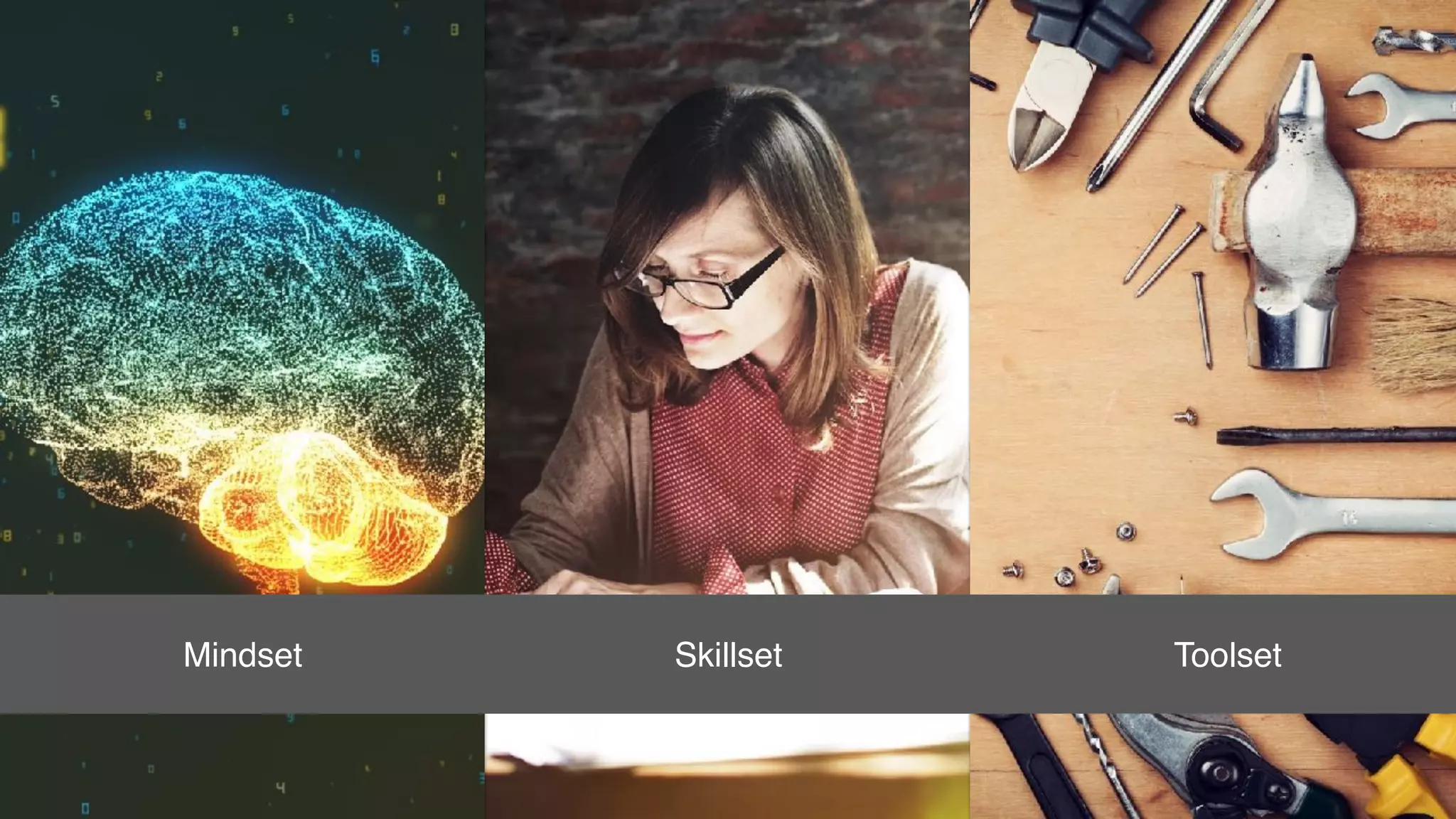
Mindset ToolsetSkillset
Ownership
(80%)
Never Give Up
(20%)
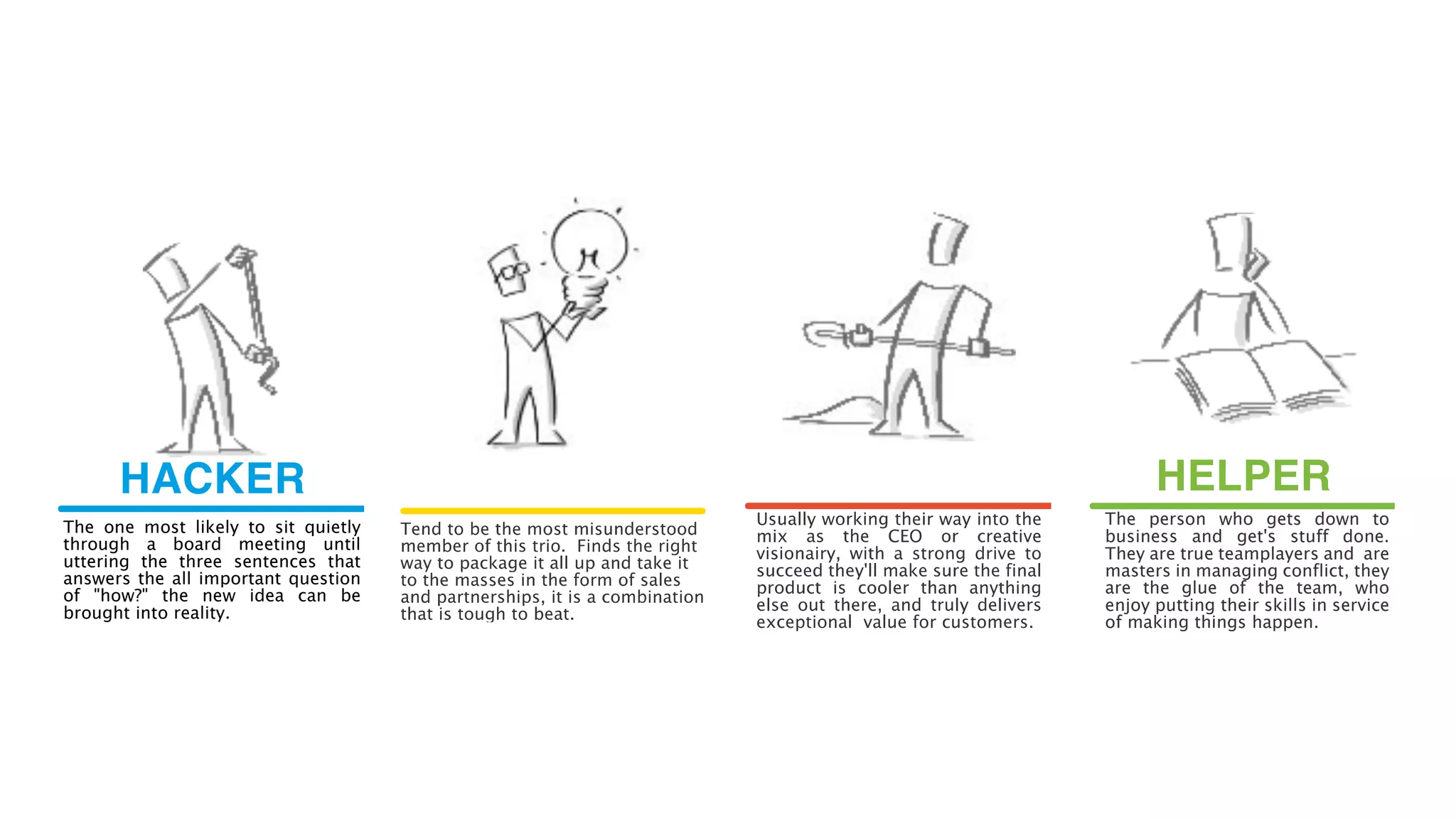
Hacker HipsterHustler
HELPER
The person who gets down to
business and get's stuff done.
They are true teamplayers and are
masters in managing conflict, they
are the glue of the team, who
enjoy putting their skills in service
of making things happen.
HACKER
The one most likely to sit quietly
through a board meeting until
uttering the three sentences that
answers the all important question
of "how?" the new idea can be
brought into reality.
Bring in outsiders to join a team
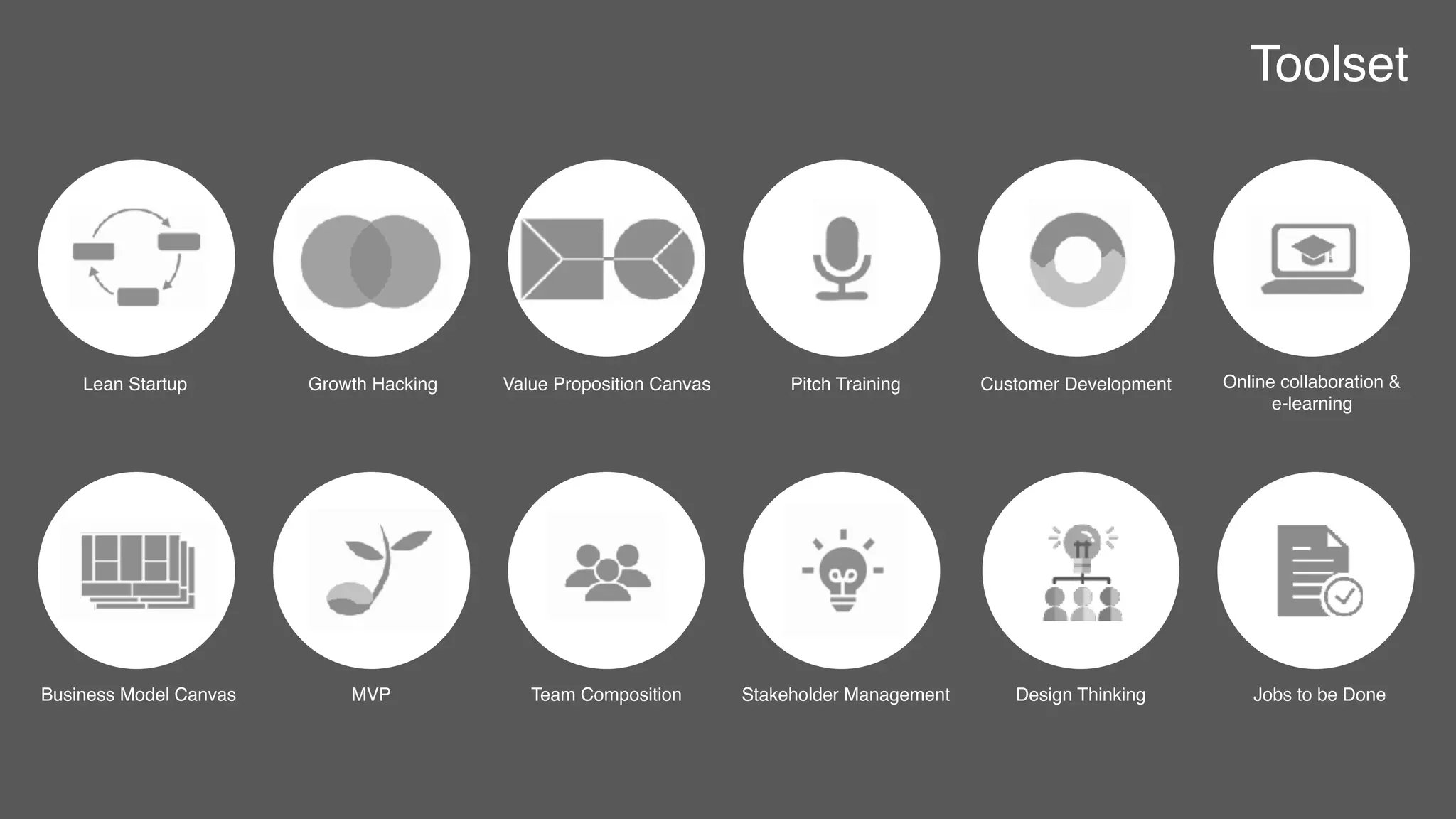
Toolset
Lean Startup Growth Hacking Value Proposition Canvas Pitch Training Customer Development Online collaboration &
e-learning
Business Model Canvas MVP Team Composition Stakeholder Management Design Thinking Jobs to be Done
Practices
that shift
Mindsets
Fast
Scaling
Organize
for Innovation
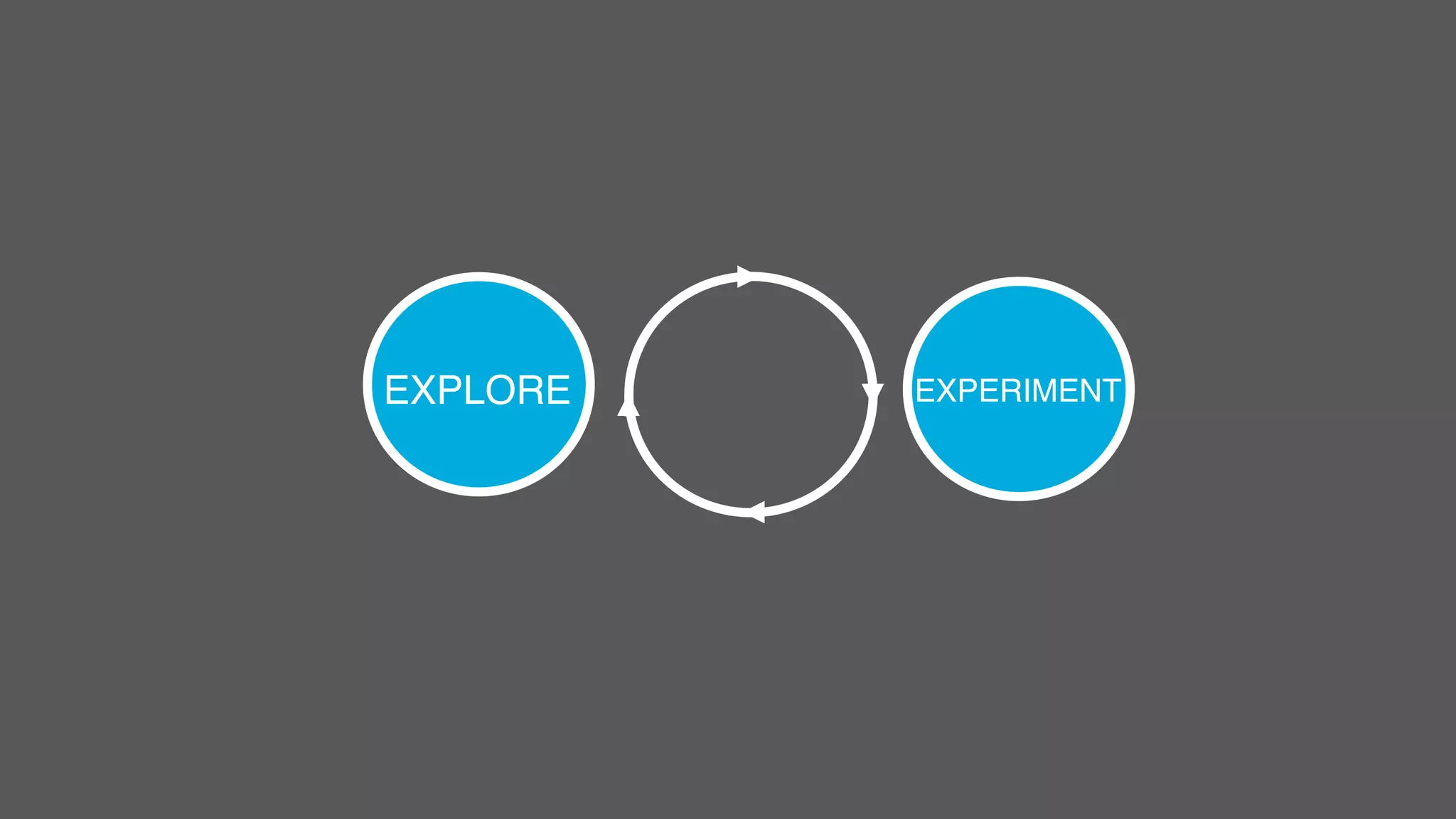
EXPLORE EXPERIMENT
AGILE
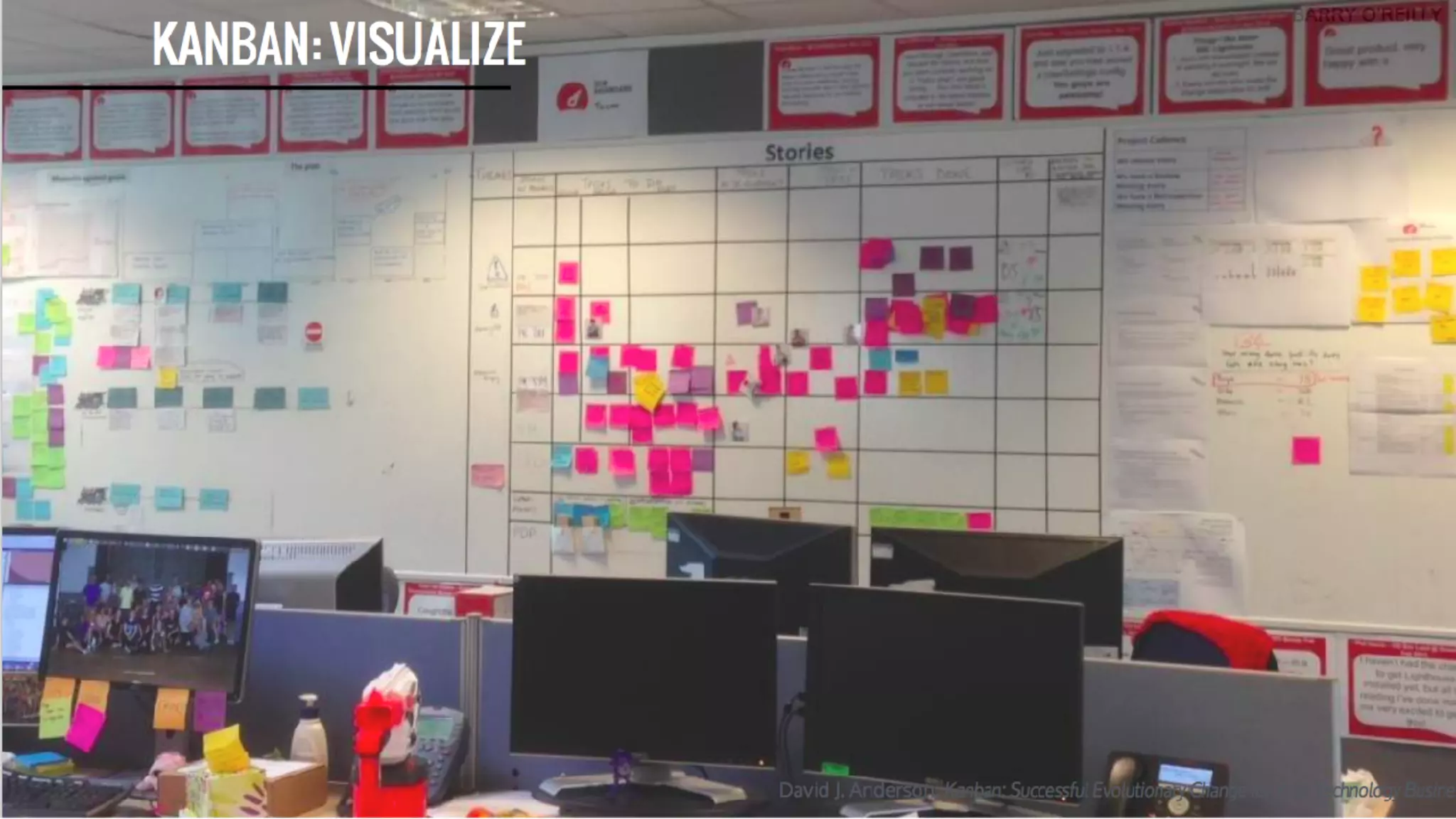
Sprint Weekly demo & retrospectiveSprint KANBANExperiment backlog
1 week
24 hr
Daily standup
B
M
L
Learnings & next steps
Our success at Amazon is
a function of how many
experiments we do per year,
per month, per week, per
day…
Jeff Bezos
CEO and Founder Amazon
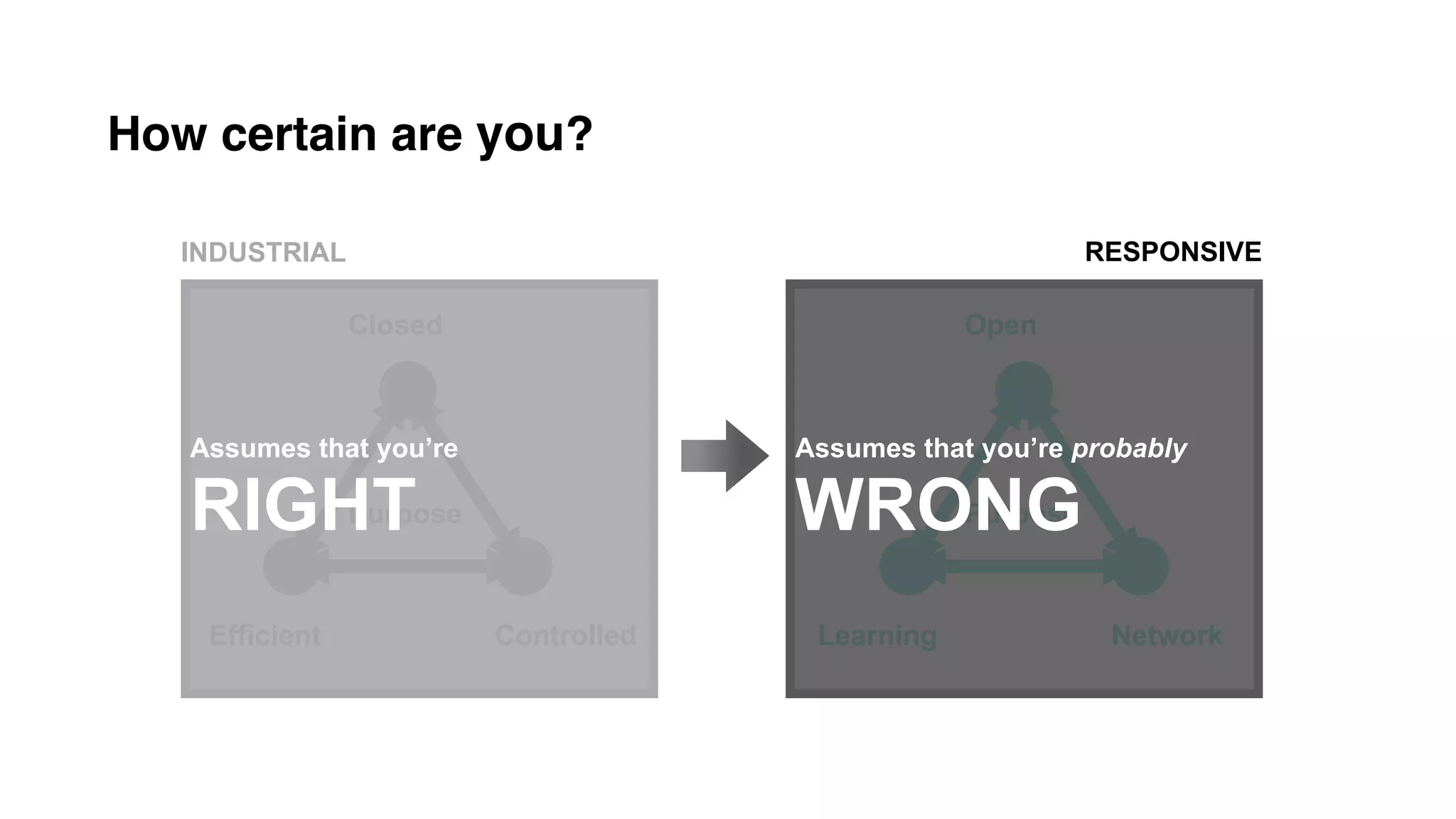
How certain are you?
Closed
ControlledEfficient
Open
NetworkLearning
PurposePurpose
Assumes that you’re
RIGHT
Assumes that you’re probably
WRONG
INDUSTRIAL RESPONSIVE
Also applying to your Ecosystem Design
Nurturing Innovation takes time
Adaptive Culture

Is all about making
change work
Imagine your corporate culture as a garden
112
STARTUP
ENDUP
Install an ‘OS’,
that assumes
that you
are wrong
“Duh” – Peter Senge
Bringing
it all
together
Ideas aren’t
facts
It’s all about
the team
Fail fast
& often!
Before launch:
“Fluffy expectations land”
After launch:
“Bad mean reality”
Also, you most of the
time have no idea what
your doing……
It needs practices and
training!!
Any
questions?
www.perpetulon.com
@ofreijser
otto.freijser@perpetulon.com

Otto Freijser - Perpetulon - Lean Startup Night Warsaw - Feb 13th, 2018