International Research Journal of Engineering and Technology (IRJET) e-ISSN: 2395-0056
Volume: 06 Issue: 04 | Apr 2019 www.irjet.net p-ISSN: 2395-0072
© 2019, IRJET | Impact Factor value: 7.211 | ISO 9001:2008 Certified Journal | Page 4665
Single Minute Exchange of Dies (SMED) concept
Akshay Hasabe1, Akshay Kakde2, Ashish Khandagle3 , Kiran Surve4, Asst. Prof. Pankaj Pardeshi5
1,2,3,4Students, Department of Mechanical Engineering, Dr. D. Y. Patil Institute of Technology, Pimpri, Pune, India.
5Assistant Professor, Department of Mechanical Engineering, Dr. D. Y. Patil Institute of Techology,Pimpri, Pune,
India.
---------------------------------------------------------------------***---------------------------------------------------------------------
Abstract - To survive in cutthroat competition, industries
need to reduce production time and costs in order to improve
operating performanceandflexibility. SingleMinuteExchange
of Dies (SMED) mainly focuses on recognition of internal and
external activities. Accordingly, this article has as its main
objective to review the literature addressing this less studied
topic: SMED. This paper covers the literature review of SMED
tool and purpose of this literature review is to develop an
overview of the conceptual framework of SMED tool. The
various industrial applications and the existing articles
indicate the relevance of thetopicandmethodology. Flexibility
and responsiveness aremainpillarsofmanufacturing, whichis
operated by demands of greaterproductvarietyandimproved
quality.
Key Words: changeover reduction, SMED concept , FMEA
analysis , productivity Improvement, internal and
external functions, Quality Tools etc
1.INTRODUCTION
SMED was developed by Shigeo Shingo in 1950s Japan in
response to the emerging needs of increasingly smaller
production lot sizes required to meet the required flexibility
for customer demand. The study was originally developed
through the study of a die change process. Generally, SMED
aims to standardize and simplify the operations. By this
means, the need for special skilled workers is also
minimized. Since then, the ways to improve and support the
SMED technique are considered in the literature. The SMED
technique is used as an element of Total Productivity
Maintenance and “continuous improvement process” in
various studies to reach lean manufacturing .Describes lean
enablers which is based on the principles ofleanproduction.
Incorporated into an appropriate methodology, lean
enablers can be employed to design new factories or deduce
measures to improve existing factories.
1.1 SMED concept
Single Minute Exchange of Die (SMED) is one of the many
lean production methods for reducing waste in a
manufacturing process. It provides a rapid and efficientway
of converting a manufacturing process from running the
current product to running the next product. This rapid
changeover is key to reducing production lot sizes and
thereby improving flow. SMED is the term used to represent
the Single Minute Exchange of Die or setup time that can be
counted in a single digit of minutes. SMED is often used
interchangeably with “quick changeover”. SMED and quick
changeover are the practice of reducing the time it takes to
change a line or machine from running one product to the
next. The need for SMED and quick changeover programs is
more popular now than ever due to increased demand for
product variability, reduced product life cycles and theneed
to significantly reduce inventories. This rapid changeover is
key to reducing production lot sizes and thereby improving
flow. The phrase "single minute" does not mean that all
changeovers and startups should take only one minute, but
that they should take less than 10 minutes (in other words,
"single digit minute").
2. FOCUS ON SMED
The focus on the SMED applications for process industry
plants that produce materials like paints, paper products,
foods, beverages, personal care items and fiber, and apparel
rather than assembled products such as refrigerators, cell
phones, or automobiles. It is noted that changeover
complexity should be considered in addition to the
mechanical and electrical changes when changing to a
different productsincethese industriesoftenneedchemistry
and physics changes during the process is reaching
equilibrium on the new product and specified properties.
Describes the improvement of the quick changeoverprocess
of a painting line in a wooden framesfactory. Theapplication
presents the scheduling of the involved setup operations,
considering their duration, precedence relations and
resources' need, in order to achieve a reduced setup time.
The main focus of the project is to reduce the lead time in a
manufacturing process, by analyzing the cycle time for each
of the process and identifying the critical process in the
manufacturing line. Then identification of value added and
non-value added activities in process and to reduce non
value added activities to increase the productivity in it.
 To increase the productivity of the industry so that
the demands are met.
 To reduce the wastes leading to reduced
expenditure.
 To eliminate the bottlenecks in the production line.
 To increase the efficiencyoftheprocessbyreducing
the non-value added activities.
International Research Journal of Engineering and Technology (IRJET) e-ISSN: 2395-0056
Volume: 06 Issue: 04 | Apr 2019 www.irjet.net p-ISSN: 2395-0072
© 2019, IRJET | Impact Factor value: 7.211 | ISO 9001:2008 Certified Journal | Page 4666
3. OBJECTIVES of SMED:
 Study the process flow in the production line of a
manufacturing.
 Estimate the cycle time for each manufacturing
processes.
 Create the current state value stream map with the
cycle time.
 Find out the bottleneck in the current state value
stream map.
 Identifying the value added and non-value added
activities for the product.
 Apply lean tools to minimize non value added
activities.
 Create the future state value stream map and
compare the benefits.
4. PROCESS OF SMED
1. Observe the current methodology: Current
procedures generally recorded on video tape of all
the changeover process. It covers the complete
changeover from one model to another model.
2. Separate the Internal and External activities:
Internal activities are those that can only be
performed when the process is stopped, while
External activities can be done while the last batch
is being produced, or once the next batch has
started.
3. Stream line the process of changeover: For each
iteration of the above process, a substantial
improvement in set-up times shouldbeexpected,so
it may take several iterations to cross the ten
minute line.
4. Continuous Training: After the successful first
iteration of SMED application the prime
requirement becomes the training of all the
operator of the cell. Training has been given by cell
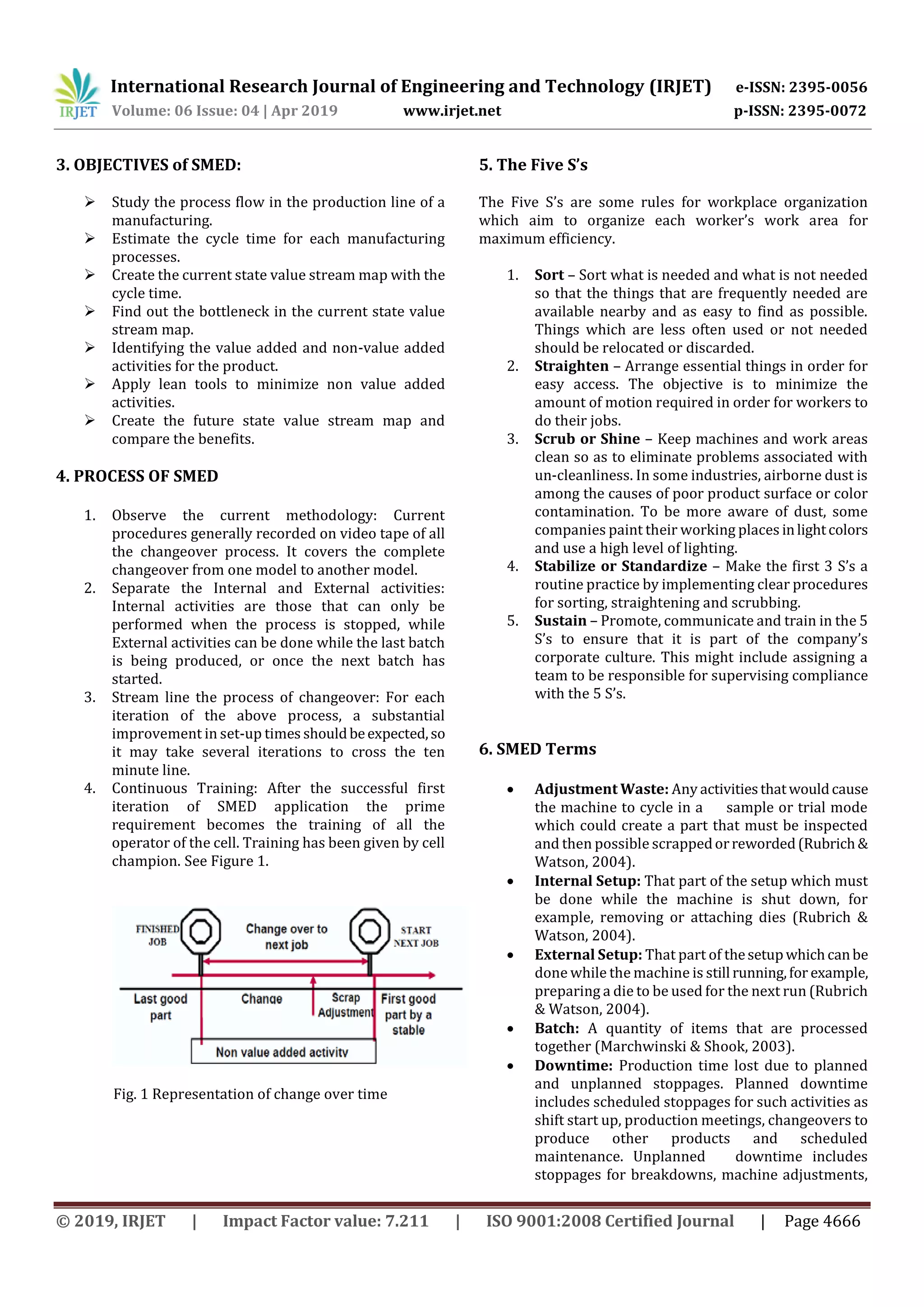
champion. See Figure 1.
Fig. 1 Representation of change over time
5. The Five S’s
The Five S’s are some rules for workplace organization
which aim to organize each worker’s work area for
maximum efficiency.
1. Sort – Sort what is needed and what is not needed
so that the things that are frequently needed are
available nearby and as easy to find as possible.
Things which are less often used or not needed
should be relocated or discarded.
2. Straighten – Arrange essential things in order for
easy access. The objective is to minimize the
amount of motion required in order for workers to
do their jobs.
3. Scrub or Shine – Keep machines and work areas
clean so as to eliminate problems associated with
un-cleanliness. In some industries, airborne dust is
among the causes of poor product surface or color
contamination. To be more aware of dust, some
companies paint their working places inlightcolors
and use a high level of lighting.
4. Stabilize or Standardize – Make the first 3 S’s a
routine practice by implementing clear procedures
for sorting, straightening and scrubbing.
5. Sustain – Promote, communicate and train in the 5
S’s to ensure that it is part of the company’s
corporate culture. This might include assigning a
team to be responsible for supervising compliance
with the 5 S’s.
6. SMED Terms
 Adjustment Waste: Any activitiesthatwouldcause
the machine to cycle in a sample or trial mode
which could create a part that must be inspected
and then possible scrappedorreworded(Rubrich&
Watson, 2004).
 Internal Setup: That part of the setup which must
be done while the machine is shut down, for
example, removing or attaching dies (Rubrich &
Watson, 2004).
 External Setup: That part of thesetupwhichcanbe
done while the machine is still running,for example,
preparing a die to be used for the next run (Rubrich
& Watson, 2004).
 Batch: A quantity of items that are processed
together (Marchwinski & Shook, 2003).
 Downtime: Production time lost due to planned
and unplanned stoppages. Planned downtime
includes scheduled stoppages for such activities as
shift start up, production meetings, changeovers to
produce other products and scheduled
maintenance. Unplanned downtime includes
stoppages for breakdowns, machine adjustments,
International Research Journal of Engineering and Technology (IRJET) e-ISSN: 2395-0056
Volume: 06 Issue: 04 | Apr 2019 www.irjet.net p-ISSN: 2395-0072
© 2019, IRJET | Impact Factor value: 7.211 | ISO 9001:2008 Certified Journal | Page 4667
material shortages and absenteeism (Marchwinski
& Shook, 2003).
 Changeover: The process of switching from the
production of one product or part number to
another in a machine or a series of linked machines
by changing parts, dies, molds or fixtures, also
called a set-up. Changeover time is measured as the
time elapsed between the last piece in the run just
completed until the first good piece from the
process after the changeover (Marchwinski &
Shook, 2003).
 Die Set: This is the tooling that is removed and
replaced in a punch press during a changeover. A
die set consists of a set of male punches and female
dies which, when pressed together either creates a
hole in the work piece or forms the work piece
creating features desired by the customer.
 Waste: Any activity that consumes resources but
creates no value for the customer (Marchwinski &
Shook, 2003).
 Lean Production: A system of production that
makes and delivers just what is needed, justwhenit
is needed and just in the amount needed. Lean
manufacturing aims for the total elimination of all
waste to achieve the best possible quality, lowest
possible cost and use of resources, and the lowest
possible production and delivery lead times
(Marchwinski & Shook, 2003).
 Value Stream Map: A diagram that defines each
step of the material an information flow needed
from initial order of a good or service through
delivery (Marchwinski & Shook, 2003).
 Lot: A quantity of items that are processed together
(Krajewski & Ritzman, 2007).
 Value Added Activities: The time spent on
activities that add value to an item from the
customer's perspective. These are activities that
effectively change the form and function of a raw
material into a good or service that the customer is
willing to pay for (Marchwin ski & Shook, 2003).
 Non-Value Added Activities: The time spent on
activities that add costs but novaluetoanitemfrom
the customer's perspective. Theseareactivitiesthat
the customer is generally not willing to pay for
(Marchwinski & Shook, 2003).
 Shingo, Shigeo (1909-1990): A consultant to
Toyota who made key contributions to the
development of the Toyota Production System,
especially quick changeovers, SMED and
standardized work (Marchwinski & Shook, 2003).
the target of reducing changeover times to a single
digit, or less than 10 minutes (Marchwinski &
Shook, 2003)
 Punch Press: A machine tool used to work
materials (typically steel) by changing the shape of
the raw material. Material shapeischangedthrough
application of direct pressure which forces the
material to change shape. The function of thepunch
press is to hold the die set and apply the motionand
pressure required to perform value added
operations to raw materials.
 Setup Waste, Internal: Alignment activities
required to remove and install tools, for example,
the time associated with using a fork truck to
maneuver the old tool out and the new tool in while
setting up a press (Rubrich & Watson, 2004).
 Setup: The process of switching from the
production of one product or part number to
another in a machine or a series of linked machines
by changing parts, dies, molds or fixtures, also
called a set-up. Changeover time is measured as the
time elapsed between the last piece in the run just
completed until the first good piece from the
process after the changeover (Marchwinski &
Shook, 2003).
 Setup Waste, External: Activities such as
searching, locating or moving jigs, tools, bolts,
clamps, fasteners, gauges or instructions in the
setup area (Rubrich & Watson, 2003).
7. SMED Implementation in CNC machine Fixture
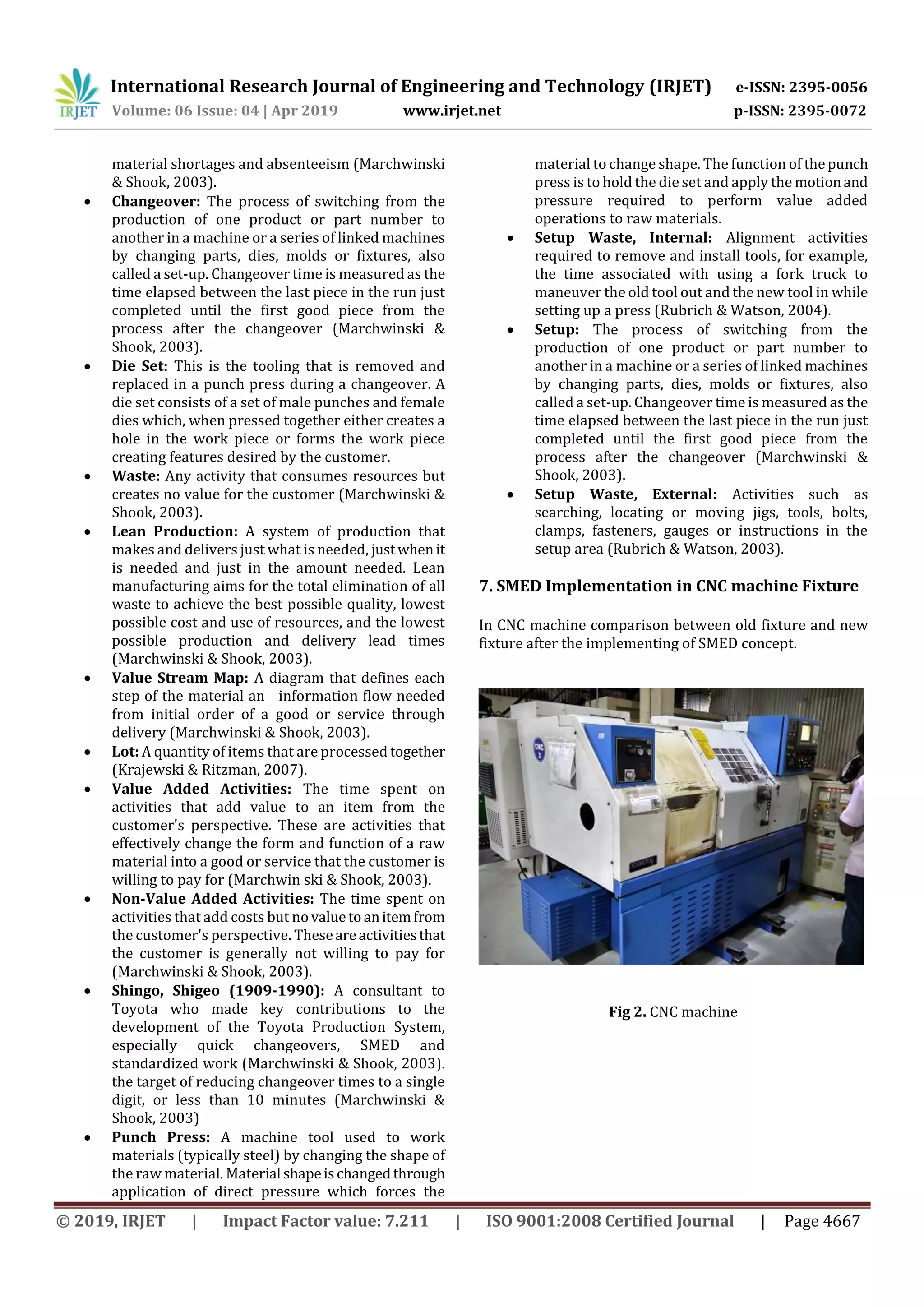
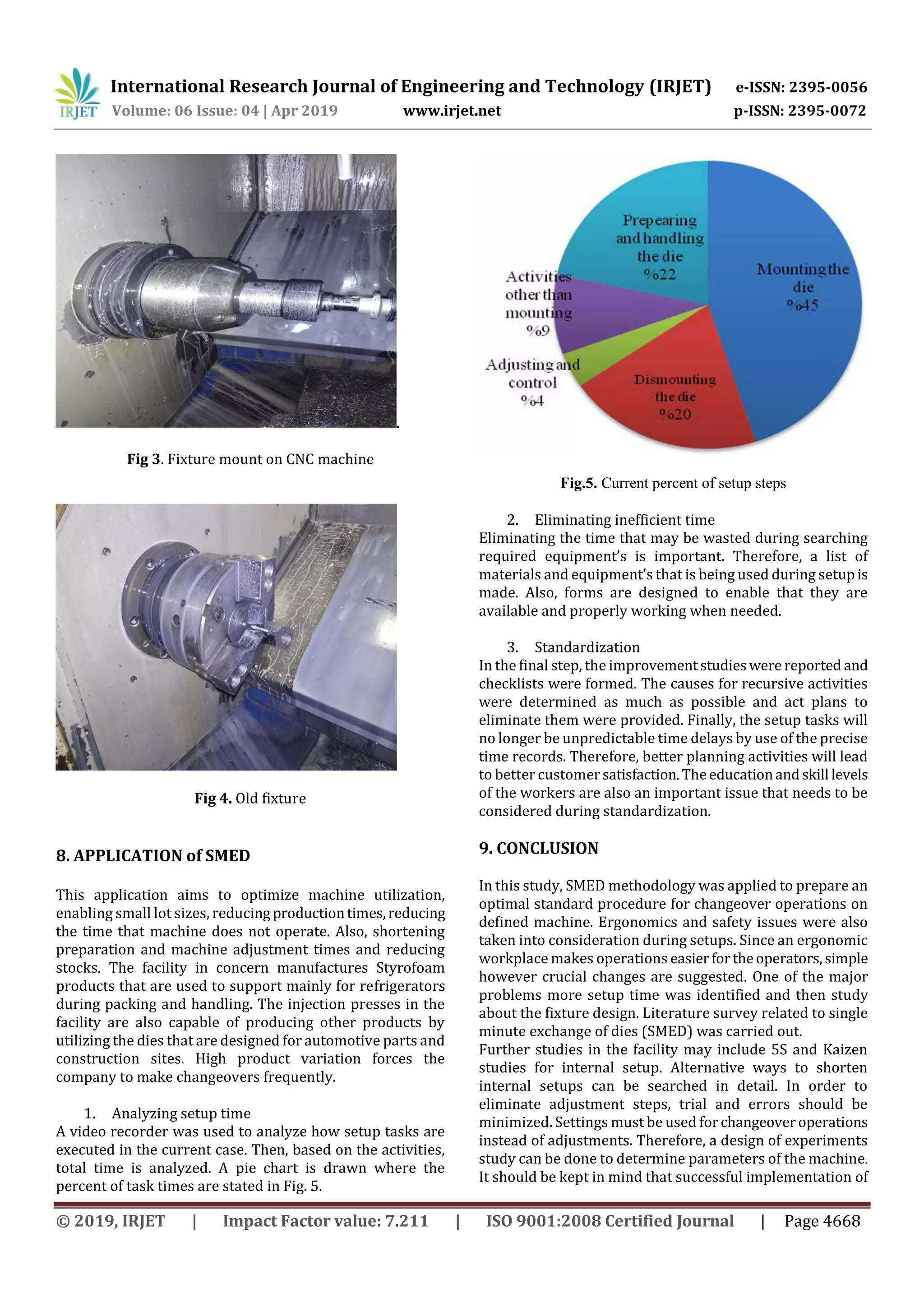
In CNC machine comparison between old fixture and new
fixture after the implementing of SMED concept.
Fig 2. CNC machine
International Research Journal of Engineering and Technology (IRJET) e-ISSN: 2395-0056
Volume: 06 Issue: 04 | Apr 2019 www.irjet.net p-ISSN: 2395-0072
© 2019, IRJET | Impact Factor value: 7.211 | ISO 9001:2008 Certified Journal | Page 4668
.
Fig 3. Fixture mount on CNC machine
Fig 4. Old fixture
8. APPLICATION of SMED
This application aims to optimize machine utilization,
enabling small lot sizes, reducingproductiontimes,reducing
the time that machine does not operate. Also, shortening
preparation and machine adjustment times and reducing
stocks. The facility in concern manufactures Styrofoam
products that are used to support mainly for refrigerators
during packing and handling. The injection presses in the
facility are also capable of producing other products by
utilizing the dies that are designed for automotive parts and
construction sites. High product variation forces the
company to make changeovers frequently.
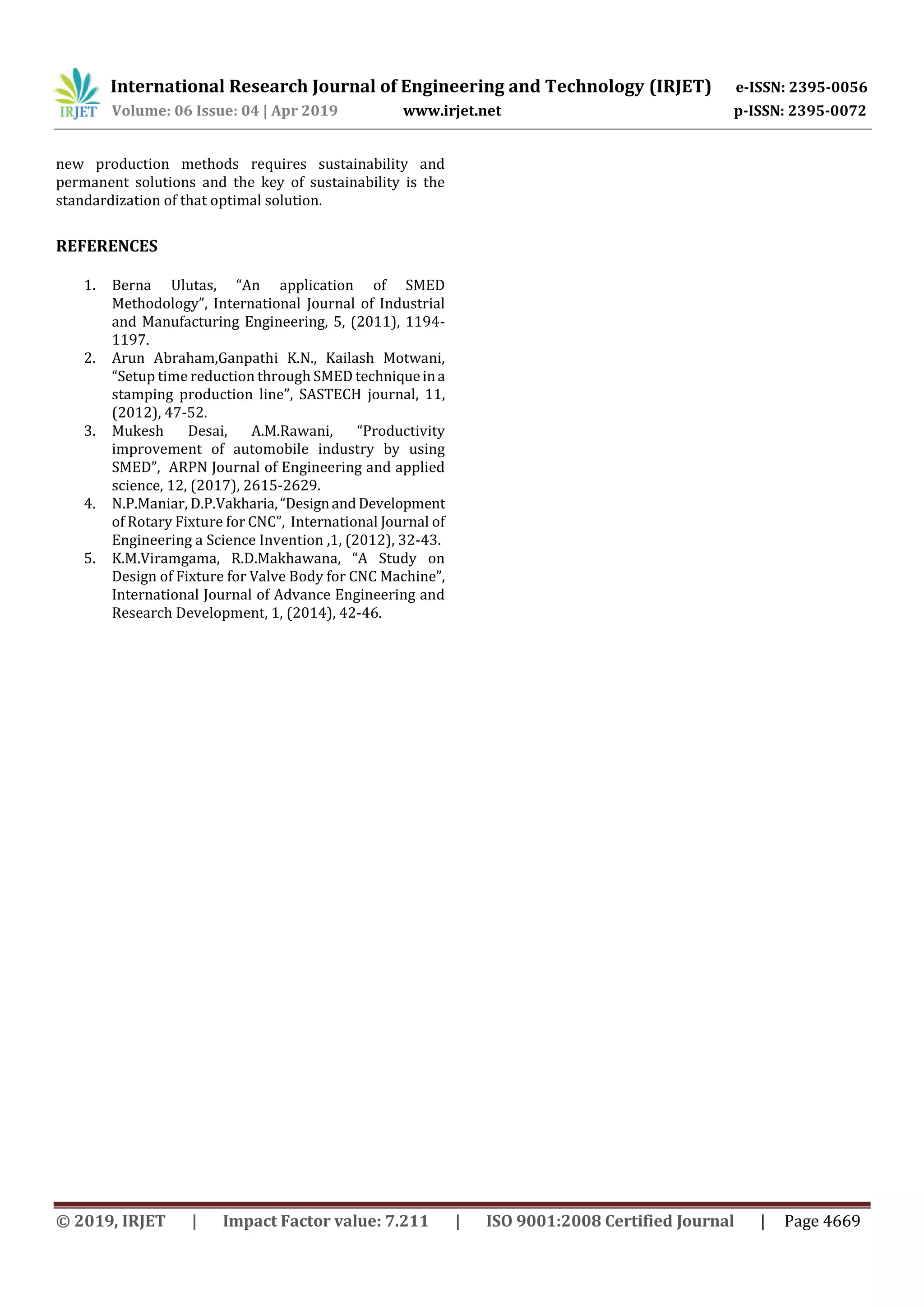
1. Analyzing setup time
A video recorder was used to analyze how setup tasks are
executed in the current case. Then, based on the activities,
total time is analyzed. A pie chart is drawn where the
percent of task times are stated in Fig. 5.
Fig.5. Current percent of setup steps
2. Eliminating inefficient time
Eliminating the time that may be wasted during searching
required equipment’s is important. Therefore, a list of
materials and equipment’s that is being used during setupis
made. Also, forms are designed to enable that they are
available and properly working when needed.
3. Standardization
In the final step, the improvementstudieswere reported and
checklists were formed. The causes for recursive activities
were determined as much as possible and act plans to
eliminate them were provided. Finally, the setup tasks will
no longer be unpredictable time delays by use of the precise
time records. Therefore, better planning activities will lead
to better customersatisfaction.Theeducationandskill levels
of the workers are also an important issue that needs to be
considered during standardization.
9. CONCLUSION
In this study, SMED methodology was applied to prepare an
optimal standard procedure for changeover operations on
defined machine. Ergonomics and safety issues were also
taken into consideration during setups. Since an ergonomic
workplace makes operations easierfortheoperators,simple
however crucial changes are suggested. One of the major
problems more setup time was identified and then study
about the fixture design. Literature survey related to single
minute exchange of dies (SMED) was carried out.
Further studies in the facility may include 5S and Kaizen
studies for internal setup. Alternative ways to shorten
internal setups can be searched in detail. In order to
eliminate adjustment steps, trial and errors should be
minimized. Settings must be used forchangeoveroperations
instead of adjustments. Therefore, a design of experiments
study can be done to determine parameters of the machine.
It should be kept in mind that successful implementation of
International Research Journal of Engineering and Technology (IRJET) e-ISSN: 2395-0056
Volume: 06 Issue: 04 | Apr 2019 www.irjet.net p-ISSN: 2395-0072
© 2019, IRJET | Impact Factor value: 7.211 | ISO 9001:2008 Certified Journal | Page 4669
new production methods requires sustainability and
permanent solutions and the key of sustainability is the
standardization of that optimal solution.
REFERENCES
1. Berna Ulutas, “An application of SMED
Methodology”, International Journal of Industrial
and Manufacturing Engineering, 5, (2011), 1194-
1197.
2. Arun Abraham,Ganpathi K.N., Kailash Motwani,
“Setup time reduction through SMED techniqueina
stamping production line”, SASTECH journal, 11,
(2012), 47-52.
3. Mukesh Desai, A.M.Rawani, “Productivity
improvement of automobile industry by using
SMED”, ARPN Journal of Engineering and applied
science, 12, (2017), 2615-2629.
4. N.P.Maniar, D.P.Vakharia,“DesignandDevelopment
of Rotary Fixture for CNC”, International Journal of
Engineering a Science Invention ,1, (2012), 32-43.
5. K.M.Viramgama, R.D.Makhawana, “A Study on
Design of Fixture for Valve Body for CNC Machine”,
International Journal of Advance Engineering and
Research Development, 1, (2014), 42-46.

IRJET- Single Minute Exchange of Dies (SMED) Concept

  • 1.
    International Research Journalof Engineering and Technology (IRJET) e-ISSN: 2395-0056 Volume: 06 Issue: 04 | Apr 2019 www.irjet.net p-ISSN: 2395-0072 © 2019, IRJET | Impact Factor value: 7.211 | ISO 9001:2008 Certified Journal | Page 4665 Single Minute Exchange of Dies (SMED) concept Akshay Hasabe1, Akshay Kakde2, Ashish Khandagle3 , Kiran Surve4, Asst. Prof. Pankaj Pardeshi5 1,2,3,4Students, Department of Mechanical Engineering, Dr. D. Y. Patil Institute of Technology, Pimpri, Pune, India. 5Assistant Professor, Department of Mechanical Engineering, Dr. D. Y. Patil Institute of Techology,Pimpri, Pune, India. ---------------------------------------------------------------------***--------------------------------------------------------------------- Abstract - To survive in cutthroat competition, industries need to reduce production time and costs in order to improve operating performanceandflexibility. SingleMinuteExchange of Dies (SMED) mainly focuses on recognition of internal and external activities. Accordingly, this article has as its main objective to review the literature addressing this less studied topic: SMED. This paper covers the literature review of SMED tool and purpose of this literature review is to develop an overview of the conceptual framework of SMED tool. The various industrial applications and the existing articles indicate the relevance of thetopicandmethodology. Flexibility and responsiveness aremainpillarsofmanufacturing, whichis operated by demands of greaterproductvarietyandimproved quality. Key Words: changeover reduction, SMED concept , FMEA analysis , productivity Improvement, internal and external functions, Quality Tools etc 1.INTRODUCTION SMED was developed by Shigeo Shingo in 1950s Japan in response to the emerging needs of increasingly smaller production lot sizes required to meet the required flexibility for customer demand. The study was originally developed through the study of a die change process. Generally, SMED aims to standardize and simplify the operations. By this means, the need for special skilled workers is also minimized. Since then, the ways to improve and support the SMED technique are considered in the literature. The SMED technique is used as an element of Total Productivity Maintenance and “continuous improvement process” in various studies to reach lean manufacturing .Describes lean enablers which is based on the principles ofleanproduction. Incorporated into an appropriate methodology, lean enablers can be employed to design new factories or deduce measures to improve existing factories. 1.1 SMED concept Single Minute Exchange of Die (SMED) is one of the many lean production methods for reducing waste in a manufacturing process. It provides a rapid and efficientway of converting a manufacturing process from running the current product to running the next product. This rapid changeover is key to reducing production lot sizes and thereby improving flow. SMED is the term used to represent the Single Minute Exchange of Die or setup time that can be counted in a single digit of minutes. SMED is often used interchangeably with “quick changeover”. SMED and quick changeover are the practice of reducing the time it takes to change a line or machine from running one product to the next. The need for SMED and quick changeover programs is more popular now than ever due to increased demand for product variability, reduced product life cycles and theneed to significantly reduce inventories. This rapid changeover is key to reducing production lot sizes and thereby improving flow. The phrase "single minute" does not mean that all changeovers and startups should take only one minute, but that they should take less than 10 minutes (in other words, "single digit minute"). 2. FOCUS ON SMED The focus on the SMED applications for process industry plants that produce materials like paints, paper products, foods, beverages, personal care items and fiber, and apparel rather than assembled products such as refrigerators, cell phones, or automobiles. It is noted that changeover complexity should be considered in addition to the mechanical and electrical changes when changing to a different productsincethese industriesoftenneedchemistry and physics changes during the process is reaching equilibrium on the new product and specified properties. Describes the improvement of the quick changeoverprocess of a painting line in a wooden framesfactory. Theapplication presents the scheduling of the involved setup operations, considering their duration, precedence relations and resources' need, in order to achieve a reduced setup time. The main focus of the project is to reduce the lead time in a manufacturing process, by analyzing the cycle time for each of the process and identifying the critical process in the manufacturing line. Then identification of value added and non-value added activities in process and to reduce non value added activities to increase the productivity in it.  To increase the productivity of the industry so that the demands are met.  To reduce the wastes leading to reduced expenditure.  To eliminate the bottlenecks in the production line.  To increase the efficiencyoftheprocessbyreducing the non-value added activities.
  • 2.
    International Research Journalof Engineering and Technology (IRJET) e-ISSN: 2395-0056 Volume: 06 Issue: 04 | Apr 2019 www.irjet.net p-ISSN: 2395-0072 © 2019, IRJET | Impact Factor value: 7.211 | ISO 9001:2008 Certified Journal | Page 4666 3. OBJECTIVES of SMED:  Study the process flow in the production line of a manufacturing.  Estimate the cycle time for each manufacturing processes.  Create the current state value stream map with the cycle time.  Find out the bottleneck in the current state value stream map.  Identifying the value added and non-value added activities for the product.  Apply lean tools to minimize non value added activities.  Create the future state value stream map and compare the benefits. 4. PROCESS OF SMED 1. Observe the current methodology: Current procedures generally recorded on video tape of all the changeover process. It covers the complete changeover from one model to another model. 2. Separate the Internal and External activities: Internal activities are those that can only be performed when the process is stopped, while External activities can be done while the last batch is being produced, or once the next batch has started. 3. Stream line the process of changeover: For each iteration of the above process, a substantial improvement in set-up times shouldbeexpected,so it may take several iterations to cross the ten minute line. 4. Continuous Training: After the successful first iteration of SMED application the prime requirement becomes the training of all the operator of the cell. Training has been given by cell champion. See Figure 1. Fig. 1 Representation of change over time 5. The Five S’s The Five S’s are some rules for workplace organization which aim to organize each worker’s work area for maximum efficiency. 1. Sort – Sort what is needed and what is not needed so that the things that are frequently needed are available nearby and as easy to find as possible. Things which are less often used or not needed should be relocated or discarded. 2. Straighten – Arrange essential things in order for easy access. The objective is to minimize the amount of motion required in order for workers to do their jobs. 3. Scrub or Shine – Keep machines and work areas clean so as to eliminate problems associated with un-cleanliness. In some industries, airborne dust is among the causes of poor product surface or color contamination. To be more aware of dust, some companies paint their working places inlightcolors and use a high level of lighting. 4. Stabilize or Standardize – Make the first 3 S’s a routine practice by implementing clear procedures for sorting, straightening and scrubbing. 5. Sustain – Promote, communicate and train in the 5 S’s to ensure that it is part of the company’s corporate culture. This might include assigning a team to be responsible for supervising compliance with the 5 S’s. 6. SMED Terms  Adjustment Waste: Any activitiesthatwouldcause the machine to cycle in a sample or trial mode which could create a part that must be inspected and then possible scrappedorreworded(Rubrich& Watson, 2004).  Internal Setup: That part of the setup which must be done while the machine is shut down, for example, removing or attaching dies (Rubrich & Watson, 2004).  External Setup: That part of thesetupwhichcanbe done while the machine is still running,for example, preparing a die to be used for the next run (Rubrich & Watson, 2004).  Batch: A quantity of items that are processed together (Marchwinski & Shook, 2003).  Downtime: Production time lost due to planned and unplanned stoppages. Planned downtime includes scheduled stoppages for such activities as shift start up, production meetings, changeovers to produce other products and scheduled maintenance. Unplanned downtime includes stoppages for breakdowns, machine adjustments,
  • 3.
    International Research Journalof Engineering and Technology (IRJET) e-ISSN: 2395-0056 Volume: 06 Issue: 04 | Apr 2019 www.irjet.net p-ISSN: 2395-0072 © 2019, IRJET | Impact Factor value: 7.211 | ISO 9001:2008 Certified Journal | Page 4667 material shortages and absenteeism (Marchwinski & Shook, 2003).  Changeover: The process of switching from the production of one product or part number to another in a machine or a series of linked machines by changing parts, dies, molds or fixtures, also called a set-up. Changeover time is measured as the time elapsed between the last piece in the run just completed until the first good piece from the process after the changeover (Marchwinski & Shook, 2003).  Die Set: This is the tooling that is removed and replaced in a punch press during a changeover. A die set consists of a set of male punches and female dies which, when pressed together either creates a hole in the work piece or forms the work piece creating features desired by the customer.  Waste: Any activity that consumes resources but creates no value for the customer (Marchwinski & Shook, 2003).  Lean Production: A system of production that makes and delivers just what is needed, justwhenit is needed and just in the amount needed. Lean manufacturing aims for the total elimination of all waste to achieve the best possible quality, lowest possible cost and use of resources, and the lowest possible production and delivery lead times (Marchwinski & Shook, 2003).  Value Stream Map: A diagram that defines each step of the material an information flow needed from initial order of a good or service through delivery (Marchwinski & Shook, 2003).  Lot: A quantity of items that are processed together (Krajewski & Ritzman, 2007).  Value Added Activities: The time spent on activities that add value to an item from the customer's perspective. These are activities that effectively change the form and function of a raw material into a good or service that the customer is willing to pay for (Marchwin ski & Shook, 2003).  Non-Value Added Activities: The time spent on activities that add costs but novaluetoanitemfrom the customer's perspective. Theseareactivitiesthat the customer is generally not willing to pay for (Marchwinski & Shook, 2003).  Shingo, Shigeo (1909-1990): A consultant to Toyota who made key contributions to the development of the Toyota Production System, especially quick changeovers, SMED and standardized work (Marchwinski & Shook, 2003). the target of reducing changeover times to a single digit, or less than 10 minutes (Marchwinski & Shook, 2003)  Punch Press: A machine tool used to work materials (typically steel) by changing the shape of the raw material. Material shapeischangedthrough application of direct pressure which forces the material to change shape. The function of thepunch press is to hold the die set and apply the motionand pressure required to perform value added operations to raw materials.  Setup Waste, Internal: Alignment activities required to remove and install tools, for example, the time associated with using a fork truck to maneuver the old tool out and the new tool in while setting up a press (Rubrich & Watson, 2004).  Setup: The process of switching from the production of one product or part number to another in a machine or a series of linked machines by changing parts, dies, molds or fixtures, also called a set-up. Changeover time is measured as the time elapsed between the last piece in the run just completed until the first good piece from the process after the changeover (Marchwinski & Shook, 2003).  Setup Waste, External: Activities such as searching, locating or moving jigs, tools, bolts, clamps, fasteners, gauges or instructions in the setup area (Rubrich & Watson, 2003). 7. SMED Implementation in CNC machine Fixture In CNC machine comparison between old fixture and new fixture after the implementing of SMED concept. Fig 2. CNC machine
  • 4.
    International Research Journalof Engineering and Technology (IRJET) e-ISSN: 2395-0056 Volume: 06 Issue: 04 | Apr 2019 www.irjet.net p-ISSN: 2395-0072 © 2019, IRJET | Impact Factor value: 7.211 | ISO 9001:2008 Certified Journal | Page 4668 . Fig 3. Fixture mount on CNC machine Fig 4. Old fixture 8. APPLICATION of SMED This application aims to optimize machine utilization, enabling small lot sizes, reducingproductiontimes,reducing the time that machine does not operate. Also, shortening preparation and machine adjustment times and reducing stocks. The facility in concern manufactures Styrofoam products that are used to support mainly for refrigerators during packing and handling. The injection presses in the facility are also capable of producing other products by utilizing the dies that are designed for automotive parts and construction sites. High product variation forces the company to make changeovers frequently. 1. Analyzing setup time A video recorder was used to analyze how setup tasks are executed in the current case. Then, based on the activities, total time is analyzed. A pie chart is drawn where the percent of task times are stated in Fig. 5. Fig.5. Current percent of setup steps 2. Eliminating inefficient time Eliminating the time that may be wasted during searching required equipment’s is important. Therefore, a list of materials and equipment’s that is being used during setupis made. Also, forms are designed to enable that they are available and properly working when needed. 3. Standardization In the final step, the improvementstudieswere reported and checklists were formed. The causes for recursive activities were determined as much as possible and act plans to eliminate them were provided. Finally, the setup tasks will no longer be unpredictable time delays by use of the precise time records. Therefore, better planning activities will lead to better customersatisfaction.Theeducationandskill levels of the workers are also an important issue that needs to be considered during standardization. 9. CONCLUSION In this study, SMED methodology was applied to prepare an optimal standard procedure for changeover operations on defined machine. Ergonomics and safety issues were also taken into consideration during setups. Since an ergonomic workplace makes operations easierfortheoperators,simple however crucial changes are suggested. One of the major problems more setup time was identified and then study about the fixture design. Literature survey related to single minute exchange of dies (SMED) was carried out. Further studies in the facility may include 5S and Kaizen studies for internal setup. Alternative ways to shorten internal setups can be searched in detail. In order to eliminate adjustment steps, trial and errors should be minimized. Settings must be used forchangeoveroperations instead of adjustments. Therefore, a design of experiments study can be done to determine parameters of the machine. It should be kept in mind that successful implementation of
  • 5.
    International Research Journalof Engineering and Technology (IRJET) e-ISSN: 2395-0056 Volume: 06 Issue: 04 | Apr 2019 www.irjet.net p-ISSN: 2395-0072 © 2019, IRJET | Impact Factor value: 7.211 | ISO 9001:2008 Certified Journal | Page 4669 new production methods requires sustainability and permanent solutions and the key of sustainability is the standardization of that optimal solution. REFERENCES 1. Berna Ulutas, “An application of SMED Methodology”, International Journal of Industrial and Manufacturing Engineering, 5, (2011), 1194- 1197. 2. Arun Abraham,Ganpathi K.N., Kailash Motwani, “Setup time reduction through SMED techniqueina stamping production line”, SASTECH journal, 11, (2012), 47-52. 3. Mukesh Desai, A.M.Rawani, “Productivity improvement of automobile industry by using SMED”, ARPN Journal of Engineering and applied science, 12, (2017), 2615-2629. 4. N.P.Maniar, D.P.Vakharia,“DesignandDevelopment of Rotary Fixture for CNC”, International Journal of Engineering a Science Invention ,1, (2012), 32-43. 5. K.M.Viramgama, R.D.Makhawana, “A Study on Design of Fixture for Valve Body for CNC Machine”, International Journal of Advance Engineering and Research Development, 1, (2014), 42-46.