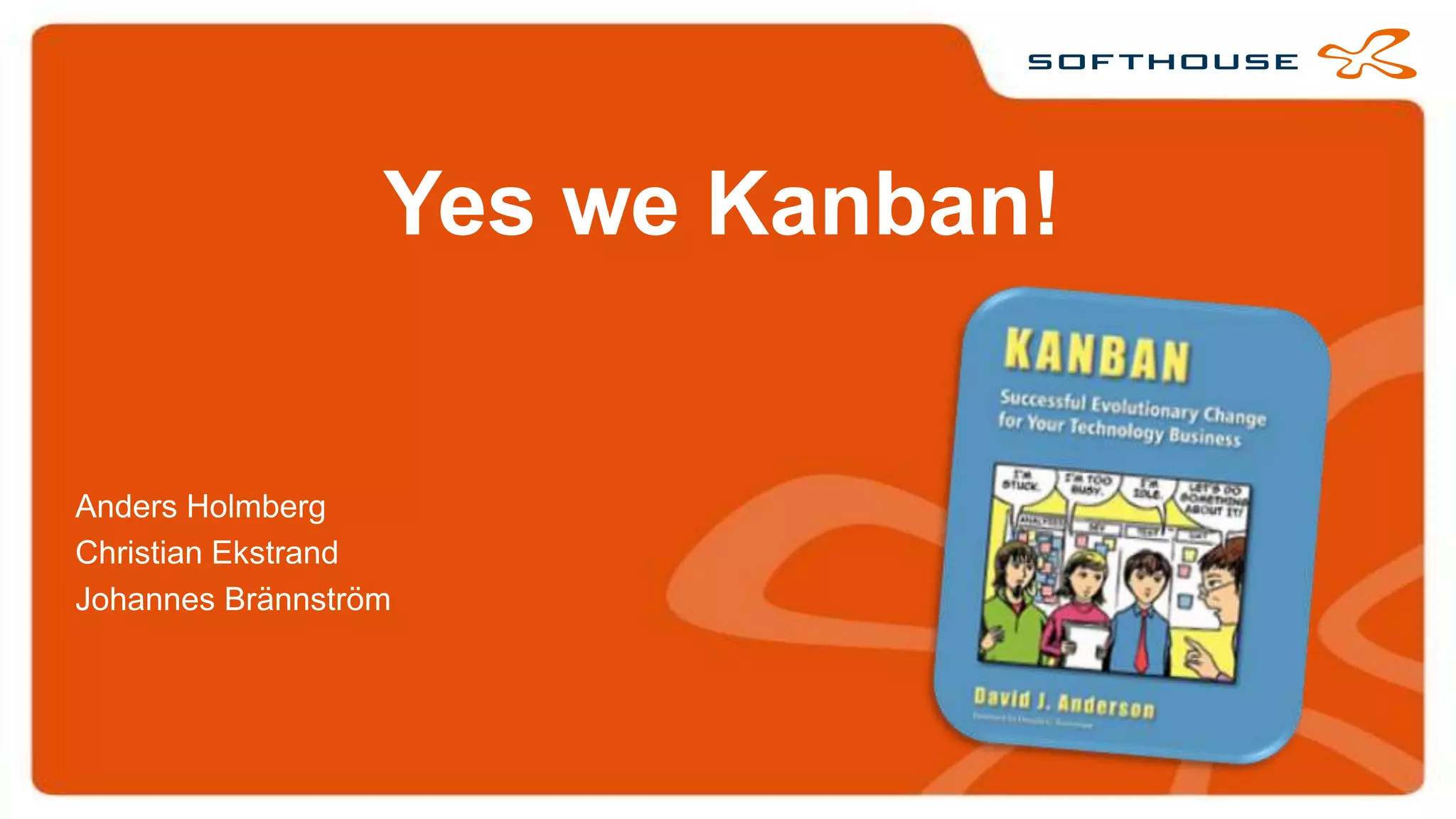
Yes we Kanban!

Anders Holmberg
Christian Ekstrand
Johannes Brännström
CHECK IN
• 1 min each:
– How are you feeling today?
Agenda
• 45 min Kanban Theory
• 45 min Kanban Simulation
• 30 min Discussion: Kanban in your environment
Anders Holmberg
• Coach and instructor
•
•
•
•
•

anders.holmberg@softhouse.se

Agile
Lean
Lean Startup
Visualize information
Internal communication
A common problem
Goal
Bus Dev

Sys Analysis

Design

Development

Test

Deploy

Problem

Capacity

Output

Strategy

How do you handle this today?
Perhaps Kanban?
Kanban stops you
from working with
too much at the
same time.

Kanban helps you
to deliver more
without
overloading
workers.

Kanban helps you
get a balanced
flow of work.
The Kanban Strategy
Goal
Bus Dev

Sys Analysis

Design

Development

Test

Problem
Kanban says:
- No one is allowed to
work more than the
bottleneck can handle!
Strategy

Kanban says:
- Otherwise the
company will
produce less!

Deploy
Saying no is hard!
Is it in anybodys’ responsibility?
And Kanban can help you:
–
–
–
–
–

To say NO to low priority work
To say NO to too much work at the same time
To say NO when you ask your bottleneck to do too much
To say NO to new coding until we have finished the delivery
To say NO to more development when the receiver is not ready.

And sometimes we need this help.
This is Kanban!

http://en.wikipedia.org/wiki/Kanban_(development)#Six_core_practices

1. Visualize
(the entire flow if possible)

2. Limit Work in progress
(based on your bottlenecks capacity)

3. Manage flow
(monitor, measure and optimize the whole)

4. Make policies explicit
(definition of done, team rules)

5. Implement feedback loops

(don’t wait for feedback, build it into the organisation)

6. Improve collaboratively, evolve experimentally
(using models and scientific methods)
This is Kanban!

http://en.wikipedia.org/wiki/Kanban_(development)#Six_core_practices

1. Visualize
(the entire flow if possible)

2. Limit Work in progress
(based on your bottlenecks capacity)

3. Manage flow

If you are not doing
these 6 you are not
doing Kanban.

(monitor, measure and optimize the whole)

4. Make policies explicit
(definition of done, team rules)

5. Implement feedback loops

(don’t wait for feedback, build it into the organisation)

6. Improve collaboratively, evolve experimentally
(using models and scientific methods)
Remember the slogan

1) Visualize
2) Limit Work In Progress
Goal
Bus Dev

Sys Analysis

Design

Development

Test

Deploy

Problem

Strategy

3]
[Limit = 2]

3]
[Limit = 2]

3]
[Limit = 2]

3]
[Limit = 2]

[Limit = 3]
Capacity = 2

Capacity = 3

14
3) Manage Flow
Gather & Define
Requirements

Analyze & Design

Develop

Test & Accept

[1]

[3]

[4]

[2]
doing

done

doing

done

Limit reached

doing

done

doing

Bottleneck

Package &
Deploy
[4]

done

doing

done

Available

15
4) Make Policies Explicit
For instance:
• Way of working
• Limit WIP quantified as a number
• Expedite lane
• Visualize different prioritization for everyone
To make it easier to discuss and improve policies.
5) Implement Feedback Loops
1st level of feedback:

When do
YOU get
feedback?

You (the team) give yourself feedback
2nd level of feedback:

You ask the persons receiving your work for feedback
3rd level of feedback:

You ask your customer for feedback
6) Improve Collaboratively,
Evolve Experimentally

Plan:

Do:
Check:
Act:

Decide a new way of working.
Set an acceptance criteria.
Define a test period.
Try the new way of working during the test period.
After the test period you evaluate outcome.
Decide to keep or throw away the new way of working.
Run Simulation!
Really
urgent
tasks
Getting Started
• The game begins in the Standup Meeting at start of Day 9.
• Assign workers by dragging them to the story you want them to work
on for the day.
• When all workers are assigned, click the begin Work Button to have
them perform the day’s work.
• Workers work a random number between 1 and 6. Or 2 and 12 when
the specialists work in their area.
• The game ends when Day 30 is complete.
Good Luck!
Start the game here!
Thank you!

Anders Holmberg
anders.holmberg@softhouse.se
Personal blog: agilcoach.se

Kanban six core practices

  • 1.
    Yes we Kanban! AndersHolmberg Christian Ekstrand Johannes Brännström
  • 2.
    CHECK IN • 1min each: – How are you feeling today?
  • 3.
    Agenda • 45 minKanban Theory • 45 min Kanban Simulation • 30 min Discussion: Kanban in your environment
  • 4.
    Anders Holmberg • Coachand instructor • • • • • anders.holmberg@softhouse.se Agile Lean Lean Startup Visualize information Internal communication
  • 5.
    A common problem Goal BusDev Sys Analysis Design Development Test Deploy Problem Capacity Output Strategy How do you handle this today?
  • 6.
    Perhaps Kanban? Kanban stopsyou from working with too much at the same time. Kanban helps you to deliver more without overloading workers. Kanban helps you get a balanced flow of work.
  • 7.
    The Kanban Strategy Goal BusDev Sys Analysis Design Development Test Problem Kanban says: - No one is allowed to work more than the bottleneck can handle! Strategy Kanban says: - Otherwise the company will produce less! Deploy
  • 8.
    Saying no ishard! Is it in anybodys’ responsibility? And Kanban can help you: – – – – – To say NO to low priority work To say NO to too much work at the same time To say NO when you ask your bottleneck to do too much To say NO to new coding until we have finished the delivery To say NO to more development when the receiver is not ready. And sometimes we need this help.
  • 9.
    This is Kanban! http://en.wikipedia.org/wiki/Kanban_(development)#Six_core_practices 1.Visualize (the entire flow if possible) 2. Limit Work in progress (based on your bottlenecks capacity) 3. Manage flow (monitor, measure and optimize the whole) 4. Make policies explicit (definition of done, team rules) 5. Implement feedback loops (don’t wait for feedback, build it into the organisation) 6. Improve collaboratively, evolve experimentally (using models and scientific methods)
  • 10.
    This is Kanban! http://en.wikipedia.org/wiki/Kanban_(development)#Six_core_practices 1.Visualize (the entire flow if possible) 2. Limit Work in progress (based on your bottlenecks capacity) 3. Manage flow If you are not doing these 6 you are not doing Kanban. (monitor, measure and optimize the whole) 4. Make policies explicit (definition of done, team rules) 5. Implement feedback loops (don’t wait for feedback, build it into the organisation) 6. Improve collaboratively, evolve experimentally (using models and scientific methods)
  • 11.
  • 12.
    2) Limit WorkIn Progress Goal Bus Dev Sys Analysis Design Development Test Deploy Problem Strategy 3] [Limit = 2] 3] [Limit = 2] 3] [Limit = 2] 3] [Limit = 2] [Limit = 3] Capacity = 2 Capacity = 3 14
  • 13.
    3) Manage Flow Gather& Define Requirements Analyze & Design Develop Test & Accept [1] [3] [4] [2] doing done doing done Limit reached doing done doing Bottleneck Package & Deploy [4] done doing done Available 15
  • 14.
    4) Make PoliciesExplicit For instance: • Way of working • Limit WIP quantified as a number • Expedite lane • Visualize different prioritization for everyone To make it easier to discuss and improve policies.
  • 15.
    5) Implement FeedbackLoops 1st level of feedback: When do YOU get feedback? You (the team) give yourself feedback 2nd level of feedback: You ask the persons receiving your work for feedback 3rd level of feedback: You ask your customer for feedback
  • 16.
    6) Improve Collaboratively, EvolveExperimentally Plan: Do: Check: Act: Decide a new way of working. Set an acceptance criteria. Define a test period. Try the new way of working during the test period. After the test period you evaluate outcome. Decide to keep or throw away the new way of working.
  • 17.
  • 18.
    Getting Started • Thegame begins in the Standup Meeting at start of Day 9. • Assign workers by dragging them to the story you want them to work on for the day. • When all workers are assigned, click the begin Work Button to have them perform the day’s work. • Workers work a random number between 1 and 6. Or 2 and 12 when the specialists work in their area. • The game ends when Day 30 is complete. Good Luck! Start the game here!
  • 19.

Editor's Notes

  • #3 1)Skapamedvetenhetomproblemet2) Skapavilkaattlösaproblemet3) Skapakunskapattlösaproblemet
  • #14 Draw your board in class and discuss bottlenecks and limits.
  • #20 Do it together in class.