Topics
• WHAT IS LEAN
• HISTORY OF LEAN
• LEAN PRINCIPLES
• TYPES OF WASTES
• LEAN SUCCESS AND BENEFITS
• LEAN CHALLENGES
WHAT IS LEAN
Lean is set of principles to perform certain activities that reduces waste to add/increase customer
value.
Motto behind Lean was
“Offer higher quality, and more affordable products in less time”
LEAN HISTORY
Roots of the lean are derived from Toyota Production System
After world war, Japanese economy was rebuilding and based on Ford’s
original thinking, series of simple innovation steps we implemented. These
innovation steps were focused on improving end to end process rather than
optimizing individual machines. The steady growth of Toyota, from a small
company to the world's largest automaker, made world think how it has
achieved this success.
From this success, Lean principles came into picture.
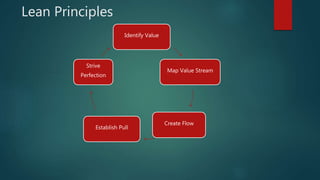
Lean Principles
Identify Value
Map Value Stream
Create Flow
Establish Pull
Strive
Perfection
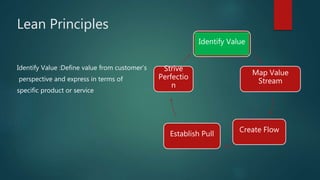
Lean Principles
Identify Value :Define value from customer’s
perspective and express in terms of
specific product or service
Identify Value
Map Value
Stream
Create Flow
Establish Pull
Strive
Perfectio
n
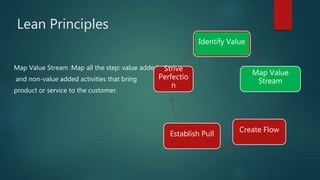
Lean Principles
Map Value Stream :Map all the step: value added
and non-value added activities that bring
product or service to the customer.
Identify Value
Map Value
Stream
Create Flow
Establish Pull
Strive
Perfectio
n
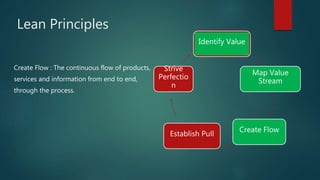
Lean Principles
Create Flow : The continuous flow of products,
services and information from end to end,
through the process.
Identify Value
Map Value
Stream
Create Flow
Establish Pull
Strive
Perfectio
n
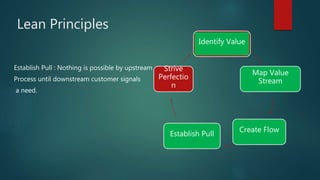
Lean Principles
Establish Pull : Nothing is possible by upstream
Process until downstream customer signals
a need.
Identify Value
Map Value
Stream
Create Flow
Establish Pull
Strive
Perfectio
n
Lean Principles
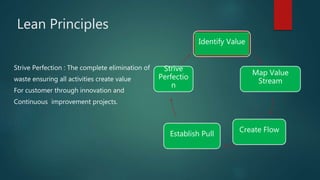
Strive Perfection : The complete elimination of
waste ensuring all activities create value
For customer through innovation and
Continuous improvement projects.
Identify Value
Map Value
Stream
Create Flow
Establish Pull
Strive
Perfectio
n
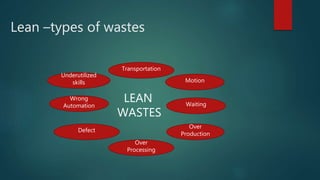
Lean –types of wastes
Underutilized
skills
Wrong
Automation
Transportation
Motion
Waiting
Defect
Over
Production
Over
Processing
LEAN
WASTES
Lean –types of wastes
Underutilize
d skills
Wrong
Automatio
n
Transportatio
n
Motion
Waiting
Defect
Over
Production
Over
Processing
LEAN
WASTES
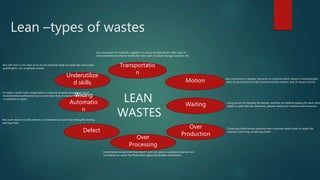
Any movement of materials, suppliers or resources that doesn’t add value to
internal/external customer needs like extra carts, multiple storage locations etc.
Any movement of people, resources or machine which doesn’t contribute/add
value to product/service like human/machine motion, lack of visual controls
Long period of inactivity for people, machine or material waiting for each other
leads to waste like late deliveries, people waiting for machine and resources.
Producing faster/excess quantity than customer needs leads to waste like
improper planning, producing earlier.
Investment(money/time) that doesn’t add any value to product/customer are
considered as waste like Redundant approvals/Endless refinement.
Any work done to rectify defects is considered as waste like testing/Re-testing
and bug fixes.
In today’s world, every organization is moving towards automation but if
investment(time/effort/money) is more than that of manual then this is
considered as waste.
Any skill that is not used up to its full potential leads to waste like over/under
qualification, low employee morale.
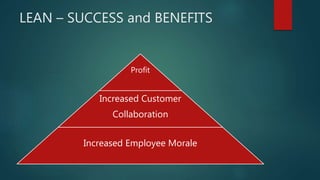
LEAN – SUCCESS and BENEFITS
Profit
Increased Customer
Collaboration
Increased Employee Morale
LEAN Challenges
ď‚· Disruptions, Downtime and Design Failure
People might not be ready to take new process, this could cause delay in delivery or even design
failure because it was designed as per older process.
ď‚· Process changes causes rethinking of process flow
Process require input/output and processing. If process changes it will alter any of these things.

Lean fundamentals

  • 1.
    Topics • WHAT ISLEAN • HISTORY OF LEAN • LEAN PRINCIPLES • TYPES OF WASTES • LEAN SUCCESS AND BENEFITS • LEAN CHALLENGES
  • 2.
    WHAT IS LEAN Leanis set of principles to perform certain activities that reduces waste to add/increase customer value. Motto behind Lean was “Offer higher quality, and more affordable products in less time”
  • 3.
    LEAN HISTORY Roots ofthe lean are derived from Toyota Production System After world war, Japanese economy was rebuilding and based on Ford’s original thinking, series of simple innovation steps we implemented. These innovation steps were focused on improving end to end process rather than optimizing individual machines. The steady growth of Toyota, from a small company to the world's largest automaker, made world think how it has achieved this success. From this success, Lean principles came into picture.
  • 4.
    Lean Principles Identify Value MapValue Stream Create Flow Establish Pull Strive Perfection
  • 5.
    Lean Principles Identify Value:Define value from customer’s perspective and express in terms of specific product or service Identify Value Map Value Stream Create Flow Establish Pull Strive Perfectio n
  • 6.
    Lean Principles Map ValueStream :Map all the step: value added and non-value added activities that bring product or service to the customer. Identify Value Map Value Stream Create Flow Establish Pull Strive Perfectio n
  • 7.
    Lean Principles Create Flow: The continuous flow of products, services and information from end to end, through the process. Identify Value Map Value Stream Create Flow Establish Pull Strive Perfectio n
  • 8.
    Lean Principles Establish Pull: Nothing is possible by upstream Process until downstream customer signals a need. Identify Value Map Value Stream Create Flow Establish Pull Strive Perfectio n
  • 9.
    Lean Principles Strive Perfection: The complete elimination of waste ensuring all activities create value For customer through innovation and Continuous improvement projects. Identify Value Map Value Stream Create Flow Establish Pull Strive Perfectio n
  • 10.
    Lean –types ofwastes Underutilized skills Wrong Automation Transportation Motion Waiting Defect Over Production Over Processing LEAN WASTES
  • 11.
    Lean –types ofwastes Underutilize d skills Wrong Automatio n Transportatio n Motion Waiting Defect Over Production Over Processing LEAN WASTES Any movement of materials, suppliers or resources that doesn’t add value to internal/external customer needs like extra carts, multiple storage locations etc. Any movement of people, resources or machine which doesn’t contribute/add value to product/service like human/machine motion, lack of visual controls Long period of inactivity for people, machine or material waiting for each other leads to waste like late deliveries, people waiting for machine and resources. Producing faster/excess quantity than customer needs leads to waste like improper planning, producing earlier. Investment(money/time) that doesn’t add any value to product/customer are considered as waste like Redundant approvals/Endless refinement. Any work done to rectify defects is considered as waste like testing/Re-testing and bug fixes. In today’s world, every organization is moving towards automation but if investment(time/effort/money) is more than that of manual then this is considered as waste. Any skill that is not used up to its full potential leads to waste like over/under qualification, low employee morale.
  • 12.
    LEAN – SUCCESSand BENEFITS Profit Increased Customer Collaboration Increased Employee Morale
  • 13.
    LEAN Challenges ď‚· Disruptions,Downtime and Design Failure People might not be ready to take new process, this could cause delay in delivery or even design failure because it was designed as per older process. ď‚· Process changes causes rethinking of process flow Process require input/output and processing. If process changes it will alter any of these things.