∙ MANUFACTURING ∙
LEAN
LEAN 101
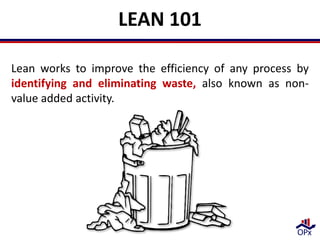
Lean works to improve the efficiency of any process by
identifying and eliminating waste, also known as non-
value added activity.
LEAN 101
An Optimized Value Stream
LEAN is a system which produces:
What the customer wants…“The Right Part”
When the customer wants it… “The Right Time”
In the quantity the customer wants…“The Right Amount”
While using the minimum:
Raw Materials
Equipment
Labor
Space
Value Adding Activities...
...transform raw materials and information into products or services
which the customer wants!
Non-Value Adding Activities...
...consume resources, but don't directly contribute to the product.
VALUE ADD vs. NON-VALUE ADD
Value Adding Activities...
...transform raw materials and information into products or services
which the customer wants!
Non-Value Adding Activities...
...consume resources, but don't directly contribute to the product.
VALUE ADD vs. NON-VALUE ADD
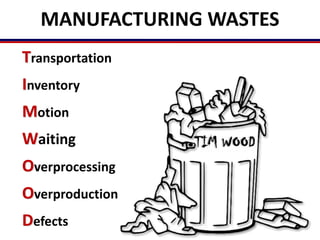
Transportation
Inventory
Motion
Waiting
Overprocessing
Overproduction
Defects
MANUFACTURING WASTES
Waste of Transportation:
“Transporting parts and materials around the plant.”
Causes of Transportation:
▪ Poor plant layout
▪ Poor understanding of process flow
▪ Large batch sizes
▪ Long lead times
▪ Large storage areas
▪ Double and triple handling
WASTE 1
Waste of Inventory:
“Inventory waste is stock or work in process in excess of the requirements
necessary to produce goods or services just in time.”
Causes of Inventory
▪ Unleveled Scheduling
▪ Poor Market Forecast
▪ Unbalanced Workload
▪ Unreliable shipments by suppliers
▪ Misunderstood communications
WASTE 2
Waste of Motion:
“Any movement of people or machines that does not add value.”
Causes of Wasted Motion:
▪ Inconsistent work methods
▪ Unfavorable facility or cell layout
▪ Poor workplace organization
▪ Misplaced tools and equipment
WASTE 3
Waste of Waiting:
“Idle Time created when waiting for…”
Causes of Waiting:
▪ Unbalanced work load
▪ Unplanned Maintenance
▪ Long set ups
▪ Misuses of automation
▪ Upstream quality problems
▪ Unleveled scheduling
▪ Waiting for approvals
▪ Poor communication
WASTE 4
Waste of Overprocessing:
“Effort adds no value to the product or service from the customers viewpoint.”
Causes of Overprocessing:
▪ Product changes without process changes
▪ Just in case mentality
▪ Customer requirements undefined
▪ Large downtime
▪ Lack of Communication
▪ Redundant approvals
▪ Extra copies/excessive information
WASTE 5
Waste of Overproduction:
“Making more, earlier, or faster than is required by the next process.”
Causes of Overproduction
▪ Misuse of automation
▪ Push Production Mentality
▪ Long process set up
▪ Un-level scheduling
▪ Unbalanced work load
WASTE 6
Waste of Defects:
“Using resources to inspect and repair material in inventory wastes time.”
Causes of Defects:
▪ Weak Process control
▪ Poor quality materials
▪ Unbalanced inventory level
▪ Deficient planned maintenance
▪ Inadequate training/work orders
▪ Product design
▪ Customer needs not understood
WASTE 7
• Layout (distance)
• Long setup times
• Incapable processes
• Poor operating practices
• Poor communication
• Lack of training
• Lack of adherence
• Poor management
techniques
• Ineffective production
planning/scheduling
• Lack of workplace
organization
• Quality/Reliability Issues
• Unreliable equipment
• More…
“If it doesn’t add value, it’s waste.”
Henry Ford
1920
CAUSES OF WASTE
TIME REDUCTION
99%
ELIMINATE NVA ACTIVITY
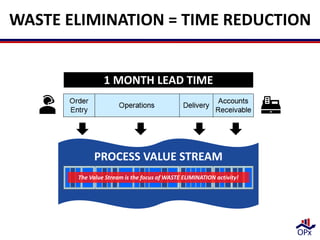
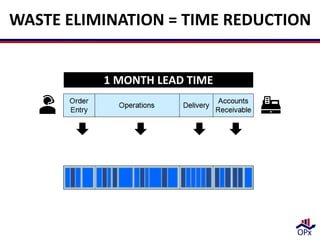
1 MONTH LEAD TIME
WASTE ELIMINATION = TIME REDUCTION
1 MONTH LEAD TIME
WASTE ELIMINATION = TIME REDUCTION
1 MONTH LEAD TIME
WASTE ELIMINATION = TIME REDUCTION
COMMUNICATION & INFORMATION STEPS
1 MONTH LEAD TIME
WASTE ELIMINATION = TIME REDUCTION
COMMUNICATION & INFORMATION STEPS
PROCESSING (MANUFACTURING) STEPS
PROCESS VALUE STREAM
1 MONTH LEAD TIME
WASTE ELIMINATION = TIME REDUCTION
PROCESS VALUE STREAM
1 MONTH LEAD TIME
WASTE ELIMINATION = TIME REDUCTION
The Value Stream is the focus of WASTE ELIMINATION activity!
1 MONTH LEAD TIME
WASTE ELIMINATION = TIME REDUCTION
VALUE ADDIdentify what is --------->
WASTE ELIMINATION = TIME REDUCTION
1 MONTH LEAD TIME
VALUE ADDIdentify what is --------->
NON-VALUE ADDIdentify what is --------->
WASTE ELIMINATION = TIME REDUCTION
1 MONTH LEAD TIME
ELIMINATE NON-VALUE ADDED STEPS IN THE PROCESS
1 MONTH LEAD TIME
VALUE ADD
WASTE ELIMINATION = TIME REDUCTION
1 MONTH LEAD TIME
VALUE ADD
WASTE ELIMINATION = TIME REDUCTION
7 DAY LEAD TIME
1 MONTH LEAD TIME
WASTE ELIMINATION = TIME REDUCTION
∙ MANUFACTURING ∙
LEAN

Lean Manufacturing 101

  • 1.
  • 2.
    LEAN 101 Lean worksto improve the efficiency of any process by identifying and eliminating waste, also known as non- value added activity.
  • 3.
    LEAN 101 An OptimizedValue Stream LEAN is a system which produces: What the customer wants…“The Right Part” When the customer wants it… “The Right Time” In the quantity the customer wants…“The Right Amount” While using the minimum: Raw Materials Equipment Labor Space
  • 4.
    Value Adding Activities... ...transformraw materials and information into products or services which the customer wants! Non-Value Adding Activities... ...consume resources, but don't directly contribute to the product. VALUE ADD vs. NON-VALUE ADD
  • 5.
    Value Adding Activities... ...transformraw materials and information into products or services which the customer wants! Non-Value Adding Activities... ...consume resources, but don't directly contribute to the product. VALUE ADD vs. NON-VALUE ADD
  • 6.
  • 7.
    Waste of Transportation: “Transportingparts and materials around the plant.” Causes of Transportation: ▪ Poor plant layout ▪ Poor understanding of process flow ▪ Large batch sizes ▪ Long lead times ▪ Large storage areas ▪ Double and triple handling WASTE 1
  • 8.
    Waste of Inventory: “Inventorywaste is stock or work in process in excess of the requirements necessary to produce goods or services just in time.” Causes of Inventory ▪ Unleveled Scheduling ▪ Poor Market Forecast ▪ Unbalanced Workload ▪ Unreliable shipments by suppliers ▪ Misunderstood communications WASTE 2
  • 9.
    Waste of Motion: “Anymovement of people or machines that does not add value.” Causes of Wasted Motion: ▪ Inconsistent work methods ▪ Unfavorable facility or cell layout ▪ Poor workplace organization ▪ Misplaced tools and equipment WASTE 3
  • 10.
    Waste of Waiting: “IdleTime created when waiting for…” Causes of Waiting: ▪ Unbalanced work load ▪ Unplanned Maintenance ▪ Long set ups ▪ Misuses of automation ▪ Upstream quality problems ▪ Unleveled scheduling ▪ Waiting for approvals ▪ Poor communication WASTE 4
  • 11.
    Waste of Overprocessing: “Effortadds no value to the product or service from the customers viewpoint.” Causes of Overprocessing: ▪ Product changes without process changes ▪ Just in case mentality ▪ Customer requirements undefined ▪ Large downtime ▪ Lack of Communication ▪ Redundant approvals ▪ Extra copies/excessive information WASTE 5
  • 12.
    Waste of Overproduction: “Makingmore, earlier, or faster than is required by the next process.” Causes of Overproduction ▪ Misuse of automation ▪ Push Production Mentality ▪ Long process set up ▪ Un-level scheduling ▪ Unbalanced work load WASTE 6
  • 13.
    Waste of Defects: “Usingresources to inspect and repair material in inventory wastes time.” Causes of Defects: ▪ Weak Process control ▪ Poor quality materials ▪ Unbalanced inventory level ▪ Deficient planned maintenance ▪ Inadequate training/work orders ▪ Product design ▪ Customer needs not understood WASTE 7
  • 14.
    • Layout (distance) •Long setup times • Incapable processes • Poor operating practices • Poor communication • Lack of training • Lack of adherence • Poor management techniques • Ineffective production planning/scheduling • Lack of workplace organization • Quality/Reliability Issues • Unreliable equipment • More… “If it doesn’t add value, it’s waste.” Henry Ford 1920 CAUSES OF WASTE
  • 15.
  • 16.
  • 17.
  • 18.
    1 MONTH LEADTIME WASTE ELIMINATION = TIME REDUCTION
  • 19.
    1 MONTH LEADTIME WASTE ELIMINATION = TIME REDUCTION
  • 20.
    1 MONTH LEADTIME WASTE ELIMINATION = TIME REDUCTION COMMUNICATION & INFORMATION STEPS
  • 21.
    1 MONTH LEADTIME WASTE ELIMINATION = TIME REDUCTION COMMUNICATION & INFORMATION STEPS PROCESSING (MANUFACTURING) STEPS
  • 22.
    PROCESS VALUE STREAM 1MONTH LEAD TIME WASTE ELIMINATION = TIME REDUCTION
  • 23.
    PROCESS VALUE STREAM 1MONTH LEAD TIME WASTE ELIMINATION = TIME REDUCTION The Value Stream is the focus of WASTE ELIMINATION activity!
  • 24.
    1 MONTH LEADTIME WASTE ELIMINATION = TIME REDUCTION
  • 25.
    VALUE ADDIdentify whatis ---------> WASTE ELIMINATION = TIME REDUCTION 1 MONTH LEAD TIME
  • 26.
    VALUE ADDIdentify whatis ---------> NON-VALUE ADDIdentify what is ---------> WASTE ELIMINATION = TIME REDUCTION 1 MONTH LEAD TIME
  • 27.
    ELIMINATE NON-VALUE ADDEDSTEPS IN THE PROCESS 1 MONTH LEAD TIME VALUE ADD WASTE ELIMINATION = TIME REDUCTION
  • 28.
    1 MONTH LEADTIME VALUE ADD WASTE ELIMINATION = TIME REDUCTION
  • 29.
    7 DAY LEADTIME 1 MONTH LEAD TIME WASTE ELIMINATION = TIME REDUCTION
  • 30.