Dr A Jagan Mohan Reddy
Introduction:
“ Before you are a leader, success is all about growing
yourself. When you become a leader, success is all
about growing others. “--Jack Welch
3 Skills - leading, Managing, And Working.
 A leader -Strongest in leadership,
 A Manager-Strongest is management and
 A Worker -Strongest in workmanship.
 Leadership is different from management in several
aspects. e.g., A President/ CEO - both a L/M;
Chief Architect –Just A L; A Project Manager -Just
a Manager. A Programmer can just be a worker.
 This does not imply that a Manager's role is less
significant..
Difference between Manager and Leader
 Have Employees.
 React to Change.
 Have Good Ideas. .
 Communicates
 Directs Groups
 Try to be Heroes.
 Takes Credit.
 Managers are Focused
 Exercise
Power Over People
 Win Followers.
 Create change.
 Implement them.
 Persuade.
 Create Teams.
 Make Heroes Of Everyone
around them.
 Take
Responsibility.
 Create shared focus.
 Develop power with people
Concept of Leadership
“Managers are people who do things right,
while leaders are people who do the right
thing.”
 Good leaders are made not born. If you have
the desire and will power, you can.
 LS Skills[ what you must be, know and do]can
be acquired through continual work and study.
 The best leaders are continually working and
studying to improve their leadership skills.
'Leadership is all about courage to dream
big.'
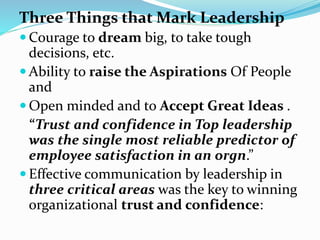
Three Things that Mark Leadership
 Courage to dream big, to take tough
decisions, etc.
 Ability to raise the Aspirations Of People
and
 Open minded and to Accept Great Ideas .
“Trust and confidence in Top leadership
was the single most reliable predictor of
employee satisfaction in an orgn.”
 Effective communication by leadership in
three critical areas was the key to winning
organizational trust and confidence:
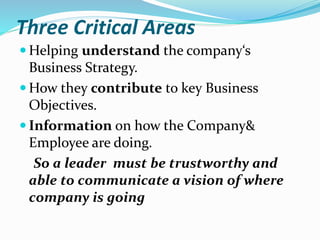
Three Critical Areas
 Helping understand the company‘s
Business Strategy.
 How they contribute to key Business
Objectives.
 Information on how the Company&
Employee are doing.
So a leader must be trustworthy and
able to communicate a vision of where
company is going
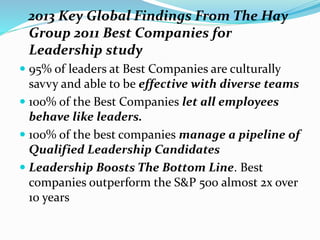
2013 Key Global Findings From The Hay
Group 2011 Best Companies for
Leadership study
 95% of leaders at Best Companies are culturally
savvy and able to be effective with diverse teams
 100% of the Best Companies let all employees
behave like leaders.
 100% of the best companies manage a pipeline of
Qualified Leadership Candidates
 Leadership Boosts The Bottom Line. Best
companies outperform the S&P 500 almost 2x over
10 years
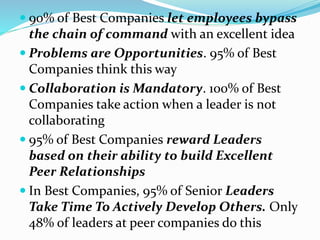
 90% of Best Companies let employees bypass
the chain of command with an excellent idea
 Problems are Opportunities. 95% of Best
Companies think this way
 Collaboration is Mandatory. 100% of Best
Companies take action when a leader is not
collaborating
 95% of Best Companies reward Leaders
based on their ability to build Excellent
Peer Relationships
 In Best Companies, 95% of Senior Leaders
Take Time To Actively Develop Others. Only
48% of leaders at peer companies do this
The Process Of Great Leadership
 Challenge the Process-Find a process that needs to
be improved the most.
 Inspire a Shared Vision-Share your vision in words
that can be understood .
 Enable Others To Act-Give them the tools and
methods to solve the problem.
 Model The Way-when the process gets tough, get your
hands dirty.e.g.,Ratan rolling his sleeves
“ A boss tells others what to do…a leader shows it
can be done.”
 Encourage the Heart-Share the glory and keep the
pains in your heart.
Impact of leadership in organization
a}Leadership and Human Behavior
 Able to understand and motivate them.
 Know human nature-needs- motivators.
b}Leadership and Communication
“LS is the hallmark of management.”
 Faulty Communication causes the most
problems.
 Effective Communication occurs only if the
receiver understands the exact information
or idea that the sender intended to transmit.
c}Leadership and Motivation
 Influencing someone's motivation means
getting them to want to do what you know
must be done.
 A person's motivation depends upon two
things:
a}The strength of certain needs.
b}The perception that taking a certain
action will help satisfy those needs.
Leadership Secrets
1. Decisiveness Is Key
“The most distinguished trait that defines a
good leader is the willingness to make
decisions that are need of the hour no
matter how difficult they may be. “
2.Visionary Leadership (B.Muthuraman,
MD, Tata steel)
 The ability to create a shared vision among
team members is the primary trait of a true
leader.
3. Relate And Rule
 Ability to recognize all the factors that would make
the leader succeed in motivating the group.
4. Take Responsibility: Satish Dhavan and Kalam
saab
“A leader is only as good as his team. “
Leadership Involves Two Steps:
 helping subordinates take advantage of their
talents, and then
 fine tuning their performance.
“Good leaders always take responsibility
for both the success and failure of their
teams.”
Conclusion
 LS has paramount importance in VUCA.
 Competitive/competent LS- will face all the
problems very efficiently.
“The recognition of hearing you did
a great job and that others are
hearing about it is worth more than
money”.
“Being centered around others
rather than oneself or owns task”
-Altrocentric LS.
Importance ls in current times

Importance ls in current times

  • 1.
    Dr A JaganMohan Reddy
  • 2.
    Introduction: “ Before youare a leader, success is all about growing yourself. When you become a leader, success is all about growing others. “--Jack Welch 3 Skills - leading, Managing, And Working.  A leader -Strongest in leadership,  A Manager-Strongest is management and  A Worker -Strongest in workmanship.  Leadership is different from management in several aspects. e.g., A President/ CEO - both a L/M; Chief Architect –Just A L; A Project Manager -Just a Manager. A Programmer can just be a worker.  This does not imply that a Manager's role is less significant..
  • 3.
    Difference between Managerand Leader  Have Employees.  React to Change.  Have Good Ideas. .  Communicates  Directs Groups  Try to be Heroes.  Takes Credit.  Managers are Focused  Exercise Power Over People  Win Followers.  Create change.  Implement them.  Persuade.  Create Teams.  Make Heroes Of Everyone around them.  Take Responsibility.  Create shared focus.  Develop power with people
  • 4.
    Concept of Leadership “Managersare people who do things right, while leaders are people who do the right thing.”  Good leaders are made not born. If you have the desire and will power, you can.  LS Skills[ what you must be, know and do]can be acquired through continual work and study.  The best leaders are continually working and studying to improve their leadership skills. 'Leadership is all about courage to dream big.'
  • 5.
    Three Things thatMark Leadership  Courage to dream big, to take tough decisions, etc.  Ability to raise the Aspirations Of People and  Open minded and to Accept Great Ideas . “Trust and confidence in Top leadership was the single most reliable predictor of employee satisfaction in an orgn.”  Effective communication by leadership in three critical areas was the key to winning organizational trust and confidence:
  • 6.
    Three Critical Areas Helping understand the company‘s Business Strategy.  How they contribute to key Business Objectives.  Information on how the Company& Employee are doing. So a leader must be trustworthy and able to communicate a vision of where company is going
  • 7.
    2013 Key GlobalFindings From The Hay Group 2011 Best Companies for Leadership study  95% of leaders at Best Companies are culturally savvy and able to be effective with diverse teams  100% of the Best Companies let all employees behave like leaders.  100% of the best companies manage a pipeline of Qualified Leadership Candidates  Leadership Boosts The Bottom Line. Best companies outperform the S&P 500 almost 2x over 10 years
  • 8.
     90% ofBest Companies let employees bypass the chain of command with an excellent idea  Problems are Opportunities. 95% of Best Companies think this way  Collaboration is Mandatory. 100% of Best Companies take action when a leader is not collaborating  95% of Best Companies reward Leaders based on their ability to build Excellent Peer Relationships  In Best Companies, 95% of Senior Leaders Take Time To Actively Develop Others. Only 48% of leaders at peer companies do this
  • 9.
    The Process OfGreat Leadership  Challenge the Process-Find a process that needs to be improved the most.  Inspire a Shared Vision-Share your vision in words that can be understood .  Enable Others To Act-Give them the tools and methods to solve the problem.  Model The Way-when the process gets tough, get your hands dirty.e.g.,Ratan rolling his sleeves “ A boss tells others what to do…a leader shows it can be done.”  Encourage the Heart-Share the glory and keep the pains in your heart.
  • 10.
    Impact of leadershipin organization a}Leadership and Human Behavior  Able to understand and motivate them.  Know human nature-needs- motivators. b}Leadership and Communication “LS is the hallmark of management.”  Faulty Communication causes the most problems.  Effective Communication occurs only if the receiver understands the exact information or idea that the sender intended to transmit.
  • 11.
    c}Leadership and Motivation Influencing someone's motivation means getting them to want to do what you know must be done.  A person's motivation depends upon two things: a}The strength of certain needs. b}The perception that taking a certain action will help satisfy those needs.
  • 12.
    Leadership Secrets 1. DecisivenessIs Key “The most distinguished trait that defines a good leader is the willingness to make decisions that are need of the hour no matter how difficult they may be. “ 2.Visionary Leadership (B.Muthuraman, MD, Tata steel)  The ability to create a shared vision among team members is the primary trait of a true leader.
  • 13.
    3. Relate AndRule  Ability to recognize all the factors that would make the leader succeed in motivating the group. 4. Take Responsibility: Satish Dhavan and Kalam saab “A leader is only as good as his team. “ Leadership Involves Two Steps:  helping subordinates take advantage of their talents, and then  fine tuning their performance. “Good leaders always take responsibility for both the success and failure of their teams.”
  • 14.
    Conclusion  LS hasparamount importance in VUCA.  Competitive/competent LS- will face all the problems very efficiently. “The recognition of hearing you did a great job and that others are hearing about it is worth more than money”. “Being centered around others rather than oneself or owns task” -Altrocentric LS.