TRAINING AND
DEVELOPMENT

BY:
Deepa Makhija
Rahul Chaudhary
Manisha Kunwar
SHREYA LIFE SCIENCE
 Shreya Life Sciences -

Shreya Group Company – Started in

2001
 Acuqired the Pharma Division of Rallis India Ltd., a TATA
Group company.
 Acquistion of the domestic pharma business of Plethico
Pharmaceuticals Ltd. In 2003
 Today, Shreya Life Sciences Pvt. Ltd., Mumbai - India, operates
through three Strategic Business Units (SBUs).
 Amadeus
 AkuCare
 BioLife
MISSION AND VISION
Vision
To be a globally admired Pharmaceutical company for world-class
quality and innovation.
Mission
 To be a 10 billion company by the year 2014-15.
 To be amongst the top 25 Pharmaceutical companies of India by the
year 2014- 15 and to achieve this objective through both organic
and inorganic growth.
 Expand our business to all continents by 2015-16
TRAINING POLICY
1. Scientific knowledge enhancement & sharpening
communication skills of field executives.
2. Controlling the percentage of Untrained-field-force in each
and every division of the company.
3. Focus on “Trained-field-force” affectivity by doing joint field
work.
4. Special Guidance to Area-managers in the perspective of
strategy implementation, time management and Target
achievement.
5. Attention on newly launched products for in-clinic
effectiveness of communication for first 6 months.
CONTINUED ….
6. Update and review of training needs of newly joined
employees/fresher’s.
7. For advanced -technology based products ensuring
simplification of discussion with customers.
8. Team-building and Team-management guidance at various
levels of organization for increasing managerial affectivity.
9. In the Budgeted Annual-Finance, conducting training-programs
to benefit all zones for all the product-range.
10. Following meticulously the timing-schedule for the stipulated
topics in the Agenda during a training-program.
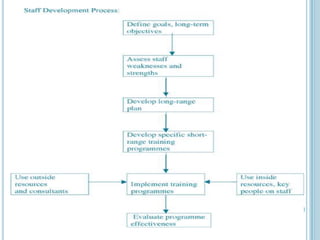
TRAINING PROCESS
TRAINING NEED ANALYSIS
TRAINING METHODS
- E.G. PHARMA SALES TEAM
 Classroom training: Initial in-house training on disease,

products, company, software, and skills.
 Field training (on-job-training – OJT): Initial field training
with trainer, supervisor, and manager.
 Double calling: Sales calling with senior colleague,
supervisor, or manager.
 New product classroom training: Additional training
before new product, formulation, or dosage launch.
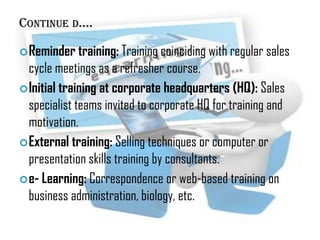
CONTINUE D….
 Reminder training: Training coinciding with regular sales

cycle meetings as a refresher course.
 Initial training at corporate headquarters (HQ): Sales
specialist teams invited to corporate HQ for training and
motivation.
 External training: Selling techniques or computer or
presentation skills training by consultants.
 e- Learning: Correspondence or web-based training on
business administration, biology, etc.
TRAINING EVALUATION METHODS
The process of examining a training program

is
called training evaluation. Whether candidates are
able to implement their learning in their respective
workplaces, or to the regular work routines.

Evaluation methods can be either qualitative (e.g.,

interviews, case studies, focus groups) or
quantitative (e.g., surveys, experiments)
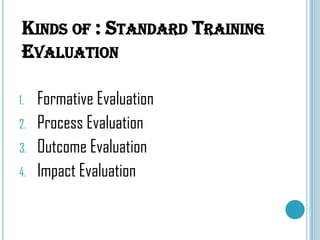
KINDS OF : STANDARD TRAINING
EVALUATION
1.
2.

3.
4.

Formative Evaluation
Process Evaluation
Outcome Evaluation
Impact Evaluation
Formative evaluation

provides ongoing
feedback to the curriculum designers and
developers to ensure that what is being created
really meets the needs of the intended
audience.
Process evaluation provides information
about what occurs during training. This includes
giving and receiving verbal feedback.
Outcome evaluation determines

whether or not the desired results
(e.g., what participants are doing) of
applying new skills were Achieved in the
short-term.
Impact determines how the results of
the training affect the strategic goal
THANK

T&d presentation

  • 1.
  • 2.
    SHREYA LIFE SCIENCE Shreya Life Sciences - Shreya Group Company – Started in 2001  Acuqired the Pharma Division of Rallis India Ltd., a TATA Group company.  Acquistion of the domestic pharma business of Plethico Pharmaceuticals Ltd. In 2003  Today, Shreya Life Sciences Pvt. Ltd., Mumbai - India, operates through three Strategic Business Units (SBUs).  Amadeus  AkuCare  BioLife
  • 3.
    MISSION AND VISION Vision Tobe a globally admired Pharmaceutical company for world-class quality and innovation. Mission  To be a 10 billion company by the year 2014-15.  To be amongst the top 25 Pharmaceutical companies of India by the year 2014- 15 and to achieve this objective through both organic and inorganic growth.  Expand our business to all continents by 2015-16
  • 4.
    TRAINING POLICY 1. Scientificknowledge enhancement & sharpening communication skills of field executives. 2. Controlling the percentage of Untrained-field-force in each and every division of the company. 3. Focus on “Trained-field-force” affectivity by doing joint field work. 4. Special Guidance to Area-managers in the perspective of strategy implementation, time management and Target achievement. 5. Attention on newly launched products for in-clinic effectiveness of communication for first 6 months.
  • 5.
    CONTINUED …. 6. Updateand review of training needs of newly joined employees/fresher’s. 7. For advanced -technology based products ensuring simplification of discussion with customers. 8. Team-building and Team-management guidance at various levels of organization for increasing managerial affectivity. 9. In the Budgeted Annual-Finance, conducting training-programs to benefit all zones for all the product-range. 10. Following meticulously the timing-schedule for the stipulated topics in the Agenda during a training-program.
  • 6.
  • 8.
  • 9.
    TRAINING METHODS - E.G.PHARMA SALES TEAM  Classroom training: Initial in-house training on disease, products, company, software, and skills.  Field training (on-job-training – OJT): Initial field training with trainer, supervisor, and manager.  Double calling: Sales calling with senior colleague, supervisor, or manager.  New product classroom training: Additional training before new product, formulation, or dosage launch.
  • 10.
    CONTINUE D….  Remindertraining: Training coinciding with regular sales cycle meetings as a refresher course.  Initial training at corporate headquarters (HQ): Sales specialist teams invited to corporate HQ for training and motivation.  External training: Selling techniques or computer or presentation skills training by consultants.  e- Learning: Correspondence or web-based training on business administration, biology, etc.
  • 11.
    TRAINING EVALUATION METHODS Theprocess of examining a training program is called training evaluation. Whether candidates are able to implement their learning in their respective workplaces, or to the regular work routines. Evaluation methods can be either qualitative (e.g., interviews, case studies, focus groups) or quantitative (e.g., surveys, experiments)
  • 12.
    KINDS OF :STANDARD TRAINING EVALUATION 1. 2. 3. 4. Formative Evaluation Process Evaluation Outcome Evaluation Impact Evaluation
  • 13.
    Formative evaluation provides ongoing feedbackto the curriculum designers and developers to ensure that what is being created really meets the needs of the intended audience. Process evaluation provides information about what occurs during training. This includes giving and receiving verbal feedback.
  • 14.
    Outcome evaluation determines whetheror not the desired results (e.g., what participants are doing) of applying new skills were Achieved in the short-term. Impact determines how the results of the training affect the strategic goal
  • 15.