Effective Leadership
‘empowering transformational leadership’
’jomberubah’
Megat Zainurul Anuar bin Megat Johari
www.thedreamsoft.com
megat@thedreamsoft.com
objectives
• describe leadership and identify the relationship between
leadership and management.
• analyze different theories of leadership as they apply to
management.
• examine styles of leadership and their impact on
organizations.
• consider the question of leadership power and control.
• leadership from the ethnic diversity management point.
• Identify modern frameworks for leadership
• Identify and analyze the skills needed for effective
leadership
icebreaking
• what is leadership?
• what is management?
leadership vs. management
“managers are people who do things right and
leaders are people who do the right things”
Exercise…1
Personal Check-In: Individual Leadership Reflection
Think about a leadership experience that really pleased you, a
time when you worked with others and did a good job of
helping something positive or effective occur. It can be a work
experience or a personal experience.
1. Briefly summarize the situation.
2. What action did you take to make it happen?
3. What three words would you use to describe the
situation?
effective leadership and management styles
effective leadership & effective management
'effective leadership is putting first things first' and
'effective management is discipline, carrying it out'
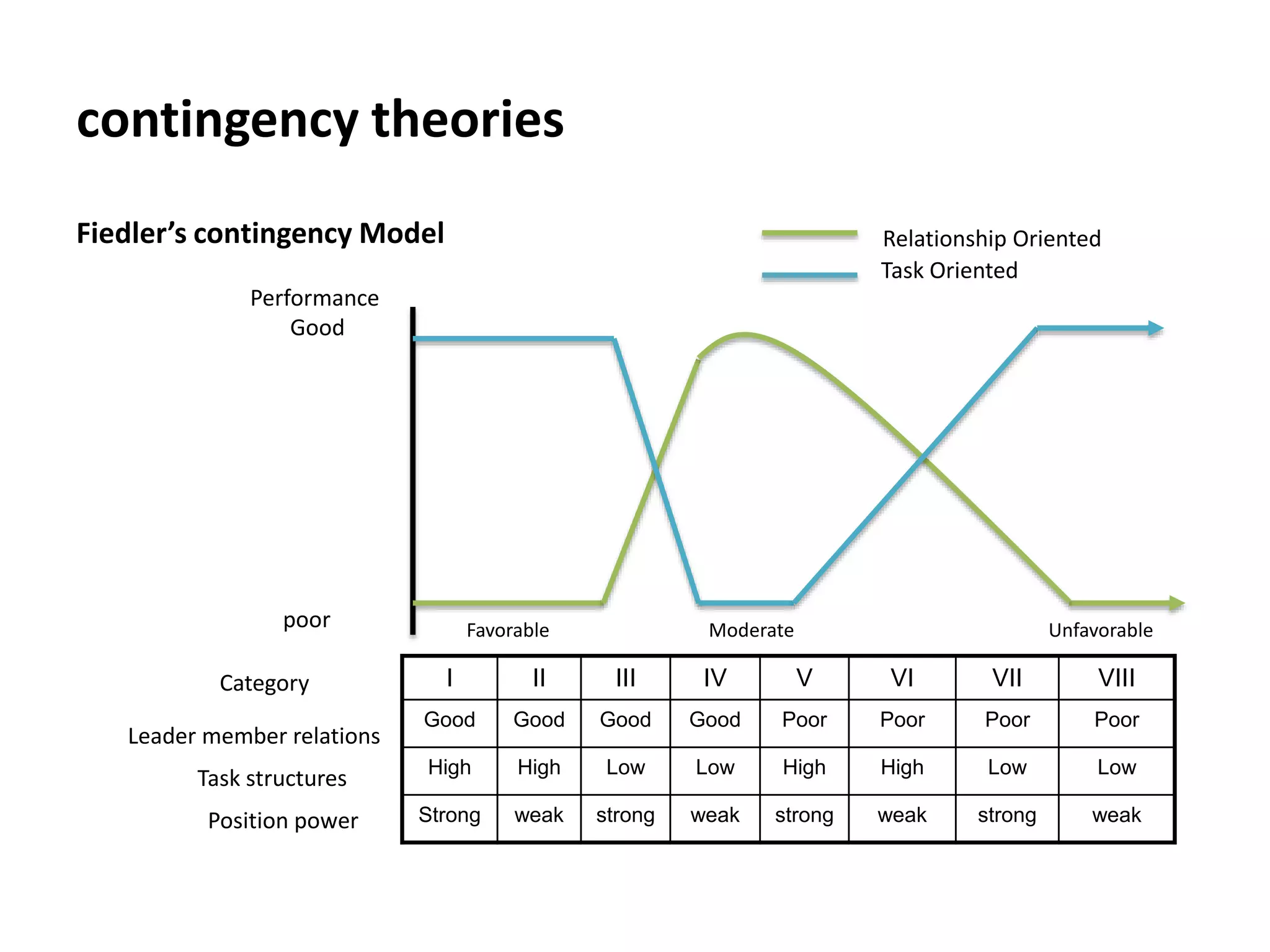
contingency theories
Fiedler’s contingency Model
I II III IV V VI VII VIII
Good Good Good Good Poor Poor Poor Poor
High High Low Low High High Low Low
Strong weak strong weak strong weak strong weak
Category
Leader member relations
Task structures
Position power
Moderate UnfavorableFavorable
Task Oriented
Relationship Oriented
Performance
Good
poor
path goal theory
Environmental Contingency Factors
• Task Structure
• Formal authority system
• Work Group
Subordinate contingency factors
•Locus of control
•Experience
•Perceived ability
Outcomes
•Performance
•Satisfaction
Leader Behavior
•Directive
•Supportive
•Participative
•Achievement -oriented
the management grid
HIGHLOW
9.11.1
5.5
9.91.9HIGH
1
1
2
3
4
5
6
7
8
9
2 3 4 5 6 7 8 9
Country Club
management
Team
management
Middle-of-the-road
management
Impoverished
management
Authoritarian
management
LOW
Autocratic Democratic Laissez-fair
Use of authority by
manager Area of freedom for
employees
Manager
makes
decision
and
announces
it.
Manager
permits
employees
to function
within
limits
defined
by
senior
manager.
Manager
allows
employees
complete
freedom
of
action.
Manager
defines
limits
set by
senior
manager
and
asks
group
to
Make
decision.
Manager
presents
problem,
receives
suggestions,
and makes
decisions.
Manager
presents
tentative
decision,
subject
to change.
Manager
presents
ideas
and
invites
questions.
Manager
Sells
decisions.
leadership continuum
situational approach to leadership
• Leader-member relations
• Task Structure
• Leaders’ position power
situational determinants of effective leadership
Task Structure
Leader-member
relation
Leader position
power
Good
High
Low
1 2 3 4 5 6 7 8
Relationship
-motivated leaders
perform better
Task motivated
Leaders perform
better
Good Good Good Poor Poor Poor Poor
Structured Unstructured Structured Unstructured
Strong Strong Strong StrongWeak Weak Weak Weak
situational approach to leadership
managers need to vary their leadership style with each phase
Task Behavior
Directive behavior
1. Provide specific
instructions and
closely supervise
performance…
4. Turn over responsibility
for decisions and
implementation…
2. Explain your decisions
and provide opportunity
for clarification
3. Share ideas
and facilitate in making
decisions…
Leader Behavior
Low
[RELATIONSHIP]
High
High [TASK]
RelationshipBehavior
Supportivebehavior
Lo. Task & Lo. rel.
Hi. Task & Lo. rel.
Hi. Task & Lo. rel.
Hi. Task & Hi. rel.
path-goal approach of leadership
manager identifies the ‘goals’ and rewards the ‘paths’ to be take, to reach them
In this process an effective leader:
• Identifies and communicates to subordinates the path they
follow in order to achieve personal and organizational
objectives.
• Helps subordinates along the chosen path.
• Helps to remove obstacles on the path that might prevent the
achievement of these objectives.
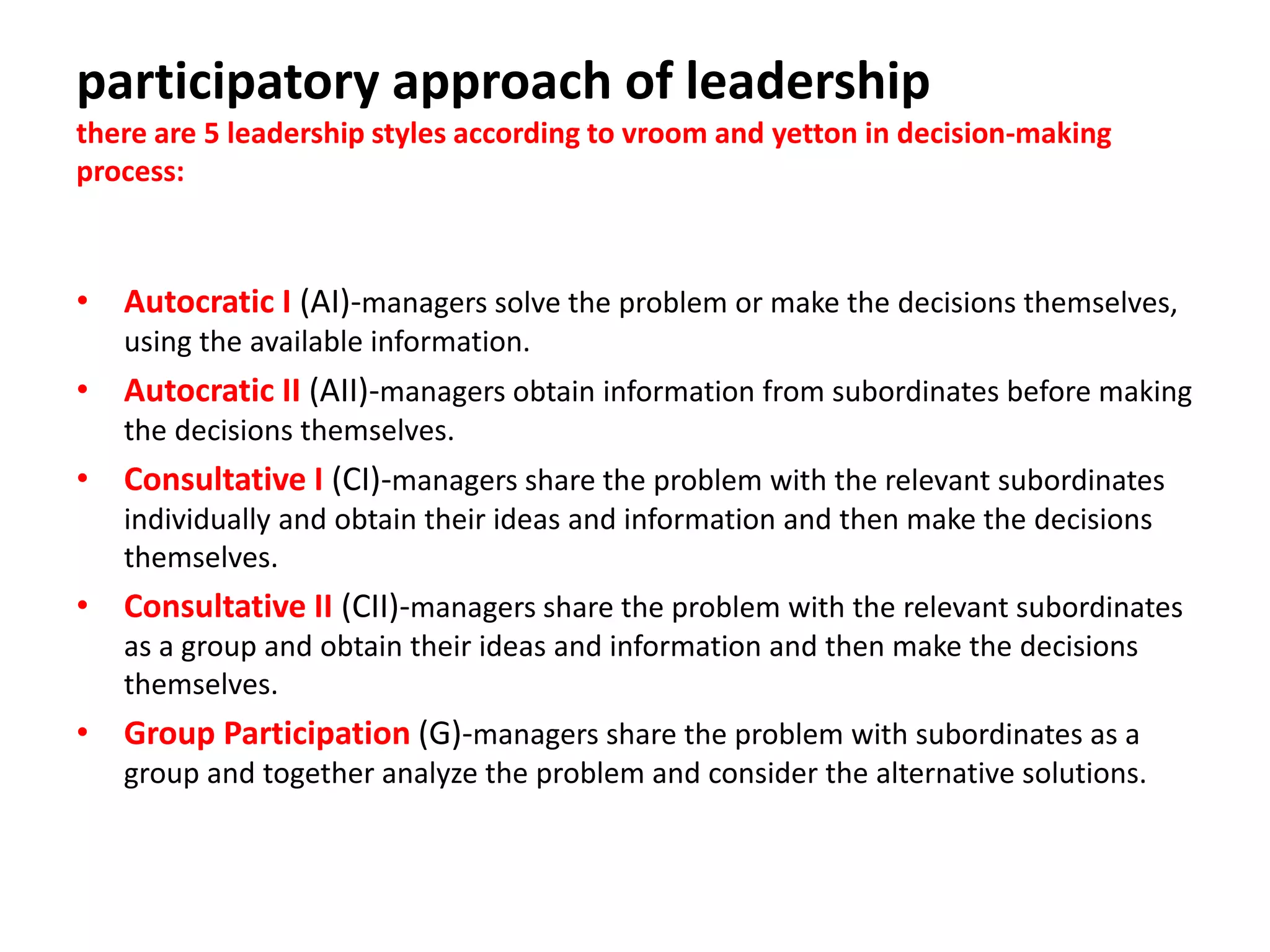
participatory approach of leadership
there are 5 leadership styles according to vroom and yetton in decision-making
process:
• Autocratic I (AI)-managers solve the problem or make the decisions themselves,
using the available information.
• Autocratic II (AII)-managers obtain information from subordinates before making
the decisions themselves.
• Consultative I (CI)-managers share the problem with the relevant subordinates
individually and obtain their ideas and information and then make the decisions
themselves.
• Consultative II (CII)-managers share the problem with the relevant subordinates
as a group and obtain their ideas and information and then make the decisions
themselves.
• Group Participation (G)-managers share the problem with subordinates as a
group and together analyze the problem and consider the alternative solutions.
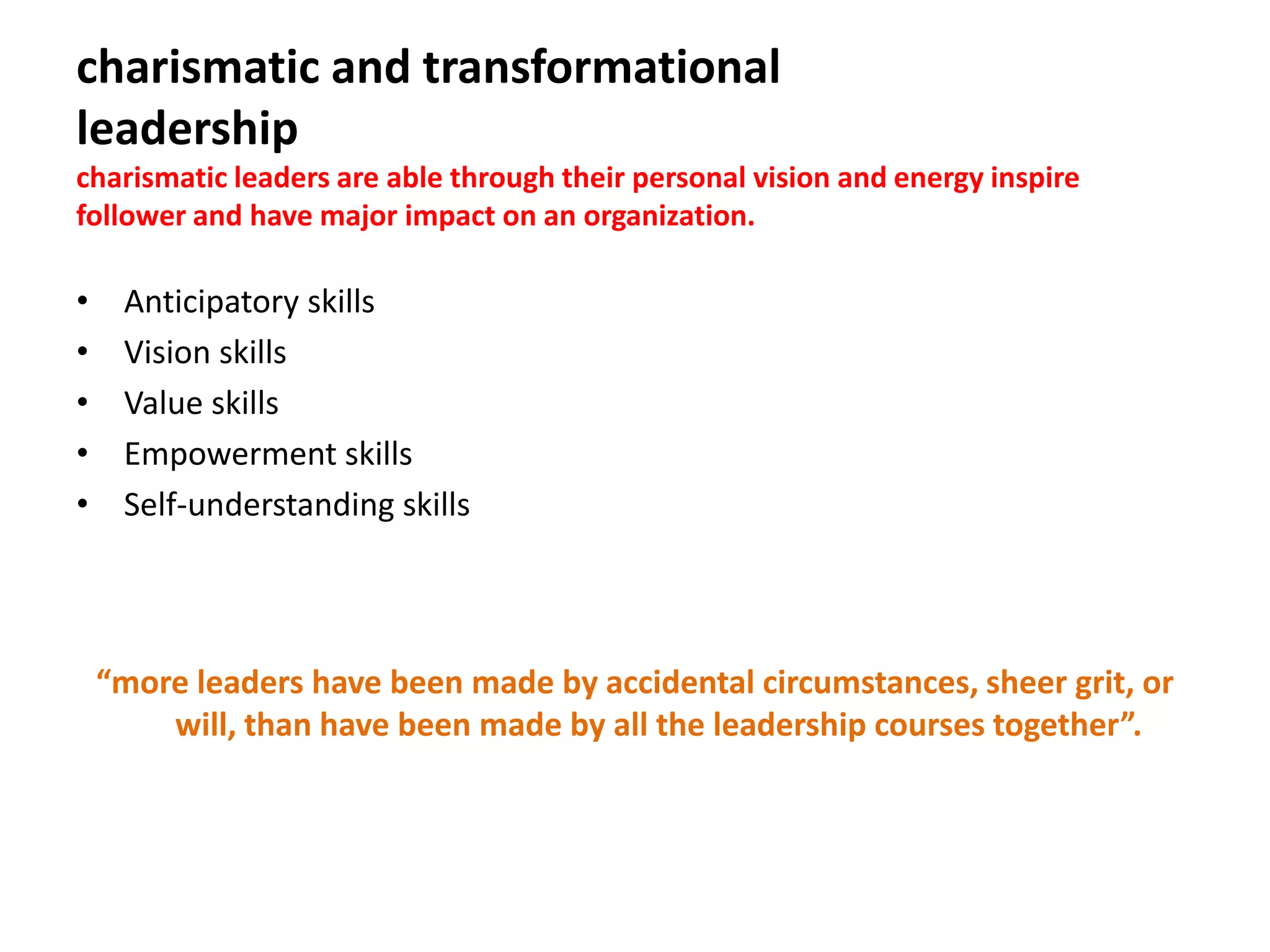
charismatic and transformational
leadership
charismatic leaders are able through their personal vision and energy inspire
follower and have major impact on an organization.
• Anticipatory skills
• Vision skills
• Value skills
• Empowerment skills
• Self-understanding skills
“more leaders have been made by accidental circumstances, sheer grit, or
will, than have been made by all the leadership courses together”.
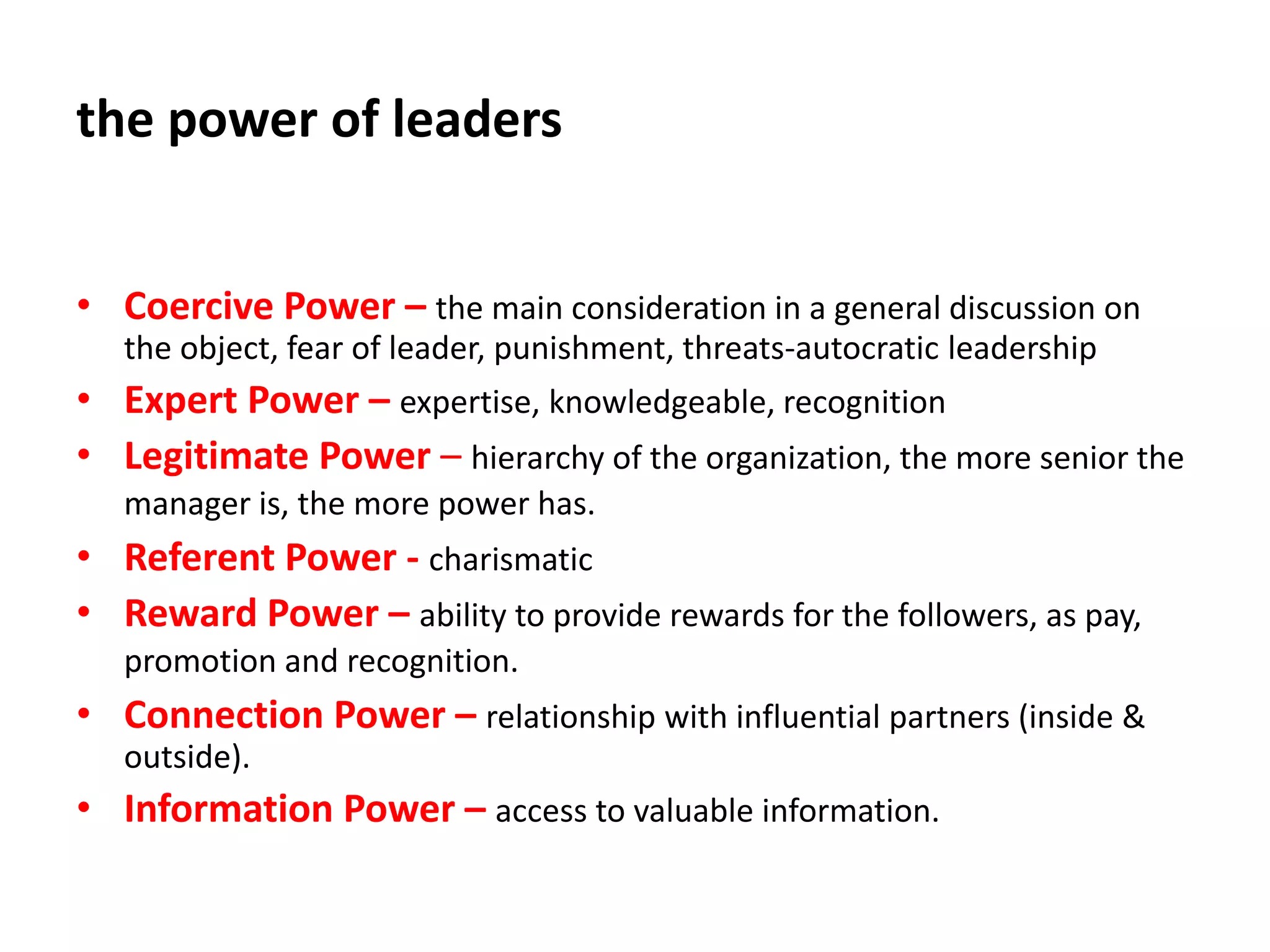
the power of leaders
• Coercive Power – the main consideration in a general discussion on
the object, fear of leader, punishment, threats-autocratic leadership
• Expert Power – expertise, knowledgeable, recognition
• Legitimate Power – hierarchy of the organization, the more senior the
manager is, the more power has.
• Referent Power - charismatic
• Reward Power – ability to provide rewards for the followers, as pay,
promotion and recognition.
• Connection Power – relationship with influential partners (inside &
outside).
• Information Power – access to valuable information.
what do the effective leaders do?
Set strategy
Motivate
Create a Mission
Build a Culture
what should leaders do?
To get Results
Exercise…2
write down your own leadership style- you are
given 5 minutes for this exercise
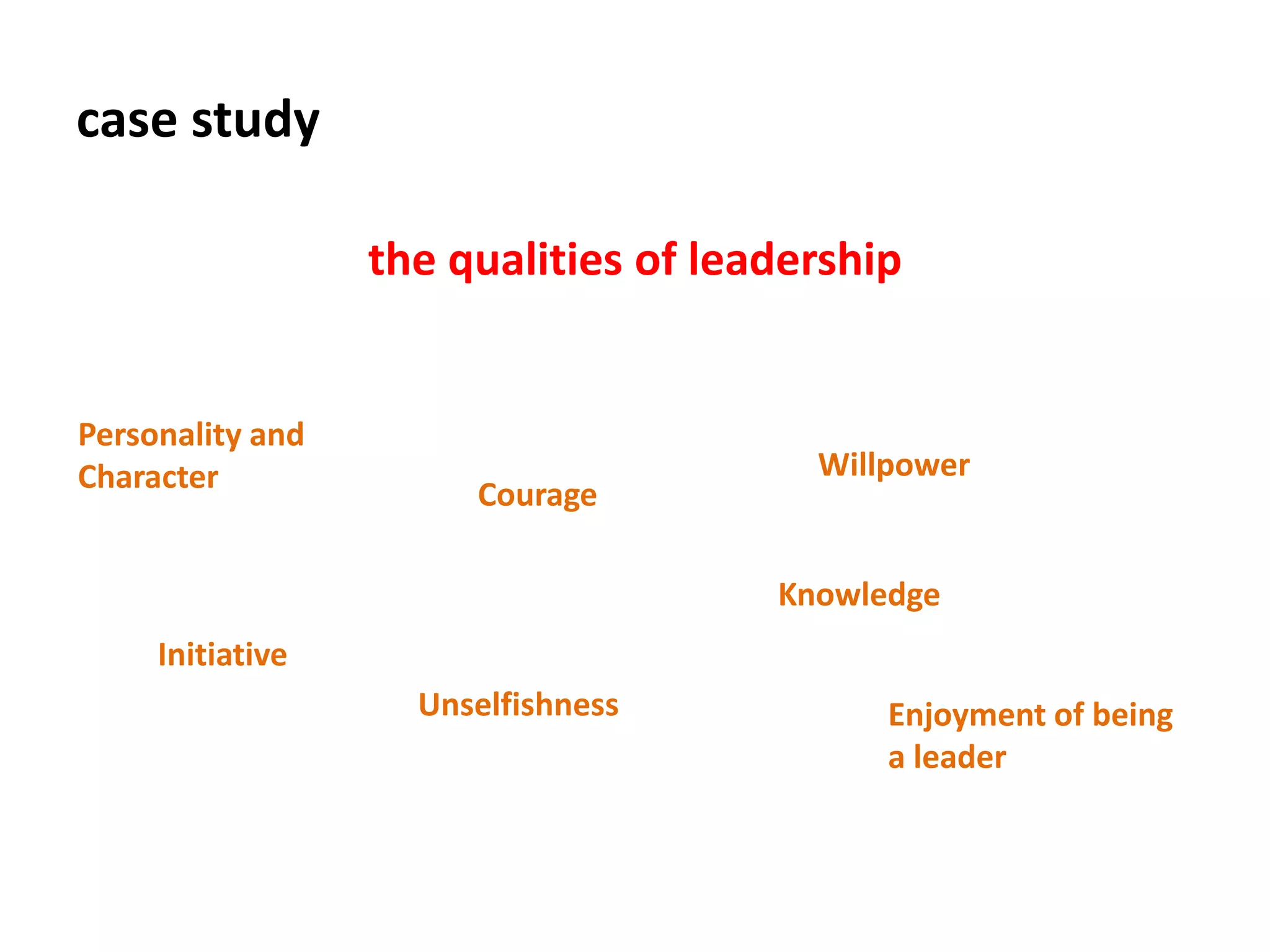
case study
the qualities of leadership
Personality and
Character
Courage
Willpower
Knowledge
Initiative
Unselfishness Enjoyment of being
a leader
conclusion
• management is largely concerned with leadership,
because managers need to establish a sense of
direction and to motivate people to move in that
direction.
• understanding of leadership theories provides the basis
for analyzing leadership and management styles. it is
also a factor in the process of making decisions.
• charismatic leadership helps to illustrate the power of
leaders. discussion of the need for leadership highlights
the management tasks and objectives.

Megat on Leadership

  • 1.
    Effective Leadership ‘empowering transformationalleadership’ ’jomberubah’ Megat Zainurul Anuar bin Megat Johari www.thedreamsoft.com megat@thedreamsoft.com
  • 2.
    objectives • describe leadershipand identify the relationship between leadership and management. • analyze different theories of leadership as they apply to management. • examine styles of leadership and their impact on organizations. • consider the question of leadership power and control. • leadership from the ethnic diversity management point. • Identify modern frameworks for leadership • Identify and analyze the skills needed for effective leadership
  • 3.
    icebreaking • what isleadership? • what is management?
  • 4.
    leadership vs. management “managersare people who do things right and leaders are people who do the right things”
  • 5.
  • 6.
    Personal Check-In: IndividualLeadership Reflection Think about a leadership experience that really pleased you, a time when you worked with others and did a good job of helping something positive or effective occur. It can be a work experience or a personal experience. 1. Briefly summarize the situation. 2. What action did you take to make it happen? 3. What three words would you use to describe the situation? effective leadership and management styles
  • 7.
    effective leadership &effective management 'effective leadership is putting first things first' and 'effective management is discipline, carrying it out'
  • 8.
    contingency theories Fiedler’s contingencyModel I II III IV V VI VII VIII Good Good Good Good Poor Poor Poor Poor High High Low Low High High Low Low Strong weak strong weak strong weak strong weak Category Leader member relations Task structures Position power Moderate UnfavorableFavorable Task Oriented Relationship Oriented Performance Good poor
  • 9.
    path goal theory EnvironmentalContingency Factors • Task Structure • Formal authority system • Work Group Subordinate contingency factors •Locus of control •Experience •Perceived ability Outcomes •Performance •Satisfaction Leader Behavior •Directive •Supportive •Participative •Achievement -oriented
  • 10.
    the management grid HIGHLOW 9.11.1 5.5 9.91.9HIGH 1 1 2 3 4 5 6 7 8 9 23 4 5 6 7 8 9 Country Club management Team management Middle-of-the-road management Impoverished management Authoritarian management LOW
  • 11.
    Autocratic Democratic Laissez-fair Useof authority by manager Area of freedom for employees Manager makes decision and announces it. Manager permits employees to function within limits defined by senior manager. Manager allows employees complete freedom of action. Manager defines limits set by senior manager and asks group to Make decision. Manager presents problem, receives suggestions, and makes decisions. Manager presents tentative decision, subject to change. Manager presents ideas and invites questions. Manager Sells decisions. leadership continuum
  • 12.
    situational approach toleadership • Leader-member relations • Task Structure • Leaders’ position power
  • 13.
    situational determinants ofeffective leadership Task Structure Leader-member relation Leader position power Good High Low 1 2 3 4 5 6 7 8 Relationship -motivated leaders perform better Task motivated Leaders perform better Good Good Good Poor Poor Poor Poor Structured Unstructured Structured Unstructured Strong Strong Strong StrongWeak Weak Weak Weak
  • 14.
    situational approach toleadership managers need to vary their leadership style with each phase Task Behavior Directive behavior 1. Provide specific instructions and closely supervise performance… 4. Turn over responsibility for decisions and implementation… 2. Explain your decisions and provide opportunity for clarification 3. Share ideas and facilitate in making decisions… Leader Behavior Low [RELATIONSHIP] High High [TASK] RelationshipBehavior Supportivebehavior Lo. Task & Lo. rel. Hi. Task & Lo. rel. Hi. Task & Lo. rel. Hi. Task & Hi. rel.
  • 15.
    path-goal approach ofleadership manager identifies the ‘goals’ and rewards the ‘paths’ to be take, to reach them In this process an effective leader: • Identifies and communicates to subordinates the path they follow in order to achieve personal and organizational objectives. • Helps subordinates along the chosen path. • Helps to remove obstacles on the path that might prevent the achievement of these objectives.
  • 16.
    participatory approach ofleadership there are 5 leadership styles according to vroom and yetton in decision-making process: • Autocratic I (AI)-managers solve the problem or make the decisions themselves, using the available information. • Autocratic II (AII)-managers obtain information from subordinates before making the decisions themselves. • Consultative I (CI)-managers share the problem with the relevant subordinates individually and obtain their ideas and information and then make the decisions themselves. • Consultative II (CII)-managers share the problem with the relevant subordinates as a group and obtain their ideas and information and then make the decisions themselves. • Group Participation (G)-managers share the problem with subordinates as a group and together analyze the problem and consider the alternative solutions.
  • 17.
    charismatic and transformational leadership charismaticleaders are able through their personal vision and energy inspire follower and have major impact on an organization. • Anticipatory skills • Vision skills • Value skills • Empowerment skills • Self-understanding skills “more leaders have been made by accidental circumstances, sheer grit, or will, than have been made by all the leadership courses together”.
  • 18.
    the power ofleaders • Coercive Power – the main consideration in a general discussion on the object, fear of leader, punishment, threats-autocratic leadership • Expert Power – expertise, knowledgeable, recognition • Legitimate Power – hierarchy of the organization, the more senior the manager is, the more power has. • Referent Power - charismatic • Reward Power – ability to provide rewards for the followers, as pay, promotion and recognition. • Connection Power – relationship with influential partners (inside & outside). • Information Power – access to valuable information.
  • 19.
    what do theeffective leaders do? Set strategy Motivate Create a Mission Build a Culture what should leaders do? To get Results
  • 20.
  • 21.
    write down yourown leadership style- you are given 5 minutes for this exercise
  • 22.
    case study the qualitiesof leadership Personality and Character Courage Willpower Knowledge Initiative Unselfishness Enjoyment of being a leader
  • 23.
    conclusion • management islargely concerned with leadership, because managers need to establish a sense of direction and to motivate people to move in that direction. • understanding of leadership theories provides the basis for analyzing leadership and management styles. it is also a factor in the process of making decisions. • charismatic leadership helps to illustrate the power of leaders. discussion of the need for leadership highlights the management tasks and objectives.