Leadership in
Management
By: Arpita Mohata, Ashutosh, Anusha Verma,
Sneha Nagar, Yash Chandra, Yash Agnihotri (In
speaking order)
Definition and Scope of Leadership
Leadership, at its core, is the ability to influence and inspire others towards the achievement of a shared vision. It goes beyond simply
giving orders; it involves motivating, guiding, and empowering individuals to contribute their best. The scope of leadership extends
far beyond individual roles. Effective leaders cultivate a positive work culture, foster innovation, and drive organizational success.
Influence
The capacity to guide and shape the
actions and decisions of others.
Inspiration
The power to ignite passion and
enthusiasm in others, motivating them
to strive for excellence.
Vision
A clear and compelling picture of the
desired future, guiding the team's
direction and efforts.
Types of Leadership Styles
There is no one-size-fits-all approach to leadership. Different situations call for different styles. Understanding the common
leadership styles is crucial for adapting to various contexts. This can help managers find their most effective leadership
approach.
Autocratic
A leader who makes decisions
independently, with little input from
the team. This style can be effective in
crisis situations but may stifle
creativity and engagement.
Democratic
A leader who encourages
collaboration and seeks input from
the team. This style fosters
engagement and creativity but can
lead to slower decision-making.
Laissez-Faire
A leader who provides minimal
guidance and allows the team to
operate independently. This style can
empower self-directed individuals but
can also result in lack of direction.
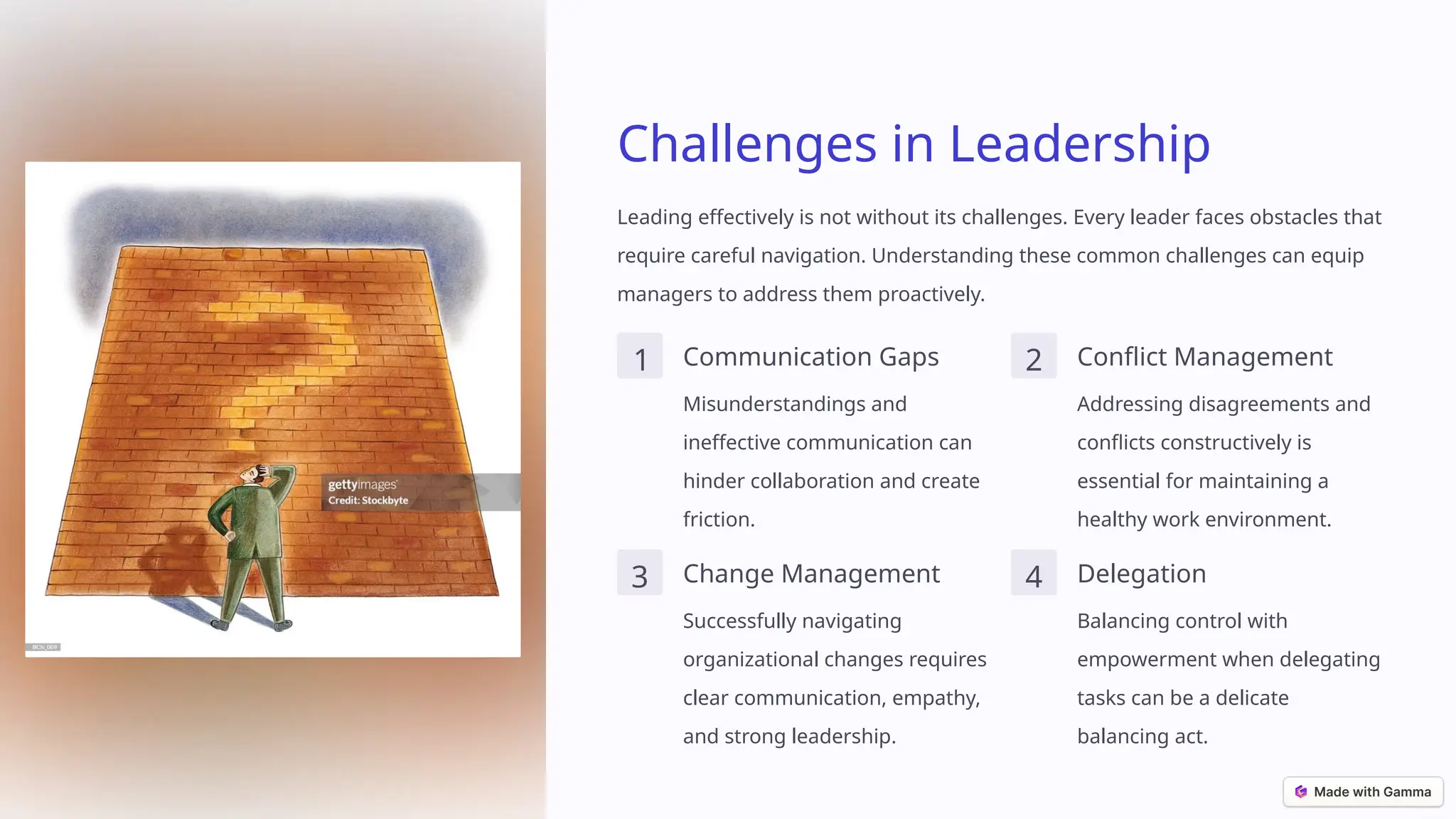
Challenges in Leadership
Leading effectively is not without its challenges. Every leader faces obstacles that
require careful navigation. Understanding these common challenges can equip
managers to address them proactively.
1 Communication Gaps
Misunderstandings and
ineffective communication can
hinder collaboration and create
friction.
2 Conflict Management
Addressing disagreements and
conflicts constructively is
essential for maintaining a
healthy work environment.
3 Change Management
Successfully navigating
organizational changes requires
clear communication, empathy,
and strong leadership.
4 Delegation
Balancing control with
empowerment when delegating
tasks can be a delicate
balancing act.
Qualities of an Effective Leader
Effective leadership is not solely about position or authority; it's about possessing certain qualities
that inspire trust, respect, and followership. These qualities are crucial for building strong teams and
achieving success.
Integrity
A leader with integrity is honest and relies on their own moral compass
and values to make decisions for the organization. An individual with a
strong sense of integrity is motivated to do what is right simply because
it is right. They will make that same decision whether they have an
audience in public or whether they are working in private.
Resilience
One of the most important qualities a leader can have is resilience. The
ability to quickly learn from mistakes and bounce back from a failure —
whether personal or professional — is invaluable when you have a team
of employees looking to you for guidance.
Communication
Strong communication skills are essential for effective leadership. A good
leader can clearly articulate their expectations, provide constructive feedback,
and actively listen to their team members. They are skilled at both verbal and
non-verbal communication, ensuring that their message is understood and
well-received. Effective communication fosters collaboration and encourages
open dialogue, enabling a team to work together efficiently and harmoniously.
Vision
A good leader possesses a clear vision for their team or organization. They
can articulate this vision effectively, inspiring their team to work towards a
common goal. A leader with a strong vision is able to anticipate challenges
and adapt their strategies to overcome obstacles. This foresight enables the
team to stay focused on their objectives, even during turbulent times.
Confidence
Confidence is essential for effective leadership. A good leader displays self-
assurance, which instils trust in their team. Confident leaders can make
difficult decisions and take risks when necessary, knowing that they are
supported by their team. It is important for a leader to remain calm and
composed in high-pressure situations, as this will ensure their team remains
focused and motivated.
Decision-making
Good leaders are able to make sound decisions in a timely manner. They
can weigh the pros and cons of a situation, gather input from their team,
and make choices that align with their team’s goals and values. Effective
decision-making requires a leader to remain objective and impartial,
taking all relevant factors into consideration. A leader who can make well-
informed decisions will demonstrate their competence and expertise to
their team, garnering trust and support.
Developing Leadership Skills
Leadership is not an innate trait; it's a skill that can be developed through continuous learning and
experience. Investing in leadership development can equip managers with the tools they need to excel in
their roles.
1 Self-Awareness
Reflecting on your strengths and weaknesses is the first step in leadership development.
Identifying your leadership style and areas for improvement is crucial.
2 Mentorship
Seeking guidance from experienced leaders can provide invaluable insights and support.
Learning from mentors who have walked the path can accelerate your leadership journey.
3 Training and Development
Formal training programs, workshops, and courses offer structured opportunities to
acquire new skills and expand your leadership knowledge.
4 Real-World Experience
Taking on leadership roles and challenges, even in small capacities, provides practical
experience and helps you refine your skills in real-world situations.
Case Study: EY's Bad Working
Culture
Ernst & Young (EY), a global professional services firm, faced a crisis in its work culture,
leading to a tragic increase in work pressure on employees. This case study highlights the
devastating consequences of unchecked leadership issues and the need for systemic change.
Issue Description
Excessive Workload Employees reported relentless pressure and unrealistic
deadlines, with work being assigned at 9 PM with an
expectation of a morning submission.
Toxic Work Environment Continuous reminder of work and propagation of
toxic culture by using remarks like, “You will have a
hard time with this manager.”.
Lack of Support Employees felt unheard and unsupported, with
inadequate mental health resources. Meetings are
being delayed for irrelevant reasons, such as
watching a cricket match.
McKinsey & Co. / IIM Calcutta / IIT Madras
Chartered Accountant / Bcom / National Level
Debator
Causes of Poor Leadership at EY
EY's work culture issues stemmed from a combination of factors related to leadership.
These factors contributed to a toxic environment that ultimately had tragic consequences.
Lack of empathy and understanding
Leaders failed to recognize and address the toll that excessive workload and
pressure were taking on employees' well-being.
Hierarchical and Authoritarian Culture
A rigid structure with limited opportunities for employee feedback and
participation created a sense of powerlessness and isolation.
Focus on Profit over People
An overwhelming emphasis on financial performance at the expense of
employee well-being created a culture where mental health was
undervalued.
Lessons Learned and
Recommendations
EY's case serves as a stark reminder of the importance of ethical and responsible leadership.
The firm's response to the crisis has highlighted the need for significant changes in corporate
culture and leadership practices. This case study provides valuable lessons that can be applied
across organizations to foster healthier and more sustainable work environments.
1 Prioritize Employee Well-
being
Organizations must recognize that
employee well-being is essential to
long-term success and invest in
initiatives that support mental health.
2 Foster Open Communication
Creating a culture of open dialogue
and feedback enables leaders to
address concerns early and prevent
issues from escalating.
3 Empower Employees
Giving employees a voice and a sense
of ownership encourages engagement
and promotes a positive work
environment.
4 Promote Ethical Leadership
Organizations should hold leaders
accountable for their conduct and
foster a culture of ethical decision-
making.
Gen Z founders working
to make the world a
better place
Gen Z employees are calling out workplace bulli
es
HR Brew
Quit-Tok: Gen Z trend exposing to
xic workplaces
Quit-Tok refers to the trend of employees, primarily Generation Z, sharing videos
of their resignation or layoff stories publicly … on TikTok.

Leadership in management ppt with case study

  • 1.
    Leadership in Management By: ArpitaMohata, Ashutosh, Anusha Verma, Sneha Nagar, Yash Chandra, Yash Agnihotri (In speaking order)
  • 2.
    Definition and Scopeof Leadership Leadership, at its core, is the ability to influence and inspire others towards the achievement of a shared vision. It goes beyond simply giving orders; it involves motivating, guiding, and empowering individuals to contribute their best. The scope of leadership extends far beyond individual roles. Effective leaders cultivate a positive work culture, foster innovation, and drive organizational success. Influence The capacity to guide and shape the actions and decisions of others. Inspiration The power to ignite passion and enthusiasm in others, motivating them to strive for excellence. Vision A clear and compelling picture of the desired future, guiding the team's direction and efforts.
  • 3.
    Types of LeadershipStyles There is no one-size-fits-all approach to leadership. Different situations call for different styles. Understanding the common leadership styles is crucial for adapting to various contexts. This can help managers find their most effective leadership approach. Autocratic A leader who makes decisions independently, with little input from the team. This style can be effective in crisis situations but may stifle creativity and engagement. Democratic A leader who encourages collaboration and seeks input from the team. This style fosters engagement and creativity but can lead to slower decision-making. Laissez-Faire A leader who provides minimal guidance and allows the team to operate independently. This style can empower self-directed individuals but can also result in lack of direction.
  • 4.
    Challenges in Leadership Leadingeffectively is not without its challenges. Every leader faces obstacles that require careful navigation. Understanding these common challenges can equip managers to address them proactively. 1 Communication Gaps Misunderstandings and ineffective communication can hinder collaboration and create friction. 2 Conflict Management Addressing disagreements and conflicts constructively is essential for maintaining a healthy work environment. 3 Change Management Successfully navigating organizational changes requires clear communication, empathy, and strong leadership. 4 Delegation Balancing control with empowerment when delegating tasks can be a delicate balancing act.
  • 5.
    Qualities of anEffective Leader Effective leadership is not solely about position or authority; it's about possessing certain qualities that inspire trust, respect, and followership. These qualities are crucial for building strong teams and achieving success. Integrity A leader with integrity is honest and relies on their own moral compass and values to make decisions for the organization. An individual with a strong sense of integrity is motivated to do what is right simply because it is right. They will make that same decision whether they have an audience in public or whether they are working in private. Resilience One of the most important qualities a leader can have is resilience. The ability to quickly learn from mistakes and bounce back from a failure — whether personal or professional — is invaluable when you have a team of employees looking to you for guidance.
  • 6.
    Communication Strong communication skillsare essential for effective leadership. A good leader can clearly articulate their expectations, provide constructive feedback, and actively listen to their team members. They are skilled at both verbal and non-verbal communication, ensuring that their message is understood and well-received. Effective communication fosters collaboration and encourages open dialogue, enabling a team to work together efficiently and harmoniously. Vision A good leader possesses a clear vision for their team or organization. They can articulate this vision effectively, inspiring their team to work towards a common goal. A leader with a strong vision is able to anticipate challenges and adapt their strategies to overcome obstacles. This foresight enables the team to stay focused on their objectives, even during turbulent times.
  • 7.
    Confidence Confidence is essentialfor effective leadership. A good leader displays self- assurance, which instils trust in their team. Confident leaders can make difficult decisions and take risks when necessary, knowing that they are supported by their team. It is important for a leader to remain calm and composed in high-pressure situations, as this will ensure their team remains focused and motivated. Decision-making Good leaders are able to make sound decisions in a timely manner. They can weigh the pros and cons of a situation, gather input from their team, and make choices that align with their team’s goals and values. Effective decision-making requires a leader to remain objective and impartial, taking all relevant factors into consideration. A leader who can make well- informed decisions will demonstrate their competence and expertise to their team, garnering trust and support.
  • 8.
    Developing Leadership Skills Leadershipis not an innate trait; it's a skill that can be developed through continuous learning and experience. Investing in leadership development can equip managers with the tools they need to excel in their roles. 1 Self-Awareness Reflecting on your strengths and weaknesses is the first step in leadership development. Identifying your leadership style and areas for improvement is crucial. 2 Mentorship Seeking guidance from experienced leaders can provide invaluable insights and support. Learning from mentors who have walked the path can accelerate your leadership journey. 3 Training and Development Formal training programs, workshops, and courses offer structured opportunities to acquire new skills and expand your leadership knowledge. 4 Real-World Experience Taking on leadership roles and challenges, even in small capacities, provides practical experience and helps you refine your skills in real-world situations.
  • 9.
    Case Study: EY'sBad Working Culture Ernst & Young (EY), a global professional services firm, faced a crisis in its work culture, leading to a tragic increase in work pressure on employees. This case study highlights the devastating consequences of unchecked leadership issues and the need for systemic change. Issue Description Excessive Workload Employees reported relentless pressure and unrealistic deadlines, with work being assigned at 9 PM with an expectation of a morning submission. Toxic Work Environment Continuous reminder of work and propagation of toxic culture by using remarks like, “You will have a hard time with this manager.”. Lack of Support Employees felt unheard and unsupported, with inadequate mental health resources. Meetings are being delayed for irrelevant reasons, such as watching a cricket match. McKinsey & Co. / IIM Calcutta / IIT Madras Chartered Accountant / Bcom / National Level Debator
  • 10.
    Causes of PoorLeadership at EY EY's work culture issues stemmed from a combination of factors related to leadership. These factors contributed to a toxic environment that ultimately had tragic consequences. Lack of empathy and understanding Leaders failed to recognize and address the toll that excessive workload and pressure were taking on employees' well-being. Hierarchical and Authoritarian Culture A rigid structure with limited opportunities for employee feedback and participation created a sense of powerlessness and isolation. Focus on Profit over People An overwhelming emphasis on financial performance at the expense of employee well-being created a culture where mental health was undervalued.
  • 11.
    Lessons Learned and Recommendations EY'scase serves as a stark reminder of the importance of ethical and responsible leadership. The firm's response to the crisis has highlighted the need for significant changes in corporate culture and leadership practices. This case study provides valuable lessons that can be applied across organizations to foster healthier and more sustainable work environments. 1 Prioritize Employee Well- being Organizations must recognize that employee well-being is essential to long-term success and invest in initiatives that support mental health. 2 Foster Open Communication Creating a culture of open dialogue and feedback enables leaders to address concerns early and prevent issues from escalating. 3 Empower Employees Giving employees a voice and a sense of ownership encourages engagement and promotes a positive work environment. 4 Promote Ethical Leadership Organizations should hold leaders accountable for their conduct and foster a culture of ethical decision- making. Gen Z founders working to make the world a better place Gen Z employees are calling out workplace bulli es HR Brew Quit-Tok: Gen Z trend exposing to xic workplaces Quit-Tok refers to the trend of employees, primarily Generation Z, sharing videos of their resignation or layoff stories publicly … on TikTok.