English on the Move: Learning 
English via Mobile Phones in 
Africa 
Paul Woods, English Manager 
Sub-Saharan Africa, British 
Council
Why Use Mobile Phones? 
• The rationale for using mobile phones as a 
distribution medium is due to the wide spread 
adoption of GSM services amongst the general 
population 
• In many Sub-Saharan African countries, there are 
more users of mobiles than landlines 
• In China there are 60 million more users of mobiles 
than landlines
Feasibility study 
• We commissioned a South African researcher with an 
extensive knowledge of the mobile phone market in 
the Southern Africa region to carry out a feasibility 
study 
• At the time, our region consisted of seven countries 
in Southern Africa, so the research did not include 
East, West or Central African countries which now 
form part of the British Council’s SSA region.
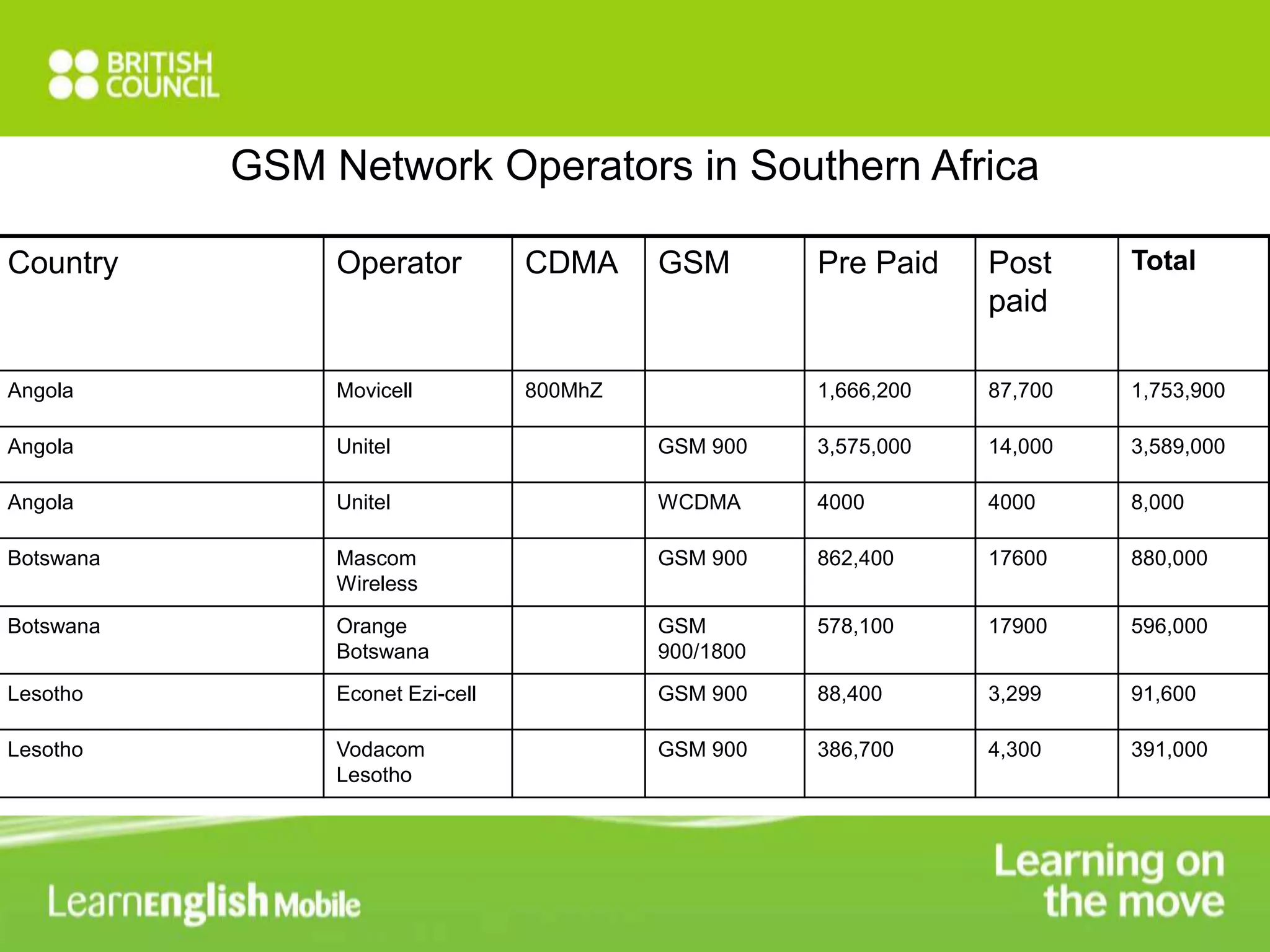
GSM Network Operators in Southern Africa 
Country Operator CDMA GSM Pre Paid Post 
paid 
Total 
Angola Movicell 800MhZ 1,666,200 87,700 1,753,900 
Angola Unitel GSM 900 3,575,000 14,000 3,589,000 
Angola Unitel WCDMA 4000 4000 8,000 
Botswana Mascom 
Wireless 
GSM 900 862,400 17600 880,000 
Botswana Orange 
Botswana 
GSM 
900/1800 
578,100 17900 596,000 
Lesotho Econet Ezi-cell GSM 900 88,400 3,299 91,600 
Lesotho Vodacom 
Lesotho 
GSM 900 386,700 4,300 391,000
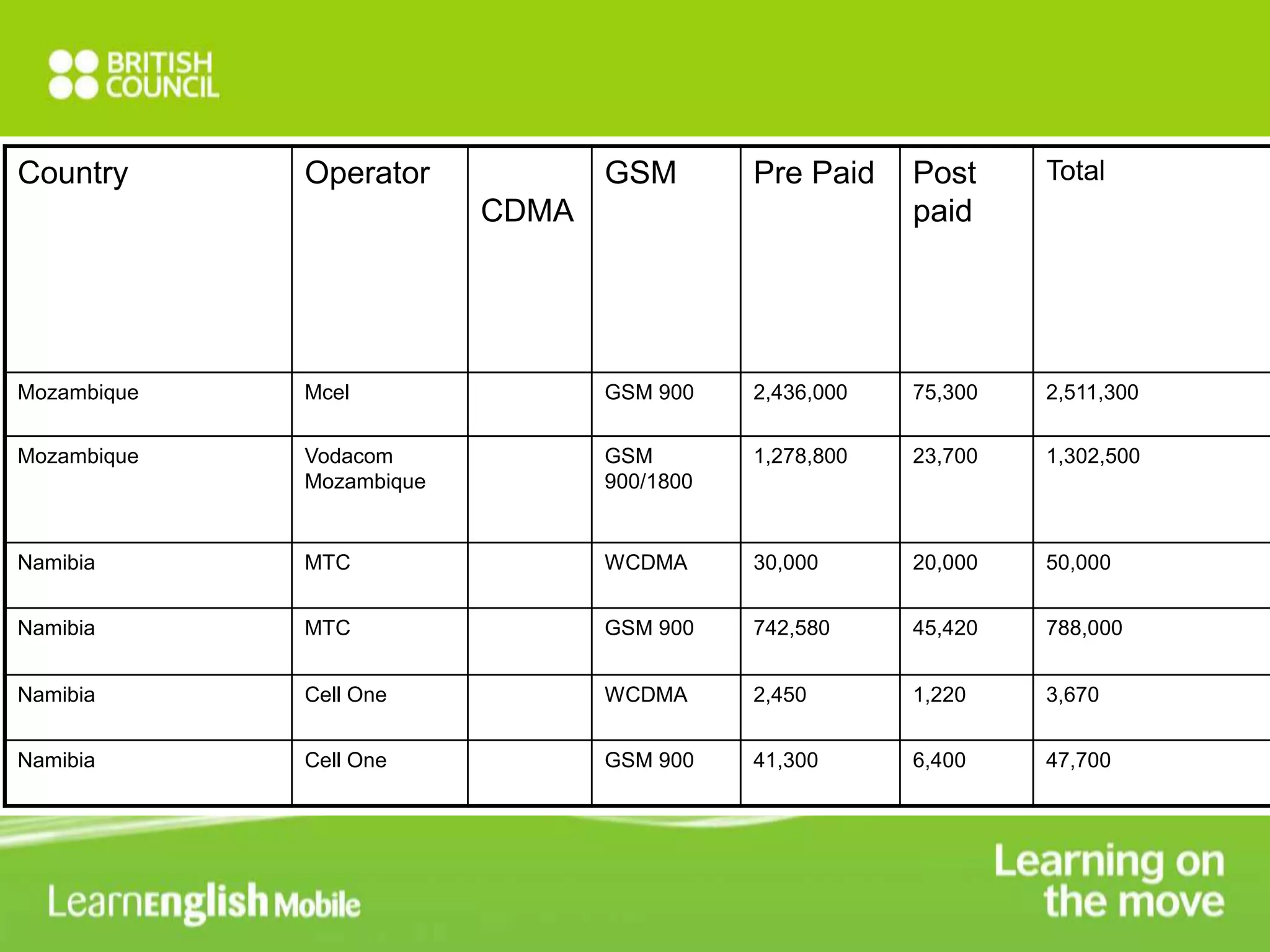
Country Operator 
CDMA 
GSM Pre Paid Post 
paid 
Total 
Mozambique Mcel GSM 900 2,436,000 75,300 2,511,300 
Mozambique Vodacom 
Mozambique 
GSM 
900/1800 
1,278,800 23,700 1,302,500 
Namibia MTC WCDMA 30,000 20,000 50,000 
Namibia MTC GSM 900 742,580 45,420 788,000 
Namibia Cell One WCDMA 2,450 1,220 3,670 
Namibia Cell One GSM 900 41,300 6,400 47,700
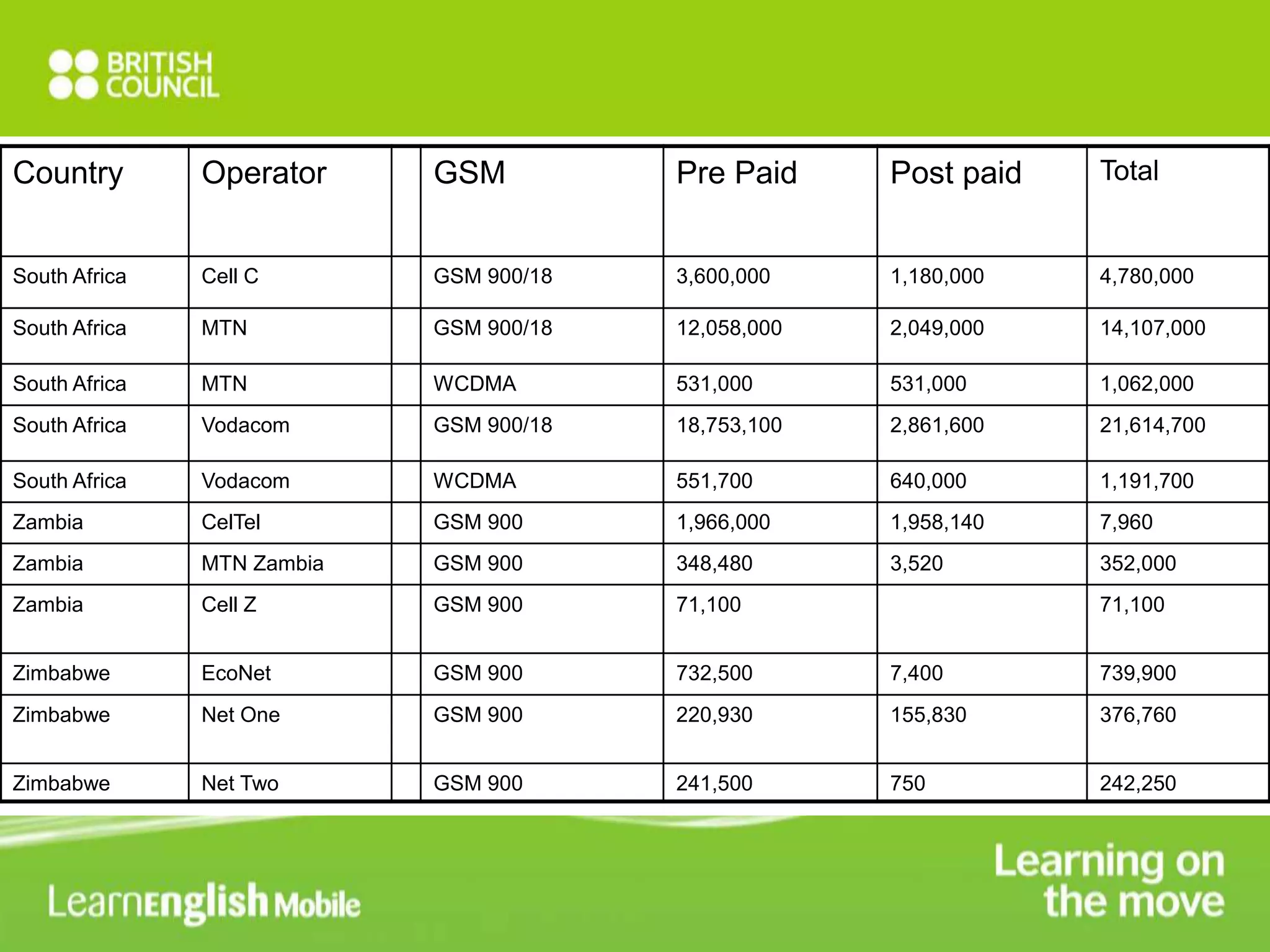
Country Operator GSM Pre Paid Post paid Total 
South Africa Cell C GSM 900/18 3,600,000 1,180,000 4,780,000 
South Africa MTN GSM 900/18 12,058,000 2,049,000 14,107,000 
South Africa MTN WCDMA 531,000 531,000 1,062,000 
South Africa Vodacom GSM 900/18 18,753,100 2,861,600 21,614,700 
South Africa Vodacom WCDMA 551,700 640,000 1,191,700 
Zambia CelTel GSM 900 1,966,000 1,958,140 7,960 
Zambia MTN Zambia GSM 900 348,480 3,520 352,000 
Zambia Cell Z GSM 900 71,100 71,100 
Zimbabwe EcoNet GSM 900 732,500 7,400 739,900 
Zimbabwe Net One GSM 900 220,930 155,830 376,760 
Zimbabwe Net Two GSM 900 241,500 750 242,250
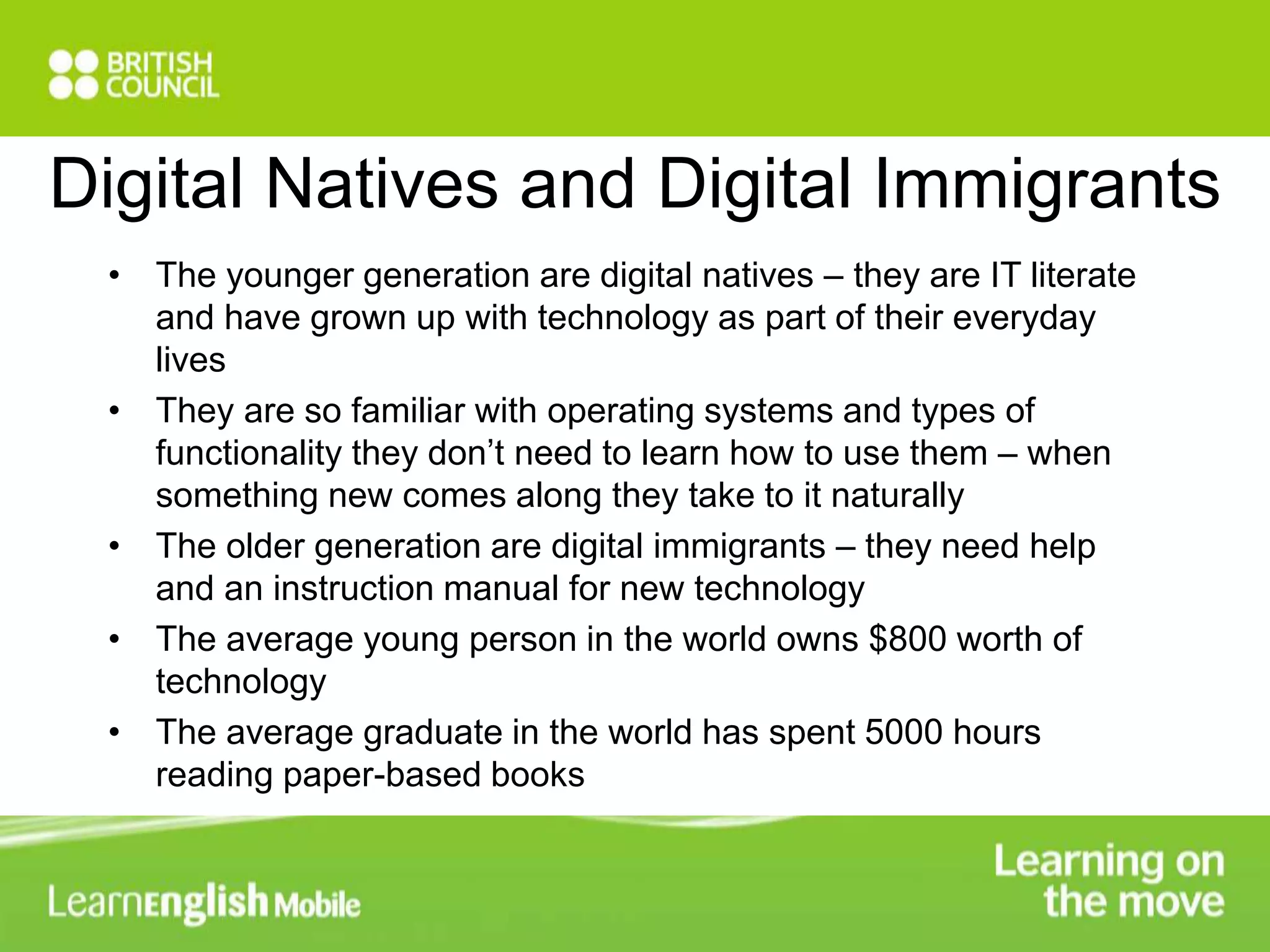
Digital Natives and Digital Immigrants 
• The younger generation are digital natives – they are IT literate 
and have grown up with technology as part of their everyday 
lives 
• They are so familiar with operating systems and types of 
functionality they don’t need to learn how to use them – when 
something new comes along they take to it naturally 
• The older generation are digital immigrants – they need help 
and an instruction manual for new technology 
• The average young person in the world owns $800 worth of 
technology 
• The average graduate in the world has spent 5000 hours 
reading paper-based books
Reaching learners in Africa 
• There are around 200 million learners of English in Africa 
• If learning content is to be relevant to the lifestyles of the 
younger 
generation it needs to be delivered via technology 
• Research in the UK by BECTA shows that using technology 
improves 
achievement in almost all national curriculum subjects
British Council Global English Products 
• There are currently six British Council Global English products 
for teachers and six products for learners 
• LearnEnglish Mobile is one of the products for Learners
The LearnEnglish Mobile Product 
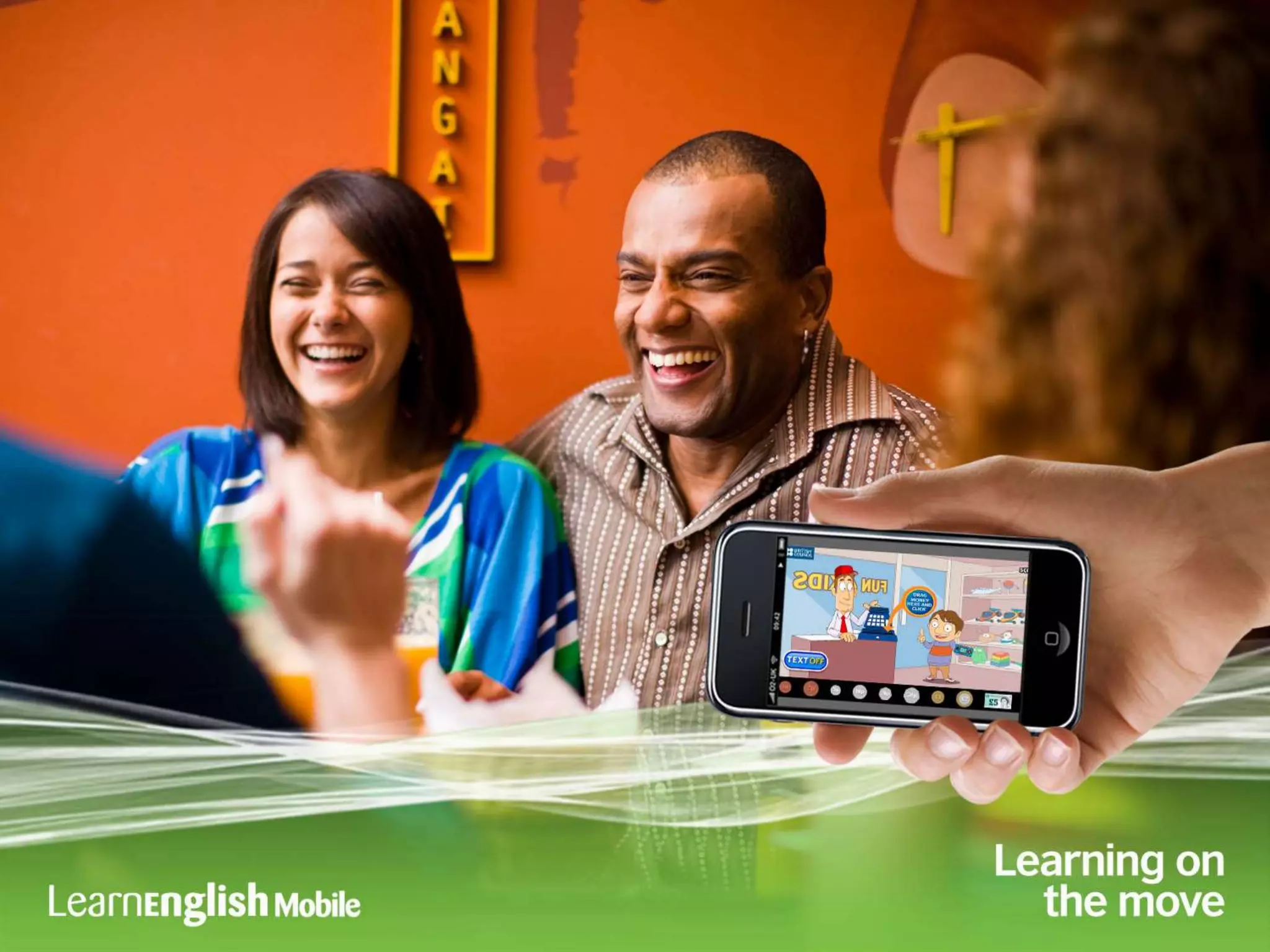
The Council experimented with content for 
3 types of mobile device: 
• Hi-tech (rich media content) 
• Medium tech (WAP content) 
• Lo-tech (SMS “push” and SMS “pull” content) 
In Africa at present, only low-tech devices 
are widely available, so this limits the kind of 
content which can be delivered.
SMS Push – “Everyday English” 
• This product was originally launched in Thailand in February 2008. 
Users subscribed to the service via their mobile network, and chose 
one of three levels – Beginner, Intermediate and Advanced. These 
were very broad levels that approximate to A, B & C bands in the 
Common European Framework (CEF). 
• Users in Thailand subscribed for a 15-day free trial, then they were 
charged at 29 baht per month (approx. 50p). Continuation of service 
was done automatically. Subscribers received a message each month 
giving instructions on how to unsubscribe. 
• Subscribers received an SMS message every day (at 10 am). These 
messages were limited to 160 characters and are divided into six 
categories – word/phrase, expression/idiom, collocations, types of 
English, learning tips and interesting facts. 
• Approximately 500 items were written for each level, so the content 
could last indefinitely (there would be no harm in repeating messages 
after a year or more).
Examples of SMS “push” content 
• Word phrases 
a factory (n) A building where large amounts of goods are made using 
machines. Eg I work in a factory which makes cars. 
• Expressions/idioms 
to take place (v phrase) To happen. Eg The last football World Cup took place 
in Germany. 
• Collocations 
a business trip (coll) To travel to a different place, Eg in another town or country, 
for work. Eg I go on two business trips a month. 
• Types of English 
sweets (n - UK) candies (n - US)A small piece of sweet food, made of sugar. 
Eg She bought a packet of sweets to suck on the journey. 
• Learning Tips 
Spelling – third person ending in ‘s’: When a verb ends in ‘y’, don’t forget to 
change the ‘y’ to ‘i’ and add ‘es’. E.g. study - studies. 
• Interesting facts 
Did you know French was the official language of England for over 600 years?
Issues – SMS vs IVR 
• The Feasibility Study recommended that, when considering 
technology acceptance and adoption in combination with the 
income levels, education levels and literacy levels of the 
potential audience, the only technology that would support 
widespread adoption is voice (IVR) with a limited amount of sms 
as an option 
• High end technologies such as WAP and Java were not 
recommended and would hinder rather than encourage 
adoption. 
• An IVR platform would be required by network providers that 
deployed the English language course - most operators had this 
in place already for customer support and other subscriber 
services. 
• However, the product as developed by British Council for global 
use was SMS, rather than IVR-based.
Issues - Billing models 
• The target market segment we are aiming at is almost entirely 
pre-paid (rather than post-paid) with incomes below R2000 per 
month. 
• The feasibility study recommended a billing model for the 
bottom of the pyramid segment, ie people who would spend 
money only on the bare necessities to survive. In this case pre-paid 
is the only option.
Market Analysis - SSA 
• The target market for English language services exists in LSM 
(Living Standard Measure) 3-6. English is considered an 
aspirational language in this segment and is normally only used 
by educated higher LSM groups. 
• They have no or a basic education, limited verbal skills in 
English. 
• They are either self employed and trade in basic commodities or 
are employed in the unskilled labour market 
• An overwhelming majority of subscribers choose pre-paid 
subscriptions and buy low end handsets with basic functionality. 
• Voice is the primary service with a limited amount of SMS. In 
South Africa only 15% of LSM 3-6 use SMS as a means of 
communication even though it is less expensive. This is 
primarily due to lack of know- how about how to send an SMS, 
and in some cases illiteracy
Benefits to operators 
Anticipated benefits for Mobile Operators include: 
• Strategic benefits: sustainable competitive advantage- unique 
proposition that takes the industry lead in customer centricity 
and provides the OpCO with an alternative acquisition strategy 
that will be unexpected and difficult for competitors to copy. 
• Corporate Social Responsibility: positioning in the community, 
thus moving subscribers up the customer bonding continuum 
• Marketing benefits: brand exposure, increased brand equity, 
brand and product entrenchment in the consumer space 
• Financial benefits: growth in voice and sms traffic (most 
markets report between 7% and 14%annual growth in revenue 
for similar services) and increased market share.
SWOT – Strengths and Weaknesses 
Strengths 
• GSM adoption wider than other communication technologies - an ideal 
medium to reach underserved target segments 
• Combination of the device and British Council brand/quality assured 
content – the product was seen in pilots as a valuable learning adjunct 
• Unique service, no other language course is available via mobile phone 
in Sub-Saharan Africa 
• Social upliftment opportunities - will receive support of operators and 
governments 
Weaknesses 
• Logistically complex if a bespoke IVR platform were to be deployed 
• Lengthy implementation time for possible new platforms and finding 
skills in indigenous and English language proficiencies. 
• SMS maybe overly complex for technology-averse subscribers and not 
suitable for illiterate subscribers 
• Learning value of content is less for the lo-tech product
Opportunities and Threats 
Opportunities 
• Increase the adoption of English language in Sub Saharan Africa 
• Wide reach using GSM technology –the product is relevant to the Sub 
Saharan African market now 
• Service take-up is correlated to GSM penetration, still on an upward 
growth curve in Africa 
Threats 
• Operators won’t subsidise the service and will pass on full license fee 
cost plus mark-up to subscribers, presenting a price barrier to the target 
segment. 
• Service needs to be positioned correctly in relation to consumer needs 
and key benefits e.g. aspirational and marketed widely for widespread 
take up. 
• Operators may demand payments / facilitation fees to deploy services 
on their network
What success have we had so far? 
• I had hoped when I initially offered this presentation to be able to 
report that the SMS push Everyday English product had been 
adopted in several countries in Sub-Saharan Africa. 
• But it has proved to be much more difficult marketing the 
product than we had initially anticipated. 
• We decided to go with the product as it stood, and put out a 
tender for an intermediary company to negotiate on our behalf 
with network providers in each country. Although there was 
initially a favourable response from one company, (the Social 
Enterprise Company), in the end none of the companies we 
approached decided to bid.
Marketing the product 
• So we decided to approach network providers in each country on a 
one-by-one basis. This country by country approach has presented 
some problems. 
• We used a Powerpoint presentation provided from the UK to raise 
interest at an initial meeting with network marketing managers. 
• The approach seemed to be working in Malawi and Mauritius, where 
there was considerable enthusiasm initially. In Malawi we reached the 
point of drawing up a draft contract with the network operator, but in 
both countries we haven’t yet managed to get a signed contract in 
place.
Why not? 
Several possible explanations: 
• Some reservations about whether the basic SMS push content is 
sufficiently interesting to attract subscribers. You can’t offer a complete 
language course in 180 character bite-sized chunks! 
• No classroom support applications for the content. 
• Reluctance of network providers to pay “up-front” for the use of the 
content. (in Thailand the business model was to split income three 
ways, between the network, the content aggregator and the British 
Council – but based on advice from the Council’s Business Relations 
Unit we went for a model where we would sell a licence to use the 
content for a fixed period of a year) 
• Lack of dedicated British Council EL staff at country level with sufficient 
understanding of the product and the technology involved to market it 
successfully.
What next? 
 Step up efforts to market the product and encourage operators to fund 
it as part of the corporate social responsibility agenda. 
 Ensure British Council English staff in each country are adequately 
briefed, feel confident about what they are being asked to promote and 
are aware of the marketing tools the British Council has provided for 
them on its intranet site. 
 Explore with the UK whether the existing lo-tech product needs to be 
developed to include an interactive voice response element.

English on the move:learning English via mobile phones in Africa

  • 1.
    English on theMove: Learning English via Mobile Phones in Africa Paul Woods, English Manager Sub-Saharan Africa, British Council
  • 3.
    Why Use MobilePhones? • The rationale for using mobile phones as a distribution medium is due to the wide spread adoption of GSM services amongst the general population • In many Sub-Saharan African countries, there are more users of mobiles than landlines • In China there are 60 million more users of mobiles than landlines
  • 4.
    Feasibility study •We commissioned a South African researcher with an extensive knowledge of the mobile phone market in the Southern Africa region to carry out a feasibility study • At the time, our region consisted of seven countries in Southern Africa, so the research did not include East, West or Central African countries which now form part of the British Council’s SSA region.
  • 5.
    GSM Network Operatorsin Southern Africa Country Operator CDMA GSM Pre Paid Post paid Total Angola Movicell 800MhZ 1,666,200 87,700 1,753,900 Angola Unitel GSM 900 3,575,000 14,000 3,589,000 Angola Unitel WCDMA 4000 4000 8,000 Botswana Mascom Wireless GSM 900 862,400 17600 880,000 Botswana Orange Botswana GSM 900/1800 578,100 17900 596,000 Lesotho Econet Ezi-cell GSM 900 88,400 3,299 91,600 Lesotho Vodacom Lesotho GSM 900 386,700 4,300 391,000
  • 6.
    Country Operator CDMA GSM Pre Paid Post paid Total Mozambique Mcel GSM 900 2,436,000 75,300 2,511,300 Mozambique Vodacom Mozambique GSM 900/1800 1,278,800 23,700 1,302,500 Namibia MTC WCDMA 30,000 20,000 50,000 Namibia MTC GSM 900 742,580 45,420 788,000 Namibia Cell One WCDMA 2,450 1,220 3,670 Namibia Cell One GSM 900 41,300 6,400 47,700
  • 7.
    Country Operator GSMPre Paid Post paid Total South Africa Cell C GSM 900/18 3,600,000 1,180,000 4,780,000 South Africa MTN GSM 900/18 12,058,000 2,049,000 14,107,000 South Africa MTN WCDMA 531,000 531,000 1,062,000 South Africa Vodacom GSM 900/18 18,753,100 2,861,600 21,614,700 South Africa Vodacom WCDMA 551,700 640,000 1,191,700 Zambia CelTel GSM 900 1,966,000 1,958,140 7,960 Zambia MTN Zambia GSM 900 348,480 3,520 352,000 Zambia Cell Z GSM 900 71,100 71,100 Zimbabwe EcoNet GSM 900 732,500 7,400 739,900 Zimbabwe Net One GSM 900 220,930 155,830 376,760 Zimbabwe Net Two GSM 900 241,500 750 242,250
  • 9.
    Digital Natives andDigital Immigrants • The younger generation are digital natives – they are IT literate and have grown up with technology as part of their everyday lives • They are so familiar with operating systems and types of functionality they don’t need to learn how to use them – when something new comes along they take to it naturally • The older generation are digital immigrants – they need help and an instruction manual for new technology • The average young person in the world owns $800 worth of technology • The average graduate in the world has spent 5000 hours reading paper-based books
  • 10.
    Reaching learners inAfrica • There are around 200 million learners of English in Africa • If learning content is to be relevant to the lifestyles of the younger generation it needs to be delivered via technology • Research in the UK by BECTA shows that using technology improves achievement in almost all national curriculum subjects
  • 11.
    British Council GlobalEnglish Products • There are currently six British Council Global English products for teachers and six products for learners • LearnEnglish Mobile is one of the products for Learners
  • 13.
    The LearnEnglish MobileProduct The Council experimented with content for 3 types of mobile device: • Hi-tech (rich media content) • Medium tech (WAP content) • Lo-tech (SMS “push” and SMS “pull” content) In Africa at present, only low-tech devices are widely available, so this limits the kind of content which can be delivered.
  • 14.
    SMS Push –“Everyday English” • This product was originally launched in Thailand in February 2008. Users subscribed to the service via their mobile network, and chose one of three levels – Beginner, Intermediate and Advanced. These were very broad levels that approximate to A, B & C bands in the Common European Framework (CEF). • Users in Thailand subscribed for a 15-day free trial, then they were charged at 29 baht per month (approx. 50p). Continuation of service was done automatically. Subscribers received a message each month giving instructions on how to unsubscribe. • Subscribers received an SMS message every day (at 10 am). These messages were limited to 160 characters and are divided into six categories – word/phrase, expression/idiom, collocations, types of English, learning tips and interesting facts. • Approximately 500 items were written for each level, so the content could last indefinitely (there would be no harm in repeating messages after a year or more).
  • 15.
    Examples of SMS“push” content • Word phrases a factory (n) A building where large amounts of goods are made using machines. Eg I work in a factory which makes cars. • Expressions/idioms to take place (v phrase) To happen. Eg The last football World Cup took place in Germany. • Collocations a business trip (coll) To travel to a different place, Eg in another town or country, for work. Eg I go on two business trips a month. • Types of English sweets (n - UK) candies (n - US)A small piece of sweet food, made of sugar. Eg She bought a packet of sweets to suck on the journey. • Learning Tips Spelling – third person ending in ‘s’: When a verb ends in ‘y’, don’t forget to change the ‘y’ to ‘i’ and add ‘es’. E.g. study - studies. • Interesting facts Did you know French was the official language of England for over 600 years?
  • 17.
    Issues – SMSvs IVR • The Feasibility Study recommended that, when considering technology acceptance and adoption in combination with the income levels, education levels and literacy levels of the potential audience, the only technology that would support widespread adoption is voice (IVR) with a limited amount of sms as an option • High end technologies such as WAP and Java were not recommended and would hinder rather than encourage adoption. • An IVR platform would be required by network providers that deployed the English language course - most operators had this in place already for customer support and other subscriber services. • However, the product as developed by British Council for global use was SMS, rather than IVR-based.
  • 18.
    Issues - Billingmodels • The target market segment we are aiming at is almost entirely pre-paid (rather than post-paid) with incomes below R2000 per month. • The feasibility study recommended a billing model for the bottom of the pyramid segment, ie people who would spend money only on the bare necessities to survive. In this case pre-paid is the only option.
  • 19.
    Market Analysis -SSA • The target market for English language services exists in LSM (Living Standard Measure) 3-6. English is considered an aspirational language in this segment and is normally only used by educated higher LSM groups. • They have no or a basic education, limited verbal skills in English. • They are either self employed and trade in basic commodities or are employed in the unskilled labour market • An overwhelming majority of subscribers choose pre-paid subscriptions and buy low end handsets with basic functionality. • Voice is the primary service with a limited amount of SMS. In South Africa only 15% of LSM 3-6 use SMS as a means of communication even though it is less expensive. This is primarily due to lack of know- how about how to send an SMS, and in some cases illiteracy
  • 20.
    Benefits to operators Anticipated benefits for Mobile Operators include: • Strategic benefits: sustainable competitive advantage- unique proposition that takes the industry lead in customer centricity and provides the OpCO with an alternative acquisition strategy that will be unexpected and difficult for competitors to copy. • Corporate Social Responsibility: positioning in the community, thus moving subscribers up the customer bonding continuum • Marketing benefits: brand exposure, increased brand equity, brand and product entrenchment in the consumer space • Financial benefits: growth in voice and sms traffic (most markets report between 7% and 14%annual growth in revenue for similar services) and increased market share.
  • 21.
    SWOT – Strengthsand Weaknesses Strengths • GSM adoption wider than other communication technologies - an ideal medium to reach underserved target segments • Combination of the device and British Council brand/quality assured content – the product was seen in pilots as a valuable learning adjunct • Unique service, no other language course is available via mobile phone in Sub-Saharan Africa • Social upliftment opportunities - will receive support of operators and governments Weaknesses • Logistically complex if a bespoke IVR platform were to be deployed • Lengthy implementation time for possible new platforms and finding skills in indigenous and English language proficiencies. • SMS maybe overly complex for technology-averse subscribers and not suitable for illiterate subscribers • Learning value of content is less for the lo-tech product
  • 22.
    Opportunities and Threats Opportunities • Increase the adoption of English language in Sub Saharan Africa • Wide reach using GSM technology –the product is relevant to the Sub Saharan African market now • Service take-up is correlated to GSM penetration, still on an upward growth curve in Africa Threats • Operators won’t subsidise the service and will pass on full license fee cost plus mark-up to subscribers, presenting a price barrier to the target segment. • Service needs to be positioned correctly in relation to consumer needs and key benefits e.g. aspirational and marketed widely for widespread take up. • Operators may demand payments / facilitation fees to deploy services on their network
  • 24.
    What success havewe had so far? • I had hoped when I initially offered this presentation to be able to report that the SMS push Everyday English product had been adopted in several countries in Sub-Saharan Africa. • But it has proved to be much more difficult marketing the product than we had initially anticipated. • We decided to go with the product as it stood, and put out a tender for an intermediary company to negotiate on our behalf with network providers in each country. Although there was initially a favourable response from one company, (the Social Enterprise Company), in the end none of the companies we approached decided to bid.
  • 25.
    Marketing the product • So we decided to approach network providers in each country on a one-by-one basis. This country by country approach has presented some problems. • We used a Powerpoint presentation provided from the UK to raise interest at an initial meeting with network marketing managers. • The approach seemed to be working in Malawi and Mauritius, where there was considerable enthusiasm initially. In Malawi we reached the point of drawing up a draft contract with the network operator, but in both countries we haven’t yet managed to get a signed contract in place.
  • 26.
    Why not? Severalpossible explanations: • Some reservations about whether the basic SMS push content is sufficiently interesting to attract subscribers. You can’t offer a complete language course in 180 character bite-sized chunks! • No classroom support applications for the content. • Reluctance of network providers to pay “up-front” for the use of the content. (in Thailand the business model was to split income three ways, between the network, the content aggregator and the British Council – but based on advice from the Council’s Business Relations Unit we went for a model where we would sell a licence to use the content for a fixed period of a year) • Lack of dedicated British Council EL staff at country level with sufficient understanding of the product and the technology involved to market it successfully.
  • 27.
    What next? Step up efforts to market the product and encourage operators to fund it as part of the corporate social responsibility agenda.  Ensure British Council English staff in each country are adequately briefed, feel confident about what they are being asked to promote and are aware of the marketing tools the British Council has provided for them on its intranet site.  Explore with the UK whether the existing lo-tech product needs to be developed to include an interactive voice response element.