Radio Industriesby Christy Guy
IntroductionRadio industry as a whole – different sectors of the industry.Commercial radioPublic Service BroadcastingNon-for-profit radioAlso…Other areas in the industry.
Commercial RadioCommercial stations’ income is funded by advertising companies, who buy airtime from different stations.The main players in the commercial sector, based on Rajar figures are Heart, Galaxy and Magic.This industry employs 43% of employees in the radio industry.
Listening figures – Commercial RadioGalaxyOwned by: Global radioReach: 4,497,000 listenersActual: 24%Listening time: 7.3 hours a weekReal RadioOwned by: GMG RadioReach: 2,843,000 listenersActual: 298,000Listening time: 8.0 hours a weekRadio AireOwned by: Bauer RadioReach: 999,000 listenersActual: 16%Listening time: 8.4 hours a week
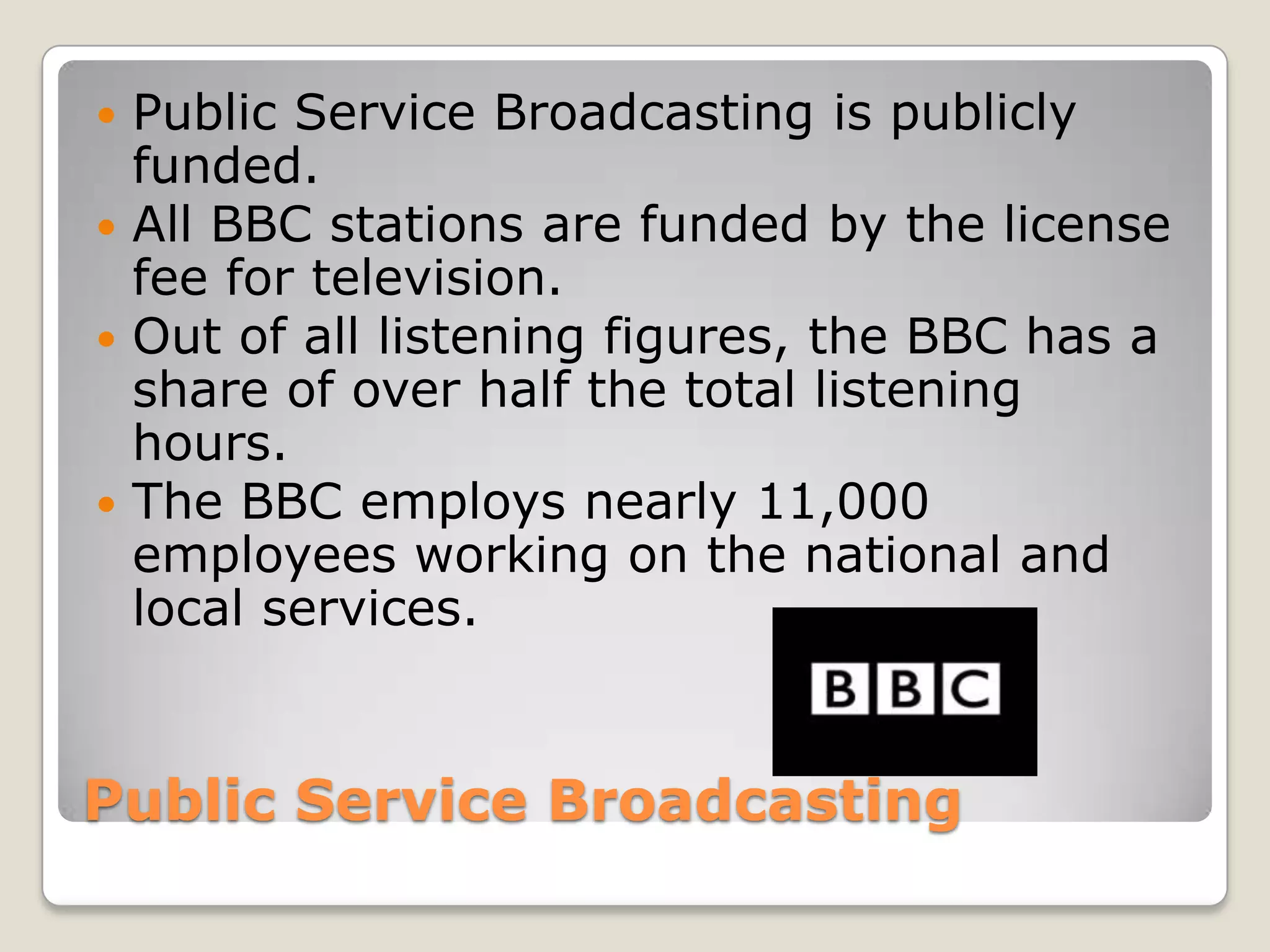
Public Service BroadcastingPublic Service Broadcasting is publicly funded.All BBC stations are funded by the license fee for television.Out of all listening figures, the BBC has a share of over half the total listening hours. The BBC employs nearly 11,000 employees working on the national and local services.
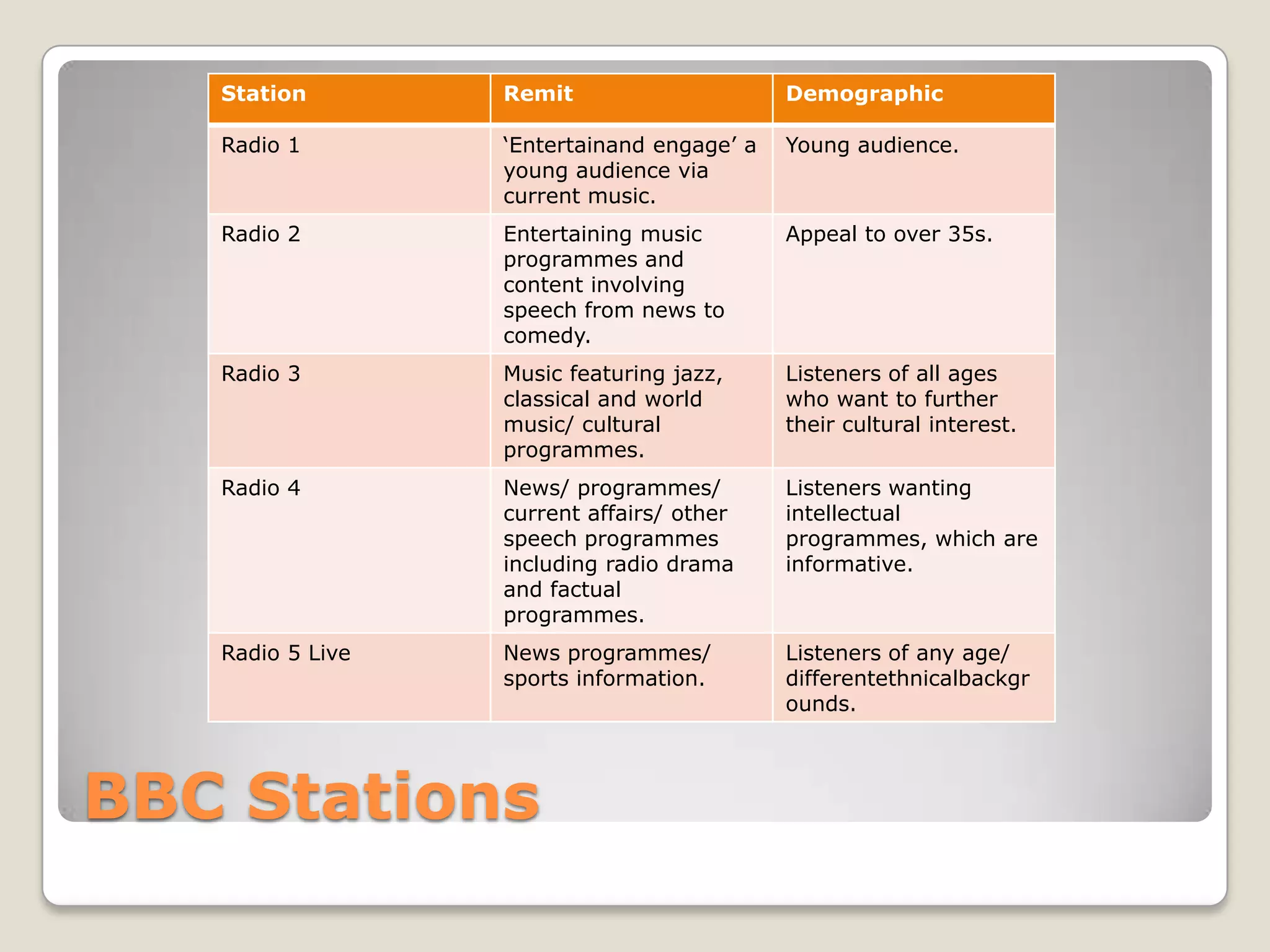
BBC Stations
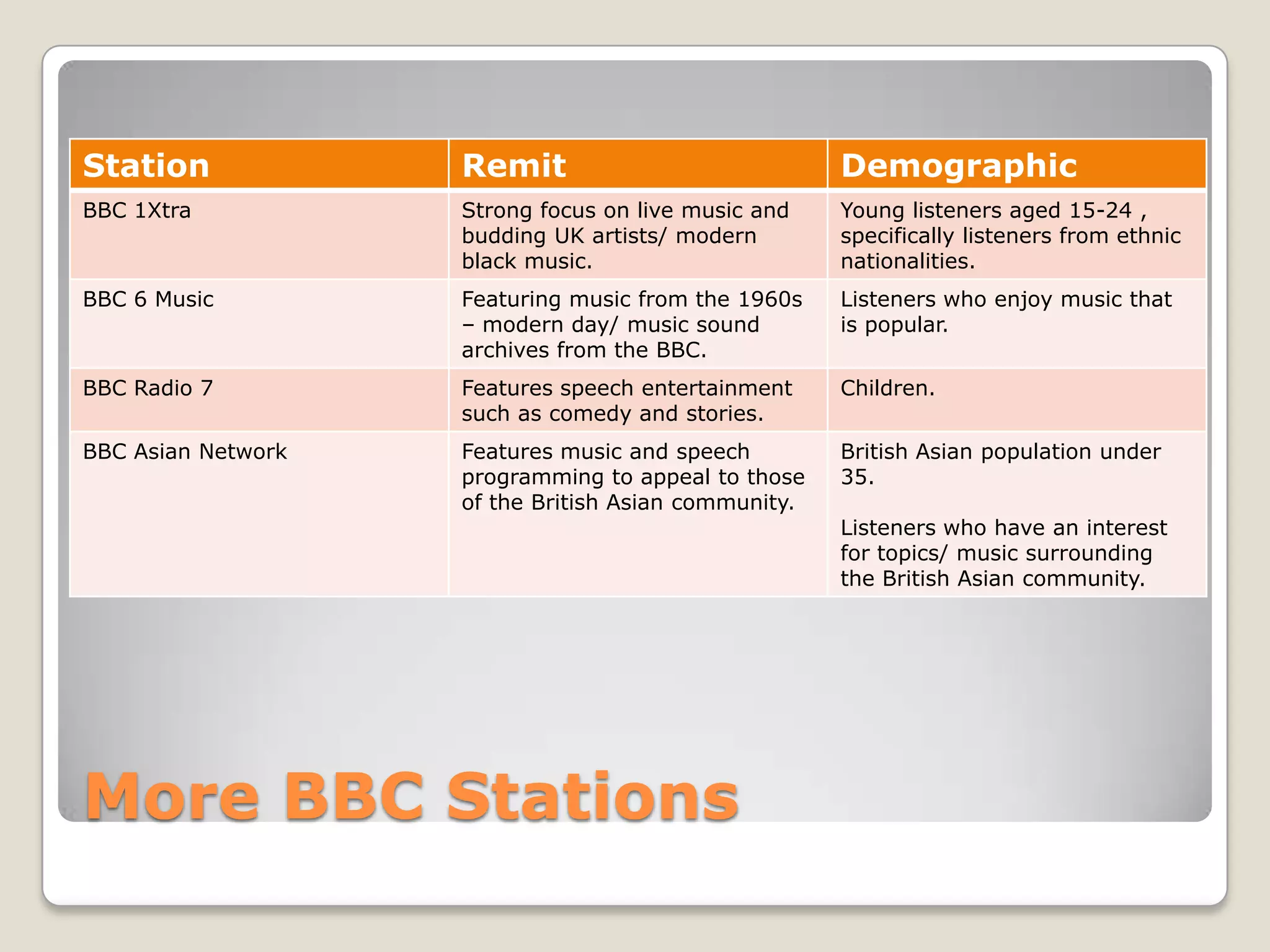
More BBC Stations
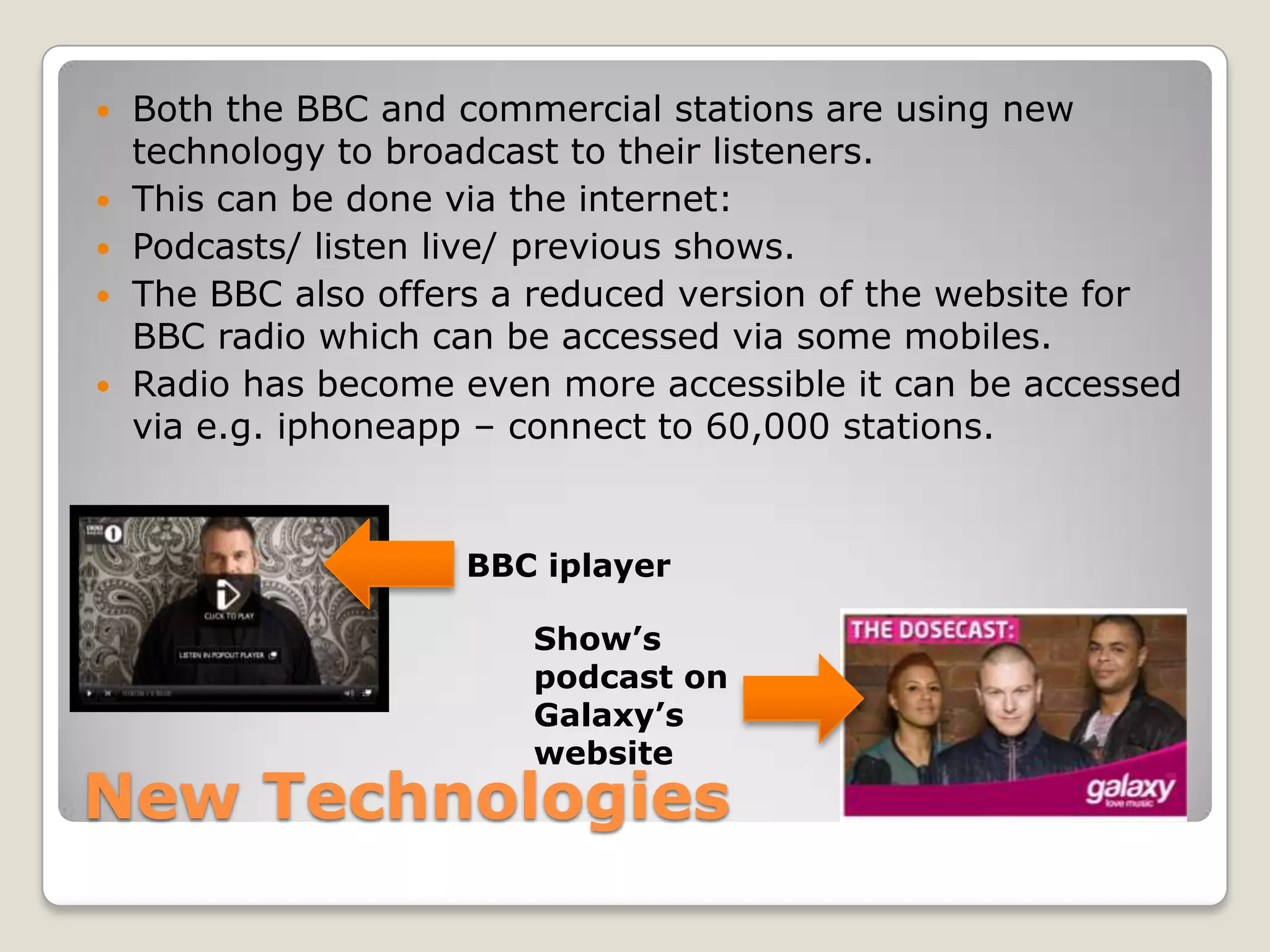
New TechnologiesBoth the BBC and commercial stations are using new technology to broadcast to their listeners.This can be done via the internet: Podcasts/ listen live/ previous shows.The BBC also offers a reduced version of the website for BBC radio which can be accessed via some mobiles.Radio has become even more accessible it can be accessed via e.g. iphoneapp – connect to 60,000 stations.BBC iplayer    Show’s podcast on Galaxy’s website
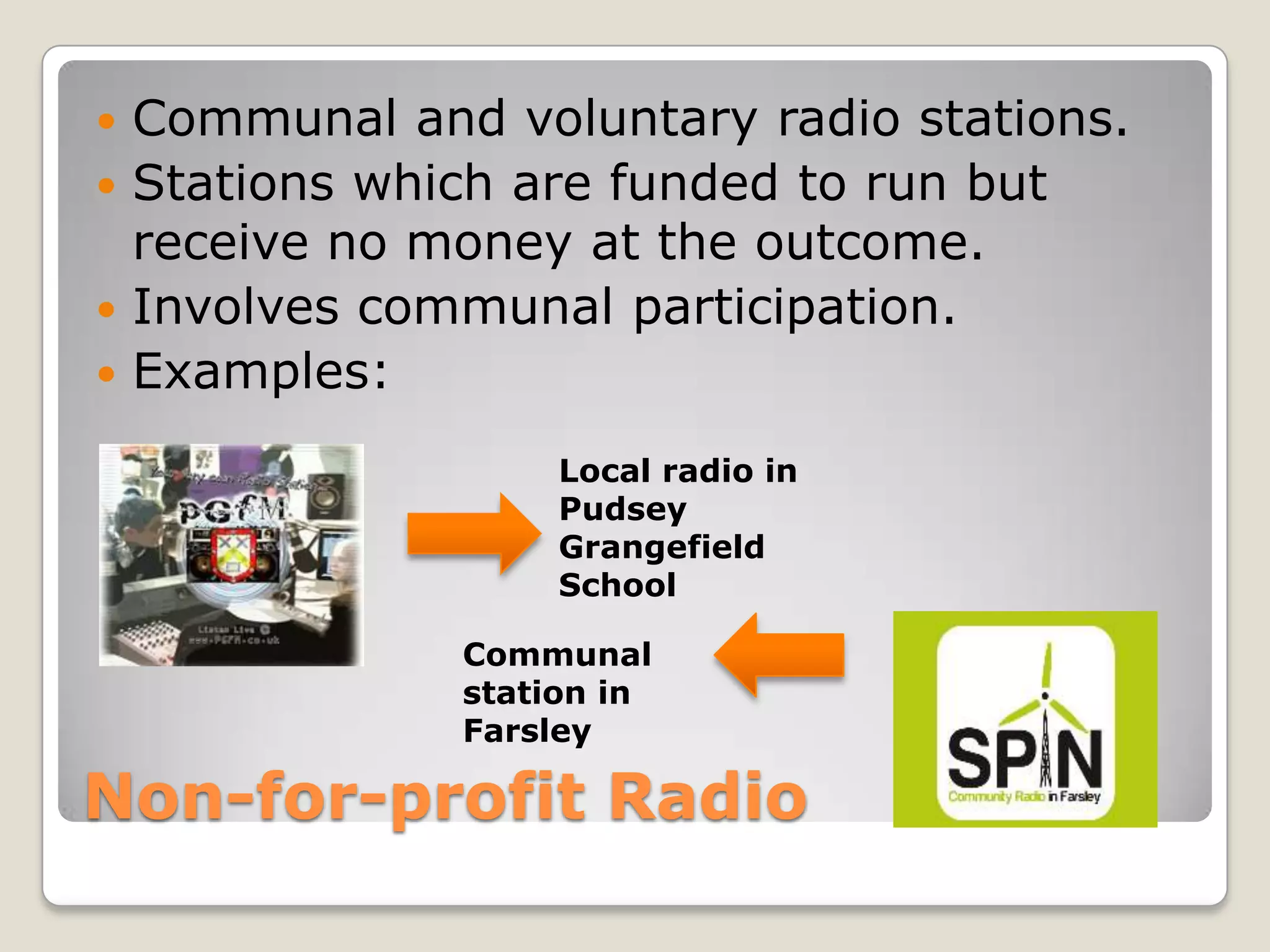
Non-for-profit RadioCommunal and voluntary radio stations.Stations which are funded to run but receive no money at the outcome.Involves communal participation.Examples:Local radio in Pudsey Grangefield SchoolCommunal station in Farsley
Job RolesDifferent roles:Radio producer: creates content for programmes and control the entire process of production for live programmes and programmes that have been recorded.Radio presenter: create scripts, research, be able to interview.Reporter: research stories and broadcast them on the radio to audiences. Gather research – witness and report events/ collect interviews.During the school’s live broadcast last year I undertook these roles:Presenter regular basis during broadcast.Script Writer features of the show.
Professional BodiesIn the radio industry there are many different professional organisations which are designed to for example, regulate programme content etc.
Professional body: The NAB (National Association of Broadcasters) are an organisation that help stations via providing them with different opportunities to benefit their station including ‘NAB Professional Development’, designed to educate and develop employee roles, which will eventually benefit the station.
Professional body: CRCA (Commercial Radio Companies Association) acts as the information centre for commercial radio.The organisation deals with enquires from a range of people including the media and advertising companies.
Professional Body: CMA (Community Media Association) represents the communal media industry and aims to enable access to media for the public and communal groups.
Professional body: ASA’s (Advertising Standards Authority) role is to regulate all areas of media, ensuring that all advertisements comply with the Advertising codes.The ASA also deals with complaints via assessing adverts against the codes.Example code: Children ‘Children must be protected from advertisements that could cause physical, mental or moral harm’.
Professional body: OFCOM (The Office of Communications) regulates communications including TV and radio, airwaves which wireless products run, mobiles and telecoms (fixed-line).Uses Broadcasting codes to regulate content.Protects communications from e.g. scams.Example: Crime ‘To ensure that material likely to incite the commission of crime or lead to disorder is not included in television or radio services’.
Professional body: PRS (Premium rate services) and MCPS (Mechanical Copyright Protection Society). Both companies formed as an alliance in 1997.Company that collects and pays members royalties (payment for their music) when their music is exploited to the public, recorded or distributed to the public, broadcast or made available for the public to access online.
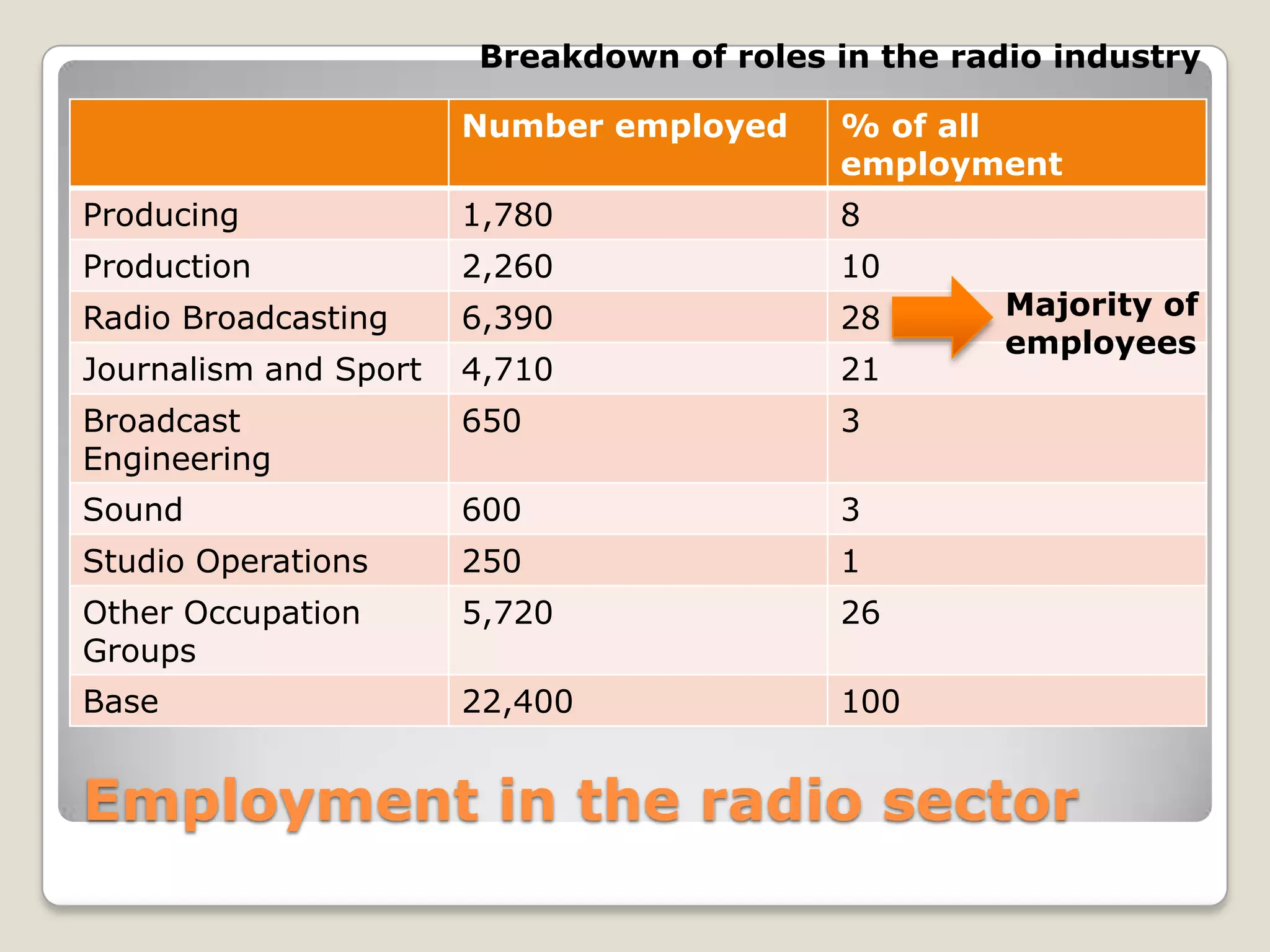
Employment in the radio sectorBreakdown of roles in the radio industryMajority of employees
Employment in the radio sector – Freelance workersFreelance workersTo work freelance means employees work with contracts that are less than a year.Most freelance workers (37%) work in the Radio Broadcasting occupational group.Example freelance worker:Radio producer.Majority of work - word of mouth.
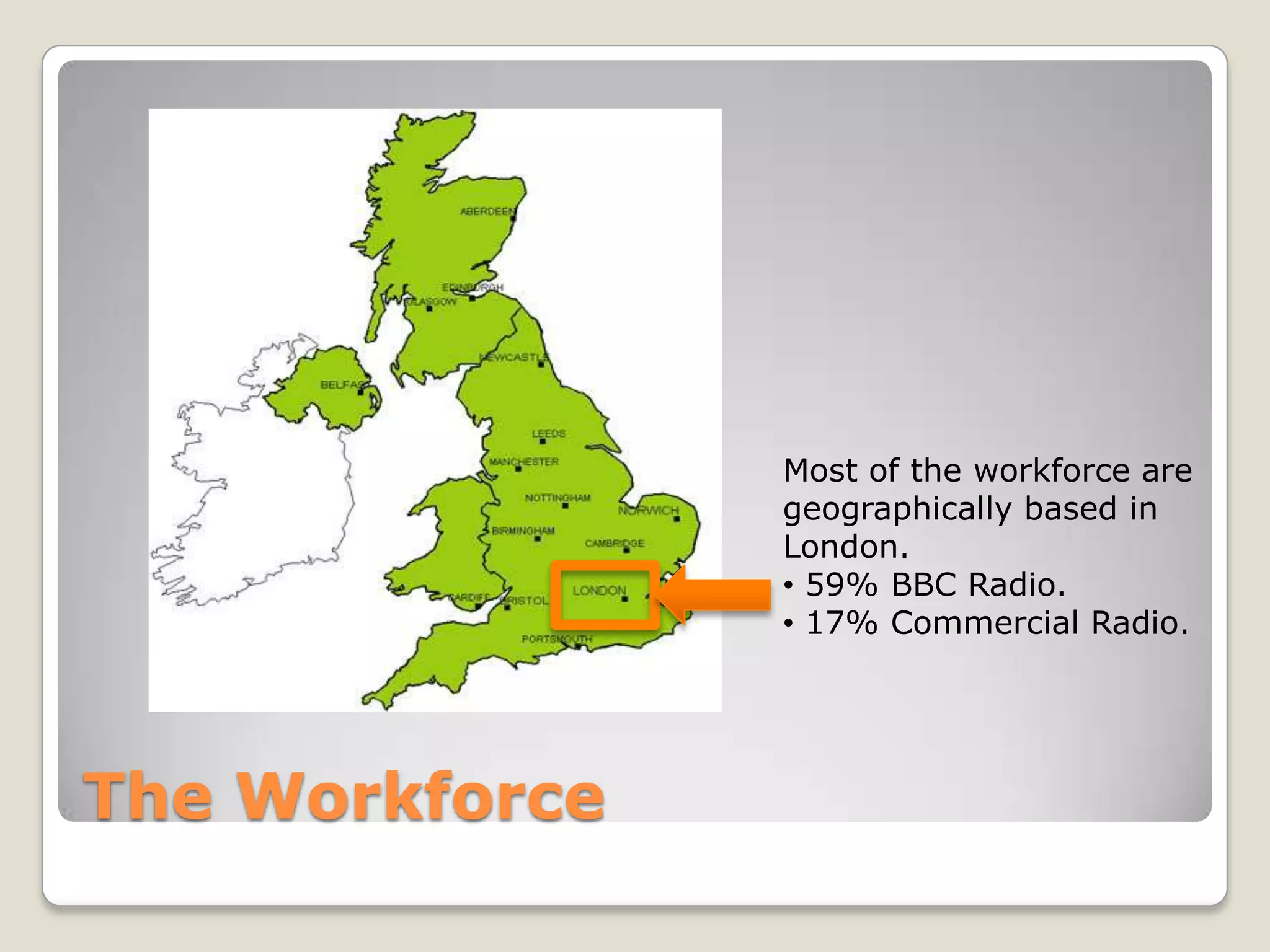
The WorkforceMost of the workforce are geographically based in London.  59% BBC Radio.
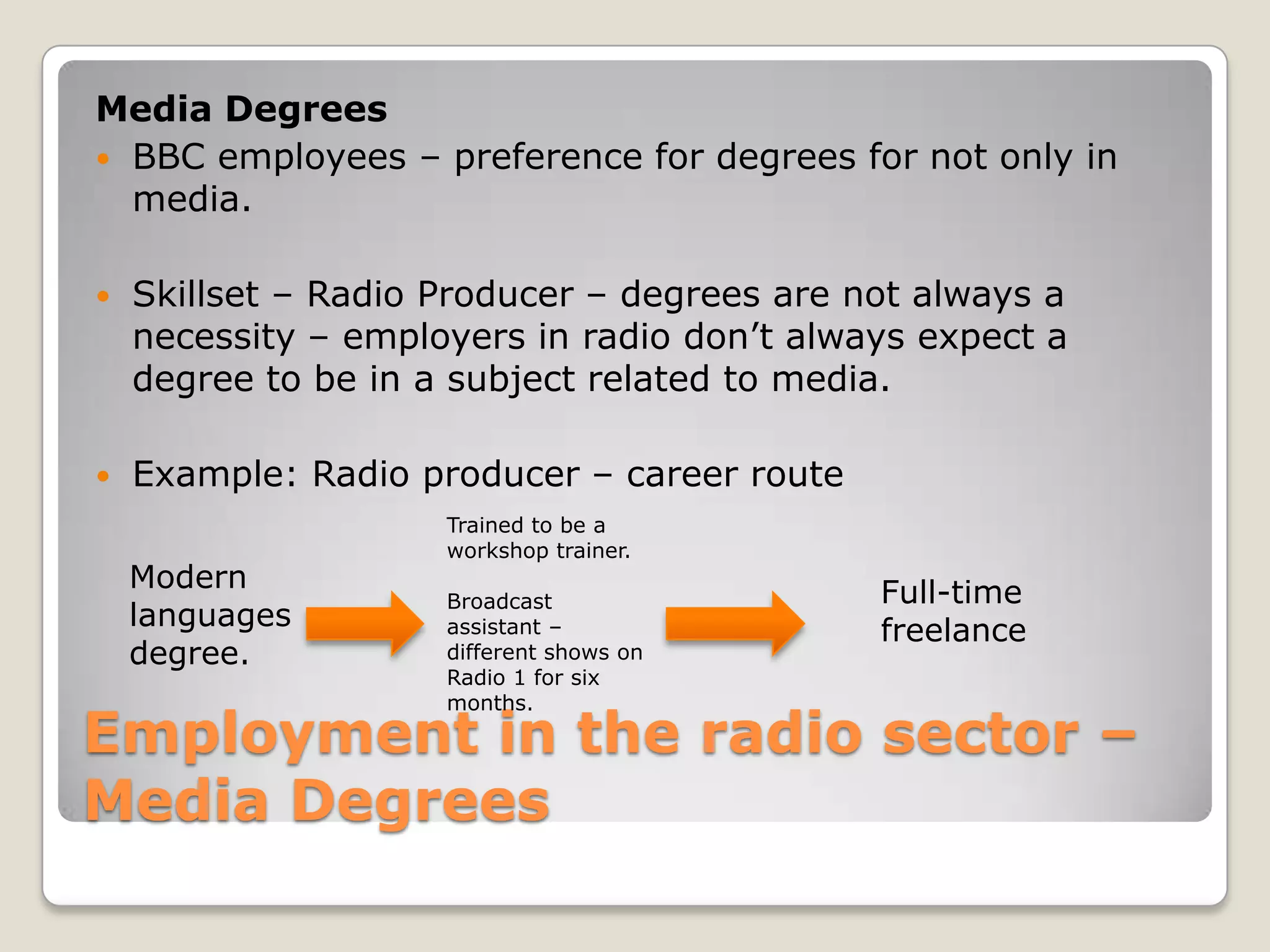
 17% Commercial Radio.Employment in the radio sector – Media DegreesMedia DegreesBBC employees – preference for degrees for not only in media.Skillset – Radio Producer – degrees are not always a necessity – employers in radio don’t always expect a degree to be in a subject related to media.Example: Radio producer – career routeTrained to be a workshop trainer.Broadcast assistant – different shows on Radio 1 for six months.Modern languages degree.Full-time freelance
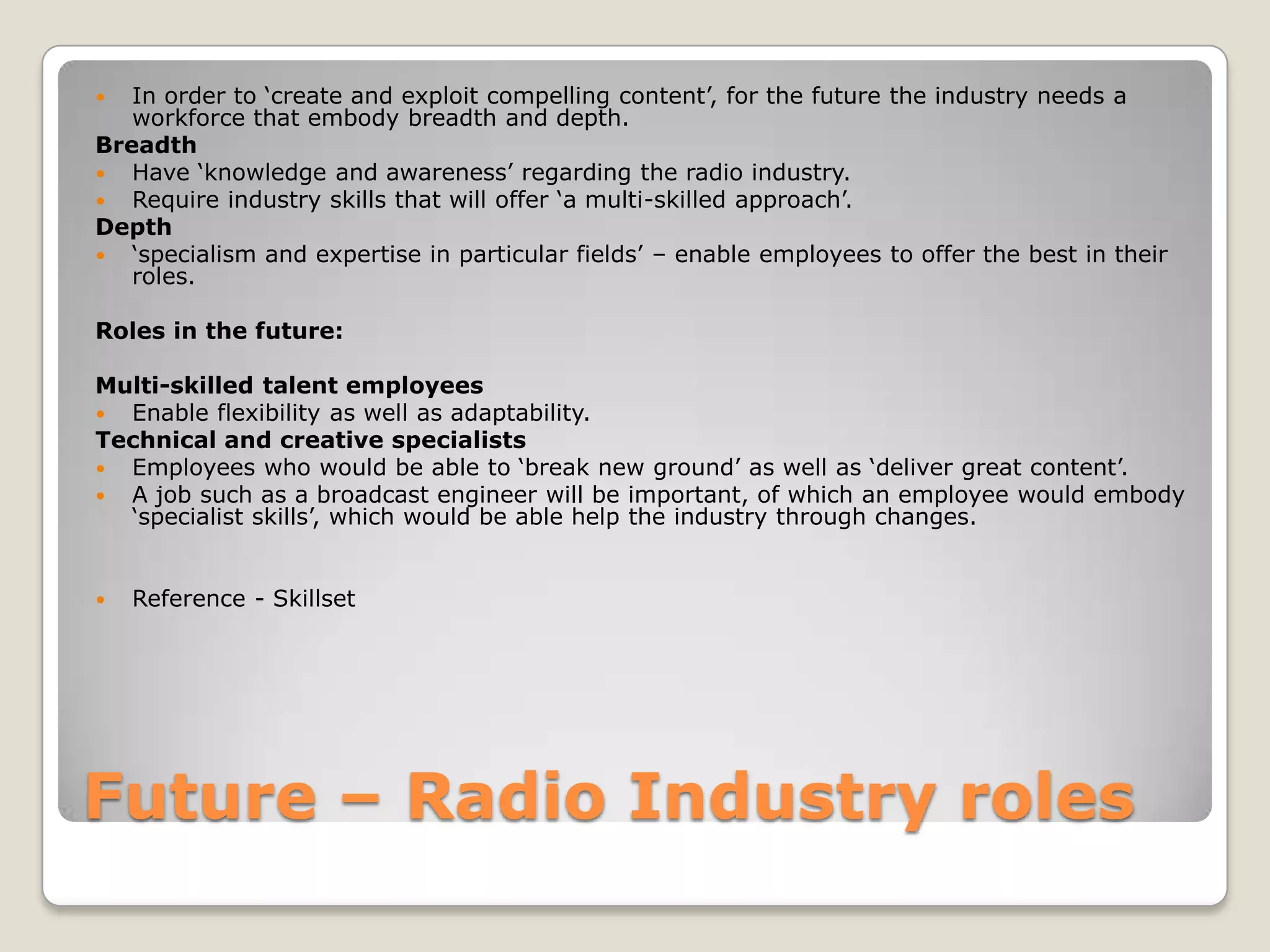
Future – Radio Industry rolesIn order to ‘create and exploit compelling content’, for the future the industry needs a workforce that embody breadth and depth.BreadthHave ‘knowledge and awareness’ regarding the radio industry.Require industry skills that will offer ‘a multi-skilled approach’.Depth‘specialism and expertise in particular fields’ – enable employees to offer the best in their roles.Roles in the future:Multi-skilled talent employeesEnable flexibility as well as adaptability.Technical and creative specialistsEmployees who would be able to ‘break new ground’ as well as ‘deliver great content’.A job such as a broadcast engineer will be important, of which an employee would embody ‘specialist skills’, which would be able help the industry through changes.Reference - Skillset

Radio industries 9.pptx (presentation)

  • 1.
  • 2.
    IntroductionRadio industry asa whole – different sectors of the industry.Commercial radioPublic Service BroadcastingNon-for-profit radioAlso…Other areas in the industry.
  • 3.
    Commercial RadioCommercial stations’income is funded by advertising companies, who buy airtime from different stations.The main players in the commercial sector, based on Rajar figures are Heart, Galaxy and Magic.This industry employs 43% of employees in the radio industry.
  • 4.
    Listening figures –Commercial RadioGalaxyOwned by: Global radioReach: 4,497,000 listenersActual: 24%Listening time: 7.3 hours a weekReal RadioOwned by: GMG RadioReach: 2,843,000 listenersActual: 298,000Listening time: 8.0 hours a weekRadio AireOwned by: Bauer RadioReach: 999,000 listenersActual: 16%Listening time: 8.4 hours a week
  • 5.
    Public Service BroadcastingPublicService Broadcasting is publicly funded.All BBC stations are funded by the license fee for television.Out of all listening figures, the BBC has a share of over half the total listening hours. The BBC employs nearly 11,000 employees working on the national and local services.
  • 6.
  • 7.
  • 8.
    New TechnologiesBoth theBBC and commercial stations are using new technology to broadcast to their listeners.This can be done via the internet: Podcasts/ listen live/ previous shows.The BBC also offers a reduced version of the website for BBC radio which can be accessed via some mobiles.Radio has become even more accessible it can be accessed via e.g. iphoneapp – connect to 60,000 stations.BBC iplayer Show’s podcast on Galaxy’s website
  • 9.
    Non-for-profit RadioCommunal andvoluntary radio stations.Stations which are funded to run but receive no money at the outcome.Involves communal participation.Examples:Local radio in Pudsey Grangefield SchoolCommunal station in Farsley
  • 10.
    Job RolesDifferent roles:Radioproducer: creates content for programmes and control the entire process of production for live programmes and programmes that have been recorded.Radio presenter: create scripts, research, be able to interview.Reporter: research stories and broadcast them on the radio to audiences. Gather research – witness and report events/ collect interviews.During the school’s live broadcast last year I undertook these roles:Presenter regular basis during broadcast.Script Writer features of the show.
  • 11.
    Professional BodiesIn theradio industry there are many different professional organisations which are designed to for example, regulate programme content etc.
  • 12.
    Professional body: TheNAB (National Association of Broadcasters) are an organisation that help stations via providing them with different opportunities to benefit their station including ‘NAB Professional Development’, designed to educate and develop employee roles, which will eventually benefit the station.
  • 13.
    Professional body: CRCA(Commercial Radio Companies Association) acts as the information centre for commercial radio.The organisation deals with enquires from a range of people including the media and advertising companies.
  • 14.
    Professional Body: CMA(Community Media Association) represents the communal media industry and aims to enable access to media for the public and communal groups.
  • 15.
    Professional body: ASA’s(Advertising Standards Authority) role is to regulate all areas of media, ensuring that all advertisements comply with the Advertising codes.The ASA also deals with complaints via assessing adverts against the codes.Example code: Children ‘Children must be protected from advertisements that could cause physical, mental or moral harm’.
  • 16.
    Professional body: OFCOM(The Office of Communications) regulates communications including TV and radio, airwaves which wireless products run, mobiles and telecoms (fixed-line).Uses Broadcasting codes to regulate content.Protects communications from e.g. scams.Example: Crime ‘To ensure that material likely to incite the commission of crime or lead to disorder is not included in television or radio services’.
  • 17.
    Professional body: PRS(Premium rate services) and MCPS (Mechanical Copyright Protection Society). Both companies formed as an alliance in 1997.Company that collects and pays members royalties (payment for their music) when their music is exploited to the public, recorded or distributed to the public, broadcast or made available for the public to access online.
  • 18.
    Employment in theradio sectorBreakdown of roles in the radio industryMajority of employees
  • 19.
    Employment in theradio sector – Freelance workersFreelance workersTo work freelance means employees work with contracts that are less than a year.Most freelance workers (37%) work in the Radio Broadcasting occupational group.Example freelance worker:Radio producer.Majority of work - word of mouth.
  • 20.
    The WorkforceMost ofthe workforce are geographically based in London. 59% BBC Radio.
  • 21.
    17% CommercialRadio.Employment in the radio sector – Media DegreesMedia DegreesBBC employees – preference for degrees for not only in media.Skillset – Radio Producer – degrees are not always a necessity – employers in radio don’t always expect a degree to be in a subject related to media.Example: Radio producer – career routeTrained to be a workshop trainer.Broadcast assistant – different shows on Radio 1 for six months.Modern languages degree.Full-time freelance
  • 22.
    Future – RadioIndustry rolesIn order to ‘create and exploit compelling content’, for the future the industry needs a workforce that embody breadth and depth.BreadthHave ‘knowledge and awareness’ regarding the radio industry.Require industry skills that will offer ‘a multi-skilled approach’.Depth‘specialism and expertise in particular fields’ – enable employees to offer the best in their roles.Roles in the future:Multi-skilled talent employeesEnable flexibility as well as adaptability.Technical and creative specialistsEmployees who would be able to ‘break new ground’ as well as ‘deliver great content’.A job such as a broadcast engineer will be important, of which an employee would embody ‘specialist skills’, which would be able help the industry through changes.Reference - Skillset