• Soft tissue and bone of shoulder
Superimposed over lower
cervical vertebrae.
Requires a swimmers.
• Patient should have been given
instructions to relax shoulders
and exposure taken on exhalation
to keep shoulder muscle and
tissue out of view of C-7 T-1.
Spinous
Process C-1
Zygapophyseal
Joints C-3 & 4
Posterior Arch
Intervertebral
Space
Lateral C-Spine
• No Marker Visible
Acceptable Lateral C-Spine
Vertebral bodies, intervertebral
joint spaces, articular pillars,
Spinous processes, and
Zyapophyseal joints all well
Demonstrated. Joint space
Between C-7 and T-1 visible.
Extension teardrop fracture
Spinous
process
Posterior arch
Zygapophyseal
joint Intervertebral space
Articular
pillar
Joint space between C-7 and T1
Lateral C-spine
Swimmers
Odontoid
Dens, C-2
Lateral Masses and
Space between superior
articlating surface of C-2
Waters for Sinuses
• Image is underexposed
• Image was not
properly collimated
• There are artifacts in the image
patient was not properly prepped
• There is rotation and “tilt” due to
poor positioning
Acceptable Waters
Properly collimated,
No rotation of MSP or
intepupilary baselines
Proper Anatomical
Marker in image
Frontal sinus
Bony nasal septum
Anterior nasal spine
Maxillary sinus
Coronoid process
Maxilla
Mastoid process
Superior orbital
Rim
Zygomatic bone
Zygomatic arch
Petrus ridge
Mandible
Odontoid process
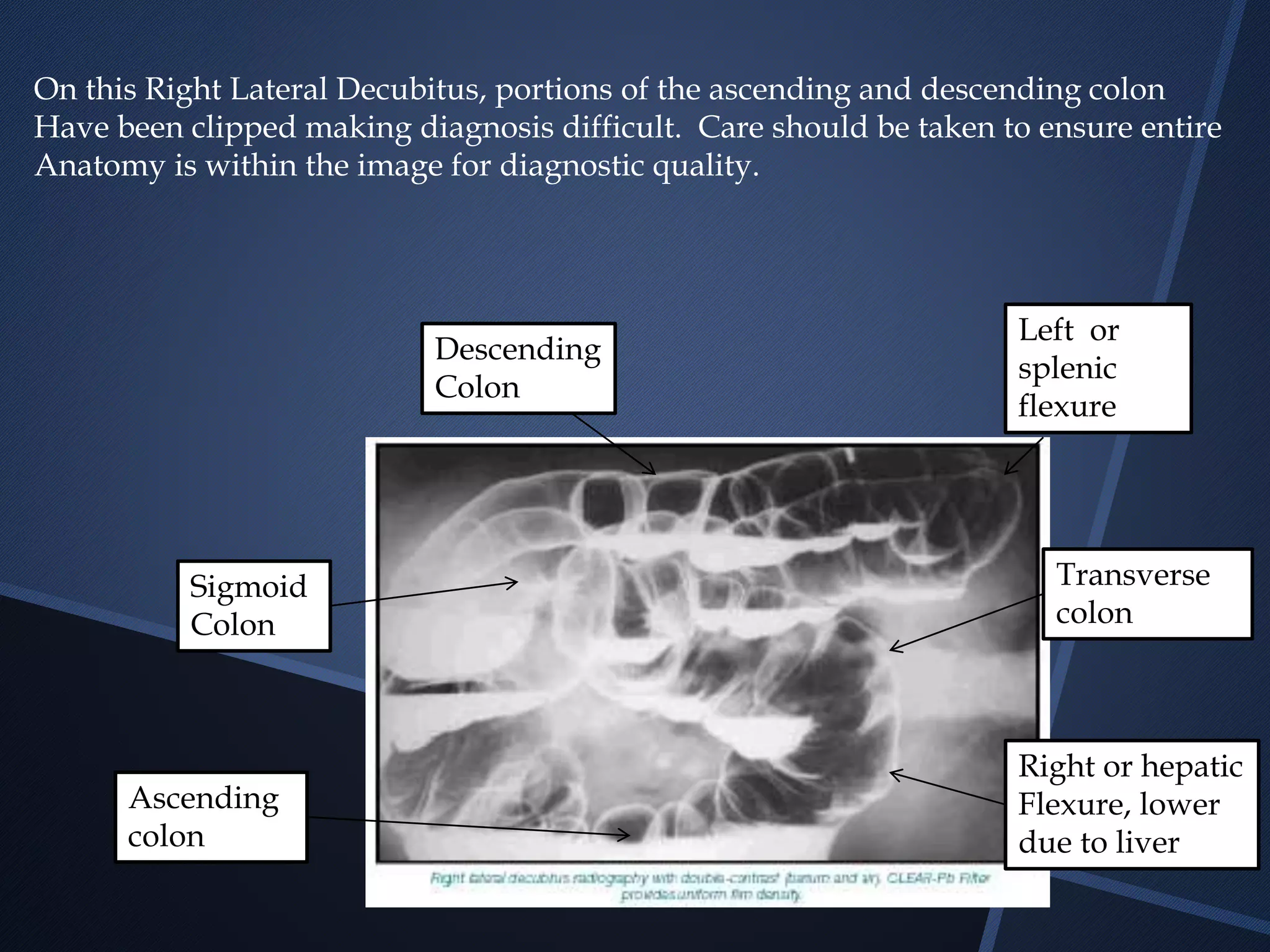
On this Right Lateral Decubitus, portions of the ascending and descending colon
Have been clipped making diagnosis difficult. Care should be taken to ensure entire
Anatomy is within the image for diagnostic quality.
Left or
splenic
flexure
Right or hepatic
Flexure, lower
due to liver
Sigmoid
Colon
Descending
Colon
Transverse
colon
Ascending
colon
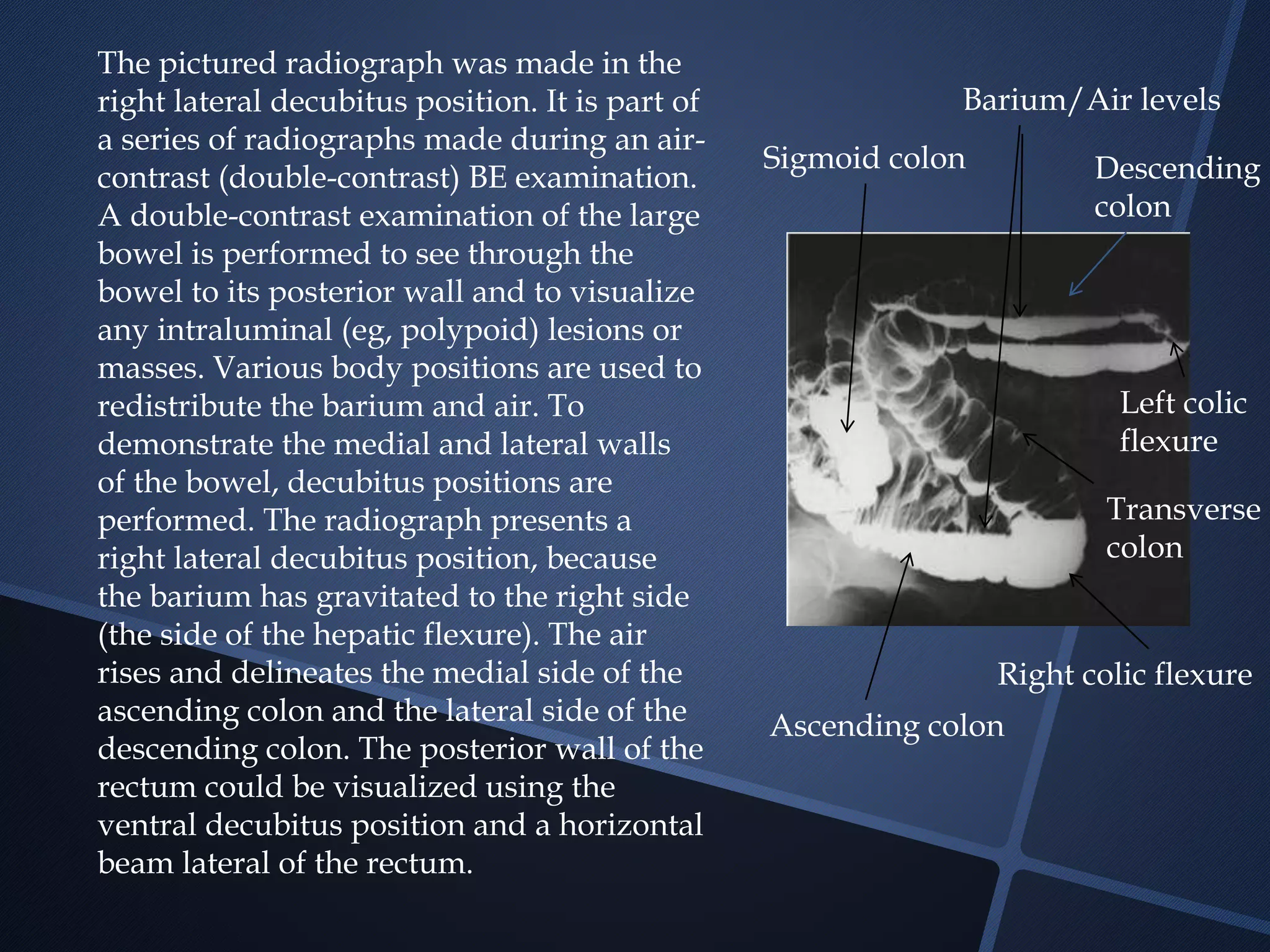
The pictured radiograph was made in the
right lateral decubitus position. It is part of
a series of radiographs made during an air-
contrast (double-contrast) BE examination.
A double-contrast examination of the large
bowel is performed to see through the
bowel to its posterior wall and to visualize
any intraluminal (eg, polypoid) lesions or
masses. Various body positions are used to
redistribute the barium and air. To
demonstrate the medial and lateral walls
of the bowel, decubitus positions are
performed. The radiograph presents a
right lateral decubitus position, because
the barium has gravitated to the right side
(the side of the hepatic flexure). The air
rises and delineates the medial side of the
ascending colon and the lateral side of the
descending colon. The posterior wall of the
rectum could be visualized using the
ventral decubitus position and a horizontal
beam lateral of the rectum.
Right colic flexure
Left colic
flexure
Ascending colon
Transverse
colon
Descending
colon
Sigmoid colon
Barium/Air levels
The End ?
References
Bontrager, Kenneth L and Lampignano. 2014. Textbook of radiographic
positioning and related anatomy. Mosby Inc. St. Louis, MO. Print.
Saia, Dorothy A .MA, RT(R), (M). 2008 . Lange’s Q&A., 9th ed. Mcgraw-Hill
United States of America. Print
www.learningradiology.com

Improved imafes

  • 2.
    • Soft tissueand bone of shoulder Superimposed over lower cervical vertebrae. Requires a swimmers. • Patient should have been given instructions to relax shoulders and exposure taken on exhalation to keep shoulder muscle and tissue out of view of C-7 T-1. Spinous Process C-1 Zygapophyseal Joints C-3 & 4 Posterior Arch Intervertebral Space Lateral C-Spine • No Marker Visible
  • 3.
    Acceptable Lateral C-Spine Vertebralbodies, intervertebral joint spaces, articular pillars, Spinous processes, and Zyapophyseal joints all well Demonstrated. Joint space Between C-7 and T-1 visible. Extension teardrop fracture Spinous process Posterior arch Zygapophyseal joint Intervertebral space Articular pillar Joint space between C-7 and T1
  • 4.
  • 5.
    Odontoid Dens, C-2 Lateral Massesand Space between superior articlating surface of C-2
  • 6.
    Waters for Sinuses •Image is underexposed • Image was not properly collimated • There are artifacts in the image patient was not properly prepped • There is rotation and “tilt” due to poor positioning
  • 7.
    Acceptable Waters Properly collimated, Norotation of MSP or intepupilary baselines Proper Anatomical Marker in image Frontal sinus Bony nasal septum Anterior nasal spine Maxillary sinus Coronoid process Maxilla Mastoid process Superior orbital Rim Zygomatic bone Zygomatic arch Petrus ridge Mandible Odontoid process
  • 8.
    On this RightLateral Decubitus, portions of the ascending and descending colon Have been clipped making diagnosis difficult. Care should be taken to ensure entire Anatomy is within the image for diagnostic quality. Left or splenic flexure Right or hepatic Flexure, lower due to liver Sigmoid Colon Descending Colon Transverse colon Ascending colon
  • 9.
    The pictured radiographwas made in the right lateral decubitus position. It is part of a series of radiographs made during an air- contrast (double-contrast) BE examination. A double-contrast examination of the large bowel is performed to see through the bowel to its posterior wall and to visualize any intraluminal (eg, polypoid) lesions or masses. Various body positions are used to redistribute the barium and air. To demonstrate the medial and lateral walls of the bowel, decubitus positions are performed. The radiograph presents a right lateral decubitus position, because the barium has gravitated to the right side (the side of the hepatic flexure). The air rises and delineates the medial side of the ascending colon and the lateral side of the descending colon. The posterior wall of the rectum could be visualized using the ventral decubitus position and a horizontal beam lateral of the rectum. Right colic flexure Left colic flexure Ascending colon Transverse colon Descending colon Sigmoid colon Barium/Air levels
  • 10.
  • 11.
    References Bontrager, Kenneth Land Lampignano. 2014. Textbook of radiographic positioning and related anatomy. Mosby Inc. St. Louis, MO. Print. Saia, Dorothy A .MA, RT(R), (M). 2008 . Lange’s Q&A., 9th ed. Mcgraw-Hill United States of America. Print www.learningradiology.com