Susan G. Schwartz
The River Birch Group
sgs@riverbirchgroup.com
703-395-1219
2
EVOLVING ENVIRONMENTS
“The coming age of evolution won’t be
driven by physical adaptation, but by
human consciousness, creativity, and
spirit.”
Pierre Teilhard de Chardin
Jesuit Paleontologist
1881-1955
TEAMS
“A small number of people with
complementary skills who are committed
to a common purpose, performance
goals, and common approach for which
they hold themselves mutually
accountable.”
Jon Katzenbach
MATRIX TEAMS
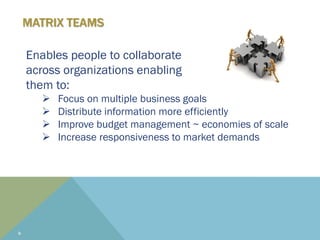
Enables people to collaborate
across organizations enabling
them to:
 Focus on multiple business goals
 Distribute information more efficiently
 Improve budget management ~ economies of scale
 Increase responsiveness to market demands
MATRIX TEAMS
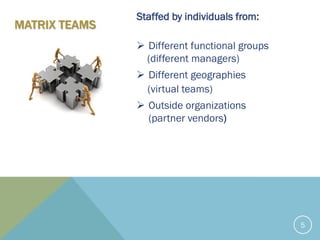
Staffed by individuals from:
 Different functional groups
(different managers)
 Different geographies
(virtual teams)
 Outside organizations
(partner vendors)
5
MATRIX TEAMS
MATRIX TEAM CHALLENGES
Management can hinder success:
 Competing or conflicting group objectives
and/or loyalties
 Non-coordinated resources and work plans
 Insufficient communication vehicles between
groups
6
7
MATRIX TEAM ~ POSSIBLE RESULTS
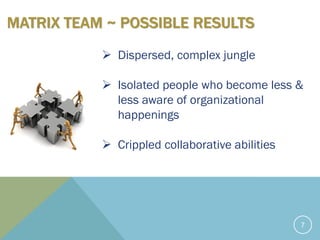
 Dispersed, complex jungle
 Isolated people who become less &
less aware of organizational
happenings
 Crippled collaborative abilities
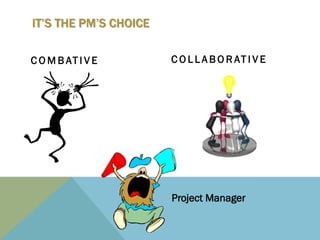
IT’S THE PM’S CHOICE
C O M B AT I V E C O L L A B O R AT I V E
Project Manager
DIVERSITY OF WORK STYLES (THE WHO)
 The whole is greater than the sum
of the parts
 Best teams contain a balance of
work styles
9
CREATING COMPLEMENTARY
COLLABORATIVE RELATIONSHIPS
Psychological Inventories
 Identifies Personality Types
 Myers-Briggs
 DISC
Understand innate personality traits
 Manage self better
 Manage work and social interactions
10
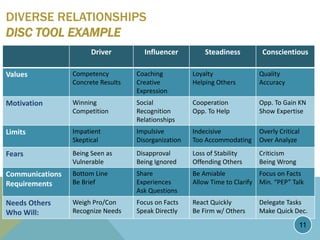
DIVERSE RELATIONSHIPS
DISC TOOL EXAMPLE
Driver Influencer Steadiness Conscientious
Values Competency
Concrete Results
Coaching
Creative
Expression
Loyalty
Helping Others
Quality
Accuracy
Motivation Winning
Competition
Social
Recognition
Relationships
Cooperation
Opp. To Help
Opp. To Gain KN
Show Expertise
Limits Impatient
Skeptical
Impulsive
Disorganization
Indecisive
Too Accommodating
Overly Critical
Over Analyze
Fears Being Seen as
Vulnerable
Disapproval
Being Ignored
Loss of Stability
Offending Others
Criticism
Being Wrong
Communications
Requirements
Bottom Line
Be Brief
Share
Experiences
Ask Questions
Be Amiable
Allow Time to Clarify
Focus on Facts
Min. “PEP” Talk
Needs Others
Who Will:
Weigh Pro/Con
Recognize Needs
Focus on Facts
Speak Directly
React Quickly
Be Firm w/ Others
Delegate Tasks
Make Quick Dec.
11
GROW MODEL (THE WHAT)
COACHING FOR IMPROVED PERFORMANCE
Goal
How will you know you have achieved
your quest?
 Completed task
 Resolved Problem
Current Reality
Fully describe the starting point
 What, who, when, how often
 Cause and effects
Options
What is possible?
 Other options
 Remove a constraint
 Benefits/downsides
 Key decision factors
Will
Establish Follow-up Action
 Defined action and schedule
 Potential challenges
 When is goal accomplished
12
ACCOUNTABILITY (THE WHY)
Clearly Defined Goals and Expectations
Individual/Group Performance Ownership
 Set realistic and “stretch” metrics
 Active communication among team members
 Peer guidance and counseling
 Objective performance evaluation and project learning
 Evolutionary process and procedures
13
LEVERAGING MATRIX TEAMS
SUMMARY
Collaborative partnering across team matrix
Options
Brainstorm, review, and evaluate
Honest assessment of current reality
Strengths
Weaknesses
Accountability ~ role model
Connect
Communicate
14
Susan G. Schwartz
The River Birch Group
sgs@riverbirchgroup.com
www.riverbirchgroup.com
703-395-1219

Ldp matrix pm reston luncheon_february 2017

  • 1.
    Susan G. Schwartz TheRiver Birch Group sgs@riverbirchgroup.com 703-395-1219
  • 2.
    2 EVOLVING ENVIRONMENTS “The comingage of evolution won’t be driven by physical adaptation, but by human consciousness, creativity, and spirit.” Pierre Teilhard de Chardin Jesuit Paleontologist 1881-1955
  • 3.
    TEAMS “A small numberof people with complementary skills who are committed to a common purpose, performance goals, and common approach for which they hold themselves mutually accountable.” Jon Katzenbach
  • 4.
    MATRIX TEAMS Enables peopleto collaborate across organizations enabling them to:  Focus on multiple business goals  Distribute information more efficiently  Improve budget management ~ economies of scale  Increase responsiveness to market demands
  • 5.
    MATRIX TEAMS Staffed byindividuals from:  Different functional groups (different managers)  Different geographies (virtual teams)  Outside organizations (partner vendors) 5
  • 6.
    MATRIX TEAMS MATRIX TEAMCHALLENGES Management can hinder success:  Competing or conflicting group objectives and/or loyalties  Non-coordinated resources and work plans  Insufficient communication vehicles between groups 6
  • 7.
    7 MATRIX TEAM ~POSSIBLE RESULTS  Dispersed, complex jungle  Isolated people who become less & less aware of organizational happenings  Crippled collaborative abilities
  • 8.
    IT’S THE PM’SCHOICE C O M B AT I V E C O L L A B O R AT I V E Project Manager
  • 9.
    DIVERSITY OF WORKSTYLES (THE WHO)  The whole is greater than the sum of the parts  Best teams contain a balance of work styles 9
  • 10.
    CREATING COMPLEMENTARY COLLABORATIVE RELATIONSHIPS PsychologicalInventories  Identifies Personality Types  Myers-Briggs  DISC Understand innate personality traits  Manage self better  Manage work and social interactions 10
  • 11.
    DIVERSE RELATIONSHIPS DISC TOOLEXAMPLE Driver Influencer Steadiness Conscientious Values Competency Concrete Results Coaching Creative Expression Loyalty Helping Others Quality Accuracy Motivation Winning Competition Social Recognition Relationships Cooperation Opp. To Help Opp. To Gain KN Show Expertise Limits Impatient Skeptical Impulsive Disorganization Indecisive Too Accommodating Overly Critical Over Analyze Fears Being Seen as Vulnerable Disapproval Being Ignored Loss of Stability Offending Others Criticism Being Wrong Communications Requirements Bottom Line Be Brief Share Experiences Ask Questions Be Amiable Allow Time to Clarify Focus on Facts Min. “PEP” Talk Needs Others Who Will: Weigh Pro/Con Recognize Needs Focus on Facts Speak Directly React Quickly Be Firm w/ Others Delegate Tasks Make Quick Dec. 11
  • 12.
    GROW MODEL (THEWHAT) COACHING FOR IMPROVED PERFORMANCE Goal How will you know you have achieved your quest?  Completed task  Resolved Problem Current Reality Fully describe the starting point  What, who, when, how often  Cause and effects Options What is possible?  Other options  Remove a constraint  Benefits/downsides  Key decision factors Will Establish Follow-up Action  Defined action and schedule  Potential challenges  When is goal accomplished 12
  • 13.
    ACCOUNTABILITY (THE WHY) ClearlyDefined Goals and Expectations Individual/Group Performance Ownership  Set realistic and “stretch” metrics  Active communication among team members  Peer guidance and counseling  Objective performance evaluation and project learning  Evolutionary process and procedures 13
  • 14.
    LEVERAGING MATRIX TEAMS SUMMARY Collaborativepartnering across team matrix Options Brainstorm, review, and evaluate Honest assessment of current reality Strengths Weaknesses Accountability ~ role model Connect Communicate 14
  • 15.
    Susan G. Schwartz TheRiver Birch Group sgs@riverbirchgroup.com www.riverbirchgroup.com 703-395-1219