Workshop Overland Park Leadership Classes 2/18/2011 Presented by Andy Huckaba – Huckaba & Associates Materials derived from the  Kansas Leadership Center Field Guide
KLC LEADERSHIP PRINCIPLES Leadership is an activity not position or authority. Each of us has the opportunity to exercise leadership at any time in any situation. The activity of leadership starts with a personal intervention. Exercising leadership is an experimental and improvisatory art. We cannot know if an intervention will work until we try it. Exercising leadership is inherently risky: Once we intervene we lose significant control over the outcome.
KLC LEADERSHIP PRINCIPLES The risks of exercising leadership are both personal and professional. To make progress, we need to be more conscious, purposeful and intentional about our leadership interventions. Making progress requires us to do what is needed in the situation rather than what is wanted or is comfortable for others or ourselves. To make progress, we have to be willing to raise the heat to get others and ourselves into the zone of productive work. Exercising leadership involves managing losses and risking casualties. Our own defaults, how we would usually or unconsciously react or intervene in a situation can be significant barriers to making progress on the issues we care about.
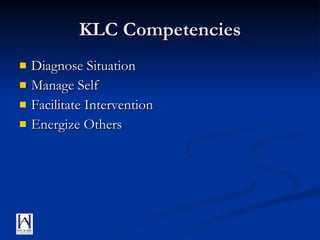
KLC Competencies Diagnose Situation Manage Self Facilitate Intervention Energize Others
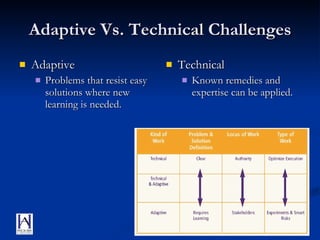
Adaptive Vs. Technical Challenges Adaptive Problems that resist easy solutions where new learning is needed. Technical Known remedies and expertise can be applied.
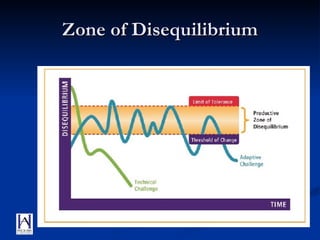
Zone of Disequilibrium
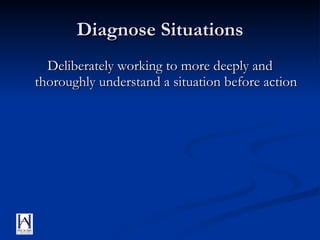
Diagnose Situations Deliberately working to more deeply and thoroughly understand a situation before action
Diagnose Situations If you don’t identify the right problems, then you are working on the wrong things!
Diagnose Situations Technical vs Adaptive Faction Mapping Process versus Content Disequilibrium Test multiple Interpretations
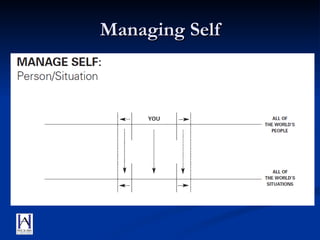
Managing Self Managing Self:  Exercising civic leadership effectively requires knowing yourself enough to understand how well you are situated to intervene. This will involve challenging your assumptions about your strengths and weaknesses as well as expanding your repertoire of possible responses.
Managing Self Managing Self: Identify your capabilities, vulnerabilities and triggers Figure out how others perceive your role in the system Distinguish self from role Choose among competing values Increase tolerance for uncertainty, ambiguity and conflict Experiment beyond your comfort zone
Managing Self
Managing Self 5-Column Exercise
Facilitate Intervention Make conscious choices Raise the heat Give the work back Hold relentlessly to purpose Speak from the heart Act experimentally
Facilitate Intervention If you keep doing what you have always been doing, nothing is going to change!
Facilitate Intervention Leadership is about activity (interventions) not position Effective interventions are intentionally designed and delivered
Energize Others Exercising leadership on adaptive challenges requires engaging others. Engaging others means connecting interests, attending to how people work together (the process) and inspiring them to make progress.
Energize Others Engage unusual voices Work across factions Start where they are Speak to loss Infuse the work with purpose Build a trustworthy process Discover connecting interest
Recap: KLC Competencies Diagnose Situation Manage Self Facilitate Intervention Energize Others
KLC LEADERSHIP PRINCIPLES Leadership is an activity not position or authority. Each of us has the opportunity to exercise leadership at any time in any situation. The activity of leadership starts with a personal intervention. Exercising leadership is an experimental and improvisatory art. We cannot know if an intervention will work until we try it. Exercising leadership is inherently risky: Once we intervene we lose significant control over the outcome.
KLC LEADERSHIP PRINCIPLES The risks of exercising leadership are both personal and professional. To make progress, we need to be more conscious, purposeful and intentional about our leadership interventions. Making progress requires us to do what is needed in the situation rather than what is wanted or is comfortable for others or ourselves. To make progress, we have to be willing to raise the heat to get others and ourselves into the zone of productive work. Exercising leadership involves managing losses and risking casualties. Our own defaults, how we would usually or unconsciously react or intervene in a situation can be significant barriers to making progress on the issues we care about.
Kansas Leadership Center MISSION To foster civic leadership for healthier Kansas communities VISION To be the center of excellence for civic leadership development
Contact Andy Huckaba - President, Huckaba & Associates Email: andy@huckaba.com Phone: (913) 485-3210 Twitter –  http:// www.twitter.com/andyhuckaba Facebook –  http:// www.facebook.com/andyhuckaba LinkedIn –  http:// www.linkedin.com/in/andyhuckaba Blog –  http:// blog.huckaba.com Website –  http:// www.huckaba.com Kansas Leadership Center Website –  http:// www.kansasleadershipcenter.org

Leadership Workshop

  • 1.
    Workshop Overland ParkLeadership Classes 2/18/2011 Presented by Andy Huckaba – Huckaba & Associates Materials derived from the Kansas Leadership Center Field Guide
  • 2.
    KLC LEADERSHIP PRINCIPLESLeadership is an activity not position or authority. Each of us has the opportunity to exercise leadership at any time in any situation. The activity of leadership starts with a personal intervention. Exercising leadership is an experimental and improvisatory art. We cannot know if an intervention will work until we try it. Exercising leadership is inherently risky: Once we intervene we lose significant control over the outcome.
  • 3.
    KLC LEADERSHIP PRINCIPLESThe risks of exercising leadership are both personal and professional. To make progress, we need to be more conscious, purposeful and intentional about our leadership interventions. Making progress requires us to do what is needed in the situation rather than what is wanted or is comfortable for others or ourselves. To make progress, we have to be willing to raise the heat to get others and ourselves into the zone of productive work. Exercising leadership involves managing losses and risking casualties. Our own defaults, how we would usually or unconsciously react or intervene in a situation can be significant barriers to making progress on the issues we care about.
  • 4.
    KLC Competencies DiagnoseSituation Manage Self Facilitate Intervention Energize Others
  • 5.
    Adaptive Vs. TechnicalChallenges Adaptive Problems that resist easy solutions where new learning is needed. Technical Known remedies and expertise can be applied.
  • 6.
  • 7.
    Diagnose Situations Deliberatelyworking to more deeply and thoroughly understand a situation before action
  • 8.
    Diagnose Situations Ifyou don’t identify the right problems, then you are working on the wrong things!
  • 9.
    Diagnose Situations Technicalvs Adaptive Faction Mapping Process versus Content Disequilibrium Test multiple Interpretations
  • 10.
    Managing Self ManagingSelf: Exercising civic leadership effectively requires knowing yourself enough to understand how well you are situated to intervene. This will involve challenging your assumptions about your strengths and weaknesses as well as expanding your repertoire of possible responses.
  • 11.
    Managing Self ManagingSelf: Identify your capabilities, vulnerabilities and triggers Figure out how others perceive your role in the system Distinguish self from role Choose among competing values Increase tolerance for uncertainty, ambiguity and conflict Experiment beyond your comfort zone
  • 12.
  • 13.
  • 14.
    Facilitate Intervention Makeconscious choices Raise the heat Give the work back Hold relentlessly to purpose Speak from the heart Act experimentally
  • 15.
    Facilitate Intervention Ifyou keep doing what you have always been doing, nothing is going to change!
  • 16.
    Facilitate Intervention Leadershipis about activity (interventions) not position Effective interventions are intentionally designed and delivered
  • 17.
    Energize Others Exercisingleadership on adaptive challenges requires engaging others. Engaging others means connecting interests, attending to how people work together (the process) and inspiring them to make progress.
  • 18.
    Energize Others Engageunusual voices Work across factions Start where they are Speak to loss Infuse the work with purpose Build a trustworthy process Discover connecting interest
  • 19.
    Recap: KLC CompetenciesDiagnose Situation Manage Self Facilitate Intervention Energize Others
  • 20.
    KLC LEADERSHIP PRINCIPLESLeadership is an activity not position or authority. Each of us has the opportunity to exercise leadership at any time in any situation. The activity of leadership starts with a personal intervention. Exercising leadership is an experimental and improvisatory art. We cannot know if an intervention will work until we try it. Exercising leadership is inherently risky: Once we intervene we lose significant control over the outcome.
  • 21.
    KLC LEADERSHIP PRINCIPLESThe risks of exercising leadership are both personal and professional. To make progress, we need to be more conscious, purposeful and intentional about our leadership interventions. Making progress requires us to do what is needed in the situation rather than what is wanted or is comfortable for others or ourselves. To make progress, we have to be willing to raise the heat to get others and ourselves into the zone of productive work. Exercising leadership involves managing losses and risking casualties. Our own defaults, how we would usually or unconsciously react or intervene in a situation can be significant barriers to making progress on the issues we care about.
  • 22.
    Kansas Leadership CenterMISSION To foster civic leadership for healthier Kansas communities VISION To be the center of excellence for civic leadership development
  • 23.
    Contact Andy Huckaba- President, Huckaba & Associates Email: andy@huckaba.com Phone: (913) 485-3210 Twitter – http:// www.twitter.com/andyhuckaba Facebook – http:// www.facebook.com/andyhuckaba LinkedIn – http:// www.linkedin.com/in/andyhuckaba Blog – http:// blog.huckaba.com Website – http:// www.huckaba.com Kansas Leadership Center Website – http:// www.kansasleadershipcenter.org