Land Degradation Assessment in the IGAD
      Region- Its Extent and Impact
                            Muyambi Fortunate
                      Natural Habitat Thematic Expert
              IGAD Climate Prediction and Applications Centre
      African Monitoring of Environment for Sustainable Development
                         Email: fbenda@icpac.net
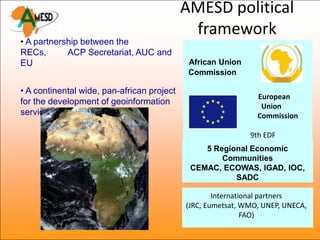
AMESD political
                                             framework
• A partnership between the
RECs,       ACP Secretariat, AUC and
EU                                           African Union
                                             Commission

• A continental wide, pan-african project
                                                               European
for the development of geoinformation                           Union
services                                                       Commission

                                                             9th EDF
                                                5 Regional Economic
                                                    Communities
                                             CEMAC, ECOWAS, IGAD, IOC,
                                                       SADC
                                                     + ACP Secretariat
                                                    International partners
                                            (JRC, Eumetsat, WMO, UNEP, UNECA,
                                                             FAO)
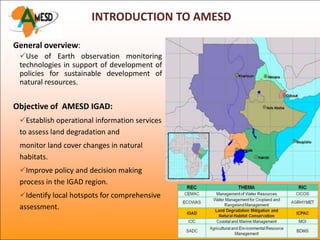
INTRODUCTION TO AMESD

General overview:
 Use of Earth observation monitoring
 technologies in support of development of
 policies for sustainable development of
 natural resources.


Objective of AMESD IGAD:
 Establish operational information services
 to assess land degradation and
 monitor land cover changes in natural
 habitats.
 Improve policy and decision making
 process in the IGAD region.
 Identify local hotspots for comprehensive
 assessment.
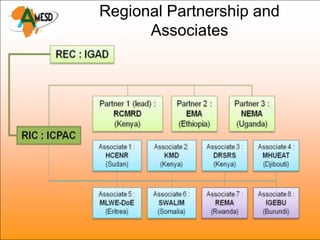
Regional Partnership and
      Associates
SCOPE

• Objective of Land Degradation Assessment
   Identify extent and severity of land degradation at the regional and national levels
   To identify local hotspots for comprehensive assessment.


• Land Degradation:                    Temporary or permanent reduction in the
 productive capacity of land to provide ecosystem goods and services (FAO, 2010)


• Expected products and outputs:
   Biannual Maps
   Bulletins at regional scale with focus on national products (depending on the
    number of seasons)
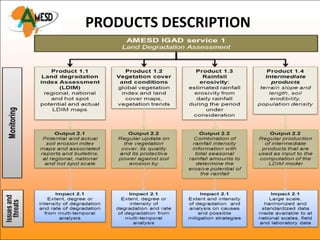
PRODUCTS DESCRIPTION
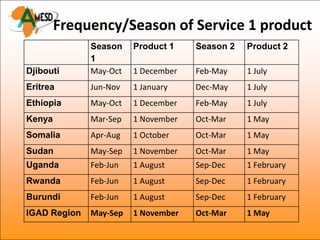
Frequency/Season of Service 1 product
              Season    Product 1    Season 2   Product 2
              1
Djibouti      May-Oct   1 December   Feb-May    1 July
Eritrea       Jun-Nov   1 January    Dec-May    1 July
Ethiopia      May-Oct   1 December   Feb-May    1 July
Kenya         Mar-Sep   1 November   Oct-Mar    1 May
Somalia       Apr-Aug   1 October    Oct-Mar    1 May
Sudan         May-Sep   1 November   Oct-Mar    1 May
Uganda        Feb-Jun   1 August     Sep-Dec    1 February
Rwanda        Feb-Jun   1 August     Sep-Dec    1 February
Burundi       Feb-Jun   1 August     Sep-Dec    1 February
IGAD Region   May-Sep   1 November   Oct-Mar    1 May
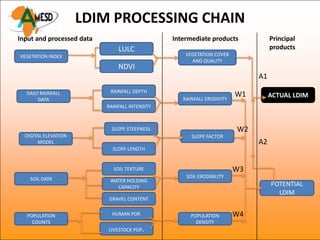
LDIM PROCESSING CHAIN
Input and processed data                        Intermediate products             Principal
                               LULC                                               products
VEGETATION INDEX                                    VEGETATION COVER
                                                      AND QUALITY
                               NDVI
                                                                             A1
                            RAINFALL DEPTH
  DAILY RAINFALL                                                        W1        ACTUAL LDIM
       DATA                                        RAINFALL EROSIVITY
                           RAINFALL INTENSITY


                             SLOPE STEEPNESS                            W2
  DIGITAL ELEVATION                                   SLOPE FACTOR
       MODEL                                                                 A2
                             SLOPE LENGTH


                             SOIL TEXTURE                               W3
    SOIL DATA                                       SOIL ERODIBILITY
                            WATER HOLDING
                              CAPACITY                                            POTENTIAL
                                                                                    LDIM
                            GRAVEL CONTENT


  POPULATION                 HUMAN POP.               POPULATION        W4
    COUNTS                                              DENSITY
                           LIVESTOCK POP.
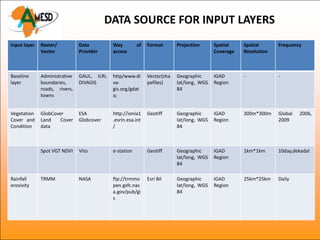
DATA SOURCE FOR INPUT LAYERS
Input layer   Raster/          Data          Way         of   Format       Projection      Spatial    Spatial      Frequency
              Vector           Provider      access                                        Coverage   Resolution


Baseline      Administrative   GAUL, ILRI,   http/www.di      Vector(sha   Geographic      IGAD       -            -
layer         boundaries,      DIVAGIS       va-              pefiles)     lat/long, WGS   Region
              roads, rivers,                 gis.org/gdat                  84
              towns                          a;


Vegetation    GlobCover        ESA           http://ionia1    Geotiff      Geographic      IGAD       300m*300m    Global   2006,
Cover and     Land    Cover    Globcover     .esrin.esa.int                lat/long, WGS   Region                  2009
Condition     data                           /                             84


              Spot VGT NDVI    Vito          e-station        Geotiff      Geographic      IGAD       1km*1km      10day,dekadal
                                                                           lat/long, WGS   Region
                                                                           84

Rainfall      TRMM             NASA          ftp://trmmo      Esri Bil     Geographic      IGAD       25km*25km    Daily
erosivity                                    pen.gsfc.nas                  lat/long, WGS   Region
                                             a.gov/pub/gi                  84
                                             s
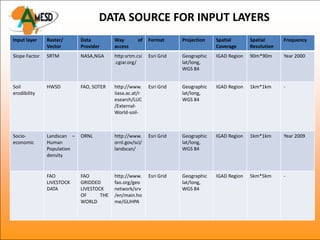
DATA SOURCE FOR INPUT LAYERS
Input layer    Raster/      Data          Way        of   Format      Projection   Spatial       Spatial      Frequency
               Vector       Provider      access                                   Coverage      Resolution
Slope Factor   SRTM         NASA,NGA      http:srtm.csi   Esri Grid   Geographic   IGAD Region   90m*90m      Year 2000
                                          .cgiar.org/                 lat/long,
                                                                      WGS 84


Soil           HWSD         FAO, SOTER    http://www.     Esri Grid   Geographic   IGAD Region   1km*1km      -
erodibility                               iiasa.ac.at/r               lat/long,
                                          esearch/LUC                 WGS 84
                                          /External-
                                          World-soil-


Socio-         Landscan –   ORNL          http://www.     Esri Grid   Geographic   IGAD Region   1km*1km      Year 2009
economic       Human                      ornl.gov/sci/               lat/long,
               Population                 landscan/                   WGS 84
               density


               FAO          FAO           http://www.     Esri Grid   Geographic   IGAD Region   5km*5km      -
               LIVESTOCK    GRIDDED       fao.org/geo                 lat/long,
               DATA         LIVESTOCK     network/srv                 WGS 84
                            OF      THE   /en/main.ho
                            WORLD         me/GLIHPA
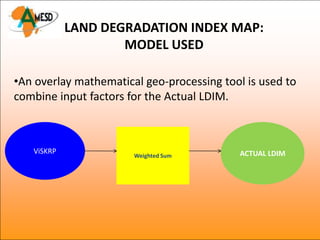
LAND DEGRADATION INDEX MAP:
                    MODEL USED

•An overlay mathematical geo-processing tool is used to
combine input factors for the Actual LDIM.


   ViSKRP                                   ACTUAL LDIM
                       Weighted Sum
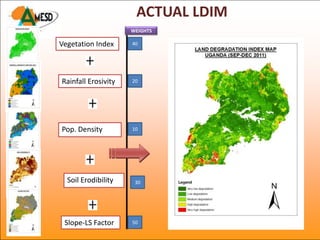
ACTUAL LDIM
                     WEIGHTS

Vegetation Index     40


Rainfall Erosivity   20


Pop. Density         10


  Soil Erodibility    30


 Slope-LS Factor     50
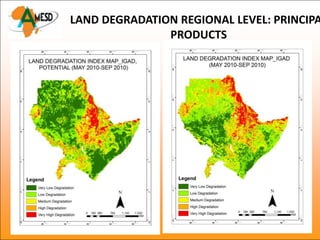
LAND DEGRADATION REGIONAL LEVEL: PRINCIPA
               PRODUCTS
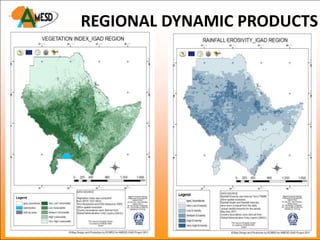
REGIONAL DYNAMIC PRODUCTS
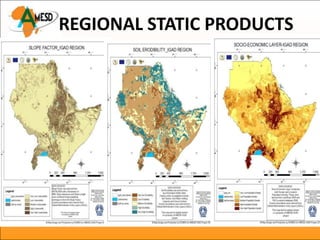
REGIONAL STATIC PRODUCTS
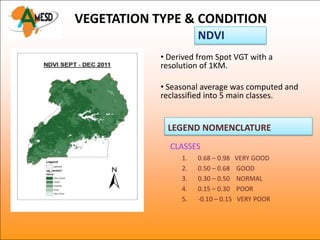
VEGETATION TYPE & CONDITION
                      NDVI
            • Derived from Spot VGT with a
            resolution of 1KM.

            • Seasonal average was computed and
            reclassified into 5 main classes.


             LEGEND NOMENCLATURE
              CLASSES
                 1.   0.68 – 0.98    VERY GOOD
                 2.   0.50 – 0.68    GOOD
                 3.   0.30 – 0.50    NORMAL
                 4.   0.15 – 0.30    POOR
                 5.   -0.10 – 0.15    VERY POOR
VEGETATION TYPE & CONDITION

           Land Use Land Cover
        Land use land cover class aggregation:
            1. Forest
            2. Agriculture:[ shrubs, bush land,
                  perennial crops]
            3. Grassland:[Annual crops, grassland
                  savanna, grassland]
            4. Woodland:[Woodland, woodland
                  savanna
            5. Bare Soils:[Bare soils, Bare rocks]
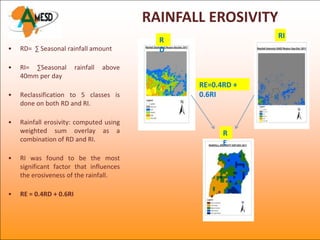
RAINFALL EROSIVITY
                                                                 RI
                                              R
•   RD= ∑ Seasonal rainfall amount            D

•   RI= ∑Seasonal        rainfall   above
    40mm per day
                                                   RE=0.4RD +
•   Reclassification to 5 classes is               0.6RI
    done on both RD and RI.

•   Rainfall erosivity: computed using
    weighted sum overlay as a                            R
    combination of RD and RI.
                                                         E
•   RI was found to be the most
    significant factor that influences
    the erosiveness of the rainfall.

•   RE = 0.4RD + 0.6RI
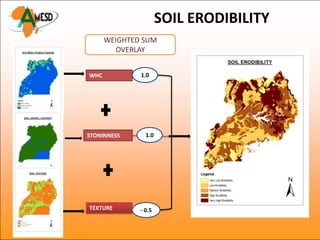
SOIL ERODIBILITY
      WEIGHTED SUM
        OVERLAY


WHC           1.0


STONINNESS      1.0


TEXTURE       - 0.5
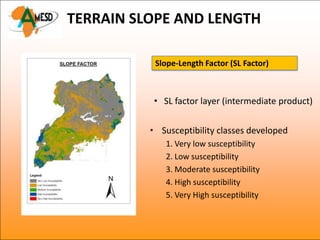
TERRAIN SLOPE AND LENGTH

           Slope-Length Factor (SL Factor)


           • SL factor layer (intermediate product)


          • Susceptibility classes developed
             1. Very low susceptibility
             2. Low susceptibility
             3. Moderate susceptibility
             4. High susceptibility
             5. Very High susceptibility
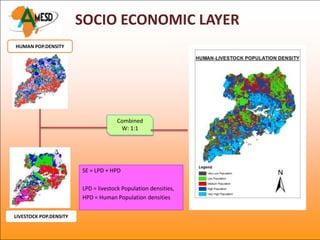
SOCIO ECONOMIC LAYER
HUMAN POP.DENSITY


                                     Combined
                                      W: 1:1


                        SE = LPD + HPD

                        LPD = livestock Population densities,
                        HPD = Human Population densities


LIVESTOCK POP.DENSITY
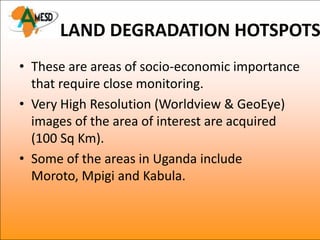
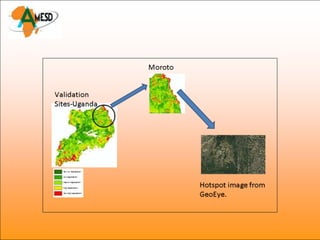
LAND DEGRADATION HOTSPOTS
• These are areas of socio-economic importance
  that require close monitoring.
• Very High Resolution (Worldview & GeoEye)
  images of the area of interest are acquired
  (100 Sq Km).
• Some of the areas in Uganda include
  Moroto, Mpigi and Kabula.
Conclusion
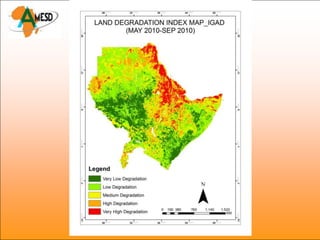
•   Land degradation index map of the IGAD region focuses on areas that are exposed to nat
    soil erosion. The importance of the slope, the soil sensitvity and the current state of the l
    cover observed by the satellite imagery are the most important factors of this assessmen
    takes into consideration also the highly density populated places and rainfall intensity
    factors potentially responsible for an increase of the land degradation. Most of the time
    land degradation generates pressure on cropped areas and as a result it can lead to f
    insecurity. This land degradation index map has helped warn about the possible food secu
    problms by giving an index of potential risk of agricultural disturbances on highly expo
    areas.
•   According to our assessment, 45% of the IGAD region (10 African countries) is affected
    considerable degradation. This means that the exposure to this phenomenon is well extend
    The most extended area of land degradation is located on the East part of IGAD region. A la
    part of coastal areas appears quite well affected due to steep slopes, highly sensitive soil
    poor vegetation cover. A bit further from the coastal areas, North and high plateaus of Ethio
    appear also well concerned by the land degradation. The land degradation is covering also
    important part of south-west of IGAD region. The eastern part of Kenya, around the rift va
    and Turkan Lake, the southern part of Uganda and almost all Rwanda and Burundi
    concerned phenomenon.
•   The western part of Sudan around Darfur area shows land degradation closely linked to
    topography. Despite of low population density, the dryness of this area can be put locally
    part of IGAD in a very critical situation. Finally, the less exposed part of IGAD region is loca
    in the south of Sudan and in south-east coastal area where the topography is almost flat. T
    assessment indicates the extent of land degradation in the IGAD region.
Thank You.


  Danke

  Merci

Muyambi Benda FORTUNATE "Land degradation assessment in the IGAD Region - Its extent and impact"

  • 1.
    Land Degradation Assessmentin the IGAD Region- Its Extent and Impact Muyambi Fortunate Natural Habitat Thematic Expert IGAD Climate Prediction and Applications Centre African Monitoring of Environment for Sustainable Development Email: fbenda@icpac.net
  • 2.
    AMESD political framework • A partnership between the RECs, ACP Secretariat, AUC and EU African Union Commission • A continental wide, pan-african project European for the development of geoinformation Union services Commission 9th EDF 5 Regional Economic Communities CEMAC, ECOWAS, IGAD, IOC, SADC + ACP Secretariat International partners (JRC, Eumetsat, WMO, UNEP, UNECA, FAO)
  • 3.
    INTRODUCTION TO AMESD Generaloverview: Use of Earth observation monitoring technologies in support of development of policies for sustainable development of natural resources. Objective of AMESD IGAD: Establish operational information services to assess land degradation and monitor land cover changes in natural habitats. Improve policy and decision making process in the IGAD region. Identify local hotspots for comprehensive assessment.
  • 4.
  • 5.
    SCOPE • Objective ofLand Degradation Assessment  Identify extent and severity of land degradation at the regional and national levels  To identify local hotspots for comprehensive assessment. • Land Degradation: Temporary or permanent reduction in the productive capacity of land to provide ecosystem goods and services (FAO, 2010) • Expected products and outputs:  Biannual Maps  Bulletins at regional scale with focus on national products (depending on the number of seasons)
  • 6.
  • 7.
    Frequency/Season of Service1 product Season Product 1 Season 2 Product 2 1 Djibouti May-Oct 1 December Feb-May 1 July Eritrea Jun-Nov 1 January Dec-May 1 July Ethiopia May-Oct 1 December Feb-May 1 July Kenya Mar-Sep 1 November Oct-Mar 1 May Somalia Apr-Aug 1 October Oct-Mar 1 May Sudan May-Sep 1 November Oct-Mar 1 May Uganda Feb-Jun 1 August Sep-Dec 1 February Rwanda Feb-Jun 1 August Sep-Dec 1 February Burundi Feb-Jun 1 August Sep-Dec 1 February IGAD Region May-Sep 1 November Oct-Mar 1 May
  • 8.
    LDIM PROCESSING CHAIN Inputand processed data Intermediate products Principal LULC products VEGETATION INDEX VEGETATION COVER AND QUALITY NDVI A1 RAINFALL DEPTH DAILY RAINFALL W1 ACTUAL LDIM DATA RAINFALL EROSIVITY RAINFALL INTENSITY SLOPE STEEPNESS W2 DIGITAL ELEVATION SLOPE FACTOR MODEL A2 SLOPE LENGTH SOIL TEXTURE W3 SOIL DATA SOIL ERODIBILITY WATER HOLDING CAPACITY POTENTIAL LDIM GRAVEL CONTENT POPULATION HUMAN POP. POPULATION W4 COUNTS DENSITY LIVESTOCK POP.
  • 9.
    DATA SOURCE FORINPUT LAYERS Input layer Raster/ Data Way of Format Projection Spatial Spatial Frequency Vector Provider access Coverage Resolution Baseline Administrative GAUL, ILRI, http/www.di Vector(sha Geographic IGAD - - layer boundaries, DIVAGIS va- pefiles) lat/long, WGS Region roads, rivers, gis.org/gdat 84 towns a; Vegetation GlobCover ESA http://ionia1 Geotiff Geographic IGAD 300m*300m Global 2006, Cover and Land Cover Globcover .esrin.esa.int lat/long, WGS Region 2009 Condition data / 84 Spot VGT NDVI Vito e-station Geotiff Geographic IGAD 1km*1km 10day,dekadal lat/long, WGS Region 84 Rainfall TRMM NASA ftp://trmmo Esri Bil Geographic IGAD 25km*25km Daily erosivity pen.gsfc.nas lat/long, WGS Region a.gov/pub/gi 84 s
  • 10.
    DATA SOURCE FORINPUT LAYERS Input layer Raster/ Data Way of Format Projection Spatial Spatial Frequency Vector Provider access Coverage Resolution Slope Factor SRTM NASA,NGA http:srtm.csi Esri Grid Geographic IGAD Region 90m*90m Year 2000 .cgiar.org/ lat/long, WGS 84 Soil HWSD FAO, SOTER http://www. Esri Grid Geographic IGAD Region 1km*1km - erodibility iiasa.ac.at/r lat/long, esearch/LUC WGS 84 /External- World-soil- Socio- Landscan – ORNL http://www. Esri Grid Geographic IGAD Region 1km*1km Year 2009 economic Human ornl.gov/sci/ lat/long, Population landscan/ WGS 84 density FAO FAO http://www. Esri Grid Geographic IGAD Region 5km*5km - LIVESTOCK GRIDDED fao.org/geo lat/long, DATA LIVESTOCK network/srv WGS 84 OF THE /en/main.ho WORLD me/GLIHPA
  • 11.
    LAND DEGRADATION INDEXMAP: MODEL USED •An overlay mathematical geo-processing tool is used to combine input factors for the Actual LDIM. ViSKRP ACTUAL LDIM Weighted Sum
  • 12.
    ACTUAL LDIM WEIGHTS Vegetation Index 40 Rainfall Erosivity 20 Pop. Density 10 Soil Erodibility 30 Slope-LS Factor 50
  • 13.
    LAND DEGRADATION REGIONALLEVEL: PRINCIPA PRODUCTS
  • 14.
  • 15.
  • 16.
    VEGETATION TYPE &CONDITION NDVI • Derived from Spot VGT with a resolution of 1KM. • Seasonal average was computed and reclassified into 5 main classes. LEGEND NOMENCLATURE CLASSES 1. 0.68 – 0.98 VERY GOOD 2. 0.50 – 0.68 GOOD 3. 0.30 – 0.50 NORMAL 4. 0.15 – 0.30 POOR 5. -0.10 – 0.15 VERY POOR
  • 17.
    VEGETATION TYPE &CONDITION Land Use Land Cover Land use land cover class aggregation: 1. Forest 2. Agriculture:[ shrubs, bush land, perennial crops] 3. Grassland:[Annual crops, grassland savanna, grassland] 4. Woodland:[Woodland, woodland savanna 5. Bare Soils:[Bare soils, Bare rocks]
  • 18.
    RAINFALL EROSIVITY RI R • RD= ∑ Seasonal rainfall amount D • RI= ∑Seasonal rainfall above 40mm per day RE=0.4RD + • Reclassification to 5 classes is 0.6RI done on both RD and RI. • Rainfall erosivity: computed using weighted sum overlay as a R combination of RD and RI. E • RI was found to be the most significant factor that influences the erosiveness of the rainfall. • RE = 0.4RD + 0.6RI
  • 19.
    SOIL ERODIBILITY WEIGHTED SUM OVERLAY WHC 1.0 STONINNESS 1.0 TEXTURE - 0.5
  • 20.
    TERRAIN SLOPE ANDLENGTH Slope-Length Factor (SL Factor) • SL factor layer (intermediate product) • Susceptibility classes developed 1. Very low susceptibility 2. Low susceptibility 3. Moderate susceptibility 4. High susceptibility 5. Very High susceptibility
  • 21.
    SOCIO ECONOMIC LAYER HUMANPOP.DENSITY Combined W: 1:1 SE = LPD + HPD LPD = livestock Population densities, HPD = Human Population densities LIVESTOCK POP.DENSITY
  • 22.
    LAND DEGRADATION HOTSPOTS •These are areas of socio-economic importance that require close monitoring. • Very High Resolution (Worldview & GeoEye) images of the area of interest are acquired (100 Sq Km). • Some of the areas in Uganda include Moroto, Mpigi and Kabula.
  • 25.
    Conclusion • Land degradation index map of the IGAD region focuses on areas that are exposed to nat soil erosion. The importance of the slope, the soil sensitvity and the current state of the l cover observed by the satellite imagery are the most important factors of this assessmen takes into consideration also the highly density populated places and rainfall intensity factors potentially responsible for an increase of the land degradation. Most of the time land degradation generates pressure on cropped areas and as a result it can lead to f insecurity. This land degradation index map has helped warn about the possible food secu problms by giving an index of potential risk of agricultural disturbances on highly expo areas. • According to our assessment, 45% of the IGAD region (10 African countries) is affected considerable degradation. This means that the exposure to this phenomenon is well extend The most extended area of land degradation is located on the East part of IGAD region. A la part of coastal areas appears quite well affected due to steep slopes, highly sensitive soil poor vegetation cover. A bit further from the coastal areas, North and high plateaus of Ethio appear also well concerned by the land degradation. The land degradation is covering also important part of south-west of IGAD region. The eastern part of Kenya, around the rift va and Turkan Lake, the southern part of Uganda and almost all Rwanda and Burundi concerned phenomenon. • The western part of Sudan around Darfur area shows land degradation closely linked to topography. Despite of low population density, the dryness of this area can be put locally part of IGAD in a very critical situation. Finally, the less exposed part of IGAD region is loca in the south of Sudan and in south-east coastal area where the topography is almost flat. T assessment indicates the extent of land degradation in the IGAD region.
  • 26.
    Thank You. Danke Merci

Editor's Notes