FONDAZIONE PER IL CLIMA E LA SOSTENIBILITA’


                              Spatial time series breakpoint and coherency analysis of
                                 climate-vegetation relationship in eastern Africa
                               Crisci A.1, Grasso V. 1,Capecchi V. 1,Genesio L.1, Bacci M.1, Tarchiani V.1,Di Vecchia A.1 and Vignaroli P.2
                                         1 National Research Council of Italy - Istitute of Biometeorology (CNR-IBIMET) ; 2 Climate and Sustainability Foundation (FCS)


                                                  Introduction                                                                                                         Results
        Food security in East Africa region essentially depends on the                                       Focusing on Ethiopia country, where agriculture sector accounts for
                                                                                                             47% of the GDP, provides 85% of employment and 90% of foreign
        stability of rain-fed crops farming, which renders its society
                                                                                                             currency earning, some preliminary results obtained using this
        vulnerable to climatic fluctuations. These ones in Africa are                                        methodology are shown.
        most widely and directly related to rainfall. The CPSZ2 project is                                                 Legend

        an initiative of Joint Research Centre of European Union to                                                             Eth_g2

                                                                                                                           Time Series Analysis


        upgrade ad modernize the Crop Production System Zones                                                              Priority MUs
                                                                                                                                No changes


        Database of the IGAD Region (CPSZ). The CPSZ database,                                                                  Low
                                                                                                                                Medium


        realized by FAO and co-funded by the Italian Cooperation is a
                                                                                                                                High


        unique information system for the agricultural monitoring and
        early warning activities on the seven countries of the Horn of
        Africa: Djibouti, Eritrea, Ethiopia, Kenya, Sudan, Somalia and
        Uganda.


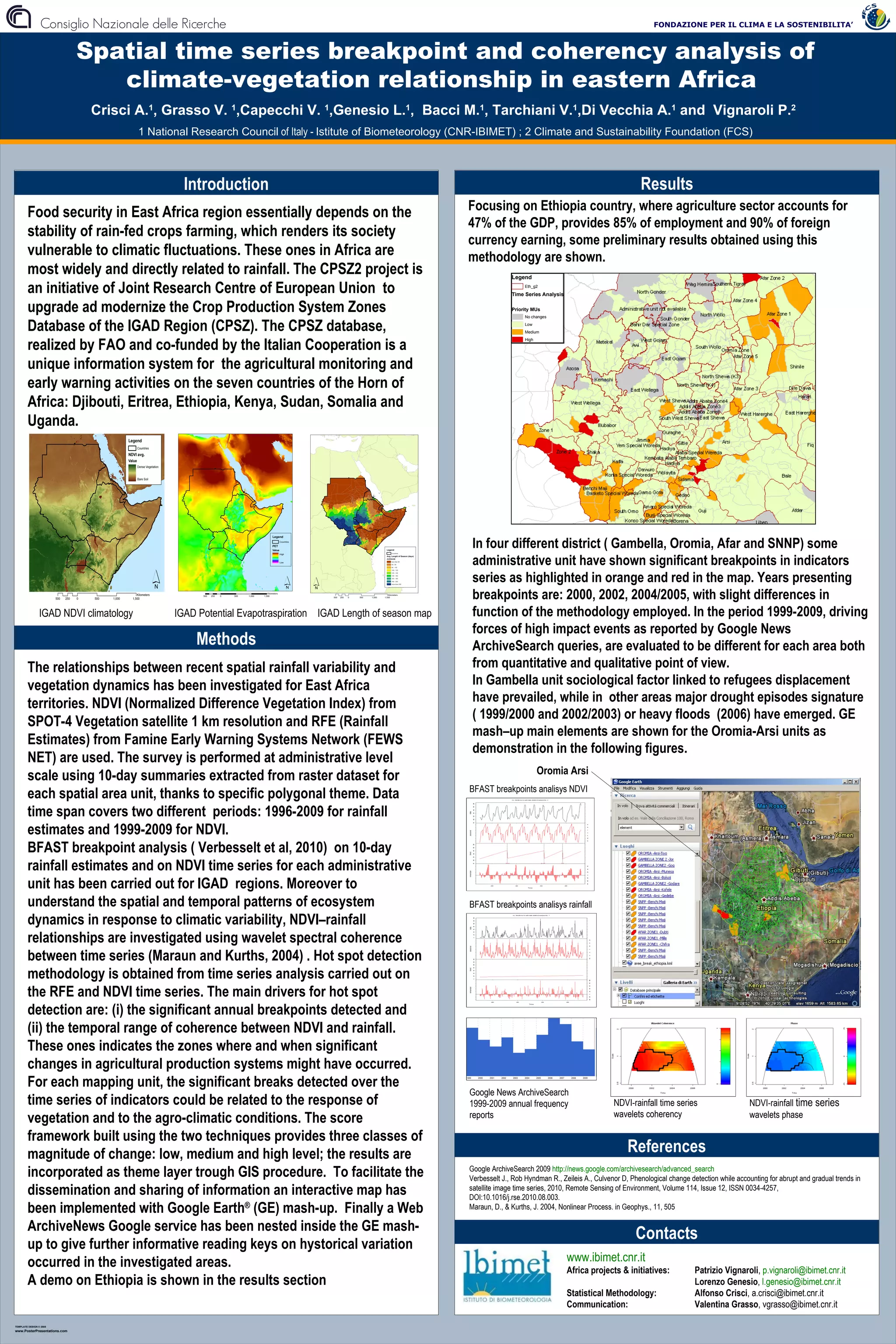
                                                                                                              In four different district ( Gambella, Oromia, Afar and SNNP) some
                                                                                                              administrative unit have shown significant breakpoints in indicators
                                                                                                              series as highlighted in orange and red in the map. Years presenting
                                                                                                              breakpoints are: 2000, 2002, 2004/2005, with slight differences in
                 IGAD NDVI climatology          IGAD Potential Evapotraspiration IGAD Length of season map    function of the methodology employed. In the period 1999-2009, driving
                                                                                                              forces of high impact events as reported by Google News
                                                    Methods                                                   ArchiveSearch queries, are evaluated to be different for each area both
        The relationships between recent spatial rainfall variability and                                     from quantitative and qualitative point of view.
        vegetation dynamics has been investigated for East Africa                                             In Gambella unit sociological factor linked to refugees displacement
        territories. NDVI (Normalized Difference Vegetation Index) from                                       have prevailed, while in other areas major drought episodes signature
                                                                                                              ( 1999/2000 and 2002/2003) or heavy floods (2006) have emerged. GE
        SPOT-4 Vegetation satellite 1 km resolution and RFE (Rainfall
                                                                                                              mash–up main elements are shown for the Oromia-Arsi units as
        Estimates) from Famine Early Warning Systems Network (FEWS
                                                                                                              demonstration in the following figures.
        NET) are used. The survey is performed at administrative level
                                                                                                                                       Oromia Arsi
        scale using 10-day summaries extracted from raster dataset for
                                                                                                             BFAST breakpoints analisys NDVI
        each spatial area unit, thanks to specific polygonal theme. Data
        time span covers two different periods: 1996-2009 for rainfall
        estimates and 1999-2009 for NDVI.
        BFAST breakpoint analysis ( Verbesselt et al, 2010) on 10-day
        rainfall estimates and on NDVI time series for each administrative
        unit has been carried out for IGAD regions. Moreover to
        understand the spatial and temporal patterns of ecosystem                                            BFAST breakpoints analisys rainfall
        dynamics in response to climatic variability, NDVI–rainfall
        relationships are investigated using wavelet spectral coherence
        between time series (Maraun and Kurths, 2004) . Hot spot detection
        methodology is obtained from time series analysis carried out on
        the RFE and NDVI time series. The main drivers for hot spot
        detection are: (i) the significant annual breakpoints detected and
        (ii) the temporal range of coherence between NDVI and rainfall.
        These ones indicates the zones where and when significant
        changes in agricultural production systems might have occurred.
        For each mapping unit, the significant breaks detected over the
                                                                                                             Google News ArchiveSearch
        time series of indicators could be related to the response of                                        1999-2009 annual frequency                        NDVI-rainfall time series                    NDVI-rainfall time series
                                                                                                                                                               wavelets coherency
        vegetation and to the agro-climatic conditions. The score                                            reports                                                                                        wavelets phase

        framework built using the two techniques provides three classes of
        magnitude of change: low, medium and high level; the results are                                                                                           References
        incorporated as theme layer trough GIS procedure. To facilitate the                                  Google ArchiveSearch 2009 http://news.google.com/archivesearch/advanced_search
                                                                                                             Verbesselt J., Rob Hyndman R., Zeileis A., Culvenor D, Phenological change detection while accounting for abrupt and gradual trends in
        dissemination and sharing of information an interactive map has                                      satellite image time series, 2010, Remote Sensing of Environment, Volume 114, Issue 12, ISSN 0034-4257,
                                                                                                             DOI:10.1016/j.rse.2010.08.003.
        been implemented with Google Earth® (GE) mash-up. Finally a Web                                      Maraun, D., & Kurths, J. 2004, Nonlinear Process. in Geophys., 11, 505

        ArchiveNews Google service has been nested inside the GE mash-
                                                                                                                                                                      Contacts
        up to give further informative reading keys on hystorical variation
        occurred in the investigated areas.                                                                                                       www.ibimet.cnr.it
                                                                                                                                                  Africa projects & initiatives:          Patrizio Vignaroli, p.vignaroli@ibimet.cnr.it
        A demo on Ethiopia is shown in the results section                                                                                                                                Lorenzo Genesio, l.genesio@ibimet.cnr.it
                                                                                                                                                  Statistical Methodology:                Alfonso Crisci, a.crisci@ibimet.cnr.it
                                                                                                                                                  Communication:                          Valentina Grasso, vgrasso@ibimet.cnr.it

TEMPLATE DESIGN © 2008

www.PosterPresentations.com

Spatial time series breakpoint and coherency analisys of climate-vegetation relationship in eastern Africa

  • 1.
    FONDAZIONE PER ILCLIMA E LA SOSTENIBILITA’ Spatial time series breakpoint and coherency analysis of climate-vegetation relationship in eastern Africa Crisci A.1, Grasso V. 1,Capecchi V. 1,Genesio L.1, Bacci M.1, Tarchiani V.1,Di Vecchia A.1 and Vignaroli P.2 1 National Research Council of Italy - Istitute of Biometeorology (CNR-IBIMET) ; 2 Climate and Sustainability Foundation (FCS) Introduction Results Food security in East Africa region essentially depends on the Focusing on Ethiopia country, where agriculture sector accounts for 47% of the GDP, provides 85% of employment and 90% of foreign stability of rain-fed crops farming, which renders its society currency earning, some preliminary results obtained using this vulnerable to climatic fluctuations. These ones in Africa are methodology are shown. most widely and directly related to rainfall. The CPSZ2 project is Legend an initiative of Joint Research Centre of European Union to Eth_g2 Time Series Analysis upgrade ad modernize the Crop Production System Zones Priority MUs No changes Database of the IGAD Region (CPSZ). The CPSZ database, Low Medium realized by FAO and co-funded by the Italian Cooperation is a High unique information system for the agricultural monitoring and early warning activities on the seven countries of the Horn of Africa: Djibouti, Eritrea, Ethiopia, Kenya, Sudan, Somalia and Uganda. In four different district ( Gambella, Oromia, Afar and SNNP) some administrative unit have shown significant breakpoints in indicators series as highlighted in orange and red in the map. Years presenting breakpoints are: 2000, 2002, 2004/2005, with slight differences in IGAD NDVI climatology IGAD Potential Evapotraspiration IGAD Length of season map function of the methodology employed. In the period 1999-2009, driving forces of high impact events as reported by Google News Methods ArchiveSearch queries, are evaluated to be different for each area both The relationships between recent spatial rainfall variability and from quantitative and qualitative point of view. vegetation dynamics has been investigated for East Africa In Gambella unit sociological factor linked to refugees displacement territories. NDVI (Normalized Difference Vegetation Index) from have prevailed, while in other areas major drought episodes signature ( 1999/2000 and 2002/2003) or heavy floods (2006) have emerged. GE SPOT-4 Vegetation satellite 1 km resolution and RFE (Rainfall mash–up main elements are shown for the Oromia-Arsi units as Estimates) from Famine Early Warning Systems Network (FEWS demonstration in the following figures. NET) are used. The survey is performed at administrative level Oromia Arsi scale using 10-day summaries extracted from raster dataset for BFAST breakpoints analisys NDVI each spatial area unit, thanks to specific polygonal theme. Data time span covers two different periods: 1996-2009 for rainfall estimates and 1999-2009 for NDVI. BFAST breakpoint analysis ( Verbesselt et al, 2010) on 10-day rainfall estimates and on NDVI time series for each administrative unit has been carried out for IGAD regions. Moreover to understand the spatial and temporal patterns of ecosystem BFAST breakpoints analisys rainfall dynamics in response to climatic variability, NDVI–rainfall relationships are investigated using wavelet spectral coherence between time series (Maraun and Kurths, 2004) . Hot spot detection methodology is obtained from time series analysis carried out on the RFE and NDVI time series. The main drivers for hot spot detection are: (i) the significant annual breakpoints detected and (ii) the temporal range of coherence between NDVI and rainfall. These ones indicates the zones where and when significant changes in agricultural production systems might have occurred. For each mapping unit, the significant breaks detected over the Google News ArchiveSearch time series of indicators could be related to the response of 1999-2009 annual frequency NDVI-rainfall time series NDVI-rainfall time series wavelets coherency vegetation and to the agro-climatic conditions. The score reports wavelets phase framework built using the two techniques provides three classes of magnitude of change: low, medium and high level; the results are References incorporated as theme layer trough GIS procedure. To facilitate the Google ArchiveSearch 2009 http://news.google.com/archivesearch/advanced_search Verbesselt J., Rob Hyndman R., Zeileis A., Culvenor D, Phenological change detection while accounting for abrupt and gradual trends in dissemination and sharing of information an interactive map has satellite image time series, 2010, Remote Sensing of Environment, Volume 114, Issue 12, ISSN 0034-4257, DOI:10.1016/j.rse.2010.08.003. been implemented with Google Earth® (GE) mash-up. Finally a Web Maraun, D., & Kurths, J. 2004, Nonlinear Process. in Geophys., 11, 505 ArchiveNews Google service has been nested inside the GE mash- Contacts up to give further informative reading keys on hystorical variation occurred in the investigated areas. www.ibimet.cnr.it Africa projects & initiatives: Patrizio Vignaroli, p.vignaroli@ibimet.cnr.it A demo on Ethiopia is shown in the results section Lorenzo Genesio, l.genesio@ibimet.cnr.it Statistical Methodology: Alfonso Crisci, a.crisci@ibimet.cnr.it Communication: Valentina Grasso, vgrasso@ibimet.cnr.it TEMPLATE DESIGN © 2008 www.PosterPresentations.com