Figures are curtsy of 3M
LCD DISPLAY
TECHNOLOGY
Program
Figures are curtsy of 3M
Digital Images and Pixels
• A digital image is a binary (digital)
representation of a two-dimensional pictorial
data.
• Digital images may have a raster or vector
representation.
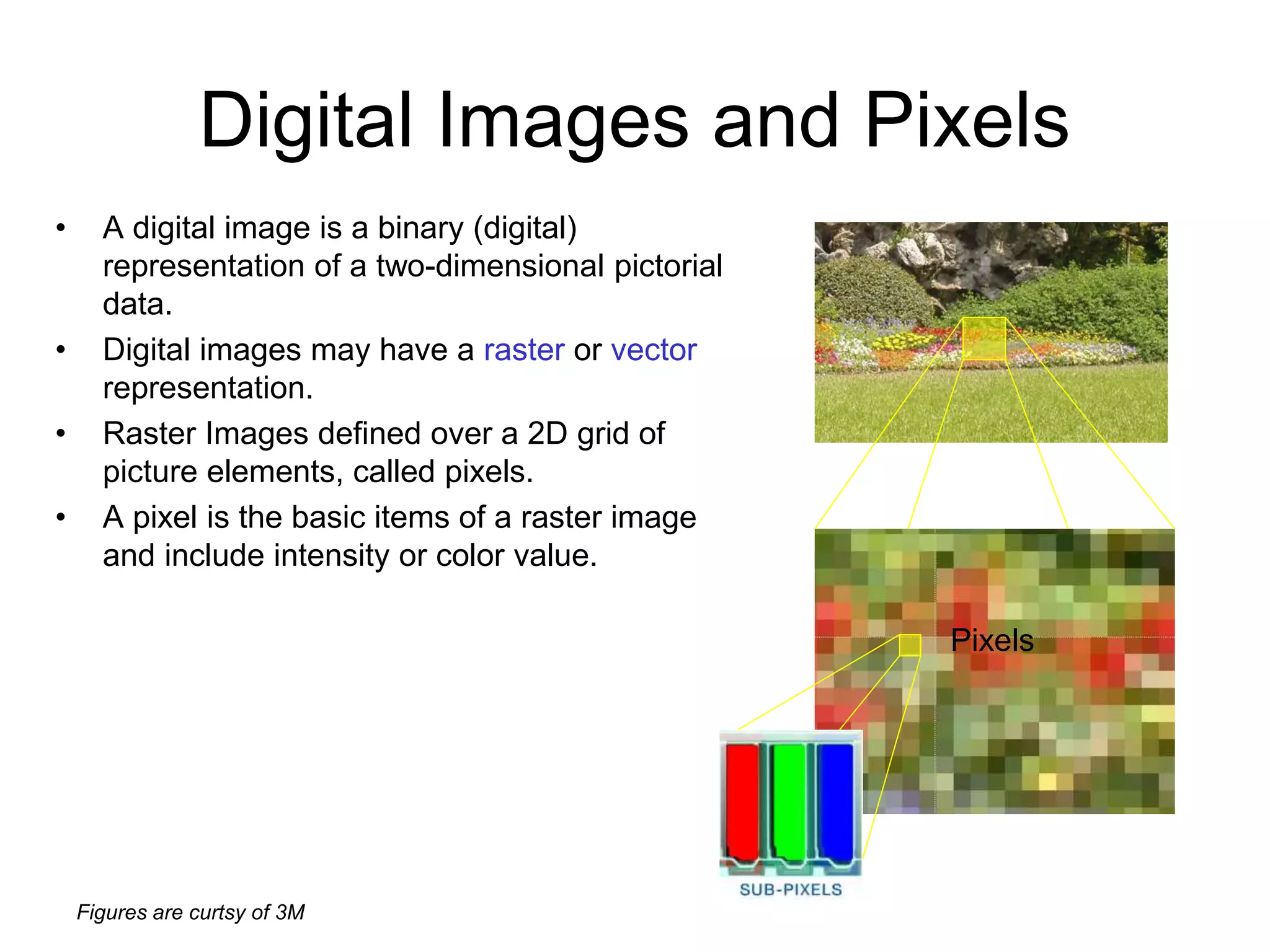
• Raster Images defined over a 2D grid of
picture elements, called pixels.
• A pixel is the basic items of a raster image
and include intensity or color value.
Pixels
Figures are curtsy of 3M
LCD (Liquid Crystal Display)
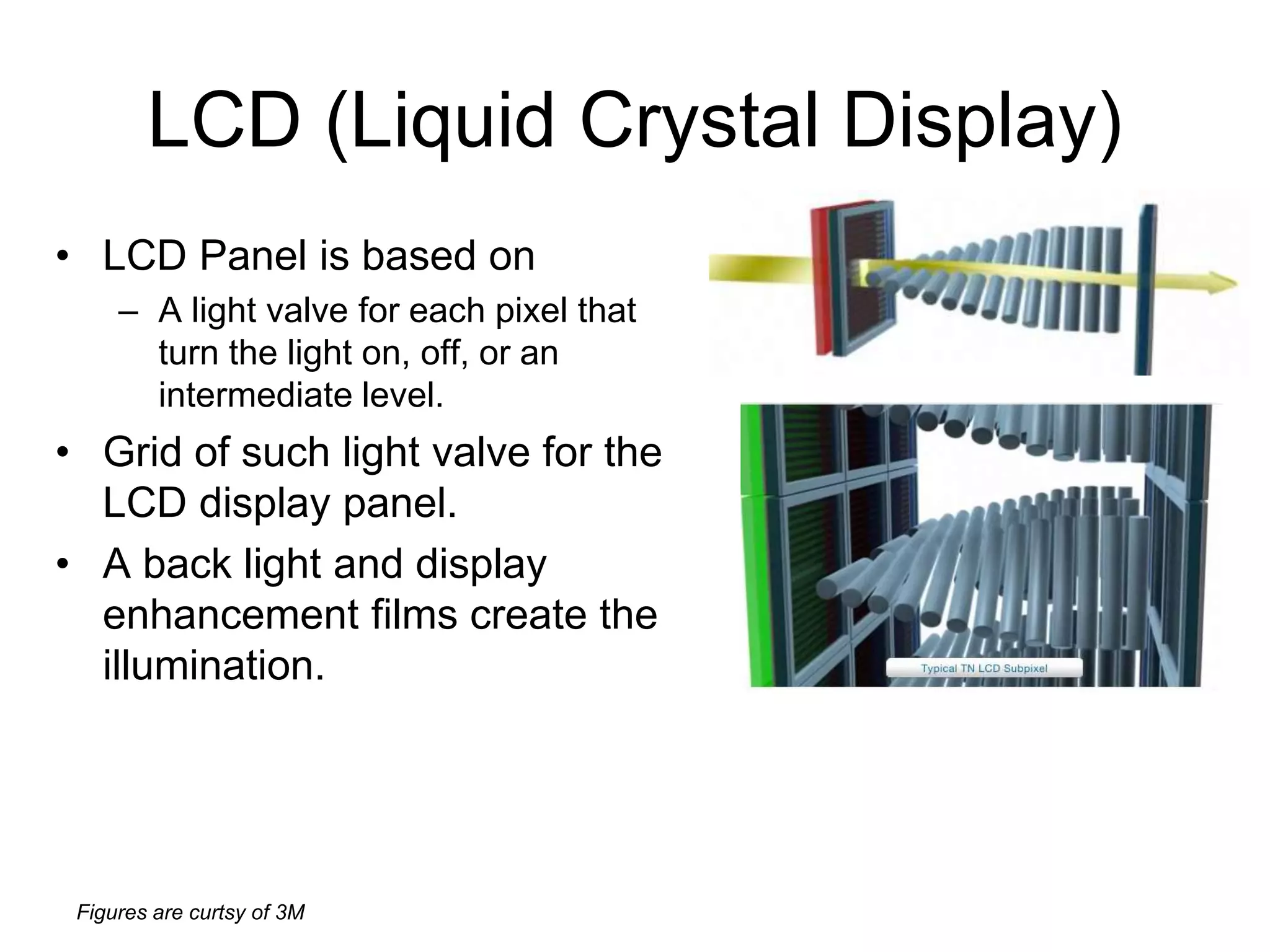
• LCD Panel is based on
– A light valve for each pixel that
turn the light on, off, or an
intermediate level.
• Grid of such light valve for the
LCD display panel.
• A back light and display
enhancement films create the
illumination.
Figures are curtsy of 3M
LCD-Display
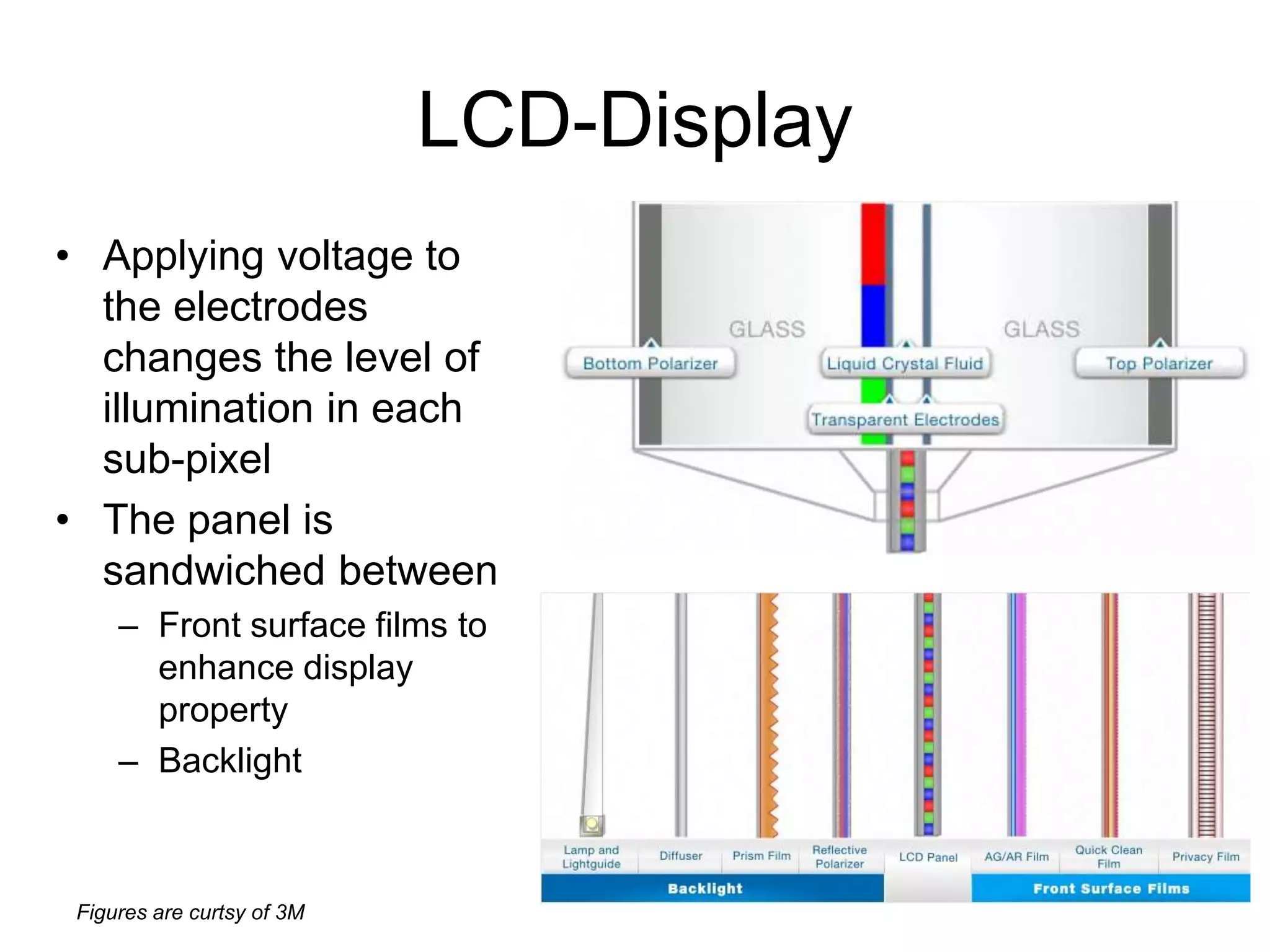
• Applying voltage to
the electrodes
changes the level of
illumination in each
sub-pixel
• The panel is
sandwiched between
– Front surface films to
enhance display
property
– Backlight
Figures are curtsy of 3M
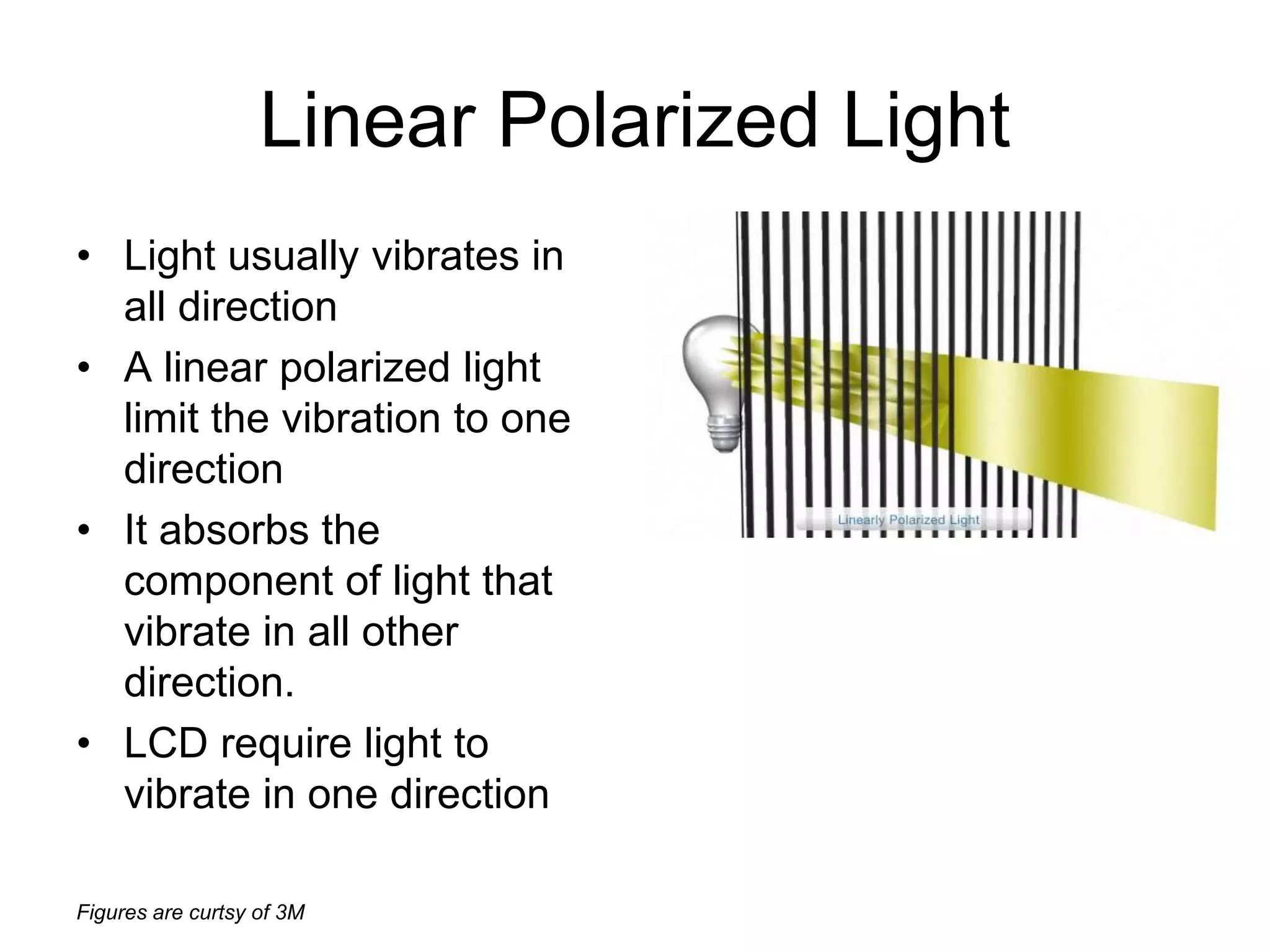
Linear Polarized Light
• Light usually vibrates in
all direction
• A linear polarized light
limit the vibration to one
direction
• It absorbs the
component of light that
vibrate in all other
direction.
• LCD require light to
vibrate in one direction
Figures are curtsy of 3M
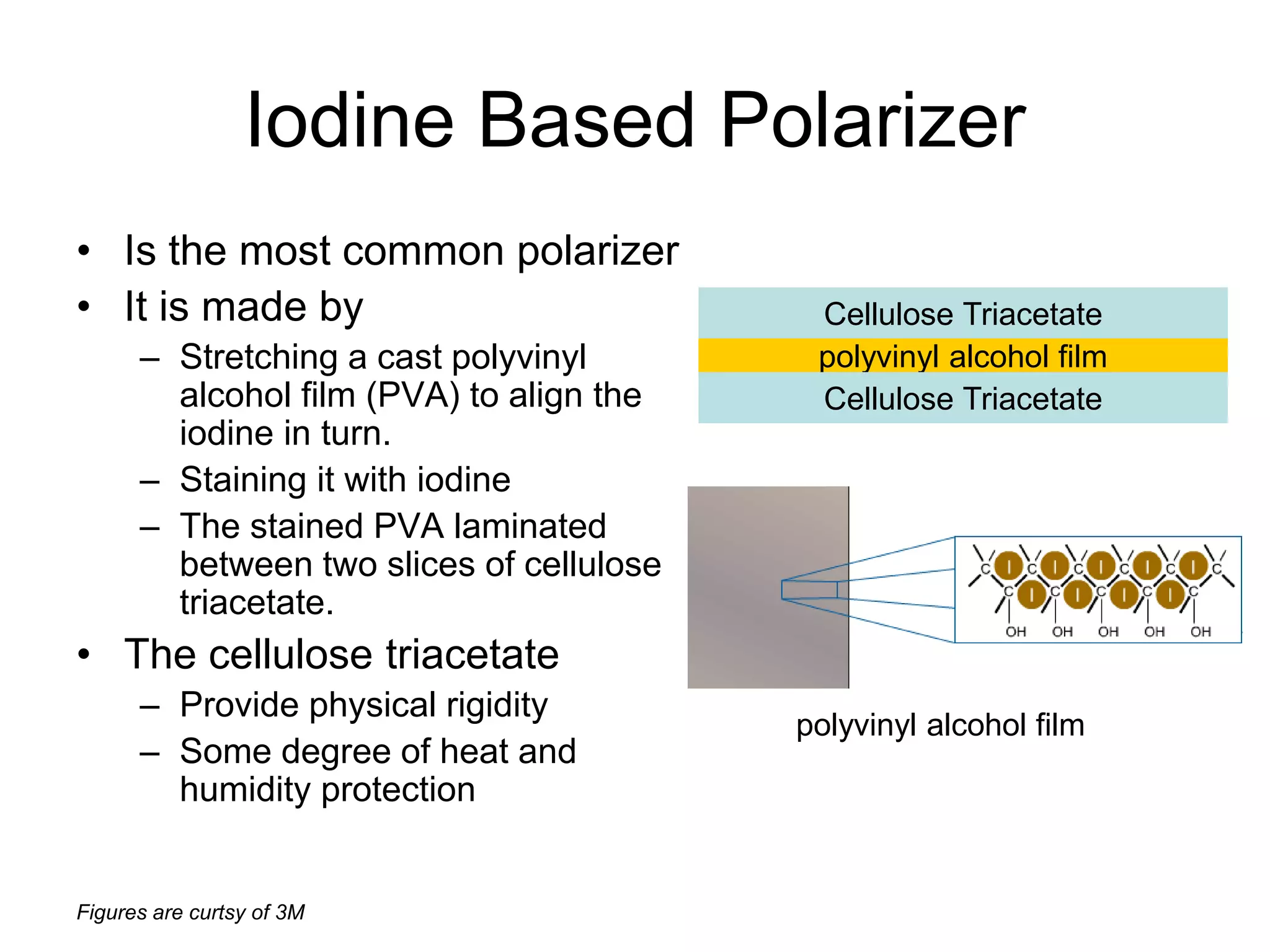
Iodine Based Polarizer
• Is the most common polarizer
• It is made by
– Stretching a cast polyvinyl
alcohol film (PVA) to align the
iodine in turn.
– Staining it with iodine
– The stained PVA laminated
between two slices of cellulose
triacetate.
• The cellulose triacetate
– Provide physical rigidity
– Some degree of heat and
humidity protection
polyvinyl alcohol film
Cellulose Triacetate
polyvinyl alcohol film
Figures are curtsy of 3M
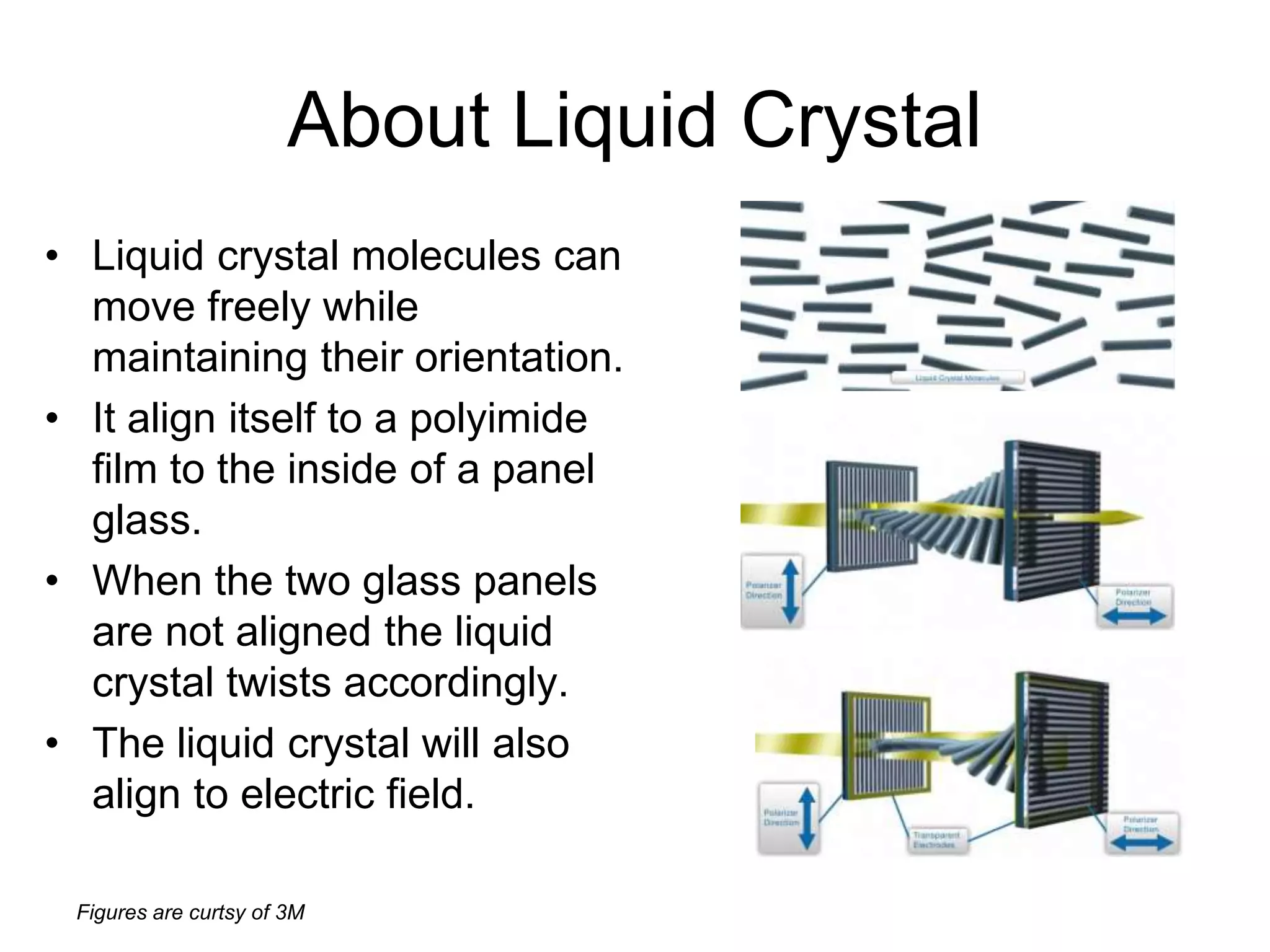
About Liquid Crystal
• Liquid crystal molecules can
move freely while
maintaining their orientation.
• It align itself to a polyimide
film to the inside of a panel
glass.
• When the two glass panels
are not aligned the liquid
crystal twists accordingly.
• The liquid crystal will also
align to electric field.
Figures are curtsy of 3M
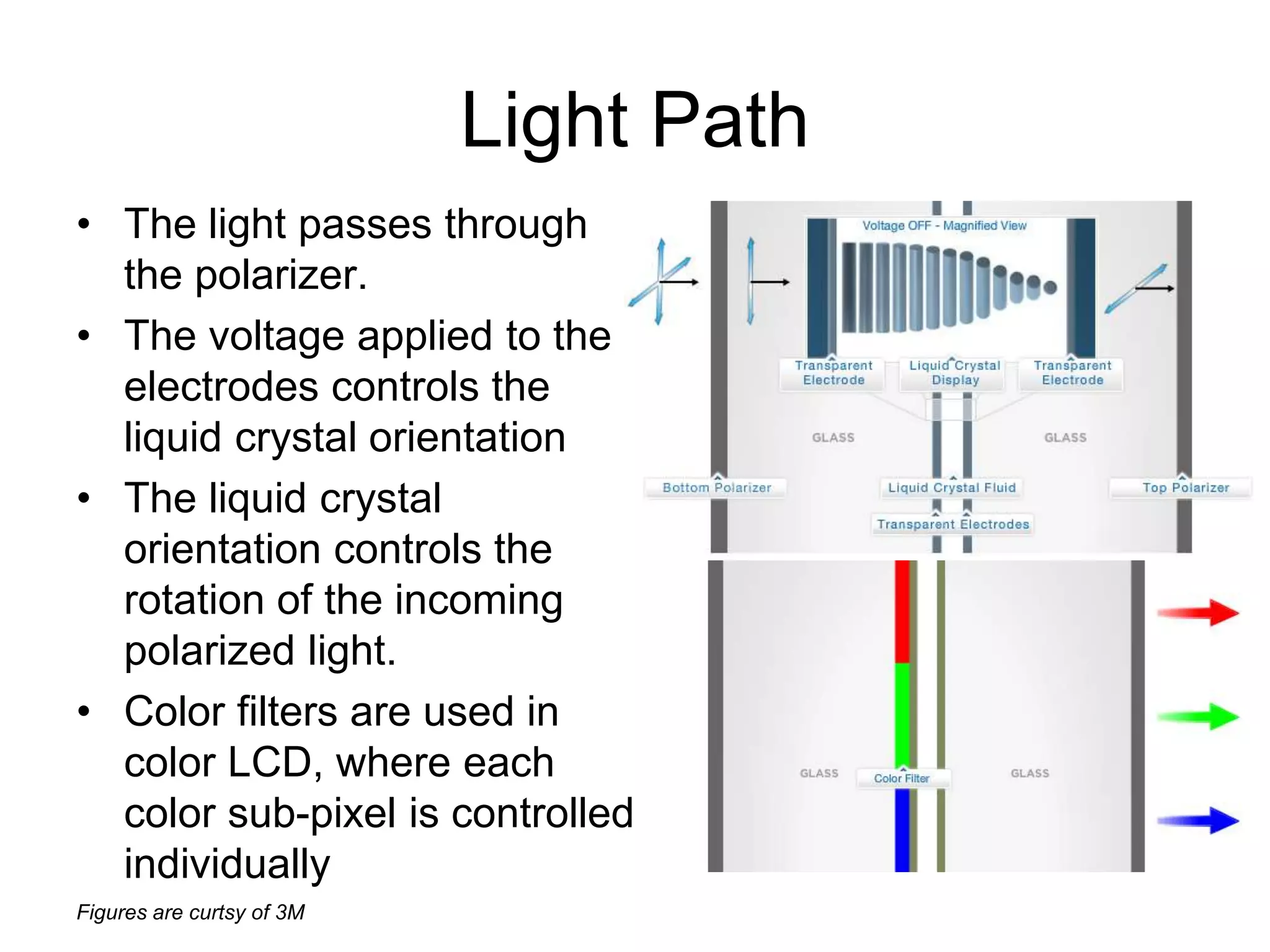
Light Path
• The light passes through
the polarizer.
• The voltage applied to the
electrodes controls the
liquid crystal orientation
• The liquid crystal
orientation controls the
rotation of the incoming
polarized light.
• Color filters are used in
color LCD, where each
color sub-pixel is controlled
individually
Figures are curtsy of 3M
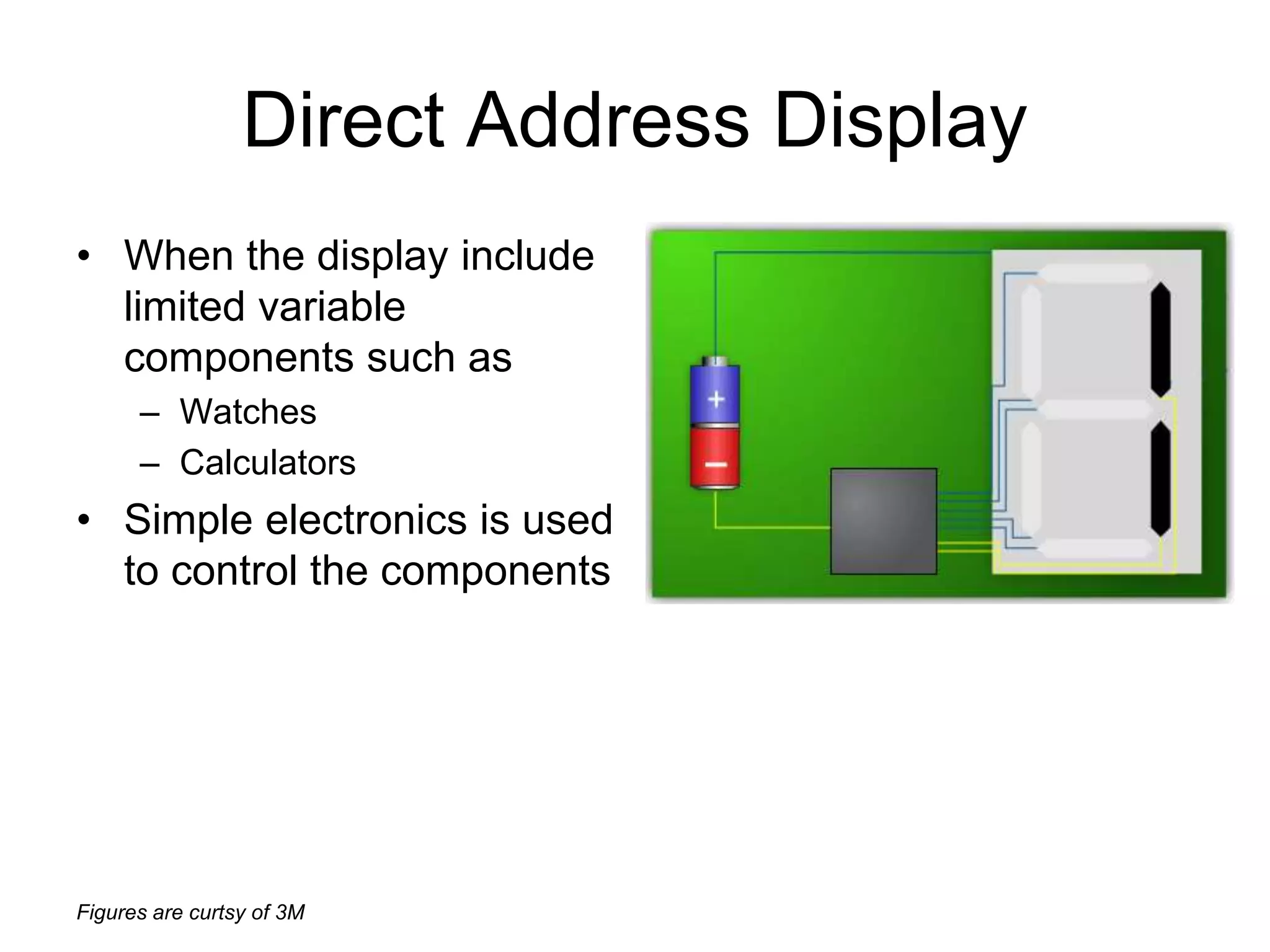
Direct Address Display
• When the display include
limited variable
components such as
– Watches
– Calculators
• Simple electronics is used
to control the components
Figures are curtsy of 3M
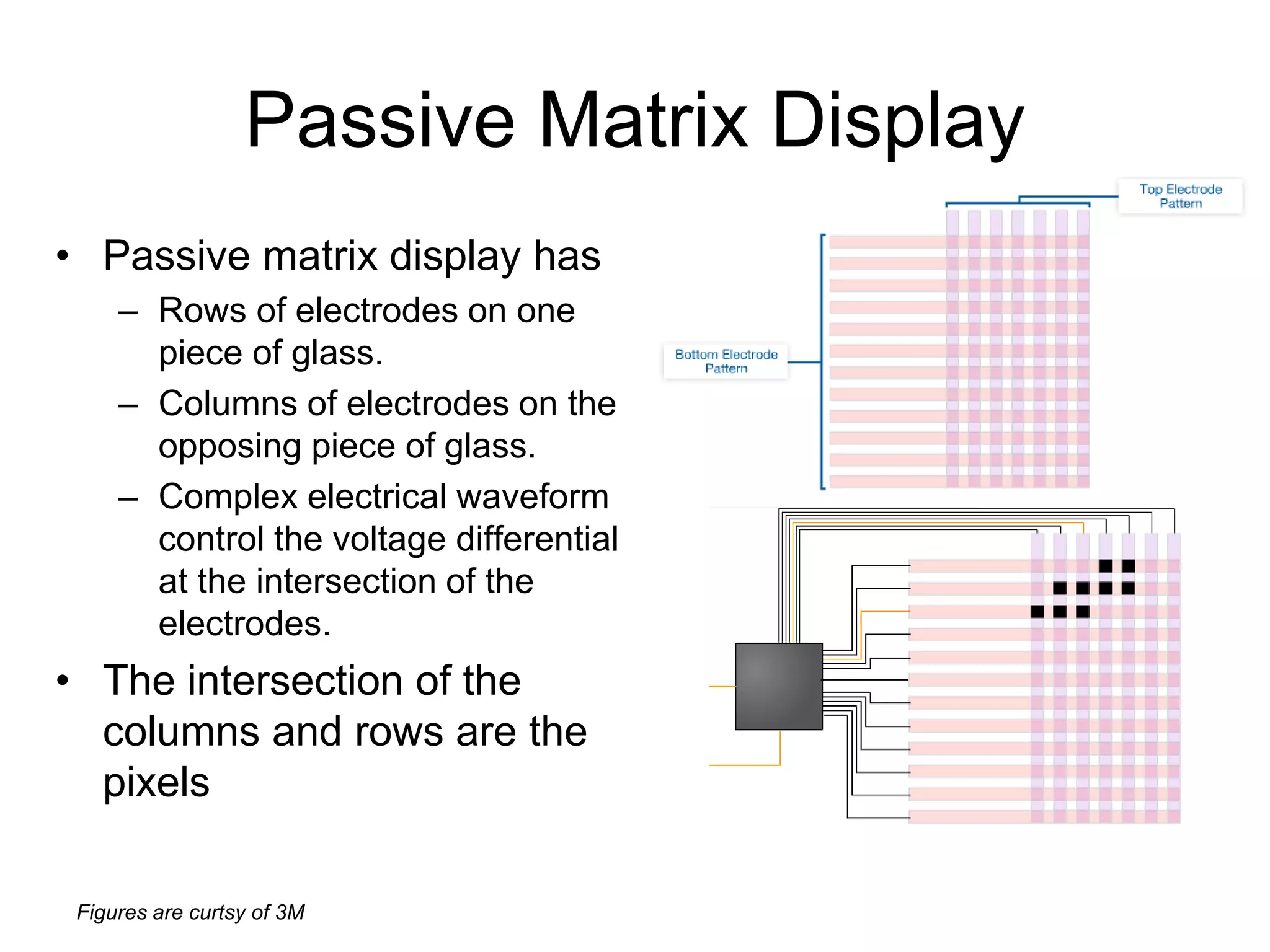
Passive Matrix Display
• Passive matrix display has
– Rows of electrodes on one
piece of glass.
– Columns of electrodes on the
opposing piece of glass.
– Complex electrical waveform
control the voltage differential
at the intersection of the
electrodes.
• The intersection of the
columns and rows are the
pixels
Figures are curtsy of 3M
Passive Matrix Display
-disadvantages-
• As more rows and columns are added the range of the
allowed voltage is reduced.
– At high range adjacent channels interferes
– Range limit reduces contrast
– Limit the types of useful liquid crystal.
• It is usually limited to about 50 rows
• Twisted nematic (TN) Display work best with large
voltage variation.
– It can not be used in Passive Matrix Display
Figures are curtsy of 3M
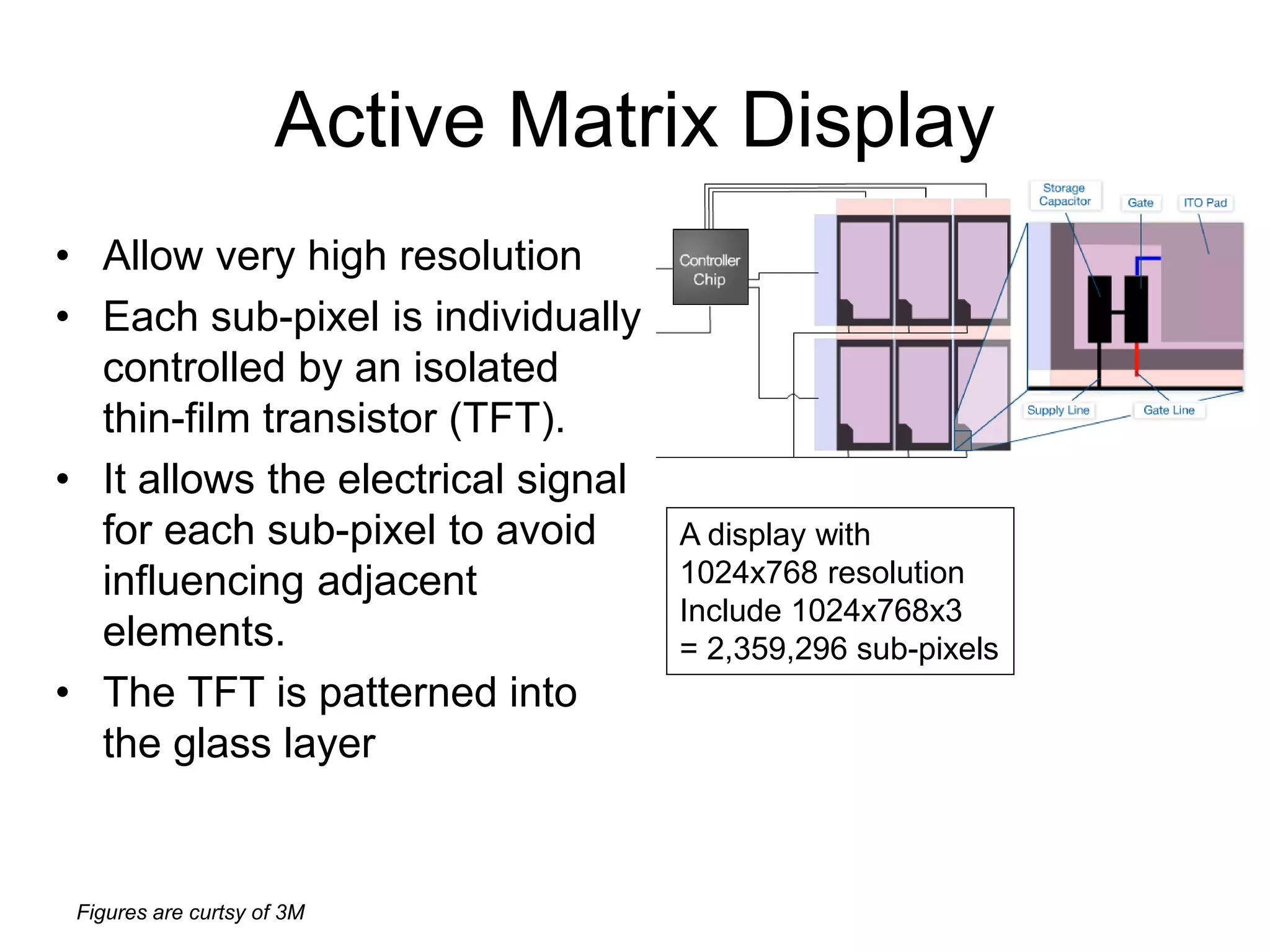
Active Matrix Display
• Allow very high resolution
• Each sub-pixel is individually
controlled by an isolated
thin-film transistor (TFT).
• It allows the electrical signal
for each sub-pixel to avoid
influencing adjacent
elements.
• The TFT is patterned into
the glass layer
A display with
1024x768 resolution
Include 1024x768x3
= 2,359,296 sub-pixels
Figures are curtsy of 3M
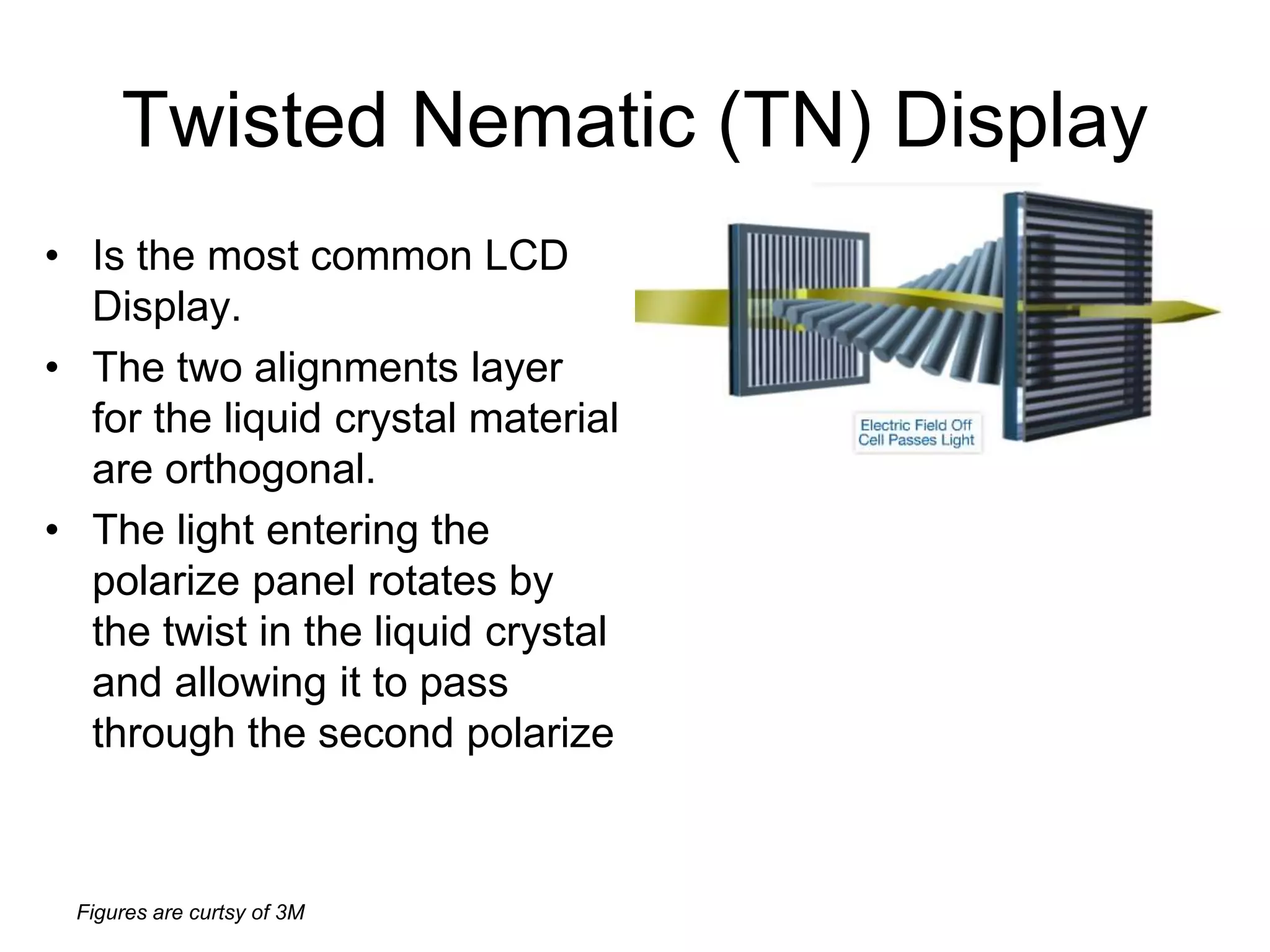
Twisted Nematic (TN) Display
• Is the most common LCD
Display.
• The two alignments layer
for the liquid crystal material
are orthogonal.
• The light entering the
polarize panel rotates by
the twist in the liquid crystal
and allowing it to pass
through the second polarize
Figures are curtsy of 3M
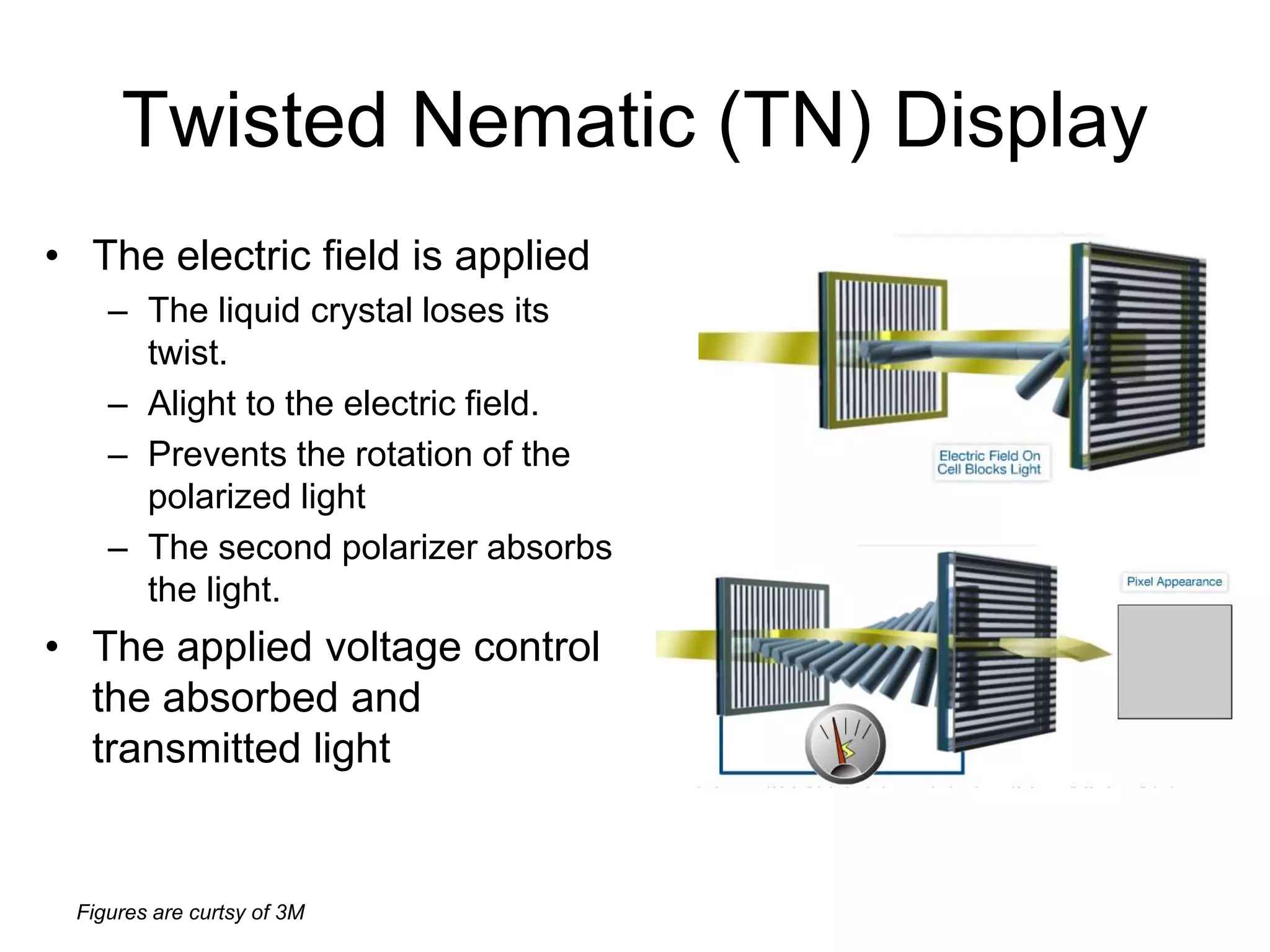
Twisted Nematic (TN) Display
• The electric field is applied
– The liquid crystal loses its
twist.
– Alight to the electric field.
– Prevents the rotation of the
polarized light
– The second polarizer absorbs
the light.
• The applied voltage control
the absorbed and
transmitted light
Figures are curtsy of 3M
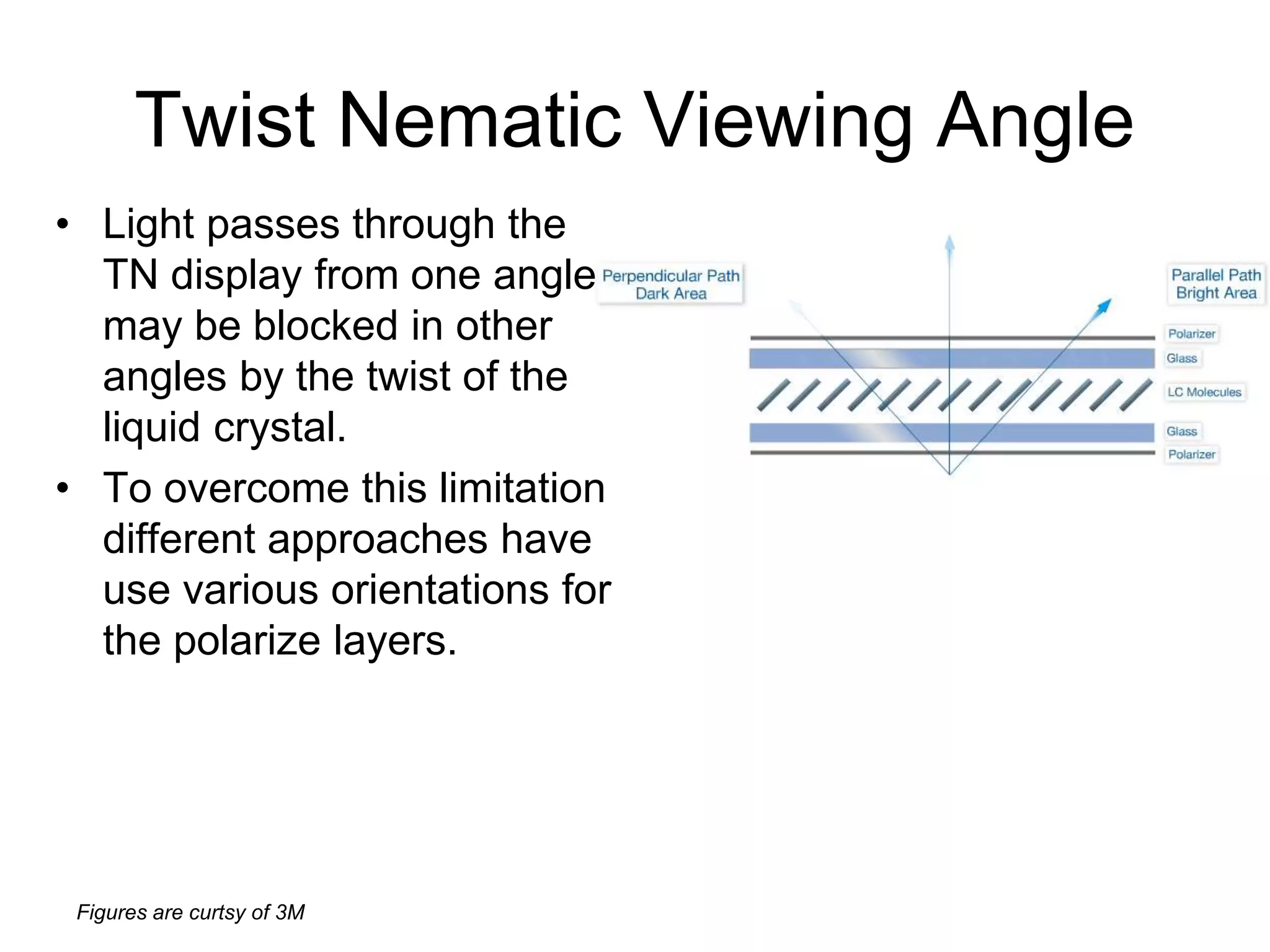
Twist Nematic Viewing Angle
• Light passes through the
TN display from one angle
may be blocked in other
angles by the twist of the
liquid crystal.
• To overcome this limitation
different approaches have
use various orientations for
the polarize layers.
Figures are curtsy of 3M
Front Surface Films
• Hard-coat Films
• Quick Clean Films
• Anti-Glare Films
• Anti-Reflection Films
• Privacy Films
Figures are curtsy of 3M
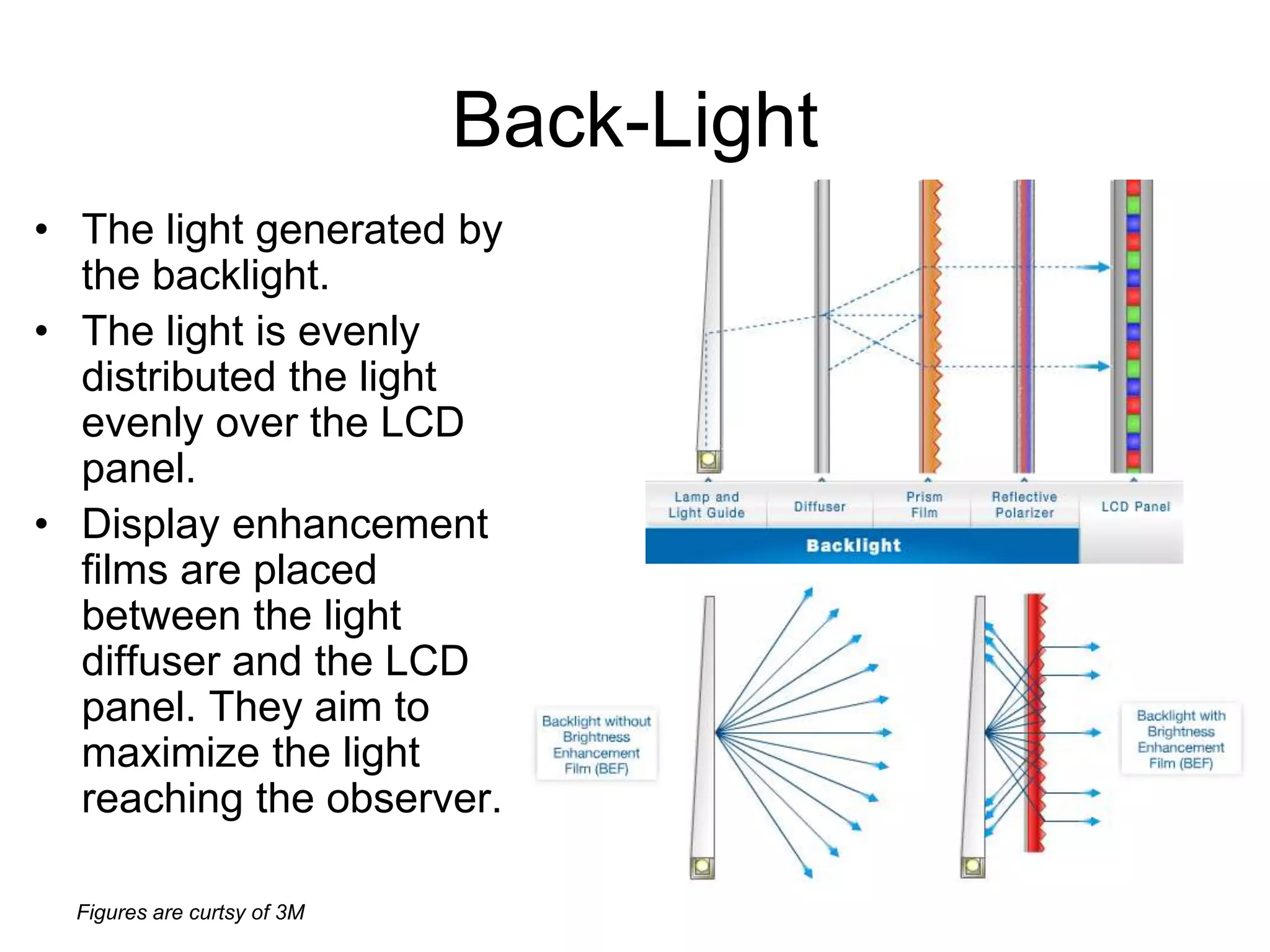
Back-Light
• The light generated by
the backlight.
• The light is evenly
distributed the light
evenly over the LCD
panel.
• Display enhancement
films are placed
between the light
diffuser and the LCD
panel. They aim to
maximize the light
reaching the observer.
Figures are curtsy of 3M
3-D LCD Displays
• This technology aims to generate stereoscopic 3D
images with the need for glasses.
• The idea is based on combining
– Active-matrix LCD with
– Lenticular lens: an array of magnifying lenses, designed to
magnify different images when viewed from slightly different
angles.
• Applications
– Industrial Visualization
– Medical imaging
– Entertainment

LCD-Display-.ppt

  • 1.
    Figures are curtsyof 3M LCD DISPLAY TECHNOLOGY Program
  • 2.
    Figures are curtsyof 3M Digital Images and Pixels • A digital image is a binary (digital) representation of a two-dimensional pictorial data. • Digital images may have a raster or vector representation. • Raster Images defined over a 2D grid of picture elements, called pixels. • A pixel is the basic items of a raster image and include intensity or color value. Pixels
  • 3.
    Figures are curtsyof 3M LCD (Liquid Crystal Display) • LCD Panel is based on – A light valve for each pixel that turn the light on, off, or an intermediate level. • Grid of such light valve for the LCD display panel. • A back light and display enhancement films create the illumination.
  • 4.
    Figures are curtsyof 3M LCD-Display • Applying voltage to the electrodes changes the level of illumination in each sub-pixel • The panel is sandwiched between – Front surface films to enhance display property – Backlight
  • 5.
    Figures are curtsyof 3M Linear Polarized Light • Light usually vibrates in all direction • A linear polarized light limit the vibration to one direction • It absorbs the component of light that vibrate in all other direction. • LCD require light to vibrate in one direction
  • 6.
    Figures are curtsyof 3M Iodine Based Polarizer • Is the most common polarizer • It is made by – Stretching a cast polyvinyl alcohol film (PVA) to align the iodine in turn. – Staining it with iodine – The stained PVA laminated between two slices of cellulose triacetate. • The cellulose triacetate – Provide physical rigidity – Some degree of heat and humidity protection polyvinyl alcohol film Cellulose Triacetate Cellulose Triacetate polyvinyl alcohol film
  • 7.
    Figures are curtsyof 3M About Liquid Crystal • Liquid crystal molecules can move freely while maintaining their orientation. • It align itself to a polyimide film to the inside of a panel glass. • When the two glass panels are not aligned the liquid crystal twists accordingly. • The liquid crystal will also align to electric field.
  • 8.
    Figures are curtsyof 3M Light Path • The light passes through the polarizer. • The voltage applied to the electrodes controls the liquid crystal orientation • The liquid crystal orientation controls the rotation of the incoming polarized light. • Color filters are used in color LCD, where each color sub-pixel is controlled individually
  • 9.
    Figures are curtsyof 3M Direct Address Display • When the display include limited variable components such as – Watches – Calculators • Simple electronics is used to control the components
  • 10.
    Figures are curtsyof 3M Passive Matrix Display • Passive matrix display has – Rows of electrodes on one piece of glass. – Columns of electrodes on the opposing piece of glass. – Complex electrical waveform control the voltage differential at the intersection of the electrodes. • The intersection of the columns and rows are the pixels
  • 11.
    Figures are curtsyof 3M Passive Matrix Display -disadvantages- • As more rows and columns are added the range of the allowed voltage is reduced. – At high range adjacent channels interferes – Range limit reduces contrast – Limit the types of useful liquid crystal. • It is usually limited to about 50 rows • Twisted nematic (TN) Display work best with large voltage variation. – It can not be used in Passive Matrix Display
  • 12.
    Figures are curtsyof 3M Active Matrix Display • Allow very high resolution • Each sub-pixel is individually controlled by an isolated thin-film transistor (TFT). • It allows the electrical signal for each sub-pixel to avoid influencing adjacent elements. • The TFT is patterned into the glass layer A display with 1024x768 resolution Include 1024x768x3 = 2,359,296 sub-pixels
  • 13.
    Figures are curtsyof 3M Twisted Nematic (TN) Display • Is the most common LCD Display. • The two alignments layer for the liquid crystal material are orthogonal. • The light entering the polarize panel rotates by the twist in the liquid crystal and allowing it to pass through the second polarize
  • 14.
    Figures are curtsyof 3M Twisted Nematic (TN) Display • The electric field is applied – The liquid crystal loses its twist. – Alight to the electric field. – Prevents the rotation of the polarized light – The second polarizer absorbs the light. • The applied voltage control the absorbed and transmitted light
  • 15.
    Figures are curtsyof 3M Twist Nematic Viewing Angle • Light passes through the TN display from one angle may be blocked in other angles by the twist of the liquid crystal. • To overcome this limitation different approaches have use various orientations for the polarize layers.
  • 16.
    Figures are curtsyof 3M Front Surface Films • Hard-coat Films • Quick Clean Films • Anti-Glare Films • Anti-Reflection Films • Privacy Films
  • 17.
    Figures are curtsyof 3M Back-Light • The light generated by the backlight. • The light is evenly distributed the light evenly over the LCD panel. • Display enhancement films are placed between the light diffuser and the LCD panel. They aim to maximize the light reaching the observer.
  • 18.
    Figures are curtsyof 3M 3-D LCD Displays • This technology aims to generate stereoscopic 3D images with the need for glasses. • The idea is based on combining – Active-matrix LCD with – Lenticular lens: an array of magnifying lenses, designed to magnify different images when viewed from slightly different angles. • Applications – Industrial Visualization – Medical imaging – Entertainment