ِ‫م‬ْ‫ي‬ِ‫ح‬َّ‫ر‬‫ال‬ ِ‫ن‬ٰ‫م‬ْ‫ح‬َّ‫ر‬‫ال‬ ِ‫هللا‬ ِ‫م‬ْ‫س‬ِ‫ب‬
Thermodynamics
Presented By
Amir Manzoor
Lecture 02
Types of thermodynamic process
 Isothermal process: Occur in constant/ same temperature
ΔT = 0
If ideal gas, ΔT = 0 , ΔE = 0
Internal energy (E = K.E ∞ T)
 Isobaric process: Occur in constant pressure
 Isochoric process: Occur in constant volume (closed vessel)
 Adiabatic process: In this process, heat can not change
Note: these are process are reversible or irreversible
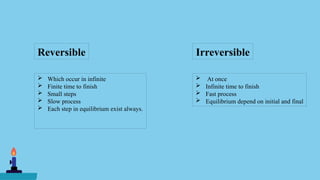
Reversible Irreversible
 Which occur in infinite
 Finite time to finish
 Small steps
 Slow process
 Each step in equilibrium exist always.
 At once
 Infinite time to finish
 Fast process
 Equilibrium depend on initial and final
 The limitation of the first law of thermodynamics is that it does not
say anything about the direction of flow of heat.
 It does not say anything whether the process is a spontaneous
process or not.
 The reverse process is not possible. In actual practice, the heat
doesn't convert completely into work.
Limitations of First Law of
Thermodynamics
 Heat is energy transferred between substances or systems due to a temperature
difference between them.
 Heat is conserved as a form of energy.
 Heat is transferred via solid material (conduction), liquids and gases (convection), and
electromagnetic waves (radiation).
 Heat describes the transfer of thermal energy between molecules within a system.
 Heat is measured in joules.
 Temperature describes the average kinetic energy of molecules within a material or
system and is measured in Celsius (°C), Kelvin(K), Fahrenheit (°F).
HEAT
 The value of the energy depends upon the state of the substance and not upon the
nature of the processes by which it attained that state.
 According to first law of thermodynamics, system undergoes a change of state only
due to work is involved, the work is equal to the change in internal energy.
 The law also implies that if both heat and work arc involved in the change of state of
a system, then the change in internal energy is equal to the heat supplied to the system
minus the work done by the system.
 The internal energy as a sum of terms that can be interpreted as kinetic energy,
potential energy, and chemical energy.
INTERNAL ENERGY
 The sum of the internal energy and the product of the pressure and volume of a
thermodynamic system.
 Enthalpy is an energy-like property or state function.
 It has the dimensions of energy and is measured in units of joules or ergs.
 Its value is determined by the temperature, pressure, and composition of the system.
 The enthalpy (H) equals the sum of the internal energy (E) and the product of the
pressure (P) and volume ( V) of the system:
H = E + PV
W=PV
So,
H=E+W
 The change in internal energy is equal to the heat transferred plus the work done by
the system.
ENTHALPY
 Entropy, the measure of a system's thermal energy per unit temperature.
 Entropy is a function of the state of the system, so the change in entropy of a system is
determined by its initial and final states.
 The amount of entropy is also a measure of the molecular disorder, or randomness, of
a system.
 Entropy is the measure of total heat present in the thermodynamic system where the
pressure is constant while Entropy is the, a thermodynamic system.
ΔS= ΔQ/T
where Q is the heat content and T is the temperature.
ENTROPY
 Zero entropy means perfect knowledge of a state ;
no motion, no temperature, no uncertainty.
 Entropy is not conserved because it can be created. But once it is created and
dissipated in surroundings the action cannot be reversed, so therefore entropy always
keep on increasing.
 As we know laws of conservation of mass and energy say that both the quantities are
uncreatable and destroyable.
 This is irreversible process.
 The second law of thermodynamics states at the heat energy cannot transfer from a
body at a lower temperature to a body at a higher temperature without the addition of
energy.
 The second law of thermodynamics states that the entropy of an isolated system is
always increasing.
 The entropy of the system is measured in terms of the changes the system has
undergone from the previous state to the final state.
 The universe is an isolated system. This means the entropy of the universe will always
increase. The entropy change of the universe is the sum of the entropy change of the
system and the entropy change of the surroundings.
Second Law of Thermodynamics
Causes of increase in entropy of the closed system are:
 In a closed system, the mass of the system remains constant but it can
exchange the heat with surroundings.
 Any change in the heat content of the system leads to disturbance in the
system, which tends to increase the entropy of the system.
 This causes irreversibility inside the system and an increase in its entropy.
 This law is applicable to all types of heat engine cycles including Auto,
Diesel, etc. for all types of working fluids used in the engines. This law has
lead to the progress of present day vehicles.
 Another application is refrigerators and heat pumps based on the Reversed
Carnot Cycle. If you want to move heat from a body at a lower temperature
to a body at a higher temperature, then you have to supply external work.
 Removing heat from the food items in the refrigerator and throwing it away
to the higher temperature atmosphere doesn't happen automatically. We need
to supply external work via the compressor to make this happen in the
refrigerator.
 Air conditioner is another example.
Application of Second law
 The third law of thermodynamics states that the entropy of a perfect crystal at a
temperature of zero Kelvin (absolute zero) is equal to zero.
 At zero kelvin the system must be in a state with the minimum energy.
 If the crystal has only one minimum energy state, third law holds true.
 Entropy is related to the number of microstates, and with only one microstates available
at zero kelvin, the entropy exactly zero.
Third Law of Thermodynamics
 It helps in the calculation of the absolute entropy of a substance at any
temperature "T.
 These determinations are based on the heat capacity measurements of the
substance.
Application of the third law
Thank You

Thermodynamics lecture 2.pptx . learning

  • 1.
  • 2.
  • 3.
    Types of thermodynamicprocess  Isothermal process: Occur in constant/ same temperature ΔT = 0 If ideal gas, ΔT = 0 , ΔE = 0 Internal energy (E = K.E ∞ T)  Isobaric process: Occur in constant pressure  Isochoric process: Occur in constant volume (closed vessel)  Adiabatic process: In this process, heat can not change Note: these are process are reversible or irreversible
  • 4.
    Reversible Irreversible  Whichoccur in infinite  Finite time to finish  Small steps  Slow process  Each step in equilibrium exist always.  At once  Infinite time to finish  Fast process  Equilibrium depend on initial and final
  • 5.
     The limitationof the first law of thermodynamics is that it does not say anything about the direction of flow of heat.  It does not say anything whether the process is a spontaneous process or not.  The reverse process is not possible. In actual practice, the heat doesn't convert completely into work. Limitations of First Law of Thermodynamics
  • 6.
     Heat isenergy transferred between substances or systems due to a temperature difference between them.  Heat is conserved as a form of energy.  Heat is transferred via solid material (conduction), liquids and gases (convection), and electromagnetic waves (radiation).  Heat describes the transfer of thermal energy between molecules within a system.  Heat is measured in joules.  Temperature describes the average kinetic energy of molecules within a material or system and is measured in Celsius (°C), Kelvin(K), Fahrenheit (°F). HEAT
  • 7.
     The valueof the energy depends upon the state of the substance and not upon the nature of the processes by which it attained that state.  According to first law of thermodynamics, system undergoes a change of state only due to work is involved, the work is equal to the change in internal energy.  The law also implies that if both heat and work arc involved in the change of state of a system, then the change in internal energy is equal to the heat supplied to the system minus the work done by the system.  The internal energy as a sum of terms that can be interpreted as kinetic energy, potential energy, and chemical energy. INTERNAL ENERGY
  • 8.
     The sumof the internal energy and the product of the pressure and volume of a thermodynamic system.  Enthalpy is an energy-like property or state function.  It has the dimensions of energy and is measured in units of joules or ergs.  Its value is determined by the temperature, pressure, and composition of the system.  The enthalpy (H) equals the sum of the internal energy (E) and the product of the pressure (P) and volume ( V) of the system: H = E + PV W=PV So, H=E+W  The change in internal energy is equal to the heat transferred plus the work done by the system. ENTHALPY
  • 9.
     Entropy, themeasure of a system's thermal energy per unit temperature.  Entropy is a function of the state of the system, so the change in entropy of a system is determined by its initial and final states.  The amount of entropy is also a measure of the molecular disorder, or randomness, of a system.  Entropy is the measure of total heat present in the thermodynamic system where the pressure is constant while Entropy is the, a thermodynamic system. ΔS= ΔQ/T where Q is the heat content and T is the temperature. ENTROPY
  • 10.
     Zero entropymeans perfect knowledge of a state ; no motion, no temperature, no uncertainty.  Entropy is not conserved because it can be created. But once it is created and dissipated in surroundings the action cannot be reversed, so therefore entropy always keep on increasing.  As we know laws of conservation of mass and energy say that both the quantities are uncreatable and destroyable.
  • 11.
     This isirreversible process.  The second law of thermodynamics states at the heat energy cannot transfer from a body at a lower temperature to a body at a higher temperature without the addition of energy.  The second law of thermodynamics states that the entropy of an isolated system is always increasing.  The entropy of the system is measured in terms of the changes the system has undergone from the previous state to the final state.  The universe is an isolated system. This means the entropy of the universe will always increase. The entropy change of the universe is the sum of the entropy change of the system and the entropy change of the surroundings. Second Law of Thermodynamics
  • 13.
    Causes of increasein entropy of the closed system are:  In a closed system, the mass of the system remains constant but it can exchange the heat with surroundings.  Any change in the heat content of the system leads to disturbance in the system, which tends to increase the entropy of the system.  This causes irreversibility inside the system and an increase in its entropy.
  • 14.
     This lawis applicable to all types of heat engine cycles including Auto, Diesel, etc. for all types of working fluids used in the engines. This law has lead to the progress of present day vehicles.  Another application is refrigerators and heat pumps based on the Reversed Carnot Cycle. If you want to move heat from a body at a lower temperature to a body at a higher temperature, then you have to supply external work.  Removing heat from the food items in the refrigerator and throwing it away to the higher temperature atmosphere doesn't happen automatically. We need to supply external work via the compressor to make this happen in the refrigerator.  Air conditioner is another example. Application of Second law
  • 15.
     The thirdlaw of thermodynamics states that the entropy of a perfect crystal at a temperature of zero Kelvin (absolute zero) is equal to zero.  At zero kelvin the system must be in a state with the minimum energy.  If the crystal has only one minimum energy state, third law holds true.  Entropy is related to the number of microstates, and with only one microstates available at zero kelvin, the entropy exactly zero. Third Law of Thermodynamics
  • 17.
     It helpsin the calculation of the absolute entropy of a substance at any temperature "T.  These determinations are based on the heat capacity measurements of the substance. Application of the third law
  • 18.