The Laws of Motion
The Laws of Motion
•The description of an object in motion included its position,
velocity, and acceleration.
•There was no consideration of what might influence that
motion.
•Two main factors need to be addressed to answer questions
about why the motion of an object will change.
– Forces acting on the object
– The mass of the object
•Dynamics studies the causes of motion.
•Will start with three basic laws of motion
– Formulated by Sir Isaac Newton
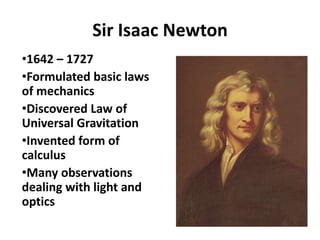
Sir Isaac Newton
•1642 – 1727
•Formulated basic laws
of mechanics
•Discovered Law of
Universal Gravitation
•Invented form of
calculus
•Many observations
dealing with light and
optics
Force
•Forces in everyday experience
– Push on an object to move it
– Throw or kick a ball
Note: You may push on an object and not be able
to move it
•Forces are what cause any change in the
velocity of an object.
– Newton’s definition
– A force is that which causes an acceleration
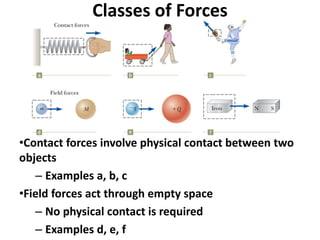
Classes of Forces
•Contact forces involve physical contact between two
objects
– Examples a, b, c
•Field forces act through empty space
– No physical contact is required
– Examples d, e, f
Fundamental Forces
•Gravitational force
– Between objects
•Electromagnetic forces
– Between electric charges
•Nuclear force
– Between subatomic particles
•Weak forces
– Arise in certain radioactive decay processes
•Note: These are all field forces.
Newton’s First Law
If an object does not interact with other
objects, it is possible to identify a reference
frame in which the object has zero
acceleration.
–This is also called the law of inertia.
–It defines a special set of reference
frames called inertial frames.
•We call this an inertial frame of
reference.
Newton’s First Law – Alternative
Statement
In the absence of external forces, when viewed
from an inertial reference frame, an object at rest
remains at rest and an object in motion continues
in motion with a constant velocity.
– Newton’s First Law describes what happens in the
absence of a force.
• Does not describe zero net force
– Also tells us that when no force acts on an object,
the acceleration of the object is zero
– Can conclude that any isolated object is either at rest
or moving at a constant velocity
•The First Law also allows the definition of force as
that which causes a change in the motion of an
object.
Inertia and Mass
•The tendency of an object to resist any
attempt to change its velocity is called inertia.
•Mass is that property of an object that
specifies how much resistance an object
exhibits to changes in its velocity.
Appropriately, it is referred to as inertial mass
•Masses can be defined in terms of the
accelerations produced by a given force acting
on them:
– The magnitude of the acceleration experienced
by an object is inversely proportional to its mass.
1
2
2
1
a
a
m
m

More About Mass
•Mass is an inherent property of an
object.
•Mass is independent of the object’s
surroundings.
•Mass is independent of the method used
to measure it.
•Mass is a scalar quantity.
–Obeys the rules of ordinary arithmetic
•The SI unit of mass is kg.
Mass vs. Weight
•Mass and weight are two
different quantities.
•Weight is equal to the magnitude
of the gravitational force exerted
on the object, i.e. W=mg.
–Weight will vary with location.
Newton’s Second Law
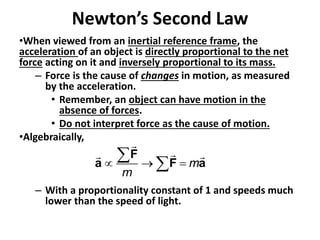
•When viewed from an inertial reference frame, the
acceleration of an object is directly proportional to the net
force acting on it and inversely proportional to its mass.
– Force is the cause of changes in motion, as measured
by the acceleration.
• Remember, an object can have motion in the
absence of forces.
• Do not interpret force as the cause of motion.
•Algebraically,
– With a proportionality constant of 1 and speeds much
lower than the speed of light.
m
m
  
 
F
a F a
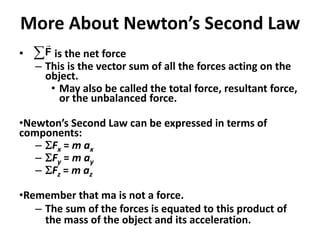
More About Newton’s Second Law
• is the net force
– This is the vector sum of all the forces acting on the
object.
• May also be called the total force, resultant force,
or the unbalanced force.
•Newton’s Second Law can be expressed in terms of
components:
– SFx = m ax
– SFy = m ay
– SFz = m az
•Remember that ma is not a force.
– The sum of the forces is equated to this product of
the mass of the object and its acceleration.
F
Units of Force
•The SI unit of force is the newton (N).
– 1 N = 1 kg·m / s2
•That is, one newton is the force that which
causes 1 kg mass to accelerate at 1 m/ s2
Force of Friction
Forces of Friction
•When an object is in motion on a surface or
through a viscous medium, there will be a
resistance to the motion.
–This is due to the interactions between
the object and its environment.
•This resistance is called the force of friction.
•There are two types of friction:
-static friction
-kinetic friction
Forces of Friction, cont’d.
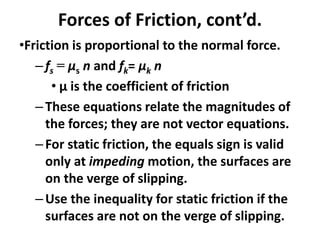
•Friction is proportional to the normal force.
–fs = µs n and fk= µk n
• μ is the coefficient of friction
–These equations relate the magnitudes of
the forces; they are not vector equations.
–For static friction, the equals sign is valid
only at impeding motion, the surfaces are
on the verge of slipping.
–Use the inequality for static friction if the
surfaces are not on the verge of slipping.
Forces of Friction, final
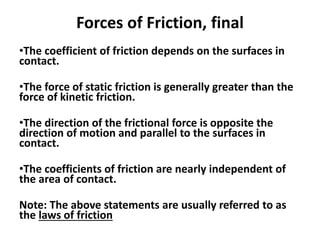
•The coefficient of friction depends on the surfaces in
contact.
•The force of static friction is generally greater than the
force of kinetic friction.
•The direction of the frictional force is opposite the
direction of motion and parallel to the surfaces in
contact.
•The coefficients of friction are nearly independent of
the area of contact.
Note: The above statements are usually referred to as
the laws of friction
Static Friction
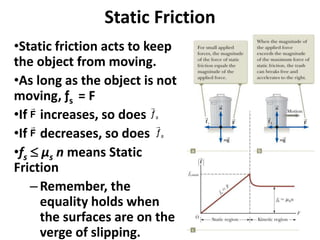
•Static friction acts to keep
the object from moving.
•As long as the object is not
moving, ƒs = F
•If increases, so does
•If decreases, so does
•ƒs  µs n means Static
Friction
–Remember, the
equality holds when
the surfaces are on the
verge of slipping.
F
F
ƒs
ƒs
Kinetic Friction
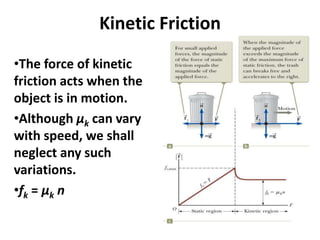
•The force of kinetic
friction acts when the
object is in motion.
•Although µk can vary
with speed, we shall
neglect any such
variations.
•ƒk = µk n
Newton’s Third Law
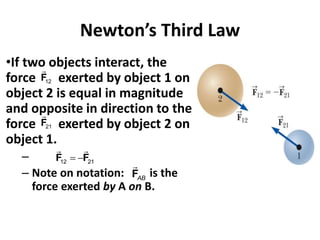
•If two objects interact, the
force exerted by object 1 on
object 2 is equal in magnitude
and opposite in direction to the
force exerted by object 2 on
object 1.
–
– Note on notation: is the
force exerted by A on B.
12
F
21
F
AB
F
12 21
 
F F
Newton’s Third Law, Alternative
Statement
•The action force is equal in magnitude to the
reaction force and opposite in direction.
– One of the forces is the action force, the other is
the reaction force.
– It doesn’t matter which is considered the action
and which the reaction.
– The action and reaction forces must act on
different objects and be of the same type.

Lecture 4-The Laws of Motion.pptx physics

  • 1.
  • 2.
    The Laws ofMotion •The description of an object in motion included its position, velocity, and acceleration. •There was no consideration of what might influence that motion. •Two main factors need to be addressed to answer questions about why the motion of an object will change. – Forces acting on the object – The mass of the object •Dynamics studies the causes of motion. •Will start with three basic laws of motion – Formulated by Sir Isaac Newton
  • 3.
    Sir Isaac Newton •1642– 1727 •Formulated basic laws of mechanics •Discovered Law of Universal Gravitation •Invented form of calculus •Many observations dealing with light and optics
  • 4.
    Force •Forces in everydayexperience – Push on an object to move it – Throw or kick a ball Note: You may push on an object and not be able to move it •Forces are what cause any change in the velocity of an object. – Newton’s definition – A force is that which causes an acceleration
  • 5.
    Classes of Forces •Contactforces involve physical contact between two objects – Examples a, b, c •Field forces act through empty space – No physical contact is required – Examples d, e, f
  • 6.
    Fundamental Forces •Gravitational force –Between objects •Electromagnetic forces – Between electric charges •Nuclear force – Between subatomic particles •Weak forces – Arise in certain radioactive decay processes •Note: These are all field forces.
  • 7.
    Newton’s First Law Ifan object does not interact with other objects, it is possible to identify a reference frame in which the object has zero acceleration. –This is also called the law of inertia. –It defines a special set of reference frames called inertial frames. •We call this an inertial frame of reference.
  • 8.
    Newton’s First Law– Alternative Statement In the absence of external forces, when viewed from an inertial reference frame, an object at rest remains at rest and an object in motion continues in motion with a constant velocity. – Newton’s First Law describes what happens in the absence of a force. • Does not describe zero net force – Also tells us that when no force acts on an object, the acceleration of the object is zero – Can conclude that any isolated object is either at rest or moving at a constant velocity •The First Law also allows the definition of force as that which causes a change in the motion of an object.
  • 9.
    Inertia and Mass •Thetendency of an object to resist any attempt to change its velocity is called inertia. •Mass is that property of an object that specifies how much resistance an object exhibits to changes in its velocity. Appropriately, it is referred to as inertial mass •Masses can be defined in terms of the accelerations produced by a given force acting on them: – The magnitude of the acceleration experienced by an object is inversely proportional to its mass. 1 2 2 1 a a m m 
  • 10.
    More About Mass •Massis an inherent property of an object. •Mass is independent of the object’s surroundings. •Mass is independent of the method used to measure it. •Mass is a scalar quantity. –Obeys the rules of ordinary arithmetic •The SI unit of mass is kg.
  • 11.
    Mass vs. Weight •Massand weight are two different quantities. •Weight is equal to the magnitude of the gravitational force exerted on the object, i.e. W=mg. –Weight will vary with location.
  • 12.
    Newton’s Second Law •Whenviewed from an inertial reference frame, the acceleration of an object is directly proportional to the net force acting on it and inversely proportional to its mass. – Force is the cause of changes in motion, as measured by the acceleration. • Remember, an object can have motion in the absence of forces. • Do not interpret force as the cause of motion. •Algebraically, – With a proportionality constant of 1 and speeds much lower than the speed of light. m m      F a F a
  • 13.
    More About Newton’sSecond Law • is the net force – This is the vector sum of all the forces acting on the object. • May also be called the total force, resultant force, or the unbalanced force. •Newton’s Second Law can be expressed in terms of components: – SFx = m ax – SFy = m ay – SFz = m az •Remember that ma is not a force. – The sum of the forces is equated to this product of the mass of the object and its acceleration. F
  • 14.
    Units of Force •TheSI unit of force is the newton (N). – 1 N = 1 kg·m / s2 •That is, one newton is the force that which causes 1 kg mass to accelerate at 1 m/ s2
  • 15.
  • 16.
    Forces of Friction •Whenan object is in motion on a surface or through a viscous medium, there will be a resistance to the motion. –This is due to the interactions between the object and its environment. •This resistance is called the force of friction. •There are two types of friction: -static friction -kinetic friction
  • 17.
    Forces of Friction,cont’d. •Friction is proportional to the normal force. –fs = µs n and fk= µk n • μ is the coefficient of friction –These equations relate the magnitudes of the forces; they are not vector equations. –For static friction, the equals sign is valid only at impeding motion, the surfaces are on the verge of slipping. –Use the inequality for static friction if the surfaces are not on the verge of slipping.
  • 18.
    Forces of Friction,final •The coefficient of friction depends on the surfaces in contact. •The force of static friction is generally greater than the force of kinetic friction. •The direction of the frictional force is opposite the direction of motion and parallel to the surfaces in contact. •The coefficients of friction are nearly independent of the area of contact. Note: The above statements are usually referred to as the laws of friction
  • 19.
    Static Friction •Static frictionacts to keep the object from moving. •As long as the object is not moving, ƒs = F •If increases, so does •If decreases, so does •ƒs  µs n means Static Friction –Remember, the equality holds when the surfaces are on the verge of slipping. F F ƒs ƒs
  • 20.
    Kinetic Friction •The forceof kinetic friction acts when the object is in motion. •Although µk can vary with speed, we shall neglect any such variations. •ƒk = µk n
  • 22.
    Newton’s Third Law •Iftwo objects interact, the force exerted by object 1 on object 2 is equal in magnitude and opposite in direction to the force exerted by object 2 on object 1. – – Note on notation: is the force exerted by A on B. 12 F 21 F AB F 12 21   F F
  • 23.
    Newton’s Third Law,Alternative Statement •The action force is equal in magnitude to the reaction force and opposite in direction. – One of the forces is the action force, the other is the reaction force. – It doesn’t matter which is considered the action and which the reaction. – The action and reaction forces must act on different objects and be of the same type.