Completely Randomized
Design
By: Jan Dave E. Deocampo and Riza Joy Palomar
A completely randomized design (CRD) is one assigned completely at random so that
each experimental unit has the same chance of receiving any one treatment. For the
CRD, any difference among experimental units receiving the same treatment is
considered as experimental error. Hence, the CRD is only appropriate for experiments
with homogeneous experimental units, such as laboratory experiments, where
environmental effects are relatively easy to control. For field experiments, where there
is generally large variation among experimental plots, in such environmental factors as
soil, the CRD is rarely used.
In experiments, a treatment is something that researchers administer to
experimental units. For example, a corn field is divided into four, each part is
'treated' with a different fertiliser to see which produces the most corn; a
teacher practices different teaching methods on different groups in her class to
see which yields the best results; a doctor treats a patient with a skin condition
with different creams to see which is most effective. Treatments are
administered to experimental units by 'level', where level implies amount or
magnitude. For example, if the experimental units were given 5mg, 10mg,
15mg of a medication, those amounts would be three levels of the treatment.
Randomization Procedure
-Treatments are assigned to experimental units
completely at random.
-Every experimental unit has the same probability of
receiving any treatment.
-Any difference among experimental units receiving
the same treatment is considered experimental
ERROR
-Randomization is performed using a random number
table, computer, program, etc.
Advantages of a CRD
-Its layout is very easy.
-There is complete flexibility in this design i.e. any number of
treatments and replications for each treatment can be tried.
-Whole experimental material can be utilized in this design.
-This design yields maximum degrees of freedom for
experimental error.
-The analysis of data is simplest as compared to any other design.
Even if some values are missing the analysis can be done.
Disadvantages of a CRD
-It is difficult to find homogeneous experimental units
in all respects and hence CRD is seldom suitable for
field experiments as compared to other experimental
designs.
-It is less accurate than other designs.
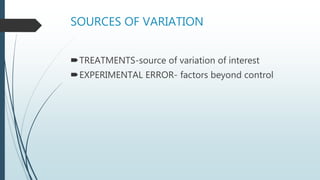
SOURCES OF VARIATION
TREATMENTS-source of variation of interest
EXPERIMENTAL ERROR- factors beyond control
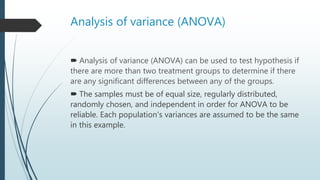
Analysis of variance (ANOVA)
 Analysis of variance (ANOVA) can be used to test hypothesis if
there are more than two treatment groups to determine if there
are any significant differences between any of the groups.
 The samples must be of equal size, regularly distributed,
randomly chosen, and independent in order for ANOVA to be
reliable. Each population's variances are assumed to be the same
in this example.
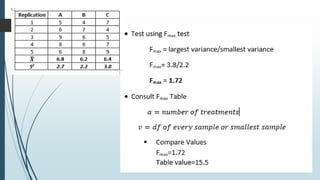
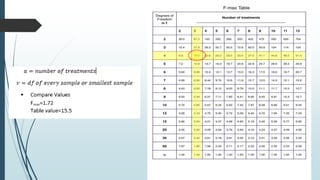
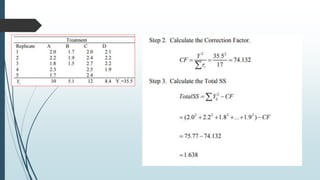
TEST FOR HOMOGENEITY OF VARIANCE
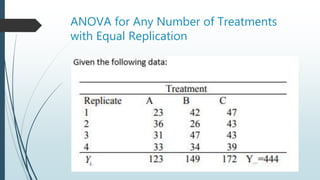
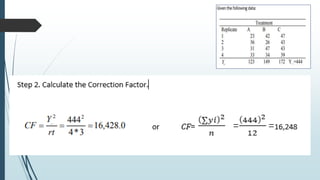
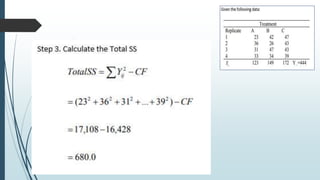
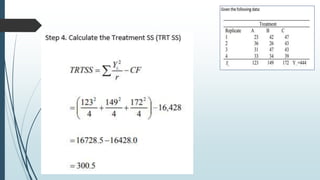
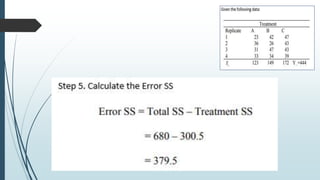
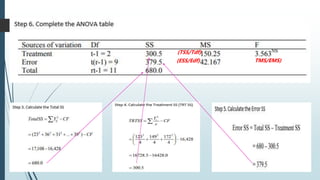
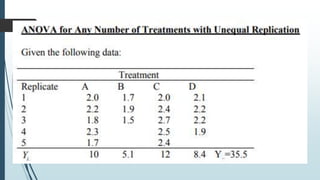
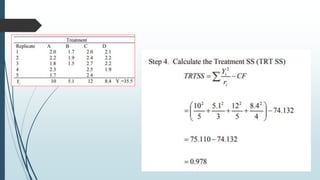
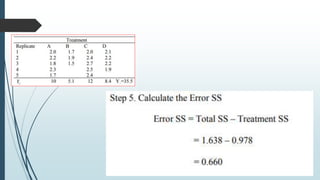
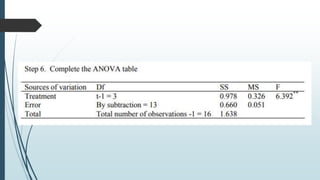
ANOVA for Any Number of Treatments
with Equal Replication
(TSS/Tdf)
(ESS/Edf) TMS/EMS)
THANK YOU!

Completely randomized-design

  • 1.
    Completely Randomized Design By: JanDave E. Deocampo and Riza Joy Palomar
  • 2.
    A completely randomizeddesign (CRD) is one assigned completely at random so that each experimental unit has the same chance of receiving any one treatment. For the CRD, any difference among experimental units receiving the same treatment is considered as experimental error. Hence, the CRD is only appropriate for experiments with homogeneous experimental units, such as laboratory experiments, where environmental effects are relatively easy to control. For field experiments, where there is generally large variation among experimental plots, in such environmental factors as soil, the CRD is rarely used.
  • 3.
    In experiments, atreatment is something that researchers administer to experimental units. For example, a corn field is divided into four, each part is 'treated' with a different fertiliser to see which produces the most corn; a teacher practices different teaching methods on different groups in her class to see which yields the best results; a doctor treats a patient with a skin condition with different creams to see which is most effective. Treatments are administered to experimental units by 'level', where level implies amount or magnitude. For example, if the experimental units were given 5mg, 10mg, 15mg of a medication, those amounts would be three levels of the treatment.
  • 4.
    Randomization Procedure -Treatments areassigned to experimental units completely at random. -Every experimental unit has the same probability of receiving any treatment. -Any difference among experimental units receiving the same treatment is considered experimental ERROR -Randomization is performed using a random number table, computer, program, etc.
  • 5.
    Advantages of aCRD -Its layout is very easy. -There is complete flexibility in this design i.e. any number of treatments and replications for each treatment can be tried. -Whole experimental material can be utilized in this design. -This design yields maximum degrees of freedom for experimental error. -The analysis of data is simplest as compared to any other design. Even if some values are missing the analysis can be done.
  • 6.
    Disadvantages of aCRD -It is difficult to find homogeneous experimental units in all respects and hence CRD is seldom suitable for field experiments as compared to other experimental designs. -It is less accurate than other designs.
  • 7.
    SOURCES OF VARIATION TREATMENTS-sourceof variation of interest EXPERIMENTAL ERROR- factors beyond control
  • 9.
    Analysis of variance(ANOVA)  Analysis of variance (ANOVA) can be used to test hypothesis if there are more than two treatment groups to determine if there are any significant differences between any of the groups.  The samples must be of equal size, regularly distributed, randomly chosen, and independent in order for ANOVA to be reliable. Each population's variances are assumed to be the same in this example.
  • 10.
  • 15.
    ANOVA for AnyNumber of Treatments with Equal Replication
  • 21.
  • 35.