Therapeutic Groups for
Israeli-Palestinian
Children

      Pioneering work,
     primary experience
Latiff
Community
Mental Health Clinic
for Children

    Umm-Al-Fahm, ISRAEL
Authors:
   Tsvi E. Gil, B. Sc., M. A.,
   Graciela Karmon, M. D.,
   and Latiff group work team

   Society for advancement of health
    services
Team members are…

   Mahmud Asla, Ph. D.
   Faten Egbaria, B. S. W.
   Ibrahim Igbariy, M. A.
   Kresteen Iskander, B, S. W., M. A.
   Mansur Mihdawi, B. S. W.
   Amany Saady, M. A.
…The Globe
…The Middle East
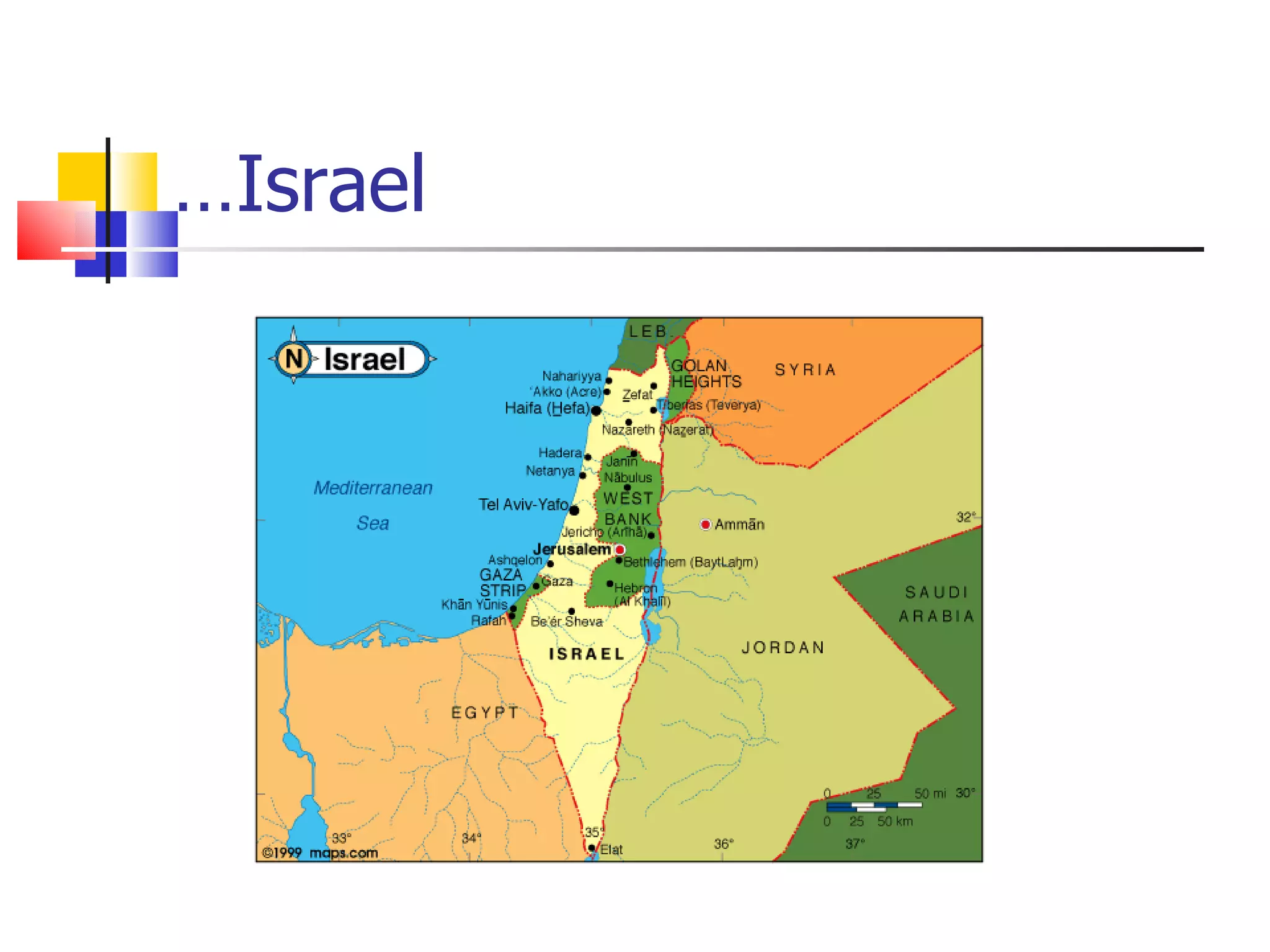
…Israel
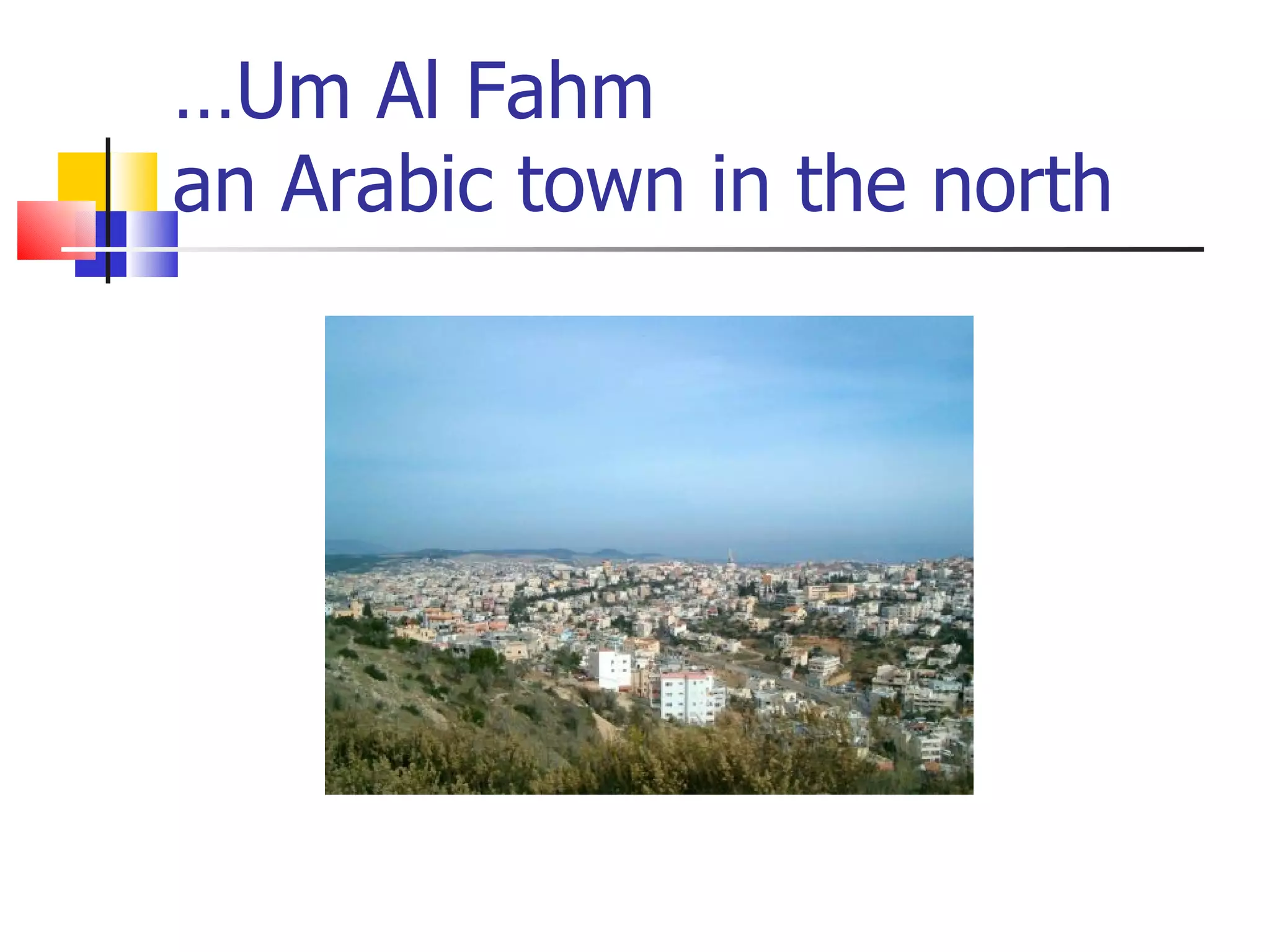
…Um Al Fahm
an Arabic town in the north
Our clients
   Palestinian children (ages 6 – 18),
    Living in Northern Israel,
   Suffering of all kinds of
    psychopathologies, as well as
    psychosocial mishaps
Our staff
   3 psychologists
   4 social workers
   2 secretaries -
       all of them Palestinians!
…and
   Director (psychiatrist) and supervising
    personnel (psychologists)- all of them
    Jewish!
    (and not speaking Arabic)
Treatments were:
   Individual psychotherapy
   Parent’s guide
   Art therapy
   Pharmacological (psychiatric)
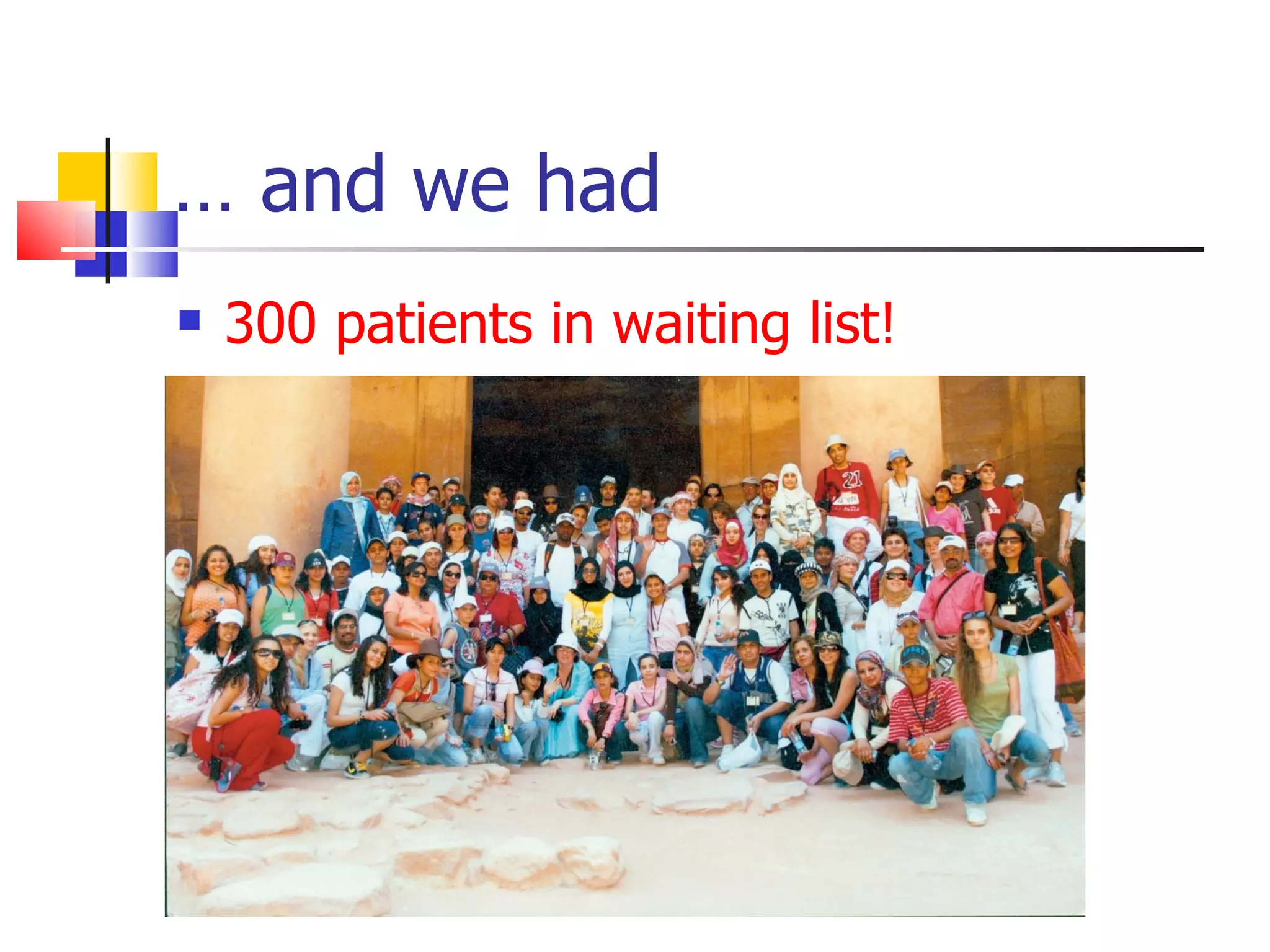
… and we had
   300 patients in waiting list!
So… we started initiating
therapeutic groups
   Groups for children according to age
    groups
   Groups for children according to
    diagnoses or classes of problems
   Groups for parents
Obstacles for creating groups:
   Staff not trained in group work
   Staff sees group work as ‘second best’
   Fear of failure
   Unrewarding previous experience
   Busy with ongoing treatments
   Anxiety in face of the unknown – uncertainty,
    lack of control, lack of knowledge,
    undefinability of goals (structured vs. open
    groups)
.. And target populations:
   Expect individual treatment, see group
    work as ‘second best’
   Fear of disclosure and contagion
   Difficulties in gathering together at
    particular timing
Principles of Group Work with Children

(Z. Shechtman – Group Counseling and Psychotherapy with
Children and Adolescents)


   Experiencing as a major mechanism of
    change (Greenberg)
   Exploration, Insight, Action (Hill)
   Vicarious learning, role flexibility, universality,
    altruism, family reenactment, interpersonal
    learning (Fuhriman & Burlingame)
   Self disclosure and mutual support (Spiegel &
    Classen)
Therapeutic factors in children’s groups
 (Z. Shechtman – Group Counseling and Psychotherapy with
Children and Adolescents)


   Group cohesion, catharsis, interpersonal
    learning (Fuhriman et al)
   Support, self-disclosure (Lieberman & Golant)
   Awareness, relationship, focus on others,
    problem definition (Kivlighan et al)
   Positive group climate (Riva & Haub)
Group therapist roles…
   Presence
   Self-Confidence
   Creativity
   Empathic understanding
   Genuiness
   Respect
Group therapist does…
   Initiates
   Encourages
   Directs
   Questions
   Informs
   Paraphrases
   Being patient (tolerant)
   and gives feedback
What is unique in working
with Palestinian population?
   Holidays (olive harvest, Ramadan,
    pilgrimage, Muhammad birthday,
    Easter, Land Day, wedding).
   A large catchment area with poor level
    of public transportation, lack of
    resources for arrival
   Anger and violence in closer and
    distant surroundings
violence
   Violence inside the family
   Violence in the culture
   Accidents
   Violence in the Israeli society
   Violence between Israeli and Palestinians
   Violence     anger and anxiety
    conflicts, distress, and misconducts
The war in Gaza Strip (December
27th 2008 – January 17n 2009)
Phenomena in parent groups:
   Traditional and patriarchal families
   Minor paternal involvement in child
    upbringing, due to traditional familial
    values
   Involvement of the larger family
   Pseudo-adoption
Phenomena in working with
parents:
   Idealization of childhood – jammed in
    traditional familial patterns
   Conflicts with sexuality, e.g. – value of
    virginity, rejection of homosexuality
   Men work and find it difficult to participate in
    parents group
   Manish roles of men (e.g., men do not touch
    or cry)
Palestinians – society in
       transition
   Laws, rules, and norms – change and are not clear-cut
   Influence of Israeli and global societies
   Influence of religious and fundamental values (Sunnis and
    Shiite)
   Vague boundaries between individuals and their family and
    community
   Conflict between women’s individual needs and their role in the
    family
   Individual is dependent on family and community
   Difficulties in contact with Israeli society
   Conflicts in national identity (Israeli, Arabic, Palestinians,
    Muslims)
Collectivist Society (M. Dwairy)
   Source of psychopathology – intra-psychic vs.
    interpersonal
   Aim of psychotherapy – strengthening the
    self vs. adaptation to societal values and
    requirements
   Adjustment to family and society vs.
    individuation and autonomy
   Treatment as individual parade vs. treatment
    as part of the community
Group leaders as social
change agents
   Parent groups proved to contribute to
    alterations in family roles: men give up
    hierarchical superiority in favor of
    proven investments and achievements;
    women take inner locus of control
   Empowerment of women in their
    families
Individual problems reflect
society conflicts:
   Identity in a transitional society
   Doubt and uncertainty in the community lead
    to conflicts and confusion in the individual
   Violence in the surrounding leads to fear and
    anxiety in the family and individual, leading to
    psychopathology
   Intrapsychic anxieties reflecting community
    fears: Palestinians in occupied territories,
    Rightists’ demonstrations
Research and findings
   Difficulties in harness staff to scientific
    missions
   Difficulties in eliciting valid reports from
    participants
   Difficulties in budgeting of research
   Evidence for significant underlying
    processes take place with participants
Literature cited
   Dwairy M. – Toward psycho-cultural approach in muddle eastern societies. Clinical psychology Review 19: 909-915, 1999.

   Dwairy M. – Foundations of psychosocial dynamic personality theory of collective people. Clinical Psychology Review 22:
    343-360, 2002.

   Fuhriman S. G. & Burlingame G. M. – Consistency of matters: a comparative analysis of individual and group process variables.
    Counseling Psychologist 18: 6-63, 1990.

   Fuhriman A. et al – Validating a behavioral measure of catharsis, cohesion, and insight, in group therapy. Ann. Conf. Soc.
    Psychotherapy Res., Braga, Portugal, 1999.

   Greenberg L. S. – Emotion-Focused Therapy. Washington, D. C., American Psychological Association, 2002.

   Hill C. E. – Helping Skills: Facilitating exploration, insight, and action. Washington, D. C., American Psychological Association, 2nd.
    Ed., 2005.

   Kivilghan D. M., Multon K. D., & Brossat D. F. – Helpful impacts in group counseling: development of multidimensional rating
    system. Journal of Counseling Psychology 43: 347-355, 1996.

   Lieberman M. A. & Golant M., Leader behavior as perceived by cancer patients in professionally directed support groups and
    outcomes. Group Dynamics: Theory, Research, and Practice 6: 267-276, 2002.

   Riva M. T. & Haub A. L. – Group counseling in the schools. In J. L. de Lucia-Waack et al (eds.) – Handbook of Group Counseling
    and Psychotherapy. Thousand Oaks, Ca, Sage,, 2004, pp. 309-321.

   Schechtman Z. – Group Counseling and Psychotherapy With Children and Adolescents. Mahwah, N. J., and London, Lawrence
    Erlbaum, 2007.

   Spiegel D. & Classen C., Group Therapy for Cancer Patients. New-York: Basic Books, 2000.
We say good-bye and thank
you…


   Our mission had not finished yet!

Latiff

  • 1.
    Therapeutic Groups for Israeli-Palestinian Children Pioneering work, primary experience
  • 2.
    Latiff Community Mental Health Clinic forChildren Umm-Al-Fahm, ISRAEL
  • 3.
    Authors:  Tsvi E. Gil, B. Sc., M. A.,  Graciela Karmon, M. D.,  and Latiff group work team  Society for advancement of health services
  • 4.
    Team members are…  Mahmud Asla, Ph. D.  Faten Egbaria, B. S. W.  Ibrahim Igbariy, M. A.  Kresteen Iskander, B, S. W., M. A.  Mansur Mihdawi, B. S. W.  Amany Saady, M. A.
  • 5.
  • 6.
  • 7.
  • 8.
    …Um Al Fahm anArabic town in the north
  • 9.
    Our clients  Palestinian children (ages 6 – 18), Living in Northern Israel,  Suffering of all kinds of psychopathologies, as well as psychosocial mishaps
  • 10.
    Our staff  3 psychologists  4 social workers  2 secretaries - all of them Palestinians!
  • 11.
    …and  Director (psychiatrist) and supervising personnel (psychologists)- all of them Jewish! (and not speaking Arabic)
  • 12.
    Treatments were:  Individual psychotherapy  Parent’s guide  Art therapy  Pharmacological (psychiatric)
  • 13.
    … and wehad  300 patients in waiting list!
  • 14.
    So… we startedinitiating therapeutic groups  Groups for children according to age groups  Groups for children according to diagnoses or classes of problems  Groups for parents
  • 15.
    Obstacles for creatinggroups:  Staff not trained in group work  Staff sees group work as ‘second best’  Fear of failure  Unrewarding previous experience  Busy with ongoing treatments  Anxiety in face of the unknown – uncertainty, lack of control, lack of knowledge, undefinability of goals (structured vs. open groups)
  • 16.
    .. And targetpopulations:  Expect individual treatment, see group work as ‘second best’  Fear of disclosure and contagion  Difficulties in gathering together at particular timing
  • 17.
    Principles of GroupWork with Children (Z. Shechtman – Group Counseling and Psychotherapy with Children and Adolescents)  Experiencing as a major mechanism of change (Greenberg)  Exploration, Insight, Action (Hill)  Vicarious learning, role flexibility, universality, altruism, family reenactment, interpersonal learning (Fuhriman & Burlingame)  Self disclosure and mutual support (Spiegel & Classen)
  • 18.
    Therapeutic factors inchildren’s groups (Z. Shechtman – Group Counseling and Psychotherapy with Children and Adolescents)  Group cohesion, catharsis, interpersonal learning (Fuhriman et al)  Support, self-disclosure (Lieberman & Golant)  Awareness, relationship, focus on others, problem definition (Kivlighan et al)  Positive group climate (Riva & Haub)
  • 19.
    Group therapist roles…  Presence  Self-Confidence  Creativity  Empathic understanding  Genuiness  Respect
  • 20.
    Group therapist does…  Initiates  Encourages  Directs  Questions  Informs  Paraphrases  Being patient (tolerant)  and gives feedback
  • 21.
    What is uniquein working with Palestinian population?  Holidays (olive harvest, Ramadan, pilgrimage, Muhammad birthday, Easter, Land Day, wedding).  A large catchment area with poor level of public transportation, lack of resources for arrival  Anger and violence in closer and distant surroundings
  • 22.
    violence  Violence inside the family  Violence in the culture  Accidents  Violence in the Israeli society  Violence between Israeli and Palestinians  Violence anger and anxiety conflicts, distress, and misconducts
  • 23.
    The war inGaza Strip (December 27th 2008 – January 17n 2009)
  • 24.
    Phenomena in parentgroups:  Traditional and patriarchal families  Minor paternal involvement in child upbringing, due to traditional familial values  Involvement of the larger family  Pseudo-adoption
  • 25.
    Phenomena in workingwith parents:  Idealization of childhood – jammed in traditional familial patterns  Conflicts with sexuality, e.g. – value of virginity, rejection of homosexuality  Men work and find it difficult to participate in parents group  Manish roles of men (e.g., men do not touch or cry)
  • 26.
    Palestinians – societyin transition  Laws, rules, and norms – change and are not clear-cut  Influence of Israeli and global societies  Influence of religious and fundamental values (Sunnis and Shiite)  Vague boundaries between individuals and their family and community  Conflict between women’s individual needs and their role in the family  Individual is dependent on family and community  Difficulties in contact with Israeli society  Conflicts in national identity (Israeli, Arabic, Palestinians, Muslims)
  • 27.
    Collectivist Society (M.Dwairy)  Source of psychopathology – intra-psychic vs. interpersonal  Aim of psychotherapy – strengthening the self vs. adaptation to societal values and requirements  Adjustment to family and society vs. individuation and autonomy  Treatment as individual parade vs. treatment as part of the community
  • 28.
    Group leaders associal change agents  Parent groups proved to contribute to alterations in family roles: men give up hierarchical superiority in favor of proven investments and achievements; women take inner locus of control  Empowerment of women in their families
  • 29.
    Individual problems reflect societyconflicts:  Identity in a transitional society  Doubt and uncertainty in the community lead to conflicts and confusion in the individual  Violence in the surrounding leads to fear and anxiety in the family and individual, leading to psychopathology  Intrapsychic anxieties reflecting community fears: Palestinians in occupied territories, Rightists’ demonstrations
  • 30.
    Research and findings  Difficulties in harness staff to scientific missions  Difficulties in eliciting valid reports from participants  Difficulties in budgeting of research  Evidence for significant underlying processes take place with participants
  • 31.
    Literature cited  Dwairy M. – Toward psycho-cultural approach in muddle eastern societies. Clinical psychology Review 19: 909-915, 1999.  Dwairy M. – Foundations of psychosocial dynamic personality theory of collective people. Clinical Psychology Review 22: 343-360, 2002.  Fuhriman S. G. & Burlingame G. M. – Consistency of matters: a comparative analysis of individual and group process variables. Counseling Psychologist 18: 6-63, 1990.  Fuhriman A. et al – Validating a behavioral measure of catharsis, cohesion, and insight, in group therapy. Ann. Conf. Soc. Psychotherapy Res., Braga, Portugal, 1999.  Greenberg L. S. – Emotion-Focused Therapy. Washington, D. C., American Psychological Association, 2002.  Hill C. E. – Helping Skills: Facilitating exploration, insight, and action. Washington, D. C., American Psychological Association, 2nd. Ed., 2005.  Kivilghan D. M., Multon K. D., & Brossat D. F. – Helpful impacts in group counseling: development of multidimensional rating system. Journal of Counseling Psychology 43: 347-355, 1996.  Lieberman M. A. & Golant M., Leader behavior as perceived by cancer patients in professionally directed support groups and outcomes. Group Dynamics: Theory, Research, and Practice 6: 267-276, 2002.  Riva M. T. & Haub A. L. – Group counseling in the schools. In J. L. de Lucia-Waack et al (eds.) – Handbook of Group Counseling and Psychotherapy. Thousand Oaks, Ca, Sage,, 2004, pp. 309-321.  Schechtman Z. – Group Counseling and Psychotherapy With Children and Adolescents. Mahwah, N. J., and London, Lawrence Erlbaum, 2007.  Spiegel D. & Classen C., Group Therapy for Cancer Patients. New-York: Basic Books, 2000.
  • 32.
    We say good-byeand thank you…  Our mission had not finished yet!