Introduction LDA model Implementation Experimental results Conclusion
Universit`a degli Studi di Firenze
Facolt`a di Ingegneria
Probabilistic topic models: Latent Dirichlet
Allocation
Marco Righini
21 Febbraio 2013
Marco Righini Probabilistic topic models: Latent Dirichlet Allocation
Introduction LDA model Implementation Experimental results Conclusion
Probabilistic topic models
Collective knowledge (scientific articles, books, images. . . )
continues to be digitized and stored.
Growing interest in tools for understanding, organizing and
searching information in these vast domains.
Topic models
Statistical models that analyze the words of documents to discover
the hidden thematic structure and annotate the documents
according to that, through an unsupervised approach.
Marco Righini Probabilistic topic models: Latent Dirichlet Allocation
Introduction LDA model Implementation Experimental results Conclusion
Probabilistic topic models
Collective knowledge (scientific articles, books, images. . . )
continues to be digitized and stored.
Growing interest in tools for understanding, organizing and
searching information in these vast domains.
Topic models
Statistical models that analyze the words of documents to discover
the hidden thematic structure and annotate the documents
according to that, through an unsupervised approach.
Marco Righini Probabilistic topic models: Latent Dirichlet Allocation
Introduction LDA model Implementation Experimental results Conclusion
Precursors of LDA
TF-IDF [Salton et Gills, 1983] : identifies sets of words
discriminative for a set of documents but doesn’t
reveal too much of inter or intra documents
statistical relations;
LSI [Deerwester et al., 1990] : based on SVD of TF-IDF matrix,
derived features can capture some basic linguistic
notions such as synonimy and polysemy;
pLSI [Hofmann, 1999] : documents are reduced to a probability
distribution on a fixed set of topics. Still there’s no
generative probabilistic model at level of documents.
Marco Righini Probabilistic topic models: Latent Dirichlet Allocation
Introduction LDA model Implementation Experimental results Conclusion
Basic intuition
Assumptions of dimensionality reduction methods: exchangeability
of words in a document and of documents in the corpus.
Theorem (De Finetti). Any collection of infinitely exchangeable
random variables has a representation as mixture distribution.
Idea [Blei, Ng and Jordan, 2003]
Represent documents as random mixture over latent topics and
each topic as a distribution over terms.
Marco Righini Probabilistic topic models: Latent Dirichlet Allocation
Introduction LDA model Implementation Experimental results Conclusion
Basic intuition
Assumptions of dimensionality reduction methods: exchangeability
of words in a document and of documents in the corpus.
Theorem (De Finetti). Any collection of infinitely exchangeable
random variables has a representation as mixture distribution.
Idea [Blei, Ng and Jordan, 2003]
Represent documents as random mixture over latent topics and
each topic as a distribution over terms.
Marco Righini Probabilistic topic models: Latent Dirichlet Allocation
Introduction LDA model Implementation Experimental results Conclusion
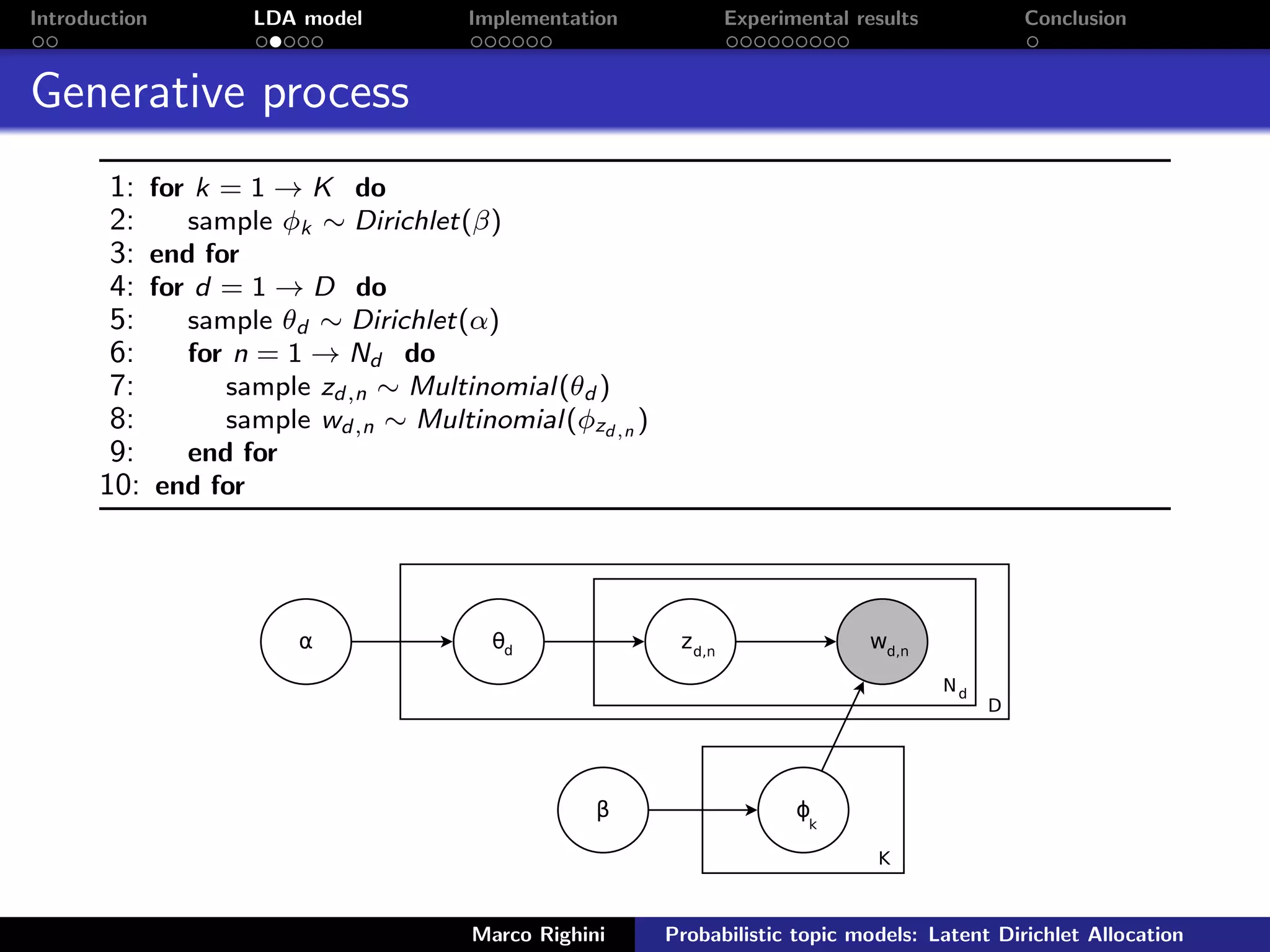
Generative process
1: for k = 1 → K do
2: sample φk ∼ Dirichlet(β)
3: end for
4: for d = 1 → D do
5: sample θd ∼ Dirichlet(α)
6: for n = 1 → Nd do
7: sample zd,n ∼ Multinomial(θd )
8: sample wd,n ∼ Multinomial(φzd,n )
9: end for
10: end for
Marco Righini Probabilistic topic models: Latent Dirichlet Allocation
Introduction LDA model Implementation Experimental results Conclusion
Dirichlet distribution
A Dirichlet distribution θ ∼ Dirichlet(α1, . . . , αK ) is a distribution
over the K-1 simplex, i.e. vectors of K components that sum to
one.
It has some important properties:
conjugate prior of categorical and multinomial distributions;
mean vector m with mi = E[θi |α1, . . . , αK ] = αi
K
k=1 αk
;
scale s = K
k=1 αk controls the peakedness around the mean.
Typically symmetric Dirichlet distribution (αi = α for
i = 1 → K) is chosen when there is no prior knowledge favoring
one component over another.
α = 1 defines an uniform distribution, α << 1 and α >> 1
respectively a sparser or more dense distribution.
Marco Righini Probabilistic topic models: Latent Dirichlet Allocation
Introduction LDA model Implementation Experimental results Conclusion
Dirichlet distribution
A Dirichlet distribution θ ∼ Dirichlet(α1, . . . , αK ) is a distribution
over the K-1 simplex, i.e. vectors of K components that sum to
one.
It has some important properties:
conjugate prior of categorical and multinomial distributions;
mean vector m with mi = E[θi |α1, . . . , αK ] = αi
K
k=1 αk
;
scale s = K
k=1 αk controls the peakedness around the mean.
Typically symmetric Dirichlet distribution (αi = α for
i = 1 → K) is chosen when there is no prior knowledge favoring
one component over another.
α = 1 defines an uniform distribution, α << 1 and α >> 1
respectively a sparser or more dense distribution.
Marco Righini Probabilistic topic models: Latent Dirichlet Allocation
Introduction LDA model Implementation Experimental results Conclusion
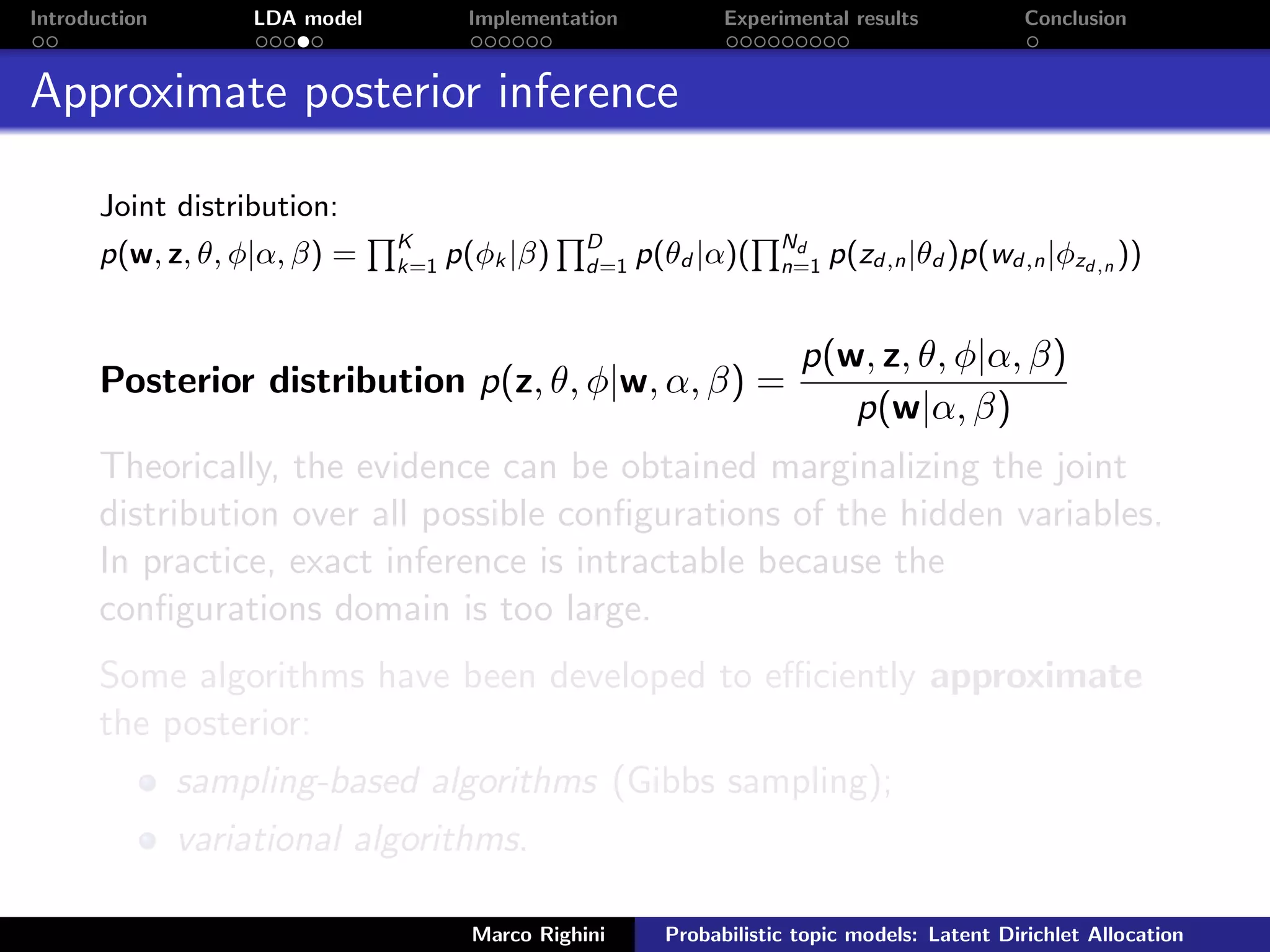
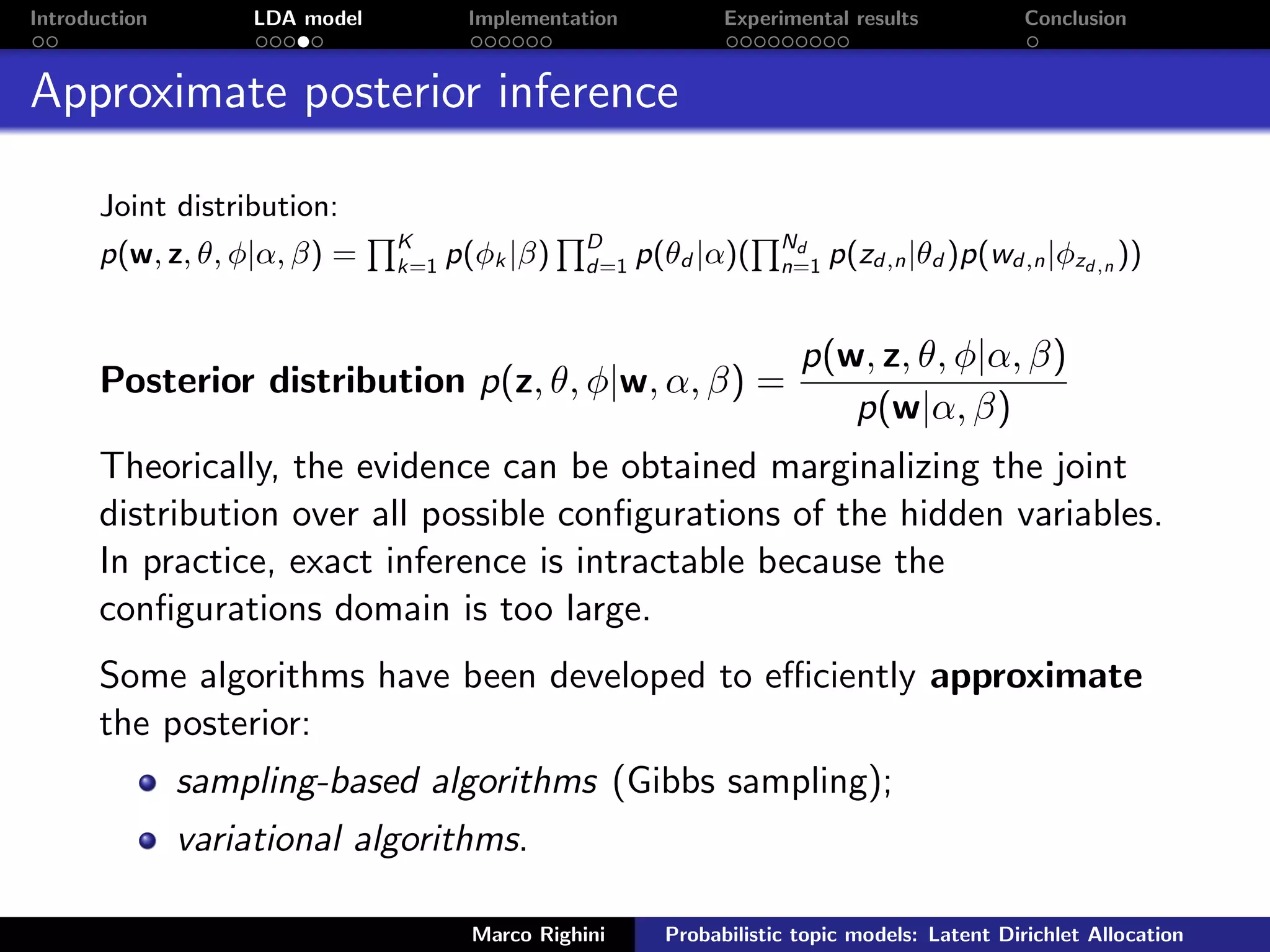
Approximate posterior inference
Joint distribution:
p(w, z, θ, φ|α, β) = K
k=1 p(φk |β) D
d=1 p(θd |α)( Nd
n=1 p(zd,n|θd )p(wd,n|φzd,n ))
Posterior distribution p(z, θ, φ|w, α, β) =
p(w, z, θ, φ|α, β)
p(w|α, β)
Theorically, the evidence can be obtained marginalizing the joint
distribution over all possible configurations of the hidden variables.
In practice, exact inference is intractable because the
configurations domain is too large.
Some algorithms have been developed to efficiently approximate
the posterior:
sampling-based algorithms (Gibbs sampling);
variational algorithms.
Marco Righini Probabilistic topic models: Latent Dirichlet Allocation
Introduction LDA model Implementation Experimental results Conclusion
Approximate posterior inference
Joint distribution:
p(w, z, θ, φ|α, β) = K
k=1 p(φk |β) D
d=1 p(θd |α)( Nd
n=1 p(zd,n|θd )p(wd,n|φzd,n ))
Posterior distribution p(z, θ, φ|w, α, β) =
p(w, z, θ, φ|α, β)
p(w|α, β)
Theorically, the evidence can be obtained marginalizing the joint
distribution over all possible configurations of the hidden variables.
In practice, exact inference is intractable because the
configurations domain is too large.
Some algorithms have been developed to efficiently approximate
the posterior:
sampling-based algorithms (Gibbs sampling);
variational algorithms.
Marco Righini Probabilistic topic models: Latent Dirichlet Allocation
Introduction LDA model Implementation Experimental results Conclusion
Approximate posterior inference
Joint distribution:
p(w, z, θ, φ|α, β) = K
k=1 p(φk |β) D
d=1 p(θd |α)( Nd
n=1 p(zd,n|θd )p(wd,n|φzd,n ))
Posterior distribution p(z, θ, φ|w, α, β) =
p(w, z, θ, φ|α, β)
p(w|α, β)
Theorically, the evidence can be obtained marginalizing the joint
distribution over all possible configurations of the hidden variables.
In practice, exact inference is intractable because the
configurations domain is too large.
Some algorithms have been developed to efficiently approximate
the posterior:
sampling-based algorithms (Gibbs sampling);
variational algorithms.
Marco Righini Probabilistic topic models: Latent Dirichlet Allocation
Introduction LDA model Implementation Experimental results Conclusion
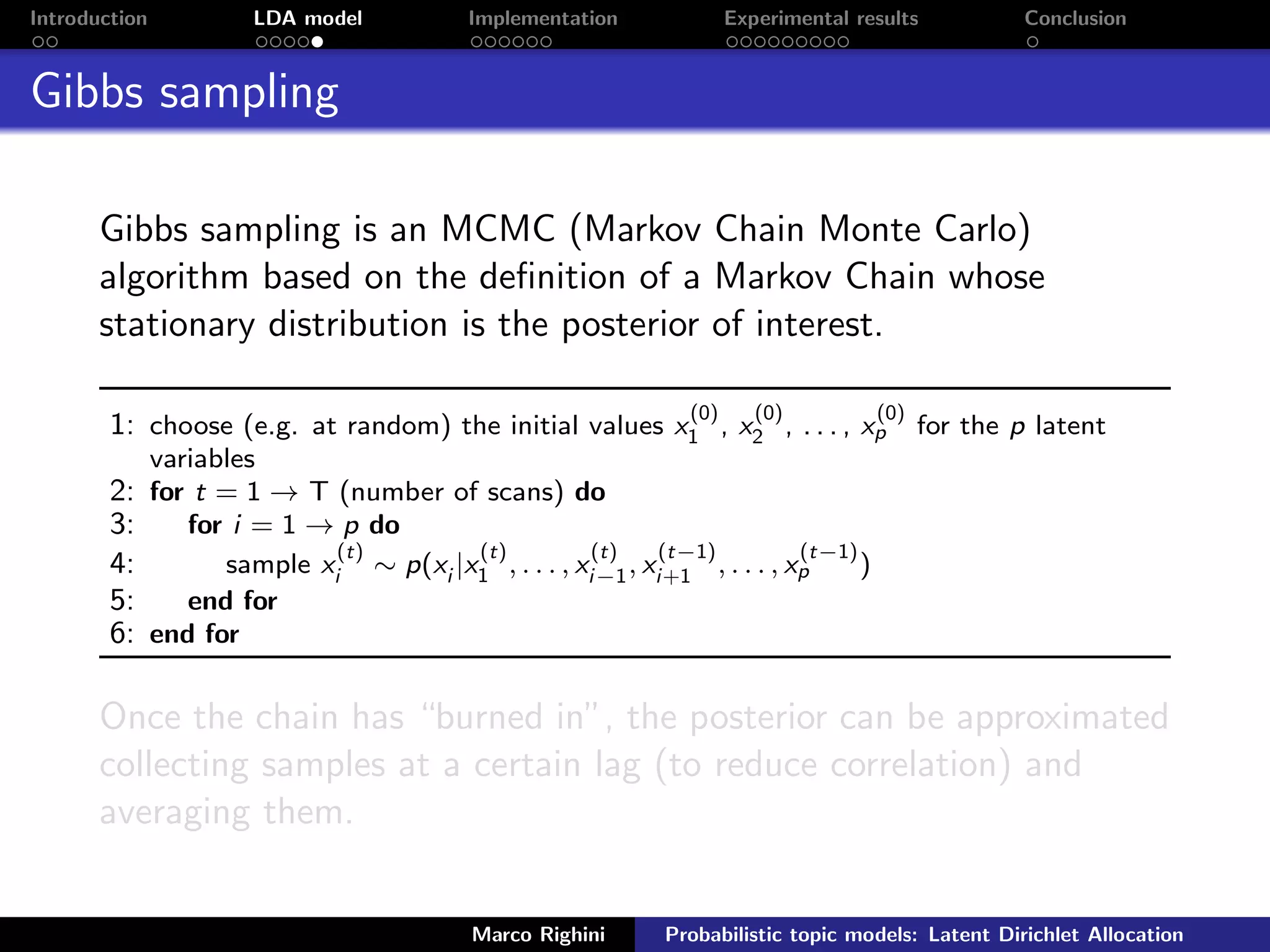
Gibbs sampling
Gibbs sampling is an MCMC (Markov Chain Monte Carlo)
algorithm based on the definition of a Markov Chain whose
stationary distribution is the posterior of interest.
1: choose (e.g. at random) the initial values x
(0)
1 , x
(0)
2 , . . . , x
(0)
p for the p latent
variables
2: for t = 1 → T (number of scans) do
3: for i = 1 → p do
4: sample x
(t)
i ∼ p(xi |x
(t)
1 , . . . , x
(t)
i−1, x
(t−1)
i+1 , . . . , x
(t−1)
p )
5: end for
6: end for
Once the chain has “burned in”, the posterior can be approximated
collecting samples at a certain lag (to reduce correlation) and
averaging them.
Marco Righini Probabilistic topic models: Latent Dirichlet Allocation
Introduction LDA model Implementation Experimental results Conclusion
Gibbs sampling
Gibbs sampling is an MCMC (Markov Chain Monte Carlo)
algorithm based on the definition of a Markov Chain whose
stationary distribution is the posterior of interest.
1: choose (e.g. at random) the initial values x
(0)
1 , x
(0)
2 , . . . , x
(0)
p for the p latent
variables
2: for t = 1 → T (number of scans) do
3: for i = 1 → p do
4: sample x
(t)
i ∼ p(xi |x
(t)
1 , . . . , x
(t)
i−1, x
(t−1)
i+1 , . . . , x
(t−1)
p )
5: end for
6: end for
Once the chain has “burned in”, the posterior can be approximated
collecting samples at a certain lag (to reduce correlation) and
averaging them.
Marco Righini Probabilistic topic models: Latent Dirichlet Allocation
Introduction LDA model Implementation Experimental results Conclusion
Implementation overview
Development has embraced the following phases:
project of the preprocessing module, including dataset format
conversion and k-fold creation;
project of the LDA module which cares about collapsed Gibbs
sampling execution and perplexity computation;
implementation.
Marco Righini Probabilistic topic models: Latent Dirichlet Allocation
Introduction LDA model Implementation Experimental results Conclusion
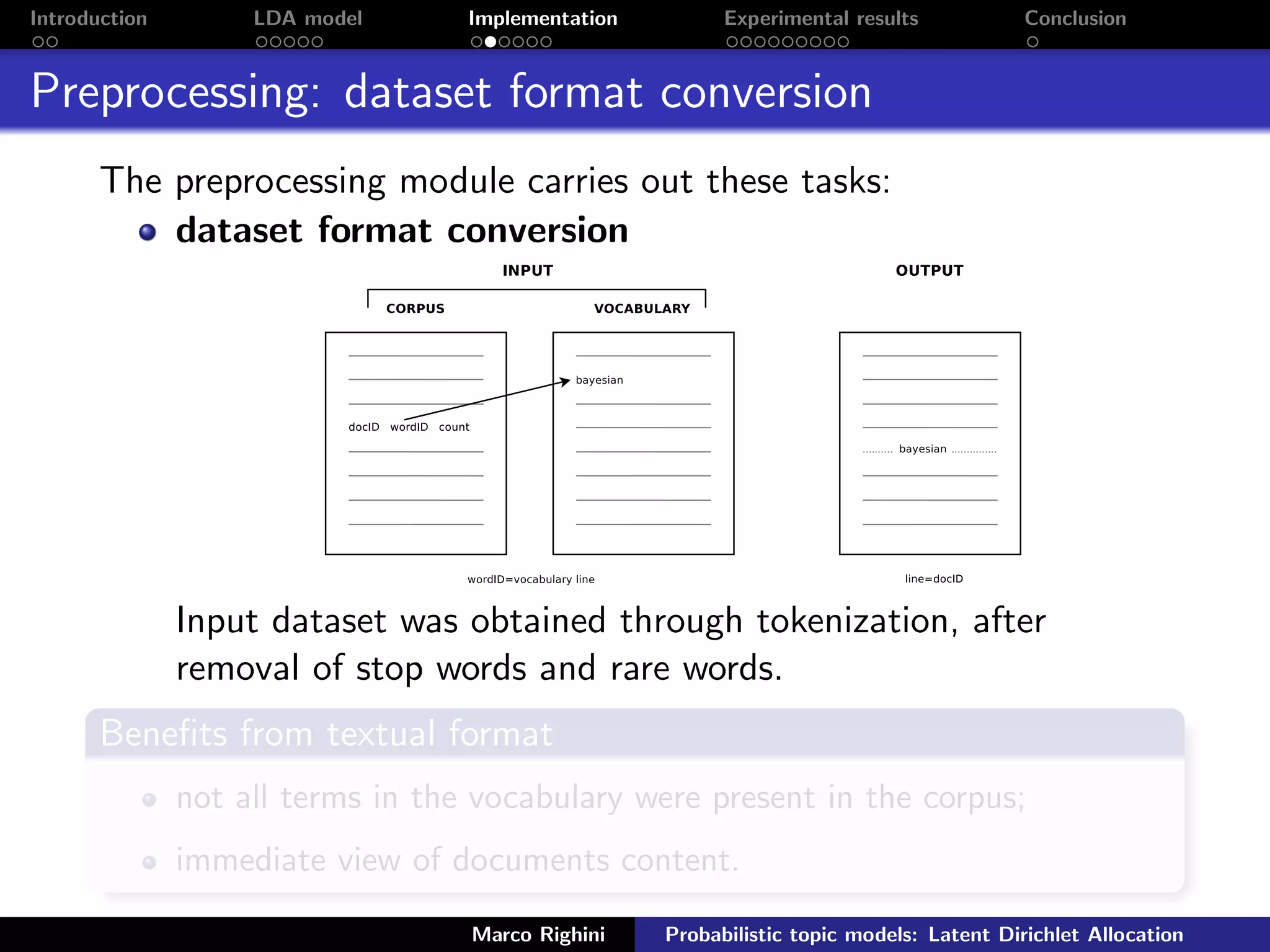
Preprocessing: dataset format conversion
The preprocessing module carries out these tasks:
dataset format conversion
Input dataset was obtained through tokenization, after
removal of stop words and rare words.
Benefits from textual format
not all terms in the vocabulary were present in the corpus;
immediate view of documents content.
Marco Righini Probabilistic topic models: Latent Dirichlet Allocation
Introduction LDA model Implementation Experimental results Conclusion
Preprocessing: dataset format conversion
The preprocessing module carries out these tasks:
dataset format conversion
Input dataset was obtained through tokenization, after
removal of stop words and rare words.
Benefits from textual format
not all terms in the vocabulary were present in the corpus;
immediate view of documents content.
Marco Righini Probabilistic topic models: Latent Dirichlet Allocation
Introduction LDA model Implementation Experimental results Conclusion
Preprocessing: k-folds and usage
k-folds creation: the documents are randomically shuffled to
prevent possible sequential correlations in the original dataset.
Afterwards, k train-validation pairs are generated.
Usage:
createKFold [-h] [--test_frac TEST_FRAC] [--k K] [--output OUTPUT] [--debug] corpus vocabulary
positional arguments:
corpus path to the corpus file
vocabulary path to the vocabulary file
optional arguments:
-h, --help show this help message and exit
--test_frac TEST_FRAC fraction of corpus documents to retain as test set (default: 0)
--k K number of folds (default: 1, no validation set)
--output OUTPUT output files directory (default: same directory of input)
--debug debug flag (default: false)
Marco Righini Probabilistic topic models: Latent Dirichlet Allocation
Introduction LDA model Implementation Experimental results Conclusion
Preprocessing: k-folds and usage
k-folds creation: the documents are randomically shuffled to
prevent possible sequential correlations in the original dataset.
Afterwards, k train-validation pairs are generated.
Usage:
createKFold [-h] [--test_frac TEST_FRAC] [--k K] [--output OUTPUT] [--debug] corpus vocabulary
positional arguments:
corpus path to the corpus file
vocabulary path to the vocabulary file
optional arguments:
-h, --help show this help message and exit
--test_frac TEST_FRAC fraction of corpus documents to retain as test set (default: 0)
--k K number of folds (default: 1, no validation set)
--output OUTPUT output files directory (default: same directory of input)
--debug debug flag (default: false)
Marco Righini Probabilistic topic models: Latent Dirichlet Allocation
Introduction LDA model Implementation Experimental results Conclusion
LDA module: collapsed Gibbs sampling
The LDA module performs two tasks:
collapsed Gibbs sampling: obtained from standard Gibbs
sampling marginalizing over θ and φ;
Data: words w ∈ documents d
Result: topic assignments z and counters nd,k, nk,w and nk
1 begin
2 randomly initialize z and increment counters;
3 foreach iteration do
4 foreach w ∈ w do
5 topic ← z[w];
6 nd,topic -=1; ntopic,w -=1; ntopic -=1;
7 for k = 0 → K-1 do
8 p(z = k|·) = (nd,k + αk )
nk,w +βw
nk +β×V
;
9 end
10 topic ← sample from p(z|·);
11 z[w] ← topic;
12 nd,topic +=1; ntopic,w +=1; ntopic +=1;
13 end
14 end
15 return z, nd,k, nk,w and nk
16 end
θd,k =
nd,k +αk
K−1
z=0 (nd,z +αz )
φk,w =
nk,w
|V |
v=1(nk,v +βv )
Marco Righini Probabilistic topic models: Latent Dirichlet Allocation
Introduction LDA model Implementation Experimental results Conclusion
LDA module: perplexity computation
perplexity computation: perplexity is an indicator of the
generalization performance of a model;
Given a new set of documents Dnew
perpl(Dnew ) = exp −
log(p(wnew|φ))
nnew
where
log(p(wnew|φ)) =
|Dnew |
d=1 w∈D
(d)
new
log(p(w|φ)) =
=
|Dnew |
d=1 w∈D
(d)
new
log
z
p(w|z, φ)p(z) =
|Dnew |
d=1 w∈D
(d)
new
log
K−1
k=0
φk,w θd,k
θ for the new documents is obtained running collapsed Gibbs sampling on a new
Markov Chain where the previously inferred counters nk,w and nk (i.e. φ) are
considered fixed.
Marco Righini Probabilistic topic models: Latent Dirichlet Allocation
Introduction LDA model Implementation Experimental results Conclusion
LDA module: perplexity computation
perplexity computation: perplexity is an indicator of the
generalization performance of a model;
Given a new set of documents Dnew
perpl(Dnew ) = exp −
log(p(wnew|φ))
nnew
where
log(p(wnew|φ)) =
|Dnew |
d=1 w∈D
(d)
new
log(p(w|φ)) =
=
|Dnew |
d=1 w∈D
(d)
new
log
z
p(w|z, φ)p(z) =
|Dnew |
d=1 w∈D
(d)
new
log
K−1
k=0
φk,w θd,k
θ for the new documents is obtained running collapsed Gibbs sampling on a new
Markov Chain where the previously inferred counters nk,w and nk (i.e. φ) are
considered fixed.
Marco Righini Probabilistic topic models: Latent Dirichlet Allocation
Introduction LDA model Implementation Experimental results Conclusion
LDA module: usage
Usage:
lda [-h] [--validation VALIDATION] [--output OUTPUT] [--topics TOPICS] [--alpha ALPHA] [--beta BETA]
[--iters ITERS] [--burnin BURNIN] [--savestep SAVESTEP] [--topwords TOPWORDS] [--perplexity]
[--export_complete] --train TRAIN
Option arguments:
-h [ --help ] print usage messages
-t [ --train ] arg path to training set file
-v [ --validation ] arg path to validation set file (default: none). Needed if perplexity flag setted
-o [ --output ] arg output files directory (default: same directory of input)
--topics arg number of topics (default: 100)
--alpha arg alpha hyperparameter value (default: 0.05*averageDocumentLength/#topics)
--beta arg beta hyperparameter value (default: 200/#wordsInVocabulary)
--iters arg number of Gibbs sampling iterations (default: 1000)
--burnin arg number of Gibbs sampling iterations considered burnin (default: iters/2)
--savestep arg step at which LDA is saved to harddisk (default: (iters-burnin)/10)
--topwords arg number of top words to show for each topic (default: 20)
--perplexity exports only perplexity (default: false, export variables). Needs validation
--export_complete exports all variables (default: false, export only topwords)
Marco Righini Probabilistic topic models: Latent Dirichlet Allocation
Introduction LDA model Implementation Experimental results Conclusion
Execution time
In the beginning, LDA module was implemented in Python
language.
At execution time, it turned out to be too much time consuming
also vectorializing the operations (over 4 minutes per iteration in a
medium level configuration).
Therefore, implementation moved to C++ language.
Timing: C++ vs Python
C++ implementation is approximately eleven time faster than
Python one.
Marco Righini Probabilistic topic models: Latent Dirichlet Allocation
Introduction LDA model Implementation Experimental results Conclusion
Execution time
In the beginning, LDA module was implemented in Python
language.
At execution time, it turned out to be too much time consuming
also vectorializing the operations (over 4 minutes per iteration in a
medium level configuration).
Therefore, implementation moved to C++ language.
Timing: C++ vs Python
C++ implementation is approximately eleven time faster than
Python one.
Marco Righini Probabilistic topic models: Latent Dirichlet Allocation
Introduction LDA model Implementation Experimental results Conclusion
Tests overview
Three datasets were selected for tests:
KOS: set of 3430 blog entries from dailykos.com, an
american political blog. Total number of words is 467714;
NIPS: set of 1500 papers from NIPS conferences, for a sum
of 1932365 words;
ENRON: set of 39861 emails from Enron Corp, for an
aggregate of 6412172 words.
For every dataset, tests concerned the following steps:
1 models evaluation: models, corresponding to different values
of topic number, were defined and then 4-fold cross-validated;
2 test on the whole dataset: model with best performance
was qualitatively selected and next applied to the whole
dataset.
Marco Righini Probabilistic topic models: Latent Dirichlet Allocation
Introduction LDA model Implementation Experimental results Conclusion
Tests overview
Three datasets were selected for tests:
KOS: set of 3430 blog entries from dailykos.com, an
american political blog. Total number of words is 467714;
NIPS: set of 1500 papers from NIPS conferences, for a sum
of 1932365 words;
ENRON: set of 39861 emails from Enron Corp, for an
aggregate of 6412172 words.
For every dataset, tests concerned the following steps:
1 models evaluation: models, corresponding to different values
of topic number, were defined and then 4-fold cross-validated;
2 test on the whole dataset: model with best performance
was qualitatively selected and next applied to the whole
dataset.
Marco Righini Probabilistic topic models: Latent Dirichlet Allocation
Introduction LDA model Implementation Experimental results Conclusion
Tests: cross-validation
During the k-th step of 4-fold cross-validation, collapsed Gibbs
sampling is executed on the k-th training set of documents.
At regular intervals, perplexity is computed on the k-th validation
set.
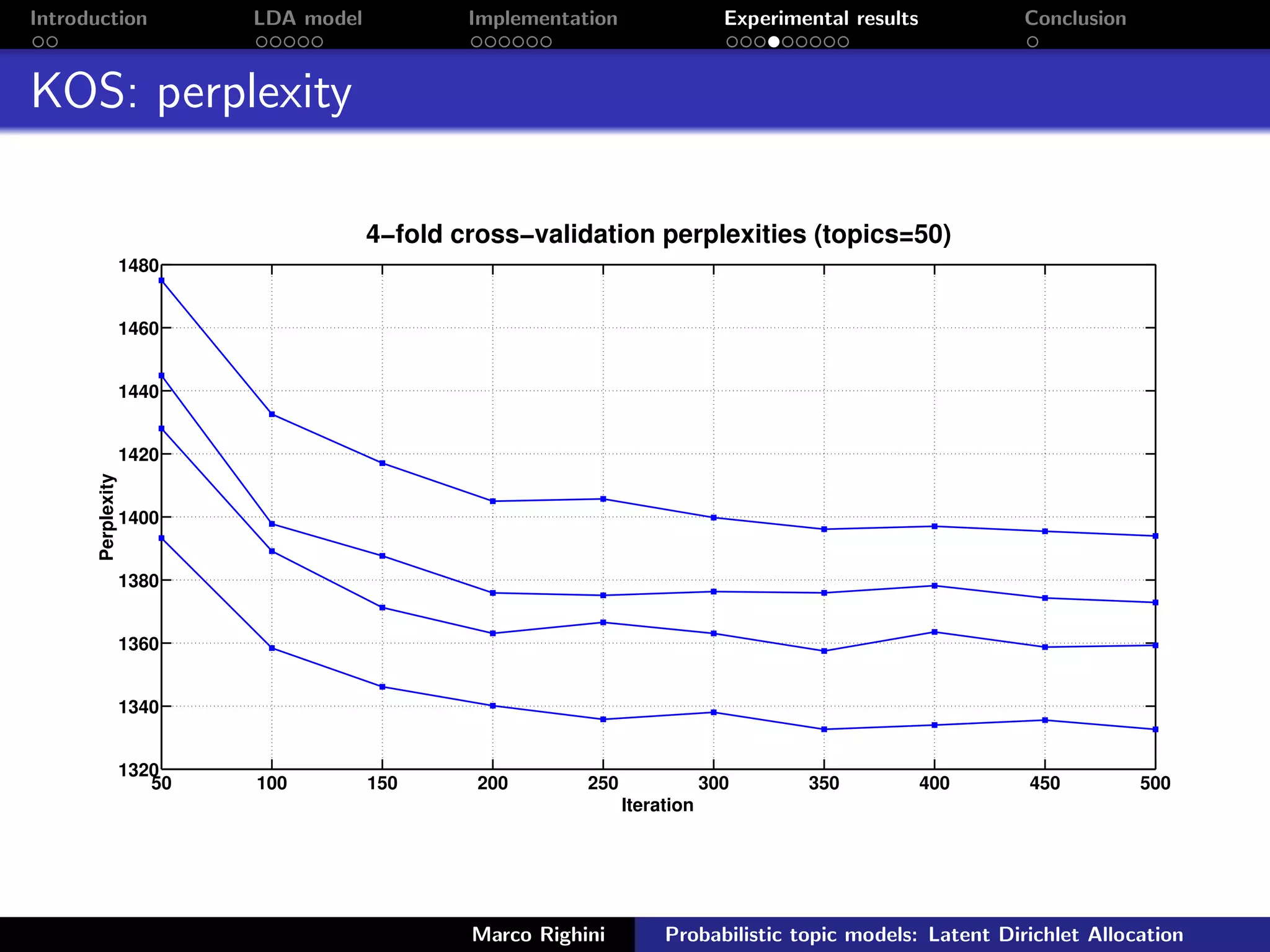
Convergence assessment
Convergence of collapsed Gibbs sampling is assessed through the
perplexity on the validation set.
Marco Righini Probabilistic topic models: Latent Dirichlet Allocation
Introduction LDA model Implementation Experimental results Conclusion
Tests: cross-validation
During the k-th step of 4-fold cross-validation, collapsed Gibbs
sampling is executed on the k-th training set of documents.
At regular intervals, perplexity is computed on the k-th validation
set.
Convergence assessment
Convergence of collapsed Gibbs sampling is assessed through the
perplexity on the validation set.
Marco Righini Probabilistic topic models: Latent Dirichlet Allocation
Introduction LDA model Implementation Experimental results Conclusion
KOS: perplexity
50 100 150 200 250 300 350 400 450 500
1320
1340
1360
1380
1400
1420
1440
1460
1480
Iteration
Perplexity
4−fold cross−validation perplexities (topics=50)
Marco Righini Probabilistic topic models: Latent Dirichlet Allocation
Introduction LDA model Implementation Experimental results Conclusion
KOS: topics
million
money
democratic
campaign
party
dnc
raised
candidates
fundraising
national
kerry
john
edwards
democratic
general
presidential
kerrys
party
campaign
choice
november
voting
election
house
governor
account
electoral
republicans
senate
poll
military
abu
rumsfeld
ghraib
war
iraq
prisoners
prison
soldiers
abuse
iraq
war
weapons
bush
saddam
united
mass
threat
hussein
powell
cheney
bush
president
vice
dick
administration
general
lies
cheneys
truth
marriage
rights
gay
amendment
issue
law
abortion
ban
civil
constitution
investigation
law
federal
justice
documents
attorney
criminal
evidence
allegations
source
jobs
economy
economic
growth
job
rate
numbers
year
report
million
media
news
times
press
read
article
washington
papers
local
piece
Marco Righini Probabilistic topic models: Latent Dirichlet Allocation
Introduction LDA model Implementation Experimental results Conclusion
NIPS: perplexity
80 160 240 320 400 480 560 640 720 800
1400
1410
1420
1430
1440
1450
1460
1470
1480
1490
Iteration
Perplexity
4−fold cross−validation perplexities (topics=100)
Marco Righini Probabilistic topic models: Latent Dirichlet Allocation
Introduction LDA model Implementation Experimental results Conclusion
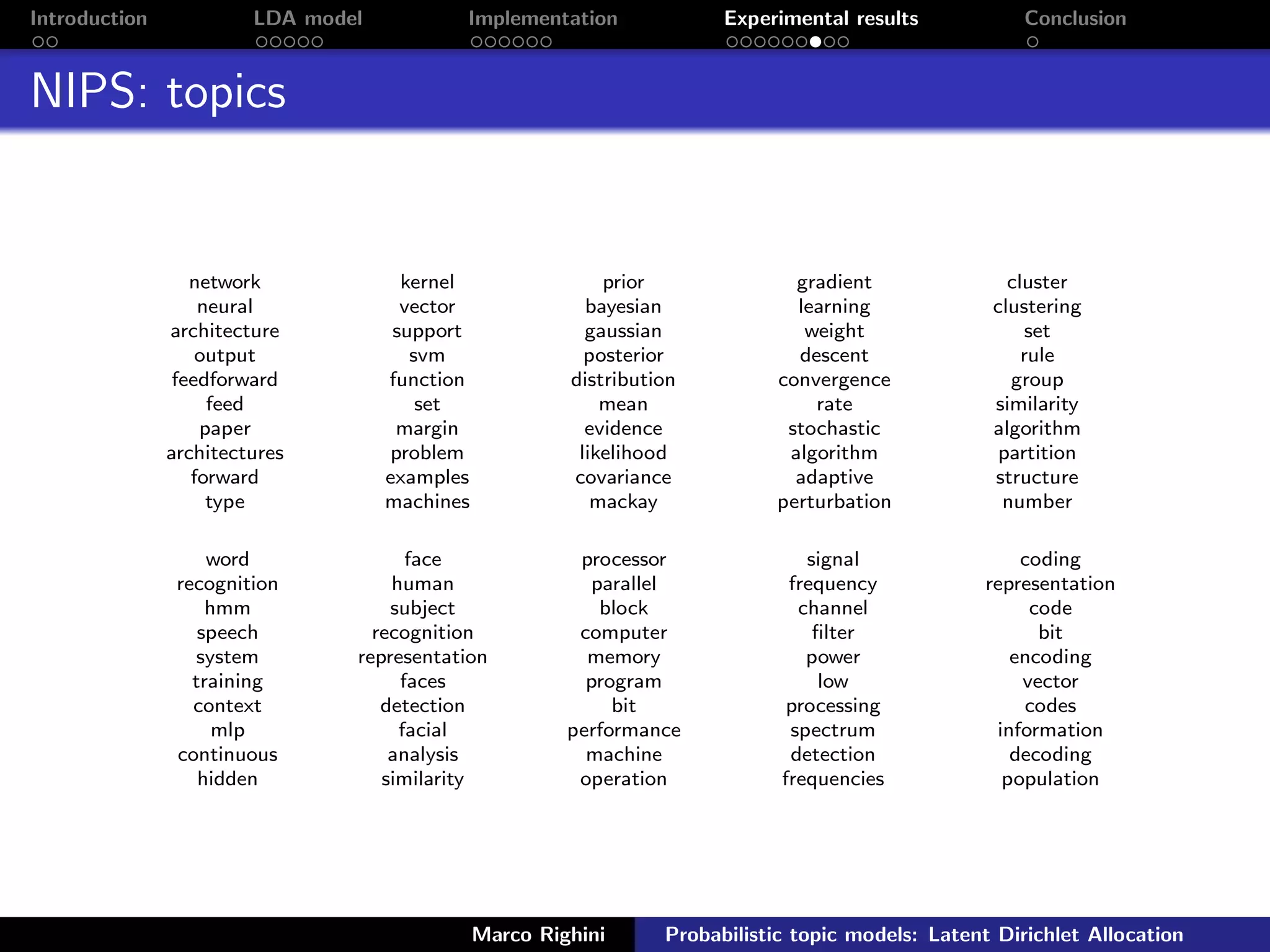
NIPS: topics
network
neural
architecture
output
feedforward
feed
paper
architectures
forward
type
kernel
vector
support
svm
function
set
margin
problem
examples
machines
prior
bayesian
gaussian
posterior
distribution
mean
evidence
likelihood
covariance
mackay
gradient
learning
weight
descent
convergence
rate
stochastic
algorithm
adaptive
perturbation
cluster
clustering
set
rule
group
similarity
algorithm
partition
structure
number
word
recognition
hmm
speech
system
training
context
mlp
continuous
hidden
face
human
subject
recognition
representation
faces
detection
facial
analysis
similarity
processor
parallel
block
computer
memory
program
bit
performance
machine
operation
signal
frequency
channel
filter
power
low
processing
spectrum
detection
frequencies
coding
representation
code
bit
encoding
vector
codes
information
decoding
population
Marco Righini Probabilistic topic models: Latent Dirichlet Allocation
Introduction LDA model Implementation Experimental results Conclusion
ENRON: perplexity
100 200 300 400 500 600 700 800 900 1000
2040
2060
2080
2100
2120
2140
2160
2180
2200
Iteration
Perplexity
4−fold cross−validation perplexities (topics=50)
Marco Righini Probabilistic topic models: Latent Dirichlet Allocation
Introduction LDA model Implementation Experimental results Conclusion
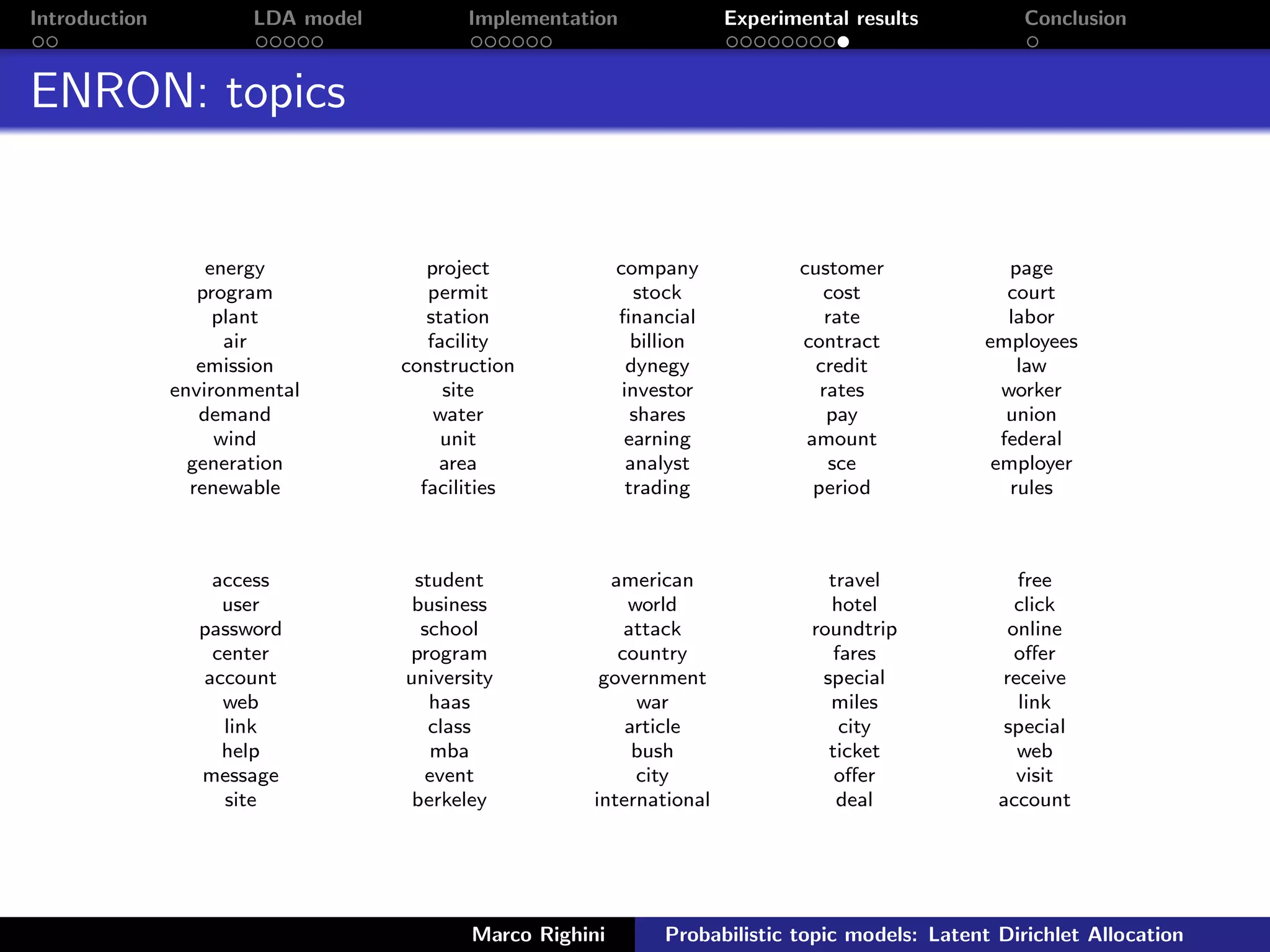
ENRON: topics
energy
program
plant
air
emission
environmental
demand
wind
generation
renewable
project
permit
station
facility
construction
site
water
unit
area
facilities
company
stock
financial
billion
dynegy
investor
shares
earning
analyst
trading
customer
cost
rate
contract
credit
rates
pay
amount
sce
period
page
court
labor
employees
law
worker
union
federal
employer
rules
access
user
password
center
account
web
link
help
message
site
student
business
school
program
university
haas
class
mba
event
berkeley
american
world
attack
country
government
war
article
bush
city
international
travel
hotel
roundtrip
fares
special
miles
city
ticket
offer
deal
free
click
online
offer
receive
link
special
web
visit
account
Marco Righini Probabilistic topic models: Latent Dirichlet Allocation
Introduction LDA model Implementation Experimental results Conclusion
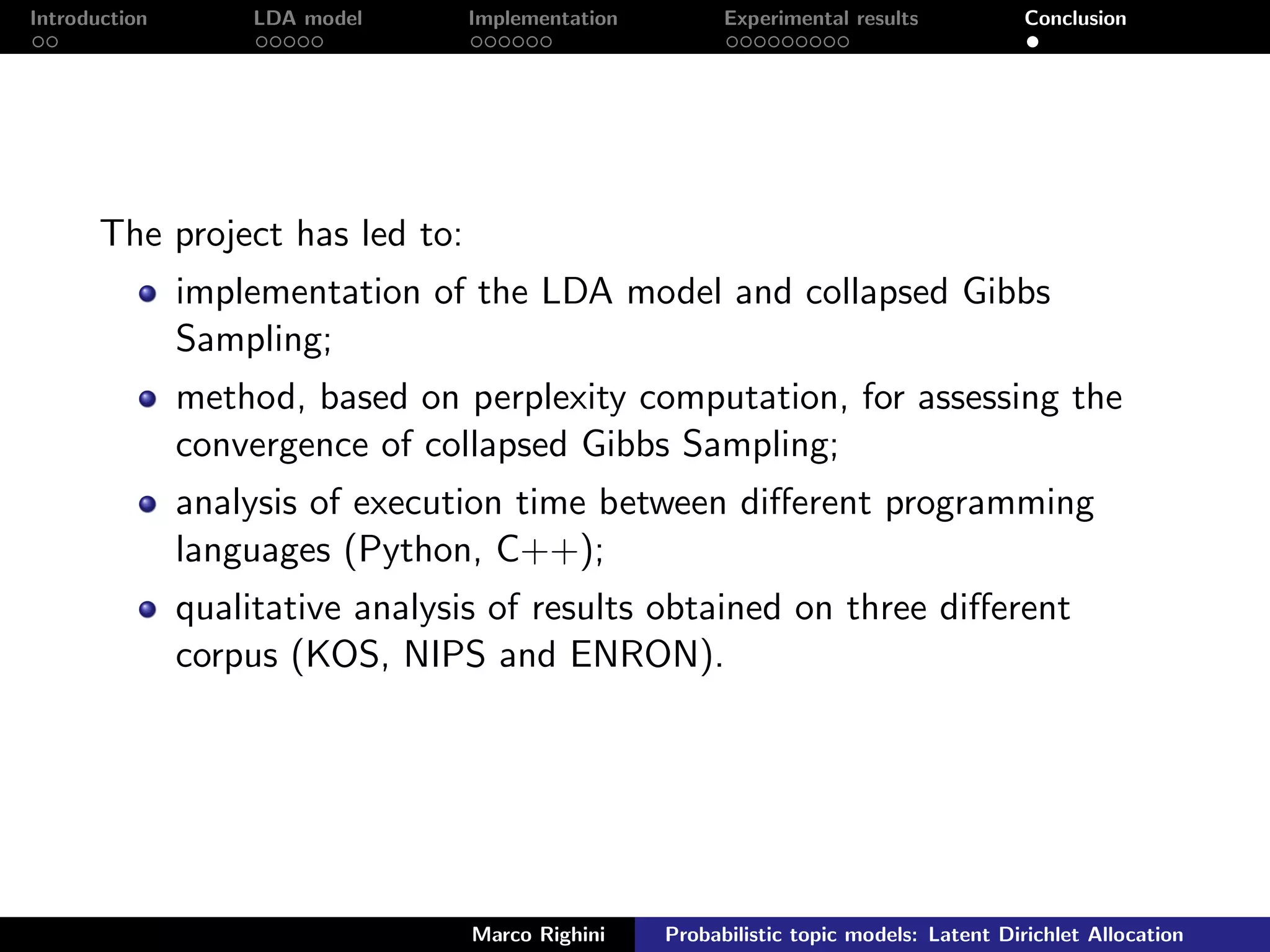
The project has led to:
implementation of the LDA model and collapsed Gibbs
Sampling;
method, based on perplexity computation, for assessing the
convergence of collapsed Gibbs Sampling;
analysis of execution time between different programming
languages (Python, C++);
qualitative analysis of results obtained on three different
corpus (KOS, NIPS and ENRON).
Marco Righini Probabilistic topic models: Latent Dirichlet Allocation
Introduction LDA model Implementation Experimental results Conclusion
25 50 100 150 200
1100
1150
1200
1250
1300
1350
1400
1450
1500
1550
topics
perplexity
KOS: perplexities (mean of cross−validation) for different # topics
Marco Righini Probabilistic topic models: Latent Dirichlet Allocation

Latent Dirichlet Allocation

  • 1.
    Introduction LDA modelImplementation Experimental results Conclusion Universit`a degli Studi di Firenze Facolt`a di Ingegneria Probabilistic topic models: Latent Dirichlet Allocation Marco Righini 21 Febbraio 2013 Marco Righini Probabilistic topic models: Latent Dirichlet Allocation
  • 2.
    Introduction LDA modelImplementation Experimental results Conclusion Probabilistic topic models Collective knowledge (scientific articles, books, images. . . ) continues to be digitized and stored. Growing interest in tools for understanding, organizing and searching information in these vast domains. Topic models Statistical models that analyze the words of documents to discover the hidden thematic structure and annotate the documents according to that, through an unsupervised approach. Marco Righini Probabilistic topic models: Latent Dirichlet Allocation
  • 3.
    Introduction LDA modelImplementation Experimental results Conclusion Probabilistic topic models Collective knowledge (scientific articles, books, images. . . ) continues to be digitized and stored. Growing interest in tools for understanding, organizing and searching information in these vast domains. Topic models Statistical models that analyze the words of documents to discover the hidden thematic structure and annotate the documents according to that, through an unsupervised approach. Marco Righini Probabilistic topic models: Latent Dirichlet Allocation
  • 4.
    Introduction LDA modelImplementation Experimental results Conclusion Precursors of LDA TF-IDF [Salton et Gills, 1983] : identifies sets of words discriminative for a set of documents but doesn’t reveal too much of inter or intra documents statistical relations; LSI [Deerwester et al., 1990] : based on SVD of TF-IDF matrix, derived features can capture some basic linguistic notions such as synonimy and polysemy; pLSI [Hofmann, 1999] : documents are reduced to a probability distribution on a fixed set of topics. Still there’s no generative probabilistic model at level of documents. Marco Righini Probabilistic topic models: Latent Dirichlet Allocation
  • 5.
    Introduction LDA modelImplementation Experimental results Conclusion Basic intuition Assumptions of dimensionality reduction methods: exchangeability of words in a document and of documents in the corpus. Theorem (De Finetti). Any collection of infinitely exchangeable random variables has a representation as mixture distribution. Idea [Blei, Ng and Jordan, 2003] Represent documents as random mixture over latent topics and each topic as a distribution over terms. Marco Righini Probabilistic topic models: Latent Dirichlet Allocation
  • 6.
    Introduction LDA modelImplementation Experimental results Conclusion Basic intuition Assumptions of dimensionality reduction methods: exchangeability of words in a document and of documents in the corpus. Theorem (De Finetti). Any collection of infinitely exchangeable random variables has a representation as mixture distribution. Idea [Blei, Ng and Jordan, 2003] Represent documents as random mixture over latent topics and each topic as a distribution over terms. Marco Righini Probabilistic topic models: Latent Dirichlet Allocation
  • 7.
    Introduction LDA modelImplementation Experimental results Conclusion Generative process 1: for k = 1 → K do 2: sample φk ∼ Dirichlet(β) 3: end for 4: for d = 1 → D do 5: sample θd ∼ Dirichlet(α) 6: for n = 1 → Nd do 7: sample zd,n ∼ Multinomial(θd ) 8: sample wd,n ∼ Multinomial(φzd,n ) 9: end for 10: end for Marco Righini Probabilistic topic models: Latent Dirichlet Allocation
  • 8.
    Introduction LDA modelImplementation Experimental results Conclusion Dirichlet distribution A Dirichlet distribution θ ∼ Dirichlet(α1, . . . , αK ) is a distribution over the K-1 simplex, i.e. vectors of K components that sum to one. It has some important properties: conjugate prior of categorical and multinomial distributions; mean vector m with mi = E[θi |α1, . . . , αK ] = αi K k=1 αk ; scale s = K k=1 αk controls the peakedness around the mean. Typically symmetric Dirichlet distribution (αi = α for i = 1 → K) is chosen when there is no prior knowledge favoring one component over another. α = 1 defines an uniform distribution, α << 1 and α >> 1 respectively a sparser or more dense distribution. Marco Righini Probabilistic topic models: Latent Dirichlet Allocation
  • 9.
    Introduction LDA modelImplementation Experimental results Conclusion Dirichlet distribution A Dirichlet distribution θ ∼ Dirichlet(α1, . . . , αK ) is a distribution over the K-1 simplex, i.e. vectors of K components that sum to one. It has some important properties: conjugate prior of categorical and multinomial distributions; mean vector m with mi = E[θi |α1, . . . , αK ] = αi K k=1 αk ; scale s = K k=1 αk controls the peakedness around the mean. Typically symmetric Dirichlet distribution (αi = α for i = 1 → K) is chosen when there is no prior knowledge favoring one component over another. α = 1 defines an uniform distribution, α << 1 and α >> 1 respectively a sparser or more dense distribution. Marco Righini Probabilistic topic models: Latent Dirichlet Allocation
  • 10.
    Introduction LDA modelImplementation Experimental results Conclusion Approximate posterior inference Joint distribution: p(w, z, θ, φ|α, β) = K k=1 p(φk |β) D d=1 p(θd |α)( Nd n=1 p(zd,n|θd )p(wd,n|φzd,n )) Posterior distribution p(z, θ, φ|w, α, β) = p(w, z, θ, φ|α, β) p(w|α, β) Theorically, the evidence can be obtained marginalizing the joint distribution over all possible configurations of the hidden variables. In practice, exact inference is intractable because the configurations domain is too large. Some algorithms have been developed to efficiently approximate the posterior: sampling-based algorithms (Gibbs sampling); variational algorithms. Marco Righini Probabilistic topic models: Latent Dirichlet Allocation
  • 11.
    Introduction LDA modelImplementation Experimental results Conclusion Approximate posterior inference Joint distribution: p(w, z, θ, φ|α, β) = K k=1 p(φk |β) D d=1 p(θd |α)( Nd n=1 p(zd,n|θd )p(wd,n|φzd,n )) Posterior distribution p(z, θ, φ|w, α, β) = p(w, z, θ, φ|α, β) p(w|α, β) Theorically, the evidence can be obtained marginalizing the joint distribution over all possible configurations of the hidden variables. In practice, exact inference is intractable because the configurations domain is too large. Some algorithms have been developed to efficiently approximate the posterior: sampling-based algorithms (Gibbs sampling); variational algorithms. Marco Righini Probabilistic topic models: Latent Dirichlet Allocation
  • 12.
    Introduction LDA modelImplementation Experimental results Conclusion Approximate posterior inference Joint distribution: p(w, z, θ, φ|α, β) = K k=1 p(φk |β) D d=1 p(θd |α)( Nd n=1 p(zd,n|θd )p(wd,n|φzd,n )) Posterior distribution p(z, θ, φ|w, α, β) = p(w, z, θ, φ|α, β) p(w|α, β) Theorically, the evidence can be obtained marginalizing the joint distribution over all possible configurations of the hidden variables. In practice, exact inference is intractable because the configurations domain is too large. Some algorithms have been developed to efficiently approximate the posterior: sampling-based algorithms (Gibbs sampling); variational algorithms. Marco Righini Probabilistic topic models: Latent Dirichlet Allocation
  • 13.
    Introduction LDA modelImplementation Experimental results Conclusion Gibbs sampling Gibbs sampling is an MCMC (Markov Chain Monte Carlo) algorithm based on the definition of a Markov Chain whose stationary distribution is the posterior of interest. 1: choose (e.g. at random) the initial values x (0) 1 , x (0) 2 , . . . , x (0) p for the p latent variables 2: for t = 1 → T (number of scans) do 3: for i = 1 → p do 4: sample x (t) i ∼ p(xi |x (t) 1 , . . . , x (t) i−1, x (t−1) i+1 , . . . , x (t−1) p ) 5: end for 6: end for Once the chain has “burned in”, the posterior can be approximated collecting samples at a certain lag (to reduce correlation) and averaging them. Marco Righini Probabilistic topic models: Latent Dirichlet Allocation
  • 14.
    Introduction LDA modelImplementation Experimental results Conclusion Gibbs sampling Gibbs sampling is an MCMC (Markov Chain Monte Carlo) algorithm based on the definition of a Markov Chain whose stationary distribution is the posterior of interest. 1: choose (e.g. at random) the initial values x (0) 1 , x (0) 2 , . . . , x (0) p for the p latent variables 2: for t = 1 → T (number of scans) do 3: for i = 1 → p do 4: sample x (t) i ∼ p(xi |x (t) 1 , . . . , x (t) i−1, x (t−1) i+1 , . . . , x (t−1) p ) 5: end for 6: end for Once the chain has “burned in”, the posterior can be approximated collecting samples at a certain lag (to reduce correlation) and averaging them. Marco Righini Probabilistic topic models: Latent Dirichlet Allocation
  • 15.
    Introduction LDA modelImplementation Experimental results Conclusion Implementation overview Development has embraced the following phases: project of the preprocessing module, including dataset format conversion and k-fold creation; project of the LDA module which cares about collapsed Gibbs sampling execution and perplexity computation; implementation. Marco Righini Probabilistic topic models: Latent Dirichlet Allocation
  • 16.
    Introduction LDA modelImplementation Experimental results Conclusion Preprocessing: dataset format conversion The preprocessing module carries out these tasks: dataset format conversion Input dataset was obtained through tokenization, after removal of stop words and rare words. Benefits from textual format not all terms in the vocabulary were present in the corpus; immediate view of documents content. Marco Righini Probabilistic topic models: Latent Dirichlet Allocation
  • 17.
    Introduction LDA modelImplementation Experimental results Conclusion Preprocessing: dataset format conversion The preprocessing module carries out these tasks: dataset format conversion Input dataset was obtained through tokenization, after removal of stop words and rare words. Benefits from textual format not all terms in the vocabulary were present in the corpus; immediate view of documents content. Marco Righini Probabilistic topic models: Latent Dirichlet Allocation
  • 18.
    Introduction LDA modelImplementation Experimental results Conclusion Preprocessing: k-folds and usage k-folds creation: the documents are randomically shuffled to prevent possible sequential correlations in the original dataset. Afterwards, k train-validation pairs are generated. Usage: createKFold [-h] [--test_frac TEST_FRAC] [--k K] [--output OUTPUT] [--debug] corpus vocabulary positional arguments: corpus path to the corpus file vocabulary path to the vocabulary file optional arguments: -h, --help show this help message and exit --test_frac TEST_FRAC fraction of corpus documents to retain as test set (default: 0) --k K number of folds (default: 1, no validation set) --output OUTPUT output files directory (default: same directory of input) --debug debug flag (default: false) Marco Righini Probabilistic topic models: Latent Dirichlet Allocation
  • 19.
    Introduction LDA modelImplementation Experimental results Conclusion Preprocessing: k-folds and usage k-folds creation: the documents are randomically shuffled to prevent possible sequential correlations in the original dataset. Afterwards, k train-validation pairs are generated. Usage: createKFold [-h] [--test_frac TEST_FRAC] [--k K] [--output OUTPUT] [--debug] corpus vocabulary positional arguments: corpus path to the corpus file vocabulary path to the vocabulary file optional arguments: -h, --help show this help message and exit --test_frac TEST_FRAC fraction of corpus documents to retain as test set (default: 0) --k K number of folds (default: 1, no validation set) --output OUTPUT output files directory (default: same directory of input) --debug debug flag (default: false) Marco Righini Probabilistic topic models: Latent Dirichlet Allocation
  • 20.
    Introduction LDA modelImplementation Experimental results Conclusion LDA module: collapsed Gibbs sampling The LDA module performs two tasks: collapsed Gibbs sampling: obtained from standard Gibbs sampling marginalizing over θ and φ; Data: words w ∈ documents d Result: topic assignments z and counters nd,k, nk,w and nk 1 begin 2 randomly initialize z and increment counters; 3 foreach iteration do 4 foreach w ∈ w do 5 topic ← z[w]; 6 nd,topic -=1; ntopic,w -=1; ntopic -=1; 7 for k = 0 → K-1 do 8 p(z = k|·) = (nd,k + αk ) nk,w +βw nk +β×V ; 9 end 10 topic ← sample from p(z|·); 11 z[w] ← topic; 12 nd,topic +=1; ntopic,w +=1; ntopic +=1; 13 end 14 end 15 return z, nd,k, nk,w and nk 16 end θd,k = nd,k +αk K−1 z=0 (nd,z +αz ) φk,w = nk,w |V | v=1(nk,v +βv ) Marco Righini Probabilistic topic models: Latent Dirichlet Allocation
  • 21.
    Introduction LDA modelImplementation Experimental results Conclusion LDA module: perplexity computation perplexity computation: perplexity is an indicator of the generalization performance of a model; Given a new set of documents Dnew perpl(Dnew ) = exp − log(p(wnew|φ)) nnew where log(p(wnew|φ)) = |Dnew | d=1 w∈D (d) new log(p(w|φ)) = = |Dnew | d=1 w∈D (d) new log z p(w|z, φ)p(z) = |Dnew | d=1 w∈D (d) new log K−1 k=0 φk,w θd,k θ for the new documents is obtained running collapsed Gibbs sampling on a new Markov Chain where the previously inferred counters nk,w and nk (i.e. φ) are considered fixed. Marco Righini Probabilistic topic models: Latent Dirichlet Allocation
  • 22.
    Introduction LDA modelImplementation Experimental results Conclusion LDA module: perplexity computation perplexity computation: perplexity is an indicator of the generalization performance of a model; Given a new set of documents Dnew perpl(Dnew ) = exp − log(p(wnew|φ)) nnew where log(p(wnew|φ)) = |Dnew | d=1 w∈D (d) new log(p(w|φ)) = = |Dnew | d=1 w∈D (d) new log z p(w|z, φ)p(z) = |Dnew | d=1 w∈D (d) new log K−1 k=0 φk,w θd,k θ for the new documents is obtained running collapsed Gibbs sampling on a new Markov Chain where the previously inferred counters nk,w and nk (i.e. φ) are considered fixed. Marco Righini Probabilistic topic models: Latent Dirichlet Allocation
  • 23.
    Introduction LDA modelImplementation Experimental results Conclusion LDA module: usage Usage: lda [-h] [--validation VALIDATION] [--output OUTPUT] [--topics TOPICS] [--alpha ALPHA] [--beta BETA] [--iters ITERS] [--burnin BURNIN] [--savestep SAVESTEP] [--topwords TOPWORDS] [--perplexity] [--export_complete] --train TRAIN Option arguments: -h [ --help ] print usage messages -t [ --train ] arg path to training set file -v [ --validation ] arg path to validation set file (default: none). Needed if perplexity flag setted -o [ --output ] arg output files directory (default: same directory of input) --topics arg number of topics (default: 100) --alpha arg alpha hyperparameter value (default: 0.05*averageDocumentLength/#topics) --beta arg beta hyperparameter value (default: 200/#wordsInVocabulary) --iters arg number of Gibbs sampling iterations (default: 1000) --burnin arg number of Gibbs sampling iterations considered burnin (default: iters/2) --savestep arg step at which LDA is saved to harddisk (default: (iters-burnin)/10) --topwords arg number of top words to show for each topic (default: 20) --perplexity exports only perplexity (default: false, export variables). Needs validation --export_complete exports all variables (default: false, export only topwords) Marco Righini Probabilistic topic models: Latent Dirichlet Allocation
  • 24.
    Introduction LDA modelImplementation Experimental results Conclusion Execution time In the beginning, LDA module was implemented in Python language. At execution time, it turned out to be too much time consuming also vectorializing the operations (over 4 minutes per iteration in a medium level configuration). Therefore, implementation moved to C++ language. Timing: C++ vs Python C++ implementation is approximately eleven time faster than Python one. Marco Righini Probabilistic topic models: Latent Dirichlet Allocation
  • 25.
    Introduction LDA modelImplementation Experimental results Conclusion Execution time In the beginning, LDA module was implemented in Python language. At execution time, it turned out to be too much time consuming also vectorializing the operations (over 4 minutes per iteration in a medium level configuration). Therefore, implementation moved to C++ language. Timing: C++ vs Python C++ implementation is approximately eleven time faster than Python one. Marco Righini Probabilistic topic models: Latent Dirichlet Allocation
  • 26.
    Introduction LDA modelImplementation Experimental results Conclusion Tests overview Three datasets were selected for tests: KOS: set of 3430 blog entries from dailykos.com, an american political blog. Total number of words is 467714; NIPS: set of 1500 papers from NIPS conferences, for a sum of 1932365 words; ENRON: set of 39861 emails from Enron Corp, for an aggregate of 6412172 words. For every dataset, tests concerned the following steps: 1 models evaluation: models, corresponding to different values of topic number, were defined and then 4-fold cross-validated; 2 test on the whole dataset: model with best performance was qualitatively selected and next applied to the whole dataset. Marco Righini Probabilistic topic models: Latent Dirichlet Allocation
  • 27.
    Introduction LDA modelImplementation Experimental results Conclusion Tests overview Three datasets were selected for tests: KOS: set of 3430 blog entries from dailykos.com, an american political blog. Total number of words is 467714; NIPS: set of 1500 papers from NIPS conferences, for a sum of 1932365 words; ENRON: set of 39861 emails from Enron Corp, for an aggregate of 6412172 words. For every dataset, tests concerned the following steps: 1 models evaluation: models, corresponding to different values of topic number, were defined and then 4-fold cross-validated; 2 test on the whole dataset: model with best performance was qualitatively selected and next applied to the whole dataset. Marco Righini Probabilistic topic models: Latent Dirichlet Allocation
  • 28.
    Introduction LDA modelImplementation Experimental results Conclusion Tests: cross-validation During the k-th step of 4-fold cross-validation, collapsed Gibbs sampling is executed on the k-th training set of documents. At regular intervals, perplexity is computed on the k-th validation set. Convergence assessment Convergence of collapsed Gibbs sampling is assessed through the perplexity on the validation set. Marco Righini Probabilistic topic models: Latent Dirichlet Allocation
  • 29.
    Introduction LDA modelImplementation Experimental results Conclusion Tests: cross-validation During the k-th step of 4-fold cross-validation, collapsed Gibbs sampling is executed on the k-th training set of documents. At regular intervals, perplexity is computed on the k-th validation set. Convergence assessment Convergence of collapsed Gibbs sampling is assessed through the perplexity on the validation set. Marco Righini Probabilistic topic models: Latent Dirichlet Allocation
  • 30.
    Introduction LDA modelImplementation Experimental results Conclusion KOS: perplexity 50 100 150 200 250 300 350 400 450 500 1320 1340 1360 1380 1400 1420 1440 1460 1480 Iteration Perplexity 4−fold cross−validation perplexities (topics=50) Marco Righini Probabilistic topic models: Latent Dirichlet Allocation
  • 31.
    Introduction LDA modelImplementation Experimental results Conclusion KOS: topics million money democratic campaign party dnc raised candidates fundraising national kerry john edwards democratic general presidential kerrys party campaign choice november voting election house governor account electoral republicans senate poll military abu rumsfeld ghraib war iraq prisoners prison soldiers abuse iraq war weapons bush saddam united mass threat hussein powell cheney bush president vice dick administration general lies cheneys truth marriage rights gay amendment issue law abortion ban civil constitution investigation law federal justice documents attorney criminal evidence allegations source jobs economy economic growth job rate numbers year report million media news times press read article washington papers local piece Marco Righini Probabilistic topic models: Latent Dirichlet Allocation
  • 32.
    Introduction LDA modelImplementation Experimental results Conclusion NIPS: perplexity 80 160 240 320 400 480 560 640 720 800 1400 1410 1420 1430 1440 1450 1460 1470 1480 1490 Iteration Perplexity 4−fold cross−validation perplexities (topics=100) Marco Righini Probabilistic topic models: Latent Dirichlet Allocation
  • 33.
    Introduction LDA modelImplementation Experimental results Conclusion NIPS: topics network neural architecture output feedforward feed paper architectures forward type kernel vector support svm function set margin problem examples machines prior bayesian gaussian posterior distribution mean evidence likelihood covariance mackay gradient learning weight descent convergence rate stochastic algorithm adaptive perturbation cluster clustering set rule group similarity algorithm partition structure number word recognition hmm speech system training context mlp continuous hidden face human subject recognition representation faces detection facial analysis similarity processor parallel block computer memory program bit performance machine operation signal frequency channel filter power low processing spectrum detection frequencies coding representation code bit encoding vector codes information decoding population Marco Righini Probabilistic topic models: Latent Dirichlet Allocation
  • 34.
    Introduction LDA modelImplementation Experimental results Conclusion ENRON: perplexity 100 200 300 400 500 600 700 800 900 1000 2040 2060 2080 2100 2120 2140 2160 2180 2200 Iteration Perplexity 4−fold cross−validation perplexities (topics=50) Marco Righini Probabilistic topic models: Latent Dirichlet Allocation
  • 35.
    Introduction LDA modelImplementation Experimental results Conclusion ENRON: topics energy program plant air emission environmental demand wind generation renewable project permit station facility construction site water unit area facilities company stock financial billion dynegy investor shares earning analyst trading customer cost rate contract credit rates pay amount sce period page court labor employees law worker union federal employer rules access user password center account web link help message site student business school program university haas class mba event berkeley american world attack country government war article bush city international travel hotel roundtrip fares special miles city ticket offer deal free click online offer receive link special web visit account Marco Righini Probabilistic topic models: Latent Dirichlet Allocation
  • 36.
    Introduction LDA modelImplementation Experimental results Conclusion The project has led to: implementation of the LDA model and collapsed Gibbs Sampling; method, based on perplexity computation, for assessing the convergence of collapsed Gibbs Sampling; analysis of execution time between different programming languages (Python, C++); qualitative analysis of results obtained on three different corpus (KOS, NIPS and ENRON). Marco Righini Probabilistic topic models: Latent Dirichlet Allocation
  • 37.
    Introduction LDA modelImplementation Experimental results Conclusion 25 50 100 150 200 1100 1150 1200 1250 1300 1350 1400 1450 1500 1550 topics perplexity KOS: perplexities (mean of cross−validation) for different # topics Marco Righini Probabilistic topic models: Latent Dirichlet Allocation