• Young adults established a style that will serve as framework for the
organization of experience during the rest of life.
• The style of life includes the tempo of activity, the balance of work
and leisure, the establishment of a circle of friends of varying
degrees of intimacy, and the selection of the life activities that
reflect the individual’s value orientation.
• Early adulthood is..
– The settling down age
– A reproductive age
– Considered a problem age
– A period of social isolation
-A period of dependency
-A time of commitments
-A time of value change
-Creative age
Exciting Time of Life!
The transition to early adulthood is a very
exciting time of life. A little thought and
preparation will make it smooth
• The time when men and women explore the possibility of forming
relationships that combine emotional closeness, shared interests and
a shared vision of the future, and sexual intimacy.
----
• Some young people engage in a form of “serial monogamy”, a
sequence of dyadic pairings with no commitment to marriage.
• Some young people find a same sex partner with whom they make a
long term commitment even though formal marriages is not
impossible
• Most young people are hoping to marry and become involved in
dating relationships or friendship relationships, one of which is
transformed into a more serious pattern of courtship and marriage.
Cont…
• It is important to recognize that many forms of
intimate relationships in addition to marriage are
being established during early adulthood,
including serious dating, cohabitation with or
without the intention of marriage, and
commitments between gay and lesbian couples
• Delaying the age at marriage is related to several
other social trends, including having children at a
later age, smaller projected family size, and
therefore fewer years devoted to childrearing
Cont…
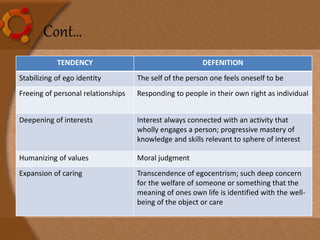
TENDENCY DEFENITION
Stabilizing of ego identity The self of the person one feels oneself to be
Freeing of personal relationships Responding to people in their own right as individual
Deepening of interests Interest always connected with an activity that
wholly engages a person; progressive mastery of
knowledge and skills relevant to sphere of interest
Humanizing of values Moral judgment
Expansion of caring Transcendence of egocentrism; such deep concern
for the welfare of someone or something that the
meaning of ones own life is identified with the well-
being of the object or care
 Readiness to Marry
• Beyond the desire to marry, an important factor is the
readiness of the two individuals for a long-term commitment
• Work on identity must be far enough along so that the
possibility of a deep, emotional involvement with another
person will be regarded as exciting rather than frightening –
• Recent studies find that early and later adolescents are likely
to be thinking about intimacy issues long before their work on
identity is completed
• School enrollment as well as educational attainment have
important links to relationship commitment
• Men tend to value youth and physical appearance in a partner
more than do women; women value earning potential and job
stability in a partner more than do men
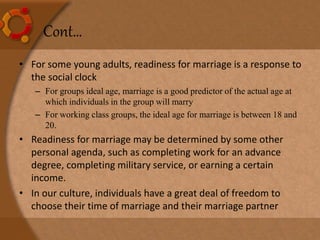
• For some young adults, readiness for marriage is a response to
the social clock
– For groups ideal age, marriage is a good predictor of the actual age at
which individuals in the group will marry
– For working class groups, the ideal age for marriage is between 18 and
20.
• Readiness for marriage may be determined by some other
personal agenda, such as completing work for an advance
degree, completing military service, or earning a certain
income.
• In our culture, individuals have a great deal of freedom to
choose their time of marriage and their marriage partner
Cont…
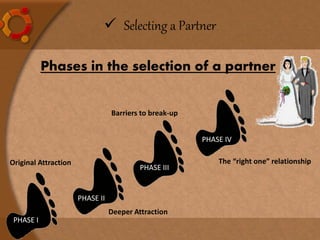
Phases in the selection of a partner
PHASE I
PHASE II
PHASE III
PHASE IV
 Selecting a Partner
Original Attraction
Barriers to break-up
The “right one” relationship
Deeper Attraction
Phase I: Original Attraction
• Partners are selected from among those who are available for
interaction
• Physical appearance is a very important element in this initial
attraction.
• In addition, people who are behaving in an admired, effective
manner may be viewed as attractive or desirable
Phase II: Deeper Attraction
• The discoveries of basic similarities and a feeling of rapport
are central to continuing the relationship
• Each person has the key values and background
characteristics that serves as a filter for assessing whether a
person is an eligible partner
• Others have criteria that limit the choice of marriage partner
to someone of a certain range, religion, race,educational
background and family history
Phase II: Deeper Attraction
• Similarities contributes to attractiveness
• Most people seek marriage partners who will understand
them and provide a sense of emotional support
• The discovery of role compatibility and empathy begins to
give the relationship a life of its own.
• Role compatibility is a sense that the two partners approach a
situation in ways that work well together
• Empathy build through these observations, enabling each
partner to know how the other is responding and to
anticipate the others needs.
Phase III: Barriers to break-up
Phase IV: The“right one” relationship
• Barriers to breaking up help consolidate the relationship
– First, the partners have a disclosed and taken risks with each other that
they probably have not taken with others.
– Second, they have achieved comfortable feelings of predictability and
empathy that make them more certain about each other than about
possible alternatives attractions.
– Third, through frequent role enactment together, they have been
identified by others as a couple
• At this point, the cost of breaking up begin to be quite high,
including loss of a confidant, a companion, and the social
network in which the couple is embedded.
Cohabitation
• It refers to partners living together in an intimate relationship
without being married.
• Cohabitation rather than marriage has become a common
expression of a committed relationship
• In recent cohorts, couples who have married after cohabitation and
those who never cohabitated before marriage are equally stable, or,
perhaps one might say, equally unstable
• Why do people choose cohabitation rather than marriage?
 Not ready for lifelong commitment “ Practice” for marriage
 Reject institution of marriage
 Those who feel that cohabiting increases their subsequent chances of a
happy marriage are incorrect.
 Chances of divorce are higher for those who have previously cohabited
6 types of cohabiting relationship
1). Marginal
o cohabiting is infrequent, its duration short, and few children are born
within this relationship.
2.) Prelude to marriage
o The duration is relatively brief, frequently transition into marriage, with few
children born to cohabiting couples.
3.)Stage in the marriage process
o couples see some disadvantages to marrying immediately, but they do
intend to marry
o childbearing is common
o the relationship are of longer duration, more often involved
childbearing and end in transition to marriage.
4.)Alternative to being single
o couples want to postpone marriage and family, because they think they are
too young to marry
o more like single dating couples than like married couples
o the relationship are short duration, end in separation
5.) Alternative to marriage
o couples view cohabiting as an alternative to marriage
o often established in the cultural support for children born outside the bonds
of marriage
o these relationship are long duration, less likely into marriage and more
likely to involved children
6.)Indistinguishable from marriage
o These relationship are not conscious alternative to marriage based on
attitudes or values
o The relationship are likely to involved children, but they may be shorter in
duration
Cont…
 Forming close relationship between partners of the same
sex
Gay and lesbian relationship
• Gay men and lesbians are a diverse group with respect to
their interests, talents, educational backgrounds, family
backgrounds, careers, and other important aspects of adult
roles
• Homosexual relationships are often established within a
climate of secrecy and social stigma, especially fears about
parental rejection
• Gay and lesbian couples often perceive less social support
from family members and seek other members of the gay or
lesbian community to validate and encourage their
relationship
• Lesbian and gay couples who are in a committed relationship
tend to give great priority to maintaining and enhancing their
relationship for several reasons
• Reasons for maintaining and enhancing their relationship
– They share conflicts around coming out the complications
that this poses in family and work setting
– Because of the nontraditional nature of same sex
relationship, the partners have to invent many of the details
of their relationship
In view of the social conflicts that gay men and lesbians are
likely to encounter and the lack of social support for their
lifestyle.
Cont…
• These years may extremely prove to be extremely difficult,
particularly because the young married couple does not
anticipate the strains that are to come.
• The partners may be quite distressed to find their “love nest”
riddled with the tensions that are part of craving out a life
together.
– sources of tension
• Compromise on many value decisions
• Must established a mutually satisfying sexual relationship
• They must work out on agreement about spending and saving
money
• They must also respond sleep patterns, food preferences,
work patterns and toilet habits
• Must achieve a sense of psychological commitment to each
other
 Adjustment during the early years of marriage
Adjustment during the early years of marriage
• It is reasonable to expect that intimacy and a high level of
marital satisfaction require effective communication and the
capacity to cope effectively with conflict
• The marriage ceremony is intended to make the commitment
public and binding
 Communication and marital adjustment
• An intimacy and a high level of marital
satisfaction will require effective communication
and the capacity to cope effectively with conflict.
Conflict…
May be a product of the interaction of two well-developed
identities, each with a distinct temperament and a distinct
set of values and goals
May be a product of the uneven distribution of power or
resources
May be a product of the failure of the partner or the
relationship to meet critical expectations.
Communication and marital adjustment
Marital conflict
Negative communication-a non verbal negative expressions and
hostile put-downs
Coercive escalation- a style of interaction in which the
probability that a negative remark will be followed by another
negative remark
perceptions of partners conflict resolution style –the
incongruence between the partner in how they think they and
their partners are approaching the resolution of conflicts
• As the communication become increasingly negative, the
partners become so physiologically disorganize that they lose
access to their more rational ego functions.
• In comparison happy couples become more effective in
soothing one another and in finding ways of preventing
conflicts
• Partners who has a high level of marital satisfaction report
frequent, pleasurable interaction and a high degree of
disclosure
• In contrast ,a decline in pleasurable interactions and an
absence of communication of any kind, even conflicts, are
associated with a high probability of divorce.
Communication and marital adjustment
Four types of communication styles
Conventional interactions-they maintained interaction but do
not express much emotional commitment to explore the others
persons view.
Controlling interactions-express the persons view s quite clearly
but do not take the other persons perspective into account.
Speculative interactions -are guarded; they explore the other
persons point of view but do not fully reveal the persons own
position.
Contractful interactions-are open to the other persons point of
view and also clearly express the speakers own position.
Advice for married couples and soon to be…
• Couples should need to learn how to anticipate conflicts and
use them as a means to clarify the relationship itself as well as
the problem at hand
• They need to know how to avert conflict when possible and
how to establish some family rules for “fair fight” when
differences arise.
 Adjustment in dual-earner marriages
• The involvement of wife and husband in the labor market
which requires a redefinition of traditional family roles and
the division of labor
• For women;
– They has little power and the majority of responsibility for the
household tasks
• For men;
– Has more power as a result of his access to financial resources and
participates little in the low-status household task
• A potential conflict for dual-earner couples is the relative balance of
power and demands for household labor for the two partners
• There are many benefits to the dual earner arrangement, but the
advantages of the dual- earner, multiple-role lifestyle can be offset
when one or both partners experience role overload
Characteristic of dual earner couples with a high levels of
marital satisfaction
• Adequate income, with husbands earning more than their
wives
• Couple consensus that husbands career is preeminent
• Husband supports wife’s career
• Satisfying social life
• Husband empathic to wife stress
• Good sexual relationship
• Discussion of work related problems
• Role complementarity and role sharing
• Shared activities and companionship
Conclusion…
• In conclusion, positive adjustment and marital satisfaction in
the early years of marriage are a function of the identity
status of each partner, the desire for intimacy, open
communication, closeness, participation in pleasurable,
companionate time together, the resources available to both
the husband and the wife and how those resources are
shared, the way power is shared or struggled for, the way
conflicts are expressed, avoided, or resolved, and the
congruence or lack of congruence between the husband’s and
wife's perception of their ideal and actual role enactment.

Early adulthood

  • 2.
    • Young adultsestablished a style that will serve as framework for the organization of experience during the rest of life. • The style of life includes the tempo of activity, the balance of work and leisure, the establishment of a circle of friends of varying degrees of intimacy, and the selection of the life activities that reflect the individual’s value orientation. • Early adulthood is.. – The settling down age – A reproductive age – Considered a problem age – A period of social isolation -A period of dependency -A time of commitments -A time of value change -Creative age
  • 3.
    Exciting Time ofLife! The transition to early adulthood is a very exciting time of life. A little thought and preparation will make it smooth
  • 6.
    • The timewhen men and women explore the possibility of forming relationships that combine emotional closeness, shared interests and a shared vision of the future, and sexual intimacy. ---- • Some young people engage in a form of “serial monogamy”, a sequence of dyadic pairings with no commitment to marriage. • Some young people find a same sex partner with whom they make a long term commitment even though formal marriages is not impossible • Most young people are hoping to marry and become involved in dating relationships or friendship relationships, one of which is transformed into a more serious pattern of courtship and marriage.
  • 7.
    Cont… • It isimportant to recognize that many forms of intimate relationships in addition to marriage are being established during early adulthood, including serious dating, cohabitation with or without the intention of marriage, and commitments between gay and lesbian couples • Delaying the age at marriage is related to several other social trends, including having children at a later age, smaller projected family size, and therefore fewer years devoted to childrearing
  • 8.
    Cont… TENDENCY DEFENITION Stabilizing ofego identity The self of the person one feels oneself to be Freeing of personal relationships Responding to people in their own right as individual Deepening of interests Interest always connected with an activity that wholly engages a person; progressive mastery of knowledge and skills relevant to sphere of interest Humanizing of values Moral judgment Expansion of caring Transcendence of egocentrism; such deep concern for the welfare of someone or something that the meaning of ones own life is identified with the well- being of the object or care
  • 9.
     Readiness toMarry • Beyond the desire to marry, an important factor is the readiness of the two individuals for a long-term commitment • Work on identity must be far enough along so that the possibility of a deep, emotional involvement with another person will be regarded as exciting rather than frightening – • Recent studies find that early and later adolescents are likely to be thinking about intimacy issues long before their work on identity is completed • School enrollment as well as educational attainment have important links to relationship commitment • Men tend to value youth and physical appearance in a partner more than do women; women value earning potential and job stability in a partner more than do men
  • 10.
    • For someyoung adults, readiness for marriage is a response to the social clock – For groups ideal age, marriage is a good predictor of the actual age at which individuals in the group will marry – For working class groups, the ideal age for marriage is between 18 and 20. • Readiness for marriage may be determined by some other personal agenda, such as completing work for an advance degree, completing military service, or earning a certain income. • In our culture, individuals have a great deal of freedom to choose their time of marriage and their marriage partner Cont…
  • 11.
    Phases in theselection of a partner PHASE I PHASE II PHASE III PHASE IV  Selecting a Partner Original Attraction Barriers to break-up The “right one” relationship Deeper Attraction
  • 12.
    Phase I: OriginalAttraction • Partners are selected from among those who are available for interaction • Physical appearance is a very important element in this initial attraction. • In addition, people who are behaving in an admired, effective manner may be viewed as attractive or desirable
  • 13.
    Phase II: DeeperAttraction • The discoveries of basic similarities and a feeling of rapport are central to continuing the relationship • Each person has the key values and background characteristics that serves as a filter for assessing whether a person is an eligible partner • Others have criteria that limit the choice of marriage partner to someone of a certain range, religion, race,educational background and family history
  • 14.
    Phase II: DeeperAttraction • Similarities contributes to attractiveness • Most people seek marriage partners who will understand them and provide a sense of emotional support
  • 15.
    • The discoveryof role compatibility and empathy begins to give the relationship a life of its own. • Role compatibility is a sense that the two partners approach a situation in ways that work well together • Empathy build through these observations, enabling each partner to know how the other is responding and to anticipate the others needs. Phase III: Barriers to break-up
  • 16.
    Phase IV: The“rightone” relationship • Barriers to breaking up help consolidate the relationship – First, the partners have a disclosed and taken risks with each other that they probably have not taken with others. – Second, they have achieved comfortable feelings of predictability and empathy that make them more certain about each other than about possible alternatives attractions. – Third, through frequent role enactment together, they have been identified by others as a couple • At this point, the cost of breaking up begin to be quite high, including loss of a confidant, a companion, and the social network in which the couple is embedded.
  • 17.
    Cohabitation • It refersto partners living together in an intimate relationship without being married. • Cohabitation rather than marriage has become a common expression of a committed relationship • In recent cohorts, couples who have married after cohabitation and those who never cohabitated before marriage are equally stable, or, perhaps one might say, equally unstable • Why do people choose cohabitation rather than marriage?  Not ready for lifelong commitment “ Practice” for marriage  Reject institution of marriage  Those who feel that cohabiting increases their subsequent chances of a happy marriage are incorrect.  Chances of divorce are higher for those who have previously cohabited
  • 18.
    6 types ofcohabiting relationship 1). Marginal o cohabiting is infrequent, its duration short, and few children are born within this relationship. 2.) Prelude to marriage o The duration is relatively brief, frequently transition into marriage, with few children born to cohabiting couples. 3.)Stage in the marriage process o couples see some disadvantages to marrying immediately, but they do intend to marry o childbearing is common o the relationship are of longer duration, more often involved childbearing and end in transition to marriage.
  • 19.
    4.)Alternative to beingsingle o couples want to postpone marriage and family, because they think they are too young to marry o more like single dating couples than like married couples o the relationship are short duration, end in separation 5.) Alternative to marriage o couples view cohabiting as an alternative to marriage o often established in the cultural support for children born outside the bonds of marriage o these relationship are long duration, less likely into marriage and more likely to involved children 6.)Indistinguishable from marriage o These relationship are not conscious alternative to marriage based on attitudes or values o The relationship are likely to involved children, but they may be shorter in duration Cont…
  • 20.
     Forming closerelationship between partners of the same sex Gay and lesbian relationship • Gay men and lesbians are a diverse group with respect to their interests, talents, educational backgrounds, family backgrounds, careers, and other important aspects of adult roles • Homosexual relationships are often established within a climate of secrecy and social stigma, especially fears about parental rejection • Gay and lesbian couples often perceive less social support from family members and seek other members of the gay or lesbian community to validate and encourage their relationship
  • 21.
    • Lesbian andgay couples who are in a committed relationship tend to give great priority to maintaining and enhancing their relationship for several reasons • Reasons for maintaining and enhancing their relationship – They share conflicts around coming out the complications that this poses in family and work setting – Because of the nontraditional nature of same sex relationship, the partners have to invent many of the details of their relationship In view of the social conflicts that gay men and lesbians are likely to encounter and the lack of social support for their lifestyle. Cont…
  • 23.
    • These yearsmay extremely prove to be extremely difficult, particularly because the young married couple does not anticipate the strains that are to come. • The partners may be quite distressed to find their “love nest” riddled with the tensions that are part of craving out a life together. – sources of tension • Compromise on many value decisions • Must established a mutually satisfying sexual relationship • They must work out on agreement about spending and saving money • They must also respond sleep patterns, food preferences, work patterns and toilet habits • Must achieve a sense of psychological commitment to each other  Adjustment during the early years of marriage
  • 24.
    Adjustment during theearly years of marriage • It is reasonable to expect that intimacy and a high level of marital satisfaction require effective communication and the capacity to cope effectively with conflict • The marriage ceremony is intended to make the commitment public and binding
  • 26.
     Communication andmarital adjustment • An intimacy and a high level of marital satisfaction will require effective communication and the capacity to cope effectively with conflict. Conflict… May be a product of the interaction of two well-developed identities, each with a distinct temperament and a distinct set of values and goals May be a product of the uneven distribution of power or resources May be a product of the failure of the partner or the relationship to meet critical expectations.
  • 27.
    Communication and maritaladjustment Marital conflict Negative communication-a non verbal negative expressions and hostile put-downs Coercive escalation- a style of interaction in which the probability that a negative remark will be followed by another negative remark perceptions of partners conflict resolution style –the incongruence between the partner in how they think they and their partners are approaching the resolution of conflicts • As the communication become increasingly negative, the partners become so physiologically disorganize that they lose access to their more rational ego functions. • In comparison happy couples become more effective in soothing one another and in finding ways of preventing conflicts
  • 28.
    • Partners whohas a high level of marital satisfaction report frequent, pleasurable interaction and a high degree of disclosure • In contrast ,a decline in pleasurable interactions and an absence of communication of any kind, even conflicts, are associated with a high probability of divorce. Communication and marital adjustment
  • 29.
    Four types ofcommunication styles Conventional interactions-they maintained interaction but do not express much emotional commitment to explore the others persons view. Controlling interactions-express the persons view s quite clearly but do not take the other persons perspective into account. Speculative interactions -are guarded; they explore the other persons point of view but do not fully reveal the persons own position. Contractful interactions-are open to the other persons point of view and also clearly express the speakers own position.
  • 30.
    Advice for marriedcouples and soon to be… • Couples should need to learn how to anticipate conflicts and use them as a means to clarify the relationship itself as well as the problem at hand • They need to know how to avert conflict when possible and how to establish some family rules for “fair fight” when differences arise.
  • 31.
     Adjustment indual-earner marriages • The involvement of wife and husband in the labor market which requires a redefinition of traditional family roles and the division of labor • For women; – They has little power and the majority of responsibility for the household tasks • For men; – Has more power as a result of his access to financial resources and participates little in the low-status household task • A potential conflict for dual-earner couples is the relative balance of power and demands for household labor for the two partners • There are many benefits to the dual earner arrangement, but the advantages of the dual- earner, multiple-role lifestyle can be offset when one or both partners experience role overload
  • 32.
    Characteristic of dualearner couples with a high levels of marital satisfaction • Adequate income, with husbands earning more than their wives • Couple consensus that husbands career is preeminent • Husband supports wife’s career • Satisfying social life • Husband empathic to wife stress • Good sexual relationship • Discussion of work related problems • Role complementarity and role sharing • Shared activities and companionship
  • 33.
    Conclusion… • In conclusion,positive adjustment and marital satisfaction in the early years of marriage are a function of the identity status of each partner, the desire for intimacy, open communication, closeness, participation in pleasurable, companionate time together, the resources available to both the husband and the wife and how those resources are shared, the way power is shared or struggled for, the way conflicts are expressed, avoided, or resolved, and the congruence or lack of congruence between the husband’s and wife's perception of their ideal and actual role enactment.