What is meant by Latch
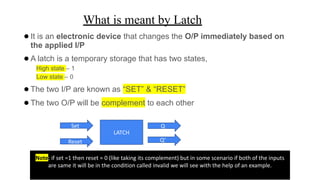
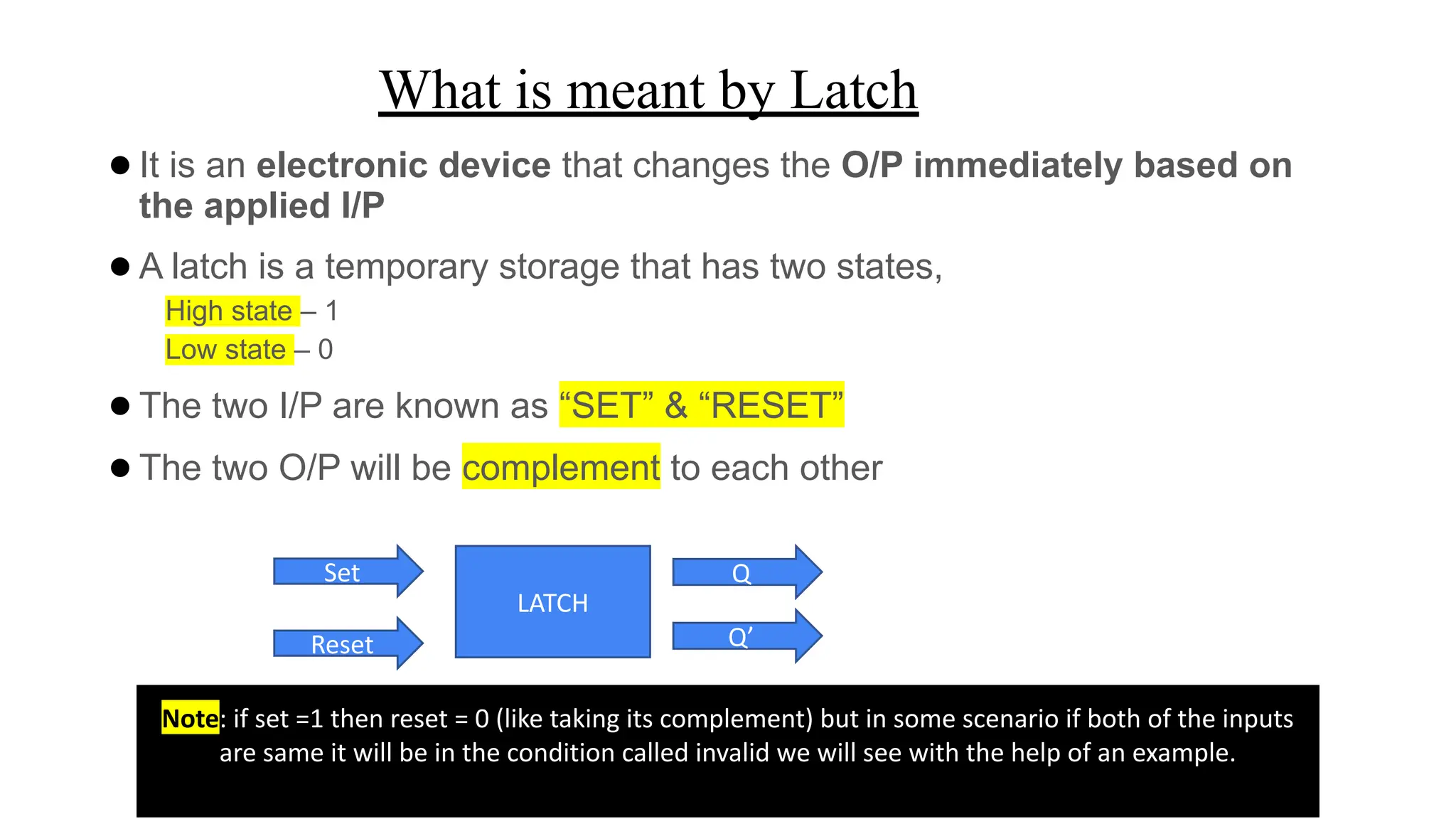
●It is an electronic device that changes the O/P immediately based on
the applied I/P
●A latch is a temporary storage that has two states,
High state – 1
Low state – 0
●The two I/P are known as “SET” & “RESET”
●The two O/P will be complement to each other
Set
Reset
LATCH
Q
Q’
Note: if set =1 then reset = 0 (like taking its complement) but in some scenario if both of the inputs
are same it will be in the condition called invalid we will see with the help of an example.
SR Latch using NAND gate
In this memory circuit, we are implementing two inputs,
SET & RESET
SET : this type of input sets the output to 1
RESET : this type of input resets the output to 0
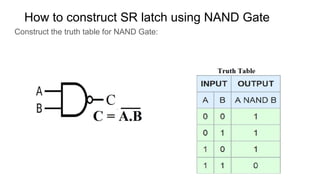
How to construct SR latch using NAND Gate
Construct the truth table for NAND Gate:
Note: from the above table it is clear that if any one of the input is ‘0’ the output is
‘True’.
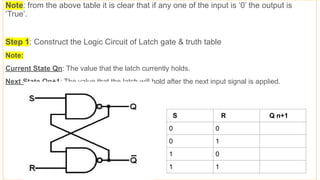
Step 1: Construct the Logic Circuit of Latch gate & truth table
Note:
Current State Qn: The value that the latch currently holds.
Next State Qn+1: The value that the latch will hold after the next input signal is applied.
S R Q n+1
0 0
0 1
1 0
1 1
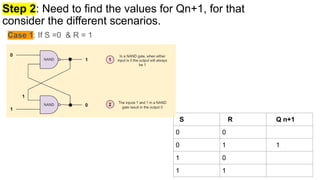
Step 2: Need to find the values for Qn+1, for that
consider the different scenarios.
Case 1: If S =0 & R = 1
S R Q n+1
0 0
0 1 1
1 0
1 1
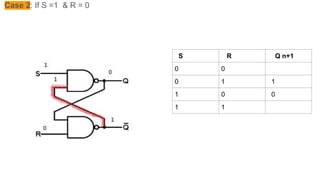
Case 2: If S =1 & R = 0
S R Q n+1
0 0
0 1 1
1 0 0
1 1
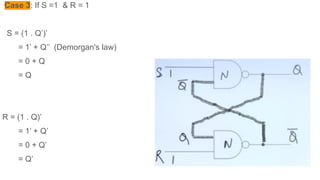
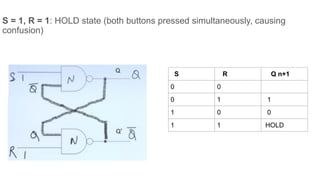
Case 3: If S =1 & R = 1
S = (1 . Q’)’
= 1’ + Q’’ (Demorgan's law)
= 0 + Q
= Q
R = (1 . Q)’
= 1’ + Q’
= 0 + Q’
= Q’
S = 1, R = 1: HOLD state (both buttons pressed simultaneously, causing
confusion)
S R Q n+1
0 0
0 1 1
1 0 0
1 1 HOLD
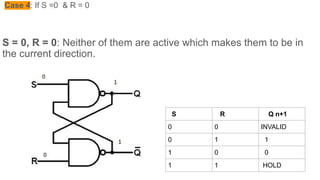
Case 4: If S =0 & R = 0
S = 0, R = 0: Neither of them are active which makes them to be in
the current direction.
S R Q n+1
0 0 INVALID
0 1 1
1 0 0
1 1 HOLD
Applications of SR Latch
Pushbutton Switch Debouncing:
● In devices like doorbells or light switches, an SR latch can be used to ensure that the output
remains stable despite the mechanical bounce of the switch contacts when pressed.
Simple Memory Storage:
● In small embedded systems, SR latches can be used to hold configuration settings, like the last
selected mode of operation in a device (e.g., a microwave oven).
Control Systems:
● In automation systems, SR latches can help control actuators or relays based on certain
conditions. For example, a latch might be used to keep a motor running until a specific reset
condition is met.
LED Control:
● In lighting systems, an SR latch can control whether an LED remains on or off, allowing for
toggle functionality with a single button press.
State Indicators:
● In status indicator systems (like traffic lights), SR latches can maintain the
state of the light (red, yellow, green) until a specific reset condition is
triggered.
Data Acquisition Systems:
● In systems that need to capture and hold data for processing (like sensors
in industrial applications), SR latches can temporarily hold the state of the
input signals.
Sequential Logic Circuits:
● In more complex systems, SR latches are used as building blocks in
sequential logic circuits, such as in digital clocks, counters, and state
machines.
FLIP-FLOPS
A flip-flop is a type of digital memory circuit used to store a single bit of data. It has
two stable states, representing binary values 0 and 1, and can change states based
on input signals. Flip-flops are fundamental building blocks in digital electronics, used
in applications such as data storage, memory registers, and sequential logic circuits.

Latch sequential circuit in Digital Electronics.pdf

  • 1.
    What is meantby Latch ●It is an electronic device that changes the O/P immediately based on the applied I/P ●A latch is a temporary storage that has two states, High state – 1 Low state – 0 ●The two I/P are known as “SET” & “RESET” ●The two O/P will be complement to each other Set Reset LATCH Q Q’ Note: if set =1 then reset = 0 (like taking its complement) but in some scenario if both of the inputs are same it will be in the condition called invalid we will see with the help of an example.
  • 2.
    SR Latch usingNAND gate In this memory circuit, we are implementing two inputs, SET & RESET SET : this type of input sets the output to 1 RESET : this type of input resets the output to 0
  • 3.
    How to constructSR latch using NAND Gate Construct the truth table for NAND Gate:
  • 4.
    Note: from theabove table it is clear that if any one of the input is ‘0’ the output is ‘True’. Step 1: Construct the Logic Circuit of Latch gate & truth table Note: Current State Qn: The value that the latch currently holds. Next State Qn+1: The value that the latch will hold after the next input signal is applied. S R Q n+1 0 0 0 1 1 0 1 1
  • 5.
    Step 2: Needto find the values for Qn+1, for that consider the different scenarios. Case 1: If S =0 & R = 1 S R Q n+1 0 0 0 1 1 1 0 1 1
  • 6.
    Case 2: IfS =1 & R = 0 S R Q n+1 0 0 0 1 1 1 0 0 1 1
  • 7.
    Case 3: IfS =1 & R = 1 S = (1 . Q’)’ = 1’ + Q’’ (Demorgan's law) = 0 + Q = Q R = (1 . Q)’ = 1’ + Q’ = 0 + Q’ = Q’
  • 8.
    S = 1,R = 1: HOLD state (both buttons pressed simultaneously, causing confusion) S R Q n+1 0 0 0 1 1 1 0 0 1 1 HOLD
  • 9.
    Case 4: IfS =0 & R = 0 S = 0, R = 0: Neither of them are active which makes them to be in the current direction. S R Q n+1 0 0 INVALID 0 1 1 1 0 0 1 1 HOLD
  • 10.
    Applications of SRLatch Pushbutton Switch Debouncing: ● In devices like doorbells or light switches, an SR latch can be used to ensure that the output remains stable despite the mechanical bounce of the switch contacts when pressed. Simple Memory Storage: ● In small embedded systems, SR latches can be used to hold configuration settings, like the last selected mode of operation in a device (e.g., a microwave oven). Control Systems: ● In automation systems, SR latches can help control actuators or relays based on certain conditions. For example, a latch might be used to keep a motor running until a specific reset condition is met. LED Control: ● In lighting systems, an SR latch can control whether an LED remains on or off, allowing for toggle functionality with a single button press.
  • 11.
    State Indicators: ● Instatus indicator systems (like traffic lights), SR latches can maintain the state of the light (red, yellow, green) until a specific reset condition is triggered. Data Acquisition Systems: ● In systems that need to capture and hold data for processing (like sensors in industrial applications), SR latches can temporarily hold the state of the input signals. Sequential Logic Circuits: ● In more complex systems, SR latches are used as building blocks in sequential logic circuits, such as in digital clocks, counters, and state machines.
  • 12.
    FLIP-FLOPS A flip-flop isa type of digital memory circuit used to store a single bit of data. It has two stable states, representing binary values 0 and 1, and can change states based on input signals. Flip-flops are fundamental building blocks in digital electronics, used in applications such as data storage, memory registers, and sequential logic circuits.