Presented By:
Dr Irawati Poleshwar Sarode
Assistant Professor
Department of Veterinary Surgery & Radiology
COVAS, Parbhani
LASER THERAPY IN COMPANION
ANIMALS
Maharashtra Animal & Fishery Sciences University, Nagpur
Seven days online Training Course
On
“Updates on advance technologies in Veterinary, Animal
and Poultry Sciences having field application”
1st- 7th June 2020
:: TOPIC ::
Presentation Outline
LASER Introduction
Historical Notes
Factors Affecting LASER
Tissue-LASER Interactions
Mechanism of Action
Clinical Effects of LASER
Applications of LASER
Indications of LASER
1
2
3
4
5
6
7
8
9
Concluding Remarks
2
Newer Technology
REGENERATIVE
THERAPEUTICS
Autologous
Conditioned
Serum
PlateletRich
Plasma
Physical
Rehabilitation
StemCell
Therapy
Laser Therapy
“Laser therapies are treatments that
use focused light of specific
wavelengths”
Laser therapy allows less pain,
swelling, and scarring than with
traditional surgery.
3
Historical Notes
1500 B.C.,
Indian
medical
literature
Herodotus
in the 6th
century BC
1704,
Newton
1903,
Niels
Ryberg
Finsen
1960,
Theodore
Maiman
Endre
Mester
2002,
FDA
Approval
Original proponent
of phototherapy,
Got Nobel
Heliotherapy
Prisms could
disassemble
white light
First laser
produced Class IIIb LASER
Father of laser
therapy
Herbal medicine
with natural
sunlight to treat
non‐pigmented
skin
2016,
Photobiomodulation
therapy
4
LASER Introduction
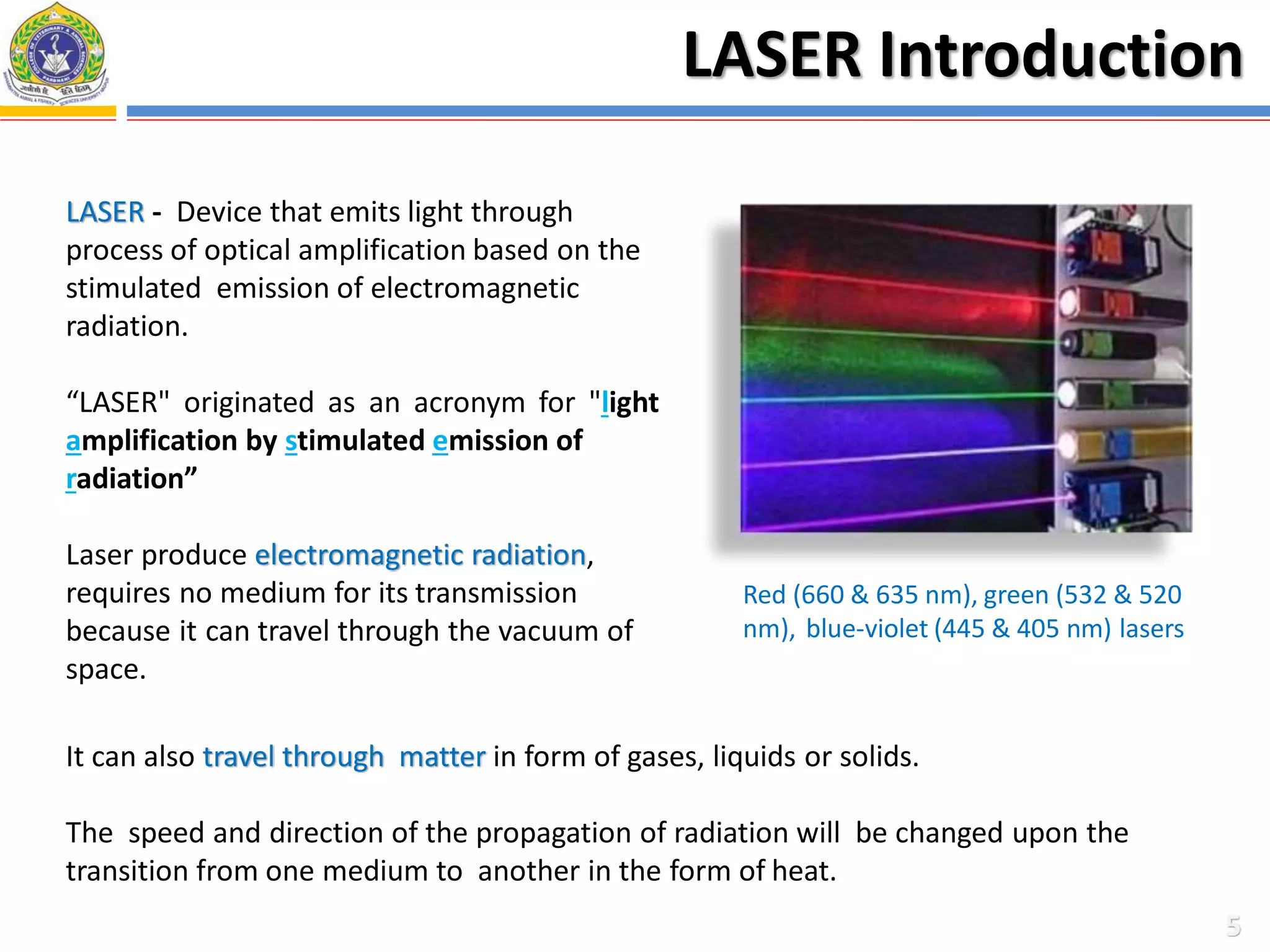
Red (660 & 635 nm), green (532 & 520
nm), blue-violet (445 & 405 nm) lasers
LASER - Device that emits light through
process of optical amplification based on the
stimulated emission of electromagnetic
radiation.
“LASER" originated as an acronym for "light
amplification by stimulated emission of
radiation”
Laser produce electromagnetic radiation,
requires no medium for its transmission
because it can travel through the vacuum of
space.
It can also travel through matter in form of gases, liquids or solids.
The speed and direction of the propagation of radiation will be changed upon the
transition from one medium to another in the form of heat.
5
Functional laser Production requires 3 things: Optical resonant cavity that contains the
lasing medium and external energy source.
1) Electron is pumped to a higher energy level by supplying energy.
2) Electron in meta stable state jumps to lower level releasing photon.
3) Photon interacts with another electron in meta stable state.
4) This interaction produces another photon at same wavelength and same phase.
5) These photons are reflected by mirror and laser beam comes through the partially
transparent mirror.
How LASER Beam Produced?
Introduction Contd…
6
• Single wavelength
• Target specific light production
Highly
Monochromatic
• All in same phase
• Improves focusing
Highly Coherent
• In one plane
• Easy to pass through media
Highly Polarized
• One direction
• Non-spreading
Highly Collimated
Introduction Contd…
Properties of LASER
7
Lasers are classified by potential danger tothe eye
CLASS-1
• Safe
• e.g. Binoculars,
Telescopes,
Microscopes
CLASS-2
• Safe for
accidental
viewing
• e.g. Laser
pointers,
aiming lasers
CLASS-3
• Considered
low risk, but
potentially
hazardous
• e.g. Cold lasers
CLASS-4
• Hazardous,
require
protective
eyewear
• e.g. Surgical &
Therapeutic
lasers (hot)
Classification of LASER
Introduction Contd…
8
Factors Affecting Therapeutic LASER
• Absorption.
• The most important factor
WAVELENGTH
• The number of photons to
saturate the tissues
• Joules/cm2
POWER
• Appropriate number of
treatments .
• Proper application
technique
DOSAGE
9
475nm 530nm 650nm 700nm – 1 mm
Wavelength determines impaling of photons
Blue Green Red Infra-red
Factors Affecting LASER Contd…
WAVELENGTH
10
Both at 980nm wavelength
5 Watts 10 Watts
Power determines the number of photons in tissue
Factors Affecting LASER Contd…
POWER
11
Tissue Interaction with LASER
Reflection of photons takes place at epidermis; lack
clinical effect; can cause tissue damage
Scattering occurs once the photons penetrate the
tissue. Each time the scattered photons strike an
object outside the target tissue, the amount of photon
energy is reduced.
Transmitted photons lack clinical effect; pass through
the tissue without being absorbed
Absorption of photons by the target tissue realizes the
therapeutic benefit of lasers
12
LASER Interaction with TISSUE
Interaction Contd…
PHOTO
CHEMICAL
PHOTO
MECHANICAL
PHOTO
BIOCHEMICAL
Long Pulses,
Biological
Effect Due To
Heating
Short Pulsed
Lasers Cause
Ablation
Laser Causes
Biochemical
Change
13
Hb release
NO
Unbound NO
stimulates
Guanylate
Cyclase
cGMP
Production
Myosin
phosphorylation
Smooth muscle
relaxation
leading to
vasodilation
Increased
microcirculation
After laser stimulation of the cell,
NO becomes unbound.
(Nitric oxide)
Mechanism of Action
14
Mechanism of Action Contd…
Increasing activity of
ATPdriven carriers for
ions, such Ca2+ pumps.
Also increasing the
level of cAMP.
Ca2+ & cAMP - Important secondmessengers;
regulates almost every process in the body
(muscle contraction, blood coagulation, signal
transfer in nerves, gene expression, etc.).
LASER Red
light affects
all cell
types
Absorbed by
mitochondria
Biostimulation
of cytochrome.
CytC oxidase
primary photo-
acceptor
Oxidation of
CytC
Increased
electron
transfer
Increased
ATP
production
15
Physiological/Clinical Effects of LASER
Collagen
Production
Angiogenesis
Muscle
Regeneration
Cartilage
Production
Nerve
Regeneration
Inflammation
& Edema
Bone
Formation
16
Physiological/Clinical Effects of LASER Contd…
Thermal
Biochemical
Bioelectric
Bioenergetic
CLINICAL EFFECTS
LASER Therapy
17
ANALGESI
A
Biochemical Cascade Induced by Laser Therapy
Resulting Analgesia
Physiological/Clinical Effects of LASER Contd…
18
INFLAMATION
Modulation of Inflammatory Response by
Laser Therapy
Physiological/Clinical Effects of LASER Contd…
19
WhatLASER
Accomplishes?
Relieves
Pain
Modulation of the
Inflammatory Response
Increases
Microcirculation
ACCELERATION OF THE
HEALING PROCESS
Physiological/Clinical Effects of LASER Contd…
20
Step-by-Step LASER Application
• Clip the patient’s hair, which maximizes the laser’s effect because hair absorbs
50% to 90% of the light.
• Measure the area to be treated
• Determine the treatment dose; in areas of darker skin, the dose should be
increased by 25%.
• Determine the total joules (J/cm2) and treatment time needed.
• For example: If treating an area of 57 cm2 (size of a playing card) with 10 J/cm2,
the total treatment is 600 J.
• If using a 10-W laser, the treatment time is 60 seconds.
• Place safety goggles prior to using the laser
• All personnel in the room should wear protective eye gear, and the patient’s eyes
should also be protected.
• The laser should be pointed perpendicular to the treatment area
• Apply the laser treatment, moving slowly, over the area by using an overlapping
grid technique to ensure the entire area is treated.
21
Laser Therapy Treatment Guidelines
Millis et al 2014
LASER Therapy Application Contd…
22
Hot lasers use Class 4 laser that
produces heat, protective goggles
must be worn.
Penetrate deeper into the tissues than
cold lasers, referred to as deep laser
therapy.
More effective at treating pain that
originates in deep muscles.
Cold laser therapy is low-intensity laser
therapy that stimulates healing using low
levels of light, aren’t enough to heat body’s
tissue.
Cold laser therapy is also known as:
low-level laser therapy (LLLT)
low-power laser therapy (LPLT)
soft laser biostimulation
photobiomodulation
Hot laser therapy may be followed up by cold laser therapy, known as contrast therapy.
LASER Therapy Application Contd…
Types of LASER Therapeutics
COLD HOT
23
 The tip of the probe is held
perpendicular in contact of the
skin.
 This technique allow deeper
penetration and maximize the
power density on the target
tissues as reflection is minimized
 This technique is used in treatment of
open wounds.
 The distance between the laser probe
and wound bed should be 0.5-1 cm.
 The probe also should be held
perpendicular to the site of radiation
Treatment Probe
Skin Layer
Target Tissue
LASER Therapy Application Contd…
LASER Application
Indirect Contact Direct Contact
24
• No contact
between laser tip
in skin; tip is held
5-10 mm from
wound
• Acupuncture
point, to irradiate
localized painful
spot
• Divide areas into grids
of square centimeters;
lightly contacted
applicator
• A grid area is
bathed with
laser in
oscillating
fashion;
distance <1 cmGridding
Technique
Wanding
Technique
Point
Technique
Scanning
Technique
LASER Therapy Application Contd…
Application Techniques
25
Therapeutic LASER Beam Production Machine
LASER Therapy Indications Contd…
Pain control (Acute & Chronic)
 Pain secondary to soft tissue injuries (sprain, strain, bursitis)
 Osteoarthritis, arthritis
 Neurogenic Pain
 Acupuncture
Indications for LASER Therapy
Wound healing
 Pressure sores
 Burn wound
 Postoperative wound care
 Fracture healing
Inflammatory conditions
 Post traumatic peripheral nerve injury
 Edema reduction
 Scar tissue remodeling
27
LASER Therapy Indications Contd…
28
Multi-pharmaceutical
Approach
Good Nursing CareLaser Therapy
Pain Free
Fast
Recovery
Integration into Pain Management Protocols
29
Common Pain Management in Surgical Practice
Acute Pain Management
1. Trauma
2. Post surgical acute pain
3. Dental procedures
4. Burns, Otitis
5. Urinary disorders
6. Gastrointestinal disorders
Chronic Pain Management
1. Osteoarthritis
2. Geriatrics
3. Dermatologic disorders
4. Abdominal
5. Respiratory
6. Post surgical chronic pain
30
 Nine month old female spayed
Chihuahua
 Avascular necrosis - femoral head and
neck excision
 Post-op laser therapy
Post-op Pain Management by LASER Therapy
31
Post Femoral Head Ostectomy (FHO)
Sx laser therapy protocol
 Incision: 2 Joules/cm2
 Periarticular muscles:
Day 1 and 2: 8 Joules/cm2
 Periarticular muscles, back and thigh:
6 Joules/cm2 on day 3 then alternate
days
32
LASER Therapy in Burn Injury
 Foot pad
meets stove
top
 Dosage:
1 – 2 J/cm2
33
LASER Therapy in Cervical Disc Pain
 Dosage:
8 – 10 J/cm2
34
 Uroliths , Interstitial Cystitis
Pyelonephritis , Urethral
Obstruction
 Dosage:
10 -12 J/cm2
LASER Therapy for Urinary Track Pain
35
 Pancreatitis ~ Parvovirus ~ GI
Surgery ~
 Dosage:
 10 – 12 J/cm2; lateral
recumb. both sides and
ventrally
 Increase dosage for larger
patients >60 lbs.
LASER Therapy for Gastrointestinal Pain
 Intestinal resection and
anastomosis:
 Dosage:
 2 – 3 J/cm2 during surgery and before
closing incision then 1 – 2 J/cm2 after
closure.
 Incision (1 – 2 J/cm2) and abdomen
(10 – 12J/cm2) for three
consecutive days.36
 Chronic pain serves no purpose.
 Stimulus may be persistent like in
Osteoarthritis.
 Lasts longer than 1 month.
 Stimulus may be absent.
– CNS malfunctioning
– Wind up- centralneuronal
hyperexcitability
LASER Therapy for Chronic Pain
management
37
 Chronic otitis
 Dosages:
Pinna
2 – 4 J/cm2
Ear canal
10 – 12 J/cm2
Frequency
Daily X 3
then EOD for two weeks
LASER Therapy for Chronic Dermatologic
Conditions
38
Administration of 5 J/cm2
Emission of 600 Joules
Three hours post administration
 Dry
 Decreased
inflammation
LASER Therapy for Pyotraumatic
Dermatitis
39
 Case presented for Delayed reunion of
fracture
 Pug, Two-years-old
 Due to economics opted for external
fixation
 Meta Splint
LASER Therapy in Fractures
40
After five weeks:
ten therapy sessions.
Resulting angiogenesis and a reduction
in edema resulting in a better healing
environment.
After Four weeks fracture site still mobile
Made a window in the Meta splint and
therapy applied at all angles
Twice/week for five weeks Dosage: 8 J/cm2
41
LASER Therapy for Foot paw
Labrador suffered degloving injuries to the foot pads in RTA
42
Contraindications Precautions
Application over
eyes
Cancerous growths
Over pregnant
uterus
Over endocrine
glands
Pretreated
photosensitizers
Over cardiac region
Vagus nerve
Growth plates in young
ones
Fever, Infected tissue &
Epilepsy
Disoriented patients
43
Concluding Remarks
 Light energy at the appropriate wavelength and power density has the
ability to provide modulation of tissues at the cellular level to enhance
healing.
 Laser therapy is an emerging technique that appears to at least have
subjective benefits.
 Relieves pain, Modulates the inflammatory reaction, Increases
circulation and Accelerates healing.
 Scientific and clinical evidence based medicine.
 Potential areas where laser therapy can be incorporated are in wound
healing, pain management, and rehabilitation for various conditions.
44
THANK YOU… …
Presented By: Dr Irawati Poleshwar Sarode Date: 05.06.2020 Time: 14.00 IST

Laser therapy in companion animals

  • 1.
    Presented By: Dr IrawatiPoleshwar Sarode Assistant Professor Department of Veterinary Surgery & Radiology COVAS, Parbhani LASER THERAPY IN COMPANION ANIMALS Maharashtra Animal & Fishery Sciences University, Nagpur Seven days online Training Course On “Updates on advance technologies in Veterinary, Animal and Poultry Sciences having field application” 1st- 7th June 2020 :: TOPIC ::
  • 2.
    Presentation Outline LASER Introduction HistoricalNotes Factors Affecting LASER Tissue-LASER Interactions Mechanism of Action Clinical Effects of LASER Applications of LASER Indications of LASER 1 2 3 4 5 6 7 8 9 Concluding Remarks 2
  • 3.
    Newer Technology REGENERATIVE THERAPEUTICS Autologous Conditioned Serum PlateletRich Plasma Physical Rehabilitation StemCell Therapy Laser Therapy “Lasertherapies are treatments that use focused light of specific wavelengths” Laser therapy allows less pain, swelling, and scarring than with traditional surgery. 3
  • 4.
    Historical Notes 1500 B.C., Indian medical literature Herodotus inthe 6th century BC 1704, Newton 1903, Niels Ryberg Finsen 1960, Theodore Maiman Endre Mester 2002, FDA Approval Original proponent of phototherapy, Got Nobel Heliotherapy Prisms could disassemble white light First laser produced Class IIIb LASER Father of laser therapy Herbal medicine with natural sunlight to treat non‐pigmented skin 2016, Photobiomodulation therapy 4
  • 5.
    LASER Introduction Red (660& 635 nm), green (532 & 520 nm), blue-violet (445 & 405 nm) lasers LASER - Device that emits light through process of optical amplification based on the stimulated emission of electromagnetic radiation. “LASER" originated as an acronym for "light amplification by stimulated emission of radiation” Laser produce electromagnetic radiation, requires no medium for its transmission because it can travel through the vacuum of space. It can also travel through matter in form of gases, liquids or solids. The speed and direction of the propagation of radiation will be changed upon the transition from one medium to another in the form of heat. 5
  • 6.
    Functional laser Productionrequires 3 things: Optical resonant cavity that contains the lasing medium and external energy source. 1) Electron is pumped to a higher energy level by supplying energy. 2) Electron in meta stable state jumps to lower level releasing photon. 3) Photon interacts with another electron in meta stable state. 4) This interaction produces another photon at same wavelength and same phase. 5) These photons are reflected by mirror and laser beam comes through the partially transparent mirror. How LASER Beam Produced? Introduction Contd… 6
  • 7.
    • Single wavelength •Target specific light production Highly Monochromatic • All in same phase • Improves focusing Highly Coherent • In one plane • Easy to pass through media Highly Polarized • One direction • Non-spreading Highly Collimated Introduction Contd… Properties of LASER 7
  • 8.
    Lasers are classifiedby potential danger tothe eye CLASS-1 • Safe • e.g. Binoculars, Telescopes, Microscopes CLASS-2 • Safe for accidental viewing • e.g. Laser pointers, aiming lasers CLASS-3 • Considered low risk, but potentially hazardous • e.g. Cold lasers CLASS-4 • Hazardous, require protective eyewear • e.g. Surgical & Therapeutic lasers (hot) Classification of LASER Introduction Contd… 8
  • 9.
    Factors Affecting TherapeuticLASER • Absorption. • The most important factor WAVELENGTH • The number of photons to saturate the tissues • Joules/cm2 POWER • Appropriate number of treatments . • Proper application technique DOSAGE 9
  • 10.
    475nm 530nm 650nm700nm – 1 mm Wavelength determines impaling of photons Blue Green Red Infra-red Factors Affecting LASER Contd… WAVELENGTH 10
  • 11.
    Both at 980nmwavelength 5 Watts 10 Watts Power determines the number of photons in tissue Factors Affecting LASER Contd… POWER 11
  • 12.
    Tissue Interaction withLASER Reflection of photons takes place at epidermis; lack clinical effect; can cause tissue damage Scattering occurs once the photons penetrate the tissue. Each time the scattered photons strike an object outside the target tissue, the amount of photon energy is reduced. Transmitted photons lack clinical effect; pass through the tissue without being absorbed Absorption of photons by the target tissue realizes the therapeutic benefit of lasers 12
  • 13.
    LASER Interaction withTISSUE Interaction Contd… PHOTO CHEMICAL PHOTO MECHANICAL PHOTO BIOCHEMICAL Long Pulses, Biological Effect Due To Heating Short Pulsed Lasers Cause Ablation Laser Causes Biochemical Change 13
  • 14.
    Hb release NO Unbound NO stimulates Guanylate Cyclase cGMP Production Myosin phosphorylation Smoothmuscle relaxation leading to vasodilation Increased microcirculation After laser stimulation of the cell, NO becomes unbound. (Nitric oxide) Mechanism of Action 14
  • 15.
    Mechanism of ActionContd… Increasing activity of ATPdriven carriers for ions, such Ca2+ pumps. Also increasing the level of cAMP. Ca2+ & cAMP - Important secondmessengers; regulates almost every process in the body (muscle contraction, blood coagulation, signal transfer in nerves, gene expression, etc.). LASER Red light affects all cell types Absorbed by mitochondria Biostimulation of cytochrome. CytC oxidase primary photo- acceptor Oxidation of CytC Increased electron transfer Increased ATP production 15
  • 16.
    Physiological/Clinical Effects ofLASER Collagen Production Angiogenesis Muscle Regeneration Cartilage Production Nerve Regeneration Inflammation & Edema Bone Formation 16
  • 17.
    Physiological/Clinical Effects ofLASER Contd… Thermal Biochemical Bioelectric Bioenergetic CLINICAL EFFECTS LASER Therapy 17
  • 18.
    ANALGESI A Biochemical Cascade Inducedby Laser Therapy Resulting Analgesia Physiological/Clinical Effects of LASER Contd… 18
  • 19.
    INFLAMATION Modulation of InflammatoryResponse by Laser Therapy Physiological/Clinical Effects of LASER Contd… 19
  • 20.
    WhatLASER Accomplishes? Relieves Pain Modulation of the InflammatoryResponse Increases Microcirculation ACCELERATION OF THE HEALING PROCESS Physiological/Clinical Effects of LASER Contd… 20
  • 21.
    Step-by-Step LASER Application •Clip the patient’s hair, which maximizes the laser’s effect because hair absorbs 50% to 90% of the light. • Measure the area to be treated • Determine the treatment dose; in areas of darker skin, the dose should be increased by 25%. • Determine the total joules (J/cm2) and treatment time needed. • For example: If treating an area of 57 cm2 (size of a playing card) with 10 J/cm2, the total treatment is 600 J. • If using a 10-W laser, the treatment time is 60 seconds. • Place safety goggles prior to using the laser • All personnel in the room should wear protective eye gear, and the patient’s eyes should also be protected. • The laser should be pointed perpendicular to the treatment area • Apply the laser treatment, moving slowly, over the area by using an overlapping grid technique to ensure the entire area is treated. 21
  • 22.
    Laser Therapy TreatmentGuidelines Millis et al 2014 LASER Therapy Application Contd… 22
  • 23.
    Hot lasers useClass 4 laser that produces heat, protective goggles must be worn. Penetrate deeper into the tissues than cold lasers, referred to as deep laser therapy. More effective at treating pain that originates in deep muscles. Cold laser therapy is low-intensity laser therapy that stimulates healing using low levels of light, aren’t enough to heat body’s tissue. Cold laser therapy is also known as: low-level laser therapy (LLLT) low-power laser therapy (LPLT) soft laser biostimulation photobiomodulation Hot laser therapy may be followed up by cold laser therapy, known as contrast therapy. LASER Therapy Application Contd… Types of LASER Therapeutics COLD HOT 23
  • 24.
     The tipof the probe is held perpendicular in contact of the skin.  This technique allow deeper penetration and maximize the power density on the target tissues as reflection is minimized  This technique is used in treatment of open wounds.  The distance between the laser probe and wound bed should be 0.5-1 cm.  The probe also should be held perpendicular to the site of radiation Treatment Probe Skin Layer Target Tissue LASER Therapy Application Contd… LASER Application Indirect Contact Direct Contact 24
  • 25.
    • No contact betweenlaser tip in skin; tip is held 5-10 mm from wound • Acupuncture point, to irradiate localized painful spot • Divide areas into grids of square centimeters; lightly contacted applicator • A grid area is bathed with laser in oscillating fashion; distance <1 cmGridding Technique Wanding Technique Point Technique Scanning Technique LASER Therapy Application Contd… Application Techniques 25
  • 26.
    Therapeutic LASER BeamProduction Machine LASER Therapy Indications Contd…
  • 27.
    Pain control (Acute& Chronic)  Pain secondary to soft tissue injuries (sprain, strain, bursitis)  Osteoarthritis, arthritis  Neurogenic Pain  Acupuncture Indications for LASER Therapy Wound healing  Pressure sores  Burn wound  Postoperative wound care  Fracture healing Inflammatory conditions  Post traumatic peripheral nerve injury  Edema reduction  Scar tissue remodeling 27
  • 28.
  • 29.
    Multi-pharmaceutical Approach Good Nursing CareLaserTherapy Pain Free Fast Recovery Integration into Pain Management Protocols 29
  • 30.
    Common Pain Managementin Surgical Practice Acute Pain Management 1. Trauma 2. Post surgical acute pain 3. Dental procedures 4. Burns, Otitis 5. Urinary disorders 6. Gastrointestinal disorders Chronic Pain Management 1. Osteoarthritis 2. Geriatrics 3. Dermatologic disorders 4. Abdominal 5. Respiratory 6. Post surgical chronic pain 30
  • 31.
     Nine monthold female spayed Chihuahua  Avascular necrosis - femoral head and neck excision  Post-op laser therapy Post-op Pain Management by LASER Therapy 31
  • 32.
    Post Femoral HeadOstectomy (FHO) Sx laser therapy protocol  Incision: 2 Joules/cm2  Periarticular muscles: Day 1 and 2: 8 Joules/cm2  Periarticular muscles, back and thigh: 6 Joules/cm2 on day 3 then alternate days 32
  • 33.
    LASER Therapy inBurn Injury  Foot pad meets stove top  Dosage: 1 – 2 J/cm2 33
  • 34.
    LASER Therapy inCervical Disc Pain  Dosage: 8 – 10 J/cm2 34
  • 35.
     Uroliths ,Interstitial Cystitis Pyelonephritis , Urethral Obstruction  Dosage: 10 -12 J/cm2 LASER Therapy for Urinary Track Pain 35
  • 36.
     Pancreatitis ~Parvovirus ~ GI Surgery ~  Dosage:  10 – 12 J/cm2; lateral recumb. both sides and ventrally  Increase dosage for larger patients >60 lbs. LASER Therapy for Gastrointestinal Pain  Intestinal resection and anastomosis:  Dosage:  2 – 3 J/cm2 during surgery and before closing incision then 1 – 2 J/cm2 after closure.  Incision (1 – 2 J/cm2) and abdomen (10 – 12J/cm2) for three consecutive days.36
  • 37.
     Chronic painserves no purpose.  Stimulus may be persistent like in Osteoarthritis.  Lasts longer than 1 month.  Stimulus may be absent. – CNS malfunctioning – Wind up- centralneuronal hyperexcitability LASER Therapy for Chronic Pain management 37
  • 38.
     Chronic otitis Dosages: Pinna 2 – 4 J/cm2 Ear canal 10 – 12 J/cm2 Frequency Daily X 3 then EOD for two weeks LASER Therapy for Chronic Dermatologic Conditions 38
  • 39.
    Administration of 5J/cm2 Emission of 600 Joules Three hours post administration  Dry  Decreased inflammation LASER Therapy for Pyotraumatic Dermatitis 39
  • 40.
     Case presentedfor Delayed reunion of fracture  Pug, Two-years-old  Due to economics opted for external fixation  Meta Splint LASER Therapy in Fractures 40
  • 41.
    After five weeks: tentherapy sessions. Resulting angiogenesis and a reduction in edema resulting in a better healing environment. After Four weeks fracture site still mobile Made a window in the Meta splint and therapy applied at all angles Twice/week for five weeks Dosage: 8 J/cm2 41
  • 42.
    LASER Therapy forFoot paw Labrador suffered degloving injuries to the foot pads in RTA 42
  • 43.
    Contraindications Precautions Application over eyes Cancerousgrowths Over pregnant uterus Over endocrine glands Pretreated photosensitizers Over cardiac region Vagus nerve Growth plates in young ones Fever, Infected tissue & Epilepsy Disoriented patients 43
  • 44.
    Concluding Remarks  Lightenergy at the appropriate wavelength and power density has the ability to provide modulation of tissues at the cellular level to enhance healing.  Laser therapy is an emerging technique that appears to at least have subjective benefits.  Relieves pain, Modulates the inflammatory reaction, Increases circulation and Accelerates healing.  Scientific and clinical evidence based medicine.  Potential areas where laser therapy can be incorporated are in wound healing, pain management, and rehabilitation for various conditions. 44
  • 45.
    THANK YOU… … PresentedBy: Dr Irawati Poleshwar Sarode Date: 05.06.2020 Time: 14.00 IST