LASER CLADDING
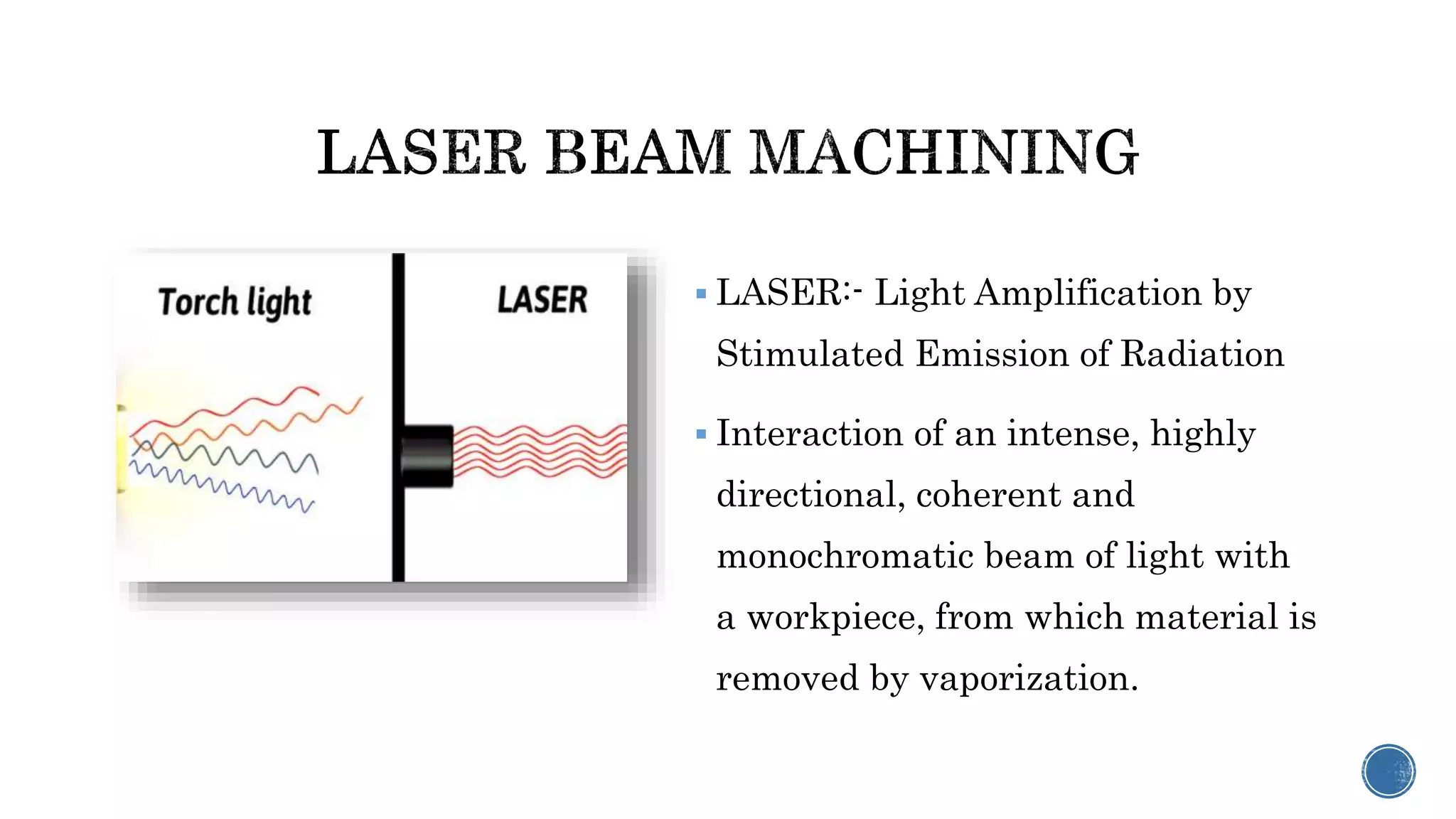
 LASER:- Light Amplification by
Stimulated Emission of Radiation
 Interaction of an intense, highly
directional, coherent and
monochromatic beam of light with
a workpiece, from which material is
removed by vaporization.
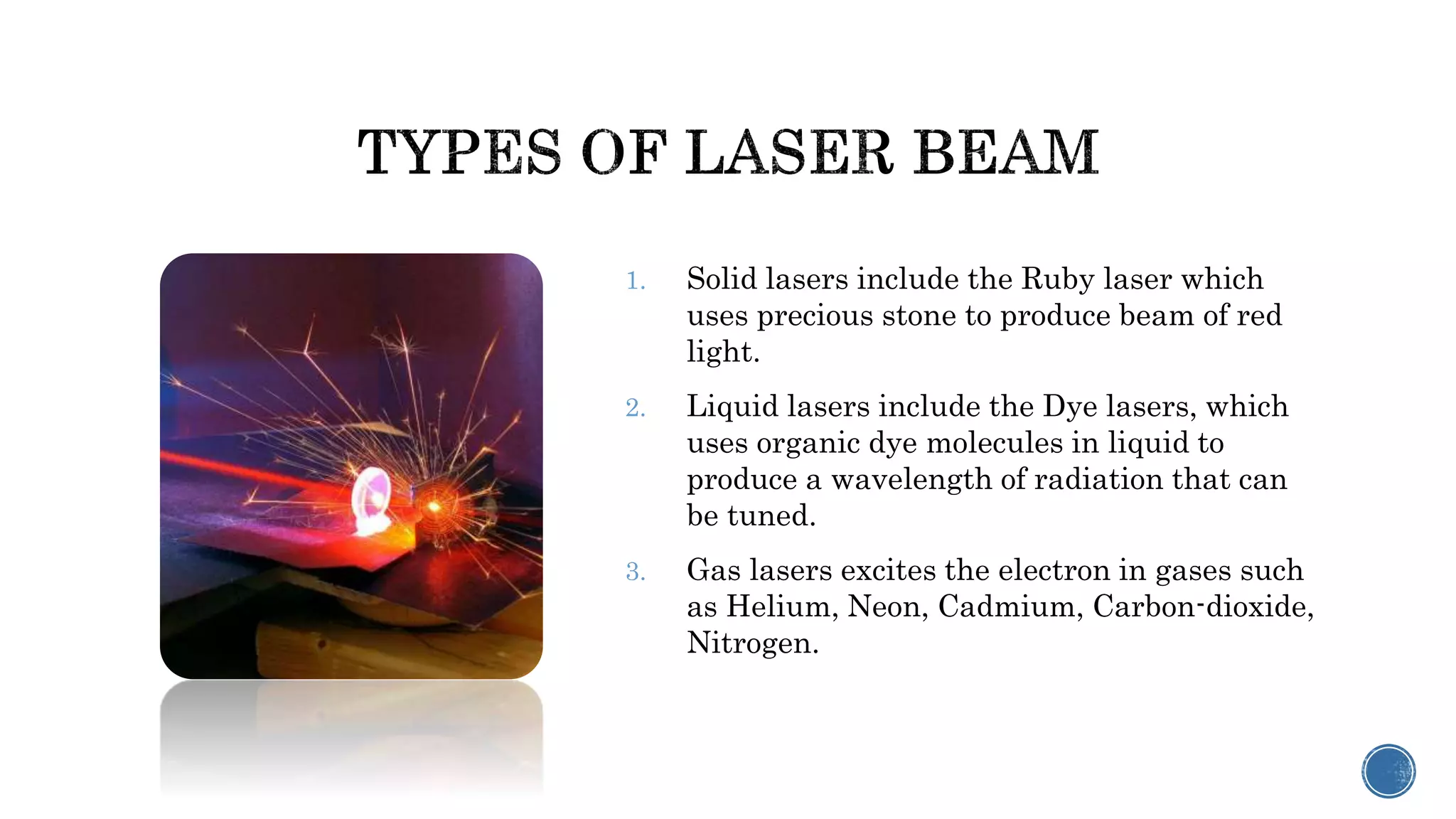
1. Solid lasers include the Ruby laser which
uses precious stone to produce beam of red
light.
2. Liquid lasers include the Dye lasers, which
uses organic dye molecules in liquid to
produce a wavelength of radiation that can
be tuned.
3. Gas lasers excites the electron in gases such
as Helium, Neon, Cadmium, Carbon-dioxide,
Nitrogen.
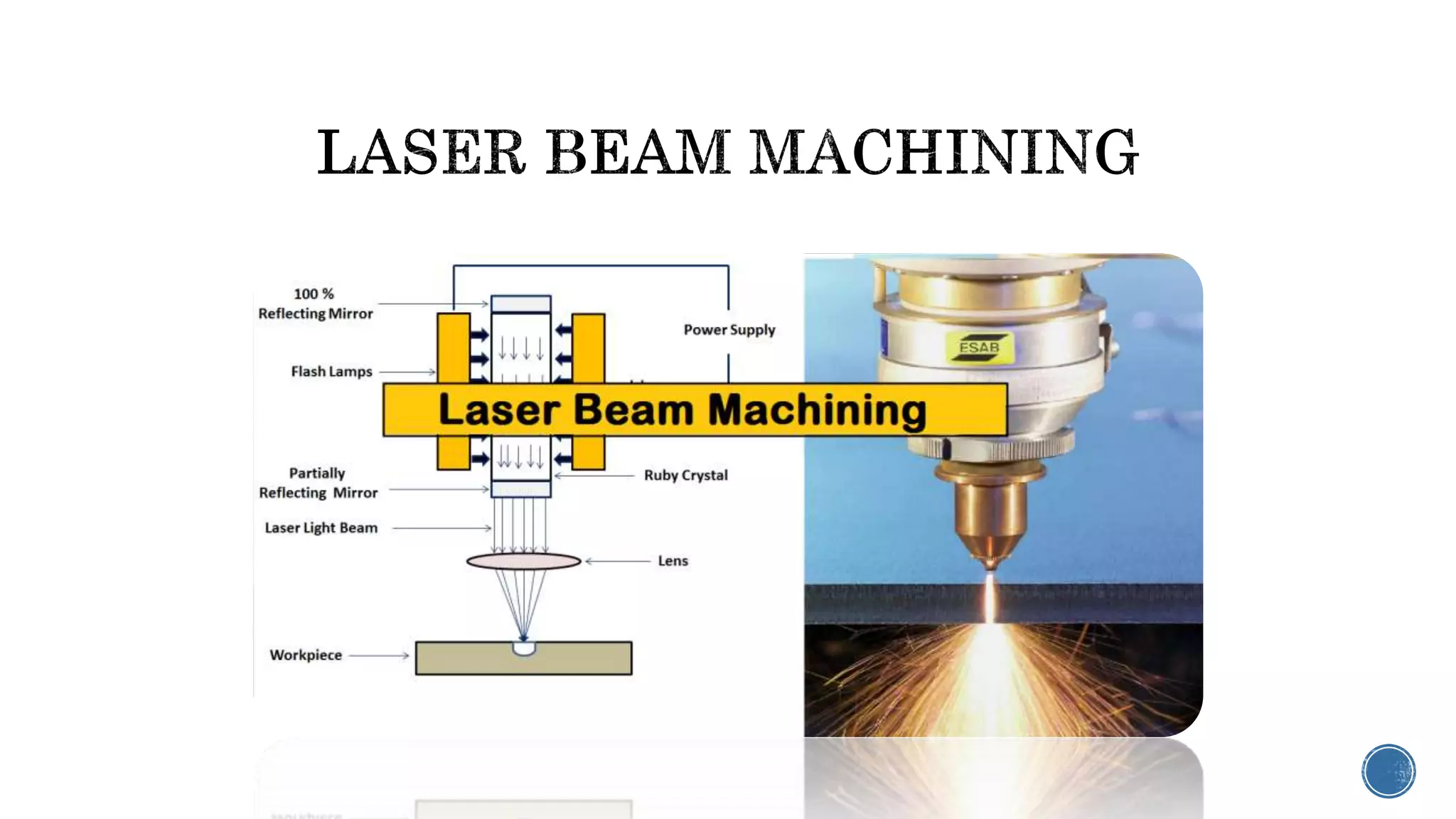
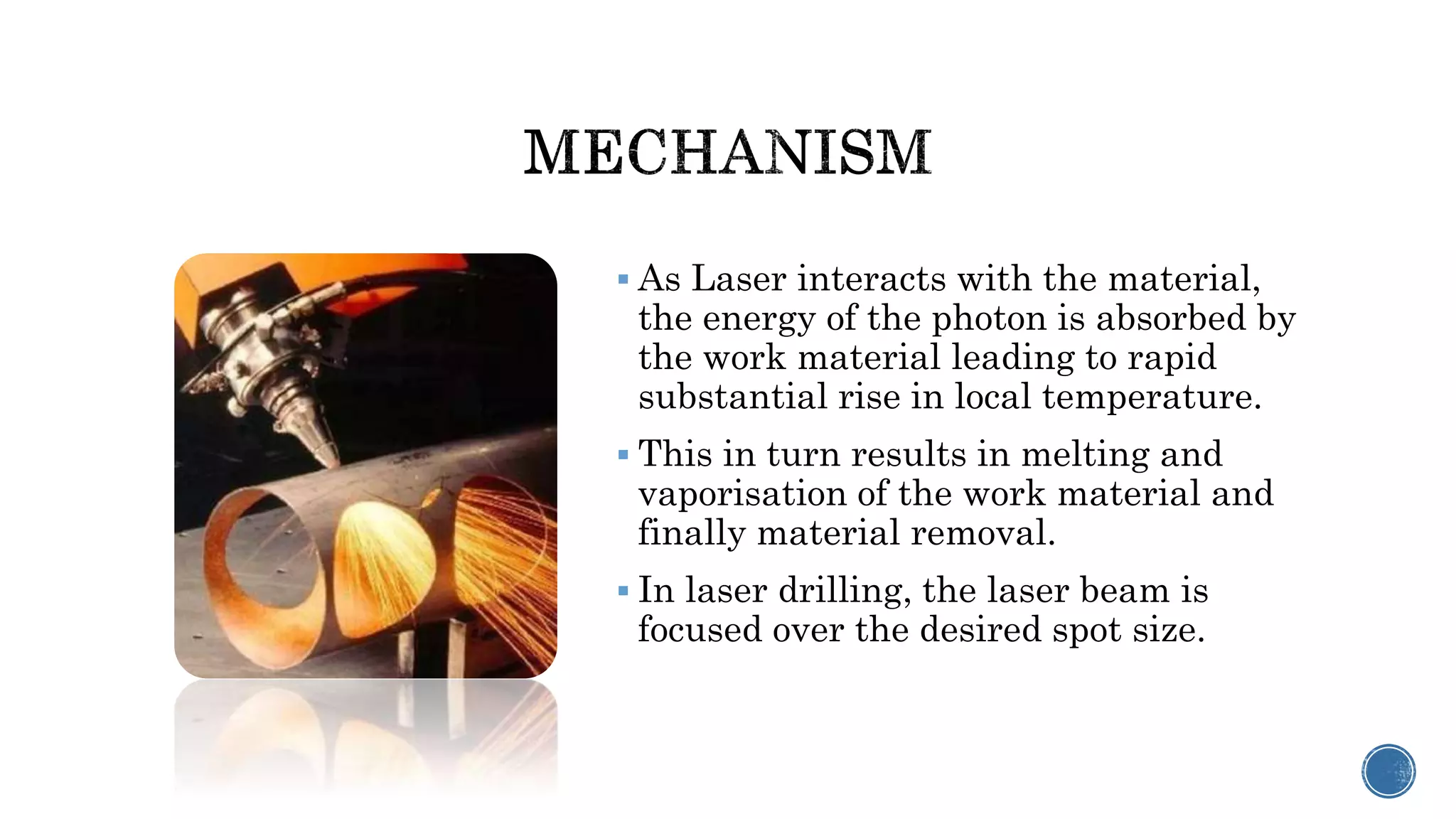
 As Laser interacts with the material,
the energy of the photon is absorbed by
the work material leading to rapid
substantial rise in local temperature.
 This in turn results in melting and
vaporisation of the work material and
finally material removal.
 In laser drilling, the laser beam is
focused over the desired spot size.
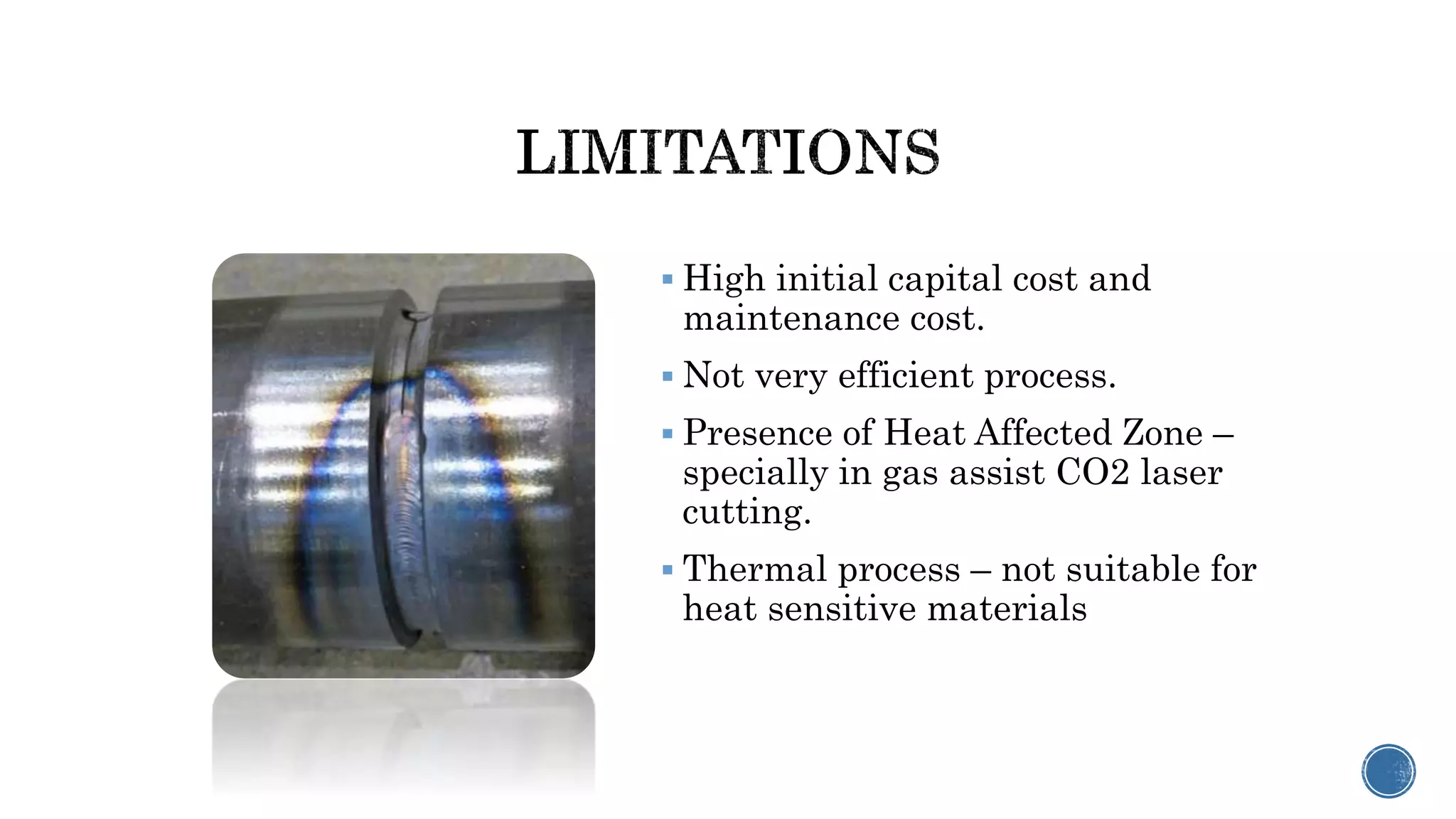
 High initial capital cost and
maintenance cost.
 Not very efficient process.
 Presence of Heat Affected Zone –
specially in gas assist CO2 laser
cutting.
 Thermal process – not suitable for
heat sensitive materials
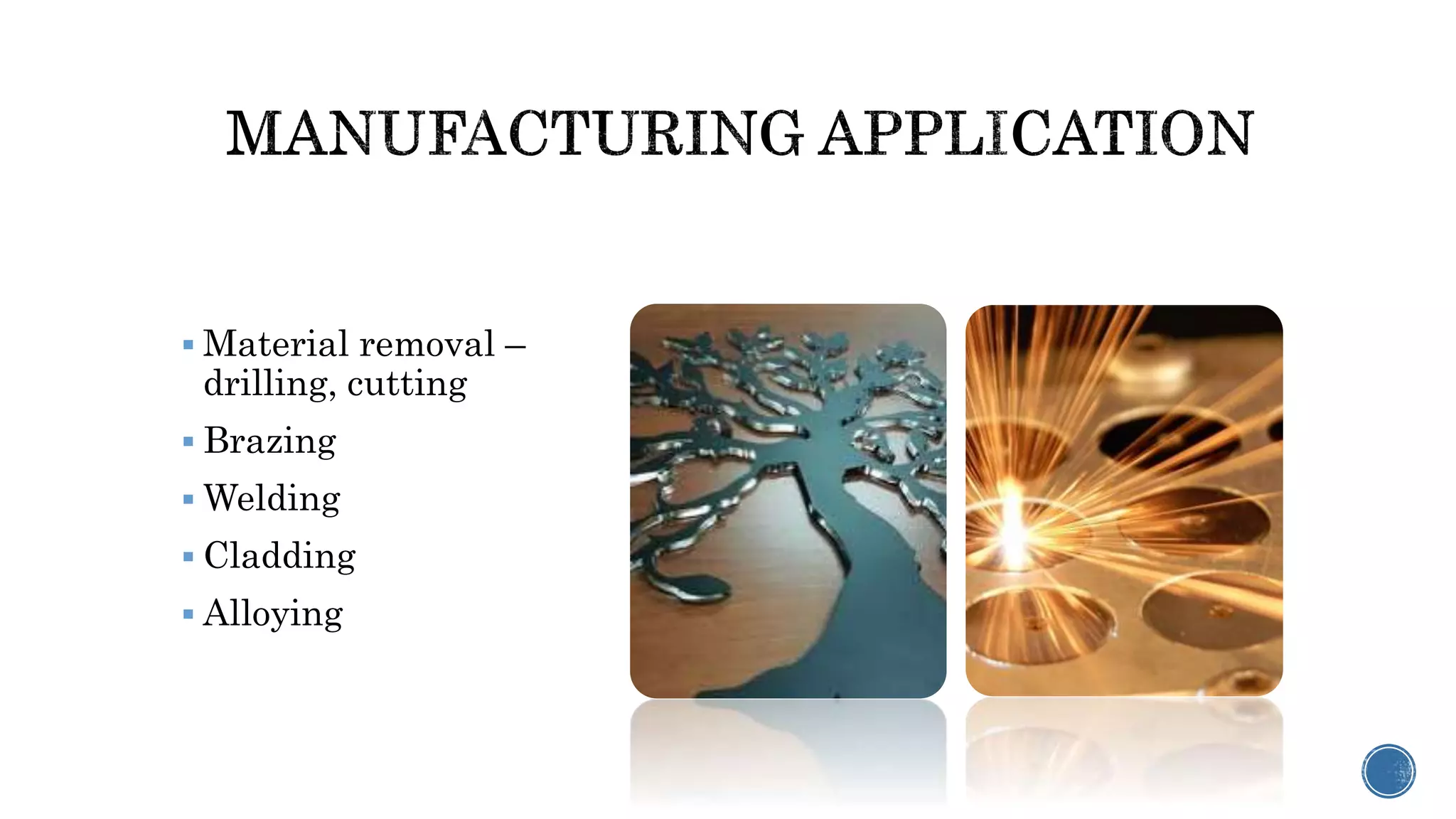
 Material removal –
drilling, cutting
 Brazing
 Welding
 Cladding
 Alloying
 Basically a covering or coating
of one material over another
 To provide a skin or layer to the
inner metal
 Bonding together of dissimilar
metals or in some cases of non-
conductive material over a
conductive one
 To improve the surface properties of the material such as corrosion
resistance, mechanical strength
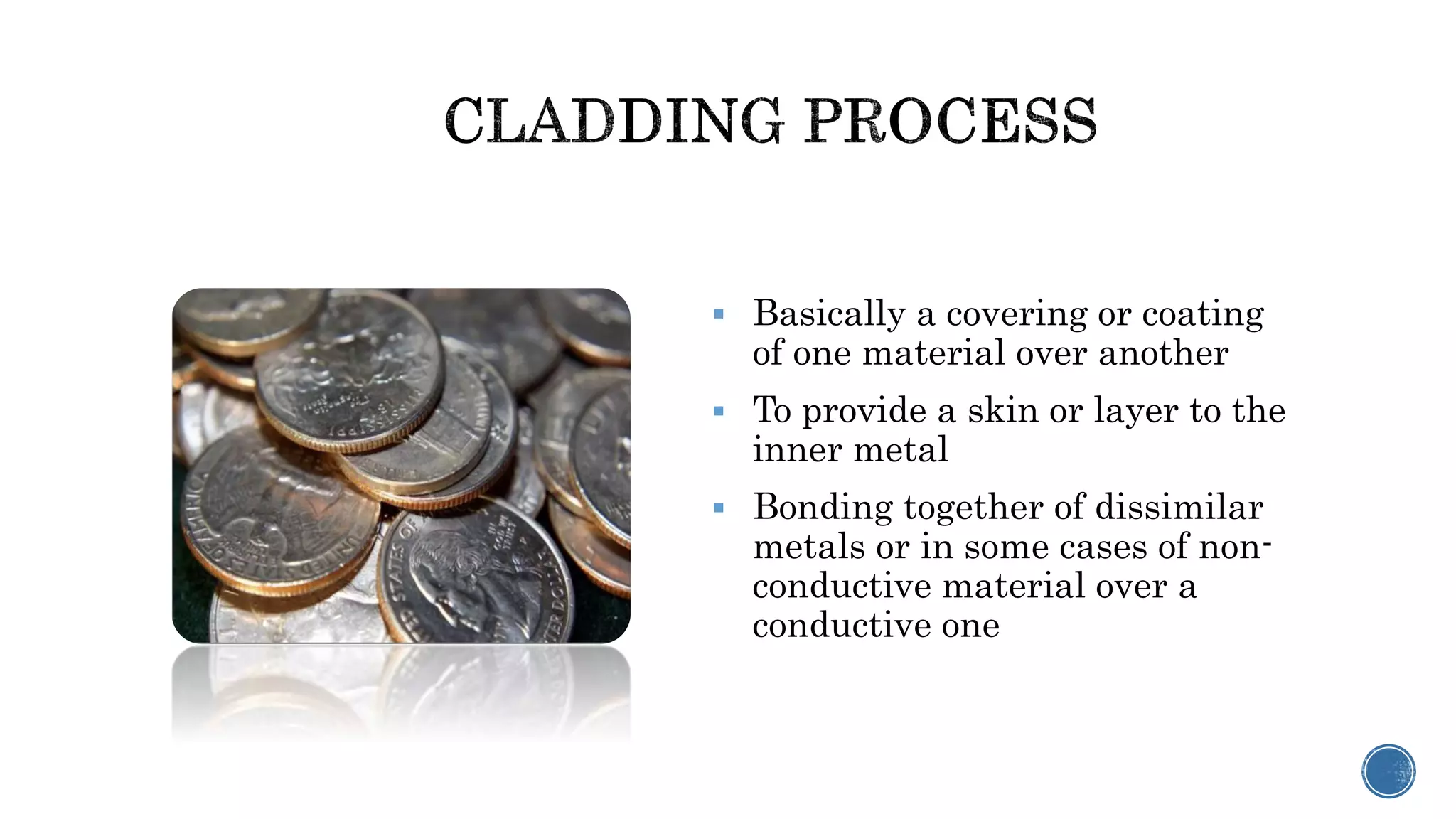
 The United States Mint uses cladding to manufacture coins from
different metals. This allows a cheaper metal to be used as a filler.
 Most current USA coins consist of an inner core of pure copper
with outer layers of cladded Ni-Cu alloy which looks like silver
1] Mechanical Bonding
2] Direct Adhered
3] Spot Bonding
 Mechanical Bonding : This method involves fixed or embedded
anchors or ties being used to attach the stone to the surface
 Direct Adhered : This is one of the most common methods. It is
thinner, less expensive and doesn’t require any onsite drilling
 Spot Bonding : Similar to the direct adhered but epoxy is applied
to about 10% of the area resulting in gaps or pockets of air
between the stone and the wall reduces the chances of water
staining
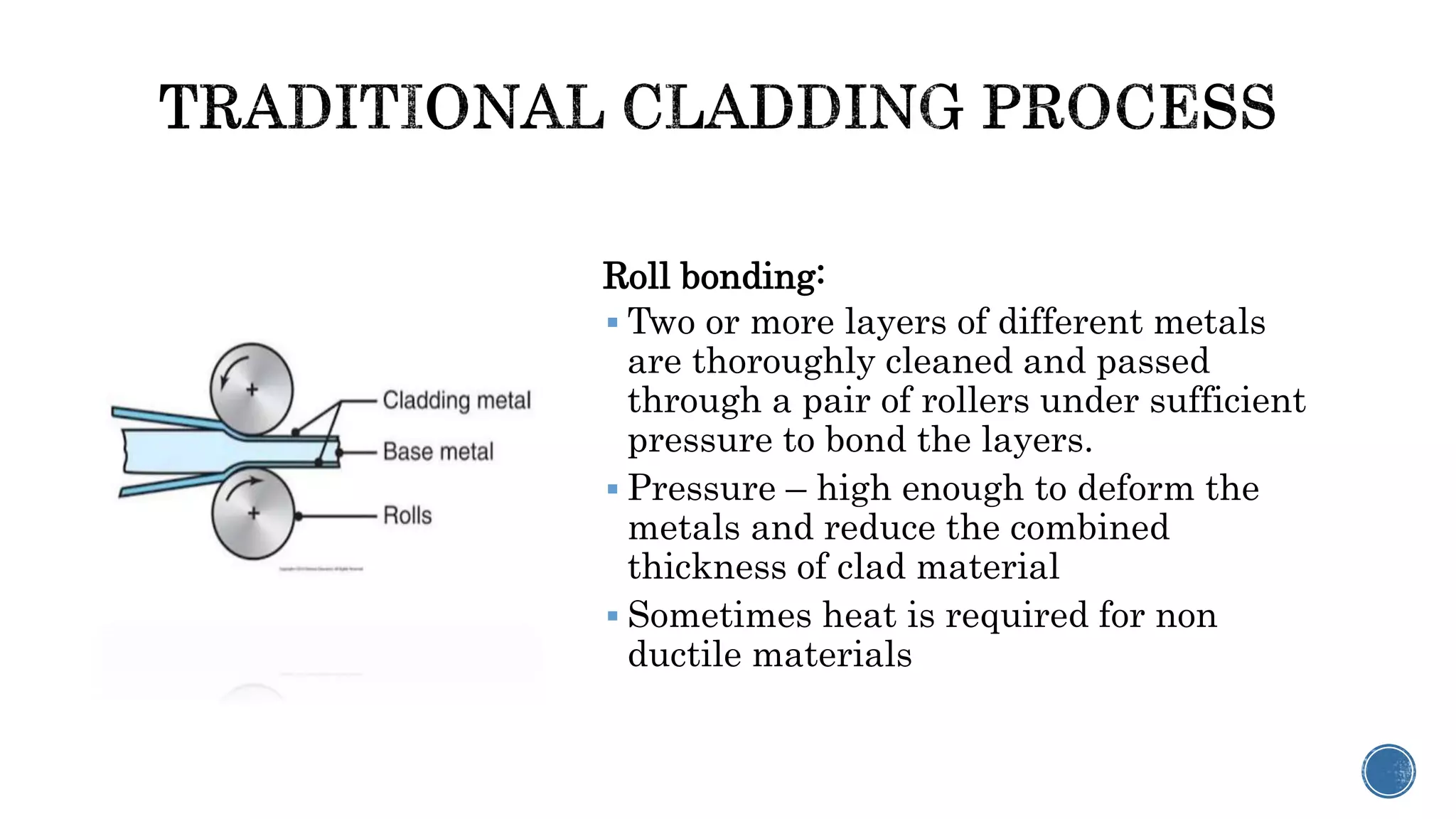
Roll bonding:
 Two or more layers of different metals
are thoroughly cleaned and passed
through a pair of rollers under sufficient
pressure to bond the layers.
 Pressure – high enough to deform the
metals and reduce the combined
thickness of clad material
 Sometimes heat is required for non
ductile materials
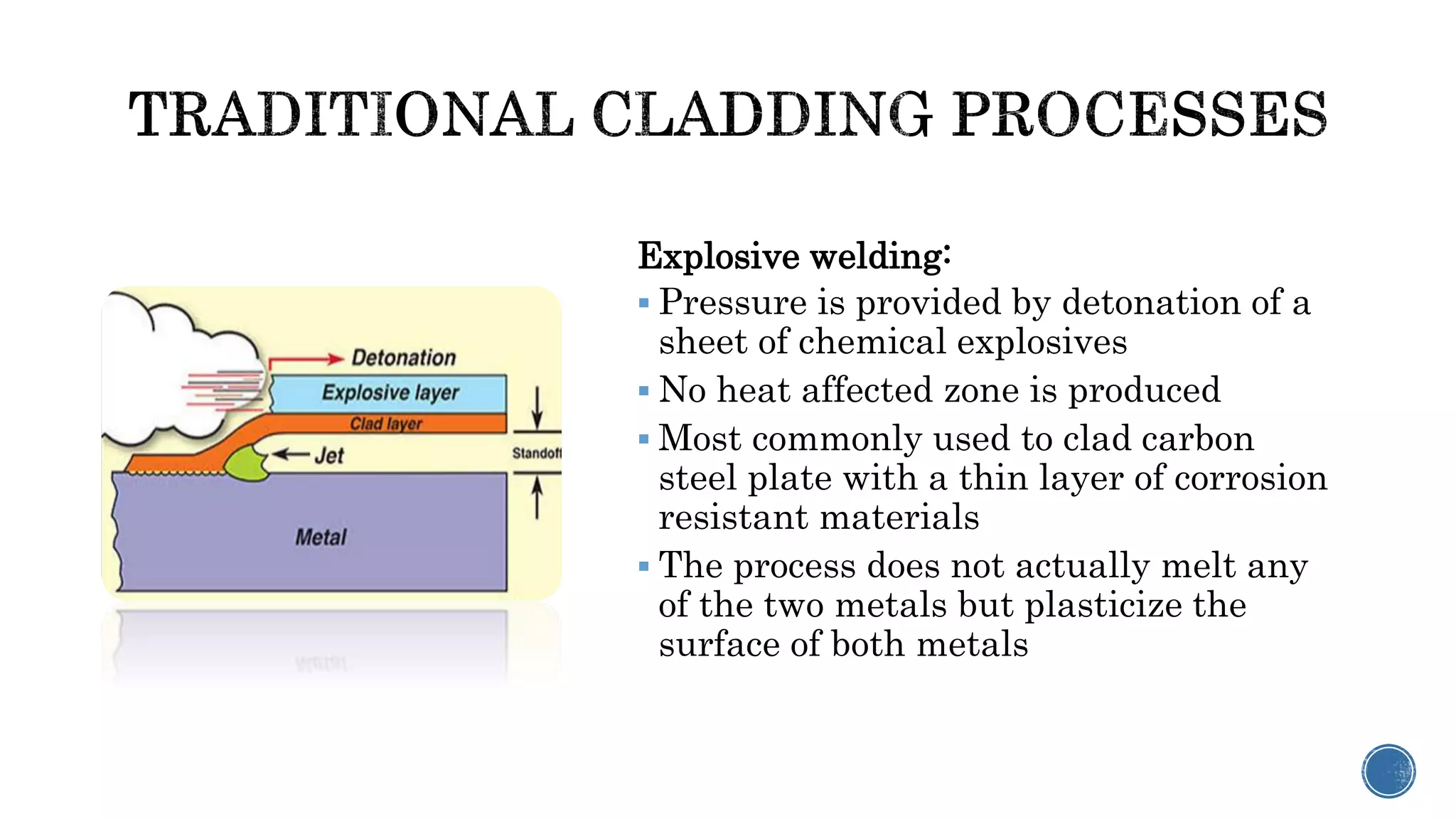
Explosive welding:
 Pressure is provided by detonation of a
sheet of chemical explosives
 No heat affected zone is produced
 Most commonly used to clad carbon
steel plate with a thin layer of corrosion
resistant materials
 The process does not actually melt any
of the two metals but plasticize the
surface of both metals
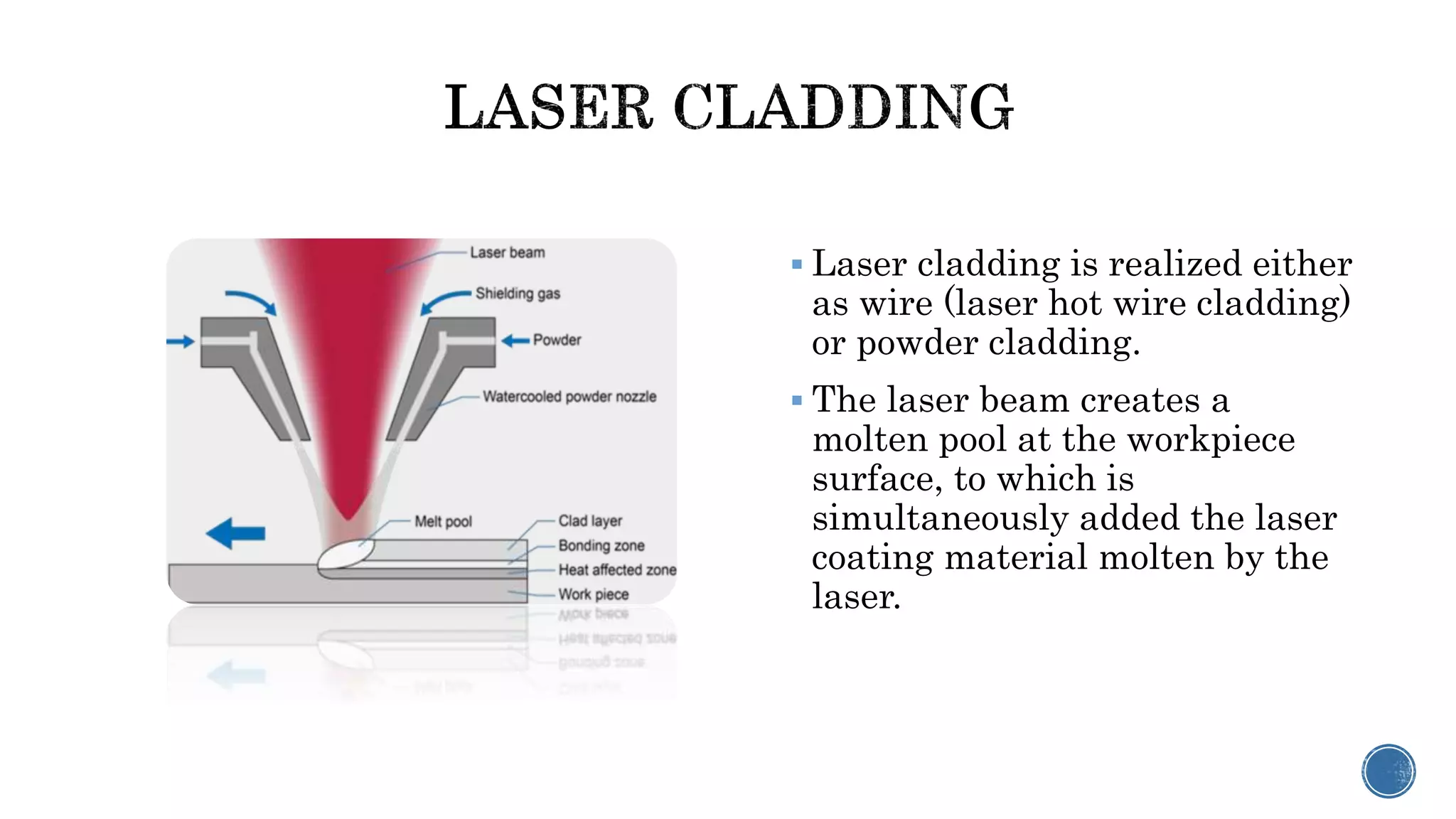
 Laser cladding is realized either
as wire (laser hot wire cladding)
or powder cladding.
 The laser beam creates a
molten pool at the workpiece
surface, to which is
simultaneously added the laser
coating material molten by the
laser.
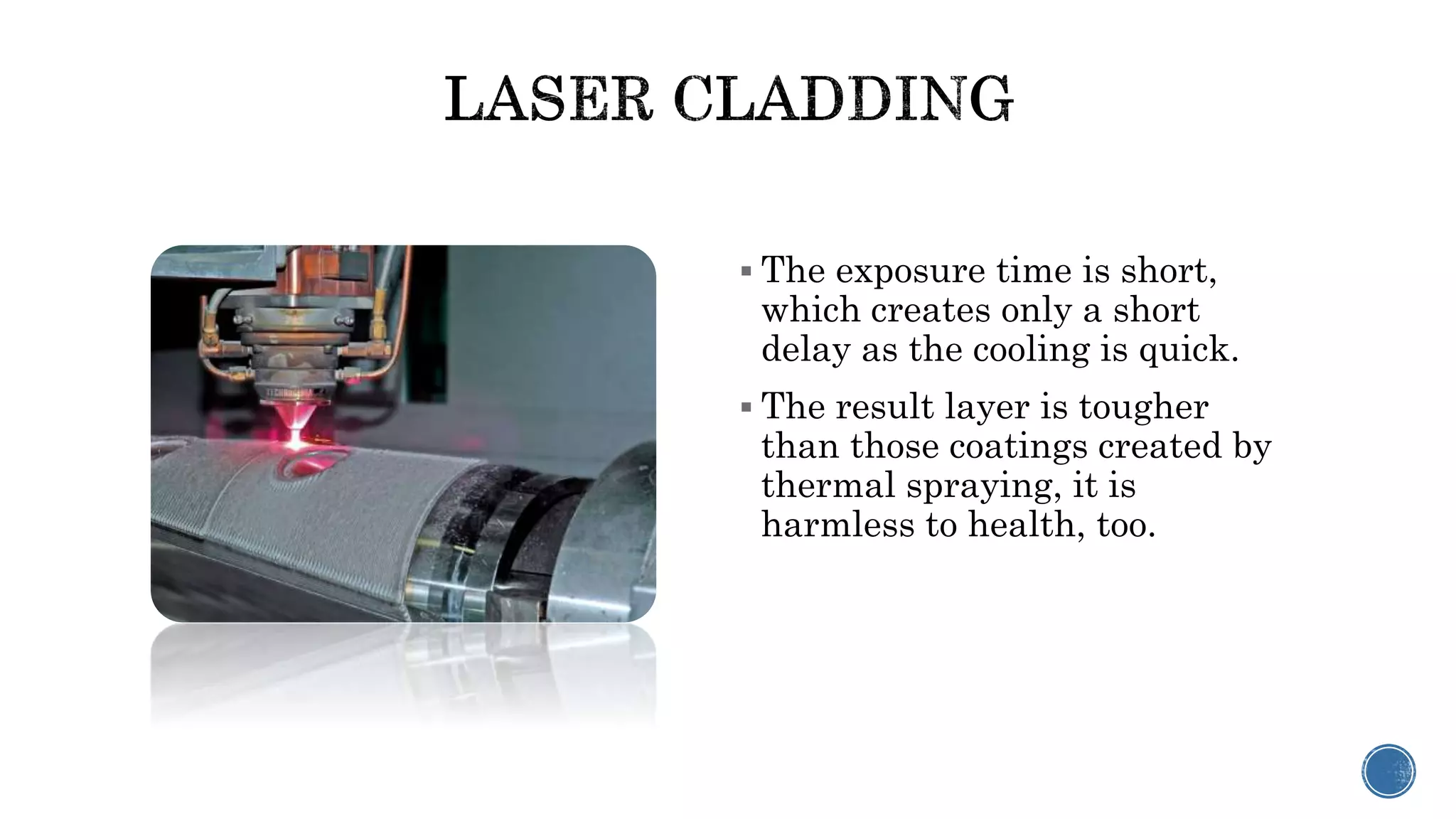
 The exposure time is short,
which creates only a short
delay as the cooling is quick.
 The result layer is tougher
than those coatings created by
thermal spraying, it is
harmless to health, too.
 For traditional cladding processes, methods such as thermal
spraying and arc welding are commonly used.
 During the process, an arc is produced to melt the surface or
base material making it more malleable.
 The clad or surface material is then added—usually in wire or
powder form—and melted by the arc, thus creating the new,
smooth and revised surface..
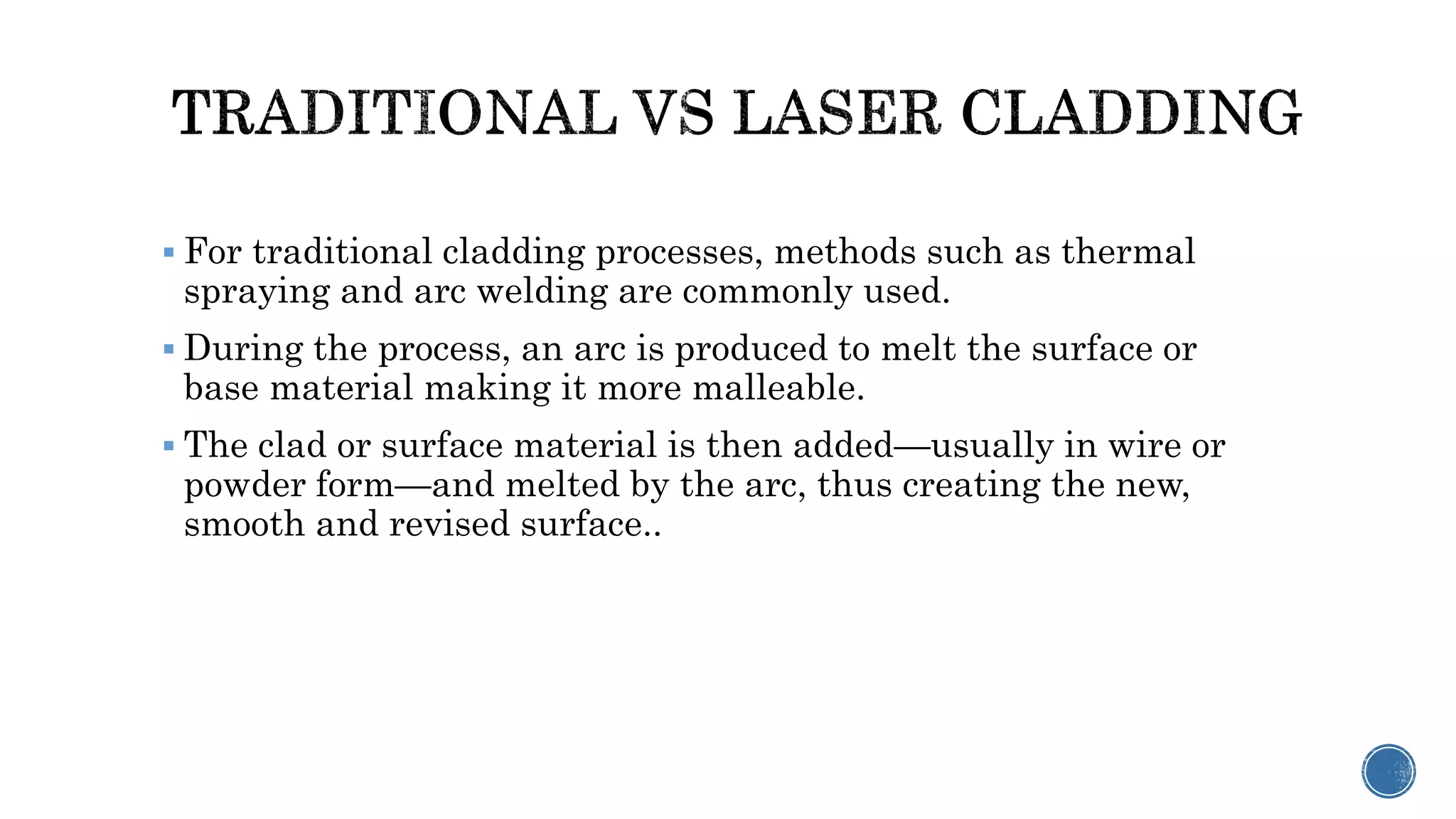
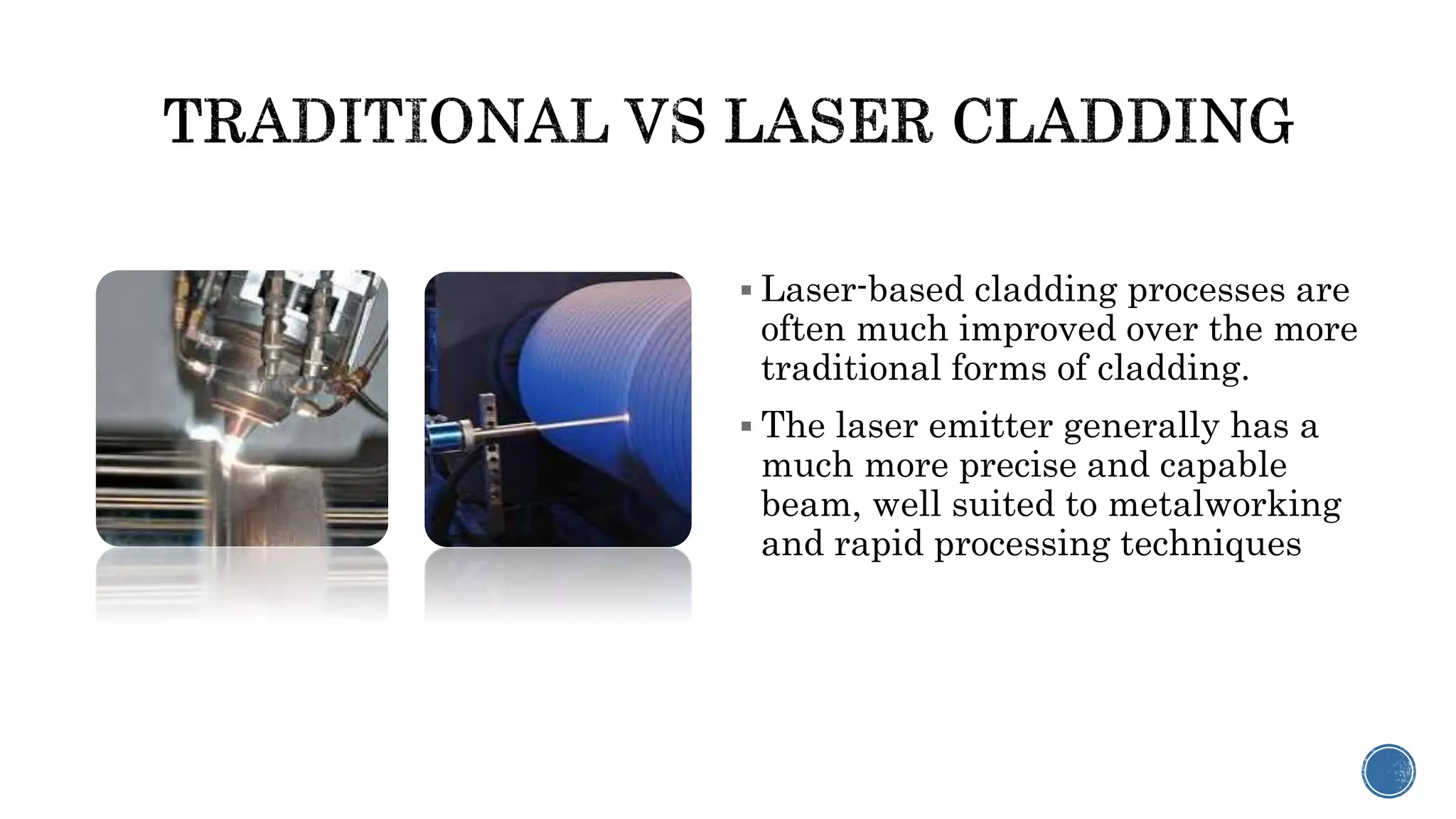
 Laser-based cladding processes are
often much improved over the more
traditional forms of cladding.
 The laser emitter generally has a
much more precise and capable
beam, well suited to metalworking
and rapid processing techniques
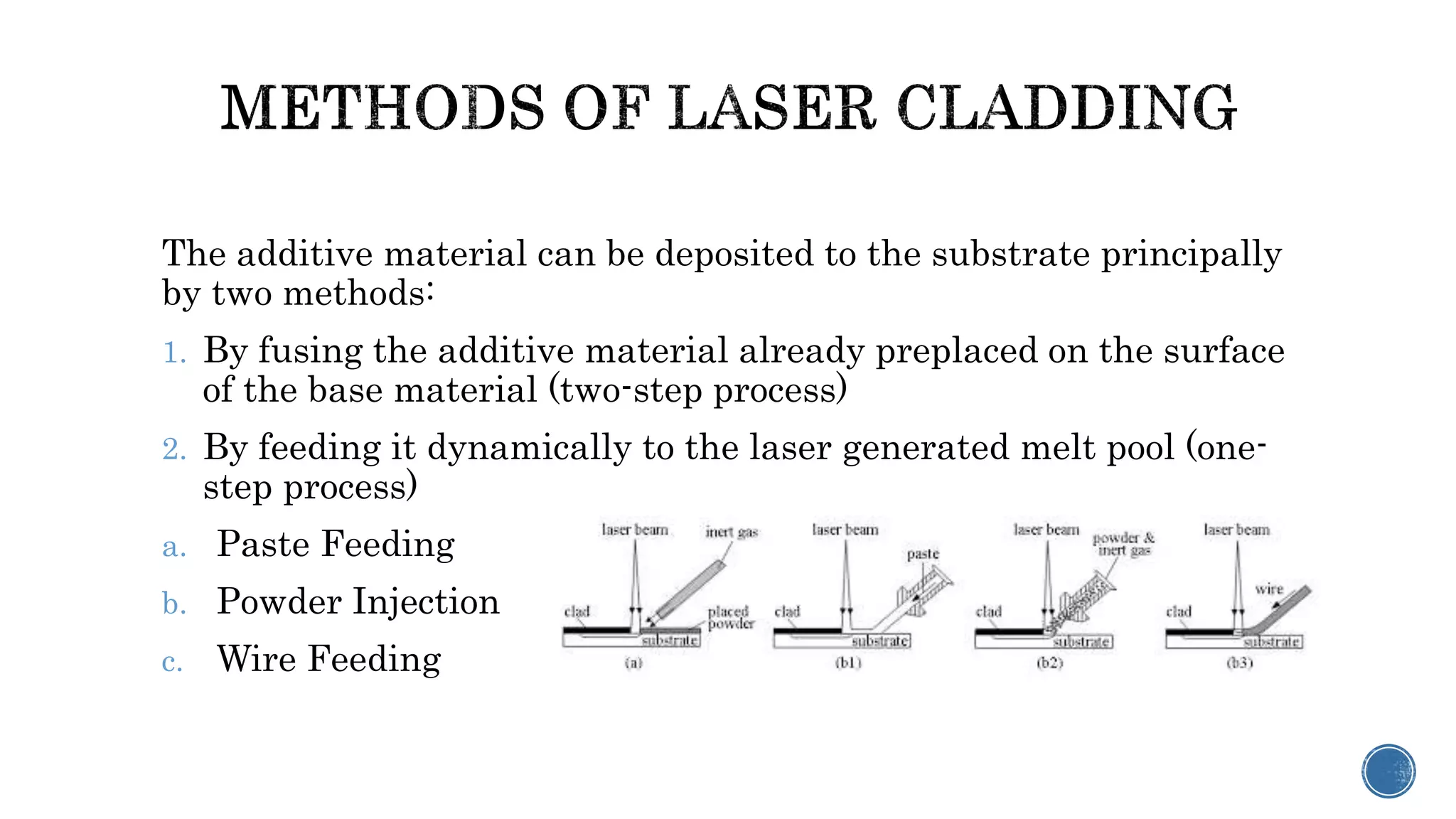
The additive material can be deposited to the substrate principally
by two methods:
1. By fusing the additive material already preplaced on the surface
of the base material (two-step process)
2. By feeding it dynamically to the laser generated melt pool (one-
step process)
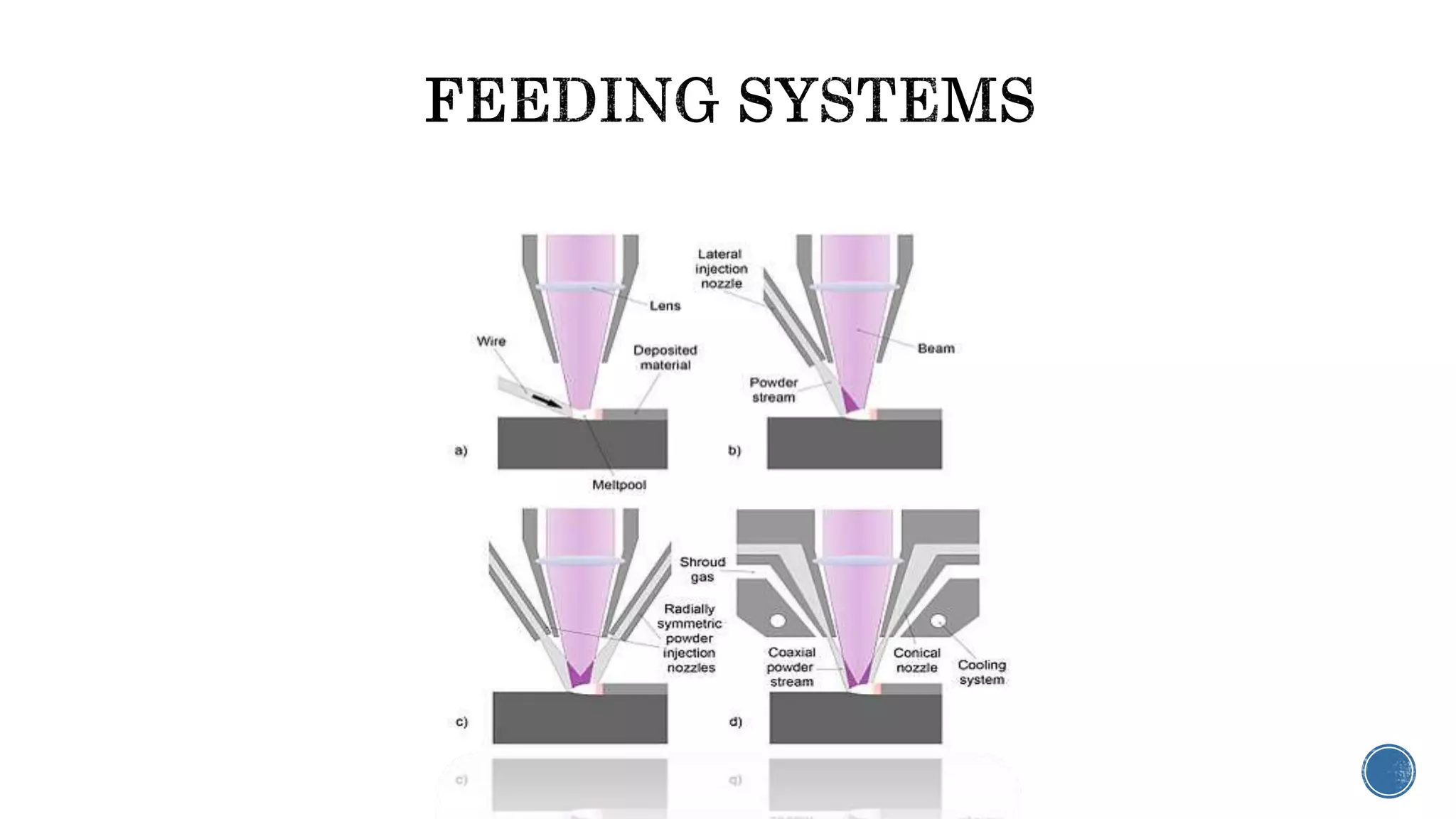
a. Paste Feeding
b. Powder Injection
c. Wire Feeding
 It is often used to improve mechanical properties or
increase corrosion resistance, repair worn out parts, and
fabricate metal matrix composites.
 Surface material may be laser cladded directly onto a highly
stressed component, i.e. to make a self-lubricating surface.
 However, such a modification requires further
industrialization of the cladding process to adapt it for
efficient mass production.
 Types of base material: Carbon-manganese, alloy, stainless and tool
steel, copper
 Cladding material alloy: Cobalt, iron, nickle alloys, martensitic
stainless steel and tungsten carbide, bronze
 Types of Cladding process: Gas fed power cladding, gravity power
cladding, hot wire cladding
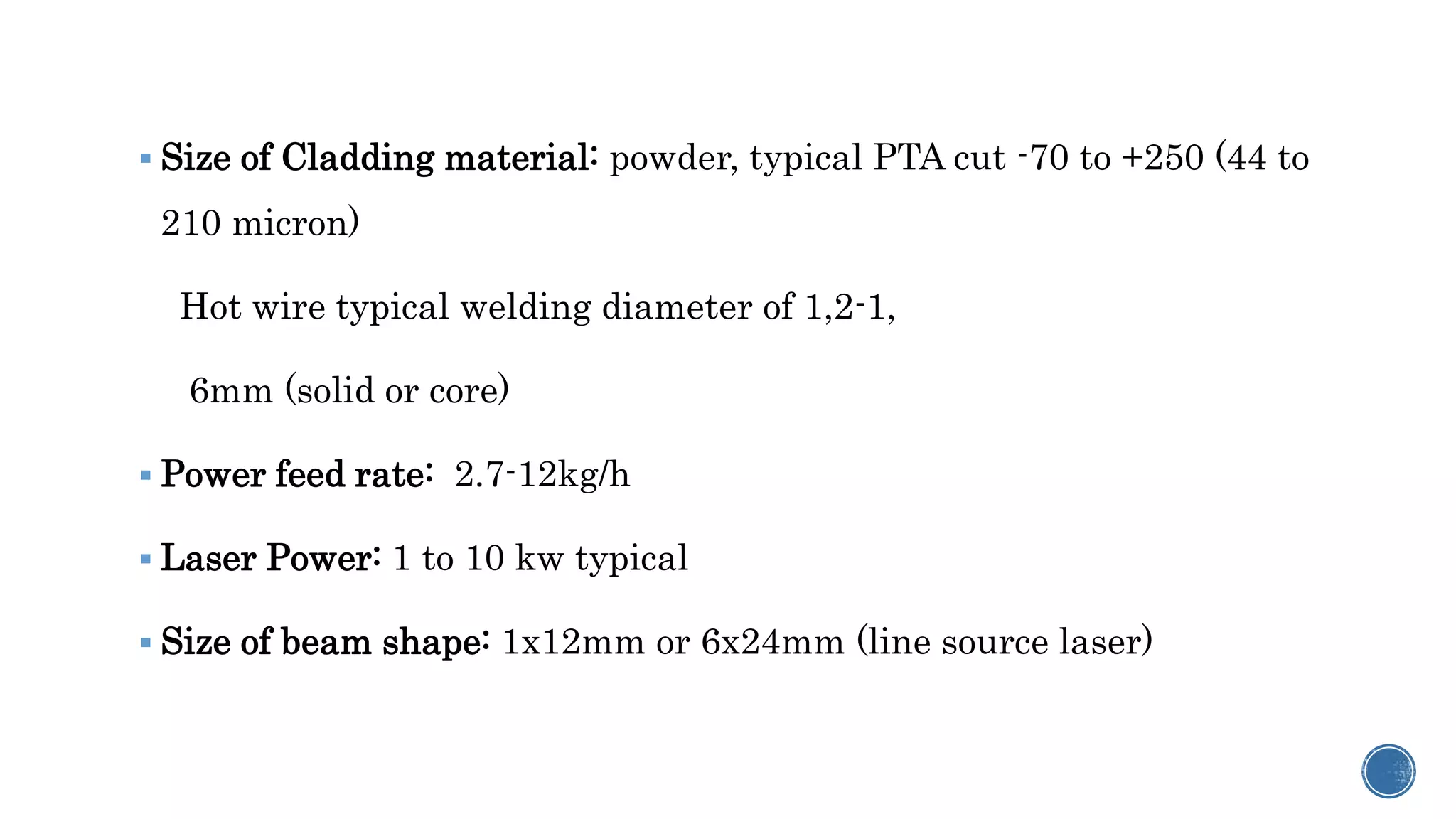
 Size of Cladding material: powder, typical PTA cut -70 to +250 (44 to
210 micron)
Hot wire typical welding diameter of 1,2-1,
6mm (solid or core)
 Power feed rate: 2.7-12kg/h
 Laser Power: 1 to 10 kw typical
 Size of beam shape: 1x12mm or 6x24mm (line source laser)
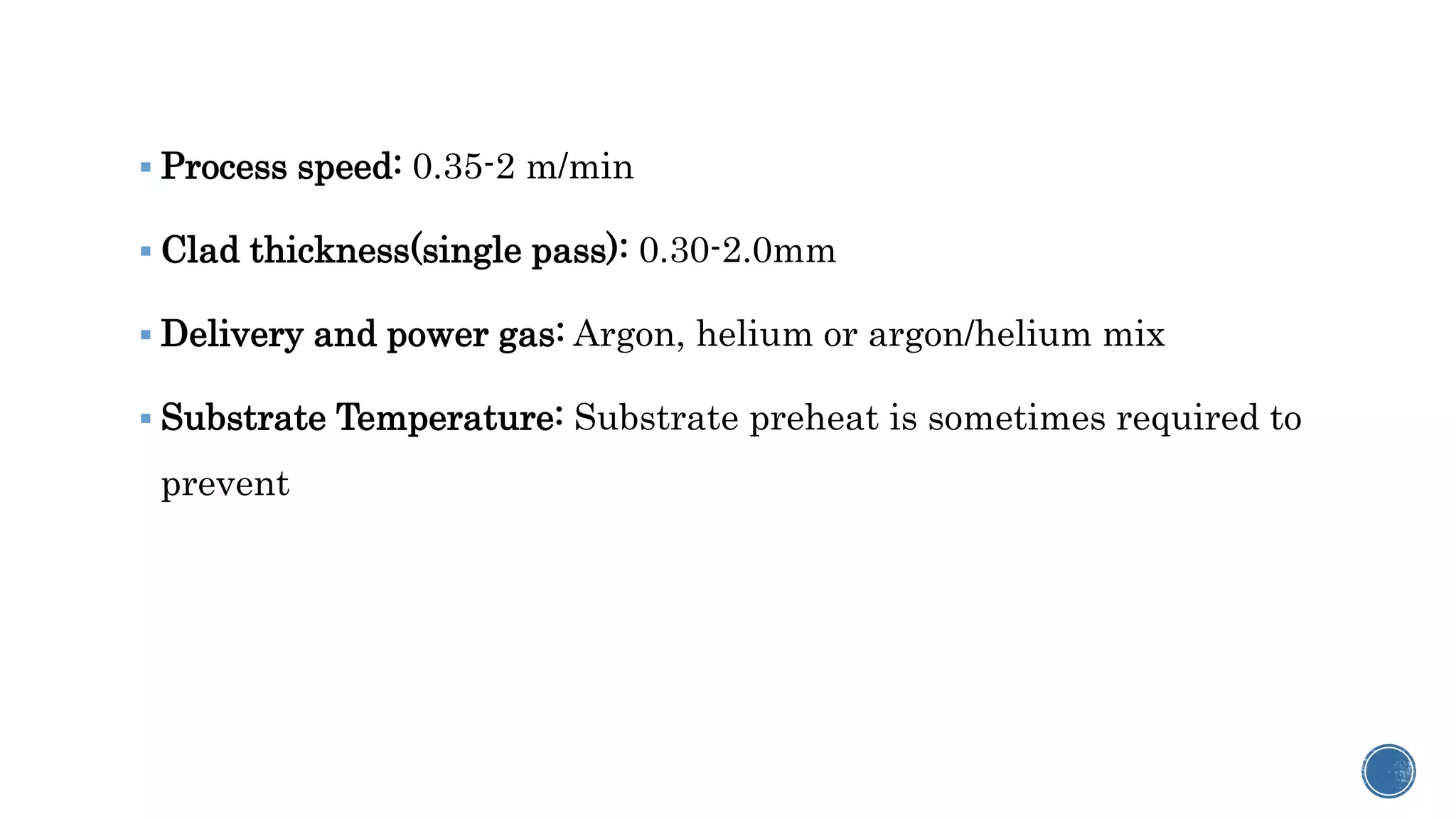
 Process speed: 0.35-2 m/min
 Clad thickness(single pass): 0.30-2.0mm
 Delivery and power gas: Argon, helium or argon/helium mix
 Substrate Temperature: Substrate preheat is sometimes required to
prevent
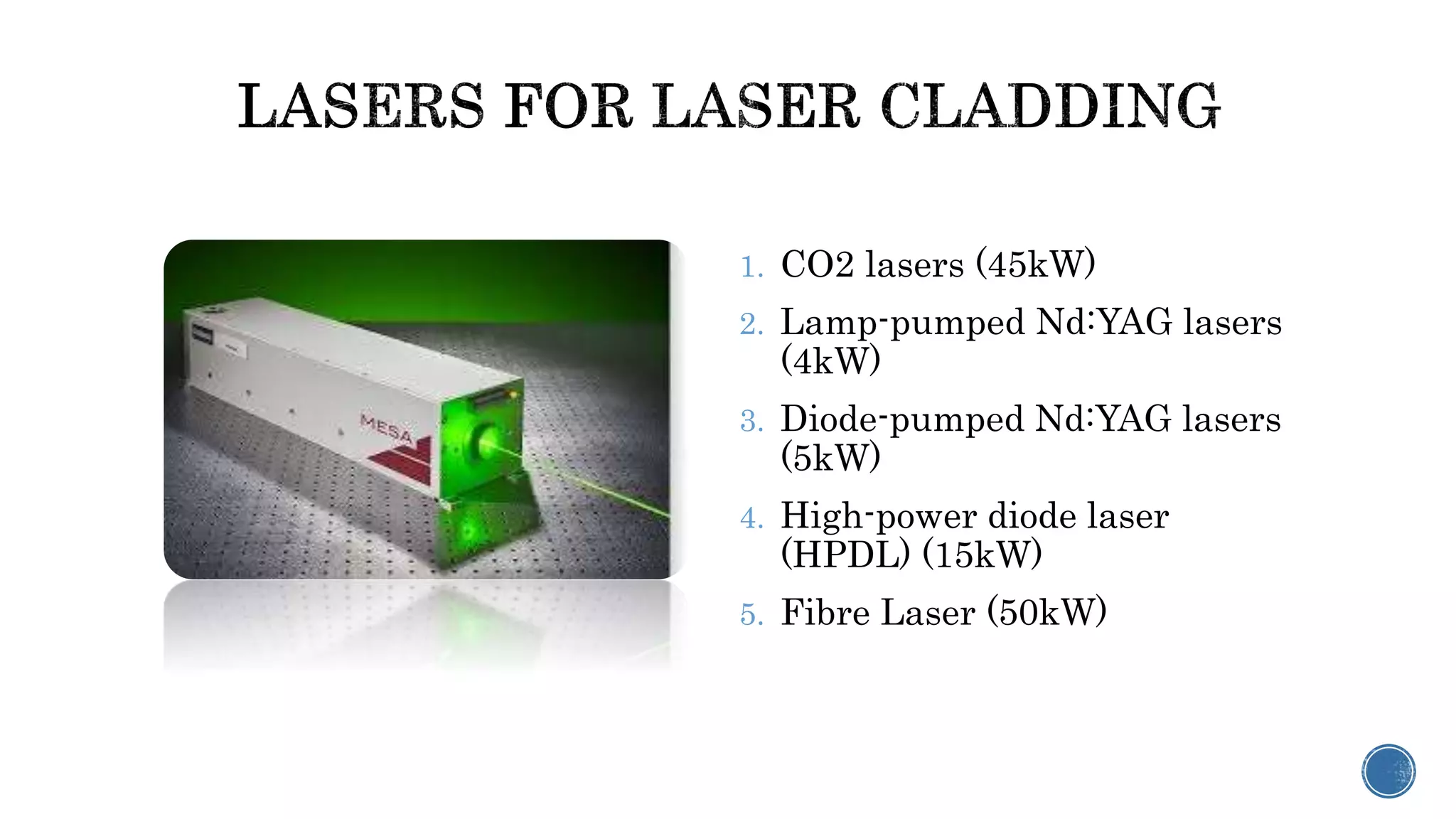
1. CO2 lasers (45kW)
2. Lamp-pumped Nd:YAG lasers
(4kW)
3. Diode-pumped Nd:YAG lasers
(5kW)
4. High-power diode laser
(HPDL) (15kW)
5. Fibre Laser (50kW)
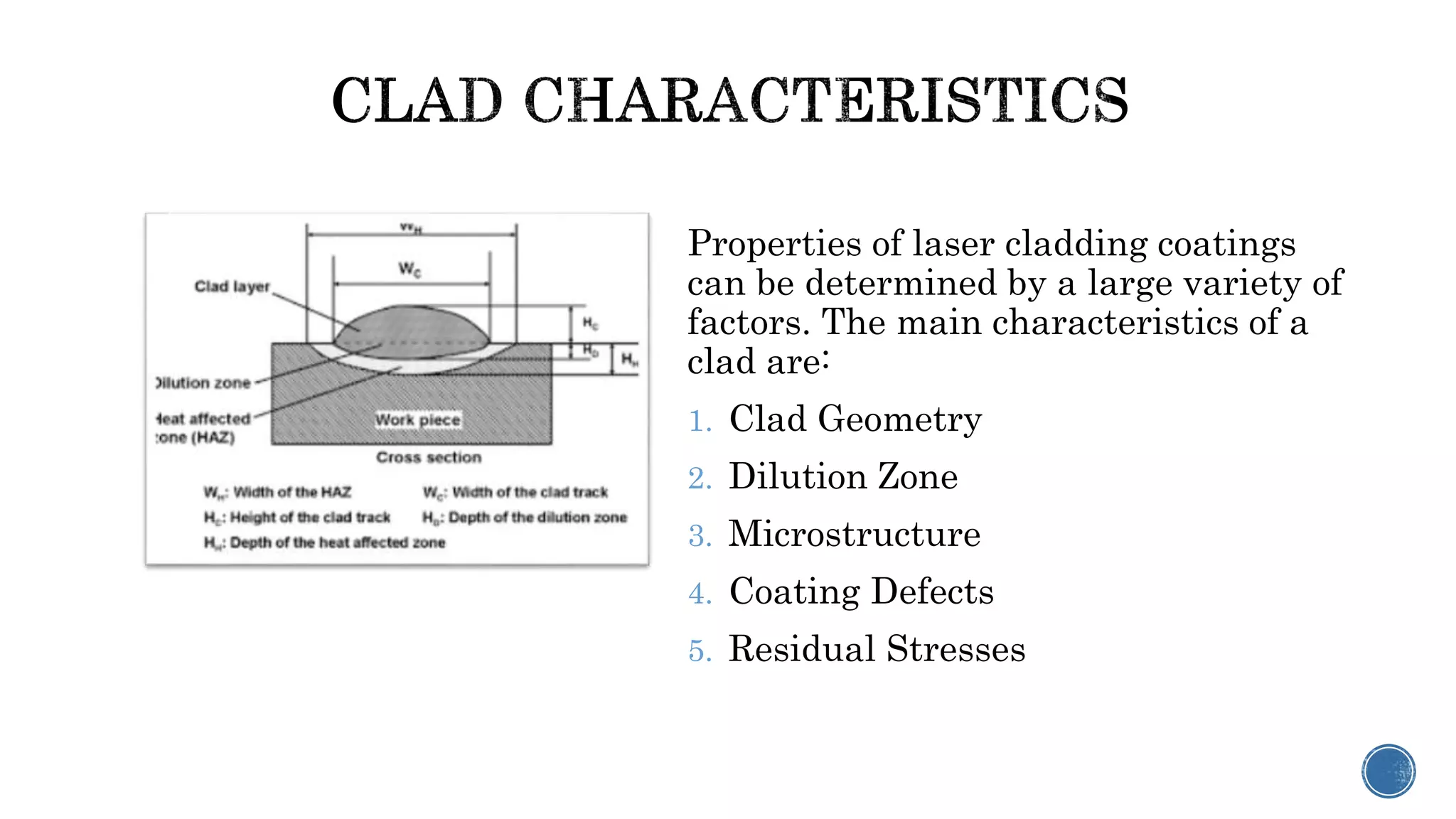
Properties of laser cladding coatings
can be determined by a large variety of
factors. The main characteristics of a
clad are:
1. Clad Geometry
2. Dilution Zone
3. Microstructure
4. Coating Defects
5. Residual Stresses
Laser cladding process provides a wide range of processing benefits
compared with conventional arc welding:
 Processing time is short
 The heat input is localised
 Lowest dilution of coating materials (< 5%) for maximum purity
and performance of the coating
 Distortion and heat-affected zones (HAZ) are much smaller than
any other welding processes
 Laser can clad smaller and thinner pieces than conventional
welding.
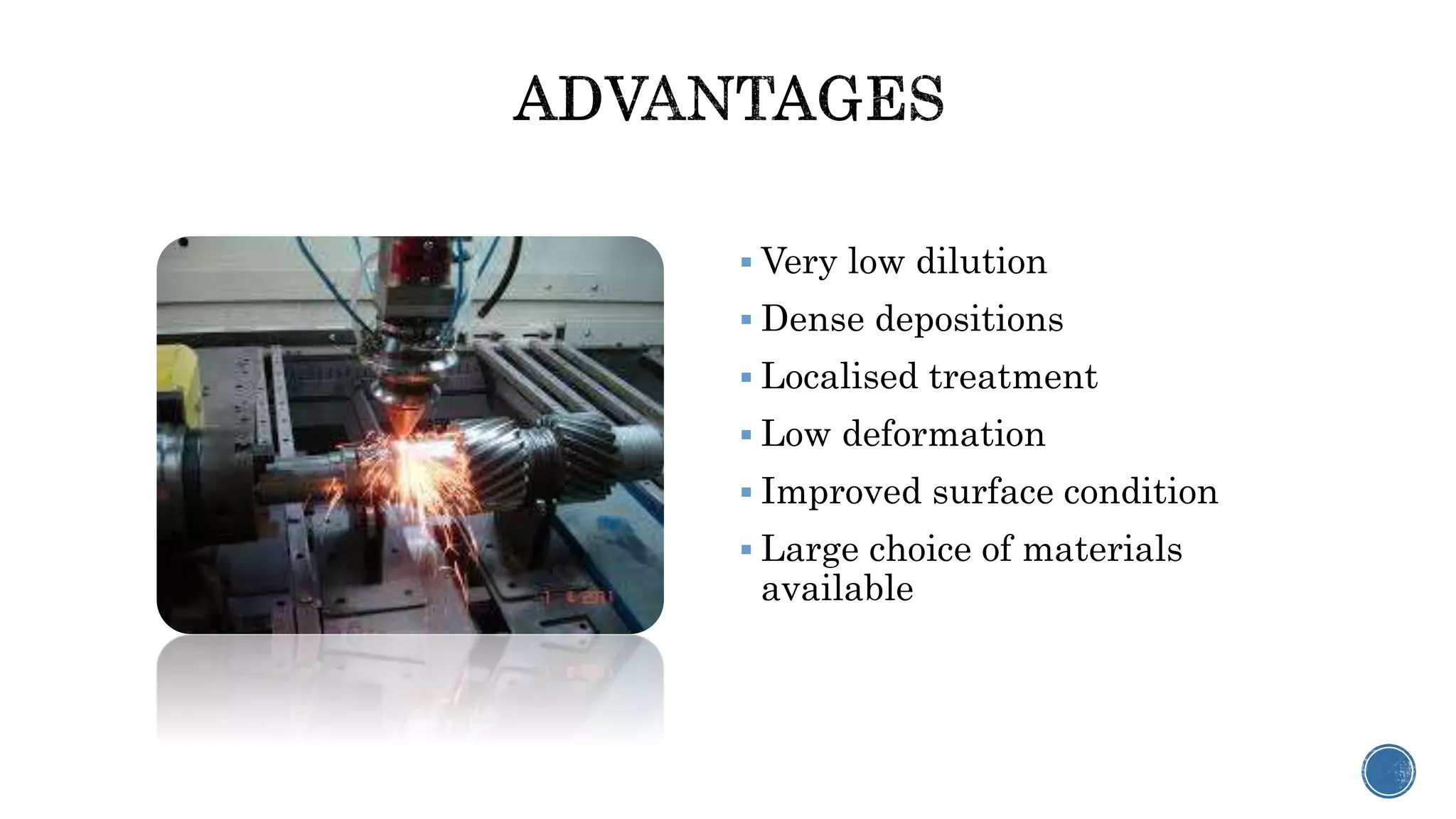
 Adaptation of the nature of the material depending on strain
(friction, wear and tear, corrosion etc).
 Longer life of parts.
 Repairs of used or worn parts.
 Repairs of high added-value parts.
 Localised mechanical reinforcement.
 Saves high added-value materials.
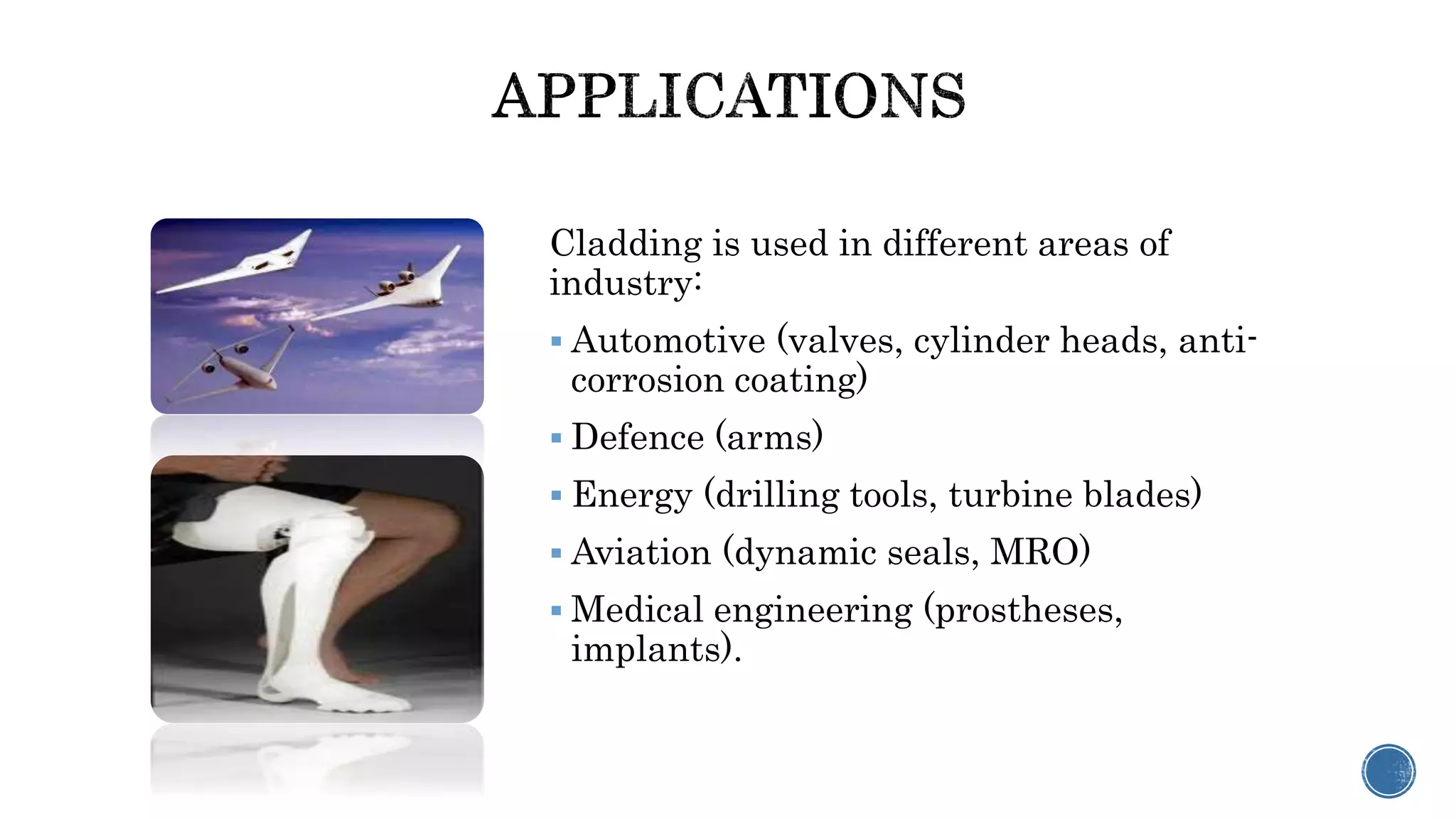
 Very low dilution
 Dense depositions
 Localised treatment
 Low deformation
 Improved surface condition
 Large choice of materials
available
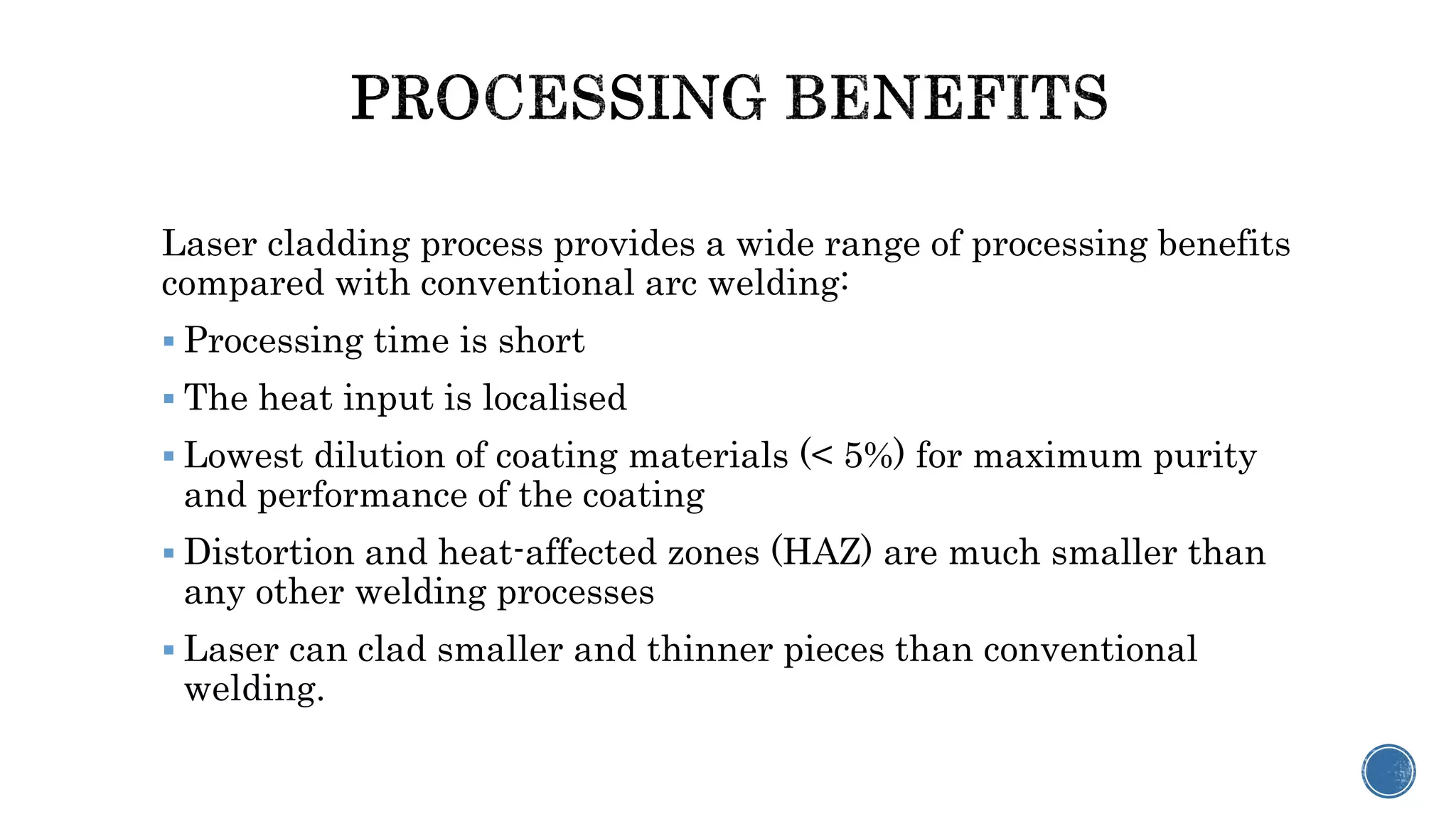
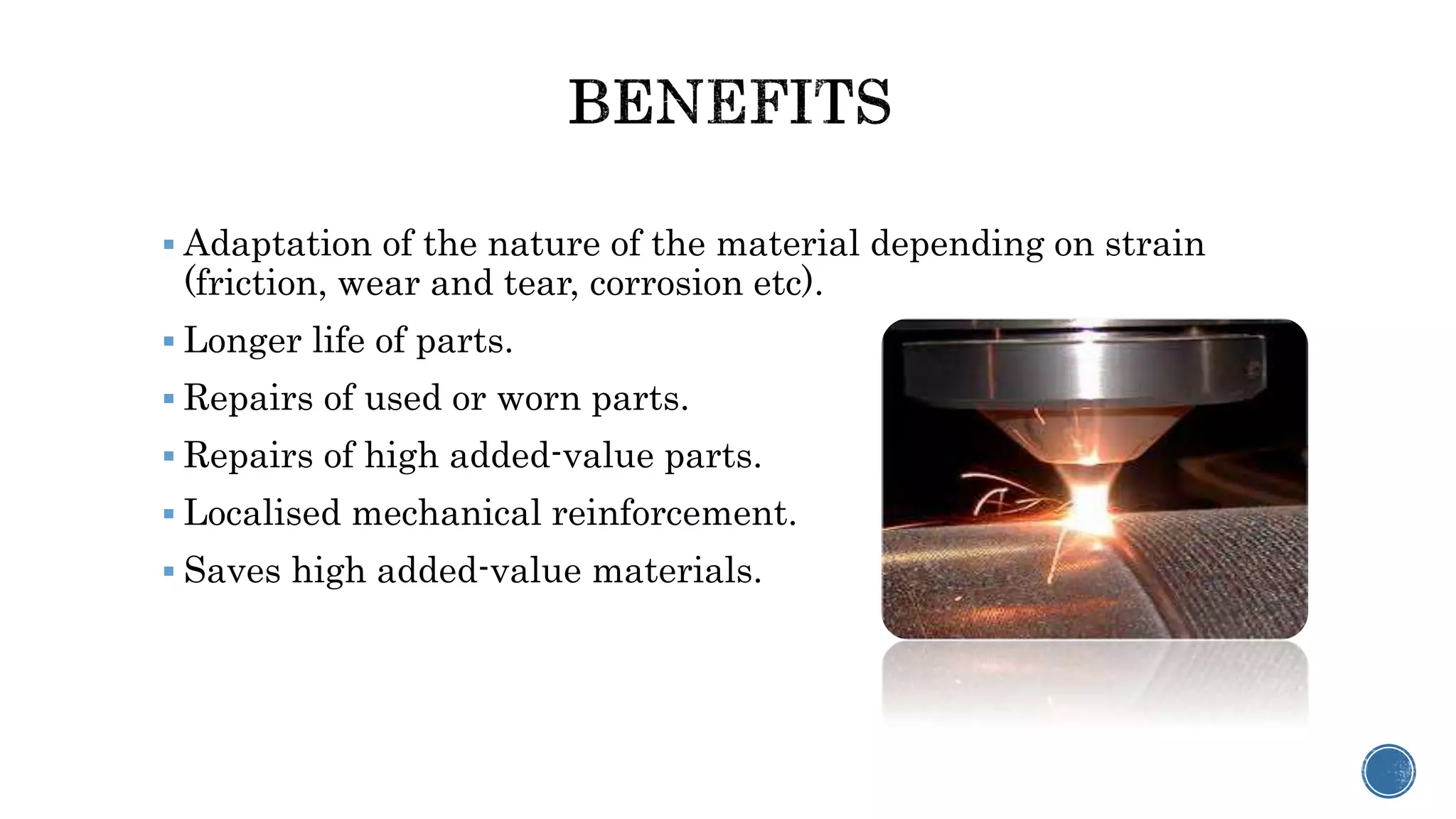
Cladding is used in different areas of
industry:
 Automotive (valves, cylinder heads, anti-
corrosion coating)
 Defence (arms)
 Energy (drilling tools, turbine blades)
 Aviation (dynamic seals, MRO)
 Medical engineering (prostheses,
implants).
 High set up costs for equipment and installation.
 Large equipment size limits. Means the system is not portable
 High build rate can lead to cracking
 Incorrect setup and power can cause stress cracking in the
cladding
 Being a new technology, availability and capability are still very
limited on laser diode
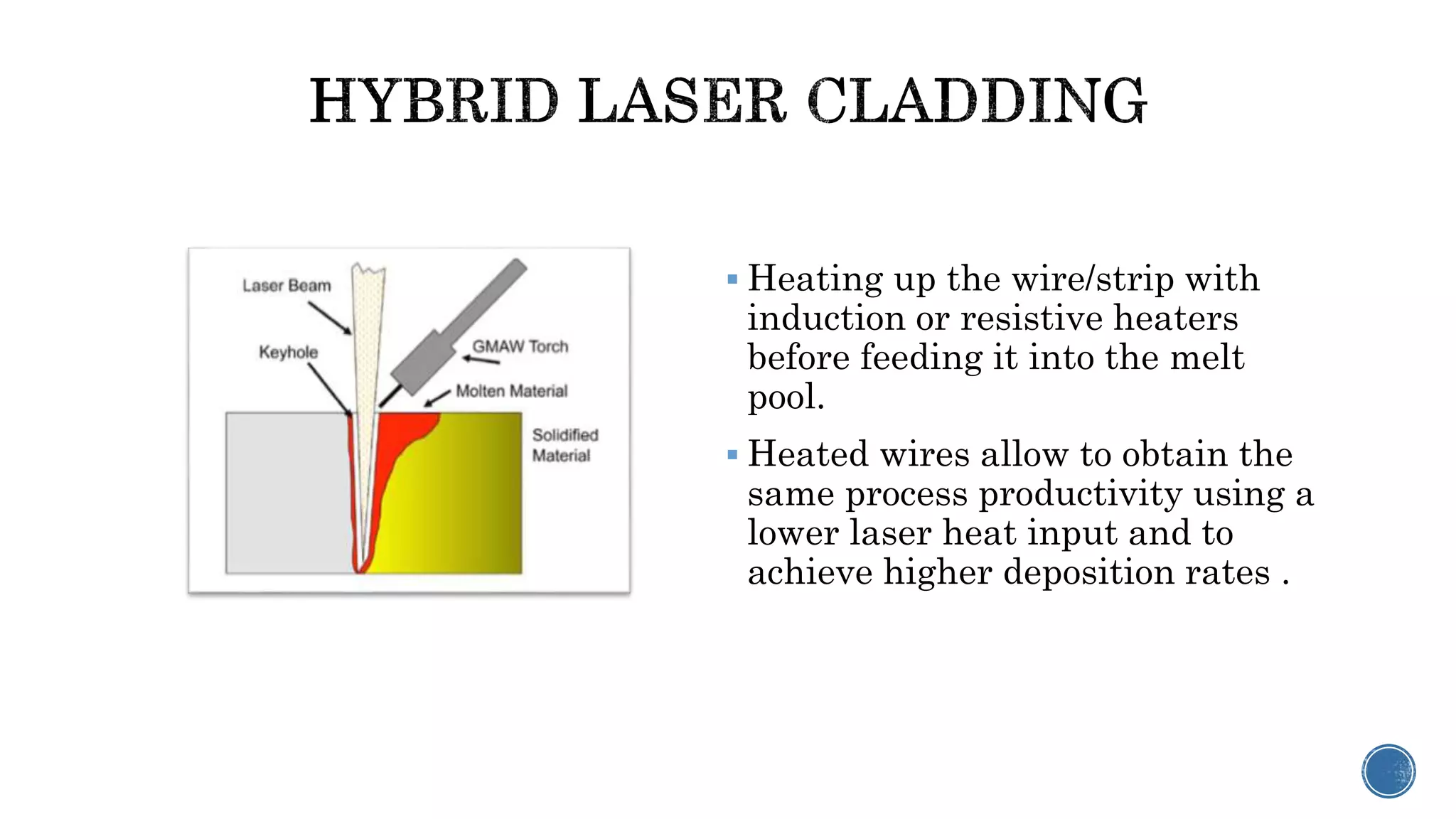
• An additional heat source is utilized together
with the typical cladding set-up to supply
extra energy to the process.
• This surplus of energy used to increase
productivity and deposition rate, produce
better coatings.
• The most efficient way to provide extra
energy to the additive material is to use the
laser cladding with wire/strip feeding
equipment.
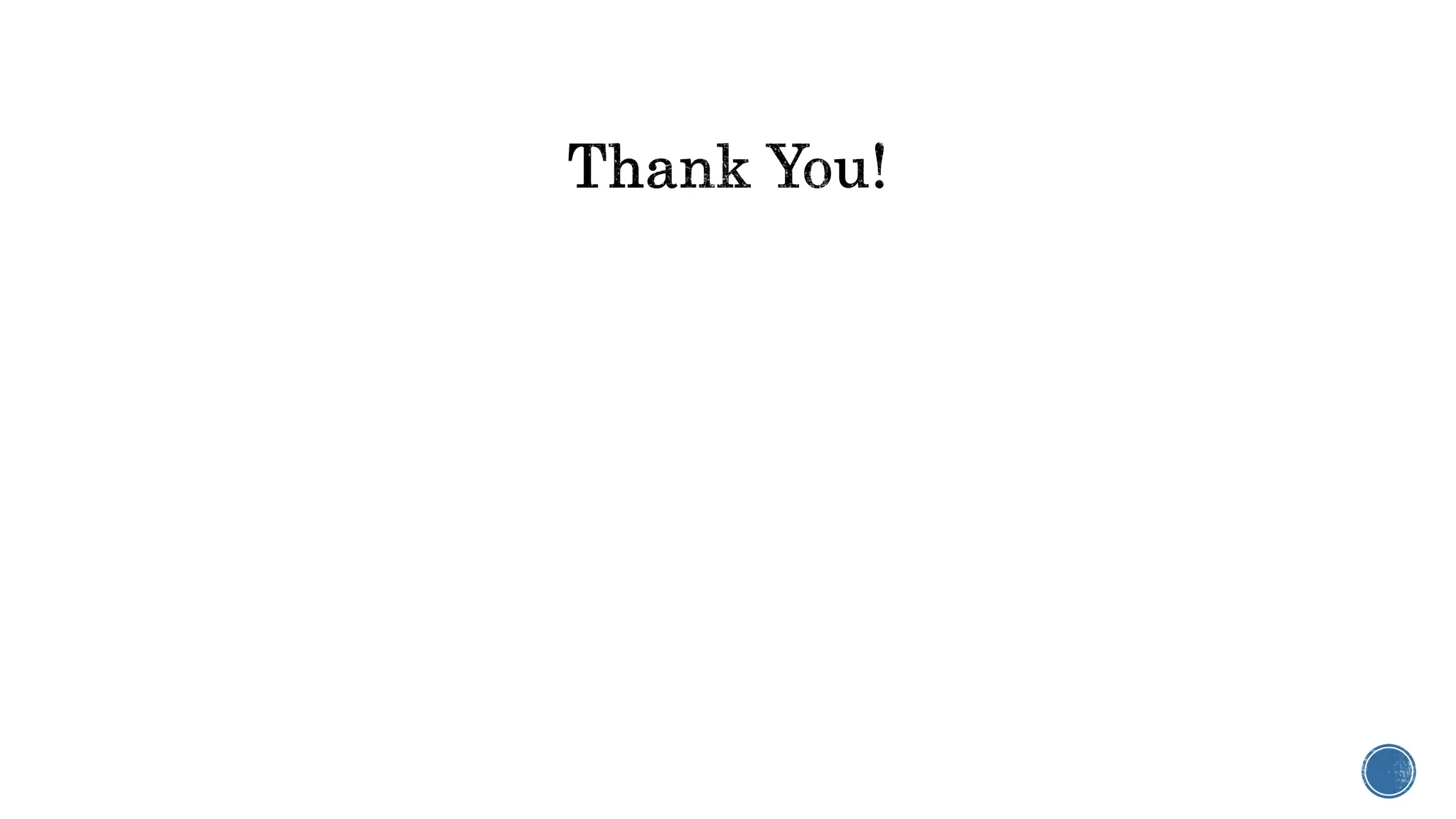
 Heating up the wire/strip with
induction or resistive heaters
before feeding it into the melt
pool.
 Heated wires allow to obtain the
same process productivity using a
lower laser heat input and to
achieve higher deposition rates .
Laser cladding

Laser cladding

  • 1.
  • 2.
     LASER:- LightAmplification by Stimulated Emission of Radiation  Interaction of an intense, highly directional, coherent and monochromatic beam of light with a workpiece, from which material is removed by vaporization.
  • 3.
    1. Solid lasersinclude the Ruby laser which uses precious stone to produce beam of red light. 2. Liquid lasers include the Dye lasers, which uses organic dye molecules in liquid to produce a wavelength of radiation that can be tuned. 3. Gas lasers excites the electron in gases such as Helium, Neon, Cadmium, Carbon-dioxide, Nitrogen.
  • 5.
     As Laserinteracts with the material, the energy of the photon is absorbed by the work material leading to rapid substantial rise in local temperature.  This in turn results in melting and vaporisation of the work material and finally material removal.  In laser drilling, the laser beam is focused over the desired spot size.
  • 6.
     High initialcapital cost and maintenance cost.  Not very efficient process.  Presence of Heat Affected Zone – specially in gas assist CO2 laser cutting.  Thermal process – not suitable for heat sensitive materials
  • 7.
     Material removal– drilling, cutting  Brazing  Welding  Cladding  Alloying
  • 8.
     Basically acovering or coating of one material over another  To provide a skin or layer to the inner metal  Bonding together of dissimilar metals or in some cases of non- conductive material over a conductive one
  • 9.
     To improvethe surface properties of the material such as corrosion resistance, mechanical strength  The United States Mint uses cladding to manufacture coins from different metals. This allows a cheaper metal to be used as a filler.  Most current USA coins consist of an inner core of pure copper with outer layers of cladded Ni-Cu alloy which looks like silver
  • 10.
    1] Mechanical Bonding 2]Direct Adhered 3] Spot Bonding
  • 11.
     Mechanical Bonding: This method involves fixed or embedded anchors or ties being used to attach the stone to the surface  Direct Adhered : This is one of the most common methods. It is thinner, less expensive and doesn’t require any onsite drilling  Spot Bonding : Similar to the direct adhered but epoxy is applied to about 10% of the area resulting in gaps or pockets of air between the stone and the wall reduces the chances of water staining
  • 12.
    Roll bonding:  Twoor more layers of different metals are thoroughly cleaned and passed through a pair of rollers under sufficient pressure to bond the layers.  Pressure – high enough to deform the metals and reduce the combined thickness of clad material  Sometimes heat is required for non ductile materials
  • 13.
    Explosive welding:  Pressureis provided by detonation of a sheet of chemical explosives  No heat affected zone is produced  Most commonly used to clad carbon steel plate with a thin layer of corrosion resistant materials  The process does not actually melt any of the two metals but plasticize the surface of both metals
  • 14.
     Laser claddingis realized either as wire (laser hot wire cladding) or powder cladding.  The laser beam creates a molten pool at the workpiece surface, to which is simultaneously added the laser coating material molten by the laser.
  • 15.
     The exposuretime is short, which creates only a short delay as the cooling is quick.  The result layer is tougher than those coatings created by thermal spraying, it is harmless to health, too.
  • 16.
     For traditionalcladding processes, methods such as thermal spraying and arc welding are commonly used.  During the process, an arc is produced to melt the surface or base material making it more malleable.  The clad or surface material is then added—usually in wire or powder form—and melted by the arc, thus creating the new, smooth and revised surface..
  • 17.
     Laser-based claddingprocesses are often much improved over the more traditional forms of cladding.  The laser emitter generally has a much more precise and capable beam, well suited to metalworking and rapid processing techniques
  • 18.
    The additive materialcan be deposited to the substrate principally by two methods: 1. By fusing the additive material already preplaced on the surface of the base material (two-step process) 2. By feeding it dynamically to the laser generated melt pool (one- step process) a. Paste Feeding b. Powder Injection c. Wire Feeding
  • 20.
     It isoften used to improve mechanical properties or increase corrosion resistance, repair worn out parts, and fabricate metal matrix composites.  Surface material may be laser cladded directly onto a highly stressed component, i.e. to make a self-lubricating surface.  However, such a modification requires further industrialization of the cladding process to adapt it for efficient mass production.
  • 21.
     Types ofbase material: Carbon-manganese, alloy, stainless and tool steel, copper  Cladding material alloy: Cobalt, iron, nickle alloys, martensitic stainless steel and tungsten carbide, bronze  Types of Cladding process: Gas fed power cladding, gravity power cladding, hot wire cladding
  • 22.
     Size ofCladding material: powder, typical PTA cut -70 to +250 (44 to 210 micron) Hot wire typical welding diameter of 1,2-1, 6mm (solid or core)  Power feed rate: 2.7-12kg/h  Laser Power: 1 to 10 kw typical  Size of beam shape: 1x12mm or 6x24mm (line source laser)
  • 23.
     Process speed:0.35-2 m/min  Clad thickness(single pass): 0.30-2.0mm  Delivery and power gas: Argon, helium or argon/helium mix  Substrate Temperature: Substrate preheat is sometimes required to prevent
  • 24.
    1. CO2 lasers(45kW) 2. Lamp-pumped Nd:YAG lasers (4kW) 3. Diode-pumped Nd:YAG lasers (5kW) 4. High-power diode laser (HPDL) (15kW) 5. Fibre Laser (50kW)
  • 25.
    Properties of lasercladding coatings can be determined by a large variety of factors. The main characteristics of a clad are: 1. Clad Geometry 2. Dilution Zone 3. Microstructure 4. Coating Defects 5. Residual Stresses
  • 26.
    Laser cladding processprovides a wide range of processing benefits compared with conventional arc welding:  Processing time is short  The heat input is localised  Lowest dilution of coating materials (< 5%) for maximum purity and performance of the coating  Distortion and heat-affected zones (HAZ) are much smaller than any other welding processes  Laser can clad smaller and thinner pieces than conventional welding.
  • 27.
     Adaptation ofthe nature of the material depending on strain (friction, wear and tear, corrosion etc).  Longer life of parts.  Repairs of used or worn parts.  Repairs of high added-value parts.  Localised mechanical reinforcement.  Saves high added-value materials.
  • 28.
     Very lowdilution  Dense depositions  Localised treatment  Low deformation  Improved surface condition  Large choice of materials available
  • 29.
    Cladding is usedin different areas of industry:  Automotive (valves, cylinder heads, anti- corrosion coating)  Defence (arms)  Energy (drilling tools, turbine blades)  Aviation (dynamic seals, MRO)  Medical engineering (prostheses, implants).
  • 30.
     High setup costs for equipment and installation.  Large equipment size limits. Means the system is not portable  High build rate can lead to cracking  Incorrect setup and power can cause stress cracking in the cladding  Being a new technology, availability and capability are still very limited on laser diode
  • 31.
    • An additionalheat source is utilized together with the typical cladding set-up to supply extra energy to the process. • This surplus of energy used to increase productivity and deposition rate, produce better coatings. • The most efficient way to provide extra energy to the additive material is to use the laser cladding with wire/strip feeding equipment.
  • 32.
     Heating upthe wire/strip with induction or resistive heaters before feeding it into the melt pool.  Heated wires allow to obtain the same process productivity using a lower laser heat input and to achieve higher deposition rates .

Editor's Notes

  • #8 Drilling micro-sized holes using laser in difficult – to – machine materials is the most dominant application in industry. For Cutting thin sheets pulse laser can be used. For thicker ones continuous laser may be used.
  • #17 Thermal spraying Melted or heated material are sprayed onto a surface.
  • #18 One step laser cladding process simultaneous movement of the laser source and of the feeding system leads to the formation of the coating. Two step Laser cladding process the first step consists in the deposition of the coating in the form of powder or paste on the substrate material, while the second step consists in the melting of the pre-placed layer through laser
  • #25 CO2: The principal drawback of CO2 lasers is the light emission wavelength. metals are less absorptive at 10 μm than at 1 μm. use for the production of complex part is restricted. Lamp pumped Nd:YAG disadvantages regarding efficiency and beam quality Diode Pumped Nd:YAG main disadvantage of the diode-pumped Nd:YAG laser is the significantly higher price compared to CO2 laser HPDL costs per kilowatt of laser power are much lower compared to those of the diode-pumped Nd:YAG and the CO2 lasers, high power diode lasers are the preferred tool for laser cladding. Fibre laser High beam quality, high efficiency and moderate investment costs
  • #26 Microstructure Functional properties and quality of coatings are strongly depend on microstructure Coating Defects main defects produced with laser cladding are cracks and pores/voids. Excessive dilution can also be considered as a defect in CP.
  • #30 Laser can clad smaller and thinner pieces than conventional welding.