Large-Scale Stream Processing
in the Hadoop Ecosystem
Gyula Fóra
gyfora@apache.org
Márton Balassi
mbalassi@apache.org
This talk
§ Stream processing by example
§ Open source stream processors
§ Runtime architecture and programming
model
§ Counting words…
§ Fault tolerance and stateful processing
§ Closing
2Apache:  Big  Data  Europe2015-­‐‑09-­‐‑28
Stream processing
by example
2015-­‐‑09-­‐‑28 Apache:  Big  Data  Europe 3
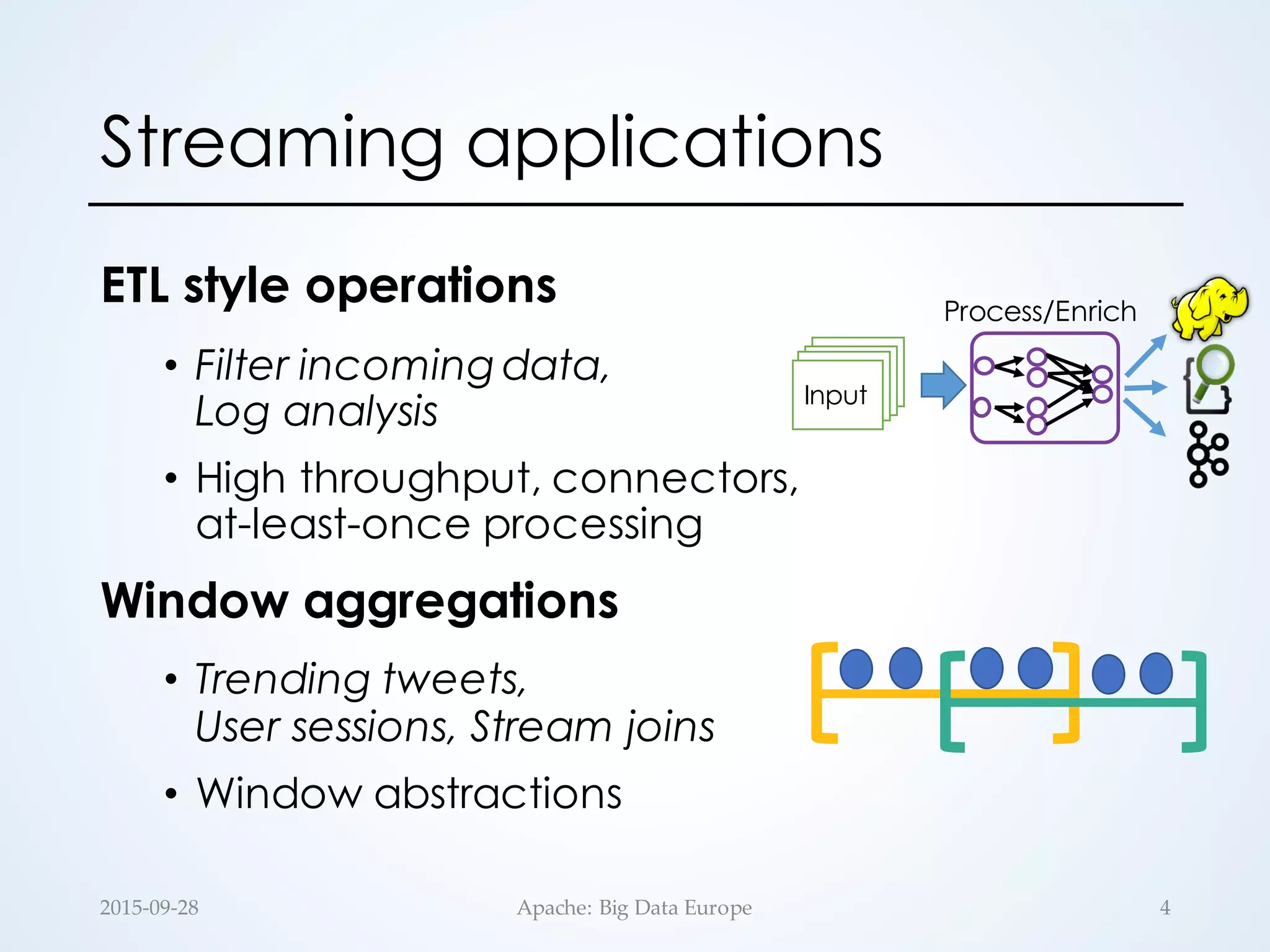
Streaming applications
ETL style operations
• Filter incoming data,
Log analysis
• High throughput, connectors,
at-least-once processing
Window aggregations
• Trending tweets,
User sessions, Stream joins
• Window abstractions
2015-­‐‑09-­‐‑28 Apache:  Big  Data  Europe 4
Inpu
t
Inpu
t
Inpu
tInput
Process/Enrich
Streaming applications
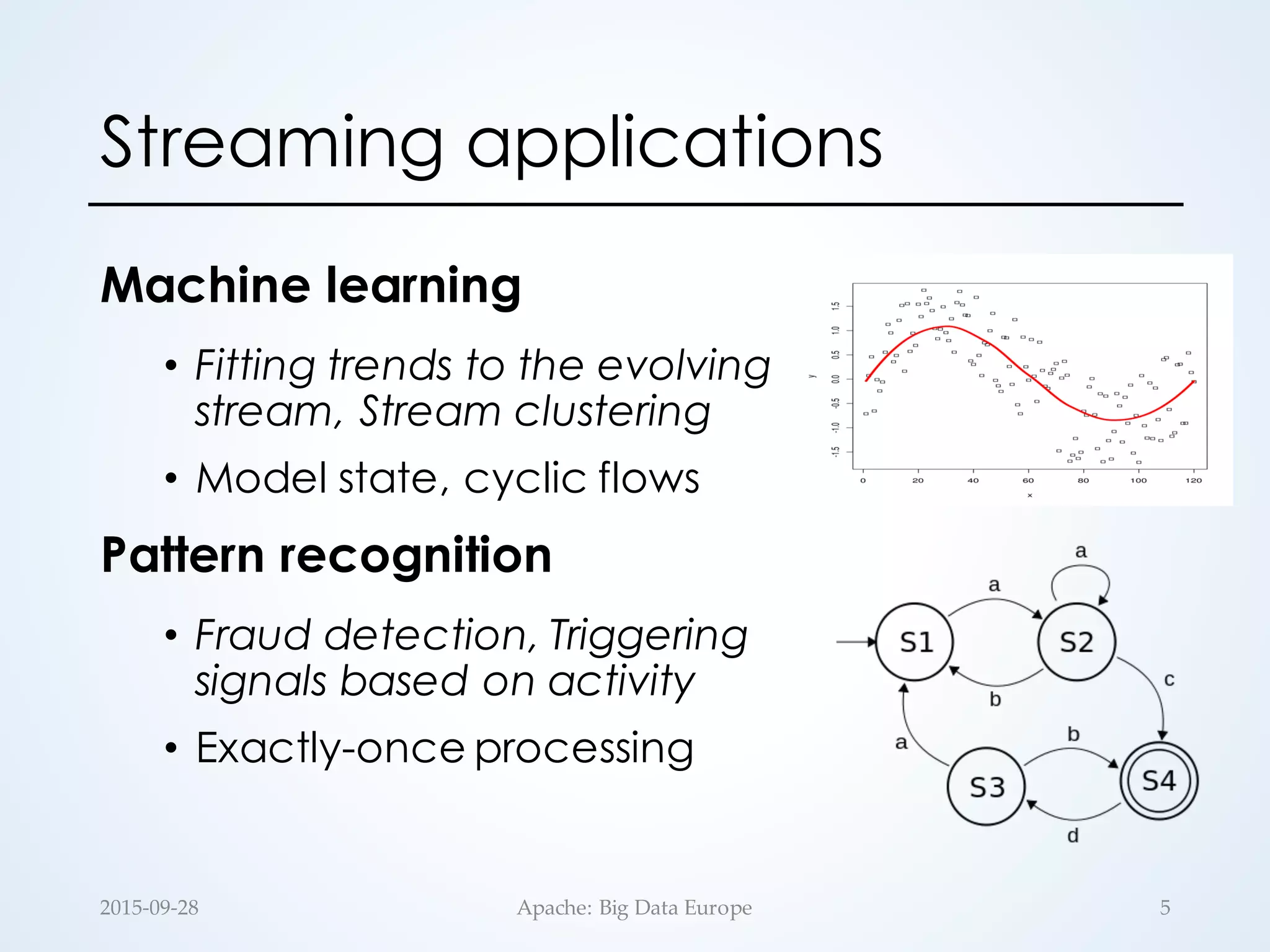
Machine learning
• Fitting trends to the evolving
stream, Stream clustering
• Model state, cyclic flows
Pattern recognition
• Fraud detection, Triggering
signals based on activity
• Exactly-once processing
5Apache:  Big  Data  Europe2015-­‐‑09-­‐‑28
Open source stream
processors
2015-­‐‑09-­‐‑28 Apache:  Big  Data  Europe 6
Apache Streaming landscape
72015-­‐‑09-­‐‑28 Apache:  Big  Data  Europe
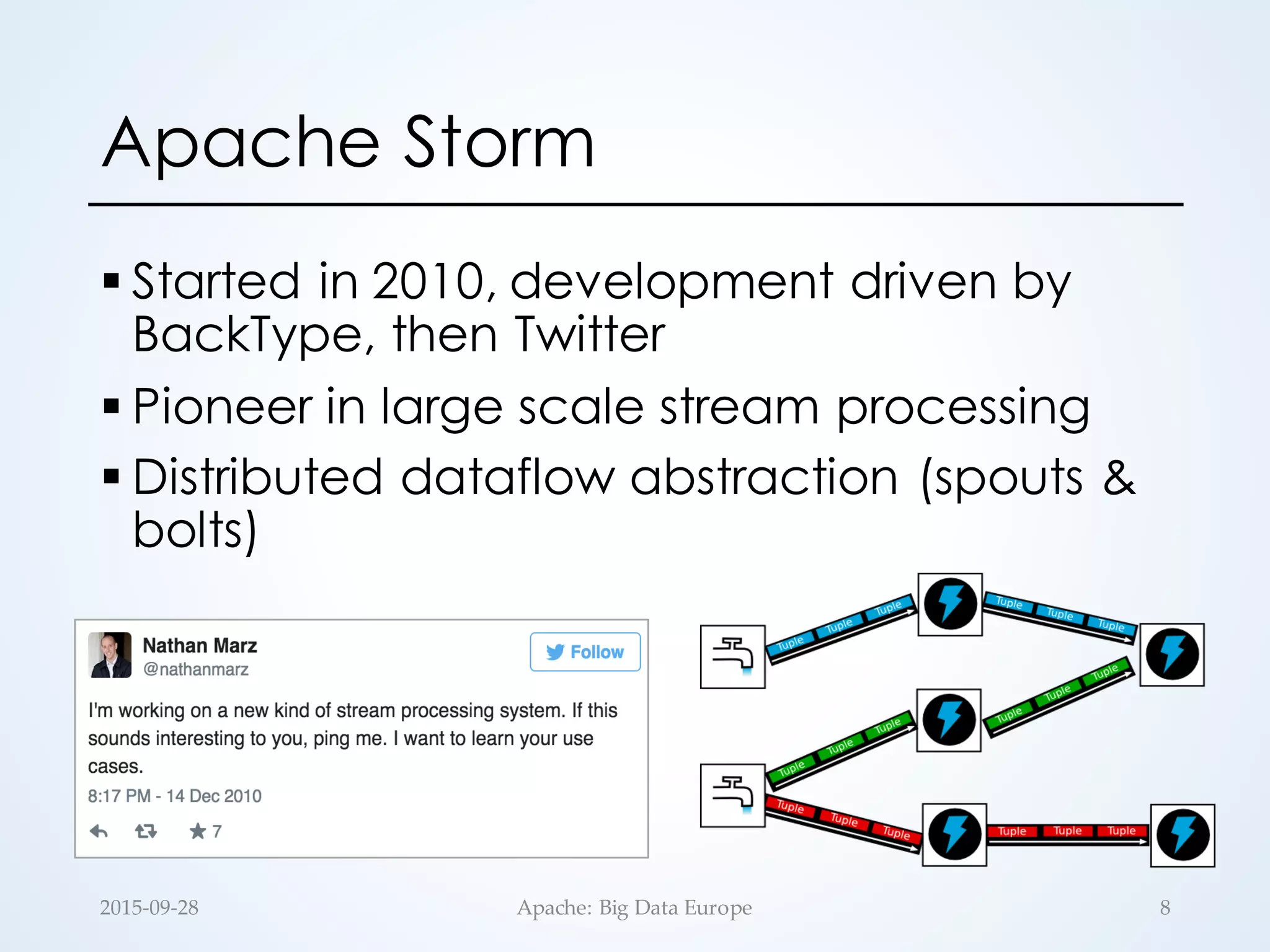
Apache Storm
§ Started in 2010, development driven by
BackType, then Twitter
§ Pioneer in large scale stream processing
§ Distributed dataflow abstraction (spouts &
bolts)
82015-­‐‑09-­‐‑28 Apache:  Big  Data  Europe
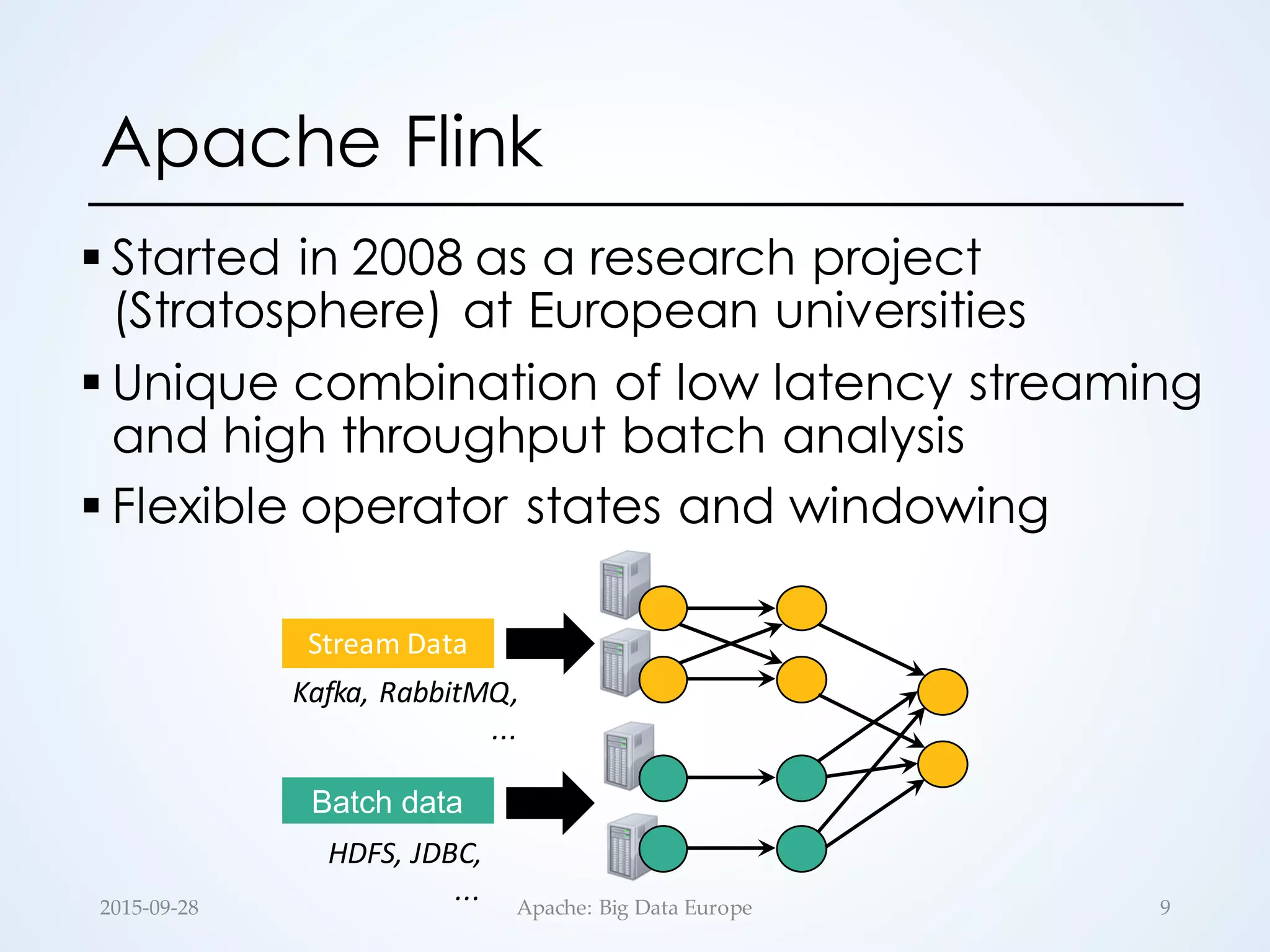
Apache Flink
§ Started in 2008 as a research project
(Stratosphere) at European universities
§ Unique combination of low latency streaming
and high throughput batch analysis
§ Flexible operator states and windowing
9
Batch  data
Kafka,	
  RabbitMQ,	
  
...
HDFS,	
  JDBC,	
  
...
Stream	
  Data
2015-­‐‑09-­‐‑28 Apache:  Big  Data  Europe
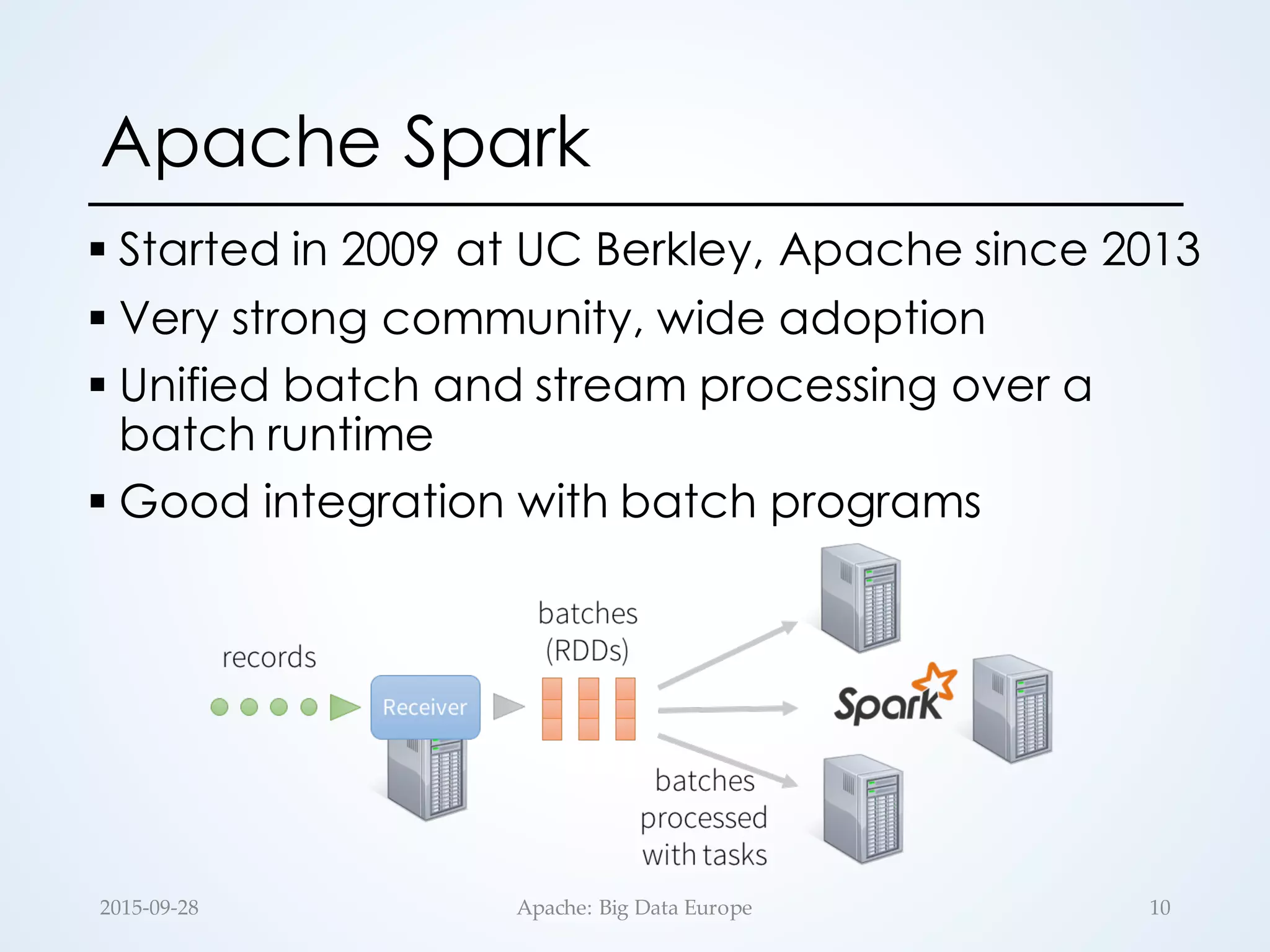
Apache Spark
§ Started in 2009 at UC Berkley, Apache since 2013
§ Very strong community, wide adoption
§ Unified batch and stream processing over a
batch runtime
§ Good integration with batch programs
102015-­‐‑09-­‐‑28 Apache:  Big  Data  Europe
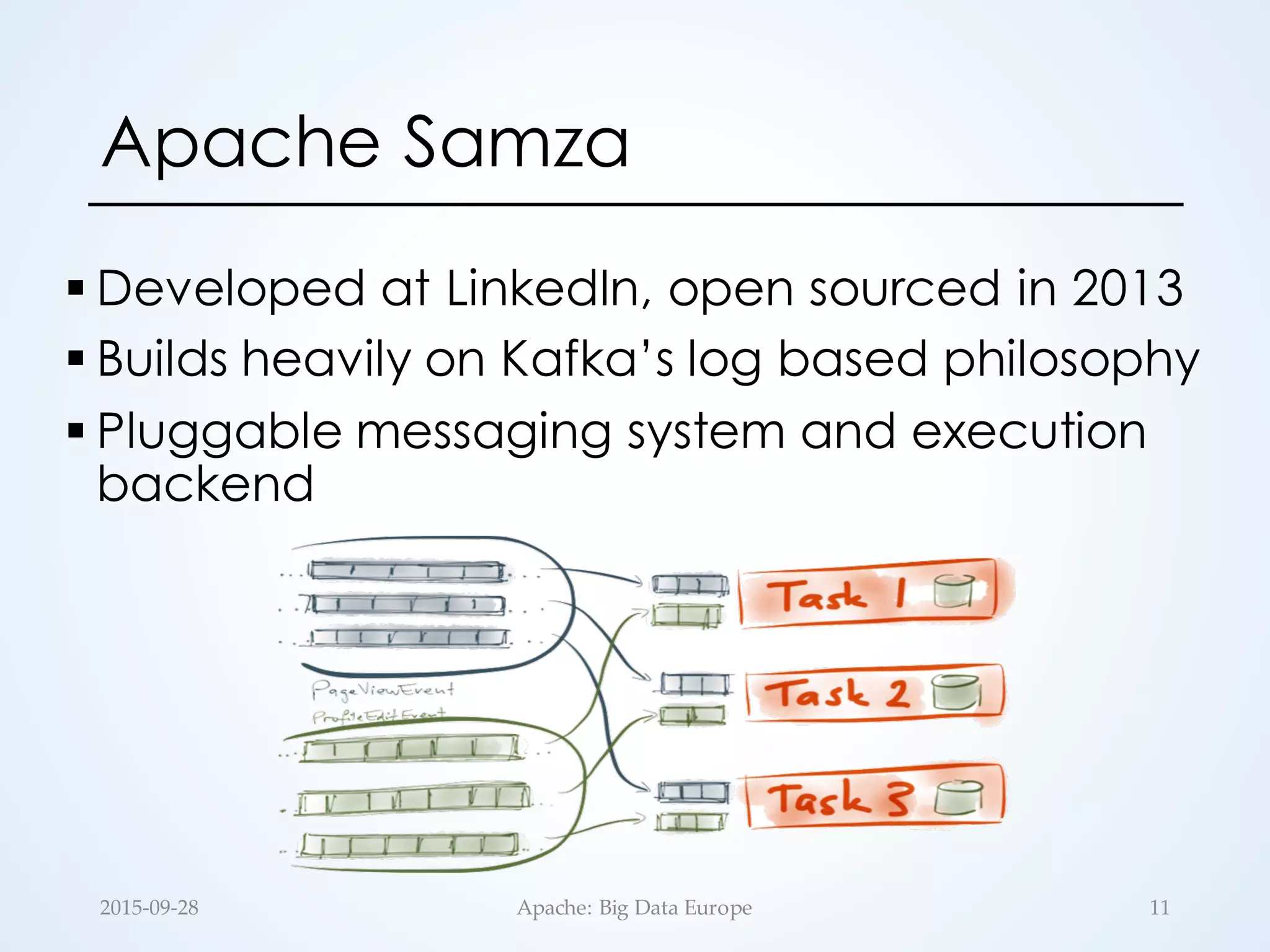
Apache Samza
§ Developed at LinkedIn, open sourced in 2013
§ Builds heavily on Kafka’s log based philosophy
§ Pluggable messaging system and execution
backend
112015-­‐‑09-­‐‑28 Apache:  Big  Data  Europe
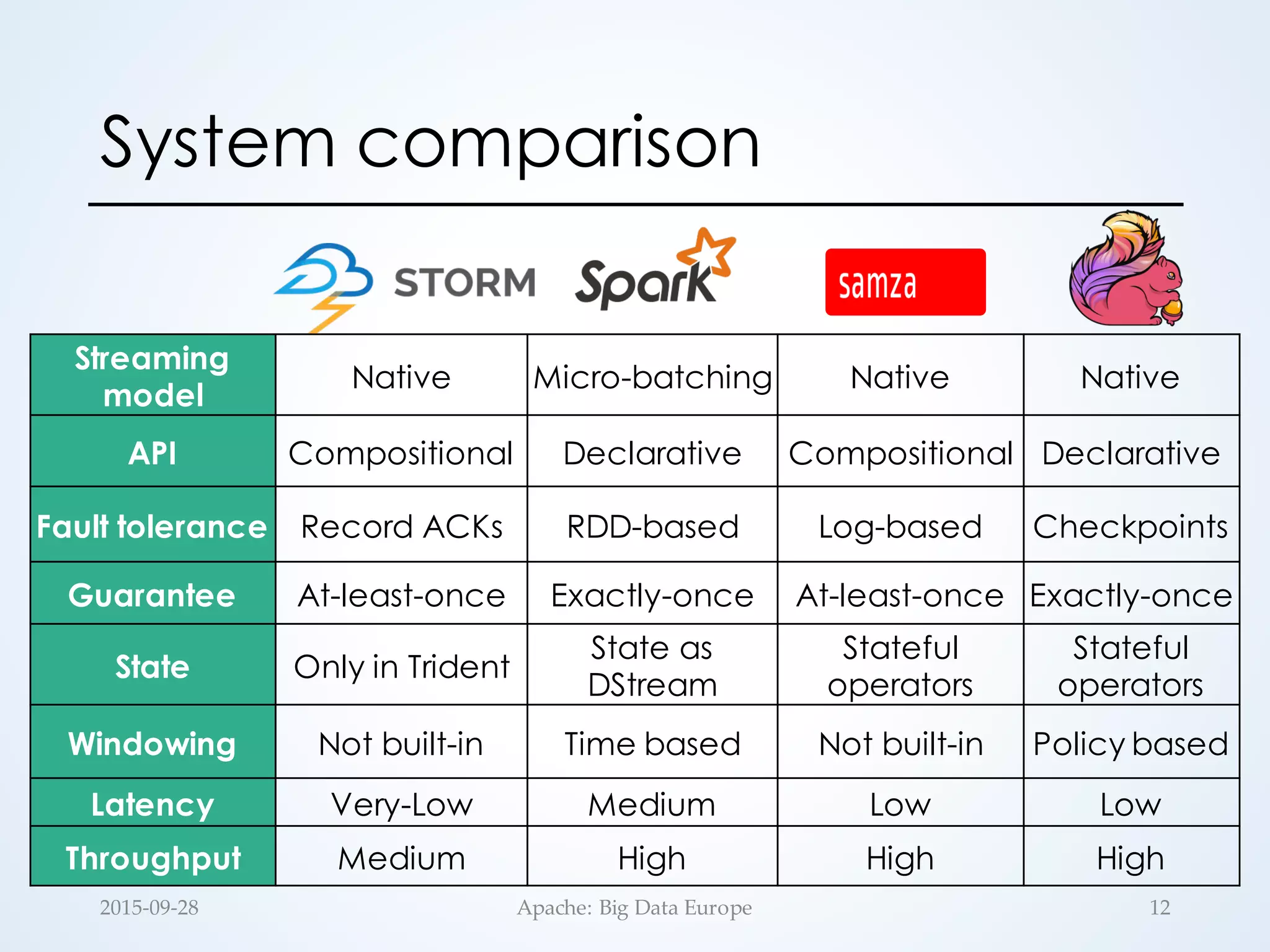
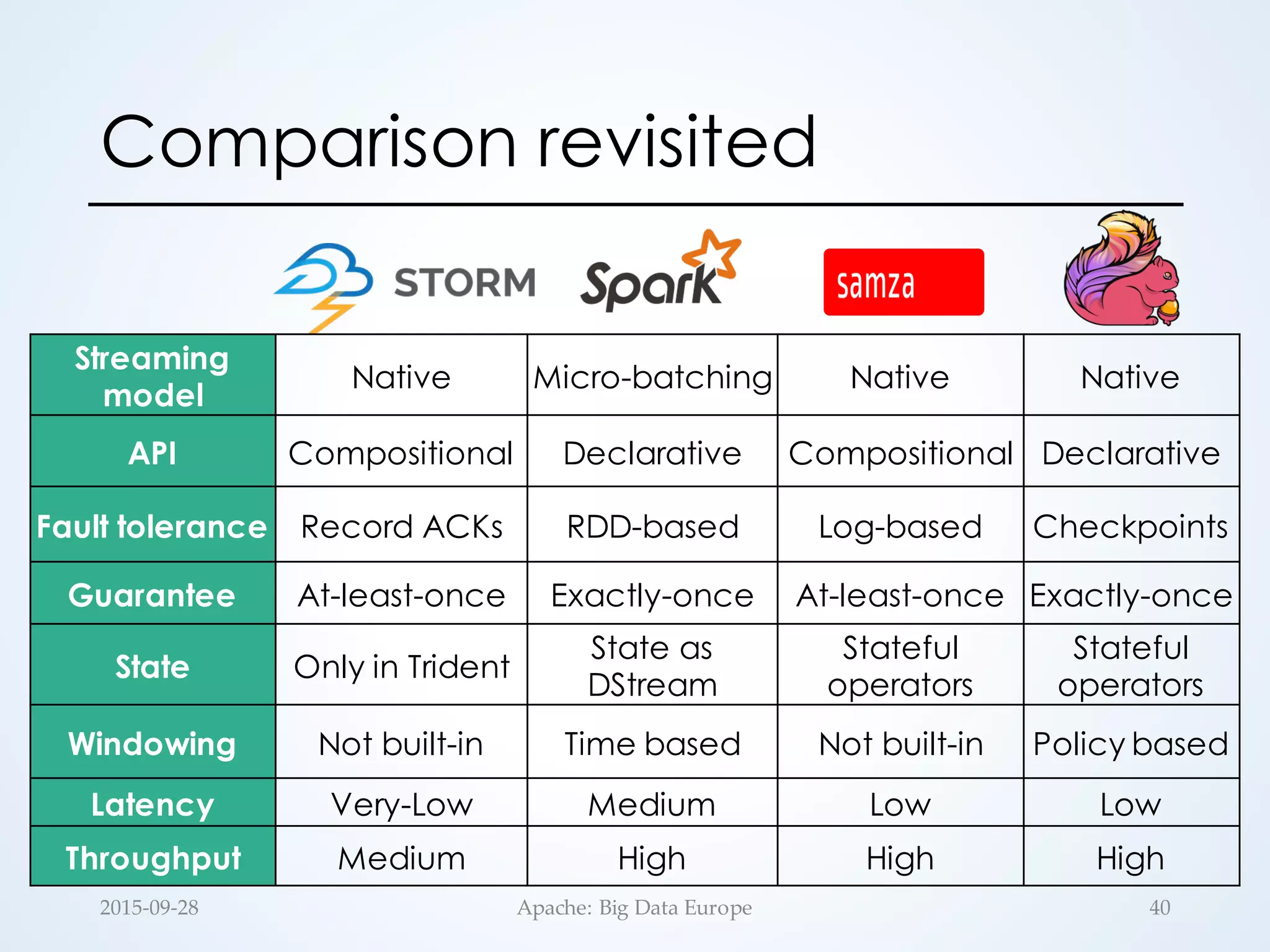
System comparison
12
Streaming
model
Native Micro-batching Native Native
API Compositional Declarative Compositional Declarative
Fault tolerance Record ACKs RDD-based Log-based Checkpoints
Guarantee At-least-once Exactly-once At-least-once Exactly-once
State Only in Trident
State as
DStream
Stateful
operators
Stateful
operators
Windowing Not built-in Time based Not built-in Policy based
Latency Very-Low Medium Low Low
Throughput Medium High High High
2015-­‐‑09-­‐‑28 Apache:  Big  Data  Europe
Runtime and
programming model
2015-­‐‑09-­‐‑28 Apache:  Big  Data  Europe 13
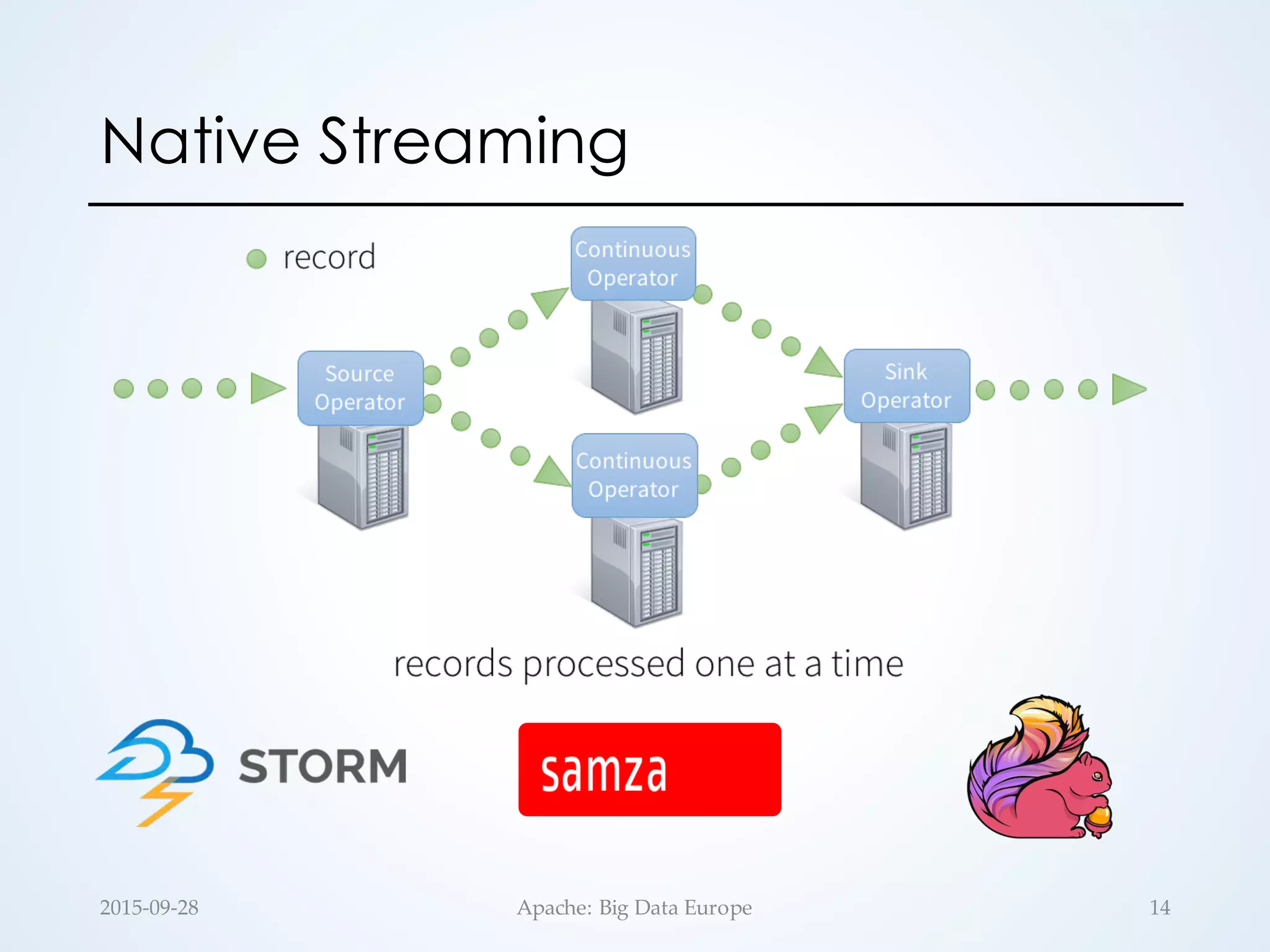
Native Streaming
2015-­‐‑09-­‐‑28 Apache:  Big  Data  Europe 14
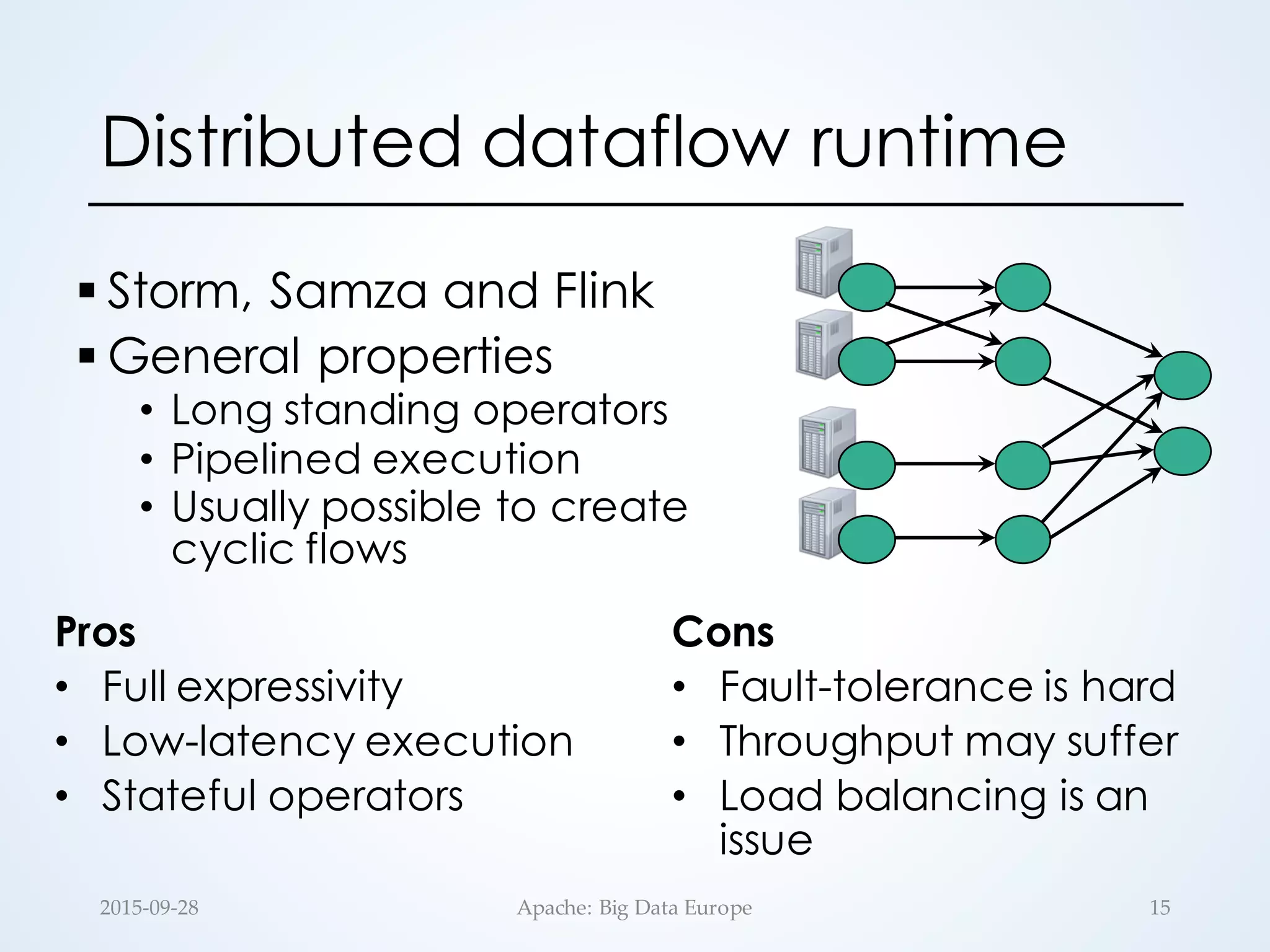
Distributed dataflow runtime
§ Storm, Samza and Flink
§ General properties
• Long standing operators
• Pipelined execution
• Usually possible to create
cyclic flows
2015-­‐‑09-­‐‑28 Apache:  Big  Data  Europe 15
Pros
• Full expressivity
• Low-latency execution
• Stateful operators
Cons
• Fault-tolerance is hard
• Throughput may suffer
• Load balancing is an
issue
Distributed dataflow runtime
§ Storm
• Dynamic typing + Kryo
• Dynamic topology rebalancing
§ Samza
• Almost every component pluggable
• Full task isolation, no backpressure (buffering
handled by the messaging layer)
§ Flink
• Strongly typed streams + custom serializers
• Flow control mechanism
• Memory management
2015-­‐‑09-­‐‑28 Apache:  Big  Data  Europe 16
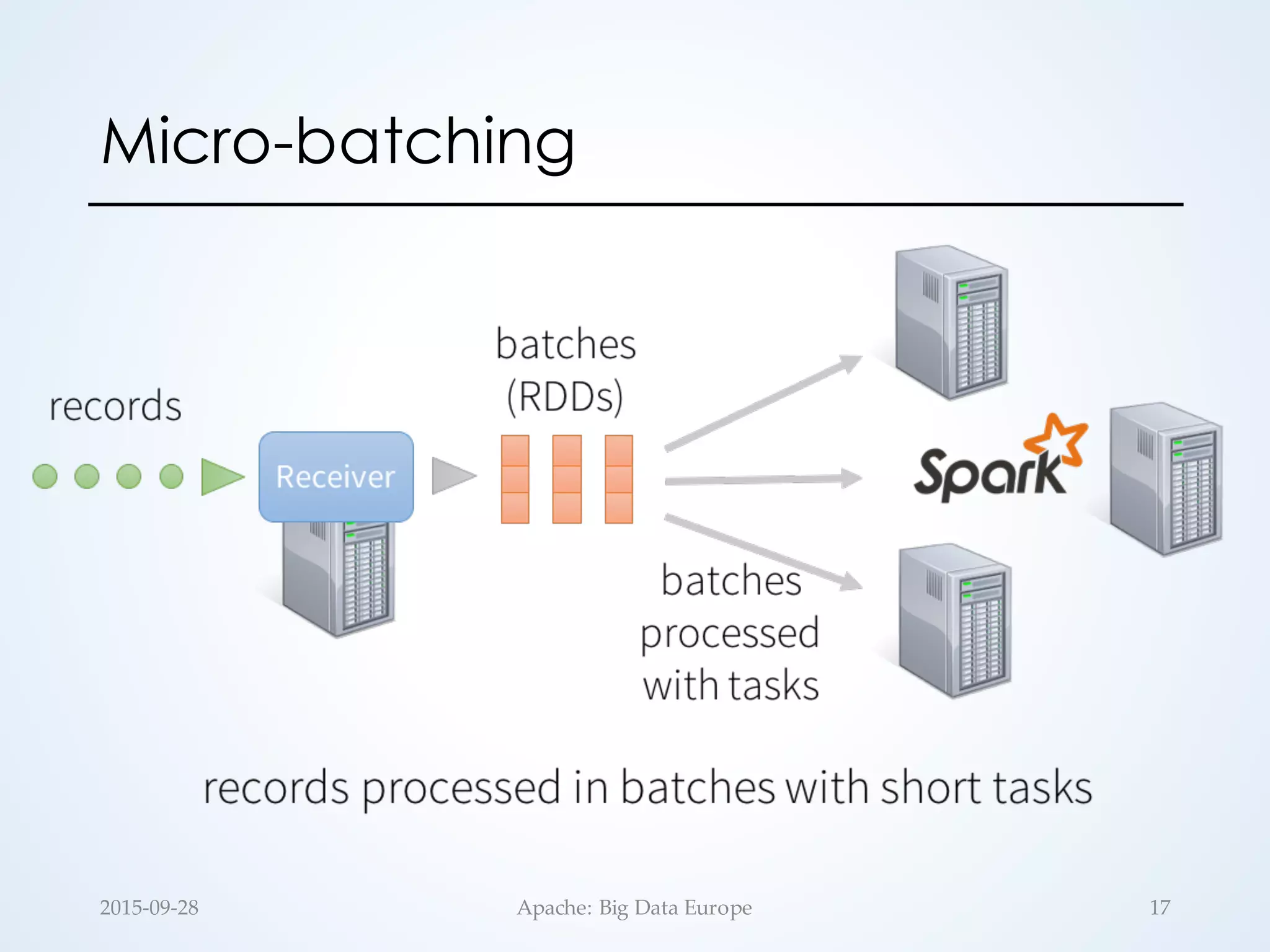
Micro-batching
2015-­‐‑09-­‐‑28 Apache:  Big  Data  Europe 17
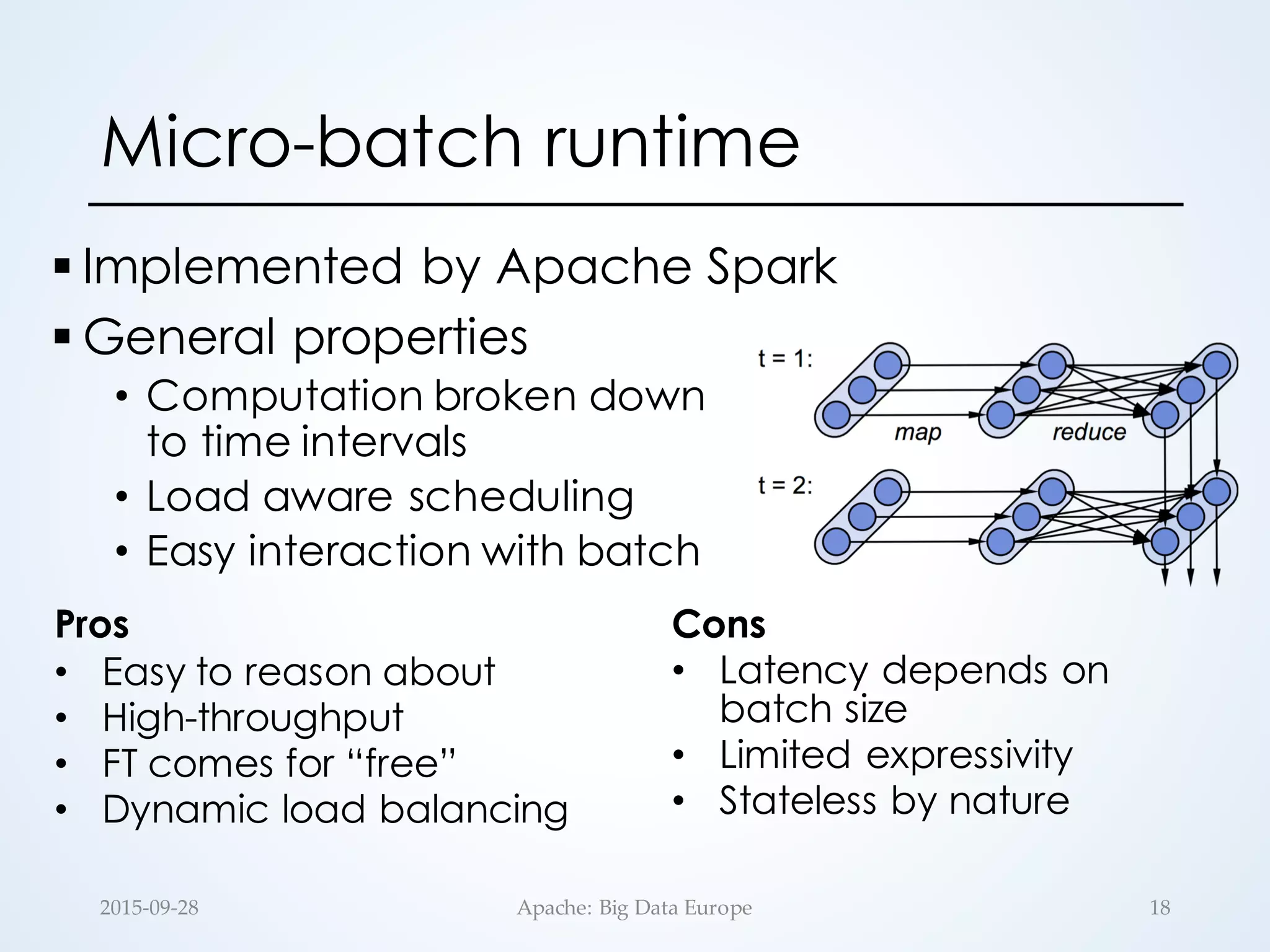
Micro-batch runtime
§ Implemented by Apache Spark
§ General properties
• Computation broken down
to time intervals
• Load aware scheduling
• Easy interaction with batch
2015-­‐‑09-­‐‑28 Apache:  Big  Data  Europe 18
Pros
• Easy to reason about
• High-throughput
• FT comes for “free”
• Dynamic load balancing
Cons
• Latency depends on
batch size
• Limited expressivity
• Stateless by nature
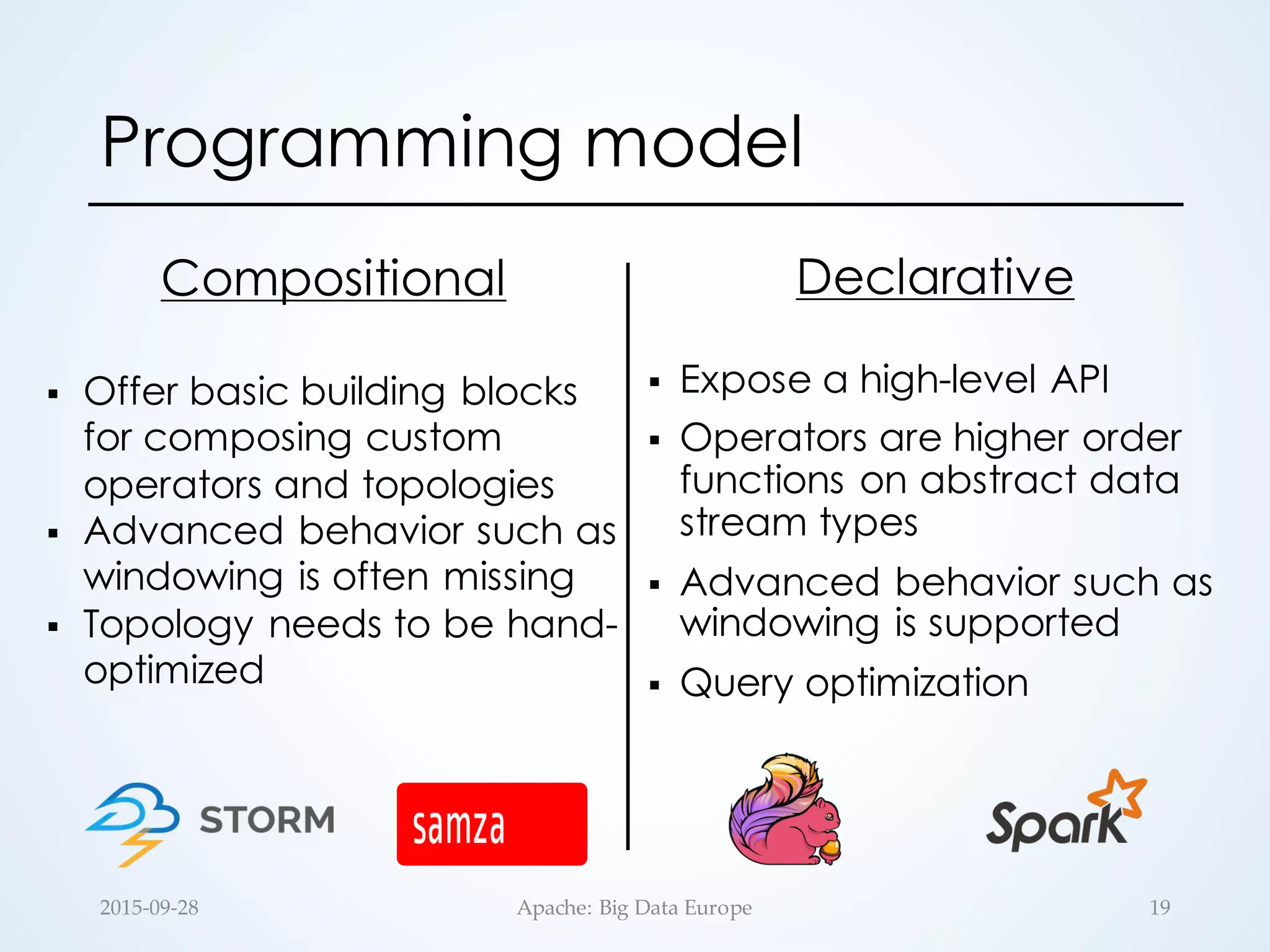
Programming model
2015-­‐‑09-­‐‑28 Apache:  Big  Data  Europe 19
Declarative
§ Expose a high-level API
§ Operators are higher order
functions on abstract data
stream types
§ Advanced behavior such as
windowing is supported
§ Query optimization
Compositional
§ Offer basic building blocks
for composing custom
operators and topologies
§ Advanced behavior such as
windowing is often missing
§ Topology needs to be hand-
optimized
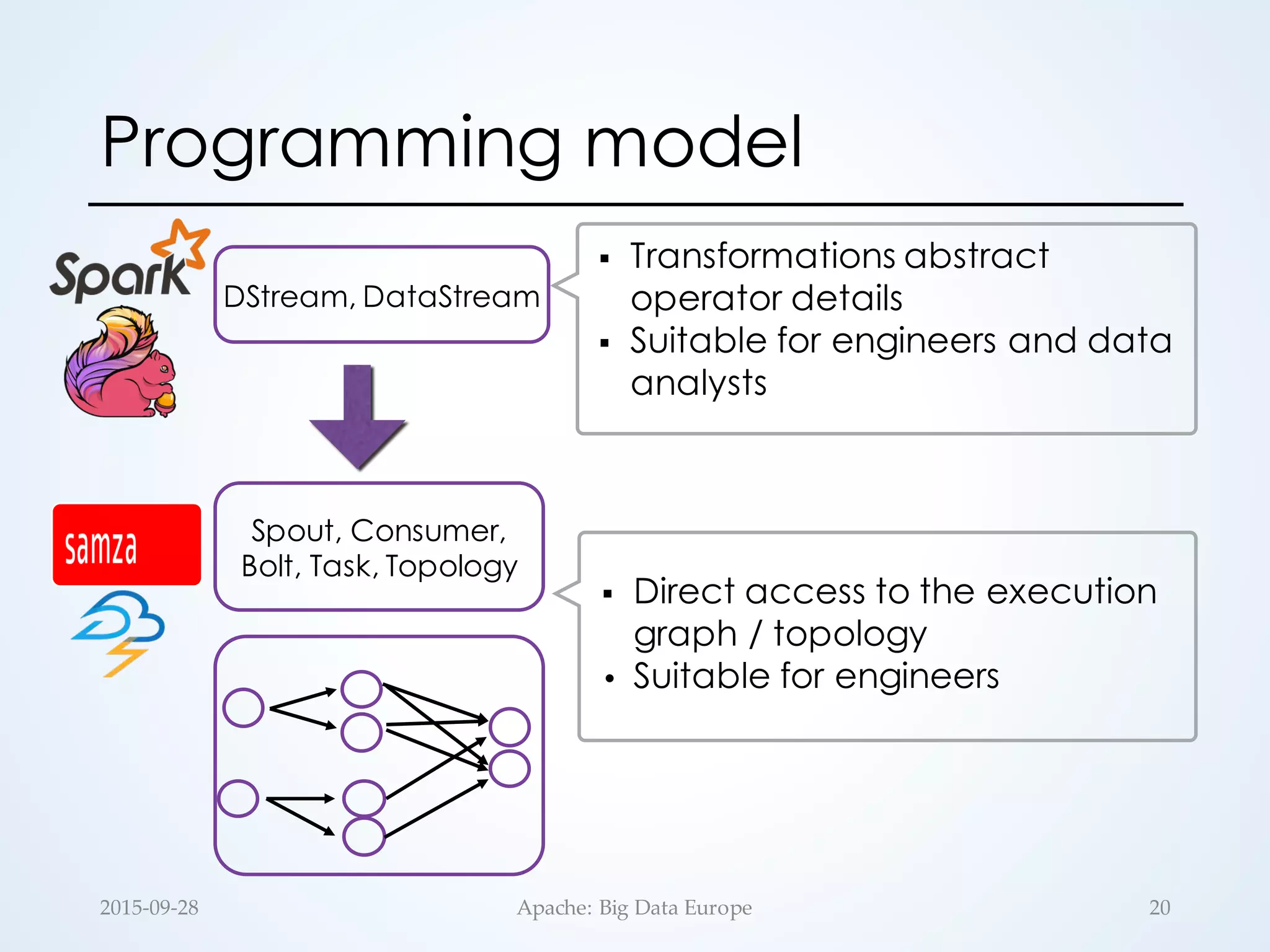
Programming model
2015-­‐‑09-­‐‑28 Apache:  Big  Data  Europe 20
DStream, DataStream
§ Transformations abstract
operator details
§ Suitable for engineers and data
analysts
Spout, Consumer,
Bolt, Task, Topology
§ Direct access to the execution
graph / topology
• Suitable for engineers
Counting words…
2015-­‐‑09-­‐‑28 Apache:  Big  Data  Europe 21
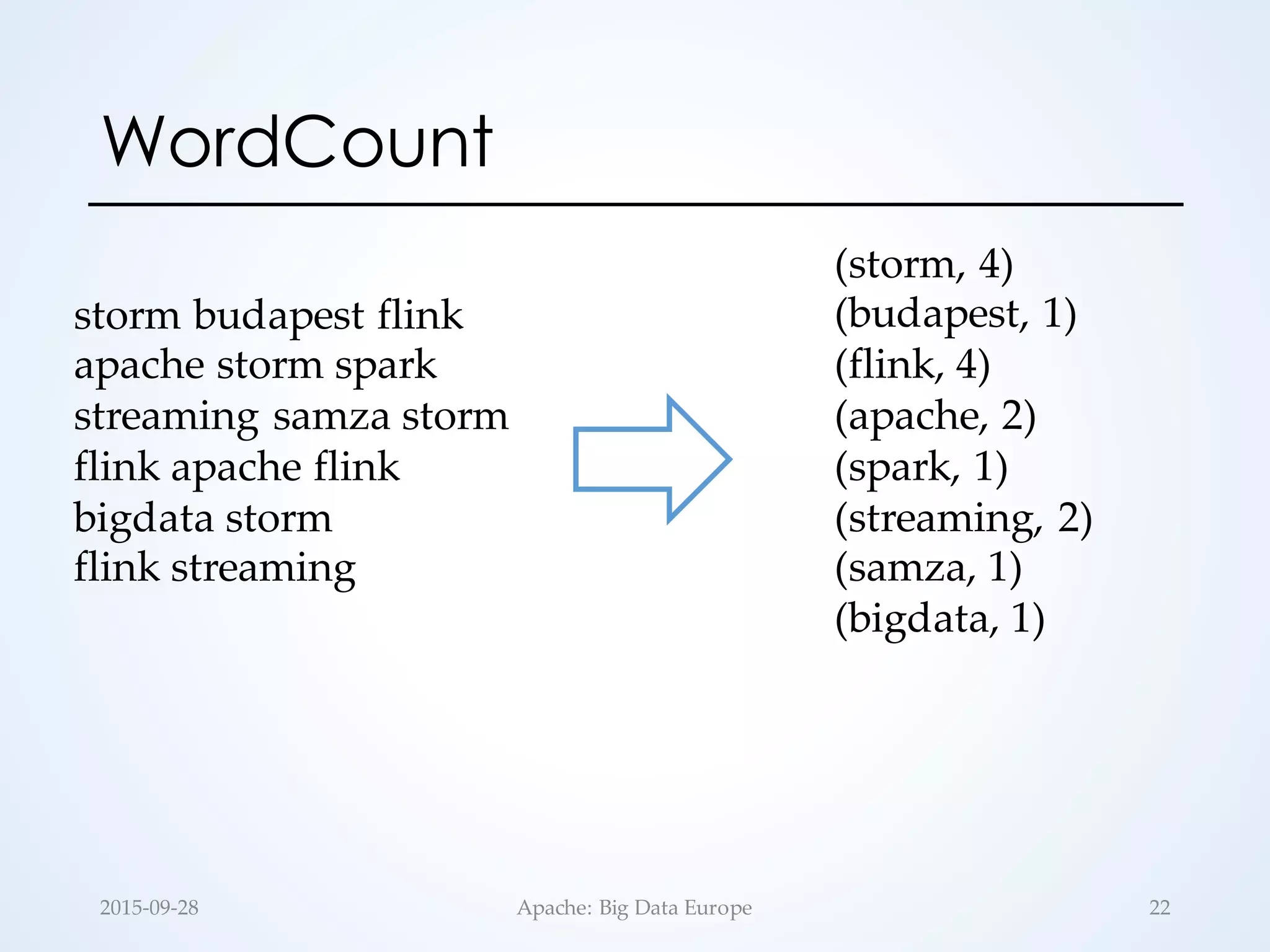
WordCount
2015-­‐‑09-­‐‑28 Apache:  Big  Data  Europe 22
storm  budapest  flink
apache  storm  spark
streaming  samza storm
flink  apache  flink
bigdata  storm
flink  streaming
(storm,  4)
(budapest,  1)
(flink,  4)
(apache,  2)
(spark,  1)
(streaming,  2)
(samza,  1)
(bigdata,  1)
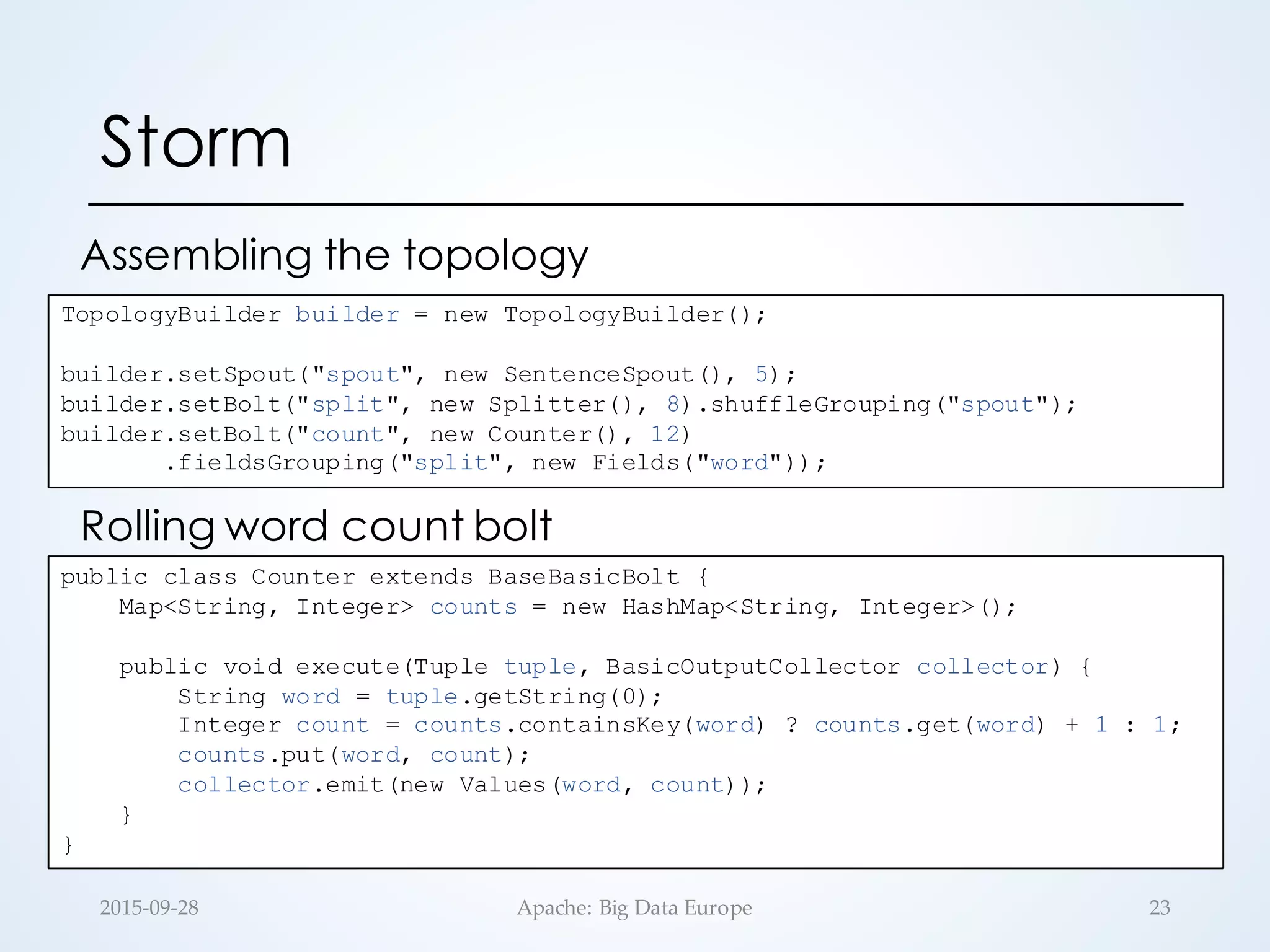
Storm
Assembling the topology
232015-­‐‑09-­‐‑28 Apache:  Big  Data  Europe
TopologyBuilder builder = new TopologyBuilder();
builder.setSpout("spout", new SentenceSpout(), 5);
builder.setBolt("split", new Splitter(), 8).shuffleGrouping("spout");
builder.setBolt("count", new Counter(), 12)
.fieldsGrouping("split", new Fields("word"));
public class Counter extends BaseBasicBolt {
Map<String, Integer> counts = new HashMap<String, Integer>();
public void execute(Tuple tuple, BasicOutputCollector collector) {
String word = tuple.getString(0);
Integer count = counts.containsKey(word) ? counts.get(word) + 1 : 1;
counts.put(word, count);
collector.emit(new Values(word, count));
}
}
Rolling word count bolt
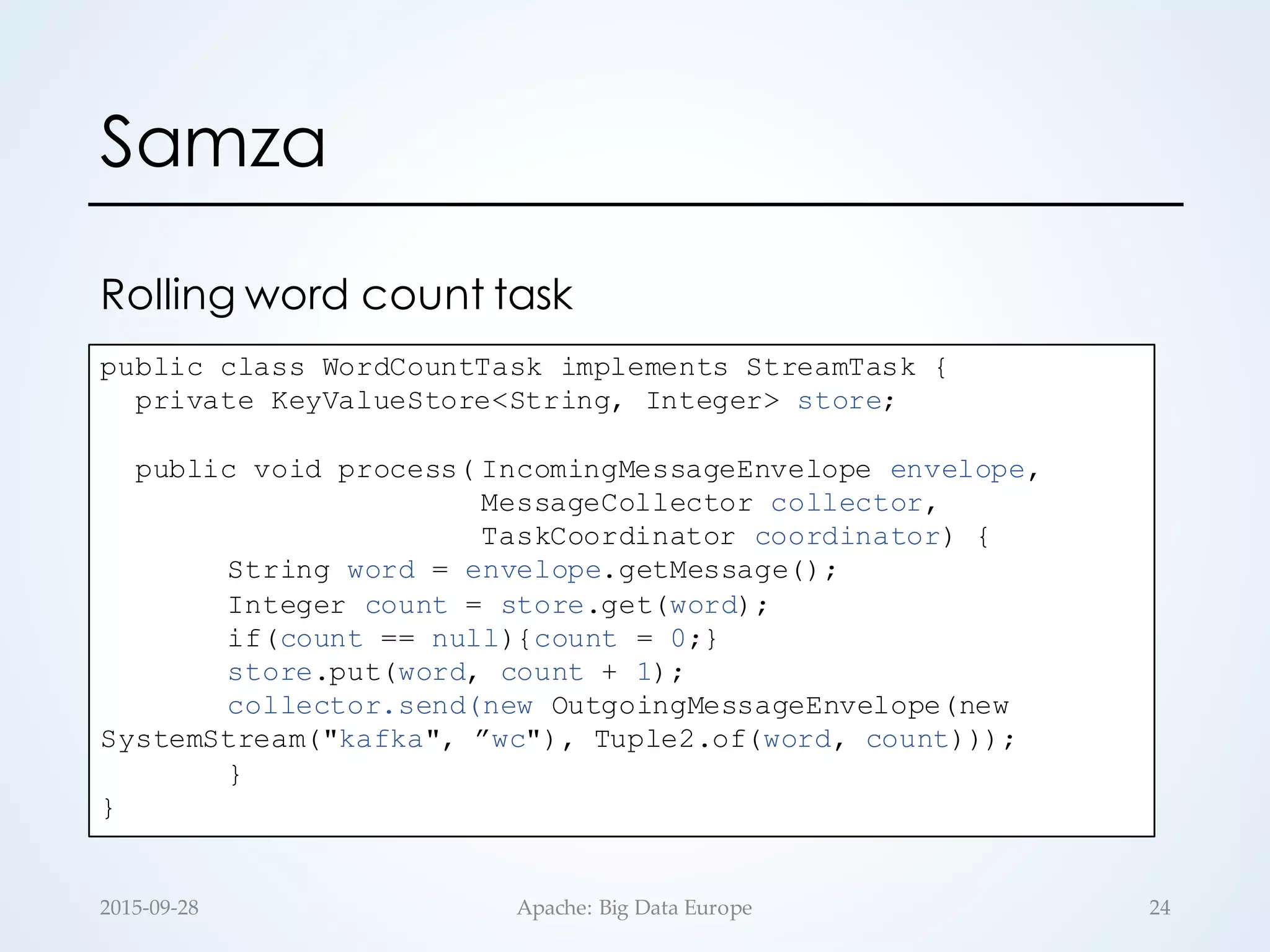
Samza
2015-­‐‑09-­‐‑28 Apache:  Big  Data  Europe 24
public class WordCountTask implements StreamTask {
private KeyValueStore<String, Integer> store;
public void process( IncomingMessageEnvelope envelope,
MessageCollector collector,
TaskCoordinator coordinator) {
String word = envelope.getMessage();
Integer count = store.get(word);
if(count == null){count = 0;}
store.put(word, count + 1);
collector.send(new OutgoingMessageEnvelope(new
SystemStream("kafka", ”wc"), Tuple2.of(word, count)));
}
}
Rolling word count task
Flink
val lines: DataStream[String] = env.fromSocketStream(...)
lines.flatMap {line => line.split(" ")
.map(word => Word(word,1))}
.groupBy("word").sum("frequency")
.print()
case class Word (word: String, frequency: Int)
val lines: DataStream[String] = env.fromSocketStream(...)
lines.flatMap {line => line.split(" ")
.map(word => Word(word,1))}
.window(Time.of(5,SECONDS)).every(Time.of(1,SECONDS))
.groupBy("word").sum("frequency")
.print()
Rolling word count
Window word count
252015-­‐‑09-­‐‑28 Apache:  Big  Data  Europe
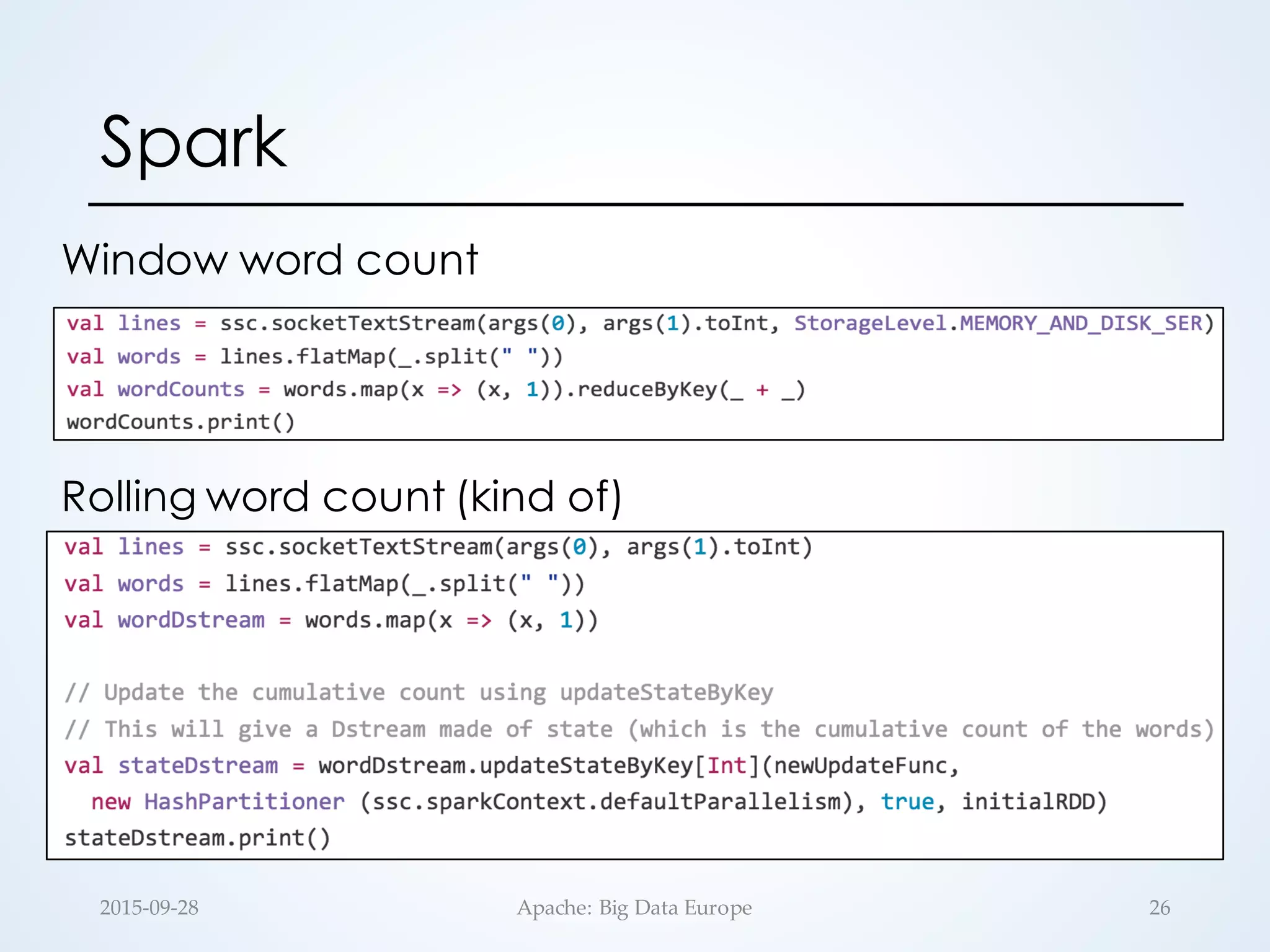
Spark
Window word count
Rolling word count (kind of)
262015-­‐‑09-­‐‑28 Apache:  Big  Data  Europe
Fault tolerance and
stateful processing
2015-­‐‑09-­‐‑28 Apache:  Big  Data  Europe 27
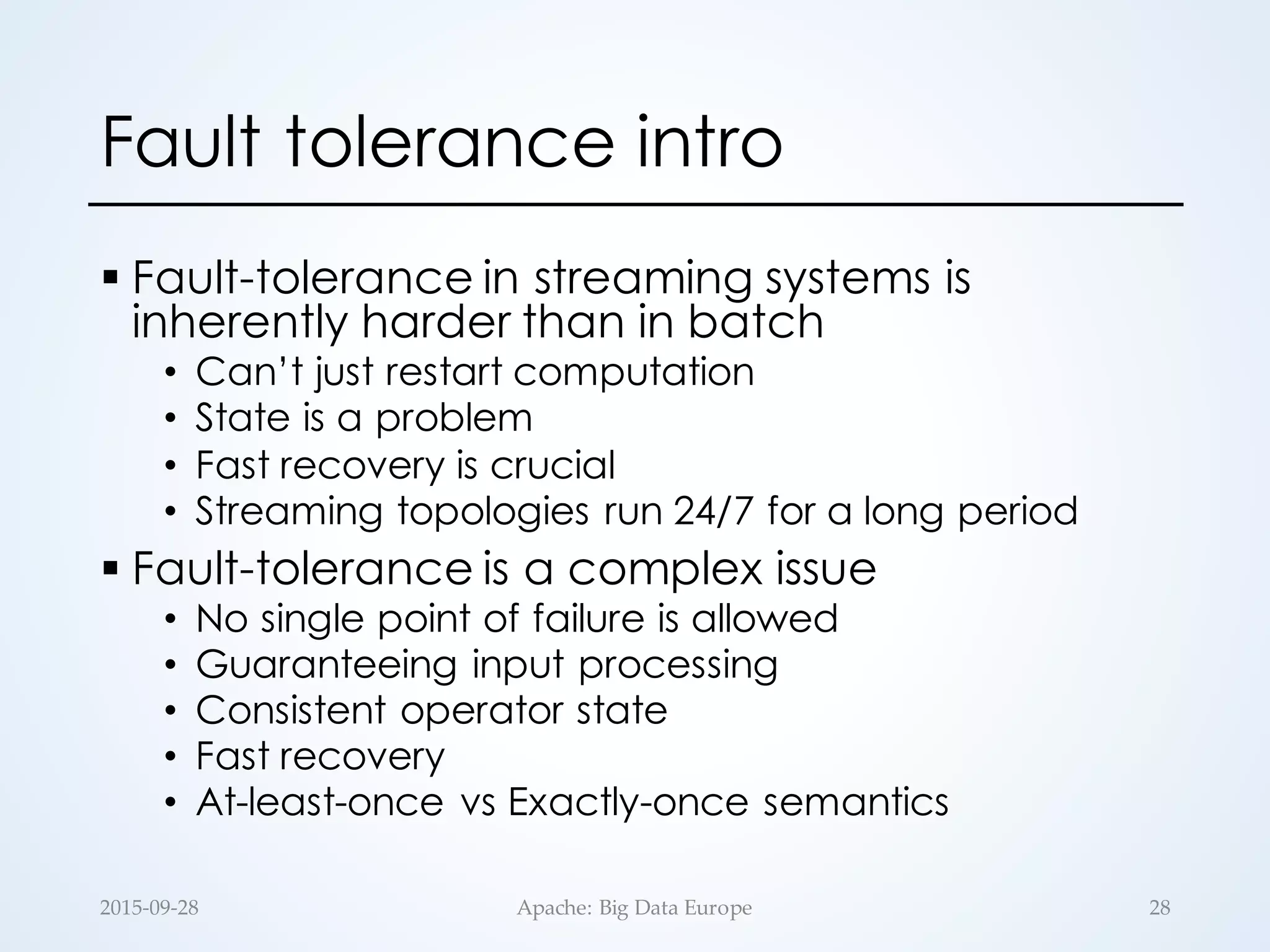
Fault tolerance intro
§ Fault-tolerance in streaming systems is
inherently harder than in batch
• Can’t just restart computation
• State is a problem
• Fast recovery is crucial
• Streaming topologies run 24/7 for a long period
§ Fault-tolerance is a complex issue
• No single point of failure is allowed
• Guaranteeing input processing
• Consistent operator state
• Fast recovery
• At-least-once vs Exactly-once semantics
2015-­‐‑09-­‐‑28 Apache:  Big  Data  Europe 28
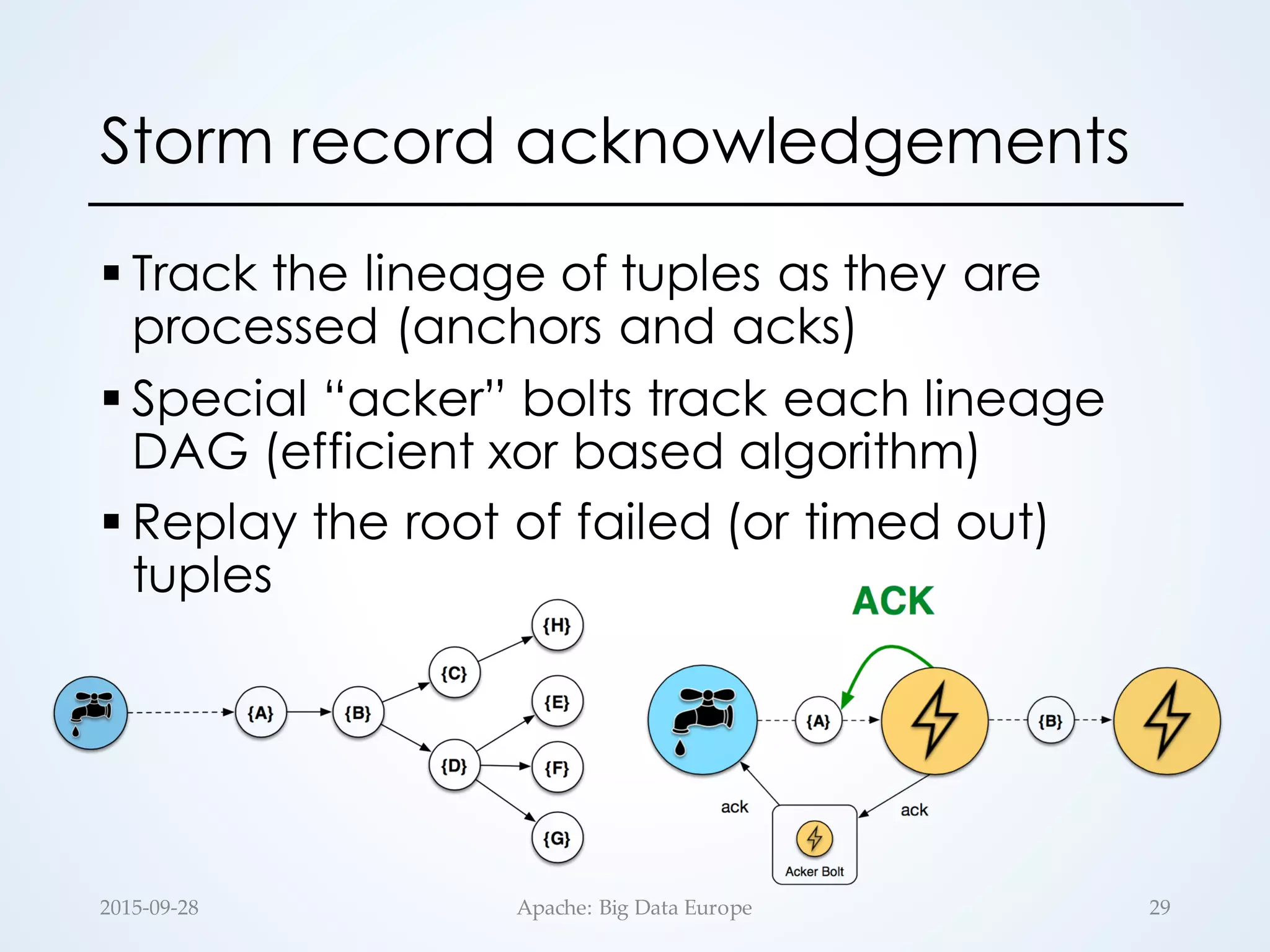
Storm record acknowledgements
§ Track the lineage of tuples as they are
processed (anchors and acks)
§ Special “acker” bolts track each lineage
DAG (efficient xor based algorithm)
§ Replay the root of failed (or timed out)
tuples
2015-­‐‑09-­‐‑28 Apache:  Big  Data  Europe 29
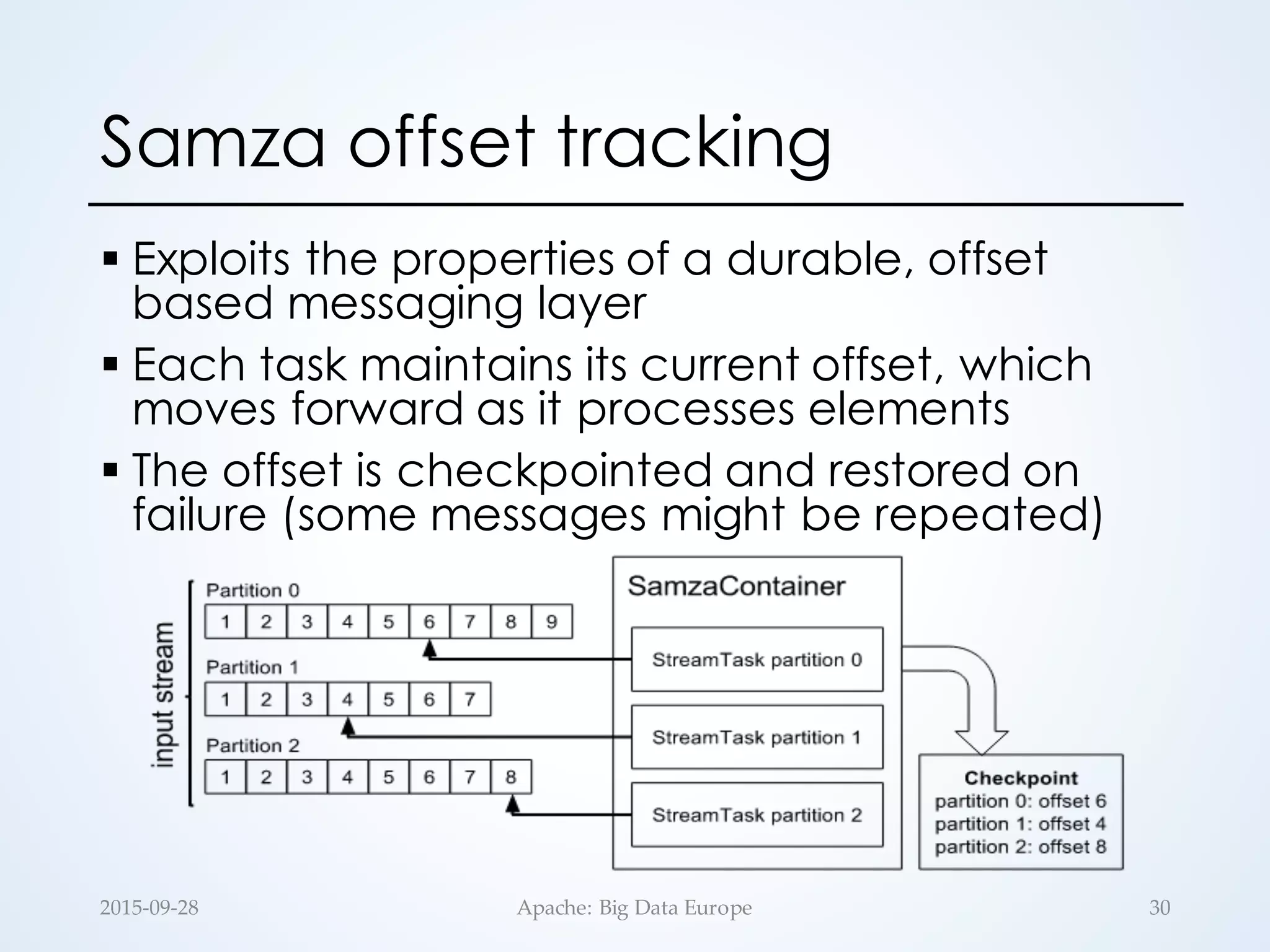
Samza offset tracking
§ Exploits the properties of a durable, offset
based messaging layer
§ Each task maintains its current offset, which
moves forward as it processes elements
§ The offset is checkpointed and restored on
failure (some messages might be repeated)
2015-­‐‑09-­‐‑28 Apache:  Big  Data  Europe 30
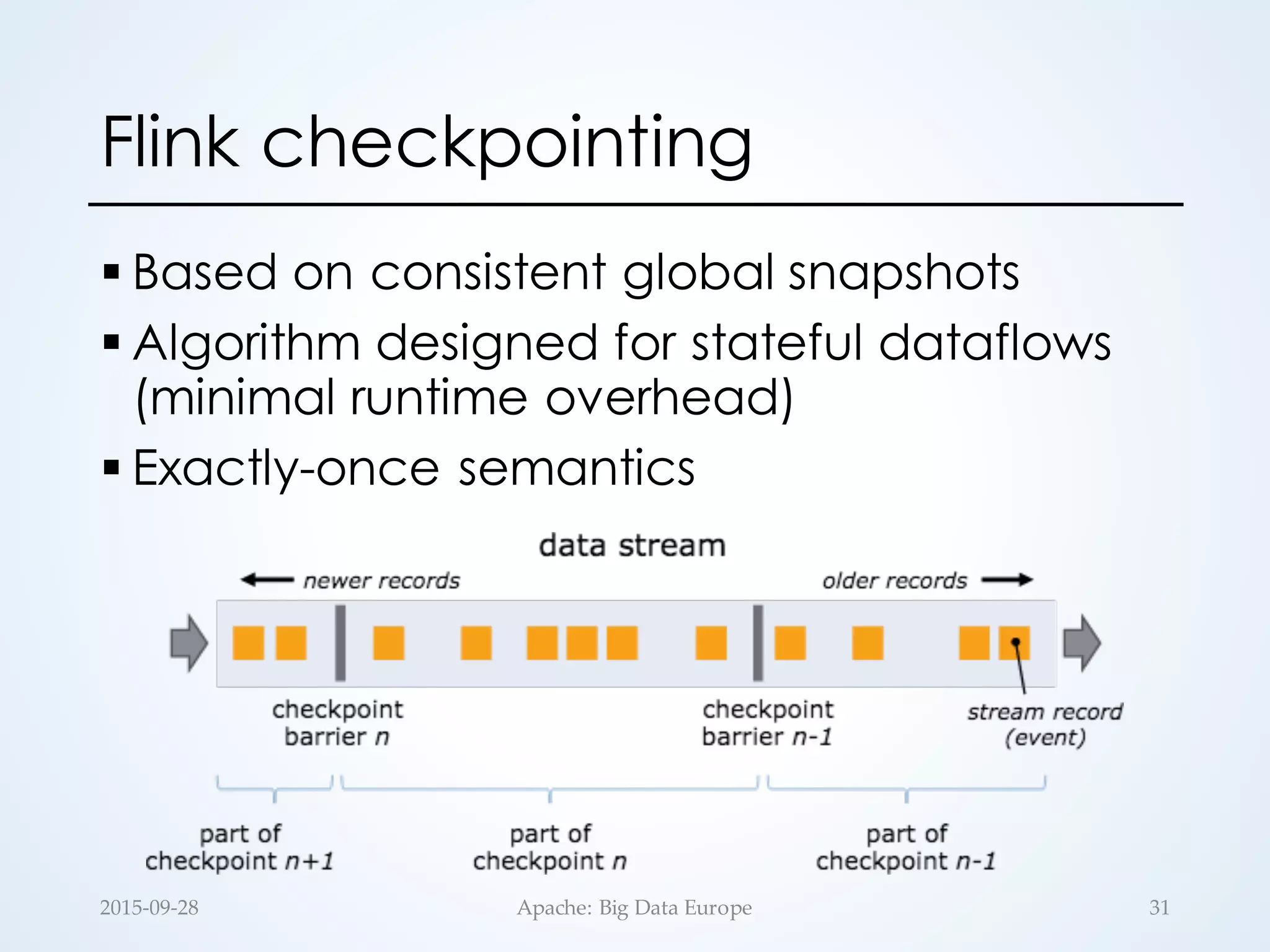
Flink checkpointing
§ Based on consistent global snapshots
§ Algorithm designed for stateful dataflows
(minimal runtime overhead)
§ Exactly-once semantics
31Apache:  Big  Data  Europe2015-­‐‑09-­‐‑28
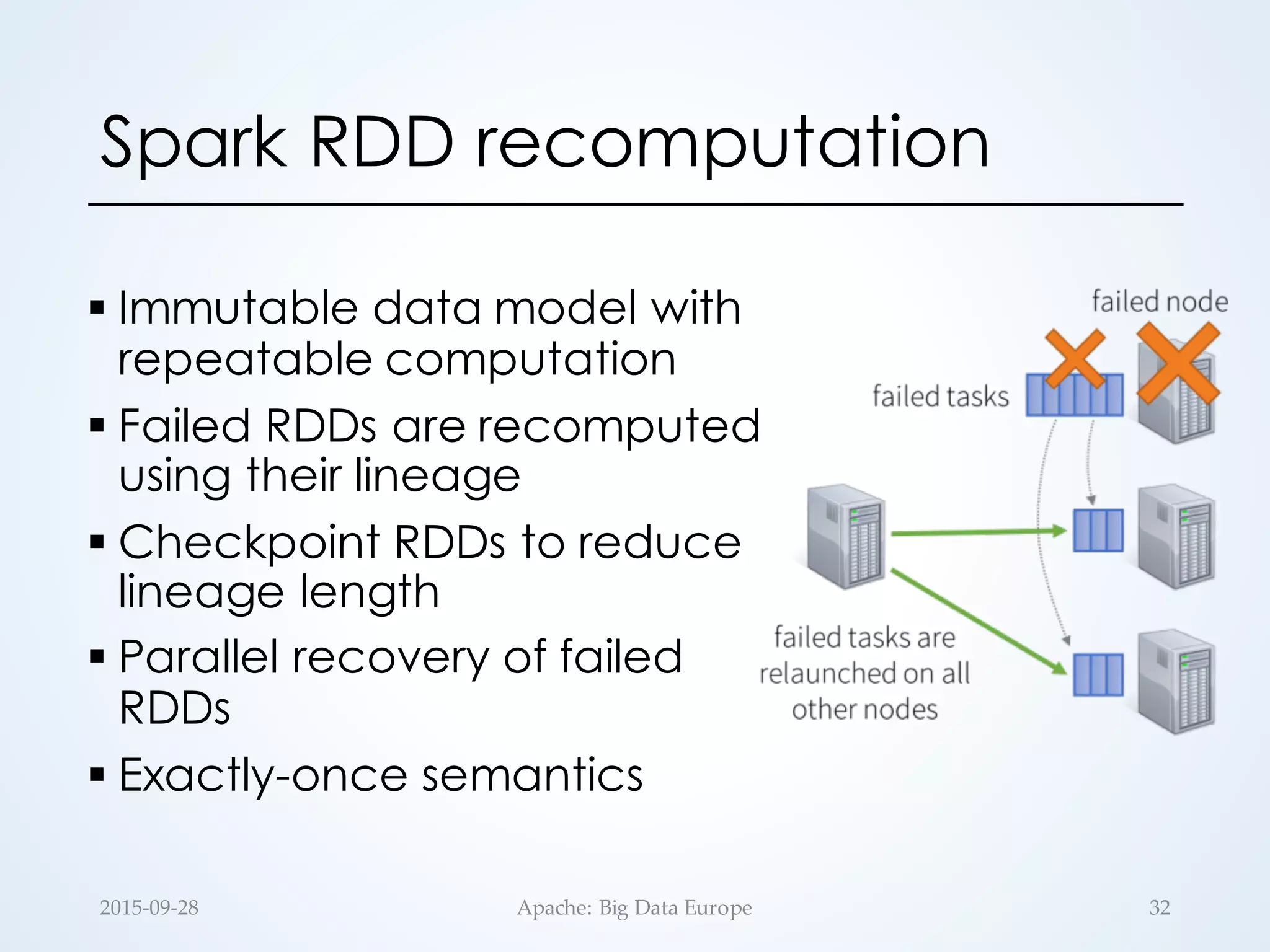
Spark RDD recomputation
§ Immutable data model with
repeatable computation
§ Failed RDDs are recomputed
using their lineage
§ Checkpoint RDDs to reduce
lineage length
§ Parallel recovery of failed
RDDs
§ Exactly-once semantics
2015-­‐‑09-­‐‑28 Apache:  Big  Data  Europe 32
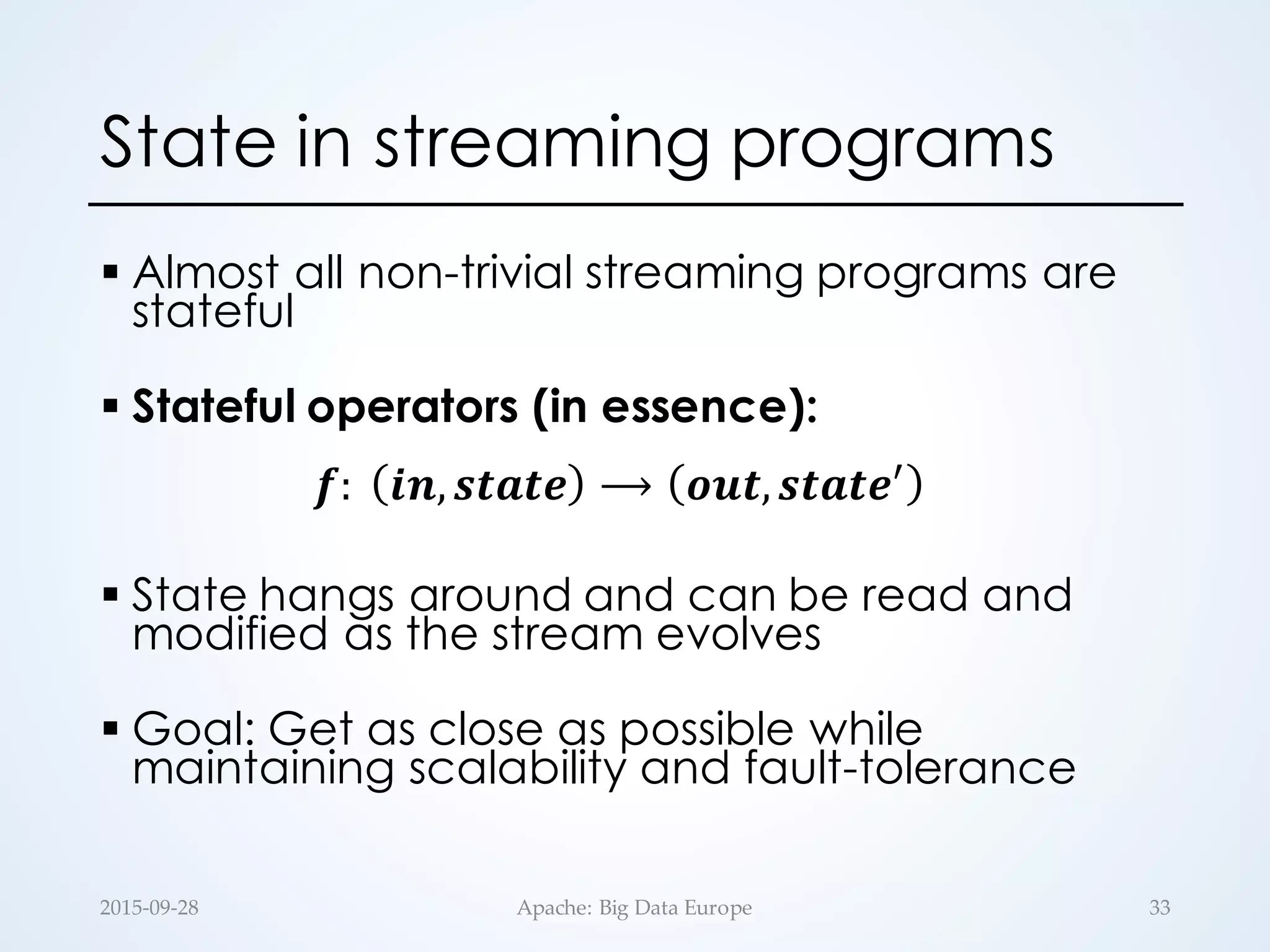
State in streaming programs
§ Almost all non-trivial streaming programs are
stateful
§ Stateful operators (in essence):
𝒇:	
   𝒊𝒏, 𝒔𝒕𝒂𝒕𝒆 ⟶ 𝒐𝒖𝒕, 𝒔𝒕𝒂𝒕𝒆.
§ State hangs around and can be read and
modified as the stream evolves
§ Goal: Get as close as possible while
maintaining scalability and fault-tolerance
33Apache:  Big  Data  Europe2015-­‐‑09-­‐‑28
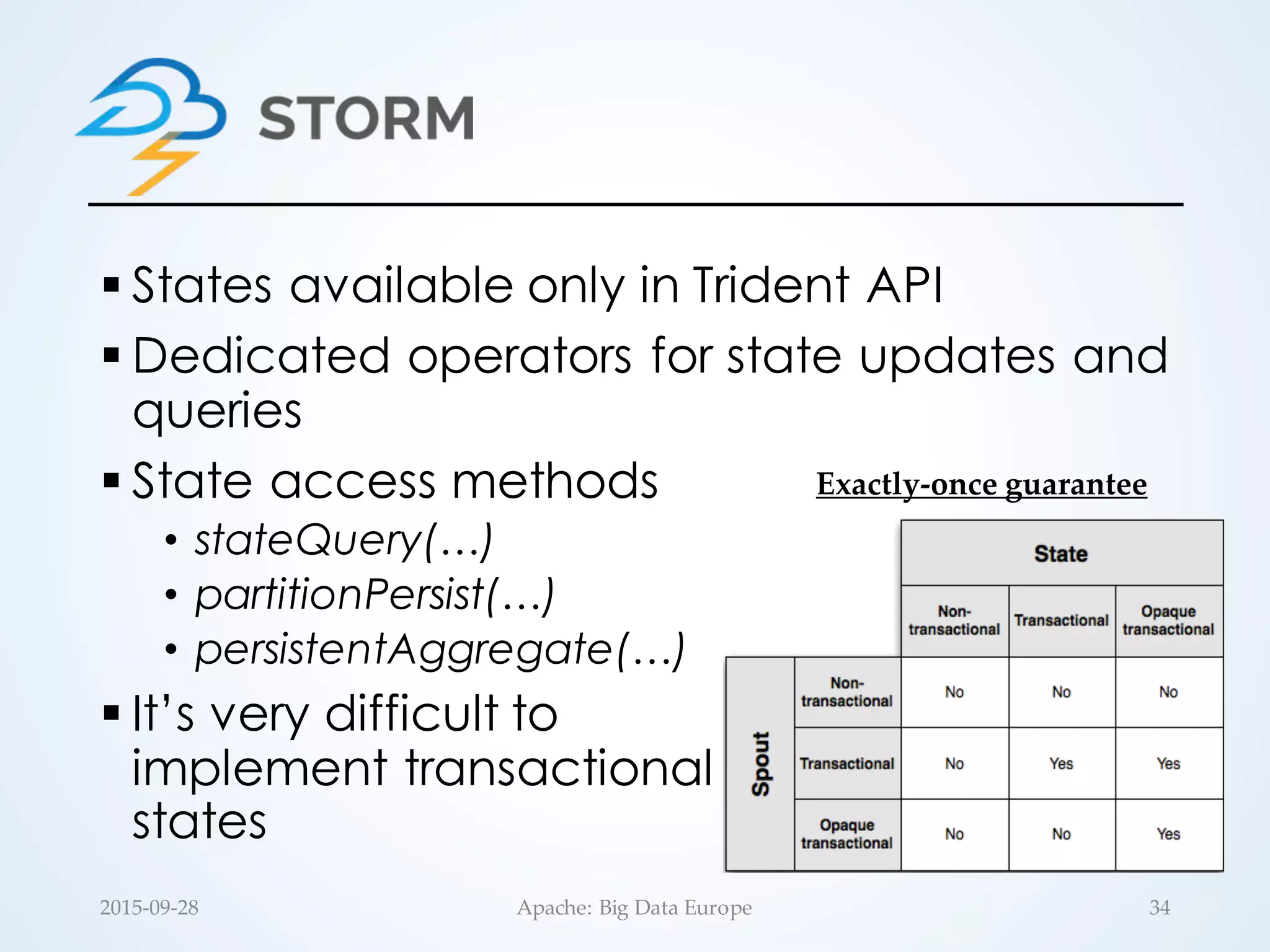
§ States available only in Trident API
§ Dedicated operators for state updates and
queries
§ State access methods
• stateQuery(…)
• partitionPersist(…)
• persistentAggregate(…)
§ It’s very difficult to
implement transactional
states
Exactly-­‐‑once  guarantee
34Apache:  Big  Data  Europe2015-­‐‑09-­‐‑28
§ Stateless runtime by design
• No continuous operators
• UDFs are assumed to be stateless
§ State can be generated as a separate
stream of RDDs: updateStateByKey(…)
𝒇:	
   𝑺𝒆𝒒[𝒊𝒏 𝒌], 𝒔𝒕𝒂𝒕𝒆 𝒌 ⟶ 𝒔𝒕𝒂𝒕𝒆.
𝒌
§ 𝒇 is scoped to a specific key
§ Exactly-once semantics
35Apache:  Big  Data  Europe2015-­‐‑09-­‐‑28
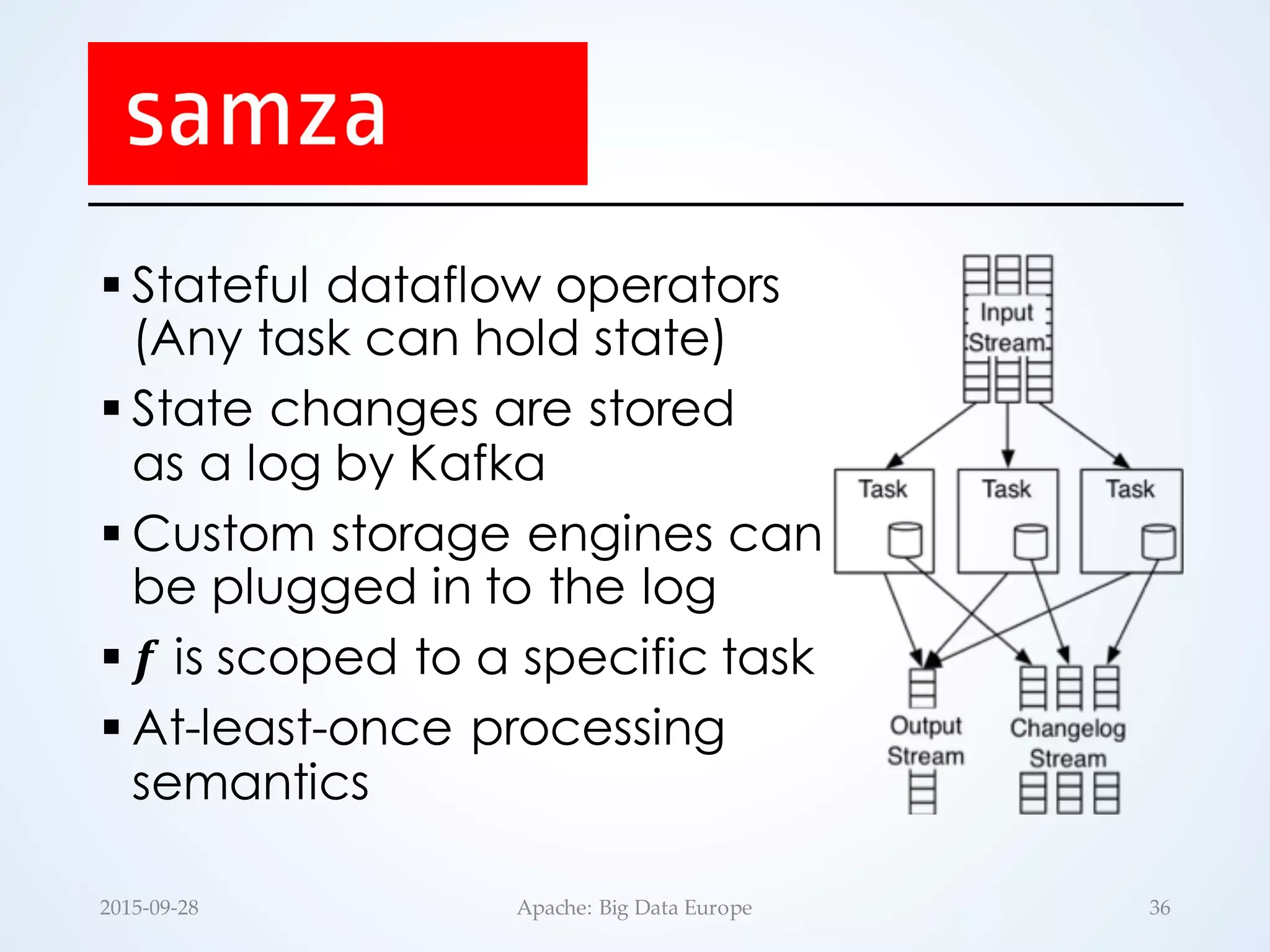
§ Stateful dataflow operators
(Any task can hold state)
§ State changes are stored
as a log by Kafka
§ Custom storage engines can
be plugged in to the log
§ 𝒇 is scoped to a specific task
§ At-least-once processing
semantics
36Apache:  Big  Data  Europe2015-­‐‑09-­‐‑28
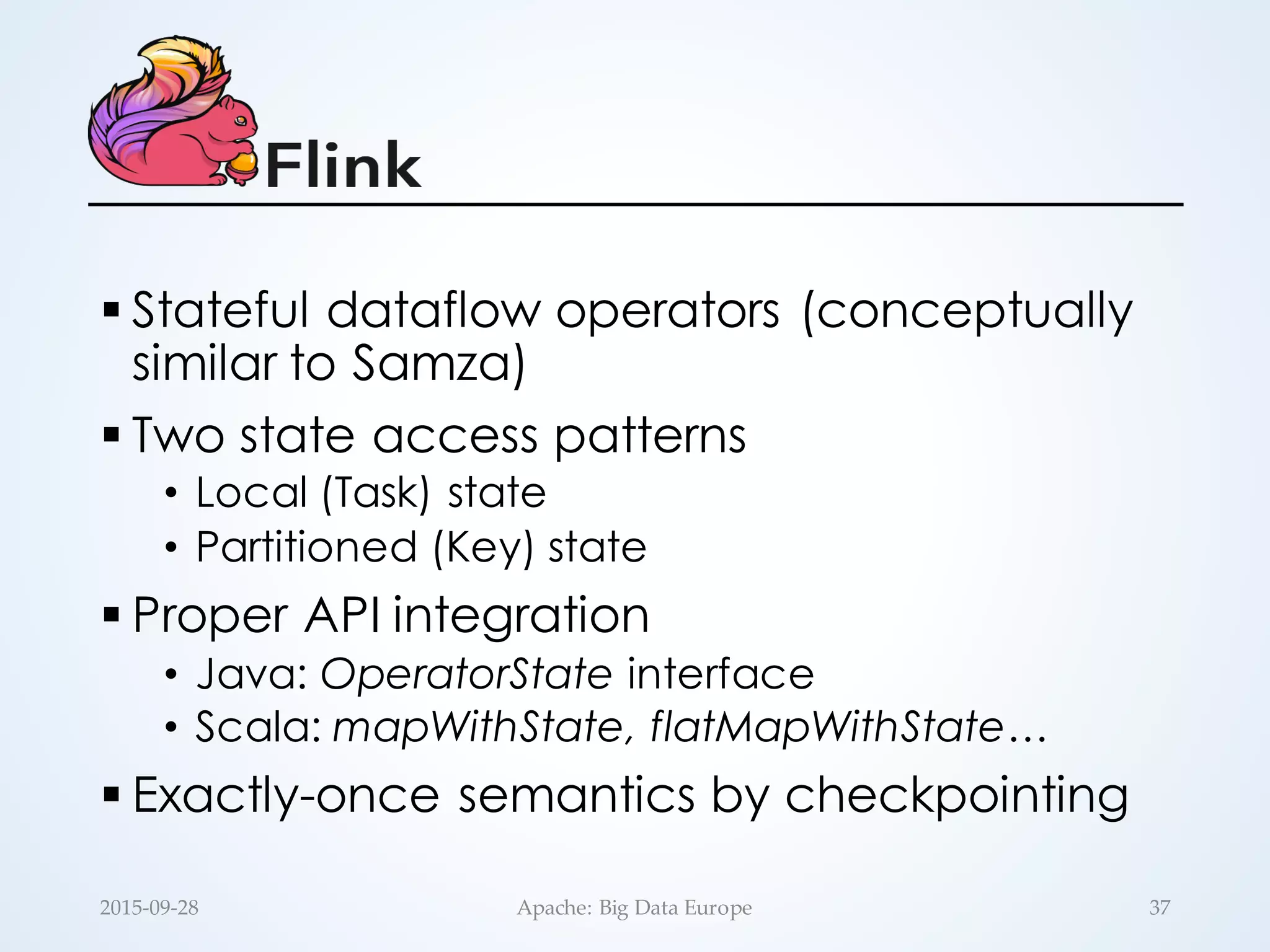
§ Stateful dataflow operators (conceptually
similar to Samza)
§ Two state access patterns
• Local (Task) state
• Partitioned (Key) state
§ Proper API integration
• Java: OperatorState interface
• Scala: mapWithState, flatMapWithState…
§ Exactly-once semantics by checkpointing
37Apache:  Big  Data  Europe2015-­‐‑09-­‐‑28
Performance
§ Throughput/Latency
• A cost of a network hop is 25+ msecs
• 1 million records/sec/core is nice
§ Size of Network Buffers/Batching
§ Buffer Timeout
§ Cost of Fault Tolerance
§ Operator chaining/Stages
§ Serialization/Types
2015-­‐‑09-­‐‑28 Apache:  Big  Data  Europe 38
Closing
2015-­‐‑09-­‐‑28 Apache:  Big  Data  Europe 39
Comparison revisited
40
Streaming
model
Native Micro-batching Native Native
API Compositional Declarative Compositional Declarative
Fault tolerance Record ACKs RDD-based Log-based Checkpoints
Guarantee At-least-once Exactly-once At-least-once Exactly-once
State Only in Trident
State as
DStream
Stateful
operators
Stateful
operators
Windowing Not built-in Time based Not built-in Policy based
Latency Very-Low Medium Low Low
Throughput Medium High High High
2015-­‐‑09-­‐‑28 Apache:  Big  Data  Europe
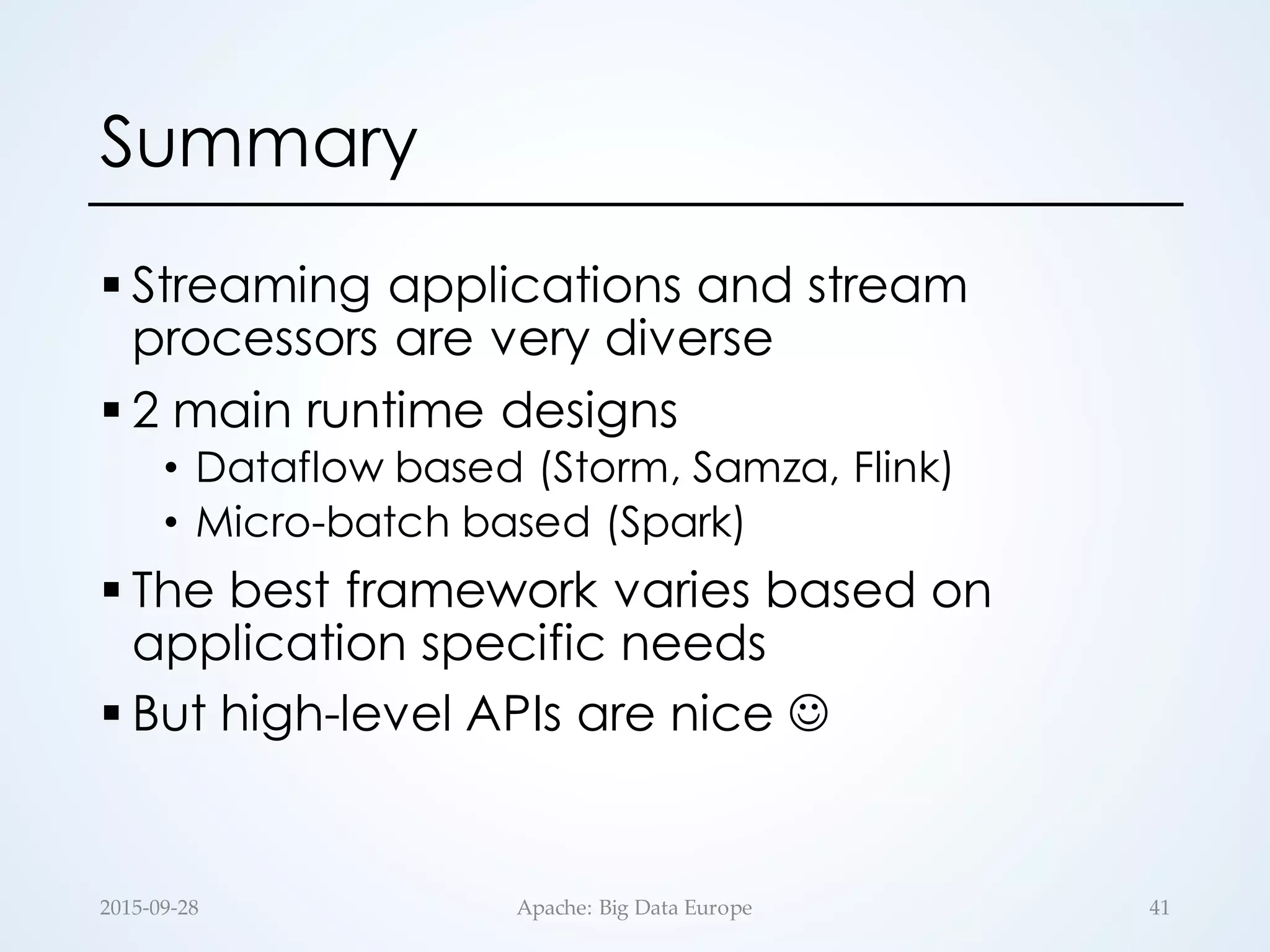
Summary
§ Streaming applications and stream
processors are very diverse
§ 2 main runtime designs
• Dataflow based (Storm, Samza, Flink)
• Micro-batch based (Spark)
§ The best framework varies based on
application specific needs
§ But high-level APIs are nice J
2015-­‐‑09-­‐‑28 Apache:  Big  Data  Europe 41
Thank you!
List of Figures (in order of usage)
§ https://upload.wikimedia.org/wikipedia/commons/thumb/2/2a/CPT-FSM-
abcd.svg/326px-CPT-FSM-abcd.svg.png
§ https://storm.apache.org/images/topology.png
§ https://databricks.com/wp-content/uploads/2015/07/image11-1024x655.png
§ https://databricks.com/wp-content/uploads/2015/07/image21-1024x734.png
§ https://people.csail.mit.edu/matei/papers/2012/hotcloud_spark_streaming.pdf,
page 2.
§ http://www.slideshare.net/ptgoetz/storm-hadoop-summit2014, page 69-71.
§ http://samza.apache.org/img/0.9/learn/documentation/container/checkpointi
ng.svg
§ https://databricks.com/wp-content/uploads/2015/07/image41-1024x602.png
§ https://storm.apache.org/documentation/images/spout-vs-state.png
§ http://samza.apache.org/img/0.9/learn/documentation/container/stateful_job.
png
2015-­‐‑09-­‐‑28 Apache:  Big  Data  Europe 43

Large-Scale Stream Processing in the Hadoop Ecosystem

  • 1.
    Large-Scale Stream Processing inthe Hadoop Ecosystem Gyula Fóra gyfora@apache.org Márton Balassi mbalassi@apache.org
  • 2.
    This talk § Streamprocessing by example § Open source stream processors § Runtime architecture and programming model § Counting words… § Fault tolerance and stateful processing § Closing 2Apache:  Big  Data  Europe2015-­‐‑09-­‐‑28
  • 3.
  • 4.
    Streaming applications ETL styleoperations • Filter incoming data, Log analysis • High throughput, connectors, at-least-once processing Window aggregations • Trending tweets, User sessions, Stream joins • Window abstractions 2015-­‐‑09-­‐‑28 Apache:  Big  Data  Europe 4 Inpu t Inpu t Inpu tInput Process/Enrich
  • 5.
    Streaming applications Machine learning •Fitting trends to the evolving stream, Stream clustering • Model state, cyclic flows Pattern recognition • Fraud detection, Triggering signals based on activity • Exactly-once processing 5Apache:  Big  Data  Europe2015-­‐‑09-­‐‑28
  • 6.
  • 7.
  • 8.
    Apache Storm § Startedin 2010, development driven by BackType, then Twitter § Pioneer in large scale stream processing § Distributed dataflow abstraction (spouts & bolts) 82015-­‐‑09-­‐‑28 Apache:  Big  Data  Europe
  • 9.
    Apache Flink § Startedin 2008 as a research project (Stratosphere) at European universities § Unique combination of low latency streaming and high throughput batch analysis § Flexible operator states and windowing 9 Batch  data Kafka,  RabbitMQ,   ... HDFS,  JDBC,   ... Stream  Data 2015-­‐‑09-­‐‑28 Apache:  Big  Data  Europe
  • 10.
    Apache Spark § Startedin 2009 at UC Berkley, Apache since 2013 § Very strong community, wide adoption § Unified batch and stream processing over a batch runtime § Good integration with batch programs 102015-­‐‑09-­‐‑28 Apache:  Big  Data  Europe
  • 11.
    Apache Samza § Developedat LinkedIn, open sourced in 2013 § Builds heavily on Kafka’s log based philosophy § Pluggable messaging system and execution backend 112015-­‐‑09-­‐‑28 Apache:  Big  Data  Europe
  • 12.
    System comparison 12 Streaming model Native Micro-batchingNative Native API Compositional Declarative Compositional Declarative Fault tolerance Record ACKs RDD-based Log-based Checkpoints Guarantee At-least-once Exactly-once At-least-once Exactly-once State Only in Trident State as DStream Stateful operators Stateful operators Windowing Not built-in Time based Not built-in Policy based Latency Very-Low Medium Low Low Throughput Medium High High High 2015-­‐‑09-­‐‑28 Apache:  Big  Data  Europe
  • 13.
  • 14.
  • 15.
    Distributed dataflow runtime §Storm, Samza and Flink § General properties • Long standing operators • Pipelined execution • Usually possible to create cyclic flows 2015-­‐‑09-­‐‑28 Apache:  Big  Data  Europe 15 Pros • Full expressivity • Low-latency execution • Stateful operators Cons • Fault-tolerance is hard • Throughput may suffer • Load balancing is an issue
  • 16.
    Distributed dataflow runtime §Storm • Dynamic typing + Kryo • Dynamic topology rebalancing § Samza • Almost every component pluggable • Full task isolation, no backpressure (buffering handled by the messaging layer) § Flink • Strongly typed streams + custom serializers • Flow control mechanism • Memory management 2015-­‐‑09-­‐‑28 Apache:  Big  Data  Europe 16
  • 17.
  • 18.
    Micro-batch runtime § Implementedby Apache Spark § General properties • Computation broken down to time intervals • Load aware scheduling • Easy interaction with batch 2015-­‐‑09-­‐‑28 Apache:  Big  Data  Europe 18 Pros • Easy to reason about • High-throughput • FT comes for “free” • Dynamic load balancing Cons • Latency depends on batch size • Limited expressivity • Stateless by nature
  • 19.
    Programming model 2015-­‐‑09-­‐‑28 Apache: Big  Data  Europe 19 Declarative § Expose a high-level API § Operators are higher order functions on abstract data stream types § Advanced behavior such as windowing is supported § Query optimization Compositional § Offer basic building blocks for composing custom operators and topologies § Advanced behavior such as windowing is often missing § Topology needs to be hand- optimized
  • 20.
    Programming model 2015-­‐‑09-­‐‑28 Apache: Big  Data  Europe 20 DStream, DataStream § Transformations abstract operator details § Suitable for engineers and data analysts Spout, Consumer, Bolt, Task, Topology § Direct access to the execution graph / topology • Suitable for engineers
  • 21.
  • 22.
    WordCount 2015-­‐‑09-­‐‑28 Apache:  Big Data  Europe 22 storm  budapest  flink apache  storm  spark streaming  samza storm flink  apache  flink bigdata  storm flink  streaming (storm,  4) (budapest,  1) (flink,  4) (apache,  2) (spark,  1) (streaming,  2) (samza,  1) (bigdata,  1)
  • 23.
    Storm Assembling the topology 232015-­‐‑09-­‐‑28Apache:  Big  Data  Europe TopologyBuilder builder = new TopologyBuilder(); builder.setSpout("spout", new SentenceSpout(), 5); builder.setBolt("split", new Splitter(), 8).shuffleGrouping("spout"); builder.setBolt("count", new Counter(), 12) .fieldsGrouping("split", new Fields("word")); public class Counter extends BaseBasicBolt { Map<String, Integer> counts = new HashMap<String, Integer>(); public void execute(Tuple tuple, BasicOutputCollector collector) { String word = tuple.getString(0); Integer count = counts.containsKey(word) ? counts.get(word) + 1 : 1; counts.put(word, count); collector.emit(new Values(word, count)); } } Rolling word count bolt
  • 24.
    Samza 2015-­‐‑09-­‐‑28 Apache:  Big Data  Europe 24 public class WordCountTask implements StreamTask { private KeyValueStore<String, Integer> store; public void process( IncomingMessageEnvelope envelope, MessageCollector collector, TaskCoordinator coordinator) { String word = envelope.getMessage(); Integer count = store.get(word); if(count == null){count = 0;} store.put(word, count + 1); collector.send(new OutgoingMessageEnvelope(new SystemStream("kafka", ”wc"), Tuple2.of(word, count))); } } Rolling word count task
  • 25.
    Flink val lines: DataStream[String]= env.fromSocketStream(...) lines.flatMap {line => line.split(" ") .map(word => Word(word,1))} .groupBy("word").sum("frequency") .print() case class Word (word: String, frequency: Int) val lines: DataStream[String] = env.fromSocketStream(...) lines.flatMap {line => line.split(" ") .map(word => Word(word,1))} .window(Time.of(5,SECONDS)).every(Time.of(1,SECONDS)) .groupBy("word").sum("frequency") .print() Rolling word count Window word count 252015-­‐‑09-­‐‑28 Apache:  Big  Data  Europe
  • 26.
    Spark Window word count Rollingword count (kind of) 262015-­‐‑09-­‐‑28 Apache:  Big  Data  Europe
  • 27.
    Fault tolerance and statefulprocessing 2015-­‐‑09-­‐‑28 Apache:  Big  Data  Europe 27
  • 28.
    Fault tolerance intro §Fault-tolerance in streaming systems is inherently harder than in batch • Can’t just restart computation • State is a problem • Fast recovery is crucial • Streaming topologies run 24/7 for a long period § Fault-tolerance is a complex issue • No single point of failure is allowed • Guaranteeing input processing • Consistent operator state • Fast recovery • At-least-once vs Exactly-once semantics 2015-­‐‑09-­‐‑28 Apache:  Big  Data  Europe 28
  • 29.
    Storm record acknowledgements §Track the lineage of tuples as they are processed (anchors and acks) § Special “acker” bolts track each lineage DAG (efficient xor based algorithm) § Replay the root of failed (or timed out) tuples 2015-­‐‑09-­‐‑28 Apache:  Big  Data  Europe 29
  • 30.
    Samza offset tracking §Exploits the properties of a durable, offset based messaging layer § Each task maintains its current offset, which moves forward as it processes elements § The offset is checkpointed and restored on failure (some messages might be repeated) 2015-­‐‑09-­‐‑28 Apache:  Big  Data  Europe 30
  • 31.
    Flink checkpointing § Basedon consistent global snapshots § Algorithm designed for stateful dataflows (minimal runtime overhead) § Exactly-once semantics 31Apache:  Big  Data  Europe2015-­‐‑09-­‐‑28
  • 32.
    Spark RDD recomputation §Immutable data model with repeatable computation § Failed RDDs are recomputed using their lineage § Checkpoint RDDs to reduce lineage length § Parallel recovery of failed RDDs § Exactly-once semantics 2015-­‐‑09-­‐‑28 Apache:  Big  Data  Europe 32
  • 33.
    State in streamingprograms § Almost all non-trivial streaming programs are stateful § Stateful operators (in essence): 𝒇:   𝒊𝒏, 𝒔𝒕𝒂𝒕𝒆 ⟶ 𝒐𝒖𝒕, 𝒔𝒕𝒂𝒕𝒆. § State hangs around and can be read and modified as the stream evolves § Goal: Get as close as possible while maintaining scalability and fault-tolerance 33Apache:  Big  Data  Europe2015-­‐‑09-­‐‑28
  • 34.
    § States availableonly in Trident API § Dedicated operators for state updates and queries § State access methods • stateQuery(…) • partitionPersist(…) • persistentAggregate(…) § It’s very difficult to implement transactional states Exactly-­‐‑once  guarantee 34Apache:  Big  Data  Europe2015-­‐‑09-­‐‑28
  • 35.
    § Stateless runtimeby design • No continuous operators • UDFs are assumed to be stateless § State can be generated as a separate stream of RDDs: updateStateByKey(…) 𝒇:   𝑺𝒆𝒒[𝒊𝒏 𝒌], 𝒔𝒕𝒂𝒕𝒆 𝒌 ⟶ 𝒔𝒕𝒂𝒕𝒆. 𝒌 § 𝒇 is scoped to a specific key § Exactly-once semantics 35Apache:  Big  Data  Europe2015-­‐‑09-­‐‑28
  • 36.
    § Stateful dataflowoperators (Any task can hold state) § State changes are stored as a log by Kafka § Custom storage engines can be plugged in to the log § 𝒇 is scoped to a specific task § At-least-once processing semantics 36Apache:  Big  Data  Europe2015-­‐‑09-­‐‑28
  • 37.
    § Stateful dataflowoperators (conceptually similar to Samza) § Two state access patterns • Local (Task) state • Partitioned (Key) state § Proper API integration • Java: OperatorState interface • Scala: mapWithState, flatMapWithState… § Exactly-once semantics by checkpointing 37Apache:  Big  Data  Europe2015-­‐‑09-­‐‑28
  • 38.
    Performance § Throughput/Latency • Acost of a network hop is 25+ msecs • 1 million records/sec/core is nice § Size of Network Buffers/Batching § Buffer Timeout § Cost of Fault Tolerance § Operator chaining/Stages § Serialization/Types 2015-­‐‑09-­‐‑28 Apache:  Big  Data  Europe 38
  • 39.
  • 40.
    Comparison revisited 40 Streaming model Native Micro-batchingNative Native API Compositional Declarative Compositional Declarative Fault tolerance Record ACKs RDD-based Log-based Checkpoints Guarantee At-least-once Exactly-once At-least-once Exactly-once State Only in Trident State as DStream Stateful operators Stateful operators Windowing Not built-in Time based Not built-in Policy based Latency Very-Low Medium Low Low Throughput Medium High High High 2015-­‐‑09-­‐‑28 Apache:  Big  Data  Europe
  • 41.
    Summary § Streaming applicationsand stream processors are very diverse § 2 main runtime designs • Dataflow based (Storm, Samza, Flink) • Micro-batch based (Spark) § The best framework varies based on application specific needs § But high-level APIs are nice J 2015-­‐‑09-­‐‑28 Apache:  Big  Data  Europe 41
  • 42.
  • 43.
    List of Figures(in order of usage) § https://upload.wikimedia.org/wikipedia/commons/thumb/2/2a/CPT-FSM- abcd.svg/326px-CPT-FSM-abcd.svg.png § https://storm.apache.org/images/topology.png § https://databricks.com/wp-content/uploads/2015/07/image11-1024x655.png § https://databricks.com/wp-content/uploads/2015/07/image21-1024x734.png § https://people.csail.mit.edu/matei/papers/2012/hotcloud_spark_streaming.pdf, page 2. § http://www.slideshare.net/ptgoetz/storm-hadoop-summit2014, page 69-71. § http://samza.apache.org/img/0.9/learn/documentation/container/checkpointi ng.svg § https://databricks.com/wp-content/uploads/2015/07/image41-1024x602.png § https://storm.apache.org/documentation/images/spout-vs-state.png § http://samza.apache.org/img/0.9/learn/documentation/container/stateful_job. png 2015-­‐‑09-­‐‑28 Apache:  Big  Data  Europe 43