Stateful distributed stream
processing
Gyula Fóra
gyfora@apache.org
@GyulaFora
This talk
§ Stateful processing by example
§ Definition and challenges
§ State in current open-source systems
§ State in Apache Flink
§ Closing
2Apache  Flink  Meetup  @  MapR2015-­‐‑08-­‐‑27
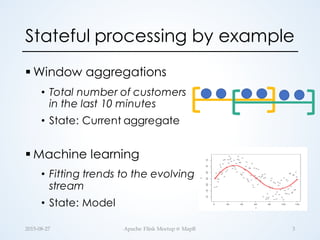
Stateful processing by example
§ Window aggregations
• Total number of customers
in the last 10 minutes
• State: Current aggregate
§ Machine learning
• Fitting trends to the evolving
stream
• State: Model
3Apache  Flink  Meetup  @  MapR2015-­‐‑08-­‐‑27
Stateful processing by example
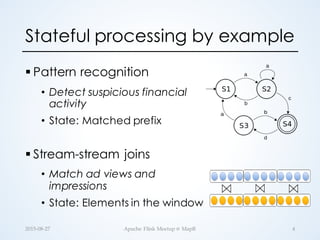
§ Pattern recognition
• Detect suspicious financial
activity
• State: Matched prefix
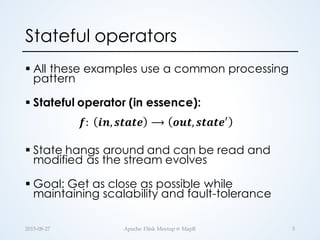
§ Stream-stream joins
• Match ad views and
impressions
• State: Elements in the window
4Apache  Flink  Meetup  @  MapR2015-­‐‑08-­‐‑27
Stateful operators
§ All these examples use a common processing
pattern
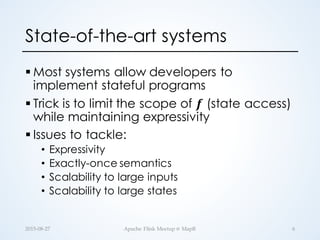
§ Stateful operator (in essence):
𝒇:	
   𝒊𝒏, 𝒔𝒕𝒂𝒕𝒆 ⟶ 𝒐𝒖𝒕, 𝒔𝒕𝒂𝒕𝒆.
§ State hangs around and can be read and
modified as the stream evolves
§ Goal: Get as close as possible while
maintaining scalability and fault-tolerance
5Apache  Flink  Meetup  @  MapR2015-­‐‑08-­‐‑27
State-of-the-art systems
§ Most systems allow developers to
implement stateful programs
§ Trick is to limit the scope of 𝒇 (state access)
while maintaining expressivity
§ Issues to tackle:
• Expressivity
• Exactly-once semantics
• Scalability to large inputs
• Scalability to large states
6Apache  Flink  Meetup  @  MapR2015-­‐‑08-­‐‑27
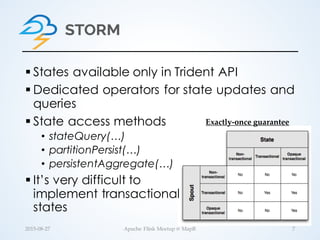
§ States available only in Trident API
§ Dedicated operators for state updates and
queries
§ State access methods
• stateQuery(…)
• partitionPersist(…)
• persistentAggregate(…)
§ It’s very difficult to
implement transactional
states
Exactly-­‐‑once  guarantee
7Apache  Flink  Meetup  @  MapR2015-­‐‑08-­‐‑27
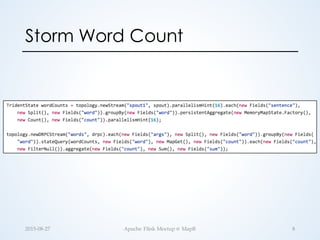
Storm Word Count
8Apache  Flink  Meetup  @  MapR2015-­‐‑08-­‐‑27
§ Stateless runtime by design
• No continuous operators
• UDFs are assumed to be stateless
§ State can be generated as a stream of
RDDs: updateStateByKey(…)
𝒇:	
   𝑺𝒆𝒒[𝒊𝒏 𝒌], 𝒔𝒕𝒂𝒕𝒆 𝒌 ⟶ 𝒔𝒕𝒂𝒕𝒆.
𝒌
§ 𝒇 is scoped to a specific key
§ Exactly-once semantics
9Apache  Flink  Meetup  @  MapR2015-­‐‑08-­‐‑27
val stateDstream = wordDstream.updateStateByKey[Int](
newUpdateFunc,
new HashPartitioner(ssc.sparkContext.defaultParallelism),
true,
initialRDD)
val updateFunc = (values: Seq[Int], state: Option[Int]) => {
val currentCount = values.sum
val previousCount = state.getOrElse(0)
Some(currentCount + previousCount)
}
Spark Streaming Word Count
10Apache  Flink  Meetup  @  MapR2015-­‐‑08-­‐‑27
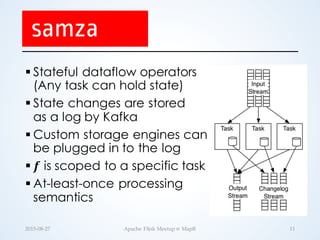
§ Stateful dataflow operators
(Any task can hold state)
§ State changes are stored
as a log by Kafka
§ Custom storage engines can
be plugged in to the log
§ 𝒇 is scoped to a specific task
§ At-least-once processing
semantics
11Apache  Flink  Meetup  @  MapR2015-­‐‑08-­‐‑27
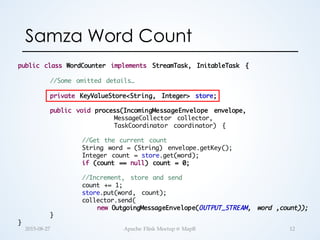
Samza Word Count
public class WordCounter implements StreamTask, InitableTask {
//Some omitted details…
private KeyValueStore<String, Integer> store;
public void process(IncomingMessageEnvelope envelope,
MessageCollector collector,
TaskCoordinator coordinator) {
//Get the current count
String word = (String) envelope.getKey();
Integer count = store.get(word);
if (count == null) count = 0;
//Increment, store and send
count += 1;
store.put(word, count);
collector.send(
new OutgoingMessageEnvelope(OUTPUT_STREAM, word ,count));
}
}
12Apache  Flink  Meetup  @  MapR2015-­‐‑08-­‐‑27
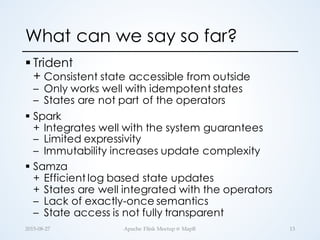
What can we say so far?
§ Trident
+ Consistent state accessible from outside
– Only works well with idempotent states
– States are not part of the operators
§ Spark
+ Integrates well with the system guarantees
– Limited expressivity
– Immutability increases update complexity
§ Samza
+ Efficient log based state updates
+ States are well integrated with the operators
– Lack of exactly-once semantics
– State access is not fully transparent
13Apache  Flink  Meetup  @  MapR2015-­‐‑08-­‐‑27
§ Take what’s good, make it work + add
some more
§ Clean and powerful abstractions
• Local (Task) state
• Partitioned (Key) state
§ Proper API integration
• Java: OperatorState interface
• Scala: mapWithState, flatMapWithState…
§ Exactly-once semantics by checkpointing
14Apache  Flink  Meetup  @  MapR2015-­‐‑08-­‐‑27
Flink Word Count
words.keyBy(x => x).mapWithState {
(word, count: Option[Int]) =>
{
val newCount = count.getOrElse(0) + 1
val output = (word, newCount)
(output, Some(newCount))
}
}
15Apache  Flink  Meetup  @  MapR2015-­‐‑08-­‐‑27
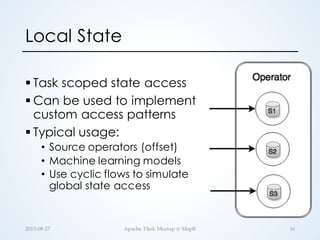
Local State
§ Task scoped state access
§ Can be used to implement
custom access patterns
§ Typical usage:
• Source operators (offset)
• Machine learning models
• Use cyclic flows to simulate
global state access
16Apache  Flink  Meetup  @  MapR2015-­‐‑08-­‐‑27
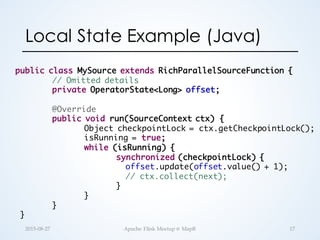
Local State Example (Java)
public class MySource extends RichParallelSourceFunction {
// Omitted details
private OperatorState<Long> offset;
@Override
public void run(SourceContext ctx) {
Object checkpointLock = ctx.getCheckpointLock();
isRunning = true;
while (isRunning) {
synchronized (checkpointLock) {
offset.update(offset.value() + 1);
// ctx.collect(next);
}
}
}
}
17Apache  Flink  Meetup  @  MapR2015-­‐‑08-­‐‑27
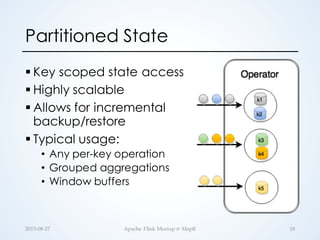
Partitioned State
§ Key scoped state access
§ Highly scalable
§ Allows for incremental
backup/restore
§ Typical usage:
• Any per-key operation
• Grouped aggregations
• Window buffers
18Apache  Flink  Meetup  @  MapR2015-­‐‑08-­‐‑27
Partitioned State Example (Scala)
// Compute the current average of each city's temperature
temps.keyBy("city").mapWithState {
(in: Temp, state: Option[(Double, Long)]) =>
{
val current = state.getOrElse((0.0, 0L))
val updated = (current._1 + in.temp, current._2 + 1)
val avg = Temp(in.city, updated._1 / updated._2)
(avg, Some(updated))
}
}
case class Temp(city: String, temp: Double)
19Apache  Flink  Meetup  @  MapR2015-­‐‑08-­‐‑27
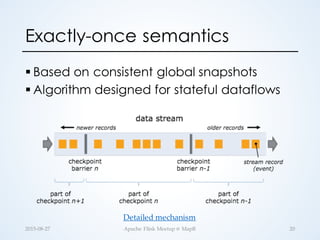
Exactly-once semantics
§ Based on consistent global snapshots
§ Algorithm designed for stateful dataflows
20Apache  Flink  Meetup  @  MapR2015-­‐‑08-­‐‑27
Detailed  mechanism
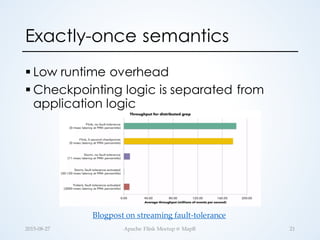
Exactly-once semantics
§ Low runtime overhead
§ Checkpointing logic is separated from
application logic
21Apache  Flink  Meetup  @  MapR2015-­‐‑08-­‐‑27
Blogpost  on  streaming  fault-­‐‑tolerance
Summary
§ State is essential to many applications
§ Fault-tolerant streaming state is a hard
problem
§ There is a trade-off between expressivity vs
scalability/fault-tolerance
§ Flink tries to hit the sweet spot with…
• Providing very flexible abstractions
• Keeping good scalability and exactly-once
semantics
22Apache  Flink  Meetup  @  MapR2015-­‐‑08-­‐‑27
Thank you!

Stateful Distributed Stream Processing

  • 1.
    Stateful distributed stream processing GyulaFóra gyfora@apache.org @GyulaFora
  • 2.
    This talk § Statefulprocessing by example § Definition and challenges § State in current open-source systems § State in Apache Flink § Closing 2Apache  Flink  Meetup  @  MapR2015-­‐‑08-­‐‑27
  • 3.
    Stateful processing byexample § Window aggregations • Total number of customers in the last 10 minutes • State: Current aggregate § Machine learning • Fitting trends to the evolving stream • State: Model 3Apache  Flink  Meetup  @  MapR2015-­‐‑08-­‐‑27
  • 4.
    Stateful processing byexample § Pattern recognition • Detect suspicious financial activity • State: Matched prefix § Stream-stream joins • Match ad views and impressions • State: Elements in the window 4Apache  Flink  Meetup  @  MapR2015-­‐‑08-­‐‑27
  • 5.
    Stateful operators § Allthese examples use a common processing pattern § Stateful operator (in essence): 𝒇:   𝒊𝒏, 𝒔𝒕𝒂𝒕𝒆 ⟶ 𝒐𝒖𝒕, 𝒔𝒕𝒂𝒕𝒆. § State hangs around and can be read and modified as the stream evolves § Goal: Get as close as possible while maintaining scalability and fault-tolerance 5Apache  Flink  Meetup  @  MapR2015-­‐‑08-­‐‑27
  • 6.
    State-of-the-art systems § Mostsystems allow developers to implement stateful programs § Trick is to limit the scope of 𝒇 (state access) while maintaining expressivity § Issues to tackle: • Expressivity • Exactly-once semantics • Scalability to large inputs • Scalability to large states 6Apache  Flink  Meetup  @  MapR2015-­‐‑08-­‐‑27
  • 7.
    § States availableonly in Trident API § Dedicated operators for state updates and queries § State access methods • stateQuery(…) • partitionPersist(…) • persistentAggregate(…) § It’s very difficult to implement transactional states Exactly-­‐‑once  guarantee 7Apache  Flink  Meetup  @  MapR2015-­‐‑08-­‐‑27
  • 8.
    Storm Word Count 8Apache Flink  Meetup  @  MapR2015-­‐‑08-­‐‑27
  • 9.
    § Stateless runtimeby design • No continuous operators • UDFs are assumed to be stateless § State can be generated as a stream of RDDs: updateStateByKey(…) 𝒇:   𝑺𝒆𝒒[𝒊𝒏 𝒌], 𝒔𝒕𝒂𝒕𝒆 𝒌 ⟶ 𝒔𝒕𝒂𝒕𝒆. 𝒌 § 𝒇 is scoped to a specific key § Exactly-once semantics 9Apache  Flink  Meetup  @  MapR2015-­‐‑08-­‐‑27
  • 10.
    val stateDstream =wordDstream.updateStateByKey[Int]( newUpdateFunc, new HashPartitioner(ssc.sparkContext.defaultParallelism), true, initialRDD) val updateFunc = (values: Seq[Int], state: Option[Int]) => { val currentCount = values.sum val previousCount = state.getOrElse(0) Some(currentCount + previousCount) } Spark Streaming Word Count 10Apache  Flink  Meetup  @  MapR2015-­‐‑08-­‐‑27
  • 11.
    § Stateful dataflowoperators (Any task can hold state) § State changes are stored as a log by Kafka § Custom storage engines can be plugged in to the log § 𝒇 is scoped to a specific task § At-least-once processing semantics 11Apache  Flink  Meetup  @  MapR2015-­‐‑08-­‐‑27
  • 12.
    Samza Word Count publicclass WordCounter implements StreamTask, InitableTask { //Some omitted details… private KeyValueStore<String, Integer> store; public void process(IncomingMessageEnvelope envelope, MessageCollector collector, TaskCoordinator coordinator) { //Get the current count String word = (String) envelope.getKey(); Integer count = store.get(word); if (count == null) count = 0; //Increment, store and send count += 1; store.put(word, count); collector.send( new OutgoingMessageEnvelope(OUTPUT_STREAM, word ,count)); } } 12Apache  Flink  Meetup  @  MapR2015-­‐‑08-­‐‑27
  • 13.
    What can wesay so far? § Trident + Consistent state accessible from outside – Only works well with idempotent states – States are not part of the operators § Spark + Integrates well with the system guarantees – Limited expressivity – Immutability increases update complexity § Samza + Efficient log based state updates + States are well integrated with the operators – Lack of exactly-once semantics – State access is not fully transparent 13Apache  Flink  Meetup  @  MapR2015-­‐‑08-­‐‑27
  • 14.
    § Take what’sgood, make it work + add some more § Clean and powerful abstractions • Local (Task) state • Partitioned (Key) state § Proper API integration • Java: OperatorState interface • Scala: mapWithState, flatMapWithState… § Exactly-once semantics by checkpointing 14Apache  Flink  Meetup  @  MapR2015-­‐‑08-­‐‑27
  • 15.
    Flink Word Count words.keyBy(x=> x).mapWithState { (word, count: Option[Int]) => { val newCount = count.getOrElse(0) + 1 val output = (word, newCount) (output, Some(newCount)) } } 15Apache  Flink  Meetup  @  MapR2015-­‐‑08-­‐‑27
  • 16.
    Local State § Taskscoped state access § Can be used to implement custom access patterns § Typical usage: • Source operators (offset) • Machine learning models • Use cyclic flows to simulate global state access 16Apache  Flink  Meetup  @  MapR2015-­‐‑08-­‐‑27
  • 17.
    Local State Example(Java) public class MySource extends RichParallelSourceFunction { // Omitted details private OperatorState<Long> offset; @Override public void run(SourceContext ctx) { Object checkpointLock = ctx.getCheckpointLock(); isRunning = true; while (isRunning) { synchronized (checkpointLock) { offset.update(offset.value() + 1); // ctx.collect(next); } } } } 17Apache  Flink  Meetup  @  MapR2015-­‐‑08-­‐‑27
  • 18.
    Partitioned State § Keyscoped state access § Highly scalable § Allows for incremental backup/restore § Typical usage: • Any per-key operation • Grouped aggregations • Window buffers 18Apache  Flink  Meetup  @  MapR2015-­‐‑08-­‐‑27
  • 19.
    Partitioned State Example(Scala) // Compute the current average of each city's temperature temps.keyBy("city").mapWithState { (in: Temp, state: Option[(Double, Long)]) => { val current = state.getOrElse((0.0, 0L)) val updated = (current._1 + in.temp, current._2 + 1) val avg = Temp(in.city, updated._1 / updated._2) (avg, Some(updated)) } } case class Temp(city: String, temp: Double) 19Apache  Flink  Meetup  @  MapR2015-­‐‑08-­‐‑27
  • 20.
    Exactly-once semantics § Basedon consistent global snapshots § Algorithm designed for stateful dataflows 20Apache  Flink  Meetup  @  MapR2015-­‐‑08-­‐‑27 Detailed  mechanism
  • 21.
    Exactly-once semantics § Lowruntime overhead § Checkpointing logic is separated from application logic 21Apache  Flink  Meetup  @  MapR2015-­‐‑08-­‐‑27 Blogpost  on  streaming  fault-­‐‑tolerance
  • 22.
    Summary § State isessential to many applications § Fault-tolerant streaming state is a hard problem § There is a trade-off between expressivity vs scalability/fault-tolerance § Flink tries to hit the sweet spot with… • Providing very flexible abstractions • Keeping good scalability and exactly-once semantics 22Apache  Flink  Meetup  @  MapR2015-­‐‑08-­‐‑27
  • 23.