1
Tale of two stream processing frameworks
Apache Storm & Apache Flink
Karthik Deivasigamani
@WalmartLabs
2
Streaming
• Stream
– Continuous flow
• Streaming Data
– Streaming data is data that is continuously
generated by different sources.
– Unbounded data
• Stream Processing
– processing of data in motion, or in other
words, computing on data directly as it is
produced or received
– data processing engine that is designed with
infinite data sets in mind
3
Retail Data
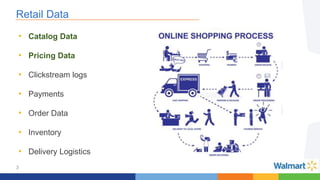
• Catalog Data
• Pricing Data
• Clickstream logs
• Payments
• Order Data
• Inventory
• Delivery Logistics
4
Not so long ago..
• Data submitted as feeds
• Periodic Data Collection
• Data Processed In Batches
• Runs offline
• Delay between actual time &
processing time
• Failures
5
Need For Speed – Fast Data
• Catalog Updates
• Price Updates
• Fraud Detection
• Out of stock
• Delivery alerts
• Personalization
6
7
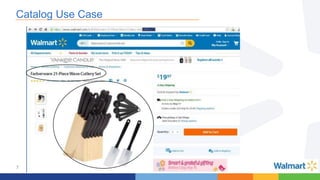
Catalog Use Case
8
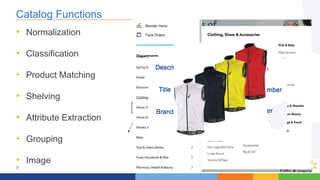
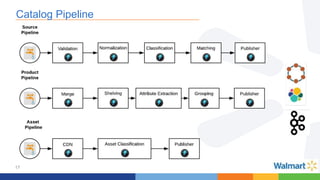
Catalog Functions
• Normalization
• Classification
• Product Matching
• Shelving
• Attribute Extraction
• Grouping
• Image
9
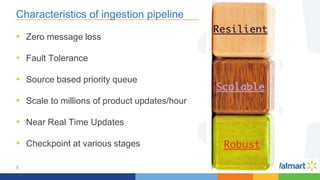
Characteristics of ingestion pipeline
• Zero message loss
• Fault Tolerance
• Source based priority queue
• Scale to millions of product updates/hour
• Near Real Time Updates
• Checkpoint at various stages
10
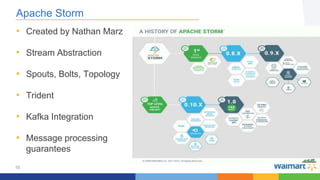
Apache Storm
• Created by Nathan Marz
• Stream Abstraction
• Spouts, Bolts, Topology
• Trident
• Kafka Integration
• Message processing
guarantees
11
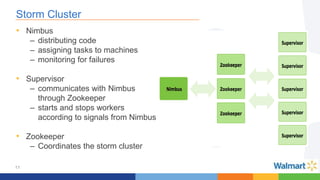
Storm Cluster
• Nimbus
– distributing code
– assigning tasks to machines
– monitoring for failures
• Supervisor
– communicates with Nimbus
through Zookeeper
– starts and stops workers
according to signals from Nimbus
• Zookeeper
– Coordinates the storm cluster
12
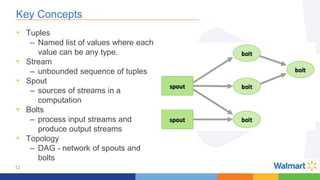
Key Concepts
• Tuples
– Named list of values where each
value can be any type.
• Stream
– unbounded sequence of tuples
• Spout
– sources of streams in a
computation
• Bolts
– process input streams and
produce output streams
• Topology
– DAG - network of spouts and
bolts
13
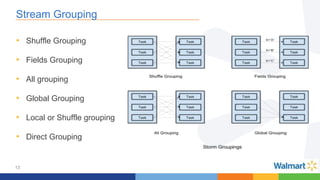
Stream Grouping
• Shuffle Grouping
• Fields Grouping
• All grouping
• Global Grouping
• Local or Shuffle grouping
• Direct Grouping
14
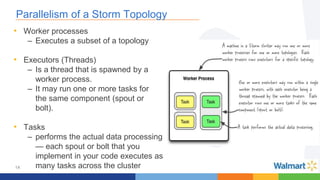
Parallelism of a Storm Topology
• Worker processes
– Executes a subset of a topology
• Executors (Threads)
– Is a thread that is spawned by a
worker process.
– It may run one or more tasks for
the same component (spout or
bolt).
• Tasks
– performs the actual data processing
— each spout or bolt that you
implement in your code executes as
many tasks across the cluster
15
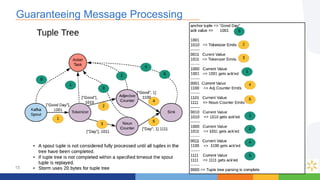
Guaranteeing Message Processing
16
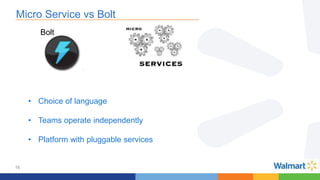
Micro Service vs Bolt
• Choice of language
• Teams operate independently
• Platform with pluggable services
Bolt
17
Catalog Pipeline
18
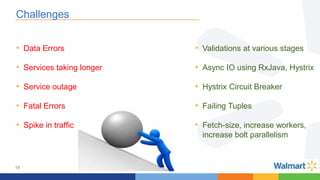
Challenges
• Validations at various stages
• Async IO using RxJava, Hystrix
• Hystrix Circuit Breaker
• Failing Tuples
• Fetch-size, increase workers,
increase bolt parallelism
• Data Errors
• Services taking longer
• Service outage
• Fatal Errors
• Spike in traffic
19
Lessons Learnt
• Things will fail
• Monitor everything
• Automation
• Scale is not a feature
• Logs don’t lie
20
21
Pricing Use Case
• Competitive pricing (EDLP)
• Seller price updates
• Handle spike during holidays
• Promotions
• Anomaly Detection
• Accuracy
22
Characteristics of ingestion pipeline
• Exactly Once
• Order Guarantee
• Stateful
• Handle tens of millions of
updates/hour
• NRT price update on website
• Traceability
23
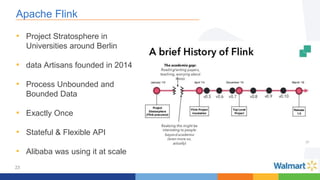
Apache Flink
• Project Stratosphere in
Universities around Berlin
• data Artisans founded in 2014
• Process Unbounded and
Bounded Data
• Exactly Once
• Stateful & Flexible API
• Alibaba was using it at scale
24
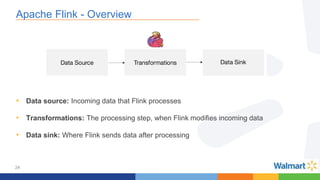
Apache Flink - Overview
• Data source: Incoming data that Flink processes
• Transformations: The processing step, when Flink modifies incoming data
• Data sink: Where Flink sends data after processing
25
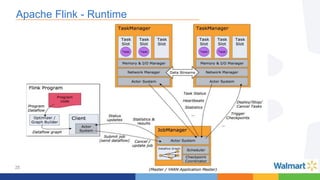
Apache Flink - Runtime
Footer
26
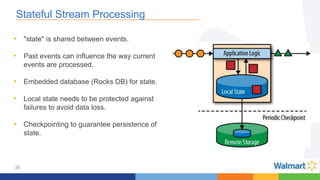
Stateful Stream Processing
• "state" is shared between events.
• Past events can influence the way current
events are processed.
• Embedded database (Rocks DB) for state.
• Local state needs to be protected against
failures to avoid data loss.
• Checkpointing to guarantee persistence of
state.
27
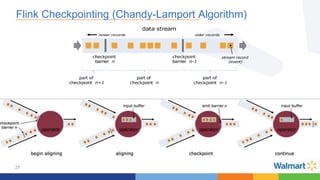
Flink Checkpointing (Chandy-Lamport Algorithm)
28
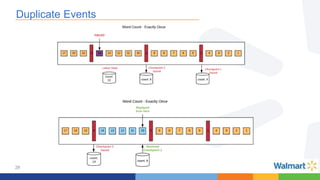
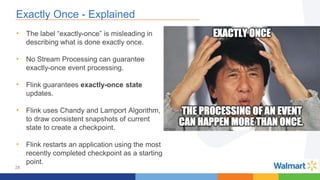
Exactly Once - Explained
• The label “exactly-once” is misleading in
describing what is done exactly once.
• No Stream Processing can guarantee
exactly-once event processing.
• Flink guarantees exactly-once state
updates.
• Flink uses Chandy and Lamport Algorithm,
to draw consistent snapshots of current
state to create a checkpoint.
• Flink restarts an application using the most
recently completed checkpoint as a starting
point.
29
Duplicate Events
30
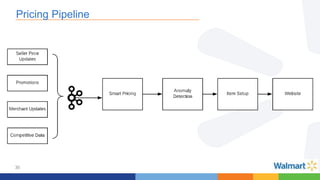
Pricing Pipeline
31
Challenges
• HTTP/DB lookup calls
• Huge payload choking network
• Isolation
• Buffer bloat
• Async I/O Operator
• Operator Chaining
• Mesos / YARN
• taskmanager.memory.segment-size
32
What we learnt
• Flink is fast, APIs are super easy to use.
• Avoid network shuffle and use forward / operator
chaining.
• Use accumulators to monitor the progress of your
application.
• Checkpoint failures indicate that your application is
running slow.
• Monitor everything – lag, checkpoints, latency etc
• For application inherently slow configure your
buffers to accommodate for buffer bloat, so that
checkpoints don’t fail.
• Join the flink users mailing list and ask questions!
33
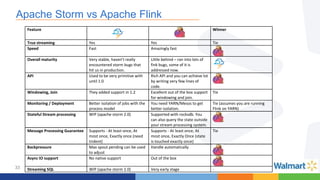
Apache Storm vs Apache Flink
Feature Winner
True streaming Yes Yes Tie
Speed Fast Amazingly fast
Overall maturity Very stable, haven’t really
encountered storm bugs that
hit us in production.
Little behind – ran into lots of
fink bugs, some of it is
addressed now.
API Used to be very primitive with
until 1.0
Rich API and you can achieve lot
by writing very few lines of
code.
Windowing, Join They added support in 1.2 Excellent out of the box support
for windowing and join.
Tie
Monitoring / Deployment Better isolation of jobs with the
process model
You need YARN/Mesos to get
better isolation.
Tie (assumes you are running
Flink on YARN)
Stateful Stream processing WIP (apache storm 2.0) Supported with rocksdb. You
can also query the state outside
your stream processing system.
Message Processing Guarantee Supports - At least once, At
most once, Exactly once (need
trident)
Supports - At least once, At
most once, Exactly Once (state
is touched exactly once)
Tie
Backpressure Max spout pending can be used
to adjust
Handle automatically
Async IO support No native support Out of the box
Streaming SQL WIP (apache storm 2.0) Very early stage -
34
What should I pick
35
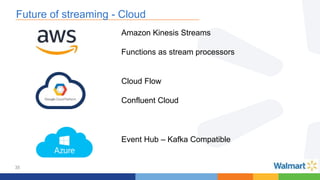
Future of streaming - Cloud
Amazon Kinesis Streams
Functions as stream processors
Cloud Flow
Confluent Cloud
Event Hub – Kafka Compatible
36
Thank You!
Yes, we are hiring!
https://indiacareers.walmartlabs.com/

Tale of two streaming frameworks- Apace Storm & Apache Flink

  • 1.
    1 Tale of twostream processing frameworks Apache Storm & Apache Flink Karthik Deivasigamani @WalmartLabs
  • 2.
    2 Streaming • Stream – Continuousflow • Streaming Data – Streaming data is data that is continuously generated by different sources. – Unbounded data • Stream Processing – processing of data in motion, or in other words, computing on data directly as it is produced or received – data processing engine that is designed with infinite data sets in mind
  • 3.
    3 Retail Data • CatalogData • Pricing Data • Clickstream logs • Payments • Order Data • Inventory • Delivery Logistics
  • 4.
    4 Not so longago.. • Data submitted as feeds • Periodic Data Collection • Data Processed In Batches • Runs offline • Delay between actual time & processing time • Failures
  • 5.
    5 Need For Speed– Fast Data • Catalog Updates • Price Updates • Fraud Detection • Out of stock • Delivery alerts • Personalization
  • 6.
  • 7.
  • 8.
    8 Catalog Functions • Normalization •Classification • Product Matching • Shelving • Attribute Extraction • Grouping • Image
  • 9.
    9 Characteristics of ingestionpipeline • Zero message loss • Fault Tolerance • Source based priority queue • Scale to millions of product updates/hour • Near Real Time Updates • Checkpoint at various stages
  • 10.
    10 Apache Storm • Createdby Nathan Marz • Stream Abstraction • Spouts, Bolts, Topology • Trident • Kafka Integration • Message processing guarantees
  • 11.
    11 Storm Cluster • Nimbus –distributing code – assigning tasks to machines – monitoring for failures • Supervisor – communicates with Nimbus through Zookeeper – starts and stops workers according to signals from Nimbus • Zookeeper – Coordinates the storm cluster
  • 12.
    12 Key Concepts • Tuples –Named list of values where each value can be any type. • Stream – unbounded sequence of tuples • Spout – sources of streams in a computation • Bolts – process input streams and produce output streams • Topology – DAG - network of spouts and bolts
  • 13.
    13 Stream Grouping • ShuffleGrouping • Fields Grouping • All grouping • Global Grouping • Local or Shuffle grouping • Direct Grouping
  • 14.
    14 Parallelism of aStorm Topology • Worker processes – Executes a subset of a topology • Executors (Threads) – Is a thread that is spawned by a worker process. – It may run one or more tasks for the same component (spout or bolt). • Tasks – performs the actual data processing — each spout or bolt that you implement in your code executes as many tasks across the cluster
  • 15.
  • 16.
    16 Micro Service vsBolt • Choice of language • Teams operate independently • Platform with pluggable services Bolt
  • 17.
  • 18.
    18 Challenges • Validations atvarious stages • Async IO using RxJava, Hystrix • Hystrix Circuit Breaker • Failing Tuples • Fetch-size, increase workers, increase bolt parallelism • Data Errors • Services taking longer • Service outage • Fatal Errors • Spike in traffic
  • 19.
    19 Lessons Learnt • Thingswill fail • Monitor everything • Automation • Scale is not a feature • Logs don’t lie
  • 20.
  • 21.
    21 Pricing Use Case •Competitive pricing (EDLP) • Seller price updates • Handle spike during holidays • Promotions • Anomaly Detection • Accuracy
  • 22.
    22 Characteristics of ingestionpipeline • Exactly Once • Order Guarantee • Stateful • Handle tens of millions of updates/hour • NRT price update on website • Traceability
  • 23.
    23 Apache Flink • ProjectStratosphere in Universities around Berlin • data Artisans founded in 2014 • Process Unbounded and Bounded Data • Exactly Once • Stateful & Flexible API • Alibaba was using it at scale
  • 24.
    24 Apache Flink -Overview • Data source: Incoming data that Flink processes • Transformations: The processing step, when Flink modifies incoming data • Data sink: Where Flink sends data after processing
  • 25.
    25 Apache Flink -Runtime Footer
  • 26.
    26 Stateful Stream Processing •"state" is shared between events. • Past events can influence the way current events are processed. • Embedded database (Rocks DB) for state. • Local state needs to be protected against failures to avoid data loss. • Checkpointing to guarantee persistence of state.
  • 27.
  • 28.
    28 Exactly Once -Explained • The label “exactly-once” is misleading in describing what is done exactly once. • No Stream Processing can guarantee exactly-once event processing. • Flink guarantees exactly-once state updates. • Flink uses Chandy and Lamport Algorithm, to draw consistent snapshots of current state to create a checkpoint. • Flink restarts an application using the most recently completed checkpoint as a starting point.
  • 29.
  • 30.
  • 31.
    31 Challenges • HTTP/DB lookupcalls • Huge payload choking network • Isolation • Buffer bloat • Async I/O Operator • Operator Chaining • Mesos / YARN • taskmanager.memory.segment-size
  • 32.
    32 What we learnt •Flink is fast, APIs are super easy to use. • Avoid network shuffle and use forward / operator chaining. • Use accumulators to monitor the progress of your application. • Checkpoint failures indicate that your application is running slow. • Monitor everything – lag, checkpoints, latency etc • For application inherently slow configure your buffers to accommodate for buffer bloat, so that checkpoints don’t fail. • Join the flink users mailing list and ask questions!
  • 33.
    33 Apache Storm vsApache Flink Feature Winner True streaming Yes Yes Tie Speed Fast Amazingly fast Overall maturity Very stable, haven’t really encountered storm bugs that hit us in production. Little behind – ran into lots of fink bugs, some of it is addressed now. API Used to be very primitive with until 1.0 Rich API and you can achieve lot by writing very few lines of code. Windowing, Join They added support in 1.2 Excellent out of the box support for windowing and join. Tie Monitoring / Deployment Better isolation of jobs with the process model You need YARN/Mesos to get better isolation. Tie (assumes you are running Flink on YARN) Stateful Stream processing WIP (apache storm 2.0) Supported with rocksdb. You can also query the state outside your stream processing system. Message Processing Guarantee Supports - At least once, At most once, Exactly once (need trident) Supports - At least once, At most once, Exactly Once (state is touched exactly once) Tie Backpressure Max spout pending can be used to adjust Handle automatically Async IO support No native support Out of the box Streaming SQL WIP (apache storm 2.0) Very early stage -
  • 34.
  • 35.
    35 Future of streaming- Cloud Amazon Kinesis Streams Functions as stream processors Cloud Flow Confluent Cloud Event Hub – Kafka Compatible
  • 36.
    36 Thank You! Yes, weare hiring! https://indiacareers.walmartlabs.com/