Large Scale Learning DesignProvincial Instructor Diploma Program (PIDP)Karen Belfer
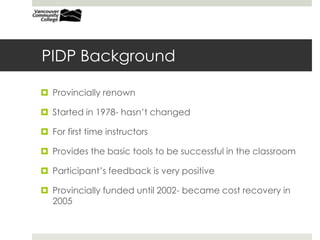
PIDP BackgroundProvincially renown Started in 1978- hasn’t changed For new instructorsProvides the basic tools to be successful in the classroomParticipant’s feedback is very positiveProvincially funded until 2002- became cost recovery in 2005
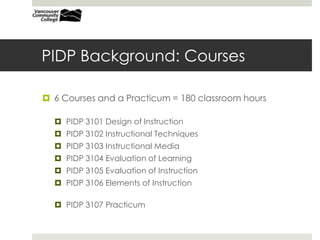
PIDP Background: Courses6 Courses and a Practicum = 180 classroom hoursPIDP 3101 Design of InstructionPIDP 3102 Instructional Techniques PIDP 3103 Instructional Media PIDP 3104 Evaluation of Learning PIDP 3105 Evaluation of Instruction PIDP 3106 Elements of Instruction PIDP 3107 Practicum
Background on PIDP FacultyAverage number of years teaching in the PIDP: 15Masters in EducationGreat “teachers”They teach others curriculum development
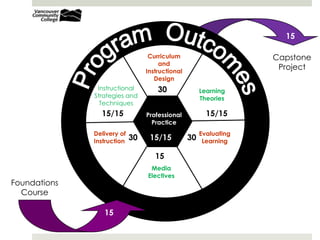
Background for the Re-DesignProgram Review Feb – June 2008Recommendations:Outcomes-based curriculumUpdate course contentLook at different modes of deliveryReinstate a Program Advisory Group (PAC)New business modelChallenge30 great years of experience- success ~ Change *
Large Scale Learning DesignSteps:Visioning  - Dec 08Mapping Exercise – Feb 09Develop a new Business Model ~ on-hold
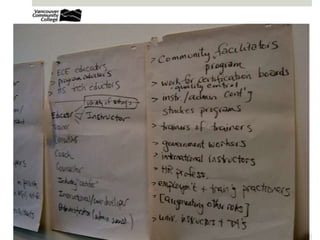
Visioning  - Dec 08Purpose: Create inspiration and excitement around future opportunities Trends shaping adult education todayHow is adult education and training changing in the 21st century? What does a PIDP program look like that provides students with the tools to be innovators?  What are the future opportunities for the PIDP program?  Invited key members of the community that the program faculty know and admire
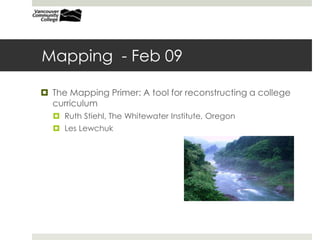
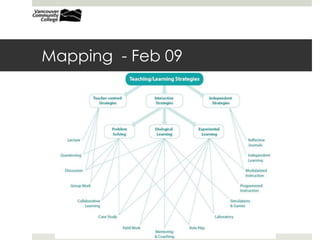
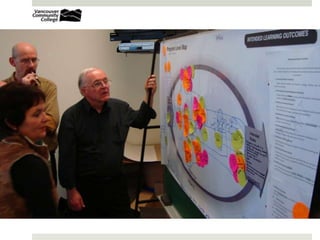
Mapping  - Feb 09The Mapping Primer: A tool for reconstructing a college curriculumRuth Stiehl, The Whitewater Institute, OregonLes Lewchuk
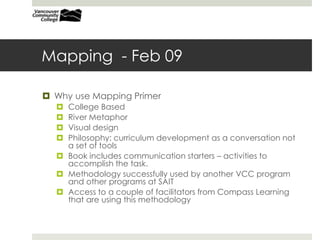
Mapping  - Feb 09Why use Mapping PrimerCollege basedRiver metaphorVisual designPhilosophy: curriculum development as a conversation not a set of tools Book includes communication starters – activities to accomplish the task.Methodology has been successfully used in the college and at SAITAccess to a couple of facilitators from Compass Learning
Mapping  - Feb 09Process Who - VoicesEmployersAdvisory groupsBusiness and community leadersStudents FacultyHowParticipationConversationNegotiationReflection
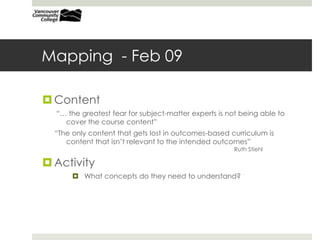
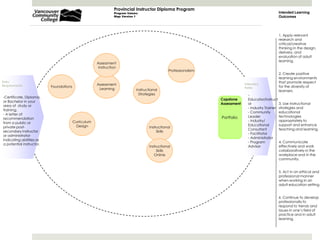
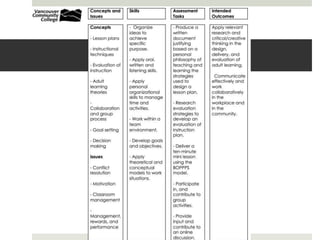
Mapping  - Feb 09Program Learning Outcomes    Program learning outcomes are not objectives or goals to be put in new wrappers. Outcome statements describe what students should be able to do “outside” the classroom –not “inside” it.Ruth StiehlActivityRoles students will take in society?What will they be able to do in these roles as a result of participating in this program?BrainstormCluster answersName clustersWrite outcomes-  action, context, scope, complexity.
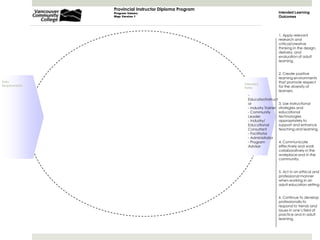
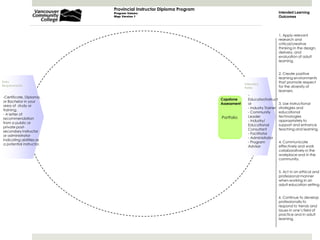
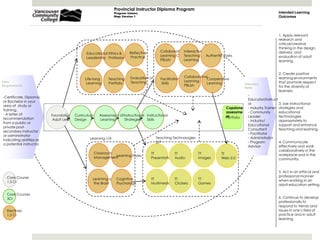
Provincial Instructor Diploma Program Program Values:Map: Version 1	Intended Learning Outcomes1. Apply relevant research and critical/creative thinking in the design, delivery, and evaluation of adult learning.  2. Create positive learning environments that promote respect for the diversity of learners.  3. Use instructional strategies and educational technologies appropriately to support and enhance teaching and learning.  4. Communicate effectively and work collaboratively in the workplace and in the community.  5. Act in an ethical and professional manner when working in an adult education setting.  6. Continue to develop professionally to respond to trends and issues in one’s field of practice and in adult learning. Entry RequirementsIntendedRoles Educator/Instructor- Industry Trainer- Community Leader
 Industry/ Educational Consultant
 Facilitator
 Administrator
 Program Advisor
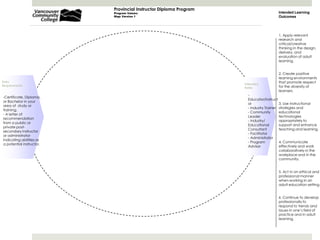
Provincial Instructor Diploma Program Program Values:Map: Version 1	Intended Learning Outcomes1. Apply relevant research and critical/creative thinking in the design, delivery, and evaluation of adult learning.  2. Create positive learning environments that promote respect for the diversity of learners.  3. Use instructional strategies and educational technologies appropriately to support and enhance teaching and learning.  4. Communicate effectively and work collaboratively in the workplace and in the community.  5. Act in an ethical and professional manner when working in an adult education setting.  6. Continue to develop professionally to respond to trends and issues in one’s field of practice and in adult learning. Entry RequirementsIntendedRoles Educator/Instructor- Industry Trainer- Community Leader
 Industry/ Educational Consultant
 Facilitator
 Administrator
 Program Advisor
Certificate, Diploma, or Bachelor in your area of  study or  training.
 A letter of recommendation from a public or private post-secondary instructor or administrator indicating abilities as a potential instructor.Mapping  - Feb 09
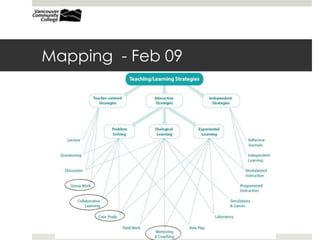
Mapping  - Feb 09
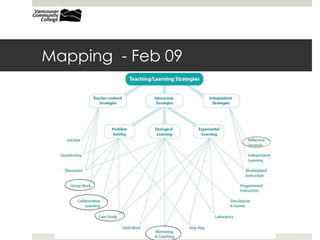
Mapping  - Feb 09
Provincial Instructor Diploma Program Program Values:Map: Version 1	Intended Learning Outcomes1. Apply relevant research and critical/creative thinking in the design, delivery, and evaluation of adult learning.  2. Create positive learning environments that promote respect for the diversity of learners.  3. Use instructional strategies and educational technologies appropriately to support and enhance teaching and learning.  4. Communicate effectively and work collaboratively in the workplace and in the community.  5. Act in an ethical and professional manner when working in an adult education setting.  6. Continue to develop professionally to respond to trends and issues in one’s field of practice and in adult learning. Entry RequirementsIntendedRoles Educator/Instructor- Industry Trainer- Community Leader
 Industry/ Educational Consultant
 Facilitator
 Administrator
 Program Advisor

Large Scale Learning Design

  • 1.
    Large Scale LearningDesignProvincial Instructor Diploma Program (PIDP)Karen Belfer
  • 2.
    PIDP BackgroundProvincially renownStarted in 1978- hasn’t changed For new instructorsProvides the basic tools to be successful in the classroomParticipant’s feedback is very positiveProvincially funded until 2002- became cost recovery in 2005
  • 3.
    PIDP Background: Courses6Courses and a Practicum = 180 classroom hoursPIDP 3101 Design of InstructionPIDP 3102 Instructional Techniques PIDP 3103 Instructional Media PIDP 3104 Evaluation of Learning PIDP 3105 Evaluation of Instruction PIDP 3106 Elements of Instruction PIDP 3107 Practicum
  • 4.
    Background on PIDPFacultyAverage number of years teaching in the PIDP: 15Masters in EducationGreat “teachers”They teach others curriculum development
  • 5.
    Background for theRe-DesignProgram Review Feb – June 2008Recommendations:Outcomes-based curriculumUpdate course contentLook at different modes of deliveryReinstate a Program Advisory Group (PAC)New business modelChallenge30 great years of experience- success ~ Change *
  • 6.
    Large Scale LearningDesignSteps:Visioning - Dec 08Mapping Exercise – Feb 09Develop a new Business Model ~ on-hold
  • 7.
    Visioning -Dec 08Purpose: Create inspiration and excitement around future opportunities Trends shaping adult education todayHow is adult education and training changing in the 21st century? What does a PIDP program look like that provides students with the tools to be innovators?  What are the future opportunities for the PIDP program?  Invited key members of the community that the program faculty know and admire
  • 8.
    Mapping -Feb 09The Mapping Primer: A tool for reconstructing a college curriculumRuth Stiehl, The Whitewater Institute, OregonLes Lewchuk
  • 9.
    Mapping -Feb 09Why use Mapping PrimerCollege basedRiver metaphorVisual designPhilosophy: curriculum development as a conversation not a set of tools Book includes communication starters – activities to accomplish the task.Methodology has been successfully used in the college and at SAITAccess to a couple of facilitators from Compass Learning
  • 10.
    Mapping -Feb 09Process Who - VoicesEmployersAdvisory groupsBusiness and community leadersStudents FacultyHowParticipationConversationNegotiationReflection
  • 11.
    Mapping -Feb 09Program Learning Outcomes Program learning outcomes are not objectives or goals to be put in new wrappers. Outcome statements describe what students should be able to do “outside” the classroom –not “inside” it.Ruth StiehlActivityRoles students will take in society?What will they be able to do in these roles as a result of participating in this program?BrainstormCluster answersName clustersWrite outcomes- action, context, scope, complexity.
  • 12.
    Provincial Instructor DiplomaProgram Program Values:Map: Version 1 Intended Learning Outcomes1. Apply relevant research and critical/creative thinking in the design, delivery, and evaluation of adult learning.  2. Create positive learning environments that promote respect for the diversity of learners.  3. Use instructional strategies and educational technologies appropriately to support and enhance teaching and learning.  4. Communicate effectively and work collaboratively in the workplace and in the community.  5. Act in an ethical and professional manner when working in an adult education setting.  6. Continue to develop professionally to respond to trends and issues in one’s field of practice and in adult learning. Entry RequirementsIntendedRoles Educator/Instructor- Industry Trainer- Community Leader
  • 13.
  • 14.
  • 15.
  • 16.
  • 17.
    Provincial Instructor DiplomaProgram Program Values:Map: Version 1 Intended Learning Outcomes1. Apply relevant research and critical/creative thinking in the design, delivery, and evaluation of adult learning.  2. Create positive learning environments that promote respect for the diversity of learners.  3. Use instructional strategies and educational technologies appropriately to support and enhance teaching and learning.  4. Communicate effectively and work collaboratively in the workplace and in the community.  5. Act in an ethical and professional manner when working in an adult education setting.  6. Continue to develop professionally to respond to trends and issues in one’s field of practice and in adult learning. Entry RequirementsIntendedRoles Educator/Instructor- Industry Trainer- Community Leader
  • 18.
  • 19.
  • 20.
  • 21.
  • 22.
    Certificate, Diploma, orBachelor in your area of study or training.
  • 23.
    A letterof recommendation from a public or private post-secondary instructor or administrator indicating abilities as a potential instructor.Mapping - Feb 09
  • 24.
    Mapping -Feb 09
  • 25.
    Mapping -Feb 09
  • 26.
    Provincial Instructor DiplomaProgram Program Values:Map: Version 1 Intended Learning Outcomes1. Apply relevant research and critical/creative thinking in the design, delivery, and evaluation of adult learning.  2. Create positive learning environments that promote respect for the diversity of learners.  3. Use instructional strategies and educational technologies appropriately to support and enhance teaching and learning.  4. Communicate effectively and work collaboratively in the workplace and in the community.  5. Act in an ethical and professional manner when working in an adult education setting.  6. Continue to develop professionally to respond to trends and issues in one’s field of practice and in adult learning. Entry RequirementsIntendedRoles Educator/Instructor- Industry Trainer- Community Leader
  • 27.
  • 28.
  • 29.
  • 30.