Curtin Education Assistants  Conversion Course  Logbook… observation framework Reflective Practice 333 Leith Hogan  Semester One 2009
Overview 1. Introduction: 2.  Context: Slide 12 3.  Relationships: Slide 14 4.  Classroom Structures: Slide 16 5.  Classroom Processes: Slide 19 a. Administrative: Slide 20 b. Instructional : Slide 21 6.  Planning: Slide 23 7.  Curriculum content: Slide 28 8.  Classroom management 1: Slide 30 9.  Classroom management 2: Slide 33 10.  Assessment: Slide 34 11.  Instructional strategies: Slide 39 12 . Inclusion/SAER: Slide 41 13.  Conclusion: Slide 44 14.  Marking Criteria Leith Hogan January 2009
EDWA Competency Framework  for Teachers Dimension  1:Facilitating student learning Dimension  2: Assessing student learning outcomes Dimension  3: Engaging in professional learning Dimension  4: Participating in Curriculum Policy and Program initiatives in an outcomes focussed environment. Dimension  5: Forming partnerships within the school community Leith Hogan January 2009
Journaling Helps to collect your thoughts Clarifies thinking and results in richer clearer thinking about your practice. Keeps track of learning Collects ideas and perspectives Involves reflections upon your own and other’s teaching and learning. Action learning cycle think/plan/ act /reflect… Leith Hogan January 2009
Confidentiality  and trust! Leith Hogan January 2009
Suggestions Write personally Write selectively Write immediately Write freely Write to take the inquiry further Leith Hogan January 2009
Observing for 12 - 2 hour sessions…. with  a specific observation focus  for each session  Questions to guide the observations…. What do I want to understand more fully What information do I need? What do I need to observe? How can I get the information I need? Who can help me? Frameworks Leith Hogan January 2009
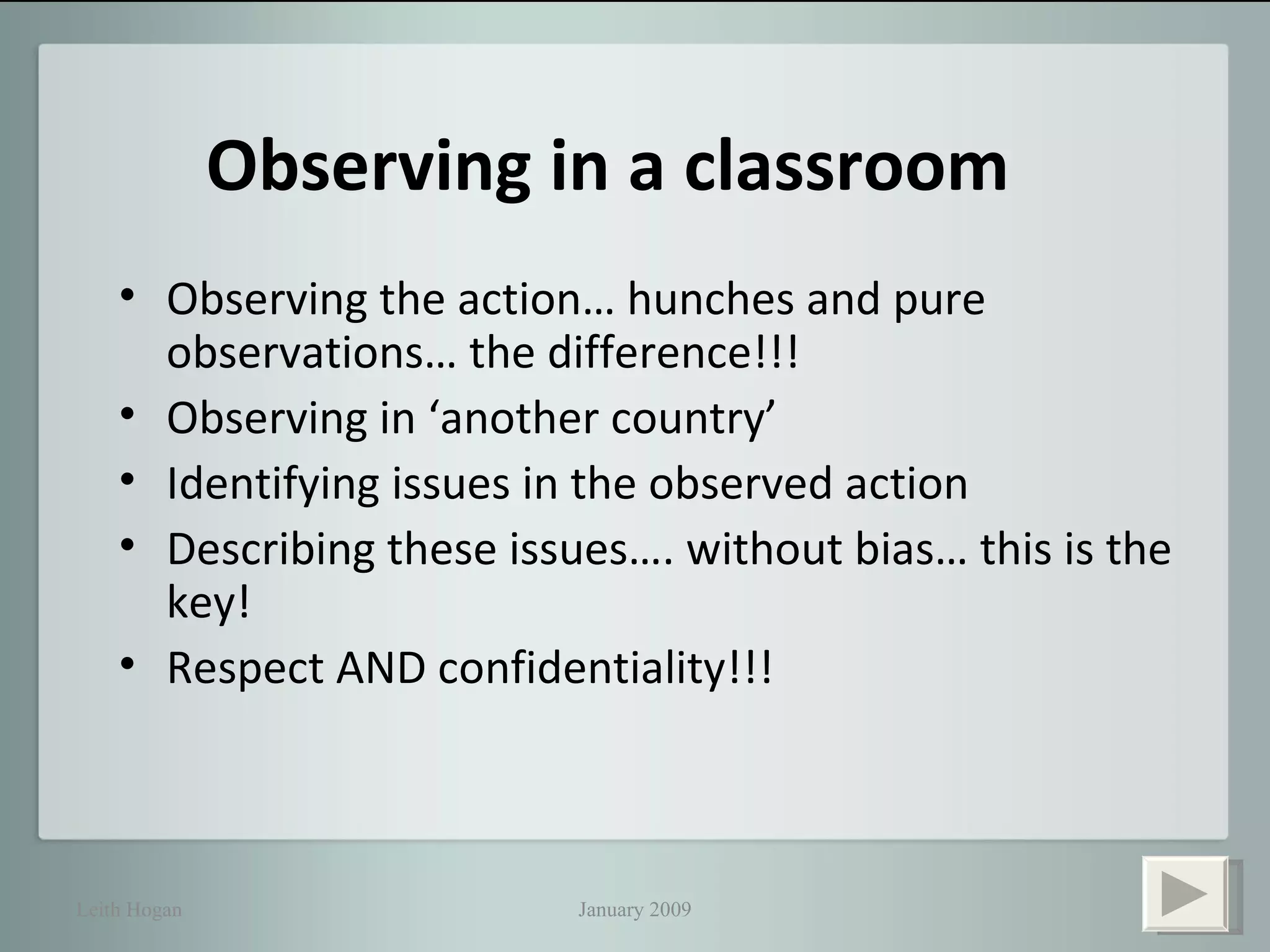
Observing in a classroom Observing the action… hunches and pure observations… the difference!!! Observing in ‘another country’ Identifying issues in the observed action Describing these issues…. without bias… this is the key! Respect AND confidentiality!!! Leith Hogan January 2009
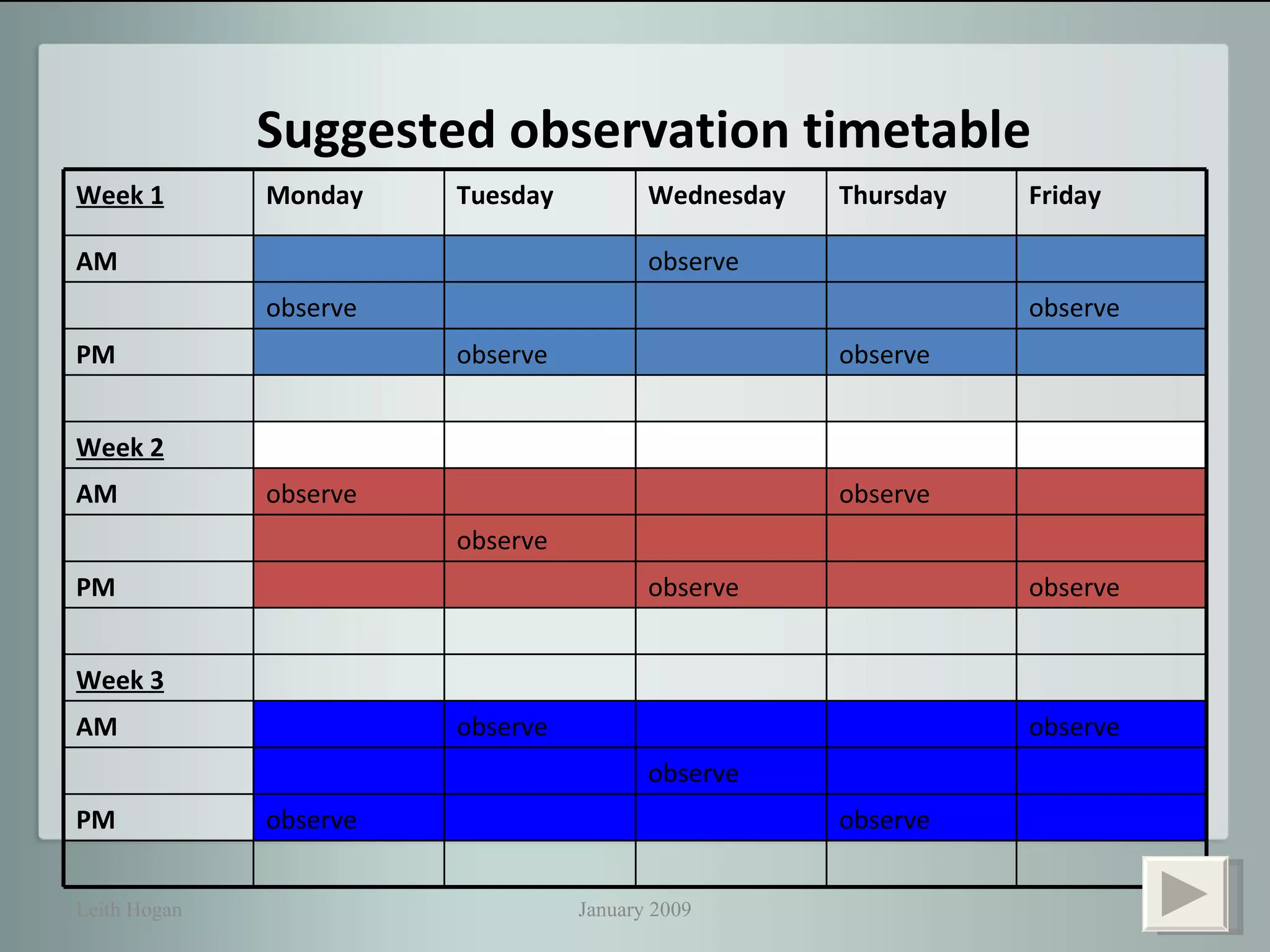
Suggested observation timetable Leith Hogan January 2009 Week 1 Monday Tuesday Wednesday Thursday Friday AM observe observe observe PM observe observe Week 2 AM observe observe observe PM observe observe Week 3 AM observe observe observe PM observe observe
Leith Hogan January 2009 Write up your Logbook/ Visual diary /  ePortfolio and submit as Assessment 1 Due on: April 14th 2009   Add diagrams, notes/ copies of teacher’s planning etc., Use the PowerPoint format provided for your logbook structure … under the headings of: Context Relationships Structure Processes Planning Curriculum Classroom Management Assessment Instructional Strategies Inclusion
Observation and Assessment framework for logbook  1. Context 2. Relationships 3. Classroom Structures 4. Classroom Processes  a. Administrative and  b. Instructional 5. Planning 6. Curriculum content 7. Classroom management 1  8. Classroom management 2 9. Assessment 10. Instructional strategies 11. Inclusion/ SAER 12. Conclusion Leith Hogan January 2009
Context This is:  the  local community’s social/ cultural practices, issues and events that may impact upon the student’s learning within the school that are different from any other community.  Leith Hogan January 2009
Observation 1: Context Take a photo of your school. Describe it. Does it have a mission, vision or goal statement about what it stands for in terms of education in this community? Describe the surrounding community. Identify any social/ cultural issues that you think might impact upon the student’s learning within the school community.  [Be aware of  your own judgments here.]  Ask the teachers/ administrative staff, support staff what they think  the local community ‘values’ in terms of education. Leith Hogan January 2009
Relationships These are:  the ways that the teacher communicates to the students that they are safe that they belong and that their voice in the classroom is valued. E.g. setting expectations and rules, building a sense of community, creating a happy classroom etc., Leith Hogan January 2009
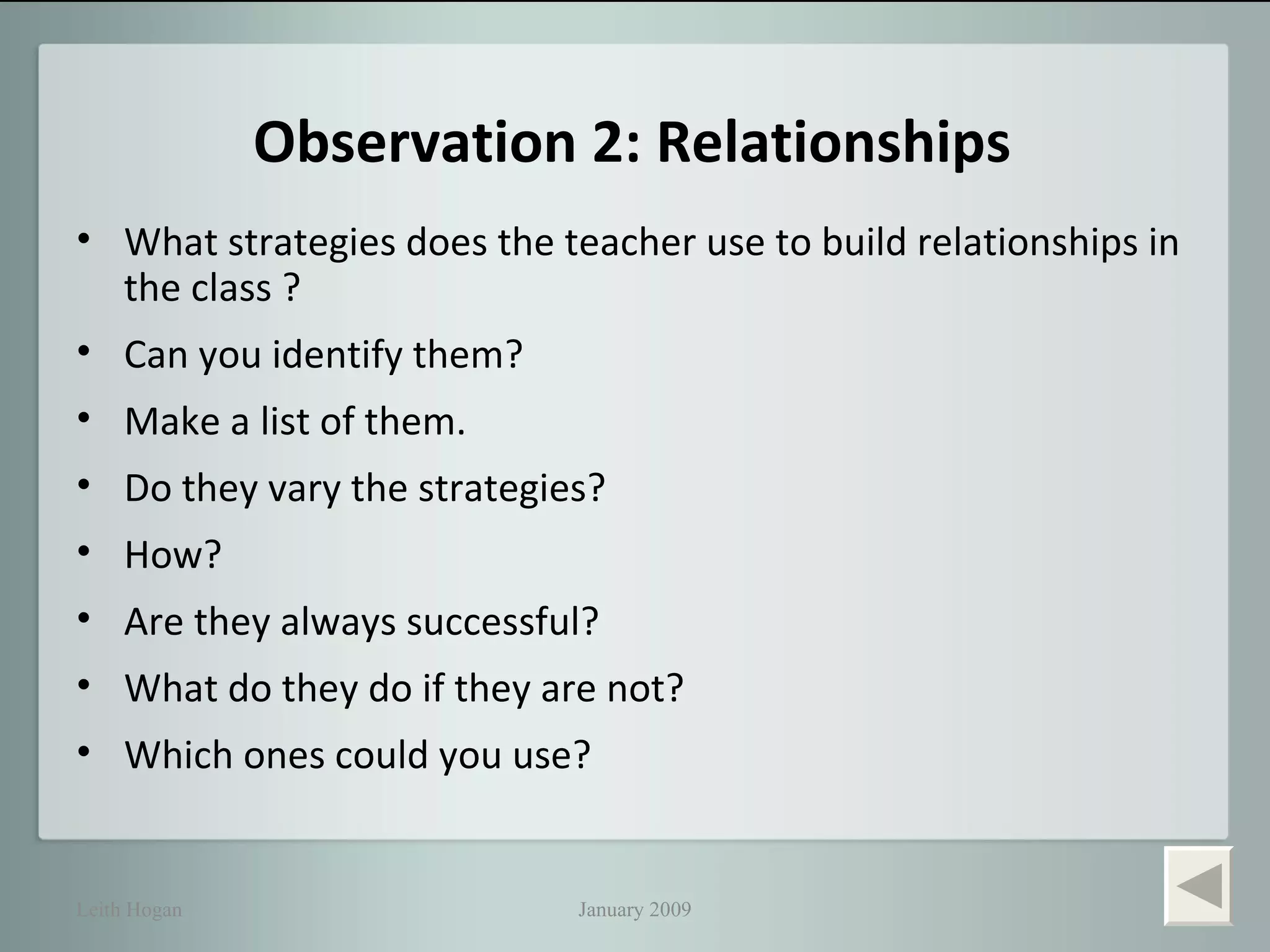
Observation 2: Relationships What strategies does the teacher use to build relationships in the class ? Can you identify them? Make a list of them. Do they vary the strategies? How?  Are they always successful? What do they do if they are not? Which ones could you use? Leith Hogan January 2009
Classroom Structures These are: The physical layout of the classroom.. What you can see feel and touch. Note where the desks, chairs, activity centres, learning centres, quiet spaces, technology, displays, storage, pens, pencils and books…etc., are placed. Leith Hogan January 2009
Take  a photo of your practicum classroom  Leith Hogan January 2009
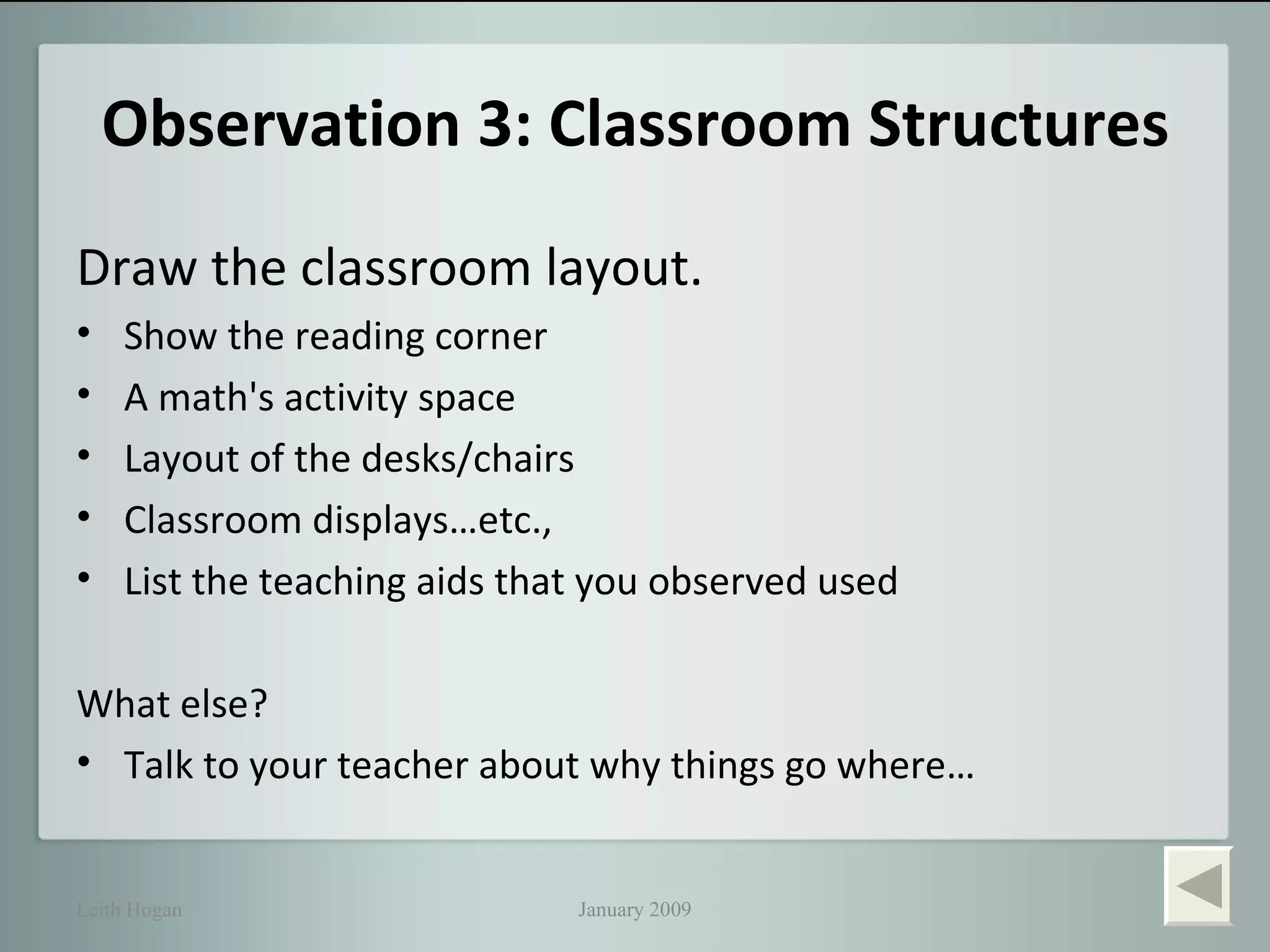
Observation 3: Classroom Structures Draw the classroom layout.  Show the reading corner A math's activity space Layout of the desks/chairs Classroom displays…etc., List the teaching aids that you observed used What else? Talk to your teacher about why things go where… Leith Hogan January 2009
Classroom Administrative Processes These are:  the organizational processes that assist the teacher to teach. For example: Marking the roll, collecting money, organizing excursions, collating data, ringing parents etc.,.. these processes keep the classroom ’humming’.  Leith Hogan January 2009
Observation 4a: Classroom Administrative Processes Make a list of all the  administrative processes that you have observed used in the classroom today.. e.g.. Marking the roll, seating plans, medical details, excursion policy, parent notes etc., Describe one  administrative  process  that you observed, in depth ... all the way through! Leith Hogan January 2009
Classroom Instructional processes/ skills These are:  the skills that the teacher employs to engage or connect their students to their learning. e.g: gaining  student attention, giving instructions, ‘wait’ time, questioning techniques, linking concepts, checking for understanding etc.  Leith Hogan January 2009
Observation 4 b:   Classroom Instructional processes/ skills Make a list of all the instructional processes or skills that the teacher has used that you have observed in the classroom today What do you think is working well in this classroom  in terms of these processes? What is not ?  What are your observations of this? Any ideas why?  Hunches? Describe one process in depth…… all the way through! Leith Hogan January 2009
Observation 5: Planning This is:  The guides that assist the teacher to think about what he/ she is going to do in the classroom to maximize student learning… Lesson plan Daily plan Weekly plan Unit/ Theme plan Leith Hogan January 2009
Lesson Plan Ask if you might see a copy of your Practicum teacher’s lesson planning book and choose a current lesson plan… identify the  specific objective …  steps in the lesson and the  assessment  of the objective. Watch the teacher run the lesson What are your observations of the lesson?  Did the children achieve the objective that the teacher aimed for? If not why not?  What is your hunch? Talk with your teacher about this. Leith Hogan January 2009
Daily Work Pad Ask if you can look at a copy of your Practicum teacher’s Daily work pad or that of other teachers in the school  and choose just one day.  When does the teacher plan to teach…………….. Math's, English, Science  etc., For how long? Are there any patterns? Can you identify the curriculum focus within each lesson? Explore these and see what you discover. Talk with your teacher about what your hunches are… Leith Hogan January 2009
Weekly Plan Ask if you might look at a copy of your Practicum teacher’s weekly plan ... When do they do their planning? Alone or with other teachers? In the weekly plan ... when does the teacher plan to teach.. Math's, English, Science ? etc., over the week…. Are there any patterns? Are  English/ Math's taught the same time every day? Is the teacher using the Syllabus/Curriculum framework to guide their planning? Explore these questions with the teacher and write what you discover. Leith Hogan January 2009
Thematic Plan Ask if you might look at a copy of your Practicum teacher’s  planning file . Do they plan using a theme? When does the teacher plan to teach Math's, English, Science etc., within the theme? Are there any patterns? How is the day divided? What is the curriculum focus within each lesson? Explore these and see what you discover. What will be the culmination of the themes? What does the teacher intend the students will gain by working through a theme? Does it work?  What do you like / dislike about a thematic approach? Leith Hogan January 2009
Curriculum This is: The information/ learning that you place before students . The content of the work that they do and things that they learn and things that they build upon. Leith Hogan January 2009
Observation 6: Curriculum What indicators can you pick up in the classroom about the curriculum? What document is the teacher using to ‘drive’ the classroom curriculum? Are there text books/ curriculum documents being referred to? Where are they kept? Observe  with just a curriculum focus and see what you learn.  What will you be looking for? How strong is the teachers connection to the curriculum?  Talk with them about this.  Leith Hogan January 2009
Classroom Management This is: The way that the teacher creates a working environment. How the teacher engages and relates to the students and manages them and also how the teacher  assists them to manage their relationships with each other. Leith Hogan January 2009
Is there a bullying policy in the school?  What is the BMIS policy for your school? Find a copy and a have look at it! Talk to the Deputy of the school and ask about the policy and how they manage the discipline within the school. Observation 7: Classroom Management Leith Hogan January 2009
Classroom Management 1: Observation 7 What’s working well in this classroom in terms of student’s behavior? What does the teacher do with their : eyes  routines Hands  collaboration Voice  competition praise rewards incentives cooperation Is the Classroom Management policy on display? Do the students know it? Does the teacher refer to it? What are the success factors/ rewards  used in this class? What is the teacher thinking about her/ his behavior management?  Ask them ! Leith Hogan January 2009
Observation 8: Classroom Management 2 Focus upon a Classroom Management issue that is problematic .  Observe for an hour or so.. observations not hunches…What’s happening? Clarify the issue. Analyze causal factors What  might make a difference do you think?  Plan a strategy to try that you might try if it was your classroom. Which theorist is giving you some new ideas…  Try your idea out in the classroom when you next take a lesson! What happened when you did this? Leith Hogan January 2009
Observation 9: Assessment This is: The judgments teachers make about student learning…formative and summative…and the way they record these judgments. Leith Hogan January 2009
Assessment What are the assessment practices that the teacher uses?  How does he/ she collect information on student performance? List the strategies that they use. Are they all working well? Do the assessments line up with the specific objectives? Is there a gap?  What does the teacher do when  they don’t get the outcome that they want from their lesson? What are the adjustments that the teacher makes when this happens? Leith Hogan January 2009
Assessment and Reporting How does the teacher make judgments on student work at the school?  How does he/she report on their work to the parents/ Principal ? Is this information reported regularly? How? Is there a school Performa for reporting?  Collect a copy of this… Is it different from class to class? Have a look at some student reports…are they giving good information to parents and students about student performance? Are there gaps? Write about this… Find out what the NAPLAN testing is and what teachers are thinking about it… Leith Hogan January 2009
Student Work What does the teacher do with completed work?  Store it? Record it? Display it?  Report on it? Put it in a scrapbook/ Portfolio? Use it to show student’s their skills? Other? Leith Hogan January 2009
Student, teacher and the work… Can you see the classroom connections? Write about this… Leith Hogan January 2009 Student Teacher Work
Teaching/ Instructional Strategies These are: Peer tutoring Direct teaching Direct instruction Individual tasks Computer assisted leaning Cooperative learning tasks etc., Leith Hogan January 2009
Observation 10: Teaching Strategies Reflect upon the ways that the student’s engaged in learning activities …list what you observed. Which learning activities kept the student’s focused the best? Which activities seemed to produce the best learning outcomes? What were the strategies that the teacher used to enhance engagement? Leith Hogan January 2009
Inclusion  This is:  What a teacher does to ensure that all children belong. e.g giving students encouragement and opportunities  to work cooperatively together so that they are all equally accountable and responsible. Leith Hogan January 2009
Observation 11: Inclusion How inclusive is this classroom? Are there students who are visually impaired, learning impaired or have a physical disability in the classroom? How many students with special needs are there in this class?  Can you identify them just by observing? What are  some adjustments that the teacher makes for these students that you observe? How do you know and how can you tell? How does the teacher use the Education Assistant to support student learning? How would you do this if it was your classroom? Leith Hogan January 2009
Intervention Plans for  Special Needs Students. What Intervention plans are in place for Special needs students in the class? Where are they kept? Does the Teacher/ Assistant refer to them?  Are they useful?  What is the format of these? Are there regular conversations with parents about the student’s progress  Leith Hogan January 2009
Observation 12: Conclusion What has been your experience in this classroom in terms of our own learning? How have the observations that you have collected and your journaling assisted you on your teaching journey? Reflective practice 325: KEY QUESTION….. Discuss the place of assessment and evaluation in the teaching and learning process within an outcomes focused environment. Leith Hogan January 2009
Assessment Rubric for Marking Logbook Leith Hogan January 2009 Introduction:  2%  Context:  2% Relationships:  3% Structures:  3% Administrative processes:  2% Instructional skills/ processes  2% Planning  3% Curriculum content  3% Classroom management 1  2% Classroom Management 2  2% Assessment  3% Instructional strategies  3% Inclusion  2% Conclusion: Summing up:  3%  Total: 35% Key question: The place of assessment and evaluation in the Teaching and learning process.  Total :15% Total mark:  / 50%

Curtin Education Assistants Conversion Course Logbook… observation framework

  • 1.
    Curtin Education Assistants Conversion Course Logbook… observation framework Reflective Practice 333 Leith Hogan Semester One 2009
  • 2.
    Overview 1. Introduction:2. Context: Slide 12 3. Relationships: Slide 14 4. Classroom Structures: Slide 16 5. Classroom Processes: Slide 19 a. Administrative: Slide 20 b. Instructional : Slide 21 6. Planning: Slide 23 7. Curriculum content: Slide 28 8. Classroom management 1: Slide 30 9. Classroom management 2: Slide 33 10. Assessment: Slide 34 11. Instructional strategies: Slide 39 12 . Inclusion/SAER: Slide 41 13. Conclusion: Slide 44 14. Marking Criteria Leith Hogan January 2009
  • 3.
    EDWA Competency Framework for Teachers Dimension 1:Facilitating student learning Dimension 2: Assessing student learning outcomes Dimension 3: Engaging in professional learning Dimension 4: Participating in Curriculum Policy and Program initiatives in an outcomes focussed environment. Dimension 5: Forming partnerships within the school community Leith Hogan January 2009
  • 4.
    Journaling Helps tocollect your thoughts Clarifies thinking and results in richer clearer thinking about your practice. Keeps track of learning Collects ideas and perspectives Involves reflections upon your own and other’s teaching and learning. Action learning cycle think/plan/ act /reflect… Leith Hogan January 2009
  • 5.
    Confidentiality andtrust! Leith Hogan January 2009
  • 6.
    Suggestions Write personallyWrite selectively Write immediately Write freely Write to take the inquiry further Leith Hogan January 2009
  • 7.
    Observing for 12- 2 hour sessions…. with a specific observation focus for each session Questions to guide the observations…. What do I want to understand more fully What information do I need? What do I need to observe? How can I get the information I need? Who can help me? Frameworks Leith Hogan January 2009
  • 8.
    Observing in aclassroom Observing the action… hunches and pure observations… the difference!!! Observing in ‘another country’ Identifying issues in the observed action Describing these issues…. without bias… this is the key! Respect AND confidentiality!!! Leith Hogan January 2009
  • 9.
    Suggested observation timetableLeith Hogan January 2009 Week 1 Monday Tuesday Wednesday Thursday Friday AM observe observe observe PM observe observe Week 2 AM observe observe observe PM observe observe Week 3 AM observe observe observe PM observe observe
  • 10.
    Leith Hogan January2009 Write up your Logbook/ Visual diary / ePortfolio and submit as Assessment 1 Due on: April 14th 2009 Add diagrams, notes/ copies of teacher’s planning etc., Use the PowerPoint format provided for your logbook structure … under the headings of: Context Relationships Structure Processes Planning Curriculum Classroom Management Assessment Instructional Strategies Inclusion
  • 11.
    Observation and Assessmentframework for logbook 1. Context 2. Relationships 3. Classroom Structures 4. Classroom Processes a. Administrative and b. Instructional 5. Planning 6. Curriculum content 7. Classroom management 1 8. Classroom management 2 9. Assessment 10. Instructional strategies 11. Inclusion/ SAER 12. Conclusion Leith Hogan January 2009
  • 12.
    Context This is: the local community’s social/ cultural practices, issues and events that may impact upon the student’s learning within the school that are different from any other community. Leith Hogan January 2009
  • 13.
    Observation 1: ContextTake a photo of your school. Describe it. Does it have a mission, vision or goal statement about what it stands for in terms of education in this community? Describe the surrounding community. Identify any social/ cultural issues that you think might impact upon the student’s learning within the school community. [Be aware of your own judgments here.] Ask the teachers/ administrative staff, support staff what they think the local community ‘values’ in terms of education. Leith Hogan January 2009
  • 14.
    Relationships These are: the ways that the teacher communicates to the students that they are safe that they belong and that their voice in the classroom is valued. E.g. setting expectations and rules, building a sense of community, creating a happy classroom etc., Leith Hogan January 2009
  • 15.
    Observation 2: RelationshipsWhat strategies does the teacher use to build relationships in the class ? Can you identify them? Make a list of them. Do they vary the strategies? How? Are they always successful? What do they do if they are not? Which ones could you use? Leith Hogan January 2009
  • 16.
    Classroom Structures Theseare: The physical layout of the classroom.. What you can see feel and touch. Note where the desks, chairs, activity centres, learning centres, quiet spaces, technology, displays, storage, pens, pencils and books…etc., are placed. Leith Hogan January 2009
  • 17.
    Take aphoto of your practicum classroom Leith Hogan January 2009
  • 18.
    Observation 3: ClassroomStructures Draw the classroom layout. Show the reading corner A math's activity space Layout of the desks/chairs Classroom displays…etc., List the teaching aids that you observed used What else? Talk to your teacher about why things go where… Leith Hogan January 2009
  • 19.
    Classroom Administrative ProcessesThese are: the organizational processes that assist the teacher to teach. For example: Marking the roll, collecting money, organizing excursions, collating data, ringing parents etc.,.. these processes keep the classroom ’humming’. Leith Hogan January 2009
  • 20.
    Observation 4a: ClassroomAdministrative Processes Make a list of all the administrative processes that you have observed used in the classroom today.. e.g.. Marking the roll, seating plans, medical details, excursion policy, parent notes etc., Describe one administrative process that you observed, in depth ... all the way through! Leith Hogan January 2009
  • 21.
    Classroom Instructional processes/skills These are: the skills that the teacher employs to engage or connect their students to their learning. e.g: gaining student attention, giving instructions, ‘wait’ time, questioning techniques, linking concepts, checking for understanding etc. Leith Hogan January 2009
  • 22.
    Observation 4 b: Classroom Instructional processes/ skills Make a list of all the instructional processes or skills that the teacher has used that you have observed in the classroom today What do you think is working well in this classroom in terms of these processes? What is not ? What are your observations of this? Any ideas why? Hunches? Describe one process in depth…… all the way through! Leith Hogan January 2009
  • 23.
    Observation 5: PlanningThis is: The guides that assist the teacher to think about what he/ she is going to do in the classroom to maximize student learning… Lesson plan Daily plan Weekly plan Unit/ Theme plan Leith Hogan January 2009
  • 24.
    Lesson Plan Askif you might see a copy of your Practicum teacher’s lesson planning book and choose a current lesson plan… identify the specific objective … steps in the lesson and the assessment of the objective. Watch the teacher run the lesson What are your observations of the lesson? Did the children achieve the objective that the teacher aimed for? If not why not? What is your hunch? Talk with your teacher about this. Leith Hogan January 2009
  • 25.
    Daily Work PadAsk if you can look at a copy of your Practicum teacher’s Daily work pad or that of other teachers in the school and choose just one day. When does the teacher plan to teach…………….. Math's, English, Science etc., For how long? Are there any patterns? Can you identify the curriculum focus within each lesson? Explore these and see what you discover. Talk with your teacher about what your hunches are… Leith Hogan January 2009
  • 26.
    Weekly Plan Askif you might look at a copy of your Practicum teacher’s weekly plan ... When do they do their planning? Alone or with other teachers? In the weekly plan ... when does the teacher plan to teach.. Math's, English, Science ? etc., over the week…. Are there any patterns? Are English/ Math's taught the same time every day? Is the teacher using the Syllabus/Curriculum framework to guide their planning? Explore these questions with the teacher and write what you discover. Leith Hogan January 2009
  • 27.
    Thematic Plan Askif you might look at a copy of your Practicum teacher’s planning file . Do they plan using a theme? When does the teacher plan to teach Math's, English, Science etc., within the theme? Are there any patterns? How is the day divided? What is the curriculum focus within each lesson? Explore these and see what you discover. What will be the culmination of the themes? What does the teacher intend the students will gain by working through a theme? Does it work? What do you like / dislike about a thematic approach? Leith Hogan January 2009
  • 28.
    Curriculum This is:The information/ learning that you place before students . The content of the work that they do and things that they learn and things that they build upon. Leith Hogan January 2009
  • 29.
    Observation 6: CurriculumWhat indicators can you pick up in the classroom about the curriculum? What document is the teacher using to ‘drive’ the classroom curriculum? Are there text books/ curriculum documents being referred to? Where are they kept? Observe with just a curriculum focus and see what you learn. What will you be looking for? How strong is the teachers connection to the curriculum? Talk with them about this. Leith Hogan January 2009
  • 30.
    Classroom Management Thisis: The way that the teacher creates a working environment. How the teacher engages and relates to the students and manages them and also how the teacher assists them to manage their relationships with each other. Leith Hogan January 2009
  • 31.
    Is there abullying policy in the school? What is the BMIS policy for your school? Find a copy and a have look at it! Talk to the Deputy of the school and ask about the policy and how they manage the discipline within the school. Observation 7: Classroom Management Leith Hogan January 2009
  • 32.
    Classroom Management 1:Observation 7 What’s working well in this classroom in terms of student’s behavior? What does the teacher do with their : eyes routines Hands collaboration Voice competition praise rewards incentives cooperation Is the Classroom Management policy on display? Do the students know it? Does the teacher refer to it? What are the success factors/ rewards used in this class? What is the teacher thinking about her/ his behavior management? Ask them ! Leith Hogan January 2009
  • 33.
    Observation 8: ClassroomManagement 2 Focus upon a Classroom Management issue that is problematic . Observe for an hour or so.. observations not hunches…What’s happening? Clarify the issue. Analyze causal factors What might make a difference do you think? Plan a strategy to try that you might try if it was your classroom. Which theorist is giving you some new ideas… Try your idea out in the classroom when you next take a lesson! What happened when you did this? Leith Hogan January 2009
  • 34.
    Observation 9: AssessmentThis is: The judgments teachers make about student learning…formative and summative…and the way they record these judgments. Leith Hogan January 2009
  • 35.
    Assessment What arethe assessment practices that the teacher uses? How does he/ she collect information on student performance? List the strategies that they use. Are they all working well? Do the assessments line up with the specific objectives? Is there a gap? What does the teacher do when they don’t get the outcome that they want from their lesson? What are the adjustments that the teacher makes when this happens? Leith Hogan January 2009
  • 36.
    Assessment and ReportingHow does the teacher make judgments on student work at the school? How does he/she report on their work to the parents/ Principal ? Is this information reported regularly? How? Is there a school Performa for reporting? Collect a copy of this… Is it different from class to class? Have a look at some student reports…are they giving good information to parents and students about student performance? Are there gaps? Write about this… Find out what the NAPLAN testing is and what teachers are thinking about it… Leith Hogan January 2009
  • 37.
    Student Work Whatdoes the teacher do with completed work? Store it? Record it? Display it? Report on it? Put it in a scrapbook/ Portfolio? Use it to show student’s their skills? Other? Leith Hogan January 2009
  • 38.
    Student, teacher andthe work… Can you see the classroom connections? Write about this… Leith Hogan January 2009 Student Teacher Work
  • 39.
    Teaching/ Instructional StrategiesThese are: Peer tutoring Direct teaching Direct instruction Individual tasks Computer assisted leaning Cooperative learning tasks etc., Leith Hogan January 2009
  • 40.
    Observation 10: TeachingStrategies Reflect upon the ways that the student’s engaged in learning activities …list what you observed. Which learning activities kept the student’s focused the best? Which activities seemed to produce the best learning outcomes? What were the strategies that the teacher used to enhance engagement? Leith Hogan January 2009
  • 41.
    Inclusion Thisis: What a teacher does to ensure that all children belong. e.g giving students encouragement and opportunities to work cooperatively together so that they are all equally accountable and responsible. Leith Hogan January 2009
  • 42.
    Observation 11: InclusionHow inclusive is this classroom? Are there students who are visually impaired, learning impaired or have a physical disability in the classroom? How many students with special needs are there in this class? Can you identify them just by observing? What are some adjustments that the teacher makes for these students that you observe? How do you know and how can you tell? How does the teacher use the Education Assistant to support student learning? How would you do this if it was your classroom? Leith Hogan January 2009
  • 43.
    Intervention Plans for Special Needs Students. What Intervention plans are in place for Special needs students in the class? Where are they kept? Does the Teacher/ Assistant refer to them? Are they useful? What is the format of these? Are there regular conversations with parents about the student’s progress Leith Hogan January 2009
  • 44.
    Observation 12: ConclusionWhat has been your experience in this classroom in terms of our own learning? How have the observations that you have collected and your journaling assisted you on your teaching journey? Reflective practice 325: KEY QUESTION….. Discuss the place of assessment and evaluation in the teaching and learning process within an outcomes focused environment. Leith Hogan January 2009
  • 45.
    Assessment Rubric forMarking Logbook Leith Hogan January 2009 Introduction: 2% Context: 2% Relationships: 3% Structures: 3% Administrative processes: 2% Instructional skills/ processes 2% Planning 3% Curriculum content 3% Classroom management 1 2% Classroom Management 2 2% Assessment 3% Instructional strategies 3% Inclusion 2% Conclusion: Summing up: 3% Total: 35% Key question: The place of assessment and evaluation in the Teaching and learning process. Total :15% Total mark: / 50%

Editor's Notes

  • #2 12 Half days observations….. 12 observations collected in Notebook / journal /log book scrapbook…. 3 week practicum: 2 days observation per week. 3 days practice. Submitted as Assessment 2 Reflective practice 333 Total mark 30% [Observations 20% Key question 10%]