The Re-design of
the Provincial
Instructor Diploma
(PID) Program
NCSPOD 2010
Karen Belfer
PIDP Background
 Provincially renown
 Started in 1978- hasn’t changed
 For new instructors
 Provides the basic tools to be successful in the classroom
 Participant’s feedback is very positive
 Provincially funded until 2002- became cost recovery in
2005
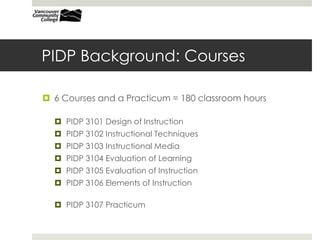
PIDP Background: Courses
 6 Courses and a Practicum = 180 classroom hours
 PIDP 3101 Design of Instruction
 PIDP 3102 Instructional Techniques
 PIDP 3103 Instructional Media
 PIDP 3104 Evaluation of Learning
 PIDP 3105 Evaluation of Instruction
 PIDP 3106 Elements of Instruction
 PIDP 3107 Practicum
Background on PIDP Faculty
 Average number of years teaching in the PIDP: 15
 Masters in Education
 Great “teachers”
 They teach others curriculum development
Background for the Re-Design
 Program Review Feb – June 2008
 Recommendations:
 Outcomes-based curriculum
 Update course content
 Look at different modes of delivery
 Challenge
 30 great years of experience- success ~ Change *
Change Management Background
 D Dunphy, D Stace - Human Relations, 1993
 What to consider in Change Management
 Scale/Context of Change (implementers-receivers)
 Type of Leadership
Scale/Context Background
 Implementer
 Achieve the desired
educational outcomes
as soon as possible
 Eliminate any adverse
impact to our students
 Receiver
 Impact
 What does this mean to
me?
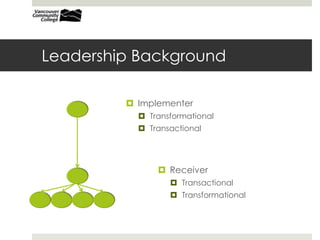
Leadership Background
 Approaches to promoting change in organizations
 Transformational
 Transactional
 They are distinguished by the ways in which leaders
motivate group members to engage in the change
process.
Leadership Background
 Transformational Leadership
 Try to meet individual needs and develop group members to
their fullest potential.
 They motivate members to exceed performance
expectations by increasing their awareness of the
importance and value of specified and idealized outcomes
 Focusing their attention on the greater good (Northouse,
2007).
 Empathic and collaborative and promote individual
development to enhance performance and organizational
growth.
 Changes the organizational culture” (Bass, 1985).
Leadership Background
 Transactional Leadership
 Focus primarily on the needs of the organization -
production and efficiency.
 They motivate group members with the promise of rewards
in exchange for performance.
 Responds to immediate goals, and its success hinges on a
leader’s capacity to reinforce desired behaviours.
 Works within the organizational culture as it exists
Leadership Background
 Leadership Dimensions
 Transformational leadership responds to the uncertainty and
complexity of our times
 Focus on traits – more than behaviours
 Not enough written about the roles of the group members
Leadership Background
 Implementer
 Transformational
 Transactional
 Receiver
 Transactional
 Transformational
Process
 Steps:
 Visioning - Dec 08
 Mapping Exercise – Feb 09
Visioning - Dec 08
 Purpose: Create inspiration and excitement around
future opportunities
 Trends shaping adult education today
 How is adult education and training changing in the 21st
century?
 What does a PIDP program look like that provides
students with the tools to be innovators?
 What are the future opportunities for the PIDP program?
 Invited key members of the community that the program
faculty know and admire
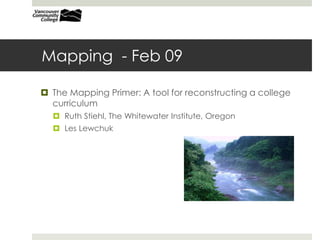
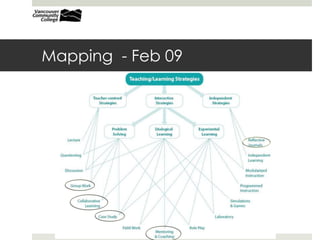
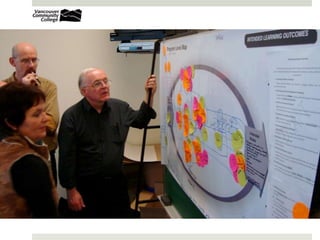
Mapping - Feb 09
 The Mapping Primer: A tool for reconstructing a college
curriculum
 Ruth Stiehl, The Whitewater Institute, Oregon
 Les Lewchuk
Mapping - Feb 09
 Why use Mapping Primer
 College based
 River metaphor
 Visual design
 Philosophy: curriculum development as a conversation not
a set of tools
 Book includes communication starters – activities to
accomplish the task.
 Methodology has been successfully used in the college and
at SAIT
 Access to a couple of facilitators from Compass Learning
Mapping - Feb 09
 Process
 Who - Voices
 Employers
 Advisory groups
 Business and community leaders
 Students
 Faculty
 How
 Participation
 Conversation
 Negotiation
 Reflection
Mapping - Feb 09
 Program Learning Outcomes
Program learning outcomes are not objectives or goals to be put in new
wrappers. Outcome statements describe what students should be able to do
“outside” the classroom –not “inside” it.
Ruth Stiehl
 Activity
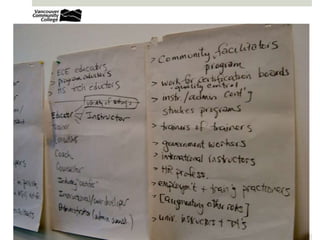
 Roles students will take in society?
 What will they be able to do in these roles as a result of
participating in this program?
 Brainstorm
 Cluster answers
 Name clusters
 Write outcomes- action, context, scope, complexity.
Mapping - Feb 09
Mapping - Feb 09
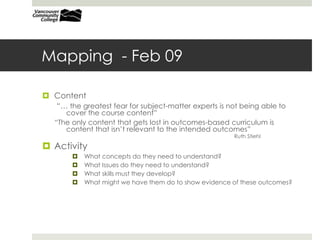
 Content
“… the greatest fear for subject-matter experts is not being able to
cover the course content”
“The only content that gets lost in outcomes-based curriculum is
content that isn’t relevant to the intended outcomes”
Ruth Stiehl
 Activity
 What concepts do they need to understand?
 What Issues do they need to understand?
 What skills must they develop?
 What might we have them do to show evidence of these outcomes?
What Happened after Feb 09
 Faculty lead
 Continue to work on the Program
 No training in this methodology
 Confident (curriculum development experience and subject
matter expertise).
 Individual development/peer review (collaborative)
 Slow….
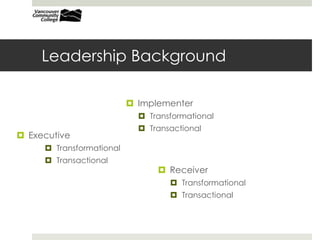
Leadership Background
 Implementer
 Transformational
 Transactional
 Receiver
 Transformational
 Transactional
 Executive
 Transformational
 Transactional
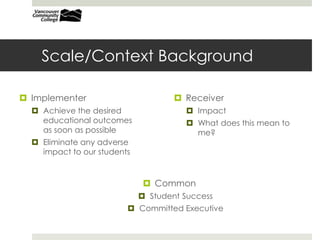
Scale/Context Background
 Implementer
 Achieve the desired
educational outcomes
as soon as possible
 Eliminate any adverse
impact to our students
 Receiver
 Impact
 What does this mean to
me?
 Common
 Student Success
 Committed Executive
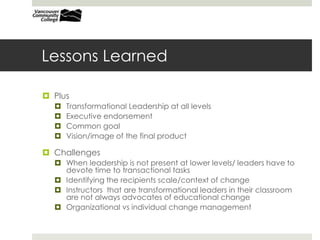
Lessons Learned
 Plus
 Transformational Leadership at all levels
 Executive endorsement
 Common goal
 Vision/image of the final product
 Challenges
 When leadership is not present at lower levels/ leaders have to
devote time to transactional tasks
 Identifying the recipients scale/context of change
 Instructors that are transformational leaders in their classroom
are not always advocates of educational change
 Organizational vs individual change management
In Oct 2010
 We have moved forward…..
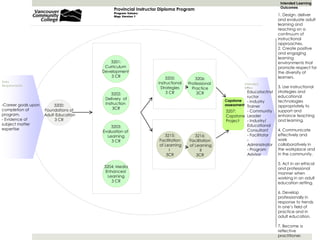
Provincial Instructor Diploma Program
Program Values:
Map: Version 1
Entry
Requirements
Intended
Roles
Intended Learning
Outcomes
1. Design, deliver
and evaluate adult
learning and
teaching on a
continuum of
instructional
approaches.
2. Create positive
and engaging
learning
environments that
promote respect for
the diversity of
learners.
3. Use instructional
strategies and
educational
technologies
appropriately to
support and
enhance teaching
and learning.
4. Communicate
effectively and
work
collaboratively in
the workplace and
in the community.
5. Act in an ethical
and professional
manner when
working in an adult
education setting.
6. Develop
professionally in
response to trends
in one’s field of
practice and in
adult education.
7. Become a
reflective
practitioner.
-
Educator/Inst
ructor
- Industry
Trainer
- Community
Leader
- Industry/
Educational
Consultant
- Facilitator
-
Administrator
- Program
Advisor
-Career goals upon
completion of
program.
- Evidence of
subject matter
expertise
3200:
Foundations of
Adult Education
3 CR
3207:
Capstone
Project
Capstone
assessment
3202:
Delivery of
Instruction
3CR
3204: Media
Enhanced
Learning
3 CR
3201:
Curriculum
Development
3 CR
3203:
Evaluation of
Learning
3 CR
3205:
instructional
Strategies
3 CR
3206:
Professional
Practice
3CR
3215:
Facilitation
of Learning
I
3CR
3216:
Facilitation
of Learning
II
3CR

Re-Design for the PID Program

  • 1.
    The Re-design of theProvincial Instructor Diploma (PID) Program NCSPOD 2010 Karen Belfer
  • 2.
    PIDP Background  Provinciallyrenown  Started in 1978- hasn’t changed  For new instructors  Provides the basic tools to be successful in the classroom  Participant’s feedback is very positive  Provincially funded until 2002- became cost recovery in 2005
  • 3.
    PIDP Background: Courses 6 Courses and a Practicum = 180 classroom hours  PIDP 3101 Design of Instruction  PIDP 3102 Instructional Techniques  PIDP 3103 Instructional Media  PIDP 3104 Evaluation of Learning  PIDP 3105 Evaluation of Instruction  PIDP 3106 Elements of Instruction  PIDP 3107 Practicum
  • 4.
    Background on PIDPFaculty  Average number of years teaching in the PIDP: 15  Masters in Education  Great “teachers”  They teach others curriculum development
  • 5.
    Background for theRe-Design  Program Review Feb – June 2008  Recommendations:  Outcomes-based curriculum  Update course content  Look at different modes of delivery  Challenge  30 great years of experience- success ~ Change *
  • 6.
    Change Management Background D Dunphy, D Stace - Human Relations, 1993  What to consider in Change Management  Scale/Context of Change (implementers-receivers)  Type of Leadership
  • 7.
    Scale/Context Background  Implementer Achieve the desired educational outcomes as soon as possible  Eliminate any adverse impact to our students  Receiver  Impact  What does this mean to me?
  • 8.
    Leadership Background  Approachesto promoting change in organizations  Transformational  Transactional  They are distinguished by the ways in which leaders motivate group members to engage in the change process.
  • 9.
    Leadership Background  TransformationalLeadership  Try to meet individual needs and develop group members to their fullest potential.  They motivate members to exceed performance expectations by increasing their awareness of the importance and value of specified and idealized outcomes  Focusing their attention on the greater good (Northouse, 2007).  Empathic and collaborative and promote individual development to enhance performance and organizational growth.  Changes the organizational culture” (Bass, 1985).
  • 10.
    Leadership Background  TransactionalLeadership  Focus primarily on the needs of the organization - production and efficiency.  They motivate group members with the promise of rewards in exchange for performance.  Responds to immediate goals, and its success hinges on a leader’s capacity to reinforce desired behaviours.  Works within the organizational culture as it exists
  • 11.
    Leadership Background  LeadershipDimensions  Transformational leadership responds to the uncertainty and complexity of our times  Focus on traits – more than behaviours  Not enough written about the roles of the group members
  • 12.
    Leadership Background  Implementer Transformational  Transactional  Receiver  Transactional  Transformational
  • 13.
    Process  Steps:  Visioning- Dec 08  Mapping Exercise – Feb 09
  • 14.
    Visioning - Dec08  Purpose: Create inspiration and excitement around future opportunities  Trends shaping adult education today  How is adult education and training changing in the 21st century?  What does a PIDP program look like that provides students with the tools to be innovators?  What are the future opportunities for the PIDP program?  Invited key members of the community that the program faculty know and admire
  • 15.
    Mapping - Feb09  The Mapping Primer: A tool for reconstructing a college curriculum  Ruth Stiehl, The Whitewater Institute, Oregon  Les Lewchuk
  • 16.
    Mapping - Feb09  Why use Mapping Primer  College based  River metaphor  Visual design  Philosophy: curriculum development as a conversation not a set of tools  Book includes communication starters – activities to accomplish the task.  Methodology has been successfully used in the college and at SAIT  Access to a couple of facilitators from Compass Learning
  • 17.
    Mapping - Feb09  Process  Who - Voices  Employers  Advisory groups  Business and community leaders  Students  Faculty  How  Participation  Conversation  Negotiation  Reflection
  • 18.
    Mapping - Feb09  Program Learning Outcomes Program learning outcomes are not objectives or goals to be put in new wrappers. Outcome statements describe what students should be able to do “outside” the classroom –not “inside” it. Ruth Stiehl  Activity  Roles students will take in society?  What will they be able to do in these roles as a result of participating in this program?  Brainstorm  Cluster answers  Name clusters  Write outcomes- action, context, scope, complexity.
  • 20.
  • 22.
    Mapping - Feb09  Content “… the greatest fear for subject-matter experts is not being able to cover the course content” “The only content that gets lost in outcomes-based curriculum is content that isn’t relevant to the intended outcomes” Ruth Stiehl  Activity  What concepts do they need to understand?  What Issues do they need to understand?  What skills must they develop?  What might we have them do to show evidence of these outcomes?
  • 23.
    What Happened afterFeb 09  Faculty lead  Continue to work on the Program  No training in this methodology  Confident (curriculum development experience and subject matter expertise).  Individual development/peer review (collaborative)  Slow….
  • 24.
    Leadership Background  Implementer Transformational  Transactional  Receiver  Transformational  Transactional  Executive  Transformational  Transactional
  • 25.
    Scale/Context Background  Implementer Achieve the desired educational outcomes as soon as possible  Eliminate any adverse impact to our students  Receiver  Impact  What does this mean to me?  Common  Student Success  Committed Executive
  • 26.
    Lessons Learned  Plus Transformational Leadership at all levels  Executive endorsement  Common goal  Vision/image of the final product  Challenges  When leadership is not present at lower levels/ leaders have to devote time to transactional tasks  Identifying the recipients scale/context of change  Instructors that are transformational leaders in their classroom are not always advocates of educational change  Organizational vs individual change management
  • 27.
    In Oct 2010 We have moved forward…..
  • 28.
    Provincial Instructor DiplomaProgram Program Values: Map: Version 1 Entry Requirements Intended Roles Intended Learning Outcomes 1. Design, deliver and evaluate adult learning and teaching on a continuum of instructional approaches. 2. Create positive and engaging learning environments that promote respect for the diversity of learners. 3. Use instructional strategies and educational technologies appropriately to support and enhance teaching and learning. 4. Communicate effectively and work collaboratively in the workplace and in the community. 5. Act in an ethical and professional manner when working in an adult education setting. 6. Develop professionally in response to trends in one’s field of practice and in adult education. 7. Become a reflective practitioner. - Educator/Inst ructor - Industry Trainer - Community Leader - Industry/ Educational Consultant - Facilitator - Administrator - Program Advisor -Career goals upon completion of program. - Evidence of subject matter expertise 3200: Foundations of Adult Education 3 CR 3207: Capstone Project Capstone assessment 3202: Delivery of Instruction 3CR 3204: Media Enhanced Learning 3 CR 3201: Curriculum Development 3 CR 3203: Evaluation of Learning 3 CR 3205: instructional Strategies 3 CR 3206: Professional Practice 3CR 3215: Facilitation of Learning I 3CR 3216: Facilitation of Learning II 3CR

Editor's Notes

  • #2 The Provincial Instructor Diploma (PID) program has a long history. It has been the main program for training college instructors within the province of British Columbia for 35 years (including the initial years, when it was offered through UBC). For the first time in 25 years since it has been offered by VCC, the programs is going through a major re-design. In this presentation the Department Head and the Dean of the area will talk about the lessons learned about in transformative and transactional leadership during the change.
  • #14 With out course, can’t create a new business model
  • #19 Most curriculum efforts over the past 50 years gave been deeply rooted in behaviorist psychology, Sputnk 1957 given money to Benjamin Bloom to develop the Taxonomy of Educational objectives. This influence still remains in educational systems and the way we design instruction. There is some value on taxonomy, hierarchy within the domains of learning. Reminds us that knowledge (lowest level) has little to do with construction of meaning and understanding).
  • #24 Context/leadership
  • #27 Acknowledge Susie Findlay essay- Transformational & Transactional Leadership