Large and Small
Volume Parenteral
By Gajanan Sormare
Contents-
• INTRODUCTION
• CLASSIFICATION OF
PARENTERALS
• LARGE VOLUME PARENTERALS
• SMALL VOLUME PARENTERALS
• PREPARATION OF PARENTERALS
• FORMULATION
CONSIDERATION
INTRODUCTION
• Parenteral means para enteron, beside the gut
or beside the intestine
• A Parenteral dosage form can be defined as a
sterile drug product, which is presented in the
form of solution, suspension, emulsion, or
reconstituted lyophilized powder, suitable for
administration by injection into the body.
• Parenteral dosage forms differ from all other
drug dosage forms, because they are injected
directly into body tissue through the primary
protective systems of the human body, the skin,
and mucous membranes.
Ideal characteristics of
parenterals
• Sterile
• Free from visible particulate
matter
• Isotonic
• Chemically and physically stable
• Free from pyrogen
• Compatible
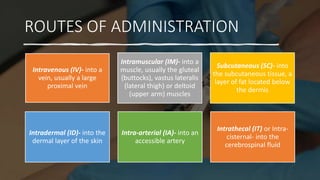
ROUTES OF ADMINISTRATION
Intravenous (IV)- into a
vein, usually a large
proximal vein
Intramuscular (IM)- into a
muscle, usually the gluteal
(buttocks), vastus lateralis
(lateral thigh) or deltoid
(upper arm) muscles
Subcutaneous (SC)- into
the subcutaneous tissue, a
layer of fat located below
the dermis
Intradermal (ID)- into the
dermal layer of the skin
Intra-arterial (IA)- into an
accessible artery
Intrathecal (IT) or Intra-
cisternal- into the
cerebrospinal fluid
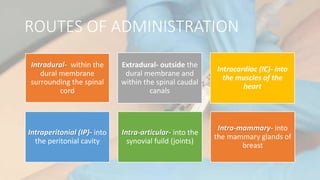
ROUTES OF ADMINISTRATION
Intradural- within the
dural membrane
surrounding the spinal
cord
Extradural- outside the
dural membrane and
within the spinal caudal
canals
Intracardiac (IC)- into
the muscles of the
heart
Intraperitonial (IP)- into
the peritonial cavity
Intra-articular- into the
synovial fuild (joints)
Intra-mammary- into
the mammary glands of
breast
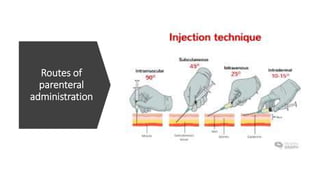
Routes of
parenteral
administration
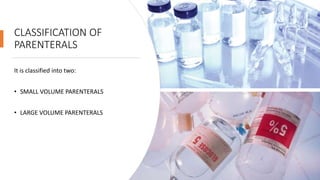
CLASSIFICATION OF
PARENTERALS
It is classified into two:
• SMALL VOLUME PARENTERALS
• LARGE VOLUME PARENTERALS
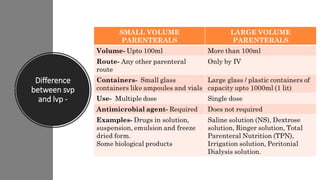
Difference
between svp
and lvp -
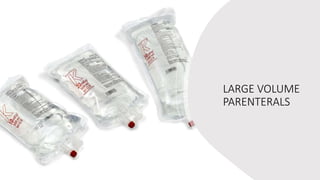
LARGE VOLUME
PARENTERALS
LARGE VOLUME PARENTERALS
• A single-dose injection that is intended for intravenous use.
• Packaged in glass bottles or in large volume flexible containers.
• May contain greater than 100 ml to greater than 1 or 2 L
• Sterile
• Pyrogen-Free
• Essentially free of particulate matter
• No anti-microbial agents
• Isotonicity
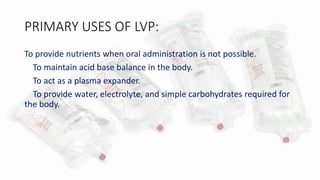
PRIMARY USES OF LVP:
To provide nutrients when oral administration is not possible.
To maintain acid base balance in the body.
To act as a plasma expander.
To provide water, electrolyte, and simple carbohydrates required for
the body.
SMALL VOLUME PARENTERALS
• Injected by a syringe.
• Less than 100 ml.
• Most routes are used.
• Could be made hypertonic.
• Could be pyrogenic.
•
PRIMARY USES OF SVP
• Therapeutic injections
• Ophthalmic products
• Diagnostic agents
• Allergenic extracts
FORMULATION OF PARENTERALS
ACTIVE DRUG:
A thorough evaluation of properties of the active drug or
drugs is essential in developing a stable and safe parenteral dosage
form.
VEHICLE:
Aqueous vehicle
Non aqueous vehicle
PRESERVATIVES:
Required to prevent microorganism growth.
Eg: Phenyl mercuric nitrate , thiomersal – 0.01%
Benzethonium chloride, benzalkonium chloride – 0.5%
Phenol, cresol – 0.5%
BUFFERS:
Add to maintain pH.
Results in stability.
Eg: citrate buffer, acetate buffer, phosphate buffer.
ANTIOXIDANTS:
Protects from oxidation.
Eg: Ascorbic acid (0.02 – 0.1%)
Tocopherols (0.05 – 0.75%)
TONICITY AGENTS:
Reduce the pain at the injection site.
Added at the last stage of production.
Eg: Nacl, Kcl, Dextrose, Mannitol.
SURFACTANTS:
Used sometimes to enhance the solubility.
Eg: sorbitan monooleate, polyoxy ethylene sorbitan
monooleate.
CHELATING AGENTS:
Used to bind in non- ionisable form, trace amount of heavy
metals.
Eg: Trisodium or calcium disodium salt of EDTA.
INERT GASES:
Used to displace oxygen from a solution and reduce
possibility of oxidation.
Eg: Nitrogen ( gentamycin sulfate injection)
Carbon dioxide (sodium bicarbonate injection)
Large and Small Volume Parenteral.pptx

Large and Small Volume Parenteral.pptx

  • 1.
    Large and Small VolumeParenteral By Gajanan Sormare
  • 2.
    Contents- • INTRODUCTION • CLASSIFICATIONOF PARENTERALS • LARGE VOLUME PARENTERALS • SMALL VOLUME PARENTERALS • PREPARATION OF PARENTERALS • FORMULATION CONSIDERATION
  • 3.
    INTRODUCTION • Parenteral meanspara enteron, beside the gut or beside the intestine • A Parenteral dosage form can be defined as a sterile drug product, which is presented in the form of solution, suspension, emulsion, or reconstituted lyophilized powder, suitable for administration by injection into the body. • Parenteral dosage forms differ from all other drug dosage forms, because they are injected directly into body tissue through the primary protective systems of the human body, the skin, and mucous membranes.
  • 4.
    Ideal characteristics of parenterals •Sterile • Free from visible particulate matter • Isotonic • Chemically and physically stable • Free from pyrogen • Compatible
  • 6.
    ROUTES OF ADMINISTRATION Intravenous(IV)- into a vein, usually a large proximal vein Intramuscular (IM)- into a muscle, usually the gluteal (buttocks), vastus lateralis (lateral thigh) or deltoid (upper arm) muscles Subcutaneous (SC)- into the subcutaneous tissue, a layer of fat located below the dermis Intradermal (ID)- into the dermal layer of the skin Intra-arterial (IA)- into an accessible artery Intrathecal (IT) or Intra- cisternal- into the cerebrospinal fluid
  • 7.
    ROUTES OF ADMINISTRATION Intradural-within the dural membrane surrounding the spinal cord Extradural- outside the dural membrane and within the spinal caudal canals Intracardiac (IC)- into the muscles of the heart Intraperitonial (IP)- into the peritonial cavity Intra-articular- into the synovial fuild (joints) Intra-mammary- into the mammary glands of breast
  • 8.
  • 9.
    CLASSIFICATION OF PARENTERALS It isclassified into two: • SMALL VOLUME PARENTERALS • LARGE VOLUME PARENTERALS
  • 10.
  • 11.
  • 12.
    LARGE VOLUME PARENTERALS •A single-dose injection that is intended for intravenous use. • Packaged in glass bottles or in large volume flexible containers. • May contain greater than 100 ml to greater than 1 or 2 L • Sterile • Pyrogen-Free • Essentially free of particulate matter • No anti-microbial agents • Isotonicity
  • 13.
    PRIMARY USES OFLVP: To provide nutrients when oral administration is not possible. To maintain acid base balance in the body. To act as a plasma expander. To provide water, electrolyte, and simple carbohydrates required for the body.
  • 14.
  • 15.
    SMALL VOLUME PARENTERALS •Injected by a syringe. • Less than 100 ml. • Most routes are used. • Could be made hypertonic. • Could be pyrogenic. •
  • 16.
    PRIMARY USES OFSVP • Therapeutic injections • Ophthalmic products • Diagnostic agents • Allergenic extracts
  • 17.
  • 18.
  • 19.
    ACTIVE DRUG: A thoroughevaluation of properties of the active drug or drugs is essential in developing a stable and safe parenteral dosage form. VEHICLE: Aqueous vehicle Non aqueous vehicle
  • 20.
    PRESERVATIVES: Required to preventmicroorganism growth. Eg: Phenyl mercuric nitrate , thiomersal – 0.01% Benzethonium chloride, benzalkonium chloride – 0.5% Phenol, cresol – 0.5% BUFFERS: Add to maintain pH. Results in stability. Eg: citrate buffer, acetate buffer, phosphate buffer.
  • 21.
    ANTIOXIDANTS: Protects from oxidation. Eg:Ascorbic acid (0.02 – 0.1%) Tocopherols (0.05 – 0.75%) TONICITY AGENTS: Reduce the pain at the injection site. Added at the last stage of production. Eg: Nacl, Kcl, Dextrose, Mannitol. SURFACTANTS: Used sometimes to enhance the solubility. Eg: sorbitan monooleate, polyoxy ethylene sorbitan monooleate.
  • 22.
    CHELATING AGENTS: Used tobind in non- ionisable form, trace amount of heavy metals. Eg: Trisodium or calcium disodium salt of EDTA. INERT GASES: Used to displace oxygen from a solution and reduce possibility of oxidation. Eg: Nitrogen ( gentamycin sulfate injection) Carbon dioxide (sodium bicarbonate injection)