REFLECTION & REFRACTION
OF EM WAVE
• Presented by-
• ACHUYT BHARALEE
• Roll No- PHP22108
• Dept of Physics
• Tezpur University
Boundary Conditions:
𝐸𝑎𝑏𝑜𝑣𝑒
⊥
− 𝐸𝑏𝑒𝑙𝑜𝑤
⊥
=
𝜎
𝜖𝜊
2. Normal component of electric field at boundary is discontinuous.
∴ 𝐸1
∥
=𝐸2
∥
1. Parallel components of electric field is continuous over the surface boundary.
𝐵1 = 𝐵2
4. Normal component of magnetic field is continuous over the boundary.
𝐵𝑡1 − 𝐵𝑡2 = 𝜇0𝐾
3. Tangential component of magnetic field is discontinuous over the boundary.
Reflection & Refraction of EM Wave at Dielectric Interference:
An EM wave incident at interference of two media at arbitrary angle.
Some part will get reflected & another get transmitted.
The plane of incidence is ⊥ to the two media interface.
We calculated the problem in two parts-
I. Normal to plane of incidence.
II. Parallel to plane of incidence.
Resultant of this two can lead us to any type of incident wave where incident electric
and magnetic field make arbitrary angle to plane of incidence.
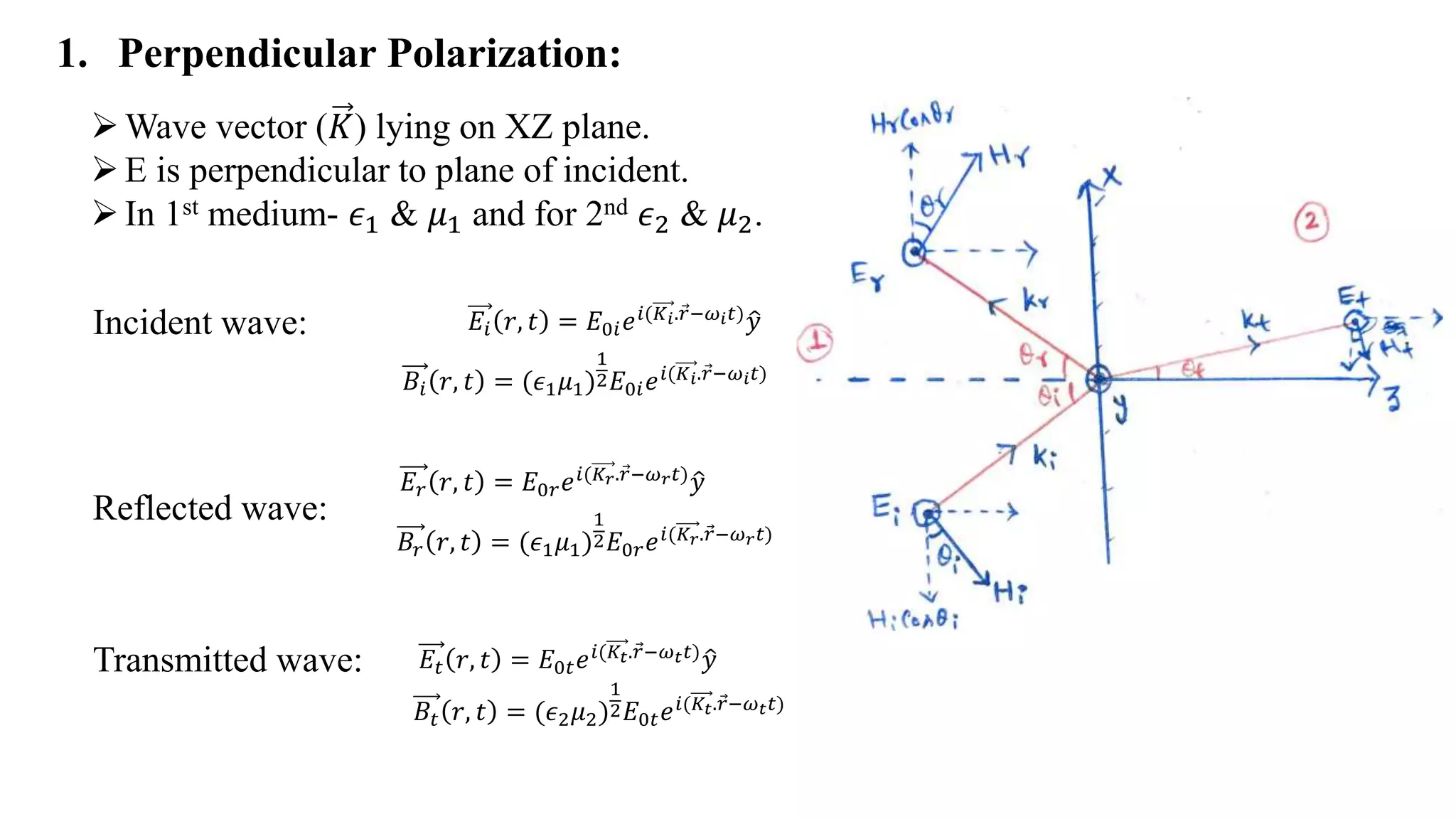
1. Perpendicular Polarization:
Wave vector (𝐾) lying on XZ plane.
E is perpendicular to plane of incident.
In 1st medium- 𝜖1 & 𝜇1 and for 2nd 𝜖2 & 𝜇2.
Incident wave:
Reflected wave:
Transmitted wave:
𝐸𝑖 𝑟, 𝑡 = 𝐸0𝑖𝑒𝑖(𝐾𝑖.𝑟−𝜔𝑖𝑡)
𝑦
𝐵𝑖 𝑟, 𝑡 = (𝜖1𝜇1)
1
2𝐸0𝑖𝑒𝑖(𝐾𝑖.𝑟−𝜔𝑖𝑡)
𝐸𝑟 𝑟, 𝑡 = 𝐸0𝑟𝑒𝑖(𝐾𝑟.𝑟−𝜔𝑟𝑡)𝑦
𝐵𝑟 𝑟, 𝑡 = (𝜖1𝜇1)
1
2𝐸0𝑟𝑒𝑖(𝐾𝑟.𝑟−𝜔𝑟𝑡)
𝐸𝑡 𝑟, 𝑡 = 𝐸0𝑡𝑒𝑖(𝐾𝑡.𝑟−𝜔𝑡𝑡)𝑦
𝐵𝑡 𝑟, 𝑡 = (𝜖2𝜇2)
1
2𝐸0𝑡𝑒𝑖(𝐾𝑡.𝑟−𝜔𝑡𝑡)
From boundary conditions:
I. Tangential electric component is continuous across boundary.
II. Tangential magnetic component is also continuous across the
boundary since there is no surface current.
At Z=0, 𝐸𝑖 𝑟, 𝑡 + 𝐸𝑟 𝑟, 𝑡 = 𝐸𝑡 𝑟, 𝑡
𝐸0𝑖𝑒𝑖(𝐾𝑖.𝑟−𝜔𝑖𝑡)
+ 𝐸0𝑟𝑒𝑖(𝐾𝑟.𝑟−𝜔𝑟𝑡)
= 𝐸0𝑡𝑒𝑖(𝐾𝑡.𝑟−𝜔𝑡𝑡)
𝐵𝑖 𝑟, 𝑡 cos 𝜃𝑖 − 𝐵𝑟 𝑟, 𝑡 cos 𝜃𝑟 = 𝐵𝑡 𝑟, 𝑡 cos 𝜃𝑡
 Since, the boundary conditions must hold at all points on the interface and for all
times, the exponential functions must be equal. This is called as Phase matching.
So, 𝝎𝒊 = 𝝎𝒓 = 𝝎𝒕 = 𝝎
Frequency of wave does not change under reflection and refraction.
Also, 𝐾𝑖. 𝑟 = 𝐾𝑟. 𝑟 = 𝐾𝑡. 𝑟
𝐾𝑖 sin 𝜃𝑖 = 𝐾𝑟 sin 𝜃𝑟 = 𝐾𝑡 sin 𝜃𝑡
𝐾𝑖 =
𝜔
𝑣𝑖
, 𝐾𝑟 =
𝜔
𝑣𝑟
, 𝐾𝑡 =
𝜔
𝑣𝑡
Since in the same medium 𝑣𝑖 = 𝑣𝑟
Hence, 𝐾𝑖= 𝐾𝑟
Therefore, 𝜃𝑖 = 𝜃𝑟; i. e, 𝐀𝐧𝐠𝐥𝐞 𝐨𝐟 𝐢𝐧𝐜𝐢𝐝𝐞𝐧𝐜𝐞 = 𝐀𝐧𝐠𝐥𝐞 𝐨𝐟 𝐑𝐞𝐟𝐥𝐞𝐜𝐢𝐨𝐧
Also, the Snell’s law 𝒔𝒊𝒏 𝜽𝒊
𝒔𝒊𝒏 𝜽𝒕
=
𝒏𝟐
𝒏𝟏
Now, Electric & Magnetic field equations for ⊥ polarisation can be write as
𝐸0𝑖 + 𝐸0𝑟 = 𝐸0𝑡
𝐸0𝑖
𝑛1
cos 𝜃𝑖 −
𝐸0𝑟
𝑛1
cos 𝜃𝑟 =
𝐸0𝑡
𝑛2
cos 𝜃𝑡
𝐸0𝑖
𝐻𝑜𝑖
= 𝑛1
𝐸0𝑡
𝐻𝑜𝑡
= 𝑛2
∵
Reflection Coefficient (Γ⊥)
𝜞⊥ =
𝑹𝒆𝒇𝒍𝒆𝒄𝒕𝒆𝒅 𝑬𝒍𝒆𝒄𝒕𝒓𝒊𝒄 𝒇𝒊𝒆𝒍𝒅
𝑰𝒏𝒄𝒊𝒅𝒆𝒏𝒕 𝑬𝒍𝒆𝒄𝒕𝒓𝒊𝒄 𝒇𝒊𝒆𝒍𝒅
=
𝑬𝒓
𝑬𝒊
=
𝒏𝟐 𝒄𝒐𝒔 𝜽𝒊 − 𝒏𝟏 𝒄𝒐𝒔 𝜽𝒕
𝒏𝟐 𝒄𝒐𝒔 𝜽𝒊 + 𝒏𝟏 𝒄𝒐𝒔 𝜽𝒕
Transmission Coefficient (𝜏⊥)
𝝉⊥ =
𝑻𝒓𝒂𝒏𝒔𝒎𝒎𝒊𝒕𝒆𝒅 𝑬𝒍𝒆𝒄𝒕𝒓𝒊𝒄 𝒇𝒊𝒆𝒍𝒅
𝑰𝒏𝒄𝒊𝒅𝒆𝒏𝒕 𝑬𝒍𝒆𝒄𝒕𝒓𝒊𝒄 𝒇𝒊𝒆𝒍𝒅
=
𝑬𝒕
𝑬𝒊
=
𝟐𝒏𝟐 𝒄𝒐𝒔 𝜽𝒊
𝒏𝟐 𝒄𝒐𝒔 𝜽𝒊 + 𝒏𝟏 𝒄𝒐𝒔 𝜽𝒕
Therefore;
𝟏 + 𝜞⊥ = 𝝉⊥
2. Parallel Polarization:
From boundary conditions:
I. Tangential electric component is continuous across
boundary.
II. Tangential magnetic component is also continuous
across the boundary since there is no surface current.
At Z=0, 𝐵𝑖 𝑟, 𝑡 + 𝐵𝑟 𝑟, 𝑡 = 𝐵𝑡 𝑟, 𝑡
𝐸0𝑖
𝑛1
+
𝐸0𝑟
𝑛1
=
𝐸0𝑡
𝑛2
𝐸𝑖 𝑟, 𝑡 cos 𝜃𝑖 − 𝐸𝑟 𝑟, 𝑡 cos 𝜃𝑟 = 𝐸𝑡 𝑟, 𝑡 cos 𝜃𝑡
𝐸0𝑖cos 𝜃𝑖 − 𝐸0𝑟cos 𝜃𝑟 = 𝐸0𝑡 cos 𝜃𝑡
Reflection (𝜞∥) & 𝐓𝐫𝐚𝐧𝐬𝐦𝐢𝐨𝐬𝐬𝐢𝐨𝐧 Coefficient (𝝉∥):
𝜞∥ =
𝑬𝒓
𝑬𝒊
=
𝒏𝟏 𝒄𝒐𝒔 𝜽𝒊 − 𝒏𝟐 𝒄𝒐𝒔 𝜽𝒕
𝒏𝟏 𝒄𝒐𝒔 𝜽𝒊 + 𝒏𝟐 𝒄𝒐𝒔 𝜽𝒕
𝝉⊥ =
𝑬𝒕
𝑬𝒊
=
𝟐𝒏𝟐 𝒄𝒐𝒔 𝜽𝒊
𝒏𝟏 𝒄𝒐𝒔 𝜽𝒊 + 𝒏𝟐 𝒄𝒐𝒔 𝜽𝒕
𝟏 + 𝜞∥ =
𝒏𝟏
𝒏𝟐
𝝉∥
3. Normal Incidence:
Electric field vector is always tangential
to boundary of interface.
So it can be consider as ∥ polarization
with 𝜃𝑖 = 𝜃𝑟 = 𝜃𝑡 = 0
Therefore, Reflection (Γ)
& Transmiossion Coefficient (𝜏) will be-
𝜞 =
𝒏𝟏 − 𝒏𝟐
𝒏𝟏 + 𝒏𝟐
𝝉 =
𝟐𝒏𝟐
𝒏𝟏 + 𝒏𝟐
Conservation of Energy:
 The intensity of wave is described by the magnitude of the Poynting Vector.
 The average value of Poynting vector in terms of Electric field is-
𝑆 =
1
2
𝜖
𝜇
1
2
𝐸0
2
 Mean intensities for incident, reflected & transmitted waves are-
𝑆𝑖 =
1
2
𝜖1
𝜇1
1
2
𝐸𝑖
2
𝑆𝑟 =
1
2
𝜖1
𝜇1
1
2
𝐸𝑟
2
=
1
2
𝜖1
𝜇1
1
2 𝑛1 − 𝑛2
𝑛1 + 𝑛2
2
𝐸𝑖
2
𝑆𝑡 =
1
2
𝜖2
𝜇2
1
2
𝐸𝑡
2
=
1
2
𝜖2
𝜇2
1
2 2𝑛2
𝑛1 + 𝑛2
2
𝐸𝑖
2
These are known as Fresnel’s Formulae.
Transmittance:
Transmittance (T) can be defined as- 𝑻 =
𝑺𝒕
𝑺𝒊
∴ 𝑻 =
𝟒𝒏𝟐𝒏𝟏
𝒏𝟏 + 𝒏𝟐
𝟐
Reflectance:
Reflectance (R) can be defined as-
𝑹 =
𝑺𝒓
𝑺𝒊
∴ 𝑹 =
𝒏𝟏 − 𝒏𝟐
𝒏𝟏 + 𝒏𝟐
𝟐
This gives 𝑻 + 𝑹 = 𝟏
𝑺𝒊 = 𝑺𝒓 + 𝑺𝒕
Conservation of energy is satisfied in the process of reflection & refraction at boundary.
Reflection & Refraction at Conducting Medium:
EM wave travelling in X direction.
In 1st medium- 𝜖1, 𝑛1 & 𝜇1 and for 2nd 𝜖2, 𝑛𝑐, 𝜎& 𝜇2.
Incident wave:
Transmitted wave:
𝐸𝑖 𝑟, 𝑡 = 𝐸0𝑖𝑒𝑖(𝐾𝑖.𝑥−𝜔𝑡)
𝑦
𝐵𝑖 𝑟, 𝑡 = (𝜖1𝜇1)
1
2𝐸0𝑖𝑒𝑖(𝐾𝑖.𝑥−𝜔𝑡)
𝑧
𝐸𝑟 𝑟, 𝑡 = −𝐸0𝑟𝑒−𝑖(𝐾𝑖.𝑥−𝜔𝑡)
𝑦
𝐵𝑟 𝑟, 𝑡 = (𝜖1𝜇1)
1
2𝐸0𝑟𝑒−𝑖(𝐾𝑖.𝑥−𝜔𝑡) 𝑧
𝐸𝑡 𝑟, 𝑡 = 𝐸0𝑡𝑒𝑖(𝛾.𝑥−𝜔𝑡)𝑦
𝐵𝑡 𝑟, 𝑡 =
𝛾
𝜔
𝐸0𝑡𝑒𝑖(𝛾.𝑥−𝜔𝑡)𝑧
Reflected wave:
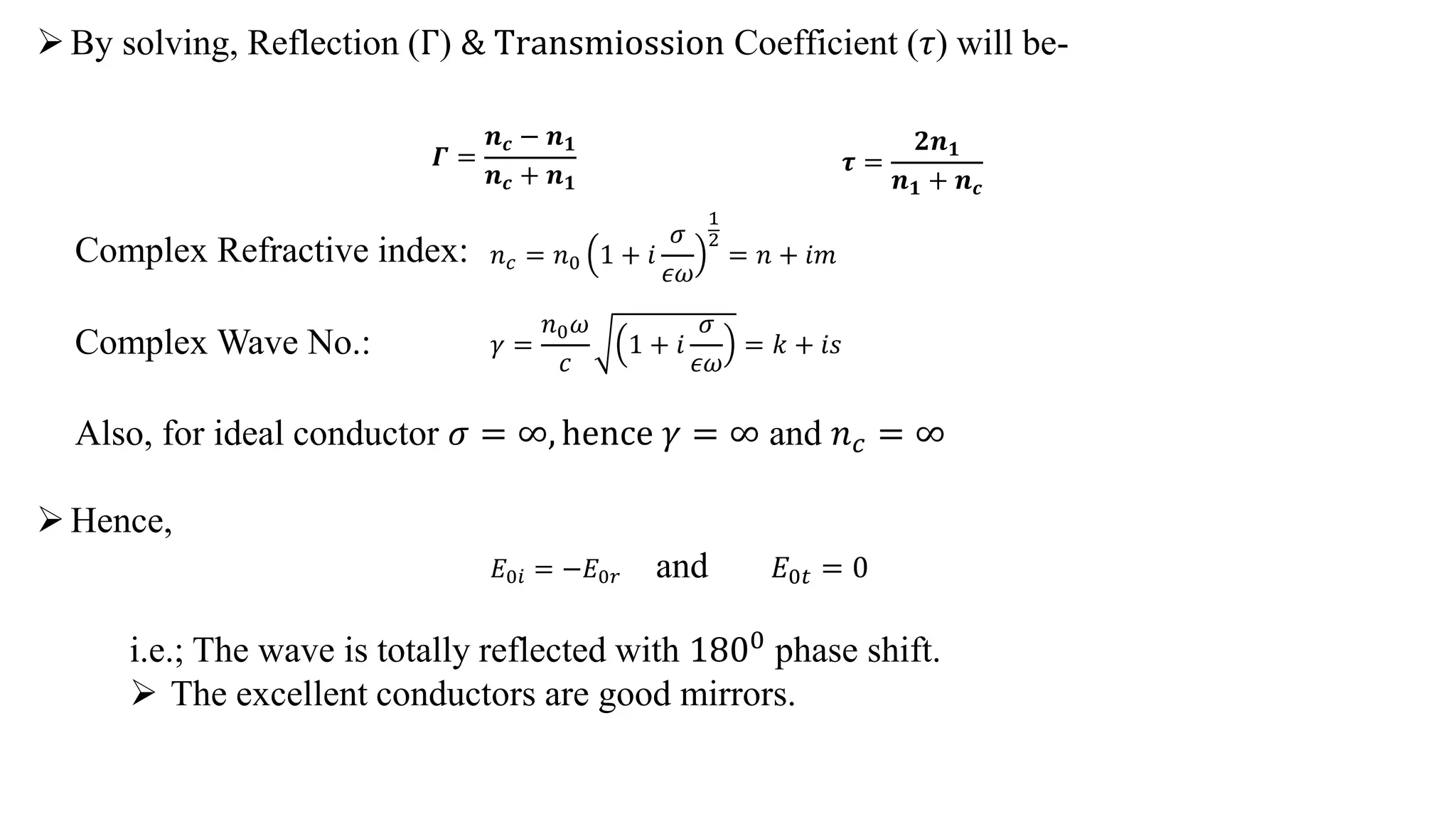
By solving, Reflection (Γ) & Transmiossion Coefficient (𝜏) will be-
𝜞 =
𝒏𝒄 − 𝒏𝟏
𝒏𝒄 + 𝒏𝟏
𝝉 =
𝟐𝒏𝟏
𝒏𝟏 + 𝒏𝒄
𝑛𝑐 = 𝑛0 1 + 𝑖
𝜎
𝜖𝜔
1
2
= 𝑛 + 𝑖𝑚
Complex Refractive index:
Also, for ideal conductor 𝜎 = ∞, hence 𝛾 = ∞ and 𝑛𝑐 = ∞
𝛾 =
𝑛0𝜔
𝑐
1 + 𝑖
𝜎
𝜖𝜔
= 𝑘 + 𝑖𝑠
Complex Wave No.:
Hence,
𝐸0𝑖 = −𝐸0𝑟 and 𝐸0𝑡 = 0
i.e.; The wave is totally reflected with 1800
phase shift.
 The excellent conductors are good mirrors.
Reflectance:
Reflectance (R)= 𝛤 2 =
𝑛−𝑛1
2+𝑚2
𝑛+𝑛1
2+𝑚2
Transmittance:
Transmittance (T)= 𝜏 2 =
4𝑛𝑛1
𝑛+𝑛1
2+𝑚2
𝑇 = 1 − 𝑅
Since, the transmitted wave is absorbed in the conducting medium, hence T is referred
as absorption A
𝑹 = 𝟏 − 𝑨
Critical Angle & Total Internal Reflection:
 If refraction angle (𝜃𝑡) is equal to 900
then the corresponding incident angle is called
critical angle (𝜃𝑐).
From Snell’s law
𝒔𝒊𝒏 𝜽𝒊
𝒔𝒊𝒏 𝟗𝟎𝟎 =
𝒏𝟐
𝒏𝟏
= 𝒔𝒊𝒏 𝜽𝒄
 Since 𝒔𝒊𝒏 𝜽𝒄 cannot be greater than 1, therefore 𝒏𝟐 must be smaller than 𝒏𝟏 for real
value of 𝜽𝒄.
 Thus wave incident from higher refractive index on the interface of lower refractive
index and refracted at an angle of 900 and more, the intensity of reflected wave is
same as incident.
 This phenomenon is called as Total Internal Reflation.
THANK YOU

Reflection & Refraction.pptx

  • 1.
    REFLECTION & REFRACTION OFEM WAVE • Presented by- • ACHUYT BHARALEE • Roll No- PHP22108 • Dept of Physics • Tezpur University
  • 2.
    Boundary Conditions: 𝐸𝑎𝑏𝑜𝑣𝑒 ⊥ − 𝐸𝑏𝑒𝑙𝑜𝑤 ⊥ = 𝜎 𝜖𝜊 2.Normal component of electric field at boundary is discontinuous. ∴ 𝐸1 ∥ =𝐸2 ∥ 1. Parallel components of electric field is continuous over the surface boundary. 𝐵1 = 𝐵2 4. Normal component of magnetic field is continuous over the boundary. 𝐵𝑡1 − 𝐵𝑡2 = 𝜇0𝐾 3. Tangential component of magnetic field is discontinuous over the boundary.
  • 3.
    Reflection & Refractionof EM Wave at Dielectric Interference: An EM wave incident at interference of two media at arbitrary angle. Some part will get reflected & another get transmitted. The plane of incidence is ⊥ to the two media interface. We calculated the problem in two parts- I. Normal to plane of incidence. II. Parallel to plane of incidence. Resultant of this two can lead us to any type of incident wave where incident electric and magnetic field make arbitrary angle to plane of incidence.
  • 4.
    1. Perpendicular Polarization: Wavevector (𝐾) lying on XZ plane. E is perpendicular to plane of incident. In 1st medium- 𝜖1 & 𝜇1 and for 2nd 𝜖2 & 𝜇2. Incident wave: Reflected wave: Transmitted wave: 𝐸𝑖 𝑟, 𝑡 = 𝐸0𝑖𝑒𝑖(𝐾𝑖.𝑟−𝜔𝑖𝑡) 𝑦 𝐵𝑖 𝑟, 𝑡 = (𝜖1𝜇1) 1 2𝐸0𝑖𝑒𝑖(𝐾𝑖.𝑟−𝜔𝑖𝑡) 𝐸𝑟 𝑟, 𝑡 = 𝐸0𝑟𝑒𝑖(𝐾𝑟.𝑟−𝜔𝑟𝑡)𝑦 𝐵𝑟 𝑟, 𝑡 = (𝜖1𝜇1) 1 2𝐸0𝑟𝑒𝑖(𝐾𝑟.𝑟−𝜔𝑟𝑡) 𝐸𝑡 𝑟, 𝑡 = 𝐸0𝑡𝑒𝑖(𝐾𝑡.𝑟−𝜔𝑡𝑡)𝑦 𝐵𝑡 𝑟, 𝑡 = (𝜖2𝜇2) 1 2𝐸0𝑡𝑒𝑖(𝐾𝑡.𝑟−𝜔𝑡𝑡)
  • 5.
    From boundary conditions: I.Tangential electric component is continuous across boundary. II. Tangential magnetic component is also continuous across the boundary since there is no surface current. At Z=0, 𝐸𝑖 𝑟, 𝑡 + 𝐸𝑟 𝑟, 𝑡 = 𝐸𝑡 𝑟, 𝑡 𝐸0𝑖𝑒𝑖(𝐾𝑖.𝑟−𝜔𝑖𝑡) + 𝐸0𝑟𝑒𝑖(𝐾𝑟.𝑟−𝜔𝑟𝑡) = 𝐸0𝑡𝑒𝑖(𝐾𝑡.𝑟−𝜔𝑡𝑡) 𝐵𝑖 𝑟, 𝑡 cos 𝜃𝑖 − 𝐵𝑟 𝑟, 𝑡 cos 𝜃𝑟 = 𝐵𝑡 𝑟, 𝑡 cos 𝜃𝑡
  • 6.
     Since, theboundary conditions must hold at all points on the interface and for all times, the exponential functions must be equal. This is called as Phase matching. So, 𝝎𝒊 = 𝝎𝒓 = 𝝎𝒕 = 𝝎 Frequency of wave does not change under reflection and refraction. Also, 𝐾𝑖. 𝑟 = 𝐾𝑟. 𝑟 = 𝐾𝑡. 𝑟 𝐾𝑖 sin 𝜃𝑖 = 𝐾𝑟 sin 𝜃𝑟 = 𝐾𝑡 sin 𝜃𝑡 𝐾𝑖 = 𝜔 𝑣𝑖 , 𝐾𝑟 = 𝜔 𝑣𝑟 , 𝐾𝑡 = 𝜔 𝑣𝑡 Since in the same medium 𝑣𝑖 = 𝑣𝑟 Hence, 𝐾𝑖= 𝐾𝑟 Therefore, 𝜃𝑖 = 𝜃𝑟; i. e, 𝐀𝐧𝐠𝐥𝐞 𝐨𝐟 𝐢𝐧𝐜𝐢𝐝𝐞𝐧𝐜𝐞 = 𝐀𝐧𝐠𝐥𝐞 𝐨𝐟 𝐑𝐞𝐟𝐥𝐞𝐜𝐢𝐨𝐧 Also, the Snell’s law 𝒔𝒊𝒏 𝜽𝒊 𝒔𝒊𝒏 𝜽𝒕 = 𝒏𝟐 𝒏𝟏
  • 7.
    Now, Electric &Magnetic field equations for ⊥ polarisation can be write as 𝐸0𝑖 + 𝐸0𝑟 = 𝐸0𝑡 𝐸0𝑖 𝑛1 cos 𝜃𝑖 − 𝐸0𝑟 𝑛1 cos 𝜃𝑟 = 𝐸0𝑡 𝑛2 cos 𝜃𝑡 𝐸0𝑖 𝐻𝑜𝑖 = 𝑛1 𝐸0𝑡 𝐻𝑜𝑡 = 𝑛2 ∵ Reflection Coefficient (Γ⊥) 𝜞⊥ = 𝑹𝒆𝒇𝒍𝒆𝒄𝒕𝒆𝒅 𝑬𝒍𝒆𝒄𝒕𝒓𝒊𝒄 𝒇𝒊𝒆𝒍𝒅 𝑰𝒏𝒄𝒊𝒅𝒆𝒏𝒕 𝑬𝒍𝒆𝒄𝒕𝒓𝒊𝒄 𝒇𝒊𝒆𝒍𝒅 = 𝑬𝒓 𝑬𝒊 = 𝒏𝟐 𝒄𝒐𝒔 𝜽𝒊 − 𝒏𝟏 𝒄𝒐𝒔 𝜽𝒕 𝒏𝟐 𝒄𝒐𝒔 𝜽𝒊 + 𝒏𝟏 𝒄𝒐𝒔 𝜽𝒕 Transmission Coefficient (𝜏⊥) 𝝉⊥ = 𝑻𝒓𝒂𝒏𝒔𝒎𝒎𝒊𝒕𝒆𝒅 𝑬𝒍𝒆𝒄𝒕𝒓𝒊𝒄 𝒇𝒊𝒆𝒍𝒅 𝑰𝒏𝒄𝒊𝒅𝒆𝒏𝒕 𝑬𝒍𝒆𝒄𝒕𝒓𝒊𝒄 𝒇𝒊𝒆𝒍𝒅 = 𝑬𝒕 𝑬𝒊 = 𝟐𝒏𝟐 𝒄𝒐𝒔 𝜽𝒊 𝒏𝟐 𝒄𝒐𝒔 𝜽𝒊 + 𝒏𝟏 𝒄𝒐𝒔 𝜽𝒕 Therefore; 𝟏 + 𝜞⊥ = 𝝉⊥
  • 8.
    2. Parallel Polarization: Fromboundary conditions: I. Tangential electric component is continuous across boundary. II. Tangential magnetic component is also continuous across the boundary since there is no surface current. At Z=0, 𝐵𝑖 𝑟, 𝑡 + 𝐵𝑟 𝑟, 𝑡 = 𝐵𝑡 𝑟, 𝑡 𝐸0𝑖 𝑛1 + 𝐸0𝑟 𝑛1 = 𝐸0𝑡 𝑛2 𝐸𝑖 𝑟, 𝑡 cos 𝜃𝑖 − 𝐸𝑟 𝑟, 𝑡 cos 𝜃𝑟 = 𝐸𝑡 𝑟, 𝑡 cos 𝜃𝑡 𝐸0𝑖cos 𝜃𝑖 − 𝐸0𝑟cos 𝜃𝑟 = 𝐸0𝑡 cos 𝜃𝑡 Reflection (𝜞∥) & 𝐓𝐫𝐚𝐧𝐬𝐦𝐢𝐨𝐬𝐬𝐢𝐨𝐧 Coefficient (𝝉∥): 𝜞∥ = 𝑬𝒓 𝑬𝒊 = 𝒏𝟏 𝒄𝒐𝒔 𝜽𝒊 − 𝒏𝟐 𝒄𝒐𝒔 𝜽𝒕 𝒏𝟏 𝒄𝒐𝒔 𝜽𝒊 + 𝒏𝟐 𝒄𝒐𝒔 𝜽𝒕 𝝉⊥ = 𝑬𝒕 𝑬𝒊 = 𝟐𝒏𝟐 𝒄𝒐𝒔 𝜽𝒊 𝒏𝟏 𝒄𝒐𝒔 𝜽𝒊 + 𝒏𝟐 𝒄𝒐𝒔 𝜽𝒕 𝟏 + 𝜞∥ = 𝒏𝟏 𝒏𝟐 𝝉∥
  • 9.
    3. Normal Incidence: Electricfield vector is always tangential to boundary of interface. So it can be consider as ∥ polarization with 𝜃𝑖 = 𝜃𝑟 = 𝜃𝑡 = 0 Therefore, Reflection (Γ) & Transmiossion Coefficient (𝜏) will be- 𝜞 = 𝒏𝟏 − 𝒏𝟐 𝒏𝟏 + 𝒏𝟐 𝝉 = 𝟐𝒏𝟐 𝒏𝟏 + 𝒏𝟐
  • 10.
    Conservation of Energy: The intensity of wave is described by the magnitude of the Poynting Vector.  The average value of Poynting vector in terms of Electric field is- 𝑆 = 1 2 𝜖 𝜇 1 2 𝐸0 2  Mean intensities for incident, reflected & transmitted waves are- 𝑆𝑖 = 1 2 𝜖1 𝜇1 1 2 𝐸𝑖 2 𝑆𝑟 = 1 2 𝜖1 𝜇1 1 2 𝐸𝑟 2 = 1 2 𝜖1 𝜇1 1 2 𝑛1 − 𝑛2 𝑛1 + 𝑛2 2 𝐸𝑖 2 𝑆𝑡 = 1 2 𝜖2 𝜇2 1 2 𝐸𝑡 2 = 1 2 𝜖2 𝜇2 1 2 2𝑛2 𝑛1 + 𝑛2 2 𝐸𝑖 2 These are known as Fresnel’s Formulae.
  • 11.
    Transmittance: Transmittance (T) canbe defined as- 𝑻 = 𝑺𝒕 𝑺𝒊 ∴ 𝑻 = 𝟒𝒏𝟐𝒏𝟏 𝒏𝟏 + 𝒏𝟐 𝟐 Reflectance: Reflectance (R) can be defined as- 𝑹 = 𝑺𝒓 𝑺𝒊 ∴ 𝑹 = 𝒏𝟏 − 𝒏𝟐 𝒏𝟏 + 𝒏𝟐 𝟐 This gives 𝑻 + 𝑹 = 𝟏 𝑺𝒊 = 𝑺𝒓 + 𝑺𝒕 Conservation of energy is satisfied in the process of reflection & refraction at boundary.
  • 12.
    Reflection & Refractionat Conducting Medium: EM wave travelling in X direction. In 1st medium- 𝜖1, 𝑛1 & 𝜇1 and for 2nd 𝜖2, 𝑛𝑐, 𝜎& 𝜇2. Incident wave: Transmitted wave: 𝐸𝑖 𝑟, 𝑡 = 𝐸0𝑖𝑒𝑖(𝐾𝑖.𝑥−𝜔𝑡) 𝑦 𝐵𝑖 𝑟, 𝑡 = (𝜖1𝜇1) 1 2𝐸0𝑖𝑒𝑖(𝐾𝑖.𝑥−𝜔𝑡) 𝑧 𝐸𝑟 𝑟, 𝑡 = −𝐸0𝑟𝑒−𝑖(𝐾𝑖.𝑥−𝜔𝑡) 𝑦 𝐵𝑟 𝑟, 𝑡 = (𝜖1𝜇1) 1 2𝐸0𝑟𝑒−𝑖(𝐾𝑖.𝑥−𝜔𝑡) 𝑧 𝐸𝑡 𝑟, 𝑡 = 𝐸0𝑡𝑒𝑖(𝛾.𝑥−𝜔𝑡)𝑦 𝐵𝑡 𝑟, 𝑡 = 𝛾 𝜔 𝐸0𝑡𝑒𝑖(𝛾.𝑥−𝜔𝑡)𝑧 Reflected wave:
  • 13.
    By solving, Reflection(Γ) & Transmiossion Coefficient (𝜏) will be- 𝜞 = 𝒏𝒄 − 𝒏𝟏 𝒏𝒄 + 𝒏𝟏 𝝉 = 𝟐𝒏𝟏 𝒏𝟏 + 𝒏𝒄 𝑛𝑐 = 𝑛0 1 + 𝑖 𝜎 𝜖𝜔 1 2 = 𝑛 + 𝑖𝑚 Complex Refractive index: Also, for ideal conductor 𝜎 = ∞, hence 𝛾 = ∞ and 𝑛𝑐 = ∞ 𝛾 = 𝑛0𝜔 𝑐 1 + 𝑖 𝜎 𝜖𝜔 = 𝑘 + 𝑖𝑠 Complex Wave No.: Hence, 𝐸0𝑖 = −𝐸0𝑟 and 𝐸0𝑡 = 0 i.e.; The wave is totally reflected with 1800 phase shift.  The excellent conductors are good mirrors.
  • 14.
    Reflectance: Reflectance (R)= 𝛤2 = 𝑛−𝑛1 2+𝑚2 𝑛+𝑛1 2+𝑚2 Transmittance: Transmittance (T)= 𝜏 2 = 4𝑛𝑛1 𝑛+𝑛1 2+𝑚2 𝑇 = 1 − 𝑅 Since, the transmitted wave is absorbed in the conducting medium, hence T is referred as absorption A 𝑹 = 𝟏 − 𝑨
  • 15.
    Critical Angle &Total Internal Reflection:  If refraction angle (𝜃𝑡) is equal to 900 then the corresponding incident angle is called critical angle (𝜃𝑐). From Snell’s law 𝒔𝒊𝒏 𝜽𝒊 𝒔𝒊𝒏 𝟗𝟎𝟎 = 𝒏𝟐 𝒏𝟏 = 𝒔𝒊𝒏 𝜽𝒄  Since 𝒔𝒊𝒏 𝜽𝒄 cannot be greater than 1, therefore 𝒏𝟐 must be smaller than 𝒏𝟏 for real value of 𝜽𝒄.  Thus wave incident from higher refractive index on the interface of lower refractive index and refracted at an angle of 900 and more, the intensity of reflected wave is same as incident.  This phenomenon is called as Total Internal Reflation.
  • 16.