Laplace Potential Distribution and Earnshaw’s Theorem © Frits F.M. de Mul
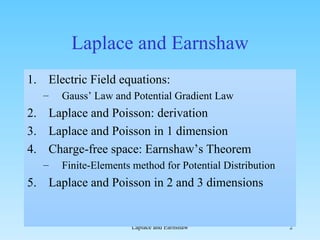
Laplace and Earnshaw Electric Field equations:  Gauss’ Law and Potential Gradient Law Laplace and Poisson: derivation Laplace and Poisson in 1 dimension Charge-free space: Earnshaw’s Theorem Finite-Elements method for Potential Distribution Laplace and Poisson in 2 and 3 dimensions
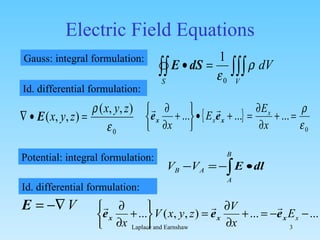
Electric Field Equations Gauss: integral formulation: Potential: integral formulation: Id. differential formulation: Id. differential formulation:
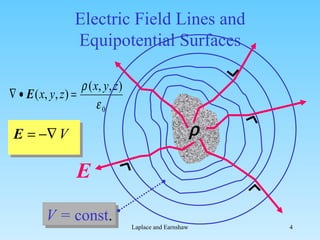
Electric Field Lines and Equipotential Surfaces E  V =  const .
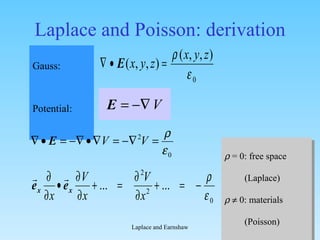
Laplace and Poisson: derivation Gauss: Potential:    = 0: free space (Laplace)         0: materials (Poisson)
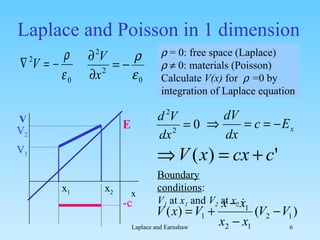
Laplace and Poisson in 1 dimension    = 0: free space (Laplace)        0: materials (Poisson) Calculate  V(x)  for    = 0 by integration of Laplace equation Boundary conditions : V 1  at  x 1  and  V 2   at  x 2  : x 1 x 2 V 1 V 2 x V -c E
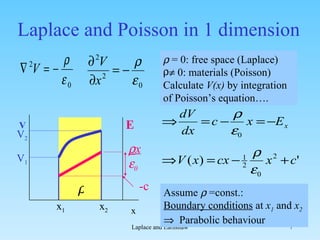
Laplace and Poisson in 1 dimension    = 0: free space (Laplace)    0: materials (Poisson) Calculate  V(x)  by integration of Poisson’s equation…. Assume    =const.: Boundary conditions  at  x 1  and  x 2      Parabolic behaviour  x V x 1 x 2 V 1 V 2 E -c  x  0
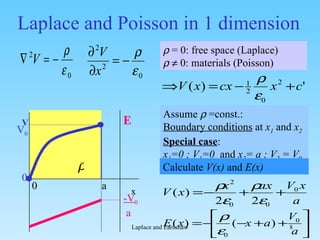
Laplace and Poisson in 1 dimension    = 0: free space (Laplace)       0: materials (Poisson) Assume    =const.: Boundary conditions  at  x 1  and  x 2   Special case :  x 1 =0 ; V 1 =0  and  x 2 = a ; V 2  = V 0 Calculate  V(x)  and  E(x) x V 0 a 0 V 0  E -V 0 a
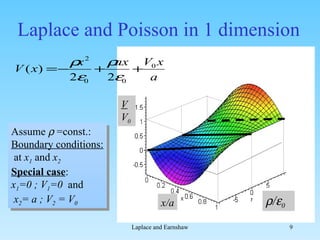
Laplace and Poisson in 1 dimension Assume    =const.: Boundary conditions: at  x 1  and  x 2   Special case :  x 1 =0 ; V 1 =0  and x 2 = a ; V 2  = V 0  /  0 x/a V V 0
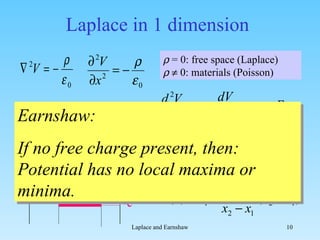
Laplace in 1 dimension    = 0: free space (Laplace)       0: materials (Poisson) Boundary conditions at  x 1  and  x 2  : Earnshaw:  If no free charge present, then: Potential has no local maxima or minima. -c V 1 V 2 x V x 1 x 2 E
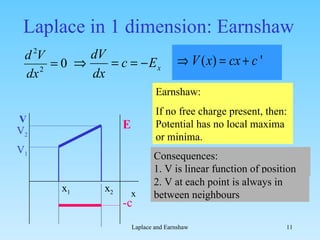
Laplace in 1 dimension: Earnshaw Earnshaw:  If no free charge present, then: Potential has no local maxima or minima. Consequences:  1. V is linear function of position 2. V at each point is always in between neighbours x V x 1 x 2 V 1 V 2 -c E
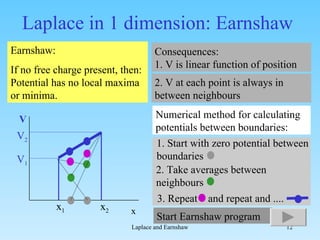
Laplace in 1 dimension: Earnshaw Earnshaw:  If no free charge present, then: Potential has no local maxima or minima. Consequences:  1. V is linear function of position 2. V at each point is always in between neighbours Numerical method for calculating potentials between boundaries: Start Earnshaw program x V x 1 x 2 V 1 V 2 1. Start with zero potential between boundaries 2. Take averages between neighbours 3. Repeat  and repeat and ....
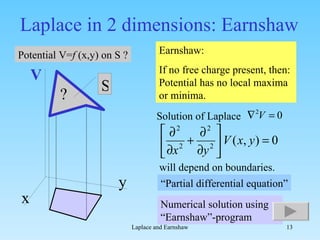
Laplace in 2 dimensions: Earnshaw Earnshaw:  If no free charge present, then: Potential has no local maxima or minima. Potential V= f  (x,y) on S ? Solution of Laplace will depend on boundaries. “ Partial differential equation” Numerical solution using “Earnshaw”-program V x y ? S
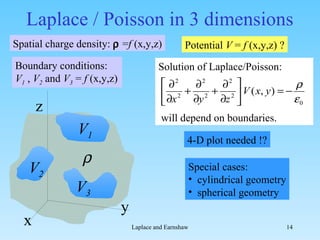
Laplace / Poisson in 3 dimensions Potential  V  =  f  (x,y,z) ? Boundary conditions: V 1  ,  V 2   and  V 3   =  f  (x,y,z) Spatial charge density:    = f  (x,y,z) Special cases: cylindrical geometry spherical geometry 4-D plot needed !? Solution of Laplace/Poisson: will depend on boundaries. z x y V 1 V 2 V 3 
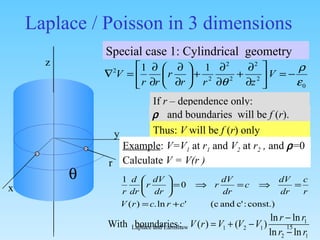
Laplace / Poisson in 3 dimensions Special case 1: Cylindrical  geometry If  r –  dependence only:    and boundaries   will be  f  ( r ).   Thus:  V  will be  f  ( r ) only Example :  V=V 1   at  r 1   and  V 2   at  r 2  ,  and   =0 Calculate  V = V(r ) z r x y 
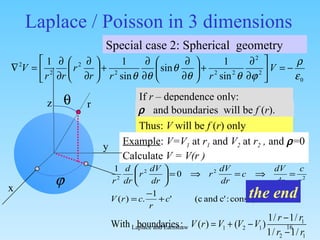
Laplace / Poisson in 3 dimensions Special case 2: Spherical  geometry If  r –  dependence only:    and boundaries   will be  f  ( r ).   Thus:  V  will be  f  ( r ) only Example :  V=V 1   at  r 1   and  V 2   at  r 2  ,  and   =0 Calculate  V = V(r ) the   end z r x y  

Laplace and Earnshaw

  • 1.
    Laplace Potential Distributionand Earnshaw’s Theorem © Frits F.M. de Mul
  • 2.
    Laplace and EarnshawElectric Field equations: Gauss’ Law and Potential Gradient Law Laplace and Poisson: derivation Laplace and Poisson in 1 dimension Charge-free space: Earnshaw’s Theorem Finite-Elements method for Potential Distribution Laplace and Poisson in 2 and 3 dimensions
  • 3.
    Electric Field EquationsGauss: integral formulation: Potential: integral formulation: Id. differential formulation: Id. differential formulation:
  • 4.
    Electric Field Linesand Equipotential Surfaces E  V = const .
  • 5.
    Laplace and Poisson:derivation Gauss: Potential:  = 0: free space (Laplace)    0: materials (Poisson)
  • 6.
    Laplace and Poissonin 1 dimension  = 0: free space (Laplace)   0: materials (Poisson) Calculate V(x) for  = 0 by integration of Laplace equation Boundary conditions : V 1 at x 1 and V 2 at x 2 : x 1 x 2 V 1 V 2 x V -c E
  • 7.
    Laplace and Poissonin 1 dimension  = 0: free space (Laplace)  0: materials (Poisson) Calculate V(x) by integration of Poisson’s equation…. Assume  =const.: Boundary conditions at x 1 and x 2  Parabolic behaviour  x V x 1 x 2 V 1 V 2 E -c  x  0
  • 8.
    Laplace and Poissonin 1 dimension  = 0: free space (Laplace)   0: materials (Poisson) Assume  =const.: Boundary conditions at x 1 and x 2 Special case : x 1 =0 ; V 1 =0 and x 2 = a ; V 2 = V 0 Calculate V(x) and E(x) x V 0 a 0 V 0  E -V 0 a
  • 9.
    Laplace and Poissonin 1 dimension Assume  =const.: Boundary conditions: at x 1 and x 2 Special case : x 1 =0 ; V 1 =0 and x 2 = a ; V 2 = V 0  /  0 x/a V V 0
  • 10.
    Laplace in 1dimension  = 0: free space (Laplace)   0: materials (Poisson) Boundary conditions at x 1 and x 2 : Earnshaw: If no free charge present, then: Potential has no local maxima or minima. -c V 1 V 2 x V x 1 x 2 E
  • 11.
    Laplace in 1dimension: Earnshaw Earnshaw: If no free charge present, then: Potential has no local maxima or minima. Consequences: 1. V is linear function of position 2. V at each point is always in between neighbours x V x 1 x 2 V 1 V 2 -c E
  • 12.
    Laplace in 1dimension: Earnshaw Earnshaw: If no free charge present, then: Potential has no local maxima or minima. Consequences: 1. V is linear function of position 2. V at each point is always in between neighbours Numerical method for calculating potentials between boundaries: Start Earnshaw program x V x 1 x 2 V 1 V 2 1. Start with zero potential between boundaries 2. Take averages between neighbours 3. Repeat and repeat and ....
  • 13.
    Laplace in 2dimensions: Earnshaw Earnshaw: If no free charge present, then: Potential has no local maxima or minima. Potential V= f (x,y) on S ? Solution of Laplace will depend on boundaries. “ Partial differential equation” Numerical solution using “Earnshaw”-program V x y ? S
  • 14.
    Laplace / Poissonin 3 dimensions Potential V = f (x,y,z) ? Boundary conditions: V 1 , V 2 and V 3 = f (x,y,z) Spatial charge density:  = f (x,y,z) Special cases: cylindrical geometry spherical geometry 4-D plot needed !? Solution of Laplace/Poisson: will depend on boundaries. z x y V 1 V 2 V 3 
  • 15.
    Laplace / Poissonin 3 dimensions Special case 1: Cylindrical geometry If r – dependence only:  and boundaries will be f ( r ). Thus: V will be f ( r ) only Example : V=V 1 at r 1 and V 2 at r 2 , and  =0 Calculate V = V(r ) z r x y 
  • 16.
    Laplace / Poissonin 3 dimensions Special case 2: Spherical geometry If r – dependence only:  and boundaries will be f ( r ). Thus: V will be f ( r ) only Example : V=V 1 at r 1 and V 2 at r 2 , and  =0 Calculate V = V(r ) the end z r x y  